
 100% FREE ACCESS
12th Standard Syllabus & Materials
12th Standard
TN 12th Computer Applications மின்னணு தரவு பரிமாற்றம் Sample Question Papers Study Material - QB365 Set A
NEW12th Standard
TN 12th Computer Applications மின் - வணிக பாதுகாப்பு அமைப்புகள் Sample Question Papers Study Material - QB365 Set A
NEW12th Standard
TN 12th Computer Applications மின்னணு செலுத்தல் முறைகள் Sample Question Papers Study Material - QB365 Set A
NEW12th Standard
TN 12th Computer Applications மின் - வணிகம் Sample Question Papers Study Material - QB365 Set A
NEW12th Standard
TN 12th Computer Applications திறந்த மூல கருத்துருக்கள் Sample Question Papers Study Material - QB365 Set A
NEW12th Standard
TN 12th Computer Applications வலையமைப்பு வடமிடல் Sample Question Papers Study Material - QB365 Set A

Published on: 29/01/2021
12th Standard Chemistry English Medium Organic Nitrogen Compounds Reduced Syllabus Important Questions 2021
Download Tamil Nadu 12th Standard Chemistry question papers, model tests, one-mark questions, important questions, and public exam papers in PDF format. Free study materials and answer keys for TN State Board students.
Questions + Answers key
Take MCQ Chemistry Test
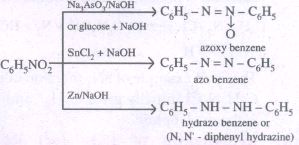
1.
Oxidation of aniline with acidified K2Cr2O7 gives ___________
p-benzoquinone
benzoic acid
benzaldehyde
benzyl alcohol
2.
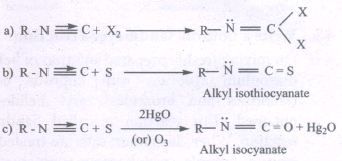
The compound that does not show tautomerism is ____________
nitrobenzene
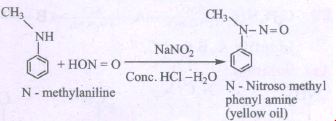
nitromethane
nitroethane
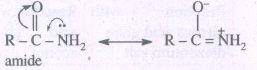
2-nitropropane
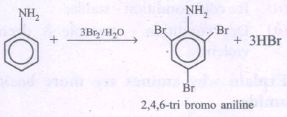
3.
p-amino phenol is the product of reducing nitrobenzene in _________
acid medium
basic medium
electrolytic reduction
neutral medium
4.
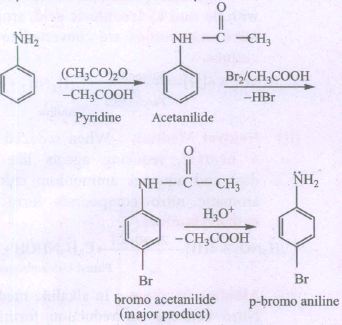
The major product obtained when aniline is treated with acetic anhydride in the presence of pyridine is ____________
p bromo acetanilide
p - bromo aniline
acetanilide
2,4,6 tribromo aniline
5.
The IUPAC name of \({ CH }_{ 3 }-\underset { \overset { | }{ { CH }_{ 3 } } }{ CH } -{ CH }_{ 2 }{ NH }_{ 2 }\)
isobutyl amine
1-amino- 2-methyl propane
1-methyl-2-amino propane
2-amino-3-methyl butane
6.
C6H5NH2 \(\underrightarrow { { NANO }_{ 2 }/HCl } \) X Identify X.
C6H5CI
C6H5NHOH
C6H5N2CI
C6H5OH
7.
Which one of the following is a secondary amine?
aniline
diphenyl amine
see.butylamine
tert.butylamine
8.
Which of the following compounds has the smell of bitter almonds?
aniline
nitro methane
benzene sulphonic acid
nitrobenzene
9.
Positive carbylamine test is not shown by?
methyl amine
aniline
N -ethyl aniline
triethyl amine
10.
Electrolytic reduction of nitrobenzene in strongly acidic medium gives
aniline
p - aminophenol
m-nitroaniline
azoxybenzene
11.
Ammonium salt of benzoic acid is heated strongly with and the product so formed is reduced and then treated with NaNO2 / HCl at low temperature. The final compound formed is _______.
Benzene diazonium chloride
Benzyl alcohol
Phenol
Nitrosobenzene
12.
C6H5NO2 \(\overset { Fe/Hel }{ \longrightarrow } A\overset { { NaNO }_{ 2 }/HCl }{ \underset { 273K }{ \longrightarrow } } B\overset { { H }_{ 2 }O }{ \underset { 283 }{ \longrightarrow } } C \) C' is _______.
C6H5 - OH
C6H5 - CH2OH
C6H5 - COH
C6H5NH2
13.
The order of basic strength for methyl substituted amines in aqueous solution is _________.
N(CH3)3> N(CH3)2H> N(CH3)H2> NH3
N(CH3)H2>N(CH3)2H > N(CH3)3>NH3
NH3> N(CH3)H2> N(CH3)2 H>N(CH3)3
N(CH3)2H>N(CH3)H2> N(CH3)3> NH3
14.
The product formed by the reaction an aldehyde with a primary amine ________.
carboxylic acid
aromatic acid
schiff ’s base
ketone
15.
Which one of the following will not undergo Hofmann bromamide reaction.
CH3CONHCH3
CH3CH2CONH2
CH3CONH2
C6H5CONH2
16.
CuSO4 on mixing with NH3 (1:4 ratio) does not give test for Cu2+ ions but gives test for SO42- ions. Why?
17.
Outline the mechanism of
(a) Nitration of aniline,
(b) Acetylation of aniline.
18.
How do primary, secondary and tertiary amines react with nitrous acid?
19.
How can the following coversion be effected?
i) Nitrobenzene ⇾ Nitrosobenzene
ii) Nitrobenzene ⇾ Azoxybenzene
iii) Nitrobenzene ⇾ Hydrazobenzene
20.
Account for
i) Reduction of CH3CH gives CH3CH2NH2 while CH3NC gives (CH3)2NH.
ii) (CH3)2NH requires two molar proportion of CH3I to give the same crystalline product formed by (CH3)2N with one mole of CH3l.
iii) Nitration of aniline with conc.HNO3 may end up with same meta nitro product.
iv) p-toluidine is a stronger base than p-nitroaniline.
21.
Write a note on the reduction of nitro benzene under different conditions.
22.
Arrange the following
i. In increasing order of solubility in water, C6H5 NH2, (C2H5)2NH, C2H5NH2
ii. In increasing order of basic strength
a) aniline, p- toludine and p – nitroaniline
b) C6H5 NH2, C6H5 NHCH3, C6H5NH2, p-Cl-C6- H4-NH2
iii. In decreasing order of basic strength in gas phase
(C2H5)NH2, (C2H5)NH, (C2H5)5N and NH3
iv. In increasing order of boiling point
C6H5OH, (CH3)2NH, C2H5NH2
v. In decreasing order of the pKb values
C2H5NH2, C6H5NHCH3.(C2H5)2 NH and CH3NH2
vi. Increasing order of basic strength
C2H5NH2,C6H5N(CH3)2, (C2H5)2 NH and CH3NH2
vii. In decreasing order of basic strength

23.
How will you distinguish between primary secondary and tertiary alphatic amines.
24.
Write short notes on the following
i. Hofmann’s bromide reaction
ii. Ammonolysis
iii. Gabriel phthalimide synthesis
iv. Schotten – Baumann reaction
v. Carbylamine reaction
vi. Mustard oil reaction
vii. Coupling reaction
viii. Diazotisation
ix. Gomberg reaction
25.
Give any two uses of nitrobenzene.
26.
Write a note on addition reactions of alkyl isocyanides.
27.
How is prepared from N-alkyl formamide?
28.
Write a note on Libermann's nitroso test.
29.
\({ C }_{ 6 }{ H }_{ 5 }CON{ H }_{ 2 }\xrightarrow [ KOH ]{ { Br }_{ 2 } } X\xrightarrow [ HCl ]{ { HNO }_{ 2 } } Y\xrightarrow [ { Cu }^{ + } ]{ { NaNO }_{ 2 } } Z\)
Identify X, Y and Z.
30.
Explain why amines are more basic than amides.
31.
What happens when aniline is treated with bromine?
32.
Write the name and structure of four isomeric amines having the molecular formula C3H9N
33.
What are amines? How are they classified?
34.
Identify A aniline + benzaldehyde → A
35.
An organic compound 'A' on reduction gives compound 'B' which on reaction with trichloromethane and caustic potash forms 'C'. Compound 'C' on catalytic reduction given N-methyl benzenamine. Identify A, B and C and write the reactions involved.
36.
Starting from the following reagents, how will your prepare ethanenitrile.
i) CH3Br
ii) CH3CONH2
iii) CH3CH=NOH
37.
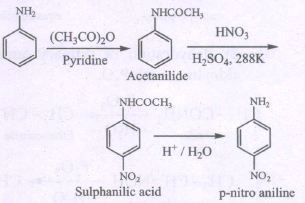
Convert aniline to p-nitro aniline
38.
Aniline reacts with Br2/H2O to give a tribromo derivative. How would you convert aniline to get a monobromo derivate?
39.
Explain Levine and hauser acetylation.
40.
Write a note on the basicity of amines.
41.
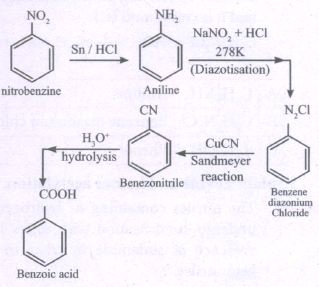
How will convert nitrobenzene to benzoic acid?
42.
How are nitro alkanes prepared for the following
i) alkyl bromides
ii) methane
1.
(a)
p-benzoquinone
2.
(a)
nitrobenzene
3.
(c)
electrolytic reduction
4.
(a)
p bromo acetanilide
5.
(b)
1-amino- 2-methyl propane
6.
(c)
C6H5N2CI
7.
(b)
diphenyl amine
8.
(d)
nitrobenzene
9.
(d)
triethyl amine
10.
(b)
p - aminophenol
11.
(b)
Benzyl alcohol
12.
(a)
C6H5 - OH
13.
(d)
N(CH3)2H>N(CH3)H2> N(CH3)3> NH3
14.
(c)
schiff ’s base
15.
(a)
CH3CONHCH3
16.
It is because when NH3 coordinates to Cu2+ ions and it forms the complex [Cu(NH3)4]SO4 copper ions are present in coordination sphere, therefore. they are non-ionisable whereas SO42- ions are counter ions which are ionisable.
17.
(i) Nitration of aniline is accompanied by oxidation. But a mixture of cone. HNO3 and cone. H2SO4 gives m-nitroaniline also. Nitric acid is a strong acid. It protonates aniline forming anilinium ion C6H5NH3+ because of positive charge on nitrogen it is meta directing.
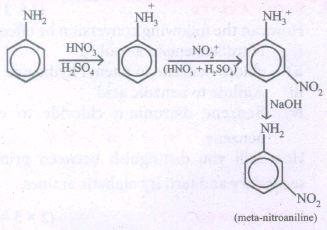
p-nitro aniline is prepared in the following three stages
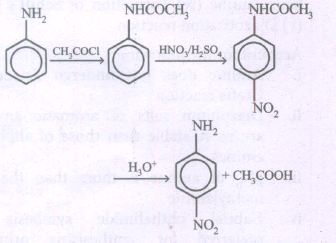
(ii) Aniline reacts with acetyl chloride and acetic anhydride to form corresponding amides called anilides.
\({ C }_{ 6 }H_{ 5 }{ NH }_{ 2 }+\underset { Acetylchloride }{ ClCO{ CH }_{ 3 } } \rightarrow \underset { Acetanilide }{ { C }_{ 6 }{ H }_{ 5 }NHCO{ CH }_{ 3 } } +HCl\)
\({ C }_{ 6 }H_{ 5 }{ NH }_{ 2 }+\underset { Aceticanhydride }{ { CH }_{ 3 }COOCO{ CH }_{ 3 } } \rightarrow \underset { Acetanilide }{ { C }_{ 6 }{ H }_{ 5 }NHCO{ CH }_{ 3 } } +{ CH }_{ 3 }COOH\)
18.
(i) Primary amine react with nitrous acid to form alcohols and nitrogen gas
\(\underset { primary \ amine }{ { CH }_{ 3 }NH_{ 2 } } \rightarrow \underset { unstable }{ { [{ CH } }_{ 3 }-N=N-OH] } \rightarrow { CH }_{ 3 }OH+{ N }_{ 2 }\)
Aliphatic diazonium compound is unstable because of absence of resonance stabilisation.
(ii) Secondary amines react with nitrous acid to form N-nitroso amines which are water insoluble yellow oils.
\(\underset { Secondary \ amine }{ { { (CH }_{ 3 } })_{ 2 }NH } +HO-N=O\rightarrow \underset { N-nitroso \ dimethy \ amine-yellow \ oil\\ (insolube \ in \ water) }{ { (CH }_{ 3 })_{ 2 }N-N=O } \)
(iii) Tertiary amine react with nitrous acid to form trialkyl ammonium nitrite salts which are soluble in water
\(\underset { Tertiary \ amine }{ { (CH }_{ 3 })_{ 2 }N } +HONO\rightarrow \underset { trimethyl \ ammonium \ nitrite\\ (salt \ soluble \ in \ water) }{ { { (CH }_{ 3 }) }_{ 3 }{ NH }^{ + }{ NO }_{ 2 }^{ - } } \)
19.
i) Nitrobenzene ⇾ Nitrosobenzene
When nitrobenzene is treated with glucose and NaOH (alkaline medium) Nitrosobenzene is formed.
\({ C }_{ 6 }{ H }_{ 5 }N{ O }_{ 2 }\rightarrow \underset { Nitrosobenzene }{ { C }_{ 6 }{ H }_{ 5 }NO+{ H }_{ 2 }O } \)
ii) Nitrobenzene ⇾ Azoxybenzene
When nitrobenzene is subjected to reduction with glucose and NaOH forms the intermediate products nitrosobenzene and phenyl hydroxyl amine. These undergo bimolecular condensation reaction to give azoxy benzene.
\({ C }_{ 6 }{ H }_{ 5 }N{ O }_{ 2 }\underrightarrow { Glucose+NaOH } \underset { Nitrosobenzene }{ { C }_{ 6 }{ H }_{ 5 }NO+{ H }_{ 2 }O } \xrightarrow [ { H }_{ 2 }O ]{ \triangle } \underset { Azoxy\quad benzene }{ { C }_{ 6 }{ H }_{ 5 }-N=N{ C }_{ 6 }{ H }_{ 5 } } \)
iii) Nitrobenzene ⇾ Hydrazobenzene
When nitrobenzene is subjected to alkaline reduction in the presence of Zn+NaOH, hydrozo benzene is formed.
\({ C }_{ 6 }{ H }_{ 5 }N{ O }_{ 2 }\underrightarrow { Zn/NaOH } \underset { Nitrosobenzene }{ { C }_{ 6 }{ H }_{ 5 }NH+{ NHC }_{ 6 }{ H }_{ 5 }} \)
20.
(i) CH3CN (Methyl cyanide) on reduction gives CH3CH2NH2 (ethylamine) because addition of hydrogen takes place at ≡ CN
\({ CH }_{ 2 }-C\equiv N\xrightarrow [ 4H ]{ { LiAH }_{ 4 } } { \underset { Ethylamine\\ (Primary\quad amine) }{ { CH }_{ 3 }-{ CH }_{ 2 }{ NH }_{ 2 } } }\)
Whereas CH3NC (Methyl isocyanide) on reduction with LiAlH4 gives secondary amine
\({ CH }_{ 3 }-\underset { \overset { | }{ H } }{ N } -{ CH }_{ 3 }\)
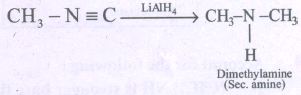
In methyl cyanide, -CN group is attached to alkyl group and by reduction it gives a primary amine wherease in methyl isocyanide -NC group is attached to alkyl group and by reduction it gives a secondary amine.
(ii) (CH3)2 NH (Secondary amine) requires 2 moles of CH3I to give a quaternary salt (crystalline product) whereas (CH3)2N (tertiary amine) require only one mole of CH3I to give the same quaternary salt. It is due to the number of alkyl groups present in amines.
\(\underset { Secondary \ anmine }{ { ( }{ CH }_{ 3 })_{ 2 }-NH+{ 2CH }_{ 3 }I } \rightarrow { { [(CH }_{ 3 })_{ 4 }N] }^{ + }\underset { Tetramethy\\ ammonium \ iodide }{ { I }^{ - } } \)
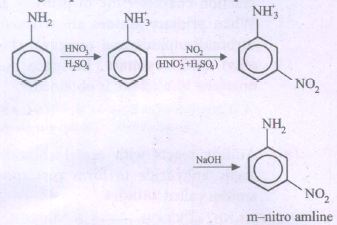
(iii) Nitration of aniline with cone. HNO3 results in the formation of m-nitro aniline because nitric acid is a strong acid. It protonates aniline forming anilinium ion C6H5NH3+ because of positive charge on nitrogen, it is meta directive and -NO2 group is substituted at meta position.
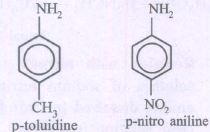
(iv) p-Toluidine contains a methyl group which has +I effect (electron withdrawing group and due to this, p-toluidine is a stronger base than p-nitro aniline in which the nitro group is less reactive and it deactivate the benzene rin make it a less basic
21.
(i) Strongly Acidic Medium: When reduced with tin and hydrochloric acid, aromatic nitro compounds are converted to aryl amines.
\({ C }_{ 6 }{ H }_{ 5 }{ NO }_{ 2 }+6[H]\xrightarrow [ or \ Fe/con.HCl ]{ Sn/con.HCl } \underset { Aniline }{ { C }_{ 6 }{ H }_{ 5 }{ NH }_{ 2 }+2 } { H }_{ 2 }Oor\)
(ii) Neutral Medium: When reduced with a neutral, reducing agents like zinc dust and aqueous ammonium chloride, aromatic nitro compounds form aryl hydroxylamines.
\({ C }_{ 6 }{ H }_{ 5 }{ NO }_{ 2 }+4[H]\xrightarrow [ ]{ Zn/{ NH }_{ 4 }Cl } \underset { Phenyl\quad hydroxylamine }{ { C }_{ 6 }{ H }_{ 5 }{ NH }OH+ } { H }_{ 2 }O\)
(iii) Alkaline Medium: In alkaline medium, Nitro benzene on reduction forms the intermediate products nitro so benzene (C6H5NO) and phenyl hydroxylamine (C6H5NHOH). These undergo bimolecular condensation reaction. According to the appropriate reducing agent in alkaline medium different products are obtained.
(iv) Catalytic Reduction: Lithium Aluminium hydride is a powerful hydride ion donor. So it reduces nitro benzene to Aniline. This reduction can also be carried out by H/Ni.
\({ C }_{ 6 }{ H }_{ 5 }{ NO }_{ 2 }\underrightarrow { LiAl{ H }_{ 4 } } { C }_{ 6 }{ H }_{ 5 }{ NH }_{ 2 }[Aniline]\)
\({ C }_{ 6 }{ H }_{ 5 }{ NO }_{ 2 }\frac { { N }_{ 2 }/Ni }{ Catalytic \ hydrognation } { C }_{ 6 }{ H }_{ 5 }{ NH }_{ 2 }\)
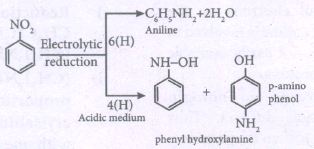
(v) Electrolytic Reduction: When nitro benzene is reduced electrolytically in presence of concentrated sulphuric acid, phenyl hydroxylamine is first produced which rearranges to give p-amino phenol.
22.
i) In increasing order of solubility in water:
\(\mathrm{C}_{6} \mathrm{H}_{5} \mathrm{NH}_{2},\left(\mathrm{C}_{2} \mathrm{H}_{5}\right)_{2} \mathrm{NH}, \mathrm{C}_{2} \mathrm{H}_{5} \mathrm{NH}_{2} \)
\(\mathrm{C}_{2} \mathrm{H}_{5} \mathrm{NH}_{2}>\mathrm{C}_{6} \mathrm{H}_{5} \mathrm{NH}_{2}>\left(\mathrm{C}_{2} \mathrm{H}_{5}\right)_{2} \mathrm{NH}\)
ii) In increasing order of basic strength:
a. Aniline, p - toluidine and p - nitro aniline
p - toluidine > aniline >p - nitro aniline
.JPG)
b. \(\mathrm{C}_{6} \mathrm{H}_{5} \mathrm{NH}_{2}, \mathrm{C}_{6} \mathrm{H}_{5} \mathrm{NHCH}_{3}, \mathrm{p}-\mathrm{Cl}-\mathrm{C}_{6} \mathrm{H}_{4}-\mathrm{NH}_{2} \)
\(\mathrm{C}_{6} \mathrm{H}_{5} \mathrm{NHCH}_{3}>\mathrm{C}_{6} \mathrm{H}_{5} \mathrm{NH}_{2}>\mathrm{p}-\mathrm{Cl}-\mathrm{C}_{6} \mathrm{H}_{4}-\mathrm{NH}_{2}\\ 2^{o} \text { amine } \quad \quad \quad \quad e^{\ominus} \text { with drawing (group) }\)
(iii) In decreasing order of basic strength in gas phase:
\(\mathrm{C}_{2} \mathrm{H}_{5} \mathrm{NH}_{2},\left(\mathrm{C}_{2} \mathrm{H}_{5}\right) \mathrm{NH},\left(\mathrm{C}_{2} \mathrm{H}_{5}\right)_{3} \mathrm{~N} \text { and } \mathrm{NH}_{3} \)
\(\mathrm{NH}_{3}<\mathrm{C}_{2} \mathrm{H}_{5} \mathrm{NH}_{2}<\left(\mathrm{C}_{2} \mathrm{H}_{5}\right)_{2} \mathrm{~N}<\left(\mathrm{C}_{2} \mathrm{H}_{5}\right)_{3} \mathrm{NH}\\ \quad \quad \quad 1^{0} \text { amine } \quad 2^{0} \text { amine } \quad \quad \quad 3^{0} \text { amine }\)
(iv) In increasing order of boiling point:
\(\mathrm{C}_{6} \mathrm{H}_{5} \mathrm{OH},\left(\mathrm{CH}_{3}\right)_{2} \mathrm{NH}, \mathrm{C}_{2} \mathrm{H}_{5} \mathrm{NH}_{2} \)
\(\left(\mathrm{CH}_{3}\right)_{2} \mathrm{NH}>\mathrm{C}_{2} \mathrm{H}_{5} \mathrm{NH}_{2}>\mathrm{C}_{6} \mathrm{H}_{5} \mathrm{OH} \\ 2^{0} \text { amine } \quad \quad1^{0} \text { amine }\)
Generally amines have lower boiling point than alcohol. Due to comparable molecular mass and weaker H-bonds in Amines.
(v) In decreasing order of the pKb values:
\( \mathrm{C}_{2} \mathrm{H}_{5} \mathrm{NH}_{2}, \mathrm{C}_{6} \mathrm{H}_{5} \mathrm{NHCH}_{3},\left(\mathrm{C}_{2} \mathrm{H}_{5}\right)_{2} \mathrm{NH} \text { and } \mathrm{CH}_{3} \mathrm{NH}_{2} \)
\(\left(\mathrm{C}_{2} \mathrm{H}_{5}\right)_{2} \mathrm{NH}<\mathrm{C}_{2} \mathrm{H}_{5} \mathrm{NH}_{2}<\mathrm{CH}_{3} \mathrm{NH}_{2}<\mathrm{C}_{6} \mathrm{H}_{5} \mathrm{NHCH}_{3} \)
\(\quad \quad \quad 2^{0} \text { amine } \quad 1^{0} \text { amine } 1^{0} \text { amine } \quad 2^{0} \text { amine } \)
\(\mathrm{PK}_{b}: \quad 3.00\quad < \quad 3.29 \quad < \quad 3.38 \quad<\quad 9.30\)
pKb ,Due to + 1 effect of C2H5 group. Higher the value of pKb lower is the basicity
(vi) Increasing Order of basic strength:
\(\mathrm{C}_{6} \mathrm{H}_{5} \mathrm{NH}_{2}, \mathrm{C}_{6} \mathrm{H}_{5} \mathrm{~N}\left(\mathrm{CH}_{3}\right)_{2},\left(\mathrm{C}_{2} \mathrm{H}_{5}\right)_{2} \mathrm{NH} \text { and } \mathrm{CH}_{3} \mathrm{NH}_{2} \)
\(\mathrm{C}_{6} \mathrm{H}_{5} \mathrm{NH}_{2}>\mathrm{C}_{6} \mathrm{H}_{5} \mathrm{~N}\left(\mathrm{CH}_{3}\right)_{2}>\mathrm{CH}_{3} \mathrm{NH}_{2}>\left(\mathrm{C}_{2} \mathrm{H}_{5}\right)_{2} \mathrm{NH} \\ \left(\mathrm{pK}_{6}: 9.38 \quad > \quad \quad 8.92 \quad \quad > \quad 3.38 \quad > \quad \quad 3.00\right)\)
Due to + 1 effect of C2H5 group.
In decreasing order of basic strength:
.JPG)
23.
| S.No | Reagents or Reaction | Primary amine RNH2 | Secondary amine R2NH | Tertiary amine R3N |
|---|---|---|---|---|
|
1. |
Carbylamine reaction or with CHCl3/KOH |
Carbylamine is formed (unpleasant smell) |
- | - |
| 2. | Mustard oil reaction or CS2/HgCl2 (Hoffmann's mustard oil test) |
Alkyl isothiocyanate is formed (Mustard oil odour) |
- | - |
| 3. | HNO2 (or) NaNO2 / HCl |
Alcohol is formed +H2 | Yellow oily nitrosoamine is formed, insoluble in water. (Liberman's Test) |
Forms nitrite in cold, soluble in water. |
| 4. | CH3COCl | N-acetyl derivative is formed | N,N- diacetyl derivative is formed |
- |
| 5. | Diethyl oxalate Hoffmann's method |
Solid oxamide is formed | Liquid oxamic ester is formed |
- |
| 6. | Benzene sulphonyl chloride in presence of excess. KOH (Hinsberg's reaction) |
N- alkyl benzene sulphonamide is formed (soluble) |
N, N - dialkyl benzene sulphonamide is formed (Insoluble). |
- |
| 7. | With RX | 1 mol → 2o amine 2 mol → 3o amine 3 mol → Quarternary salt |
1 mol → 3o amine 2 mol → Quarternary salt |
1 mol → Quarternary salt |
24.
Hoffmann's bromide reaction:
When Amides are treated with bromine in the presence of aqueous or ethanolic solution of KOH, primary amines with one carbon atom less than the parent amides are obtained.
\(\underset { \quad \quad \quad amide\\ R=Alkyl(or)Aryl }{ R-\overset { \underset { || }{ O } }{ C } -{ NH }_{ 2 } } \overset { { Br }_{ 2 }/KOH }{ \longrightarrow } \underset { Primary\quad amine }{ R-{ NH }_{ 2 }+{ K }_{ 2 }{ CO }_{ 3 } } +KBr+{ H }_{ 2 }O\)
(ii) Hoffmann's ammonolysis:
When Alkyl halides (or) benzylhalides are heated with alcoholic ammonia in a sealed tube, mixtures of 1°, 2° and 3° amines and quaternary ammonium salts are obtained.
\( { CH }_{ 3 }-Br\overset { \ddot { N } { H }_{ 3 } }{ \underset { \Delta }{ \longrightarrow } } \underset { { 1 }^{ 0 }-amine }{ { CH }_{ 3 }-\ddot { N } { H }_{ 2 } } \overset { { CH }_{ 3 }-Br }{ \longrightarrow } \underset { { 3 }^{ o }-amine }{ \left( { CH }_{ 3 } \right) _{ 2 }\ddot { N } H } \overset { { CH }_{ 3 }Br }{ \longrightarrow } \underset { 3^{ o }-amine }{ \left( { { CH }_{ 3 } } \right) _{ 3 }\ddot { N } } \overset { CH_{ 3 }Br }{ \longrightarrow } \underset { Quartenary \ ammonium\ bromide }{ \left( { CH }_{ 3 } \right) _{ 4 }\overset { + }{ N } { Br }^{ - } } \)
This is a nucleophilic substitution, the halide ion of alkyl halide is substituted by the -NH2 group. The product primary amine so formed can also has a tendency to act as a nucleophile and hence if excess alkyl halide is taken, further nucleophilic substitution takes place leading to the formation of quarternary ammonium salt. However, if the process is carried out with excess ammonia, primary amine is obtained as the major product. The order of reactivity of alkylhalides with amines
RI > RBr > RCl
(iii) Gabriel phthalimide synthesis:
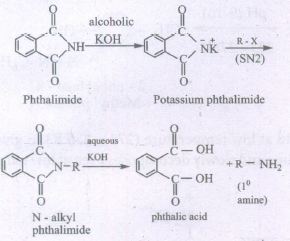
Gabriel synthesis is used for the preparation of Aliphatic primary amines. Phthalimide on treatment with ethanolic KOH forms potassium salt of phthalimide which on heating with alkyl halide followed by alkaline hydrolysis gives primary amine. Aniline cannot be prepared by this method because the arylhalides do not undergo nucleophilic substitution with the anion formed by phthalimide.
(iv) Schotten - Baumann reaction :
Aniline reacts with benzoylchloride (C6H5COCI) in the presence of NaOH to give N - phenyl benzamide. This reaction is known as Schotten - Baumann reaction. The acylation and benzoylation are nucleophilic substitutions.
\(\underset { Aniline }{ { C }_{ 6 }{ H }_{ 5 }-{ NH }_{ 2 } } +\underset { Benzoyl\quad chloride }{ { C }_{ 6 }{ H }_{ 5 }-\overset { \underset { || }{ O } }{ C } -Cl } \overset { Pyridine }{ \longrightarrow } \underset { N-phenyl\quad benzamide }{ { C }_{ 6 }{ H }_{ 5 }-NH-\overset { \underset { || }{ O } }{ C } -{ C }_{ 6 }{ H }_{ 5 } } +HCl\)
(v) Carbylamine reaction :
Aliphatic (or) aromatic primary amines react with: chloroform and alcoholic KOH to give isocyanides (carbylamines), which has an unpleasant smell. This reaction is known as carbylamines test. This test used to identify the primary amines.
\(\underset { Ethylamine }{ { C }_{ 2 }{ H }_{ 5 }-{ NH }_{ 2 } } +\underset { Chloroform }{ { CHCl }_{ 3 }+3KOH } \longrightarrow \underset { Ethylisocyanide }{ { C }_{ 2 }{ H }_{ 5 }-NC } +3KCl+3{ H }_{ 2 }O\)
(vi) Mustard oil reaction:
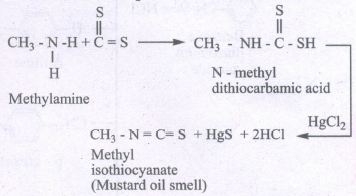
(a) When primary amines are treated with carbon disulphide (CS2), N - alkyldithio carbonic acid is formed which on subsequent treatment with HgCI2, gives an alkyl isothiocyanate.
(b) When aniline is treated with carbon disulphide, or heated together, S-diphenylthio urea is formed, which on boiling with strong HCI, phenyl isothiocyanate (phenyl mustard oil), is formed.
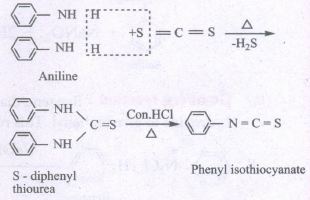
These reactions are known as Hofmann - Mustard oil reaction. This test is used to identify the primary amines.
(vii) Coupling reactions (or) p-hydroxyazobenzene, p-aminoazobenzene, 2-phenyl azo-4-methyl phenol:
Benzene diazonium chloride reacts with electron rich aromatic compounds like phenol, aniline to form brightly coloured azo compounds. Coupling generally occurs at the para position. If para position is occupied then coupling occurs at the ortho position. Coupling tendency is enhanced if an electron donating group is present at the para - position to -N2CI- group. This is an electrophilic substitution.
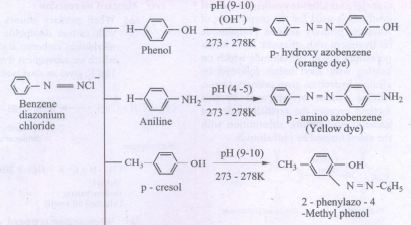
Aryl fluorides and iodides cannot be prepared by direct halogenation and the cyano group cannot be introduced by nucleophilic substitution of chlorine in chlorobenzene. For introducing such a halide group. cyano group -OH, NO2, etc.. benzenediazonium chloride is a very good intermediate Diazo compounds obtained from the coupling reactions of diazonium salts are coloured and are used as dyes.
(viii) Diazotisation :
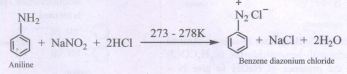
Aniline reacts with nitrous acid at low temperature (273 - 278 K) to give benzene. Diazonium chloride which is stable for a short time and slowly decomposes even at low temperatures.This reaction is known as diazotization
(ix) Gomberg reaction :
Benzene diazonium chloride reacts with benzene in the presence of sodium hydroxide to give biphenyl. This reaction in known as the Gomberg reaction

25.
(i) Nitrobenz-ene is used to produce lubricating oils in motors and machinery.
(ii) It is used in the manufacture of dyes, drugs, pesticides, synthelic rubber, aniline and explosives like TNT, TNB.
26.
Addition reaction: Alkyl isocyanides add on halogen, sulphur, and oxygen to form the corresponding addition compounds.
27.
CH3NC by reaction with POCl3 in pyridine

28.
Alkyl and aryl secondary amines react with nitrous acid to give N - nitroso amine as yellow oily liquid which is insoluble in water
This reaction is known as Libermann's nitroso test.
29.
X = C6H5NH2; Y = C6H5N2Cl; Z = C6H5NO2.
30.
In simple amines the lone pair of electrons is on nitrogen and hence available for protonation. In amides, on the other hand, the electron pair on nitrogen is delocalized to the carbonyl oxygen through resonance.
31.
Aniline decolourises bromine water with the formation of white precipitate which is 2,4,6-tribromo aniline
32.
(i) CH3 - CH2 - CH2NH2 1-amino propane
(ii) \({ CH }_{ 3 }-\underset { \overset { | }{ { NH }_{ 2 } } }{ CH } -{ CH }_{ 3 }\) 2-amino propane
(iii) \({ CH }_{ 3 }-{ CH }_{ 2 }-\underset { \overset { | }{ H } }{ N } -{ CH }_{ 3 }\) N - Methyl amino ethane
(iv) \(\quad { CH }_{ 3 }-\overset { \underset { | }{ { CH }_{ 2 } } }{ N } -{ CH }_{ 3 }\) N,N-Dimethyl methanamine
33.
(i) Amines are compounds derived from ammonia by replacing one or more hydrogen atoms by alkyl or aryl group.
(ii) They are classified as primary, secondary and tertiary amines.
(a) When one of the hydrogen atoms in NH3 is replaced by alkyl, it is primary amine CH3NH methyl aminefl
(b) If two hydrogen atoms of amine group are replaced by alkyl groups, it is a secondary amine (CH3)2 NH- dimethylamine (2°).
(c) If three hydrogen atoms of amine group are replaced by alkyl groups, it is a tertiary amine. (CH3)3 N-trimethylamine (3°). Aromatic amine - C6H5NH2 Aline
34.
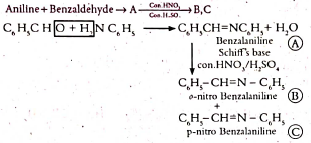
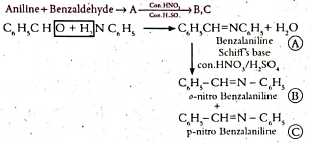

35.
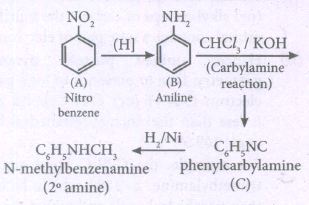
(i) A - C6H5NO2 - Nitro benzene
(ii) B - C6H5NH2 - Aniline
(iii) C - C6H5NC - Phenyl Carbylamine
36.
(i) Aryl cyanide cannot be prepared in this method because of their less reactivity towards nucleophilic substitution. Aryl cyanides are prepared using Sandmeyers reactions.
\(KCH+\underset { methyl \ bromide }{ { CH }_{ 3 }-Br } \rightarrow \underset { ethanenitrile }{ { CH }_{ 3 }-CN } +KBr\)
(ii) By dehydration' of primary amides a aldoximes with P2O5
\(\underset { Acetamide }{ { CH }_{ 3 }-CO{ NH }_{ 2 } } \xrightarrow [ { -H }_{ 2 }O ]{ { P }_{ 2 }{ O }_{ 5 } } \underset { Ethaneitrile }{ { CH }_{ 3 }-{ CN } } \)
(iii) \(\underset { Acetaldoximes }{ { CH }_{ 3 }-CH=NOH } \xrightarrow [ { -H }_{ 2 }O ]{ { P }_{ 2 }{ O }_{ 5 } } \underset { Ethaneitrile }{ { CH }_{ 3 }-{ CN } } \)
37.
To get para product, the - NH2 group is protected by acetylation with acetic anhydride. Then, the nitrated product is hydrolysed to form the product.
38.
To get mono bromo compounds, -NH2 is first acylated to reduce its activity.
39.
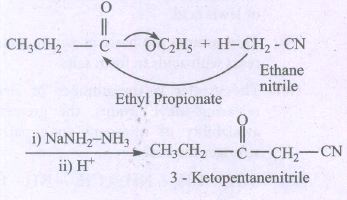
(i) The nitriles containing a-hydrogen also undergo condensation with esters in the presence of sodamide in ether to form ketonitriles.
(ii) This reaction is known as "Levine and hauser" acetylation.
(iii) This reaction involves replacement of ethoxy (OC2H5) group by methylnitrile (-CH2CN) group and is called as cyanomethylation reaction.
40.
(i) The nitrogen in amines possess an unshared pair of electrons (Lone Pair).
(ii) The lone pair of electrons is available for the formation of a new bond with a proton or lewis acid.
(iii) Thus amines are basic in nature and they react with acids to form salts.
(iv) The greater is the number of electron releasing alkyl. groups, the greater the availability of nitrogen's lone pair and stronger the base.
NH3 < CH3 - NH2 < CH3 - NH - CH3
41.
42.
(i) Alkyl bromides (or) iodides on heating with ethanolic solution of potassium nitrite gives nitroethane
\(\underset { Ethyl \ bromide }{ { CH }_{ 3 }{ CH }_{ 2 } } -Br+{ KNO }_{ 2 }\xrightarrow [ { SN }_{ 2 } ]{ ethanol/\triangle } \underset { Nitroethane }{ { CH }_{ 3 }{ CH }_{ 2 }-{ NO }_{ 2 } } +KBr\)
The reaction follows SN2 mechanism.
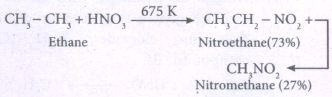
(ii) Gaseous mixture of methane and nitric acid passed through a red hot metal tube to give nitromethane.

Except methane, other alkanes (upto n- hexane) give a mixture of nitroalkanes due to C-C cleavage. The individual nitro alkanes can be separated by fractional distillation.

12th Standard Syllabus & Materials
12th Standard
TN 12th Computer Applications களப்பெயர் முறைமை (DNS) Sample Question Papers Study Material - QB365 Set A
NEW12th Standard
TN 12th Computer Applications வலையமைப்பு எடுத்துக்காட்டுகள் மற்றும் நெறிமுறைகள் Sample Question Papers Study Material - QB365 Set A
NEW12th Standard
TN 12th Computer Applications கணினி வலையமைப்பு ஓர் அறிமுகம் Sample Question Papers Study Material - QB365 Set A
NEW12th Standard
TN 12th Computer Applications PHP-உடன் MySQL-ஐ இணைத்தல் Sample Question Papers Study Material - QB365 Set A



Tamilnadu Stateboard 12th Standard Subjects

Maths
Chemistry

Physics

Biology

Computer Science

Business Maths and Statistics

Economics

Commerce

Accountancy

History

Computer Applications
Biology
Computer Technology
Computer Applications
Computer Science
Business Maths and Statistics
Commerce
Economics
Maths
Chemistry
Physics
Computer Technology
History
Accountancy

Tamil

English

French
Tamilnadu Stateboard Standards
