
 100% FREE ACCESS
12th Standard Syllabus & Materials
12th Standard
TN 12th Maths Applications of Matrices and Determinants Sample Question Papers Study Material - QB365 Set A
NEW12th Standard
TN 12th Computer Applications மின்னணு தரவு பரிமாற்றம் Sample Question Papers Study Material - QB365 Set A
NEW12th Standard
TN 12th Computer Applications மின் - வணிக பாதுகாப்பு அமைப்புகள் Sample Question Papers Study Material - QB365 Set A
NEW12th Standard
TN 12th Computer Applications மின்னணு செலுத்தல் முறைகள் Sample Question Papers Study Material - QB365 Set A
NEW12th Standard
TN 12th Computer Applications மின் - வணிகம் Sample Question Papers Study Material - QB365 Set A
NEW12th Standard
TN 12th Computer Applications திறந்த மூல கருத்துருக்கள் Sample Question Papers Study Material - QB365 Set A

Published on: 01/09/2022
QB365 provides a detailed and simple solution for every Possible Creative Questions in Class 12 Chemistry Subject - p - Block Elements - I, English Medium. It will help Students to get more practice questions, Students can Practice these question papers in addition to score best marks.
Download Tamil Nadu 12th Standard Chemistry question papers, model tests, one-mark questions, important questions, and public exam papers in PDF format. Free study materials and answer keys for TN State Board students.
Questions + Answers key
Take MCQ Chemistry Test
1.
What happens to CO2 when dissolved in water?
2.
What is water gas equilibrium?
3.
What is oxo process?
4.
What is phosgene? How is it prepared?
5.
Give the uses of alum.
6.
What is burnt alum?
7.
What are alums?
8.
What are the uses of boron trifluoride?
9.
Write the reaction of diboranes with water and alkali.
10.
Mention the physical properties of boranes.
11.
Draw the structure of borazole B3N3H6.
12.
Explain the formation of boron trifluoride.
13.
How is boric acid extracted from borax?
14.
Write a short note on anomalous properties of the first element of p-block.
1.
The aqueous solution of carbon dioxide is slightly acidic as it forms carbonic acid.
CO2 + H2O ⇌ H2CO3 ⇌ H+ + HCO3-
2.
The equilibrium involved in the reaction between carbon dioxide and hydrogen, has many industrial applications and is called water gas equilibrium.
CO2 + H2 ⇌ CO + H2O
water gas
3.
In oxo process, ethene is mixed with carbon monoxide and hydrogen gas to produce propanal.
CO + C2H4 + H2 ⟶ CH3CH2CHO
4.
When carbon monoxide is treated with chlorine in presence of light or charcoal, it forms a poisonous gas carbonyl chloride, which is also known as phosgene.
CO + Cl2 ⟶ COCl2
5.
(i) It is used for purification of water
(ii) It is also used for water proofing and textiles.
(iii) It is used in dyeing, paper and leather tanning industries.
(iv) It is employed as a styptic agent to arrest bleeding.
6.
On heating to 475 K potash alum loses water of hydration and swells up. The swollen mass is known as burnt alum.
7.
The name alum is given to the double salt of potassium aluminium sulphate.
[K2SO4.Al2(SO4)3.24H2O]
8.
(i) Boron trifluoride is used for preparing HBF4, a catalyst in organic chemistry
(ii) It is also used as a fluorinating reagent.
9.
Diboranes reacts with water and alkali to give boric acid and metaborates respectively.
B2H6+ 6H2O ⟶ 2H3BO3 + 6H2
B2H6+ 2NaOH + H2O ⟶ 2NaBO2 + 6H2
10.
(i) Boranes are colourless diamagnetic compounds with low thermal stability.
(ii) Diborane is a gas at room temperature with sweet smell and it is extremely toxic.
(iii) It is also highly reactive At high temperatures it forms higher boranes liberating hydrogen.
11.
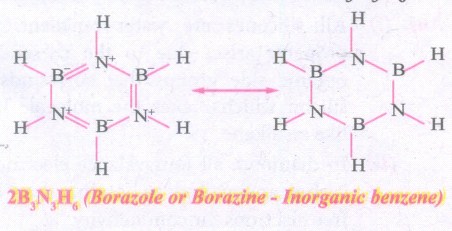
12.
(i) Boric acid reacts with calcium fluoride in presence of conc. sulphuric acid and gives boron trifluoride.
3CaF2 + 3H2SO4 + 2B(OH)3 ⟶ 3CaSO4 + 2BF3 + 6H2O
(ii) Borax when heated with soda ash it gives borax
Na2CO3 + 4B(OH)3 ⟶ Na2B4O7 +.CO2 + 6H2O
13.
Boric acid can be extracted from borax and colemanite.
Na2B4O7 + H2SO4 + 5H2O ⟶ Na2SO4 + 4H3BO3
Ca2B6O11 + 11H2SO4 + SO2 ⟶ Ca(HSO3)2 + 6H3BO3
14.
In p-block elements, the first member of each group differs from the other elements of the corresponding group. The following factors are responsible for this anomalous behaviour
(i) Small size of the first member.
(ii) High ionisation enthalpy and high electronegativity.
(iii) Absence of d-orbitals in their valance shell.

12th Standard Syllabus & Materials
12th Standard
TN 12th Computer Applications வலையமைப்பு வடமிடல் Sample Question Papers Study Material - QB365 Set A
NEW12th Standard
TN 12th Computer Applications களப்பெயர் முறைமை (DNS) Sample Question Papers Study Material - QB365 Set A
NEW12th Standard
TN 12th Computer Applications வலையமைப்பு எடுத்துக்காட்டுகள் மற்றும் நெறிமுறைகள் Sample Question Papers Study Material - QB365 Set A
NEW12th Standard
TN 12th Computer Applications கணினி வலையமைப்பு ஓர் அறிமுகம் Sample Question Papers Study Material - QB365 Set A



Tamilnadu Stateboard 12th Standard Subjects

Maths
Chemistry

Physics

Biology

Computer Science

Business Maths and Statistics

Economics

Commerce

Accountancy

History

Computer Applications
Biology
Computer Technology
Computer Applications
Computer Science
Business Maths and Statistics
Commerce
Economics
Maths
Chemistry
Physics
Computer Technology
History
Accountancy

Tamil

English

French
Tamilnadu Stateboard Standards
