
 100% FREE ACCESS
12th Standard Syllabus & Materials
12th Standard
TN 12th Maths Applications of Matrices and Determinants Sample Question Papers Study Material - QB365 Set A
NEW12th Standard
TN 12th Computer Applications மின்னணு தரவு பரிமாற்றம் Sample Question Papers Study Material - QB365 Set A
NEW12th Standard
TN 12th Computer Applications மின் - வணிக பாதுகாப்பு அமைப்புகள் Sample Question Papers Study Material - QB365 Set A
NEW12th Standard
TN 12th Computer Applications மின்னணு செலுத்தல் முறைகள் Sample Question Papers Study Material - QB365 Set A
NEW12th Standard
TN 12th Computer Applications மின் - வணிகம் Sample Question Papers Study Material - QB365 Set A
NEW12th Standard
TN 12th Computer Applications திறந்த மூல கருத்துருக்கள் Sample Question Papers Study Material - QB365 Set A

Published on: 01/09/2022
QB365 provides a detailed and simple solution for every Possible Creative Questions in Class 12 Chemistry Subject - p - Block Elements - I, English Medium. It will help Students to get more practice questions, Students can Practice these question papers in addition to score best marks.
Download Tamil Nadu 12th Standard Chemistry question papers, model tests, one-mark questions, important questions, and public exam papers in PDF format. Free study materials and answer keys for TN State Board students.
Questions + Answers key
Take MCQ Chemistry Test
1.
Give 3 uses of carbon monoxide.
2.
Describe the structure of graphene.
3.
Describe the structure of carbon nanotubes.
4.
Describe the structure of fullerenes.
5.
Describe the structure of diamond.
6.
Describe the structure of graphite.
7.
Give 3 uses of aluminium chloride
8.
How is aluminium chloride prepared by McAfee process?
9.
How is aluminum chloride prepared from aluminum?
10.
What are the uses of diborane?
11.
How is boron trifluoride obtained from boron trioxide?
12.
What happens to boranes at high temperatures?
13.
Give the uses of boric acid?
14.
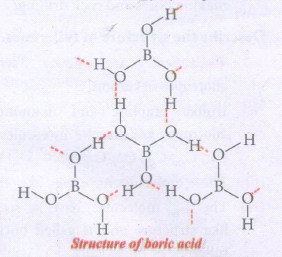
Draw the structure of boric acid.
1.
(i) Equimolar mixture of hydrogen and carbon monoxide - water gas and the mixture of carbon monoxide and nitrogen - producer gas are important industrial fuels.
(ii) Carbon monoxide is a good reducing agent and can reduce many metal oxides to metals.
(iii) Carbon monoxide is an important ligand and forms carbonyl compound with transition metals.
2.
(i) Graphene is an allotropic form of carbon.
(ii) It has a single planar sheet of sp2 hybridised carbon atoms that are densely packed in a honeycomb crystal lattice.
3.
(i) Carbon nanotubes, have graphite like tubes with fullerene ends.
(ii) Along the axis, these nanotubes are stronger than steel and conduct electricity.
(iii) These have many applications in nanoscale electronics, catalysis, polymers and medicine.
4.
(i) Fullerenes are newly synthesised allotropes of carbon.
(ii) Unlike graphite and diamond, these allotropes are discrete molecules such as C32' C50' C60' C70' C76 etc.
(iii) These molecules have cage like structures.
(iv) The C60 molecules have a soccer ball like structure and is called buckminster fullerene or buckyballs.
(v) It has a fused ring structure consists of 20 six membered rings and 12 five membered rings.
(vi) Each carbon atom is sp2 hybridised and forms three σ bonds & a delocalised π bond giving aromatic character to these molecules.
(vii) The C-C bond distance is 1.44 Å and C=C distance 1.38 Å.
5.
(i) Diamond is very hard.
(ii) The carbon atoms in diamond are sp3 hybridised and bonded to four neighbouring carbon atoms by a bonds with a C-C bond length of 1.54 Å.
(iii) This results in a tetrahedral arrangement around each carbon atom that extends to the entire lattice.
(iv) Since all four valance electrons of carbon are involved in bonding there is no free electrons for conductivity.
(v) Being the hardest element, it used for sharpening hard tools, cutting glasses, making bores and rock drilling.
6.
(i) Graphite is the most stable allotropic form of carbon at normal temperature and pressure.
(ii) It is soft and conducts electricity. It is composed of flat two dimensional sheets of carbon atoms.
(iii) Each sheet is a hexagonal net of Sp2 hybridised carbon atoms with a C-C bond length of 1.41 Å which is close to the C-C bond distance in benzene (1.40 Å).
(iv) Each carbon atom forms three a bonds with three neighbouring carbon atoms using three of its valence electrons and the fourth electron present in the unhybridised p orbital forms a π-bond.
(v) These π electrons are delocalised over the entire sheet which is responsible for its electrical conductivity.
(vi) The successive carbon sheets are held together by weak van der Waals forces. The distance between successive sheet is 3.40 Å.
(vii) It is used as a lubricant either on its own or as a graphited oil.
7.
(i) Anhydrous aluminium chloride is used as a catalyst in Friedel Crafts reactions.
(ii) It is used for the manufacture of petrol by cracking the mineral oils.
(iii) It is used as a catalyst in the manufacture on dyes, drugs and perfumes.
8.
(i) Aluminium chloride is obtained by heating a mixture of alumina and coke in a current of chlorine.
Al2O3 + 3C + 3Cl2 ⟶ 2AICl3 + 3CO2
(ii) On industrial scale it is prepared by chlorinating aluminium around 1000 K.
2Al + 3Cl2 \(\overset { 1000K }{ \longrightarrow } \) 2AICl3
9.
(i) When aluminium metal or aluminium hydroxide is treated with hydrochloric acid, aluminium trichloride is formed.
(ii) The reaction mixture is evaporated to obtain hydrated aluminium chloride.
2Al + 6HCl ⟶ 2AICl3 + 3H2
Al(OH)3 + 3HCl ⟶ AlCl3 + 3H2O
10.
(i) Diborane is used as a high energy fuel for propellant.
(ii) It is used as a reducing agent in organic chemistry.
(iii) It is used in welding torches.
11.
(i) Boron trifluoride is obtained by the treatment of calcium fluoride with boron trioxide in presence of conc. sulphuric acid.
B2O3 + 3CaF2 + 3H2SO4 \(\overset { \triangle }{ \longrightarrow } \) 2BH3 + 3CaSO4 + 3H2O
(ii) It can also be obtained by treating boron trioxide with carbon and fluorine.
B2O3 + 3C + 3F2 ⟶ 2BF3 + 3CO
(iii) In the laboratory pure BF3 is prepared by the thermal decomposition of benzene diazonium tetrafluoro borate.
PhN2BF4 \(\overset { \triangle }{ \longrightarrow } \) BF3 + PhF + N2
12.
At high temperatures it forms higher boranes liberating hydrogen.
\(5{ B }_{ 2 }{ H }_{ 6 }\overset { 388K }{ \underset { U-tube }{ \longrightarrow } } 2{ B }_{ 5 }{ H }_{ 11 }+4{ H }_{ 2 }\)
\(2{ B }_{ 2 }{ H }_{ 6 }\overset { 198-373K }{ \longrightarrow } { B }_{ 4 }{ H }_{ 10 }+{ H }_{ 2 }\)
\(5{ B }_{ 2 }{ H }_{ 6 }\overset { 373K }{ \underset { sealed\ tube }{ \longrightarrow } } { B }_{ 10 }{ H }_{ 14 }+8{ H }_{ 2 }\)
\(5{ B }_{ 2 }{ H }_{ 6 }\overset { 473-523K }{ \longrightarrow } 2{ B }_{ 5 }{ H }_{ 9 }+6{ H }_{ 2 }\)
\(10{ B }_{ 2 }{ H }_{ 6 }\overset { 523K }{ \longrightarrow } 2{ B }_{ 5 }{ H }_{ 9 }+2{ B }_{ 5 }{ H }_{ 10 }+11{ H }_{ 2 }\)
\({ B }_{ 2 }{ H }_{ 6 }\overset { Red \ hot }{ \longrightarrow } 2B+3{ H }_{ 2 }\).
13.
(i) Boric acid is used in the manufacture of pottery glasses, enamels and pigments.
(ii) It is used as an antiseptic and as an eye lotion.
(iii) It is also used as a food preservative.
14.
Boric acid has a two dimensional layered structure. It consists of [BO3]3- unit and these are linked to each other by hydrogen bonds.

12th Standard Syllabus & Materials
12th Standard
TN 12th Computer Applications வலையமைப்பு வடமிடல் Sample Question Papers Study Material - QB365 Set A
NEW12th Standard
TN 12th Computer Applications களப்பெயர் முறைமை (DNS) Sample Question Papers Study Material - QB365 Set A
NEW12th Standard
TN 12th Computer Applications வலையமைப்பு எடுத்துக்காட்டுகள் மற்றும் நெறிமுறைகள் Sample Question Papers Study Material - QB365 Set A
NEW12th Standard
TN 12th Computer Applications கணினி வலையமைப்பு ஓர் அறிமுகம் Sample Question Papers Study Material - QB365 Set A



Tamilnadu Stateboard 12th Standard Subjects

Maths
Chemistry

Physics

Biology

Computer Science

Business Maths and Statistics

Economics

Commerce

Accountancy

History

Computer Applications
Biology
Computer Technology
Computer Applications
Computer Science
Business Maths and Statistics
Commerce
Economics
Maths
Chemistry
Physics
Computer Technology
History
Accountancy

Tamil

English

French
Tamilnadu Stateboard Standards
