
 100% FREE ACCESS
12th Standard Syllabus & Materials
12th Standard
TN 12th Computer Applications மின்னணு தரவு பரிமாற்றம் Sample Question Papers Study Material - QB365 Set A
NEW12th Standard
TN 12th Computer Applications மின் - வணிக பாதுகாப்பு அமைப்புகள் Sample Question Papers Study Material - QB365 Set A
NEW12th Standard
TN 12th Computer Applications மின்னணு செலுத்தல் முறைகள் Sample Question Papers Study Material - QB365 Set A
NEW12th Standard
TN 12th Computer Applications மின் - வணிகம் Sample Question Papers Study Material - QB365 Set A
NEW12th Standard
TN 12th Computer Applications திறந்த மூல கருத்துருக்கள் Sample Question Papers Study Material - QB365 Set A
NEW12th Standard
TN 12th Computer Applications வலையமைப்பு வடமிடல் Sample Question Papers Study Material - QB365 Set A

Published on: 01/09/2022
QB365 provides a detailed and simple solution for every Possible Creative Questions in Class 12 Chemistry Subject - p - Block Elements - I, English Medium. It will help Students to get more practice questions, Students can Practice these question papers in addition to score best marks.
Download Tamil Nadu 12th Standard Chemistry question papers, model tests, one-mark questions, important questions, and public exam papers in PDF format. Free study materials and answer keys for TN State Board students.
Questions + Answers key
Take MCQ Chemistry Test
1.
Write a note an Boron Neutron Capture Therapy (BNCT).
2.
Explain the properties of silicones.
3.
Tabulate the common allotropes of p-block elements.
4.
Write a notes on different types of silicones.
5.
Explain the different types of silicates giving examples.
6.
What are silicones? Write the preparation of silicones:
7.
Write note on the structure of diborane.
8.
Distinguish between diamond and graphite.
9.
How are silicates classified? Give an example for each type of silicate.
10.
What are the various methods by which carbon-di-oxide is prepared?
1.
(i) The affinity of Boron- 10 for neutrons is the basis of a technique known as boron neutron capture therapy (BNCT) for treating patients suffering from brain tumours.
(ii) It is based on the nuclear reaction that occurs when boron-10 is irradiated with low-energy thermal neutrons to give high linear energy α particles and a Li particle.
(iii) Boron compounds are injected into a patient with a brain tumour and the compounds collect preferentially in the tumour.
(iv) The tumour area is then irradiated with thermal neutrons and results in the release of an alpha particle that damages the tissue in the tumour each time a boron-10 nucleus captures a neutron.
(v) In this way damage can be limited preferentially to the tumour, leaving the normal brain tissue less affected.
(vi) BNCT has also been studied as a treatment for several other tumours of the head and neck, the breast, the prostate, the bladder, and the liver.
2.
(i) The extent of cross linking and nature of alkyl group determine the nature of polymer.
(ii) They range from oily liquids to rubber like solids.
(iii) All silicones are water repellent.
(iv) This property arises due to the presence of organic side groups that surrounds the silicon which makes the molecule looks like an alkane.
(v) They are also thermal and electrical insulators.
(vi) Chemically they are inert.
(vii) Lower silicones are oily liquids whereas higher silicones with long chain structure are waxy solids.
(viii) The viscosity of silicon oil remains constant and doesn't change with temperature and they don't thicken during winter.
3.
| Element | Most common allotropes |
| Boron | Amorphous boron, α-rhombohedral boron, β-rhombohedral boron, \(\gamma\)-orthorhombic boron, α-tetragonal boron, β-tetragonal boron |
| Carbon | Diamond, Graphite, Graphene, Fullerenes, Carbon nanotubes |
| Silicon | Amorphous silicon, crystalline silicon |
| Germanium | α-germanium, β-germanium |
| Tin | Grey tin, white tin, rhombic tin, sigma tin |
| Phosphorous | White phosphorous, Red phosphorous, Scarlet phosphorous, Violet phosphorous, Black phosphorous. |
| Arsenic | Yellow arsenic, gray arsenic & Black arsenic |
| Antimony | Blue-white antimony, Yellow, Black |
| Oxygen | Dioxygen, ozone |
| Sulphur | Rhombus sulphur, monoclinic sulphur |
| Selenium | Red selenium, Gray selenium, Black selenium, Monoclinic selenium |
| Tellurium | Amorphous & Crystalline |
4.
(i) Linear silicones:
They are obtained by the hydrolysis and subsequent condensation of dialkyl or diaryl silicon chlorides.
(a) Silicone rubbers:
These silicones are bridged together by methylene or similar groups.
(b) Silicone resins:
They are obtained by blending silicones with organic resins such as acrylic esters.
(ii) Cyclic silicones:
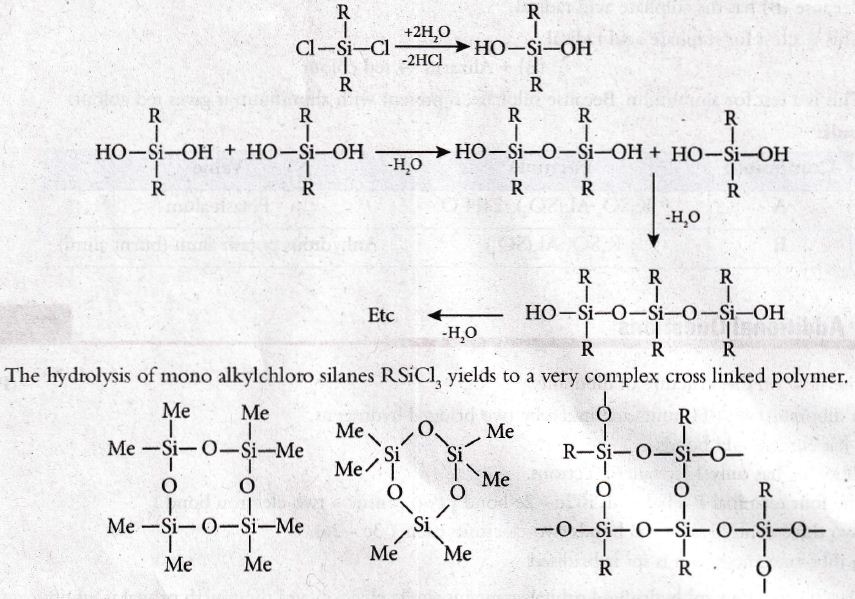
These are obtained by the hydrolysis of R2SiCl2.
(iii) Cross linked silicones:
They are obtained by hydrolysis of RSiCl3.
5.
Silicates are classified into various types based on the way in which the tetrahedral units, \(\left[\mathrm{SiO}_{4}\right]^{4-}\) are linked together.
.JPG)
Ortho silicates:
The simplest silicates which contain discrete \(\left[\mathrm{SiO}_{4}\right]^{4-}\) tetrahedral units are called ortho silicates or nesosilicates.
Ex: phenacite \(\left(\mathrm{Be}_{2} \mathrm{SiO}_{4}\right)\)
.JPG)
Pyro silicates:
(i) Silicates contain \(\left[\mathrm{Si}_{2} \mathrm{O}_{7}\right]^{6-}\) ions are called pyro silicates (or) Soro silicates.
(ii) They are formed by joining two \( \left[\mathrm{SiO}_{4}\right]^{4-}\) tetrahedral units by sharing one oxygen atom at one corner.
Ex: Thortveitite \(\left(\mathrm{Sc}_{2} \mathrm{Si}_{2} \mathrm{O}_{7}\right)\)
.JPG)
Cyclic silicates:
Silicates which contain \(\left(\mathrm{SiO}_{3}\right)_{n}^{2 n-}\) ions which are formed by linking three or more tetrahedral units \(\mathrm{SiO}_{4}^{4-}\) cyclically are called cyclic silicates (or) Ring silicates.
Ex: Beryl \(\left[\mathrm{Be}_{3} \mathrm{Al}_{2}\left(\mathrm{SiO}_{3}\right)_{6}\right]\)
.JPG)
Inosilicates:
Silicates which contain 'n' number of silicate units linked by sharing two or more oxygen atoms are called inosilicates. They are further classified into chain silicates and double chain silicates.
Chain silicates:
These silicates contain \(\left[\left(\mathrm{SiO}_{3}\right)_{\mathrm{n}}\right]^{2 n-}\) ions formed by linking 'n' number of tetrahedral \(\left[\mathrm{SiO}_{4}\right]^{4-}\)units linearly.
Ex: Spodumene - \(\mathrm{LiAl}\left(\mathrm{SiO}_{3}\right)_{2}\)
.JPG)
Double chain silicates
These silicates contains \(\left[\mathrm{Si}_{4} \mathrm{O}_{11}\right]_{\mathrm{n}}^{6 n-}\) ions. In these silicates there are two types of tetrahedra:
(i) Those sharing 3 vertices.
(ii) Those sharing only 2 vertices.
Ex: Asbestos
.JPG)
Sheet (or) phyllo silicates:
(i) Silicates which contain \(\left(\mathrm{Si}_{2} \mathrm{O}_{5}\right)_{\mathrm{n}}{ }^{2 n-}\) are called sheet (or) phyllo silicates.
(ii) These sheets silicates from layered structures in which silicate sheets are stacked ores each other.
Ex: Talc, Mica etc.
.JPG)
Three dimensional silicates:
(i) Silicates in which all the oxygen atoms of \(\left[\mathrm{SiO}_{4}\right]^{4-}\) tetrahedra are shared with other tetrahedra to form three-dimensional network are called three dimensional or tectosilicates.
(ii) General formula \(\left(\mathrm{SiO}_{2}\right)_{n}\).
Ex: Quartz
6.
(i) Silicones (or) poly siloxanes are organo silicon polymers.
(ii) General formula \((\left.\mathrm{R}_{2} \mathrm{SiO}\right)\).
(iii) Their empirical formula is similar to that of ketone \((\left.\mathrm{R}_{2} \mathrm{CO}\right)\), they were named "silicones".
(iv) These silicones may be linear (or) cross linked.
(v) It has very high thermal stability they are called high -temperature polymers.
Preparation:
(i) Silicones are prepared by the hydrolysis of dialkyl dichlorosilanes \(\left(\mathrm{R}_{2} \mathrm{SiCl}_{2}\right)\) or diaryl dichlorosilanes \(\mathrm{Ar}_{2} SiCl_2\)
(ii) Which are prepared by passing vapours of RCl or ArCl over silicon at 570 K with copper as a catalyst.
\(2 \mathrm{RCl}+\mathrm{Si} \stackrel{\mathrm{Cu} / 570 \mathrm{~K}}{\longrightarrow} \mathrm{R}_{2} \mathrm{SiCl}_{2}\)
(iii) The hydrolysis of dialkyl dichloro silanes \(\mathrm{R}_{2} \mathrm{SiCl}_{2}\) yields to a straight chain polymer which grown from both the sides.
7.
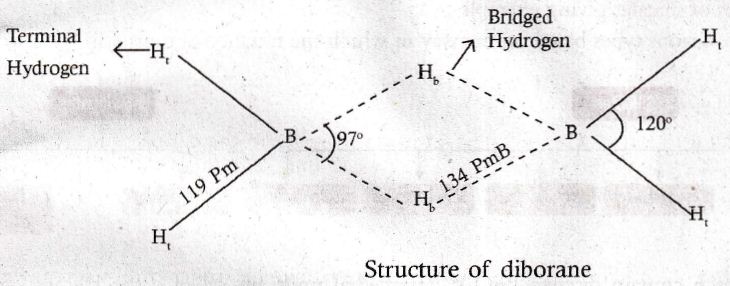
(i) In diborane two BH2 units are linked by two bridged hydrogens.
(ii) It has eight B-H bonds.
(iii) Diborane has only 12 valance electrons.
(iv) The four terminal B-H- bonds is 2c - 2e bond (two centre - two electron bond.)
(v) Two three centred B - H - B bonds two electrons each. (3c - 2e).
(vi) In diborane, the boron is sp3 hybridised
(vii) Three of the four sp3 hydridised orbitals contains single electron and the fourth orbital is empty.
8.
| DIAMOND | GRAPHITE |
| C is sp3 hybridised. | C is sp2 hybridised. |
| Three dimensional, tetrahedral structure. | Two dimensional, sheet like structure. |
| Crystalline, transparent with extra brilliance. | Crystalline, opaque and shiny substance. |
| It is hard with high density and high melting point. | It is soft with low density and high melting point. |
| Bad conductor of and electricity. | Good conductor of heat and electricity. |
9.
Silicates are classified into various types based on the way in which the tetrahedral units, [SiO4]4- are linked together.
(i) Ortho silicates (Neso silicates):
The simplest silicates which contain discrete [SiO4]4- tetrahedral units are called ortho silicates or nesosilicates.
Examples: Phenacite - Be2SiO4 (Be2+ ions are tetrahedrally surrounded by O2- ions)
(ii) pyro silicate (or) Soro silicates: Silicates:
Which contain [Si2O7]6- ions are called pyro silicates (or) Soro silicates.
Example: Thortveitite - Sc2Si2O7
(iii) Cyclic silicates (or Ring silicates):
Silicates which contain (SiO3)32n- ions which are formed by linking three or more tetrahedral SiO44- units cyclically are called cyclic silicates.
Example: Beryl [Be3Al2 (SiO3)6] (an aluminosilicate with each aluminium is surrounded by 6 oxygen atoms octahedrally)
(iv) Inosilicates: Silicates which contain 'n':
number of silicate units liked by sharing two or more oxygen atoms are called inosilicates.
Example: They are further classified as chain silicates and double chain silicates.
(v) Chain silicates (or pyroxenes):
These silicates contain [(SiO3)n]2n- ions formed: by linking 'n' number of tetrahedral [SiO4]4- units linearly. Each silicate unit shares two of its oxygen atoms with other units.
Example: Spodumene - LiAl(SiO3)2·
(vi) Double chain silicates (or amphiboles):
These silicates contains \(\left[ { Si }_{ 4 }{ O }_{ 11 } \right] _{ n }^{ 6n- }\) ions. In these silicates there are two different types of tetrahedra:
(a) Those sharing 3 vertices
(b) those sharing only 2 vertices.
Example:
Asbestos: These are fibrous and non-combustible silicates.
(vii) Sheet or phyllo silicates:
Silicates which contain \(({ Si }_{ 2 }{ O }_{ 5 })_{ n }^{ 2n- }\) are called sheet or phyllo silicates. In these, Each [SiO4]4- tetrahedron unit shares three oxygen atoms with others and thus by forming two dimensional sheets.
Example: Talc, Mica etc.
(viii) Three dimensional silicates (or tectosilicates):
Silicates in which all the oxygen atoms of [SiO4]4- tetrahedra are shared with other tetrahedra to form three dimensional network are called three dimensional or tectosilicates.
Example: Quartz.
10.
(i) Carbon monoxide can be prepared by the reaction of carbon with limited amount of oxygen.
2C + O2 ⟶ 2CO
(ii) (a) On industrial scale carbon monoxide is produced by the reaction of carbon with air.
(b) The carbon monoxide formed will contain nitrogen gas also and the mixture of nitrogen and carbon monoxide is called producer gas.
(c) \(2C+{ O }_{ 2 }/{ N }_{ 2 }(air)\longrightarrow \underset { Producers \ Gas }{ 2CO } +{ N }_{ 2 }\)
(d) The producer gas is then passed through a solution of copper(I) chloride under pressure which results in the formation of CuCI(CO).2H2O.
(e) At reduced pressures this solution releases the pure carbon monoxide.
(iii) Pure carbon monoxide is prepared by warming methanoic acid with concentrated sulphuric acid which acts as a dehydrating agent.
HCOOH + H2SO4 ⟶ CO + H2O + H2SO4

12th Standard Syllabus & Materials
12th Standard
TN 12th Computer Applications களப்பெயர் முறைமை (DNS) Sample Question Papers Study Material - QB365 Set A
NEW12th Standard
TN 12th Computer Applications வலையமைப்பு எடுத்துக்காட்டுகள் மற்றும் நெறிமுறைகள் Sample Question Papers Study Material - QB365 Set A
NEW12th Standard
TN 12th Computer Applications கணினி வலையமைப்பு ஓர் அறிமுகம் Sample Question Papers Study Material - QB365 Set A
NEW12th Standard
TN 12th Computer Applications PHP-உடன் MySQL-ஐ இணைத்தல் Sample Question Papers Study Material - QB365 Set A



Tamilnadu Stateboard 12th Standard Subjects

Maths
Chemistry

Physics

Biology

Computer Science

Business Maths and Statistics

Economics

Commerce

Accountancy

History

Computer Applications
Biology
Computer Technology
Computer Applications
Computer Science
Business Maths and Statistics
Commerce
Economics
Maths
Chemistry
Physics
Computer Technology
History
Accountancy

Tamil

English

French
Tamilnadu Stateboard Standards
