
 100% FREE ACCESS
12th Standard Syllabus & Materials
12th Standard
TN 12th Computer Applications மின்னணு தரவு பரிமாற்றம் Sample Question Papers Study Material - QB365 Set A
NEW12th Standard
TN 12th Computer Applications மின் - வணிக பாதுகாப்பு அமைப்புகள் Sample Question Papers Study Material - QB365 Set A
NEW12th Standard
TN 12th Computer Applications மின்னணு செலுத்தல் முறைகள் Sample Question Papers Study Material - QB365 Set A
NEW12th Standard
TN 12th Computer Applications மின் - வணிகம் Sample Question Papers Study Material - QB365 Set A
NEW12th Standard
TN 12th Computer Applications திறந்த மூல கருத்துருக்கள் Sample Question Papers Study Material - QB365 Set A
NEW12th Standard
TN 12th Computer Applications வலையமைப்பு வடமிடல் Sample Question Papers Study Material - QB365 Set A

Published on: 01/09/2022
QB365 provides a detailed and simple solution for every Possible Book Back Questions in Class 12 Chemistry Subject - p - Block Elements - II, English Medium. It will help Students to get more practice questions, Students can Practice these question papers in addition to score best marks.
Download Tamil Nadu 12th Standard Chemistry question papers, model tests, one-mark questions, important questions, and public exam papers in PDF format. Free study materials and answer keys for TN State Board students.
Questions + Answers key
Take MCQ Chemistry Test
1.
Complete the following reactions.
\(1. \mathrm{NaCl}+\mathrm{MnO}_{2}+\mathrm{4H}_{2} \mathrm{SO}_{4} \longrightarrow \)
\(2. \mathrm{NaNO}_{2}+\mathrm{HCl} \longrightarrow \)
\(3.\mathrm{P}_{4}+\mathrm{3NaOH}+\mathrm{3H}_{2} \mathrm{O} \longrightarrow \)
\(4. \mathrm{AgNO}_{3}+\mathrm{PH}_{3} \longrightarrow \)
\(5. \mathrm{Mg}+\mathrm{10HNO}_{3} \longrightarrow \)
\(6. \mathrm{KClO}_{3} \stackrel{\Delta}{\longrightarrow} \)
\(7. \mathrm{Cu}+Con. \ Hot \ \mathrm{H}_{2} \mathrm{SO}_{4} \longrightarrow\)
\(8. \mathrm{Sb}+\mathrm{Cl}_2 \longrightarrow \)
\(9. \mathrm{HBr}+\mathrm{H}_2 \mathrm{SO}_4 \longrightarrow \)
\(10. \mathrm{XeF}_6+\mathrm{H}_2 \mathrm{O} \longrightarrow \)
\(11. \mathrm{XeO}_6{ }^{4-}+\mathrm{Mn}^{2+}+\mathrm{H}^{+} \longrightarrow \)
\(12. \mathrm{XeOF}_4+\mathrm{SiO}_2 \longrightarrow \)
\(13. \mathrm{Xe}+\mathrm{F}_2 \frac{\mathrm{Ni} / 200 \mathrm{~atm}}{400^{\circ} \mathrm{C}}\).
2.
What type of hybridisation occur in
a) BrF5
b) BrF3
3.
Deduce the oxidation number of oxygen in hypofluorous acid – HOF.
4.
Suggest a reason why HF is a weak acid, whereas binary acids of the all other halogens are strong acids.
5.
6.
Give a reaction between nitric acid and a basic oxide.
7.
Give two equations to illustrate the chemical behaviour of phosphine.
8.
Write the valence shell electronic configuration of group-15 elements.
9.
Give the uses of argon.
10.
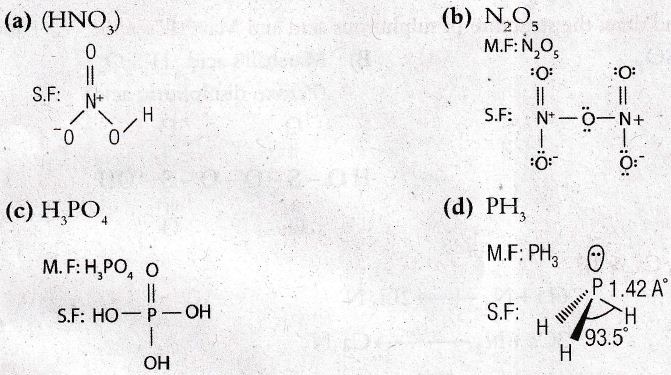
Write the molecular formula and structural formula for the following molecules.
a) Nitric acid
b) Dinitrogen pentoxide
c) phosphoric acid (PTA)
d) phosphine
11.
12.
How will you prepare chlorine in the laboratory?
13.
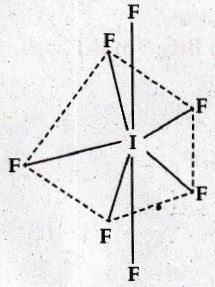
What is the hybridisation of iodine in IF7? Give its structure.
14.
Why fluorine is more reactive than other halogens?
15.
Give the oxidation state of halogen in the following.
a) OF2
b) O2F2
c) Cl2O3
d) I2O4
16.
Explain why fluorine always exhibit an oxidation state of -1?
17.
Chalcogens belongs to p-block. Give reason.
18.
What is inert pair effect?
1.
\((i) \quad 4 \mathrm{NaCl}+\mathrm{MnO}_{2}+4 \mathrm{H}_{2} \mathrm{SO}_{4} \rightarrow \mathrm{Cl}_{2}+\mathrm{MnCl}_{2}+4 \mathrm{NaHSO}_{4}+2 \mathrm{H}_{2} \mathrm{O} \)
\((ii) \quad \mathrm{NaNO}_{2}+\mathrm{HCl} \rightarrow \mathrm{NaCl}+\mathrm{HNO}_{2} \)
\((iii) \quad \mathrm{P}_{4}+3 \mathrm{NaOH}+3 \mathrm{H}_{2} \mathrm{O} \rightarrow 3 \mathrm{NaH}_{2} \mathrm{PO}_{2}+\mathrm{PH}_{3} \uparrow \)
\((iv) \quad 3 \mathrm{AgNO}_{3}+\mathrm{PH}_{3} \rightarrow \mathrm{Ag}_{3} \mathrm{P}+3 \mathrm{HNO}_{3} \)
\((v) \quad 4 \mathrm{Mg}+10 \mathrm{HNO}_{3} \rightarrow 4 \mathrm{Mg}\left(\mathrm{NO}_{3}\right)_{2}+\mathrm{N}_{2} \mathrm{O}+6 \mathrm{H}_{2} \mathrm{O} \)
\((vi) \quad 2 \mathrm{KClO}_{3} \stackrel{\Delta}{\longrightarrow} 2 \mathrm{KCl}+3 \mathrm{O}_{2} \uparrow \)
\((vii) \quad \mathrm{Cu}+Con. Hot \mathrm{H}_{2} \mathrm{SO}_{4} \rightarrow \mathrm{CuSO}_{4}+2 \mathrm{H}_{2} \mathrm{O}+\mathrm{SO}_{2} \uparrow \)
\((viii) \quad 2 \mathrm{Sb}+3 \mathrm{Cl}_{2} \rightarrow 2 \mathrm{SbCl}_{3} \)
\((ix) \quad 2 \mathrm{HBr}+\mathrm{H}_{2} \mathrm{SO}_{4} \rightarrow 2 \mathrm{SO}_{2}+2 \mathrm{H}_{2} \mathrm{O}+\mathrm{Br}_{2} \)
\((x) \quad \mathrm{XeF}_{6}+3 \mathrm{H}_{2} \mathrm{O} \rightarrow \mathrm{XeO}_{3}+6 \mathrm{HF} \)
\((xi) \quad 5 \mathrm{XeO}_{6}^{4-}+2 \mathrm{Mn}^{2+}+14 \mathrm{H}^{+} \rightarrow 2 \mathrm{MnO}_{4}^{-}+5 \mathrm{XeO}_{5}+7 \mathrm{H}_{2} \mathrm{O} \)
\((xii) \quad 2 \mathrm{XeOF}_{4}+\mathrm{SiO}_{2} \rightarrow 2 \mathrm{XeO}_{2} \mathrm{~F}_{2}+\mathrm{SiF}_{4} \)
\((xiii) \quad Xe+{ 3F }_{ 2 }\overset { Ni/200atm }{ \underset { 400^{ 0 }C }{ \longrightarrow } }XeF_6\)
2.
a) BrF5
.JPG)
Valence electron of bromine atom 7+ Number of fluorine atom (5) = 12
\(X=\frac{12}{2}=6\)
Hybridization: sp3d2 ;
Geometry: Square Pyramidal
b) BrF3
.JPG)
Valence electron of bromine atom 7+ Number of fluorine atom (3) = 10
X = \(\frac{10}{2}=5\)
Hybridization: sp3d2;
Geometry: Triangular bipyramidal (T - shaped)
3.
Oxidation number of F = -1
Oxidation number of H = +1
Oxidation number of O in HOF =x
(+1) + x + (-1) = 0
x = 0
Oxidation number of O in HOF = 0
4.
HF is a weak acid i.e. 0.1 M solution is only 10% ionised, but in 5M & 15M solution, HF is stronger acid due to chemical equilibrium.
\(\mathrm{HF}+\mathrm{H}_{2} \mathrm{O} \rightleftharpoons \mathrm{H}_{3} \mathrm{O}^{+}+\mathrm{F}^{-} \)
\(\mathrm{HF}+\mathrm{F}^{-} \rightleftharpoons \mathrm{HF}_{2}^{-}\)
5.
6.
HNO3 reacts with basic oxides to form salts and water
ZnO + 2HNO3\(\longrightarrow \) Zn(NO3)2 + H2O
3FeO + 10HNO3 \(\longrightarrow \) 3Fe(NO3)3 + NO + 5H2O
7.
Thermal stability:
\(4 \mathrm{PH}_{3} \stackrel{317 \mathrm{~K}}{\longrightarrow} \mathrm{P}_{4}+6 \mathrm{H}_{2} \)
Combustion:
\(4 \mathrm{PH}_{3}+8 \mathrm{O}_{2} \stackrel{\Delta}{\longrightarrow} \underset{\text { Phosphorus pentoxide }}{\mathrm{P}_{4} \mathrm{O}_{10}+6 \mathrm{H}_{2} \mathrm{O}} \)
\(\mathrm{P}_{4} \mathrm{O}_{10}+6 \mathrm{H}_{2} \mathrm{O} \stackrel{\Delta}{\longrightarrow} 4 \mathrm{HPO}_{3}+4 \mathrm{H}_{2} \mathrm{O}\\ \quad \quad \quad \quad \quad \quad \quad \text{Meta phosphoric acid}\)
8.
(i) The general electronic configuration of 15 group elements is ns2np3.
(ii) Nitrogen \(\Rightarrow 2 \mathrm{~s}^{2} 2 \mathrm{p}^{3}\) (Valence shell)
(iii) Phosphorus \(\Rightarrow 3 \mathrm{~s}^{2} 3 \mathrm{p}^{3}\)
(iv) Arsenic \(\Rightarrow 4 \mathrm{~s}^{2} 4 \mathrm{p}^{3}\)
(v) Antimony \(\Rightarrow 5 s^{2} 5 p^{3}\)
(vi) Bismuth \(\Rightarrow 6 \mathrm{~s}^{2} 6 \mathrm{p}^{3}\)
9.
Argon prevents the oxidation of hot filament and prolongs the life in filament bulbs.
10.
11.
12.
Chlorine is prepared by the action of conc. sulphuric acid on chlorides in presence of manganese dioxide
4NaCl + MnO2 + 4H2SO4 \(\longrightarrow \)Cl2+ MnCl2 +4NaHSO4 + 2H2O
13.
(i) sp3d3 hybridisation
(ii) Pentagonal bipyramidal structure.
14.
(i) Fluorine is more electro negative than other halogens.
(ii) Because except fluorine all the other halogens have positive oxidation state.
(iii) It has high electron affinity character
Example:
\(\mathrm{Cl}_{2}\mathrm{O} \Rightarrow+1 \text { oxidation state }(\mathrm{Cl}) \)
\(\mathrm{OF}_{2} \Rightarrow-1 \text { oxidation state }(\mathrm{F})\)
15.
(a) OF2
+ 2 + 2(x) = 0
+2 = -2x
2 x = -2 ⇒ x = -1
(b) O2F2
2(+1) + 2x = 0
2x = -2
x = -1
(c) Cl2O3
2(x) + 3(-2) = 0
2x = +6
x = +3
(d) I2O4
2(x) + 4(-2) = 0
2x = +8
x = +4
16.
(i) Fluorine is most electronegative atom.
(ii) It has only one unpaired electron.
17.
(i) The Chalcogens belong to group (16).
(ii) The group consists of elements: Oxygen, Sulphur, Selenium, Tellurium and Polonium.
(iii) These are ore forming elements as most of the ores are oxides and sulphides.
(iv) Chalcos meaning 'ore formers'.
18.
(i) In heavier post transition metals, the outers electrons (ns) have a tendency to remain inert and show reluctance to take part in the bonding, which is known as inert pair effect.
(ii) This effect is also observed in groups 14, 15 and 16.

12th Standard Syllabus & Materials
12th Standard
TN 12th Computer Applications களப்பெயர் முறைமை (DNS) Sample Question Papers Study Material - QB365 Set A
NEW12th Standard
TN 12th Computer Applications வலையமைப்பு எடுத்துக்காட்டுகள் மற்றும் நெறிமுறைகள் Sample Question Papers Study Material - QB365 Set A
NEW12th Standard
TN 12th Computer Applications கணினி வலையமைப்பு ஓர் அறிமுகம் Sample Question Papers Study Material - QB365 Set A
NEW12th Standard
TN 12th Computer Applications PHP-உடன் MySQL-ஐ இணைத்தல் Sample Question Papers Study Material - QB365 Set A



Tamilnadu Stateboard 12th Standard Subjects

Maths
Chemistry

Physics

Biology

Computer Science

Business Maths and Statistics

Economics

Commerce

Accountancy

History

Computer Applications
Biology
Computer Technology
Computer Applications
Computer Science
Business Maths and Statistics
Commerce
Economics
Maths
Chemistry
Physics
Computer Technology
History
Accountancy

Tamil

English

French
Tamilnadu Stateboard Standards
