
 100% FREE ACCESS
12th Standard Syllabus & Materials
12th Standard
TN 12th Maths Applications of Matrices and Determinants Sample Question Papers Study Material - QB365 Set A
NEW12th Standard
TN 12th Computer Applications மின்னணு தரவு பரிமாற்றம் Sample Question Papers Study Material - QB365 Set A
NEW12th Standard
TN 12th Computer Applications மின் - வணிக பாதுகாப்பு அமைப்புகள் Sample Question Papers Study Material - QB365 Set A
NEW12th Standard
TN 12th Computer Applications மின்னணு செலுத்தல் முறைகள் Sample Question Papers Study Material - QB365 Set A
NEW12th Standard
TN 12th Computer Applications மின் - வணிகம் Sample Question Papers Study Material - QB365 Set A
NEW12th Standard
TN 12th Computer Applications திறந்த மூல கருத்துருக்கள் Sample Question Papers Study Material - QB365 Set A

Published on: 01/09/2022
QB365 provides a detailed and simple solution for every Possible Creative Questions in Class 12 Chemistry Subject - p - Block Elements - II, English Medium. It will help Students to get more practice questions, Students can Practice these question papers in addition to score best marks.
Download Tamil Nadu 12th Standard Chemistry question papers, model tests, one-mark questions, important questions, and public exam papers in PDF format. Free study materials and answer keys for TN State Board students.
Questions + Answers key
Take MCQ Chemistry Test
1.
CIF3 molecule has aT-shaped structure and not a trigonal planar one. Why?
2.
Why CIF3 exists but FCl3 does not exist - Give reason.
3.
Explain why the stability of oxoacids of chlorine increases in the order given below?
HCIO < HCIO2 < HCIO3 < HCIO4
4.
Out of H2O and H2S which one has higher bond angle and why?
5.
Write the order of thermal stability of the hydrides of group 16 elements.
6.
Discuss the anomalous nature of fluorine.
7.
Explain the characteristic properties of hydrogen halides.
8.
An element A occupies group number 17 and period number 2 is the most electronegative element. Element A reacts with another element B) which occupies group number 17 and period number 4 to give a compound Compound C undergoes sp3d2 hybridisation and has octahedral structure. Identify the elements a and B and the compound C. Write the reactions.
9.
Why do noble gases form compounds with fluorine and oxygen only?
10.
Give a test for sulphate?
11.
Name a reaction for the estimation of Ozone.
12.
Explain the commercial method of preparation of nitric acid.
13.
Explain the structure of ammonia.
14.
Explain the reaction of ammonia with chlorine and chlorides at different conditions.
15.
What is Haber's process?
1.
(i) In CIF3, central atom CI has three bond pairs and two lone pairs.
(ii) According to VSEPR theory, the two lone pairs will occupy. The equatorial positions to minimise Ip-Ip and repulsions.
(iii) In addition, the axial fluorine atoms will be bent towards the equatorial fluorine in order to minimise the Ip-Ip repulsions.
(iv) Therefore CIF3 has a bent T-shaped structure
2.
(i) CI has vacant d-orbitals and hence can show an oxidation state of +3 but F has no d-orbitals, therefore, it cannot show positive oxidation states. Further, since F can show only - 1 oxidation state therefore it forms only CIF of FCI3.
(ii) Due to larger size CI an accommodate three small F-atoms around it while F being smaller cannot accommodate three bigger sized CI atoms around it.
3.
(i) All these acids on losing a proton give their corresponding conjugate bases (ie) ClO-,
CIO2 -, CIO3 - and CIO4 -. Their structures are:
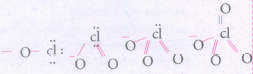
(ii) Since, oxygen is more electronegative than chlorine, therefore dispersal of negative charge present on oxygen atom (Singly bonded to CI) increases as the number of oxygen atoms attached by a double bond: to chlorine increases due to \(P\pi -d\pi \) back bonding.
(iii) Therefore stability of ions will increase in the following order:
CIO- < CIO2- < CIO3- < CIO4-
(iv) Due to increase in stability of conjugate bases, acidic strength of corresponding acid increases in the same order as :
HCIO- < HCIO2 < HCIO3 < HCIO4
4.
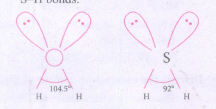
(i) Bond angel of HiX (H-O-H=104.5o) is larger than that of H2S(H-S-H=92o)
(ii) Since oxygen is more electronegative than sulphur, therefore bond pair electrons of O-H bond will be closer to oxygen which will be little away from the sulphur atom.
(iii) As a result bond pair-bond pair repulsions between bond pairs of two O-H bonds would be stronger than in the S-H bonds.
5.
(i) The thermal stability of hydrides of group 16 elements is directly proportional to the bond dissociation enthalpy of H- E bond.
(ii) On moving down the group, bond dissociation energy decreases and hence, E- H bond breaks easily.
(iii) Thus, the thermal stability of hydrides of group 16 elements decreases down the group. Hence the order of thermal stability is,
H2O > H2S > H2Se > H2Te > H2Po
6.
(i) Fluorine is the most reactive element among halogens due to minimum value of F- F bond dissociation energy.
(ii) It can form two types of salts with metals NaF and NaHF2
(iii) AgF is soluble in water but other AgX are insoluble.
(iv) HF attacks glass while others do not.
(v) Fluorine, does not form any polyhalides (absence of d - orbitals)
(vi) Fluorine exhibit only negative oxidation state (highly electronegative) while other halogens have both +ve and -ve oxidation state.
7.
(i) All halogens react with hydrogen to form volatile covalent hydrides of formula HX.
(ii) These hydrides are called hydracids.
(iii) Hydracids are the reducing agents.
(iv) Except HF, all hydrogen halides are gases. HF is a liquid because of intermolecular hydrogen bonding.
H-F...H-F....H-F....H-F
(v) The acidic character of HX are in the following order.
HF < HCI < HBr < HI.
8.
(i) The element of group number 17 and period number 2 is fluorine (A).
(ii) The element of group number 17 and period number 4 is bromine (B).
(iii) (A) and (B) react to give an interhalogen compound (C) bromine pentafluoride
\(\underset { (A) }{ { Br }_{ 3 } } +\underset { (B) }{ { 5F }_{ 2 } } \longrightarrow \underset { (C) }{ { 2BrF }_{ 5 } } \)
(C) undergoes sp3d2 hybridisation and has octahedral structure
| A | F | Fluorine |
| B | Br | Bromine |
| C | BrF5 | Bromine pentafluoride |
9.
(i) Both fluorine and oxygen have very high electron affinities and can easily cause the excitation of the electrons from 5p orbital to 5d orbital of xenon.
(ii) The unpaired electrons thus formed can take up electrons from oxygen or fluorine to form compounds.
(iii) Thus xenon has low ionisation energy and it can form compounds with strong oxidising agents (high E.A) like F2 and O2·
10.
(i) Dilute solution of sulphuric acid/aqueous : solution of sulphates gives white precipitate (barium sulphate) with barium chloride solution.
(ii) It can also be detected using lead acetate solution. Here a white precipitate of lead sulphate is obtained
(iii) \({ BaCl }_{ 2 }+{ H }_{ 2 }{ SO }_{ 4 }\longrightarrow { { BaSO }_{ 4 } } \downarrow +2Hcl\)
Barium sulphate (White precipitate)
(iv) \(\left( { CH }_{ 3 }COO \right) _{ 2 }Pb+{ H }_{ 2 }{ SO }_{ 4 }\longrightarrow { PbSO_4 }\downarrow +{ 2CH }_{ 3 }COOH\)
Lead Sulphate (White precipitate)
11.
O3 oxidises potassium iodide to iodine. This reaction is quantitative and can be used for estimation of ozone
\({ O }_{ 3 }+2KI+{ H }_{ 2 }O\longrightarrow 2KOH+{ O }_{ 2 }+{ I }_{ 2 }\)
12.
Commercial method of preparation
(i) Nitric acid prepared in large scales using Ostwald's process. In this method ammonia from Haber's process is mixed about 10 times, of air.
(ii) This mixture is preheated and passed into the catalyst chamber where they come in contact with platinum gauze.
(iii) The temperature rises to about 1275 K and the metallic gauze brings about the rapid catalytic oxidation of ammonia resulting in the formation of NO, which then oxidised to nitrogen dioxide.
\({ 4NH }_{ 3 }+{ 5O }_{ 2 }\longrightarrow 4NO+6{ H }_{ 2 }O+120KJ\)
\(2NO+{ O }_{ 2 }\longrightarrow { 2NO }_{ 2 }\)
(iv) The nitrogen dioxide produced is passed through a series of adsorption towers. It reacts with water to give nitric acid. Nitric acid formed is bleached by blowing air.
\({ 6NO }_{ 2 }+3{ H }_{ 2 }O\longrightarrow { 4HNO }_{ 3 }+2NO+{ H }_{ 2 }O\)
13.
Structure of ammonia
(i) Ammonia molecule is pyramidal in shape N-H bond distance is 1.016Å and H-H bond, distance is 1.645Å with a bond angle 107°.
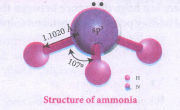
(ii) The structure of ammonia may be regarded as a tetrahedral with one lone pair of electrons in one tetrahedral position hence it has a pyramidal shape.
14.
(i) Ammonia reacts with chlorine and chlorides to give ammonium chloride as a final product.
(ii) The reactions are different under different conditions as given below.
(iii) With excess ammonia
\({ 2NH }_{ 3 }+3{ Cl }_{ 2 }\longrightarrow { N }_{ 2 }+6HCl\)
\(6HCl+6{ NH }_{ 3 }\longrightarrow { 6NH }_{ 4 }Cl\)
(iv) With excess of chlorine ammonia reacts to give nitrogen trichloride, an explosive substance.
\({ 2NH }_{ 3 }+{ 6Cl }_{ 2 }\longrightarrow { 2NCl }_{ 3 }+6HCl\)
\({ 2NH }_{ 3 }(g)+{ HCl }{ (g) }\longrightarrow NH_4Cl(s)\)
15.
Direct reaction of nitrogen with hydrogen gives ammonia. This reaction is favored by high pressures and at optimum temperature in presence of iron catalyst.
\(\cfrac { 1 }{ 2 } { N }_{ 2 }+\cfrac { 3 }{ 2 } { H }_{ 2 }\rightleftharpoons { 2NH }_{ 3 }\)\(\Delta H_f { }_{ }=-46.2KJmol^{ -1 }\)

12th Standard Syllabus & Materials
12th Standard
TN 12th Computer Applications வலையமைப்பு வடமிடல் Sample Question Papers Study Material - QB365 Set A
NEW12th Standard
TN 12th Computer Applications களப்பெயர் முறைமை (DNS) Sample Question Papers Study Material - QB365 Set A
NEW12th Standard
TN 12th Computer Applications வலையமைப்பு எடுத்துக்காட்டுகள் மற்றும் நெறிமுறைகள் Sample Question Papers Study Material - QB365 Set A
NEW12th Standard
TN 12th Computer Applications கணினி வலையமைப்பு ஓர் அறிமுகம் Sample Question Papers Study Material - QB365 Set A



Tamilnadu Stateboard 12th Standard Subjects

Maths
Chemistry

Physics

Biology

Computer Science

Business Maths and Statistics

Economics

Commerce

Accountancy

History

Computer Applications
Biology
Computer Technology
Computer Applications
Computer Science
Business Maths and Statistics
Commerce
Economics
Maths
Chemistry
Physics
Computer Technology
History
Accountancy

Tamil

English

French
Tamilnadu Stateboard Standards
