
 100% FREE ACCESS
12th Standard Syllabus & Materials
12th Standard
TN 12th Maths Applications of Matrices and Determinants Sample Question Papers Study Material - QB365 Set A
NEW12th Standard
TN 12th Computer Applications மின்னணு தரவு பரிமாற்றம் Sample Question Papers Study Material - QB365 Set A
NEW12th Standard
TN 12th Computer Applications மின் - வணிக பாதுகாப்பு அமைப்புகள் Sample Question Papers Study Material - QB365 Set A
NEW12th Standard
TN 12th Computer Applications மின்னணு செலுத்தல் முறைகள் Sample Question Papers Study Material - QB365 Set A
NEW12th Standard
TN 12th Computer Applications மின் - வணிகம் Sample Question Papers Study Material - QB365 Set A
NEW12th Standard
TN 12th Computer Applications திறந்த மூல கருத்துருக்கள் Sample Question Papers Study Material - QB365 Set A

Published on: 28/01/2021
12th Standard Chemistry English Medium P - Block Elements- II Reduced Syllabus Important Questions 2021
Download Tamil Nadu 12th Standard Chemistry question papers, model tests, one-mark questions, important questions, and public exam papers in PDF format. Free study materials and answer keys for TN State Board students.
Questions + Answers key
Take MCQ Chemistry Test
1.
Helium is used in balloons in the place of hydrogen because it is________.
incombustible
radioactive and detected easily
lighter than hydrogen
both (a) and (c)
2.
Strong reducing behaviour of H3PO2 is due to______.
High oxidation state of phosphorus
High electro gain enthalpy of phosphorus
Presence of two-OH groups and one P-H bond
Presence of one-OH groups and two P-H bonds
3.
The incorrect statement regarding structure of ozone is______.
Bond angle is less than 120°
It is linear
The two oxygen-oxygen bond length in ozone are identical
Both (b) and (c).
4.
Orthophosphorus acid on heating gives______.
Hypophosphorous
Orthophosphoric acid
Phosphine gas
both (b) and (c)
5.
Least volatile hydrogen halide is ______.
HF
HCI
HBr
HI
6.
S-S bond is present in _______.
H2S2O7
H2SO5
H2S2O6
H2S2O6
7.
Which is dibasic?
Orthophosphoric acid
Pyrophosphoric acid
Orthophosphorus acid
Hypophosphorous acid
8.
Which of the following halides of group 15 is not hydrolysed?
NF3
PF3
NI3
Both (a) and (b)
9.
When copper is heated with conc HNO3 it produces ________.
Cu(NO3)2, NO and NO2
Cu(NO3)2 and N2O
Cu(NO3)2 and NO2
Cu(NO3)2 and NO
10.
Among the following the correct order of acidity is ________.
HClO2 < HClO < HClO3 < HClO4
HClO4 < HClO2 < HClO < HClO3
HClO3 < HClO4 < HClO2 < HClO
HClO < HClO2 < HClO3 < HClO4
11.
XeF6 on complete hydrolysis produces________.
XeOF4
XeO2F2
XeO3
XeO2
12.
Which one of the following compounds is not formed?
XeOF4
XeO3
XeF2
NeF2
13.
On hydrolysis, PCl3 gives________.
H3PO3
PH3
H3PO4
POCl3
14.
In the brown ring test, brown colour of the ring is due to _______.
a mixture of No and NO2
Nitroso ferrous sulphate
Ferrous nitrate
Ferric nitrate
15.
16.
Why hydrides of oxygen is a liquid whereas hydride of sulphur is a gas?
17.
Account for the following:
(i) O-O bond lengths in ozone molecule are identical.
(ii) Most of the reactions in fluorine are exothermic.
18.
Acidic character increases from HF to HI. State whether the above statement is True or false and give reason for your answer.
19.
Why does ozone act as a powerful oxidising agent?
20.
(i) Give correct order of boiling point of hydride of group 17.
(ii) Fluorine exhibits only -1 oxidation state whereas other halogens show +1, +3, +5 and +7 oxidation state also Explain.
21.
Elements of group 16 show lower value of first ionization enthalpy compared to group 15, why?
22.
Give two uses of nitric acid.
23.
Suggest a reason why HF is a weak acid, whereas binary acids of the all other halogens are strong acids.
24.
25.
Give the uses of argon.
26.
27.
How will you prepare chlorine in the laboratory?
28.
Chalcogens belongs to p-block. Give reason.
29.
What is inert pair effect?
30.
Predict the product
(i) PCI5+ C2H5OH \(\longrightarrow \)?
(ii) P4+ SO2Cl2 \(\longrightarrow \) ?
(iii) POCl3 + H2O \(\longrightarrow \) ?
(iv) HBr + PH3\(\longrightarrow \) ? :,
(v) PCl3+ H2O\(\longrightarrow \) ?
31.
Explain why the stability of oxoacids of chlorine increases in the order given below?
HCIO < HCIO2 < HCIO3 < HCIO4
32.
Write the order of thermal stability of the hydrides of group 16 elements.
33.
Discuss the anomalous nature of fluorine.
34.
Give a test for sulphate?
35.
Explain the structure of ammonia.
36.
Give the uses of sulphuric acid.
37.
What are interhalogen compounds? Give examples.
38.
An element A occupies group number 15 and period number 3, reacts with chlorine to give compound B. The compound B on hydrolysis gives a dibasic acid C. The compound C on heating undergoes auto oxidation and reduction to give a tribasic acid D. Identify the elements A compounds B, C and D. Write the reactions.
39.
How is sulphuric acid manufacture by contact process?
40.
Complete the following reactions
(i) KCIO3\(\longrightarrow \)?
(ii) ZnS + O2\(\longrightarrow \) ?
(iii) Al2O3 + NaOH + H2O\(\longrightarrow \) ?
(iv) NaOH + SO2\(\longrightarrow \) ?
(v) KCI+ H2SO4 \(\longrightarrow \) ?
41.
Give a detailed account on allotropes of sulphur.
42.
Give a detailed account of the interhalogen, compounds with special reference to the: compounds involving iodine. Draw their structures.
1.
(d)
both (a) and (c)
2.
(d)
Presence of one-OH groups and two P-H bonds
3.
(b)
It is linear
4.
(d)
both (b) and (c)
5.
(a)
HF
6.
(d)
H2S2O6
7.
(c)
Orthophosphorus acid
8.
(d)
Both (a) and (b)
9.
(c)
Cu(NO3)2 and NO2
10.
(d)
HClO < HClO2 < HClO3 < HClO4
11.
(c)
XeO3
12.
(d)
NeF2
13.
(a)
H3PO3
14.
(b)
Nitroso ferrous sulphate
15.
(d)
16.
(i) H2O undergoes extensive H-bonding due to high electronegativity of O-atom and hence exist as an associated molecule.
(ii) Therefore H2O is a liquid. On the other hand H2O does not undergo H-bonding and hence exists as a discrete molecules and as a gas.
17.
(i) The two O-O bond lengths are identical due to resonance.
(ii) Due to the strong bond formation with other elements.
18.
(i) The given statement is true.
(ii) The relative acidic strength of HF, HCI, HBr and HI depends upon their bond dissociation enthalpies.
(iii) Since, the bond dissociation enthalpy of H-X bond from H-F to H-I as the size of atom increases from F to l. Therefore, the acidic strength increases in the opposite order as:
H - F < H - CI < H - Br < H - I
19.
(i) Ozone acts as a powerful oxidizing agent because ozone liberates nascent oxygen very easily on decomposition.
\({ O }_{ 3 }\longrightarrow { O }_{ 2 }+\left[ O \right] \)
(ii) This nascent or atomic oxygen brings about the oxidations it is very reactive.
20.
(i) HCl < HBr < HI < HF
(ii) Fluorine being the most electronegative element cannot have positive oxidation state. Other halogens have d-orbitals, therefore can expand their octet.
21.
Element of group 15 have stable half-filled p-orbitals hence large amount of energy is required to remove electrons as compared to group 16, which has an incomplete p subshell.
22.
(i) Nitric acid is used as a oxidising agent and in the preparation of aqua regia.
(ii) Salts of nitric acid are used in photography (AgNO3) and gun powder for fire arms (NaNO3)·
23.
HF is a weak acid i.e. 0.1 M solution is only 10% ionised, but in 5M & 15M solution, HF is stronger acid due to chemical equilibrium.
\(\mathrm{HF}+\mathrm{H}_{2} \mathrm{O} \rightleftharpoons \mathrm{H}_{3} \mathrm{O}^{+}+\mathrm{F}^{-} \)
\(\mathrm{HF}+\mathrm{F}^{-} \rightleftharpoons \mathrm{HF}_{2}^{-}\)
24.
25.
Argon prevents the oxidation of hot filament and prolongs the life in filament bulbs.
26.
27.
Chlorine is prepared by the action of conc. sulphuric acid on chlorides in presence of manganese dioxide
4NaCl + MnO2 + 4H2SO4 \(\longrightarrow \)Cl2+ MnCl2 +4NaHSO4 + 2H2O
28.
(i) The Chalcogens belong to group (16).
(ii) The group consists of elements: Oxygen, Sulphur, Selenium, Tellurium and Polonium.
(iii) These are ore forming elements as most of the ores are oxides and sulphides.
(iv) Chalcos meaning 'ore formers'.
29.
(i) In heavier post transition metals, the outers electrons (ns) have a tendency to remain inert and show reluctance to take part in the bonding, which is known as inert pair effect.
(ii) This effect is also observed in groups 14, 15 and 16.
30.
(i) PCI5+ C2H5OH \(\longrightarrow \) C2H5CI + POCl3 + HCI
(ii) P4+ 10SO2Cl2 \(\longrightarrow \) 4PCI5 + 10SO2
(iii) POCl3 + 3H2O \(\longrightarrow \) H3PO4 + 3HCI
(iv) PH3 + HBr\(\longrightarrow \) PH4Br
(v) PCl3+ 3H2O\(\longrightarrow \) H3PO3 + 3 HCI
31.
(i) All these acids on losing a proton give their corresponding conjugate bases (ie) ClO-,
CIO2 -, CIO3 - and CIO4 -. Their structures are:
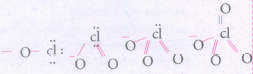
(ii) Since, oxygen is more electronegative than chlorine, therefore dispersal of negative charge present on oxygen atom (Singly bonded to CI) increases as the number of oxygen atoms attached by a double bond: to chlorine increases due to \(P\pi -d\pi \) back bonding.
(iii) Therefore stability of ions will increase in the following order:
CIO- < CIO2- < CIO3- < CIO4-
(iv) Due to increase in stability of conjugate bases, acidic strength of corresponding acid increases in the same order as :
HCIO- < HCIO2 < HCIO3 < HCIO4
32.
(i) The thermal stability of hydrides of group 16 elements is directly proportional to the bond dissociation enthalpy of H- E bond.
(ii) On moving down the group, bond dissociation energy decreases and hence, E- H bond breaks easily.
(iii) Thus, the thermal stability of hydrides of group 16 elements decreases down the group. Hence the order of thermal stability is,
H2O > H2S > H2Se > H2Te > H2Po
33.
(i) Fluorine is the most reactive element among halogens due to minimum value of F- F bond dissociation energy.
(ii) It can form two types of salts with metals NaF and NaHF2
(iii) AgF is soluble in water but other AgX are insoluble.
(iv) HF attacks glass while others do not.
(v) Fluorine, does not form any polyhalides (absence of d - orbitals)
(vi) Fluorine exhibit only negative oxidation state (highly electronegative) while other halogens have both +ve and -ve oxidation state.
34.
(i) Dilute solution of sulphuric acid/aqueous : solution of sulphates gives white precipitate (barium sulphate) with barium chloride solution.
(ii) It can also be detected using lead acetate solution. Here a white precipitate of lead sulphate is obtained
(iii) \({ BaCl }_{ 2 }+{ H }_{ 2 }{ SO }_{ 4 }\longrightarrow { { BaSO }_{ 4 } } \downarrow +2Hcl\)
Barium sulphate (White precipitate)
(iv) \(\left( { CH }_{ 3 }COO \right) _{ 2 }Pb+{ H }_{ 2 }{ SO }_{ 4 }\longrightarrow { PbSO_4 }\downarrow +{ 2CH }_{ 3 }COOH\)
Lead Sulphate (White precipitate)
35.
Structure of ammonia
(i) Ammonia molecule is pyramidal in shape N-H bond distance is 1.016Å and H-H bond, distance is 1.645Å with a bond angle 107°.
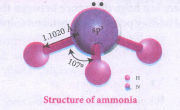
(ii) The structure of ammonia may be regarded as a tetrahedral with one lone pair of electrons in one tetrahedral position hence it has a pyramidal shape.
36.
(i) Sulphuric acid is used in the manufacture of fertilisers, ammonium sulphate and super phosphates and other chemicals such as HCl, HNO3.
(ii) It is used as a drying agent and also used in the preparation of pigments, explosives etc.
37.
Each halogen combines with other halogens to form a series of compounds are called interhalogen compounds.
Example: AB type: BrF
AB3 type: ICI3
38.
(i) As per the position in the periodic table, the element A is phosphorus as below:
(ii) Phosphorus reacts with dry chlorine to form phosphorus trichloride as below
\(\underset { (A) }{ { P }_{ 4 } } +6{ Cl }_{ 2 }\longrightarrow \underset { (B) }{ { 4PCl }_{ 3 } } \)
Hence, compound B is phosphorus trichloride.
(iii) PCl3 on hydrolysis gives phosphorus acid H3PO3, which is dibasic acid,
\(\underset { (B) }{ { PCl }_{ 3 } } +3{ H }_{ 2 }O\longrightarrow { 3HCl }+\underset { (C) }{ { H }_{ 3 }{ PO }_{ 3 } } \)
Hence, compound C is phosphorus acid.
(iv) H3PO3 on heating undergo auto oxidation and reduction producing phosphoric acid md phosphine as below:
\(\underset { (c) }{ { 4H }_{ 3 }{ PO }_{ 3 } } \overset { \Delta }{ \longrightarrow } { PH }_{ 3 }+\underset { (b) }{ { 3H }_{ 3 }{ PO }_{ 4 } } \)
Phosphoric acid is a tribasic acid. Hence, compound D is phosphoric acid.
Thus A = Phosphorus
B = Phosphorus trichloride
C = Phosphorus acid
D = Phosphoric acid
39.
Manufacture of sulphuric acid by contact process:
The contact process involves the following steps.
(i) Initially sulphur dioxide is produced by burning sulphur or iron pyrites in oxygen/ air.
\(S+{ O }_{ 2 }\longrightarrow { SO }_{ 2 }\)
\({ 4FeS }_{ 2 }+{ 11O }_{ 2 }\longrightarrow { 2Fe }_{ 2 }{ { O }_{ 3 } }+8{ SO }_{ 2 }\)
(ii) Sulphur dioxide formed is oxidised to sulphur trioxide by air in the presence of a catalyst such as V2O5 or platinised asbestos.
(iii) The sulphur trioxide is absorbed in concentrated sulphuric acid and produces oleum (H2S2O7). The oleum is converted into sulphuric acid by diluting it with water.
\(\mathrm{SO}_{3}+\mathrm{H}_{2} \mathrm{SO}_{4} \longrightarrow \mathrm{H}_{2} \mathrm{~S}_{2} \mathrm{O}_{7} \stackrel{\mathrm{H}_{2} \mathrm{O}}{\longrightarrow} 2 \mathrm{H}_{2} \mathrm{SO}_{4}\)
(iv) To maximise the yield the plant is operated at 2 bar pressure and 720 K. The sulphuric acid obtained in this process is over 96 % pure.
40.
(i) KCIO3 \(\overset { \Delta }{ \underset { { MnO }_{ 2 } }{ \longrightarrow } } \) 2KCI + 3O2
(ii) 2 ZnS + 3O2\(\longrightarrow \) 2 ZnO + 2 SO2
(iii) AIzO3(s) + 6 NaOH(aq) + 3 H2O(l) \(\longrightarrow \) 2 Na3[AI(OH)6](aq)
(iv) 2NaOH + SO2\(\longrightarrow \)Na2SO3 + H2O
(v) 2KCl + H2SO4 \(\longrightarrow \) 2 HCl + K2SO4
41.
(a) Rhombic Sulphur (α - Sulphur):
(a) It is yellow in colour.
(b) Its melting point is 385.8K and specific gravity is 2.06
(c) It is stable form of sulphur at room temperature.
(d) It is formed on evaporating the solution of sulphur in CS2.
(e) It in insoluble in water, readily soluble in CS2 and dissolves to some extent in benzene, alcohol and ether.
(b) Monoclinic sulphur \(\left( \beta -sulphur \right) \):
(a) Its melting point is 393K and specific gravity is 1.98
(b) It is prepared by melting rhombic sulphur in a dish and cooling, till crust is formed. Two holes are made in crust and remaining liquid is powered out. On removing crust, colourless needle - shaped crystals of β - sulphur is formed.
(c) Monoclinic sulphur is stable above 369K and below 369K α - sulphur is stable.
(d) At 369K both forms are stable and this temperature is called transition temperature.
(e) Both rhombic and monoclinic sulphur have S8 molecules, these are packed to give different crystal structure S8 form is puckered and has crown shape.
Several other modifications containing 6-20 sulphur atoms per ring are synthesised
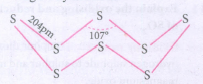
(f) In Cyclo-S6 the ng adopts chair form.
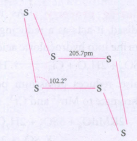
(g) At elevated temperatures (~1000K), S2 is dominant species and is, paramagnetic like O2
42.
Each halogen combines with another halogen to form several compounds known as interhalogen compounds.
| AX | AX3 | AX3 | AX7 |
| CIF | CIF2 | BrF5 | IF7 |
| ICI | ICl3 | IF5 |
Methods of Preparation interhalogen compounds:
I2+ Cl2(equimolar) \(\longrightarrow \)2ICI (AX)
Cl2 + 3F2 (Excess) 2CIF3 (AX3)
I2+ 5F2 (Excess) \(\longrightarrow \) 21F5(AX5)
IF5 + F2 (Excess)\(\overset { 573K }{ \longrightarrow } \) IF7 (AX7)
Structure of interhalogen compounds.
(i) Type AX: These are covalent compounds in which the larger halogen forms the central atom.
Eg: CIF, BrF
AX sp3 hybridisation-linear linear
(ii) Type AX3:

(a) Without lone pair of electrons, it is T-shaped.
(b) BipyramidaI structure.
(c) sp3 hybridisation. Eg: CIF3
(iii) Type AX5:

(a) Without lone pair, it iF square pyramidal
(b) Octahedral structure
(c) sp3d2 hybridisation
Eg: IF5
(iv) Type AX7:

(a) Pentagonal pyramidal.
(b) sp3d3 hybridisation Eg: IF7

12th Standard Syllabus & Materials
12th Standard
TN 12th Computer Applications வலையமைப்பு வடமிடல் Sample Question Papers Study Material - QB365 Set A
NEW12th Standard
TN 12th Computer Applications களப்பெயர் முறைமை (DNS) Sample Question Papers Study Material - QB365 Set A
NEW12th Standard
TN 12th Computer Applications வலையமைப்பு எடுத்துக்காட்டுகள் மற்றும் நெறிமுறைகள் Sample Question Papers Study Material - QB365 Set A
NEW12th Standard
TN 12th Computer Applications கணினி வலையமைப்பு ஓர் அறிமுகம் Sample Question Papers Study Material - QB365 Set A



Tamilnadu Stateboard 12th Standard Subjects

Maths
Chemistry

Physics

Biology

Computer Science

Business Maths and Statistics

Economics

Commerce

Accountancy

History

Computer Applications
Biology
Computer Technology
Computer Applications
Computer Science
Business Maths and Statistics
Commerce
Economics
Maths
Chemistry
Physics
Computer Technology
History
Accountancy

Tamil

English

French
Tamilnadu Stateboard Standards
