
 100% FREE ACCESS
12th Standard Syllabus & Materials
12th Standard
TN 12th Computer Applications மின்னணு தரவு பரிமாற்றம் Sample Question Papers Study Material - QB365 Set A
NEW12th Standard
TN 12th Computer Applications மின் - வணிக பாதுகாப்பு அமைப்புகள் Sample Question Papers Study Material - QB365 Set A
NEW12th Standard
TN 12th Computer Applications மின்னணு செலுத்தல் முறைகள் Sample Question Papers Study Material - QB365 Set A
NEW12th Standard
TN 12th Computer Applications மின் - வணிகம் Sample Question Papers Study Material - QB365 Set A
NEW12th Standard
TN 12th Computer Applications திறந்த மூல கருத்துருக்கள் Sample Question Papers Study Material - QB365 Set A
NEW12th Standard
TN 12th Computer Applications வலையமைப்பு வடமிடல் Sample Question Papers Study Material - QB365 Set A

Published on: 28/01/2021
12th Standard Chemistry English Medium P - Block Elements- II Reduced Syllabus Important Questions With Answer Key 2021
Download Tamil Nadu 12th Standard Chemistry question papers, model tests, one-mark questions, important questions, and public exam papers in PDF format. Free study materials and answer keys for TN State Board students.
Questions + Answers key
Take MCQ Chemistry Test
1.
The high reactivity of fluorine is due to________.
high ionisation energy
low bond dissociation energy
low electron affinity
high electro negativity
2.
Maximum covalent character is shown by________.
PCl3
NCl3
AsCl3
SbCl3
3.
The incorrect statement regarding structure of ozone is______.
Bond angle is less than 120°
It is linear
The two oxygen-oxygen bond length in ozone are identical
Both (b) and (c).
4.
Which one of the following orders is not in accordance with the property stated against it?
F2 > CI2 > Br2 > I2: Bond dissociation energy
HI > HBr > HCI > HF: Acidic property in water
F2 > Cl2 > Br2 > l2: Oxidising power
F2 > Cl2 > Br2 > l2: Electronegativity
5.
Oxalic acid on heating with cone H2SO4 gives ______.
CO only
CO2 only
CO2 + H2O
CO + CO2 + H2O
6.
Least volatile hydrogen halide is ______.
HF
HCI
HBr
HI
7.
Allotrope of sulphur which shows paramagnetic behaviour _______.
S8- Rhombic
S8- Monoclinic
S2- In vapour phase
Not possible
8.
The hybridisation and shape of SF6 is respectively?
sp3d2, square planar
sp3d2, octahedral
sp3d see-saw
sp3d, trigonal bipyramidal
9.
Which is dibasic?
Orthophosphoric acid
Pyrophosphoric acid
Orthophosphorus acid
Hypophosphorous acid
10.
Among the following the correct order of acidity is ________.
HClO2 < HClO < HClO3 < HClO4
HClO4 < HClO2 < HClO < HClO3
HClO3 < HClO4 < HClO2 < HClO
HClO < HClO2 < HClO3 < HClO4
11.
Which one of the following orders is correct for the bond dissociation enthalpy of halogen molecules?
Br2 > I2 > F2 > Cl2
F2 > Cl2 > Br2 > l2
I2 > Br2 > Cl2 > F2
Cl2 > Br2 > F2 > I2
12.
Which one of the following compounds is not formed?
XeOF4
XeO3
XeF2
NeF2
13.
The correct order of the thermal stability of hydrogen halide is_______.
HI > HBr > HCl > HF
HF > HCl > HBr > HI
HCl > HF > HBr > HI
HI > HCl > HF > HBr
14.
The molarity of given orthophosphoric acid solution is 2M. Its normality is _______.
6N
4N
2N
none of these
15.
Which is true regarding nitrogen?
least electronegative element
has low ionisation enthalpy than oxygen
d- orbitals available
ability to form pπ-pπ bonds with itself
16.
Arrange the following as indicated below:
(i) F2, Cl2, Br2, I2 - increasing bond dissociation enthalpy.
(ii) HF, HCI, HBr, HI - increasing acidic strength.
17.
(i) Give correct order of boiling point of hydride of group 17.
(ii) Fluorine exhibits only -1 oxidation state whereas other halogens show +1, +3, +5 and +7 oxidation state also Explain.
18.
Discuss the oxidising power of fluorine.
19.
What is phosphorescence?
20.
Give two uses of nitric acid.
21.
Give two uses of nitrogen.
22.
What type of hybridisation occur in
a) BrF5
b) BrF3
23.
Suggest a reason why HF is a weak acid, whereas binary acids of the all other halogens are strong acids.
24.
Give the uses of argon.
25.
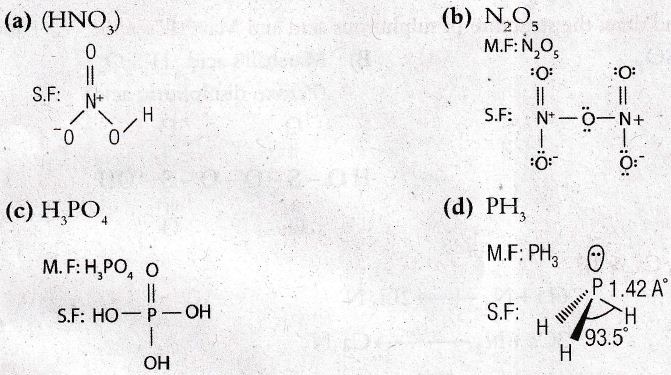
Write the molecular formula and structural formula for the following molecules.
a) Nitric acid
b) Dinitrogen pentoxide
c) phosphoric acid (PTA)
d) phosphine
26.
27.
How will you prepare chlorine in the laboratory?
28.
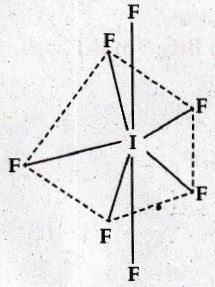
What is the hybridisation of iodine in IF7? Give its structure.
29.
Explain why fluorine always exhibit an oxidation state of -1?
30.
Complete the following reactions
(l) Cl2+ H2O\(\longrightarrow \)?
(ii) XeF6 + 2H2O \(\longrightarrow \) ?
(Iii) XeF6 + 2H2O\(\longrightarrow \)?
31.
Why CIF3 exists but FCl3 does not exist - Give reason.
32.
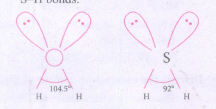
Out of H2O and H2S which one has higher bond angle and why?
33.
Why do noble gases form compounds with fluorine and oxygen only?
34.
Name a reaction for the estimation of Ozone.
35.
What is Haber's process?
36.
Give the uses of helium.
37.
What are interhalogen compounds? Give examples.
38.
An element A occupies group number 15 and period number 3, reacts with chlorine to give compound B. The compound B on hydrolysis gives a dibasic acid C. The compound C on heating undergoes auto oxidation and reduction to give a tribasic acid D. Identify the elements A compounds B, C and D. Write the reactions.
39.
An element A occupies group number 15 and period number 3, exhibits allotropy and it is tetra atomic. A reacts with caustic soda to give B which is having rotten fish odour. A reacts with chlorine to give C which has a pungent odour Identify A, B and C. Write the reactions.
40.
An amorphous solid (A) burns in air to form a gas (B) which turns lime water milky. The gas is also produced as a byproduct during roasting of sulphide ore. This gas decolourises acidified aqueous KMnO4 solution and reduces Fe3+ to Fe2+. Identify the solid 'A' and the gas 'B' and write the reactions involved.
41.
Why is dioxygen a gas but sulphur a solid?
42.
Mention the uses of helium.
1.
(b)
low bond dissociation energy
2.
(b)
NCl3
3.
(b)
It is linear
4.
(a)
F2 > CI2 > Br2 > I2: Bond dissociation energy
5.
(d)
CO + CO2 + H2O
6.
(a)
HF
7.
(c)
S2- In vapour phase
8.
(b)
sp3d2, octahedral
9.
(c)
Orthophosphorus acid
10.
(d)
HClO < HClO2 < HClO3 < HClO4
11.
(d)
Cl2 > Br2 > F2 > I2
12.
(d)
NeF2
13.
(b)
HF > HCl > HBr > HI
14.
(a)
6N
15.
(d)
ability to form pπ-pπ bonds with itself
16.
(i) l2 < F2 < Br2 < Cl2·
(ii) HF < Hq < HBr < HI.
17.
(i) HCl < HBr < HI < HF
(ii) Fluorine being the most electronegative element cannot have positive oxidation state. Other halogens have d-orbitals, therefore can expand their octet.
18.
(i) All the halogens have strong oxidising property due to their high electron affinity.
(ii) Fluorine is the strongest oxidising agent. It oxidises other halide ions into halogens in solution or when dry.
\({ F }_{ 2 }+{ 2X }^{ - }\longrightarrow { 2F }^{ - }+{ X }_{ 2 }\) (where X- = Cl-, Br-, I-)
19.
White Phosphorous glows in the dark due to oxidation which is called as phosphorescence.
20.
(i) Nitric acid is used as a oxidising agent and in the preparation of aqua regia.
(ii) Salts of nitric acid are used in photography (AgNO3) and gun powder for fire arms (NaNO3)·
21.
(i) Nitrogen is used for the manufacture of ammonia, nitric acid and calcium Cyanamide etc.
(ii) Liquid nitrogen is used for producing low temperature required in cryosurgery and so in biological preservation.
22.
a) BrF5
.JPG)
Valence electron of bromine atom 7+ Number of fluorine atom (5) = 12
\(X=\frac{12}{2}=6\)
Hybridization: sp3d2 ;
Geometry: Square Pyramidal
b) BrF3
.JPG)
Valence electron of bromine atom 7+ Number of fluorine atom (3) = 10
X = \(\frac{10}{2}=5\)
Hybridization: sp3d2;
Geometry: Triangular bipyramidal (T - shaped)
23.
HF is a weak acid i.e. 0.1 M solution is only 10% ionised, but in 5M & 15M solution, HF is stronger acid due to chemical equilibrium.
\(\mathrm{HF}+\mathrm{H}_{2} \mathrm{O} \rightleftharpoons \mathrm{H}_{3} \mathrm{O}^{+}+\mathrm{F}^{-} \)
\(\mathrm{HF}+\mathrm{F}^{-} \rightleftharpoons \mathrm{HF}_{2}^{-}\)
24.
Argon prevents the oxidation of hot filament and prolongs the life in filament bulbs.
25.
26.
27.
Chlorine is prepared by the action of conc. sulphuric acid on chlorides in presence of manganese dioxide
4NaCl + MnO2 + 4H2SO4 \(\longrightarrow \)Cl2+ MnCl2 +4NaHSO4 + 2H2O
28.
(i) sp3d3 hybridisation
(ii) Pentagonal bipyramidal structure.
29.
(i) Fluorine is most electronegative atom.
(ii) It has only one unpaired electron.
30.
(l) Cl2+ H2O\(\longrightarrow \) HCI + HOCI
(ii) XeF6 + 2H2O \(\longrightarrow \) XeO3 + 6HF
(Iii) XeF6 + 2H2O\(\longrightarrow \) XeO2F2+ 4HF
31.
(i) CI has vacant d-orbitals and hence can show an oxidation state of +3 but F has no d-orbitals, therefore, it cannot show positive oxidation states. Further, since F can show only - 1 oxidation state therefore it forms only CIF of FCI3.
(ii) Due to larger size CI an accommodate three small F-atoms around it while F being smaller cannot accommodate three bigger sized CI atoms around it.
32.
(i) Bond angel of HiX (H-O-H=104.5o) is larger than that of H2S(H-S-H=92o)
(ii) Since oxygen is more electronegative than sulphur, therefore bond pair electrons of O-H bond will be closer to oxygen which will be little away from the sulphur atom.
(iii) As a result bond pair-bond pair repulsions between bond pairs of two O-H bonds would be stronger than in the S-H bonds.
33.
(i) Both fluorine and oxygen have very high electron affinities and can easily cause the excitation of the electrons from 5p orbital to 5d orbital of xenon.
(ii) The unpaired electrons thus formed can take up electrons from oxygen or fluorine to form compounds.
(iii) Thus xenon has low ionisation energy and it can form compounds with strong oxidising agents (high E.A) like F2 and O2·
34.
O3 oxidises potassium iodide to iodine. This reaction is quantitative and can be used for estimation of ozone
\({ O }_{ 3 }+2KI+{ H }_{ 2 }O\longrightarrow 2KOH+{ O }_{ 2 }+{ I }_{ 2 }\)
35.
Direct reaction of nitrogen with hydrogen gives ammonia. This reaction is favored by high pressures and at optimum temperature in presence of iron catalyst.
\(\cfrac { 1 }{ 2 } { N }_{ 2 }+\cfrac { 3 }{ 2 } { H }_{ 2 }\rightleftharpoons { 2NH }_{ 3 }\)\(\Delta H_f { }_{ }=-46.2KJmol^{ -1 }\)
36.
(i) Helium is used to provide inert atmosphere in electric-arc welding of metals.
(ii) Helium has lowest boiling point hence used in cryogenics.
(iii) It is much less denser than air and hence used for filling air balloons.
37.
Each halogen combines with other halogens to form a series of compounds are called interhalogen compounds.
Example: AB type: BrF
AB3 type: ICI3
38.
(i) As per the position in the periodic table, the element A is phosphorus as below:
(ii) Phosphorus reacts with dry chlorine to form phosphorus trichloride as below
\(\underset { (A) }{ { P }_{ 4 } } +6{ Cl }_{ 2 }\longrightarrow \underset { (B) }{ { 4PCl }_{ 3 } } \)
Hence, compound B is phosphorus trichloride.
(iii) PCl3 on hydrolysis gives phosphorus acid H3PO3, which is dibasic acid,
\(\underset { (B) }{ { PCl }_{ 3 } } +3{ H }_{ 2 }O\longrightarrow { 3HCl }+\underset { (C) }{ { H }_{ 3 }{ PO }_{ 3 } } \)
Hence, compound C is phosphorus acid.
(iv) H3PO3 on heating undergo auto oxidation and reduction producing phosphoric acid md phosphine as below:
\(\underset { (c) }{ { 4H }_{ 3 }{ PO }_{ 3 } } \overset { \Delta }{ \longrightarrow } { PH }_{ 3 }+\underset { (b) }{ { 3H }_{ 3 }{ PO }_{ 4 } } \)
Phosphoric acid is a tribasic acid. Hence, compound D is phosphoric acid.
Thus A = Phosphorus
B = Phosphorus trichloride
C = Phosphorus acid
D = Phosphoric acid
39.
(i) The element which occupies group number 15 and period number 3 is phosphorus. Hence, A is phosphorus This is further supported by the fact that A exhibits allotropy and A is tetra atomic.
(ii) Phosphorus reacts with caustic soda to form phosphine as below:
4P + 3 NaOH + 3H2O \(\longrightarrow \) PH3 + 3 NaH2PO2
Hence, B is phosphine PH3 which has rotten fish odour.
(iii) Phosphorus reacts with dry chlorine to form phosphorus trichloride which has a pungent odour.
P4 + 6 Cl2\(\longrightarrow \) 4PCl3
Thus, A = Phosphorus
B = Phosphine
C = Phosphorus trichloride
40.
(I) Since the byproduct of roasting to sulphide ore is SO2 It turns lime water milky.
Therefore, gas 'B' must be SO2
(ii) As the gas 'B' is obtained when amorphous solid 'A' burns in air therefore, amorphous solid 'A' must be sulphur S8
\(\underset { (A) }{ { S }_{ g } } +{ 8O }_{ 2 }\overset { \Delta }{ \longrightarrow } \underset { (B) }{ { 8SO }_{ 2 } } \)
(iii) Gas (B) reduces acidified aqueous KMnO4 solution and reduces Fe3+ to Fe2+ salts as shown below:
\(\underset { (yellow) }{ { 2MnO }_{ 4 } } ^{ - }+\underset { (b) }{ { SO }_{ 2 } } +2{ H }_{ 2 }O\longrightarrow { 2Fe }^{ 2+ }+\underset { (Green) }{ { SO }_{ 4 }^{ 2- } } +{ 4H }^{ + }\)
(iv) Thus, solid 'A' is S8 and gas 'B' is SO2
41.
(i) O2 molecules are held together by weak Vander Waal's force because of small size and high electronegativity of oxygen.
(ii) In contrast, sulphur shows catenation and forms stronger S-S bonds.
(iii) Due to catenation, sulphur forms octa-atomic S8 molecules having eight membered puckered ring structure.
(iv) Because of its bigger size the force of attraction holding S8 molecules are much stronger.
(v) Hence sulphur is a solid at room temperature or in other words, that is why there is a large difference between the boiling point (also melting points) of the two elements.
42.
(i) Because of its lightness and noninflammability helium is used to filling balloons for meteorological observations.
(ii) Because of its lightness it is used in inflating aeroplane tyres.
(iii) Helium oxygen mixture is used by deep sea divers in preference to nitrogen oxygen mixtures. This prevents bends when a diver comes to the surface.
(iv) A mixture of oxygen and helium is used in the treatment of asthma.
(v) Liquid helium (b.pt 4.2K) is used as cryogenic agent for carrying out various experiments at low temperatures.
(vi)It is used to produce and sustain powerful super conducting magnets of modern NMR Spectrometers and Magnetic Resonance Imaging system (MRI) for clinical diagnosis.

12th Standard Syllabus & Materials
12th Standard
TN 12th Computer Applications களப்பெயர் முறைமை (DNS) Sample Question Papers Study Material - QB365 Set A
NEW12th Standard
TN 12th Computer Applications வலையமைப்பு எடுத்துக்காட்டுகள் மற்றும் நெறிமுறைகள் Sample Question Papers Study Material - QB365 Set A
NEW12th Standard
TN 12th Computer Applications கணினி வலையமைப்பு ஓர் அறிமுகம் Sample Question Papers Study Material - QB365 Set A
NEW12th Standard
TN 12th Computer Applications PHP-உடன் MySQL-ஐ இணைத்தல் Sample Question Papers Study Material - QB365 Set A



Tamilnadu Stateboard 12th Standard Subjects

Maths
Chemistry

Physics

Biology

Computer Science

Business Maths and Statistics

Economics

Commerce

Accountancy

History

Computer Applications
Biology
Computer Technology
Computer Applications
Computer Science
Business Maths and Statistics
Commerce
Economics
Maths
Chemistry
Physics
Computer Technology
History
Accountancy

Tamil

English

French
Tamilnadu Stateboard Standards
