
 100% FREE ACCESS
12th Standard Syllabus & Materials
12th Standard
TN 12th Computer Applications மின்னணு தரவு பரிமாற்றம் Sample Question Papers Study Material - QB365 Set A
NEW12th Standard
TN 12th Computer Applications மின் - வணிக பாதுகாப்பு அமைப்புகள் Sample Question Papers Study Material - QB365 Set A
NEW12th Standard
TN 12th Computer Applications மின்னணு செலுத்தல் முறைகள் Sample Question Papers Study Material - QB365 Set A
NEW12th Standard
TN 12th Computer Applications மின் - வணிகம் Sample Question Papers Study Material - QB365 Set A
NEW12th Standard
TN 12th Computer Applications திறந்த மூல கருத்துருக்கள் Sample Question Papers Study Material - QB365 Set A
NEW12th Standard
TN 12th Computer Applications வலையமைப்பு வடமிடல் Sample Question Papers Study Material - QB365 Set A

Published on: 27/01/2021
12th Standard Chemistry English Medium Reduced Syllabus Important Questions - 2021 Part - 1
Download Tamil Nadu 12th Standard Chemistry question papers, model tests, one-mark questions, important questions, and public exam papers in PDF format. Free study materials and answer keys for TN State Board students.
Questions + Answers key
Take MCQ Chemistry Test
1.
Which type of defect is found in transition metals that have variable valency?
Frenkel defect
Schottky defect
Line defect
Metal deficiency defect
2.
Silicones are ______.
ortho silicates
water repellent thermal insulators
both (a) and (b)
None of these
3.
In graphite electrons are _______.
localised on each C-atom
localised on every third C-atom
delocalised within the layer
present in anti-bonding orbital
4.
Which one is correct statement for zeolite?
Zeolites are aluminosilicates having three dimensional framework
Hydrate zeolites are used as ion exchangers in hardening of soft water
Zeolites are alumino silicates
all the above
5.
The catalytic activity of transition metals is due to ________.
the formation of a variety of oxidation states
the formation of intermediate products
the capability of forming interstitial compounds.
all the above
6.
Name the process by which elements such as germanium, silicon and gallium are refined.
Vapour phase method
Electrolytic refining
Zone refining
Van-Arkel method
7.
Thermodynamically the most stable form of carbon is________.
Diamond
graphite
Fullerene
none of these
8.
| Column-I | Column-II | ||
| A | Borazole | 1 | B(OH)3 |
| B | Boric acid | 2 | B3N3H6 |
| C | Quartz | 3 | Na2[B4O5(OH)4]8H2O |
| D | Borax | 4 | SiO2 |
| A | B | C | D |
| 2 | 1 | 4 | 3 |
| A | B | C | D |
| 1 | 2 | 4 | 3 |
| A | B | C | D |
| 1 | 2 | 4 | 3 |
None of these
9.
The geometry at which carbon atom in diamond are bonded to each other is _______.
Tetrahedral
hexagonal
Octahedral
none of these
10.
Most easily liquefiable gas is _______.
Ar
Ne
He
Kr
11.
The correct order of the thermal stability of hydrogen halide is_______.
HI > HBr > HCl > HF
HF > HCl > HBr > HI
HCl > HF > HBr > HI
HI > HCl > HF > HBr
12.
An element belongs to group 15 and 3rd period of the periodic table, its electronic configuration would be_______.
1s2 2s2 2p4
1s2 2s2 2p3
1s2 2s2 2p6 3s2 3p2
1s2 2s2 2p6 3s2 3p3
13.
The repeating unit in silicone is_______.
SiO2
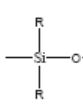
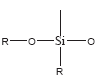
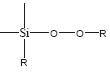
14.
The element that does not show catenation among the following p-block elements is ________.
Carbon
silicon
Lead
germanium
15.
Considering Ellingham diagram, which of the following metals can be used to reduce alumina?
Fe
Cu
Mg
Zn
16.
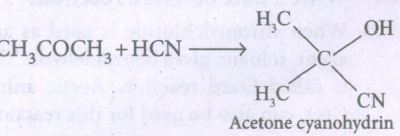
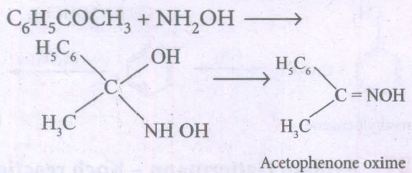
Predict the formula of the products in the
(i) CH3COCH3 + HCN ➝?
(ii) C6H5COCH + NH2OH➝?
17.
Explain the formation of delta.
18.
What are lyophobic colloids? Give examples.
19.
Define Deemulsification.
20.
What is Helmholtz double layer?
21.
For a uni - univalent electrolyte write the Debye - Huckel Onsager equation
22.
Complete the following reaction giving names of products.
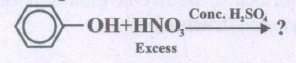
23.
Complete the following reactions
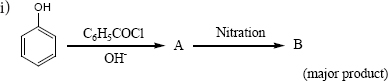
ii) \(C_6H_5-CH_{2}CH(OH)CH(CH_3)_2 \overset{ConH_2SO_4}\longrightarrow\)
24.
Two metals M1 and M2 have reduction potential values of -xV and +yV respectively. Which will liberate H2 and H2SO4.
25.
Name an element with which silicon can be doped to give an n-type semi conductor.
26.
Starting from SiCl4, prepare the following in steps not exceeding the number given in parentheses.
(i) Silicon
(ii) Linear silicon containing methyl groups only
(iii) Na2SiO3
27.
What are alums?
28.
Name and discuss the principle involved in obtaining silicon of high purity.
29.
What is the role of graphite rods in the electro metallurgy of aluminium?
30.
Write Arrhenius equation and explains the terms involved.
31.
Transition metals show high melting points. Why?
32.
What is the coordination entity formed when excess of liquid ammonia is added to an aqueous solution of copper sulphate?
33.
Classify the following ligands based on the number of donor atoms.
a) NH3
b) en
c) ox2-
d) pyridine
34.
What type of hybridisation occur in
a) BrF5
b) BrF3
35.
Atoms X and Y form bcc crystalline structure. Atom X is present at the corners of the cube and Y is at the centre of the cube. What is the formula of the compound?
36.
Chalcogens belongs to p-block. Give reason.
37.
38.
What are the various steps involved in the extraction of pure metals from their ores?
39.
An organic compound (A) of molecular formula C6H6O gives violet colour with neutral FeCI3. (A) gives maximum of two isomers (B) and (C) when an alkaline solution of (A) is refluxed with CCI4 (A) also reacts with C6H5N2CI to give the compound (D) which is red orange dye. Identify (A), (B), (C) and (D). Explain with suitable chemical reactions.
40.
Compound (A) with molecular formula C6H6O gives violet colour with neutral FeCI3 (A) reacts with CHCl3 and NaOH gives two isomers (B) and (C) with molecular formula C7H6O2 Compound (A) reacts with ammonia at 473 K in the presence of ZnCl2 gives compound (D) with molecular formula C6H7N. Compound (D) undergoes carbylamine test. Identify (A), (B), (C) and (D) and explain the reactions.
41.
An organic compound (A) (C6H6O) gives maximum of two isomers (B) and (C) When an alkaline solution of (A) is refluxed with chloroform. (B) on oxidation gives acid (D). The acid (D) is also obtained by I treating sodium salt of (A) with CO2 under pressure followed by hydrolysis. Identify the compounds (A), (B), (C) and (D) and explain with proper chemical reactions.
42.
Write an account of the Arrhenius equation for rates of chemical reactions.
43.
How does sulphuric acid react with metals at various conditions.
44.
How are silicates classified? Give an example for each type of silicate.
45.
How can you separate alumina from silica in a bauxite ore.
46.
From the following data, show that the decomposition of hydrogen peroxide is a reaction of the first order:
| t(min) | 0 | 10 | 20 |
| V(ml) | 46.1 | 29.8 | 19.3 |
Where t is the time in minutes and V is the volume of standard KMnO4 solution required for titrating the same volume of the reaction mixture.
47.
Using the Ellingham diagram,
(A) Predict the conditions under which
(i) Aluminium might be expected to reduce magnesia.
(ii) Magnesium could reduce alumina.
(B) it is possible to reduce Fe2O3 by coke at a temperature around 1200K
48.
How are colloidal solution of ink and graphite prepared?
49.
Classify the following solids in different categories based on the nature of intermolecular force operating in them: Potassium sulphate, tin, benzene, urea, ammonia, water, zinc sulphide, graphite, rubidium, argon, silicon carbide.
50.
Account for the following:
(i) CO is used in the extraction of metals.
(ii) CO is poisonous
(iii) CO2 is used in refrigeration
51.
Hydrolysis of methyl acetate in aqueous solution has been studied by titrating the liberated acetic acid against sodium hydroxide. The concentration of an ester at different temperatures is given below.
| t(min) | 0 | 20 | 40 | 60 | ∝ |
|---|---|---|---|---|---|
| v (ml) | 20.2 | 25.6 | 29.5 | 32.8 | 50.4 |
Show that the reaction is the first order reactions.
52.
Compare lanthanoids and actinoids.
53.
Explain the variation in E0M3+/M2+ 3d series.
54.
What are transition metals? Give four examples.
55.
Explain Schottky defect.
56.
Write the reason for the anomalous behaviour of Nitrogen.
57.
Give the uses of sulphuric acid.
58.
Write a note on metallic nature of p-block elements.
59.
Write a short note on electrochemical principles of metallurgy.
1.
(d)
Metal deficiency defect
2.
(c)
both (a) and (b)
3.
(c)
delocalised within the layer
4.
(d)
all the above
5.
(d)
all the above
6.
(c)
Zone refining
7.
(b)
graphite
8.
(a)
| A | B | C | D |
| 2 | 1 | 4 | 3 |
9.
(a)
Tetrahedral
10.
(d)
Kr
11.
(b)
HF > HCl > HBr > HI
12.
(d)
1s2 2s2 2p6 3s2 3p3
13.
(b)
14.
(c)
Lead
15.
(c)
Mg
16.
(i)
(ii)
17.
(i) River water is colloidal solution of clay. Sea water contains a number of electrolytes.
(ii) When river water meets the sea water, the electrolytes present in sea water coagulate the colloidal solution of clay which get deposited with the formation of delta.
18.
(i) Colloidal solutions in which the dispersed phase has very little affinity for the dtspersion medium are termed as lyophobic (solvent hating) colloids.
(ii) Colloidal solutions of metals which have negligible affinity for solvents and sulphur in water are examples of this type.
19.
Emulsion can be separated into two separate layers. The process is called Deemulsification.
20.
(i) The surface of colloidal particle adsorbs one type of ion due to preferential adsorption.
(ii) This layer attracts the oppositely charged ions in the medium and hence at the boundary separating the two electrical double layers are setup. This is called as Helmholtz electrical double layer.
21.
\({ \Lambda }_{ m }={ \Lambda }_{ m }^{ o }-(-A+B{ \Lambda }_{ m }^{ o })\sqrt { C } \)
22.
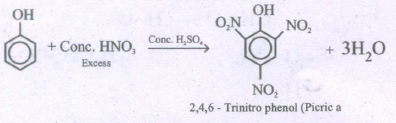
23.
(i) .JPG)
n-Nitro benzoate (Major Product)
(ii) .JPG)
24.
Metals having higher oxidation potential will liberate H2 from H2SO4. Hence, the metal M1 having +xV, oxidation potential will liberate H2 from H2SO4.
25.
Gallium.
26.
(i) 3SiCl4 + 4 Al ⟶ 4 AICl3 + 3 Si
(ii) n(CH3)2Si(OH)2
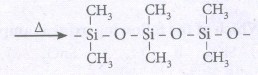
(iii) \(SiC{ l }_{ 4 }+4{ H }_{ 2 }O\longrightarrow \underset { orthosilicic \ acid }{ { H }_{ 4 }Si{ O }_{ 4 } } +4HCl\)
H4SiO4 \(\overset { \triangle }{ \longrightarrow } \) SiO2 + 2H2O
SiO2 + Na2CO3 ⟶ Na2SiO3 + H2O.
27.
The name alum is given to the double salt of potassium aluminium sulphate.
[K2SO4.Al2(SO4)3.24H2O]
28.
(i) Silicon of is refined by Zone refining method.
(ii) It is based on the principle that melting point of a substance is lowered by the presence of impurities
(iii) Consequently when an impure molten metal is cooled, crystals of the pure metal are solidified and the impurities remain behind the remaining metal.
29.
(i) Graphite rods act a anode during electrolytic reduction of alumina.
(ii) At anode, O2 gas is produced which react with the carbon of anode (rods) to produce CO2 gas.
(iii) So these graphite rods are consumed slowly and need to be replaced from time to time.
30.
Arrhenius equation is,
\(k=Ae^\left ({ \frac { -Ea }{ RT } } \right )\)
Here,
A \(\rightarrow\) Frequency factor
Ea \(\rightarrow\) Activation energy of the reaction
R \(\rightarrow\) Gas constant
T \(\rightarrow\) Absolute temperature (in K)
31.
(i) Transition metals have number of unpaired electron. They are involved in metallic bonding. Hence they show high melting point.
(ii) As we move from left to right along the transition metal series melting point first increases reach a maximum value and then decreases as the d-electrons pair up and become less available for bonding.
32.
(i) When excess of liquid ammonia is added to an aqueous solution of copper sulphate gives tetra ammine copper (II) sulphate is formed.
CUso4 + 4NH3 \(\rightarrow\) [Cu(NH3)4]SO4
(ii) The co-ordination entity is [Cu(NH3)4]2+
33.
| Ligand | Type of Ligand | Number of donor atoms |
| NH3 | monodentate ligand | 1 |
| en | bidentate ligand | 2 |
| ox2- | bidentate ligand | 2 |
| pyridine | monodentate ligand | 1 |
34.
a) BrF5
.JPG)
Valence electron of bromine atom 7+ Number of fluorine atom (5) = 12
\(X=\frac{12}{2}=6\)
Hybridization: sp3d2 ;
Geometry: Square Pyramidal
b) BrF3
.JPG)
Valence electron of bromine atom 7+ Number of fluorine atom (3) = 10
X = \(\frac{10}{2}=5\)
Hybridization: sp3d2;
Geometry: Triangular bipyramidal (T - shaped)
35.
Number of X type atoms in the unit cell \(=8 \times \frac{1}{8}=1\)
Number of Y type atoms in the unit cell \(=1 \times \frac{1}{1}=1\)
Hence the formula is XY (or) X1Y1
36.
(i) The Chalcogens belong to group (16).
(ii) The group consists of elements: Oxygen, Sulphur, Selenium, Tellurium and Polonium.
(iii) These are ore forming elements as most of the ores are oxides and sulphides.
(iv) Chalcos meaning 'ore formers'.
37.
38.
(i) Concentration of the ore
(ii) Extraction of crude metal
(iii) Refining of crude metal
39.
(i) Compound A giving violet colour with neutral ferric chloride is phenol (C6H5OH).
(ii) (B) and (C) isomers are formed when alkaline solution of (A) is refluxed with CCI4.

(iii) (A) when treated with C6H5N2CI, forms a red orange dye (D).

| Compound | Compound Name | Formula |
| A | Phenol | C6H5OH |
| B | o-Hydroxy benzoic acid | 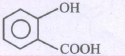 |
| C | p-Hydroxy benzoic acid | 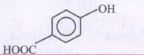 |
| D | p-Hydroxy azo benzene | 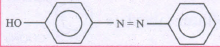 |
40.
(i) Compound (A) with molecular formula C6H6O gives violet colour with neutral FeCI3.
(ii) (A) reacts with CHCl3 and NaOH gives two isomers (B) and (C) with molecular formula C7H6O2.
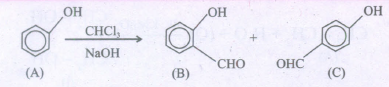
(iii) Compound (A) reacts with ammonia at 473 K in the presence of ZnCl2 gives compound (D) with molecular formula C6H7N.
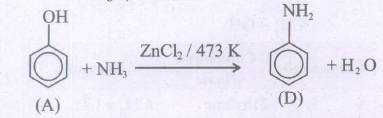
(iv) Compound (D) undergoes carbylamine test.
\(\underset { (D) }{ { C }_{ 6 }{ H }_{ 5 }{ NH }_{ 2 } } +CHCl_{ 3 }+3KOH\overset { \triangle }{ \longrightarrow } { C }_{ 6 }{ H }_{ 5 }NC+3KCl+3{ H }_{ 2 }O\)
| Compound | Compound Name | Formula |
| A | Phenol | C6H5OH |
| B | Orthohydroxy benzaldehyde | 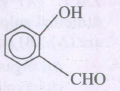 |
| C | Para hydroxy benzaldehyde | 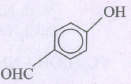 |
| D | Aniline | C6H5NH2 |
41.
(i) When alkaline solution of (A) is refluxed with chloroform.isomers (B) and (C) are obtained
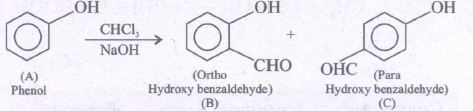
(ii) (B) on oxidation gives acid (D),
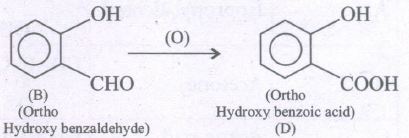
(iii) The acid (D) is also obtained by treating sodium salt of (A) with CO2 under pressure followed by hydrolysis.
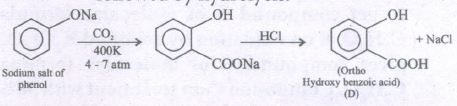
| Compound | Compound Name | Formula |
| A | Phenol | C6H5OH |
| B | Ortho hydroxy benzaldehyde | 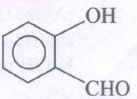 |
| C | Para hydroxy benzaldehyde | 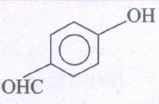 |
| D | Ortha hydroxybenzoic acid | 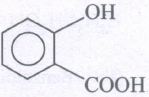 |
42.
Arrhenius suggested that the rates of most reactions vary with temperature in such a way that the rate constant is directly proportional to \({ e }^{ -\left( \frac { { E }_{ a } }{ RT } \right) }\) and he proposed a relation between the rate constant and temperature.
\(k=A{ e }^{ -\left( \frac { { E }_{ a } }{ RT } \right) }\) ....(1)
Where A the frequency factor,
R the gas constant,
Ea the activation energy of the reaction and,
T the absolute temperature (in K)
(ii) The frequency factor (A) is related to the frequency of collisions (number of collisions per second) between the reactant molecules. The factor A does not vary significantly with temperature and hence it may be taken as a constant.
(iii) Ea is the activation energy of the reaction, which Arrhenius considered as the minimum energy that a molecule must have to posses to react.
(iv) Taking logarithm on both side of the equation (1)
In k = In A + In \({ e }^{ -\left( \frac { { E }_{ a } }{ RT } \right) }\)
In k = In A -\(\left( \frac { { E }_{ a } }{ RT } \right) \) (∴ In e = 1)
In k = In A - \({ \left( \frac { { E }_{ a } }{ R } \right) }\) \(\left( \frac { 1 }{ T } \right) \)....(2)
y = c = m x
The above equation is of the form of a straight line y = mx+c
(v) A plot of In k Vs \(\left( \frac { 1 }{ T } \right) \) gives a straight line with a negative slope -\(\frac { { E }_{ a } }{ R } \) If the rate constant for a reaction at two different temperatures is known, we can calculate the activation energy as follows.
At temperature T = T1; the rate constant k = k1
In k1 = In A - \(^{ \left( \frac { { E }_{ a } }{ { RT }_{ 1 } } \right) }\) ....(3)
At temperature T = T2; the rate constant k = k2
In k2 = In A - \(\left( \frac { { E }_{ a } }{ { RT }_{ 2 } } \right) \) ......(4)
(4) - (3)
In k2 - In k1 = - \(\left( \frac { { E }_{ a } }{ { RT }_{ 2 } } \right) \) + \(^{ \left( \frac { { E }_{ a } }{ { RT }_{ 1 } } \right) }\)
In \(\left( \frac { { k }_{ 2 } }{ { k }_{ 1 } } \right) \) = \(\frac { { E }_{ a } }{ R } \) \(\left( \frac { 1 }{ T_{ 1 } } -\frac { 1 }{ { T }_{ 2 } } \right) \)
2.303 log \(\left( \frac { { k }_{ 2 } }{ { k }_{ 1 } } \right) \)= \(\frac { { E }_{ a } }{ R } \) \(\left( \frac { { T }_{ 2 }-{ T }_{ 1 } }{ { T }_{ 1 }{ T }_{ 2 } } \right) \)
log \(\left( \frac { { k }_{ 2 } }{ { k }_{ 1 } } \right) \) = \(\frac { { E }_{ a } }{ 2.303R } \) \(\left( \frac { { T }_{ 2 }-{ T }_{ 1 } }{ { T }_{ 1 }{ T }_{ 2 } } \right) \)
In k2 - k1 = - \(\left( \frac { { E }_{ a } }{ R{ T }_{ 2 } } \right) \) + \(\left( \frac { { E }_{ a } }{ R{ T }_{ 1 } } \right) \)
This equation can be used to calculate Ea from rate constants k1 and k2 at temperatures T1 and T2.
43.
Reaction with metals:
(i) Sulphuric acid reacts with metals and gives different product depending on the reactants and reacting condition
(ii) Dilute sulphuric acid reacts with metals like: tin, aluminium, zinc to give corresponding: sulphates.
Zn + H2SO4\(\longrightarrow \) ZnSO4 + H2 \(\uparrow \)
2AI + 3H2SO4 \(\longrightarrow \) Al2(SO4)3+ 3H2 \(\uparrow \)
(iii) Hot concentrated sulphuric acid reacts with copper and lead to give the respective sulphates as shown below
Cu + 2H2SO4 \(\longrightarrow \) CuSO4 + 2H2O + SO2\(\uparrow \)
Pb + 2H2SO4 \(\longrightarrow \) PbSO4 + 2H2O + SO2\(\uparrow \)
(iv) Sulphuric acid doesn't react with noble metals like gold, silver and platinum.
44.
Silicates are classified into various types based on the way in which the tetrahedral units, [SiO4]4- are linked together.
(i) Ortho silicates (Neso silicates):
The simplest silicates which contain discrete [SiO4]4- tetrahedral units are called ortho silicates or nesosilicates.
Examples: Phenacite - Be2SiO4 (Be2+ ions are tetrahedrally surrounded by O2- ions)
(ii) pyro silicate (or) Soro silicates: Silicates:
Which contain [Si2O7]6- ions are called pyro silicates (or) Soro silicates.
Example: Thortveitite - Sc2Si2O7
(iii) Cyclic silicates (or Ring silicates):
Silicates which contain (SiO3)32n- ions which are formed by linking three or more tetrahedral SiO44- units cyclically are called cyclic silicates.
Example: Beryl [Be3Al2 (SiO3)6] (an aluminosilicate with each aluminium is surrounded by 6 oxygen atoms octahedrally)
(iv) Inosilicates: Silicates which contain 'n':
number of silicate units liked by sharing two or more oxygen atoms are called inosilicates.
Example: They are further classified as chain silicates and double chain silicates.
(v) Chain silicates (or pyroxenes):
These silicates contain [(SiO3)n]2n- ions formed: by linking 'n' number of tetrahedral [SiO4]4- units linearly. Each silicate unit shares two of its oxygen atoms with other units.
Example: Spodumene - LiAl(SiO3)2·
(vi) Double chain silicates (or amphiboles):
These silicates contains \(\left[ { Si }_{ 4 }{ O }_{ 11 } \right] _{ n }^{ 6n- }\) ions. In these silicates there are two different types of tetrahedra:
(a) Those sharing 3 vertices
(b) those sharing only 2 vertices.
Example:
Asbestos: These are fibrous and non-combustible silicates.
(vii) Sheet or phyllo silicates:
Silicates which contain \(({ Si }_{ 2 }{ O }_{ 5 })_{ n }^{ 2n- }\) are called sheet or phyllo silicates. In these, Each [SiO4]4- tetrahedron unit shares three oxygen atoms with others and thus by forming two dimensional sheets.
Example: Talc, Mica etc.
(viii) Three dimensional silicates (or tectosilicates):
Silicates in which all the oxygen atoms of [SiO4]4- tetrahedra are shared with other tetrahedra to form three dimensional network are called three dimensional or tectosilicates.
Example: Quartz.
45.
(i) Alumina is separated from silica in a bauxite ore through Baeyer's process, in which bauxite ore is concentrated by the method of leaching or chemical separation.
(ii) Chemical method is employed in case where the ore is to be in a very pure form, e.g., aluminium extraction. Bauxite (Al2O3), an ore of aluminium, contains SiO2 and Fe2O3 as impurities. When bauxite ore is treated with NaOH, the Al2O3 goes into solution as sodium meta aluminate leaving behind the undissolved impurities [Fe2O3, SiO2, Fe(OH)3' etc.], which are then filtered off.
\({ Al }_{ 2 }{ O }_{ 3 }+{ 2NaOH }\longrightarrow \underset { Sod.meta.aliminate\\ (In \ solution \ form) }{ { 2NaAlO }_{ 2 }+{ H }_{ 2 }O } \)
(iii) The filtrate (containing sodium meta aluminate) on dilution, and stirring gives a precipitate of aluminium hydroxide, which is filtered, and ignited to get pure alumina.
\({ NaAlO }_{ 2 }+2{ H }_{ 2 }O\longrightarrow \underset { Ppt }{ { Al(OH) }_{ 3 } } +NaOH\)
\(2Al\left( OH \right) _{ 3 }\overset { \Delta }{ \longrightarrow } \underset { Pure }{ { Al }_{ 2 }{ O }_{ 3 } } +3{ H }_{ 2 }O\)
46.
Volume of KMnO4 used is proportional to the amount of H2O2 present. If the reaction is of first order, it must obey the equation.
\(k=\frac { 2.303 }{ t } log\frac { \left[ { A } \right] _{ 0 }}{ \left[ A \right] } \)
(or) \(k=\left( \frac { 2.303 }{ t } \right) log\left( \frac { { V }_{ 0 } }{ { V }_{ 1 } } \right) \)
(i) \( \mathrm{V}_{\mathrm{o}}=46.1 \mathrm{~mL} ; \mathrm{t}=10 \mathrm{mins} ; \mathrm{V}_{\mathrm{t}}=29.8 \mathrm{~mL}\)
\(k =\frac{2.303}{10} \log \left(\frac{46.1}{29.8}\right) \)
\(=0.2303 \log 1.5469 \)
\(=0.2303 \times 0.1894=0.0436 \mathrm{~min}^{-1}\)
\(\mathrm{t}=20 \mathrm{mins} ; \mathrm{V}_{\mathrm{t}}=19.3 ; \mathrm{V}_{\mathrm{o}}=46.1 \mathrm{~mL} \)
\(k =\frac{2.303}{20} \log \left(\frac{46.1}{19.3}\right) \)
\(=0.11515 \times \log 2.388 \)
\(=0.11515 \times 0.3780 \)
\(=0.0435 \mathrm{~min}^{-1}\)
Since the value of k comes out to be almost constant for the reaction, it is of first order. The mean value of k = 0.04355 min-1
47.
a) i) Ellingham diagram for the formation of Al2O3 and MgO intersects around 1500oC. Above this temp Mg lies above the Aluminium line. Hence only above 1500oC Aluminium might be excepted to reduce magnesia.
ii) Ellingham diagram for the formation of MgO lies below the formation of Al2O3. Hence MgO is more stable than Al2O3. Hence Magnesium could reduce Alumina.
1. Below 983K, formation of CO line lies below many of the metal oxide formation in Ellingham diagram, hence CO is more effective reducing agent than Carbon.
2. But above this temperature Carbon lies below other metal oxides.
b) Around 1200K Carbon lies below the formation of Fe2O3. Hence it is possible to reduce Fe2O3 by coke at 1200K.
48.
(i) Using a colloid mill, the solid is ground to colloidal dimension.
(ii) The colloid mill consists of two metal plates rotating in opposite direction at very high speed of nearly 7000 revolution I minute.
(iii) The colloidal particles of required colloidal size is obtained by adjusting the distance between two plates.
(iv) By this method, colloidal solutions of ink and graphite are prepared.
49.
(i) Covalent Solids: Silicon carbide, graphite.
(ii) Molecular Solids: Urea, benzene, ammonia, water and argon.
(iii) Ionic Solids: Zinc sulphide, potassium sulphate.
(iv) Metallic solids: Rubidium and tin.
50.
(i) CO being a good reducing agent, reduces several metal oxides into crude metal. Hence it is used in extraction of metals.
(ii) CO forms carboxy-hemoglobin complex with hemoglobin of blood which is about 300 times mores stable than oxygen - hemoglobin complex and thus it stops the supply of oxygen and hence, leads to death of the person.
(iii) Solid CO2, produce cooling and sublimes directly into vapour state, hence used for refrigeration.
51.
\(k=\frac { 2.303 }{ t } \log\frac { \left( { V }_{ \infty }-{ V }_{ 0 } \right) }{ \left( { V }_{ \infty }-{ V }_{ 0 } \right) } \)
\(k=\frac { 2.303 }{ 20 } \log\frac { 50.4-20.2 }{ 50.4-25.6 } \)
\(=0.1151 \log\frac { 30.2 }{ 24.8 } \)
= 0.1151 log 1.2479
= 0.1151 x 0.0959
= 11.03 x10⁻³ min-1
When t = 40 mts
\(k=\frac { 2.303 }{ 40 } \log\frac { 50.4-20.2 }{ 50.4-25.6 } \)
\(=0.0576\times \log\frac { 30.2 }{ 20.9 } \)
= 9.19 x 10⁻³ min-1
When t = 60 mts
\(k=\frac { 2.303 }{ 60 } \log\frac { 50.4-20.2 }{ 50.4-25.6 } \)
\(=0.03838\times \log\frac { 30.2 }{ 17.6 } \)
= 0.03838 x 0.2343
= 8.99 x 10⁻³ min-1
The constant values of K show that the reaction is of first order.
52.
| S.No | Lanthanoids | Actinoids |
|---|---|---|
| 1. | Differentiating electron enters in 4f orbital | Differentiating electron enters in 5f orbital |
| 2. | Binding energy of 4f orbitals are higher | Binding energy of 5f orbitals are lower |
| 3. | They show less tendency to form complexes | They show greater tendency to form complexes |
| 4. | Most of the lanthanoids are colourless | Most of the actinoids are coloured For Example: U3+ (red) U4+ (green). |
| 5. | They do not form oxo cations | They do form oxo cations such as UO22+, NpO22++ etc. |
| 6. | Besides +3 oxidation states lanthanoids show +2 and +4 oxidation states in few cases | Besides +3 oxidation states actinoids show higher oxidation states such as +4, +5, +6 and +7 |
53.
(i) In transition series, as we move down from Ti to Zn, the standard reduction potential E0M2+/M3 value is approaching towards less negative value and copper has a positive reduction potential, i. e. elemental copper is more stable than Cu2+.
(ii) E0M2+/M value for manganese and zinc are more negative than regular trend. It is due to extra stability arises due to the half filled d5 configuration in Mn2+ and completely filled d10 configuration in Zn2+.
(iii) The standard electrode potential for the M3+/M2+ half cell gives the relative stability between M3+ and M2+.
(iv) The high reduction potential of Mn3+/Mn2+ indicates Mn2+ is more stable than Mn3+.
(v) Mn3+ has a 3d4 configuration while that of Mn2+ is 3d5. The extra stability associated with a half filled d sub-shell makes the reduction of Mn3+ very feasible \(\left[\mathrm{E}^{\circ}=+1.51 \mathrm{~V}\right]\).
54.
IUPAC defines transition metal as an element whose atom has an incomplete d-sub shell or which can give rise to cations with an incomplete d-sub shell. They occupy the central position of the periodic table, between s and p-block elements.
Examples: Fe, Cu, Ag, Au
55.
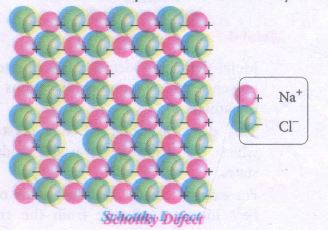
(i) Schottky defect arises due to the missing of equal number of cations and anions from the crystal lattice. This effect does not change the stoichiometry of the crystal.
(ii) Ionic solids in which the cation and anion are of almost of similar size show schottky defect.
Example: NaCl.
(iii) Presence of large number of schottky defects in a crystal, lowers its density.
(iv) Presence of Schottky defect in the crystal provides a simple way by which atoms or ions can move within the crystal lattice.
56.
(i) Its small size
(ii) Its high electronegativity
(iii) Its high ionisation energy
(iv) Non-availability of d-orbital in the valence shell.
(v) Rather inert
(vi) High bond energy
57.
(i) Sulphuric acid is used in the manufacture of fertilisers, ammonium sulphate and super phosphates and other chemicals such as HCl, HNO3.
(ii) It is used as a drying agent and also used in the preparation of pigments, explosives etc.
58.
Generally on descending a group the ionisation energy decreases and hence the metallic character increases.
59.
1. Reduction of oxides of active metals such as sodium, potassium etc., by carbon is thermodynamically not feasible.
2. Such metals are extracted from their ores by using electrochemical methods.
3. In this technique, the metal salts are taken in a fused form or in solution form.
4. The metal ion present can be reduced by some suitable reducing agent or by electrolysis.
5. Gibbs free energy for the electrolysis process is given by
Here,
\(\Delta\)Go = -nFEo
\(\Delta\)Go - Standard Gibb's free energy change
n - number of electrons involved,
F - Faraday,
Eo - Standard electrode potential
6. If Eo is positive then the \(\Delta\)Go is negative and the reduction is spontaneous
7. Hence a redox reaction is planned in such a way that the e.m.f of the net redox reaction is positive.
8. When a more reactive metal is added to less reactive metal salt solution, the more reactive metal will go into the solution.
Example:
\({ Cu }_{ (s) }+2{ Ag }^{ + }_{ (aq) }\longrightarrow { Cu }^{ 2+ }_{ (aq) }+2{ Ag }_{ (s) }\)
\({ Cu }^{ 2+ }_{ (aq) }+{ Zn }_{ (s) }\longrightarrow { Cu }_{ \left( s \right) } +{ Zn }^{ 2+ }_{ (aq) }\)

12th Standard Syllabus & Materials
12th Standard
TN 12th Computer Applications களப்பெயர் முறைமை (DNS) Sample Question Papers Study Material - QB365 Set A
NEW12th Standard
TN 12th Computer Applications வலையமைப்பு எடுத்துக்காட்டுகள் மற்றும் நெறிமுறைகள் Sample Question Papers Study Material - QB365 Set A
NEW12th Standard
TN 12th Computer Applications கணினி வலையமைப்பு ஓர் அறிமுகம் Sample Question Papers Study Material - QB365 Set A
NEW12th Standard
TN 12th Computer Applications PHP-உடன் MySQL-ஐ இணைத்தல் Sample Question Papers Study Material - QB365 Set A



Tamilnadu Stateboard 12th Standard Subjects

Maths
Chemistry

Physics

Biology

Computer Science

Business Maths and Statistics

Economics

Commerce

Accountancy

History

Computer Applications
Biology
Computer Technology
Computer Applications
Computer Science
Business Maths and Statistics
Commerce
Economics
Maths
Chemistry
Physics
Computer Technology
History
Accountancy

Tamil

English

French
Tamilnadu Stateboard Standards
