
 100% FREE ACCESS
12th Standard Syllabus & Materials
12th Standard
TN 12th Computer Applications மின்னணு தரவு பரிமாற்றம் Sample Question Papers Study Material - QB365 Set A
NEW12th Standard
TN 12th Computer Applications மின் - வணிக பாதுகாப்பு அமைப்புகள் Sample Question Papers Study Material - QB365 Set A
NEW12th Standard
TN 12th Computer Applications மின்னணு செலுத்தல் முறைகள் Sample Question Papers Study Material - QB365 Set A
NEW12th Standard
TN 12th Computer Applications மின் - வணிகம் Sample Question Papers Study Material - QB365 Set A
NEW12th Standard
TN 12th Computer Applications திறந்த மூல கருத்துருக்கள் Sample Question Papers Study Material - QB365 Set A
NEW12th Standard
TN 12th Computer Applications வலையமைப்பு வடமிடல் Sample Question Papers Study Material - QB365 Set A

Published on: 27/01/2021
12th Standard Chemistry English Medium Reduced Syllabus Important Questions - 2021 Part - 2
Download Tamil Nadu 12th Standard Chemistry question papers, model tests, one-mark questions, important questions, and public exam papers in PDF format. Free study materials and answer keys for TN State Board students.
Questions + Answers key
Take MCQ Chemistry Test
1.
Lower halogenated ethers can be converted into higher ethers by using _______ reagent.
Grignard
Tollen's
Fehling's
none of the above
2.
Henderson equation for a weak acid and its salt is _______.
pH = pKb+ log (Salt) / (Acid)
pH = pKa + log (Salt) / (Acid)
pH = pKa + log (Salt) / (Base)
pH = pKa + log (Acid) / (Salt)
3.
Ostwald's dilution law is applicable in the case of the solution of _______.
CH3COOH
NaCI
NaOH
H2SO4
4.
The impurity present in the colloidal particle is _______.
electrolytes
solute
both (a) and (b)
neither (a) or (b)
5.
Schottky defects contains _______.
Cation vacancies only
Cation vacancies and interstitial cations
Equal number of cation and anion vacancies
Anion vacancies and interstitial anions
6.
The general electronic configuration of d-block elements can be written as ________.
[Noble gas]n - 1d1-10 ns1-2
[Noble gas]n - 1d-10 n1-6
[Noble gas]n - 2 d10 ns1-2
[Noble gas]n - 2 d10 ns1-6
7.
Werner's theory was not able to explain_______ of coordination compounds.
colour
magnetic properties
both (a) and (b)
neither (a) nor (b)
8.
The type of isomerism found in the complexes [Co(NO2)(NH3)5]SO4 and [Co(SO4)(NH3)5] NO2 _______.
Hydrate isomerism
Coordination isomerism
Linkage isomerism
Ionisation
9.
Which among the following square planar complexes will exhibet geometrical isomerism?
[Ma2B2]n±
[MA2BC] n±
[M(xy)] n±
all the above
10.
Schottky defect in a crystal is observed when ______.
unequal number of anions and anions are missing from the lattice
Equal number of cations and anions are missing from the lattice
an ion leaves its normal site and occupies an interstitial site
no ion is missing from its lattice
11.
Choose the correct statement.
Square planar complexes are more stable than octahedral complexes
The spin only magnetic moment of [Cu(Cl)4]2- is BM and it has square planar structure.
Crystal field splitting energy \(\left( { \Delta }_{ 0 } \right) \) [FeF6]4- is higher than the \((\Delta _{ 0 })\) of [Fe(CN)6]4-
crystal field stabilization energy of [V(H2O)6]2+ is higher than the crystal field stabilization of [Ti(H2O)6]2+
12.
The most common oxidation state of actinoids is _______.
+2
+3
+4
+6
13.
Which of the following d block element has half filled penultimate d sub shell as well as half filled valence sub shell?
Cr
Pd
Pt
none of these
14.
Which one of the following orders is correct for the bond dissociation enthalpy of halogen molecules?
Br2 > I2 > F2 > Cl2
F2 > Cl2 > Br2 > l2
I2 > Br2 > Cl2 > F2
Cl2 > Br2 > F2 > I2
15.
The element that does not show catenation among the following p-block elements is ________.
Carbon
silicon
Lead
germanium
16.
\({ CH }_{ 3 }{ NO }_{ 2 }\underrightarrow { { Sn }_{ 2 }/HCl } A\xrightarrow [ CalcoholicKOH ]{ { CH }Cl_{ 3 } } B\underrightarrow { { H }_{ 2 }/P } \) Identify A,B and C.
17.
Write the Nernst equation.
18.
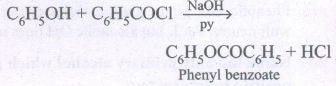
Explain Schotten - Baumann reaction.
19.
Write the tests to differentrate phenol and alcohol.
20.
Explain why phenol does not undergo substitution of the -OH group like alcohol.
21.
What are the limitations of Ostwald's dilution law?
22.
(i) Give correct order of boiling point of hydride of group 17.
(ii) Fluorine exhibits only -1 oxidation state whereas other halogens show +1, +3, +5 and +7 oxidation state also Explain.
23.
Name the building block of zeolites. Why zeolites have high porosity?
24.
Name some elements that occur as native elements.
25.
Give an example for the complexes possessing co-ordination number 8 and 7
26.
Give the names of two complexes which are used in medicines.
27.
Why tetrahedral complexes do not exhibit geometrical isomerism.
28.
Ni2+ is identified using alcoholic solution of dimethyl glyoxime. Write the structural formula for the rosy red precipitate of a complex formed in the reaction.
29.
Suggest a reason why HF is a weak acid, whereas binary acids of the all other halogens are strong acids.
30.
Give the oxidation state of halogen in the following.
a) OF2
b) O2F2
c) Cl2O3
d) I2O4
31.
How are the following compounds obtained from benzene diazonium chloride?
(i) phenol
(ii) ester
(iii) p-hydroxy azo benzene
32.
How will you prepare phenol (i) From chloro benzene (ii) From benzene sulphonic acid?
33.
Account for the following:
(a) Lower members of alcohols are soluble in water but higher members are not.
(b) Alcohols cannot be used as solvent for Grignard reagent.
34.
Write the Nernst equation for the half cell Zn2+(aq)/ Zn(s)
35.
What is Henderson equation?
36.
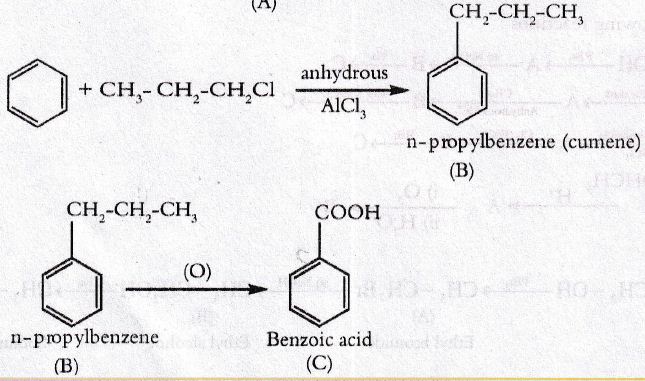
Phenol is distilled with Zn dust followed by friedel – crafts alkylation with prophyl chloride to give a compound B, B on oxidation gives (c) Indentify A,B and C.
37.
How is phenol prepared from
i) chloro benzene
ii) isopropyl benzene
38.
Can we use nucelophiles such as NH3,CH3O - for the Nucleophilic substitution of alcohols
39.
Which is the last element in the series of the actinoids? Write the electronic configuration of this element comment on the possible oxidation state of this element.
40.
Do transition elements form complex co-ordinate compounds?
41.
What are the general properties of f-block elements? (Lanthanides and Actinides)
(i) Electronic configuration
(ii) Oxidation state
(iii) Radii of tripositive ions.
42.
An element A occupies group number 17 and period number 2 is the most electronegative element. Element A reacts with another element B) which occupies group number 17 and period number 4 to give a compound Compound C undergoes sp3d2 hybridisation and has octahedral structure. Identify the elements a and B and the compound C. Write the reactions.
43.
Explain the commercial method of preparation of nitric acid.
44.
Write the complete set of reactions occurring in the zone of reduction in the blast furnace in the metallurgy of iron.
45.
Describe the variable oxidation state of 3d series elements.
46.
Write a note on metallic nature of p-block elements.
47.
An organic compound A (C7H6O) forms a bisulphite. A when treated with alcoholic KCN forms B (C14H12O2) and A on refluxing with sodium acetate and acetic anhydride forms an add C (C9HsO2). Identify A, B and C. Explain the conversion of A to B and C.
48.
An organic compound 'A' is a sodium salt of phenolic acid with molecular formula C7H5O3Na. 'A' on heating with soda lime gives compound 'B' of molecular formula C6H6O. 'B' gives violet colour with neutral ferric chloride. 'B' on treatment with C6H5COCI in the presence of NaOH gives an ester 'C'. Identify 'A', 'B' and 'C'. Explain the reactions.
49.
How would you distinguish between (i) methyl alcohol and ethyl alcohol (ii) benzyl alcohol and phenol, (iii) ethyl alcohol and benzyl alcohol?
50.
Draw a flow chart to show classification of nitro compound giving examples for each type.
51.
Derive Henderson - Hasselbalch equation
52.
53.
Write short notes on the following
i. Hofmann’s bromide reaction
ii. Ammonolysis
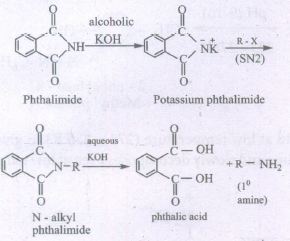
iii. Gabriel phthalimide synthesis
iv. Schotten – Baumann reaction
v. Carbylamine reaction
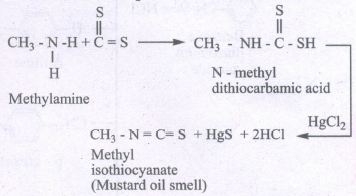
vi. Mustard oil reaction
vii. Coupling reaction
viii. Diazotisation
ix. Gomberg reaction
54.
Derive an expression for Ostwald’s dilution law.
55.
Justify the following statement.
"Elements of the first transition series possess many properties different from those of heavier transition elements".
56.
57.
Write note on impurity defect?
58.
What is meant by stability of a co-ordination compound in solution? State the factors which govern stability of complexes.
59.
Give the postulates and limitation of Werner's theory of co-ordination compounds.
60.
Write the postulates of Werner’s theory.
1.
(a)
Grignard
2.
(b)
pH = pKa + log (Salt) / (Acid)
3.
(a)
CH3COOH
4.
(a)
electrolytes
5.
(c)
Equal number of cation and anion vacancies
6.
(a)
[Noble gas]n - 1d1-10 ns1-2
7.
(c)
both (a) and (b)
8.
(d)
Ionisation
9.
(d)
all the above
10.
(b)
Equal number of cations and anions are missing from the lattice
11.
(d)
crystal field stabilization energy of [V(H2O)6]2+ is higher than the crystal field stabilization of [Ti(H2O)6]2+
12.
(b)
+3
13.
Cr ⇒ [Ar]3d54s1
14.
(d)
Cl2 > Br2 > F2 > I2
15.
(c)
Lead
16.
CH3NO2 when treated with Sn2/HCl gives CH3NH2 (methyl amine). When CH3NH2 is treated with CHCl3 and alcoholic KOH, it gives methyl isocyanide (CH3NC). When CH3NC treated with H2 / Pt, it gives Dimethylamine (CH3NHCH3)
A ⇾ CH3NH2 (methyl amine)
B ⇾ CH3NC (methyl isocyanide)
C ⇾ CH3NHCH3 (Dimethylamine)
17.
\({ E }_{ cell }={ E }_{ cell }^{ o }-\frac { Rt }{ nF } In\frac { [{ C] }^{ l }[{ D] }^{ m } }{ [{ A] }^{ x }{ [B] }^{ y } } \) (or)
\({ E }_{ cell }={ E }_{ cell }^{ o }-\frac { 2.303RT }{ nF } \log\frac { [{ C] }^{ l }[{ D] }^{ m } }{ [{ A }]^{ x }[{ B }]^{ y } } \)
18.
The reaction of phenols with benzoyl chloride in presence of sodium hydroxide to form benzoates is known as Schotten-Baumann reaction.
19.
Test to differentiate alcohol and phenols:
(i) Phenol react with benzene diazonium chloride to form a red orange dye, but ethanol has no reaction with it.
(ii) Phenol gives purple colouration with neutral ferric chloride solution, alcohols do not give such coloration with FeCI3.
(iii) Phenol reacts with NaOH to give sodium phenoxide. Ethyl alcohol does not react with NaOH.
20.
In phenol the electron density is increased in the benzene ring and hence the benzene ring is activated towards electrophilic substitution reaction and -OH group does not undergo substitution reaction like alcohol.
21.
Ostwald's dilution law is applicable only for weak electrolyte and does not hold good for concentrated solution.
22.
(i) HCl < HBr < HI < HF
(ii) Fluorine being the most electronegative element cannot have positive oxidation state. Other halogens have d-orbitals, therefore can expand their octet.
23.
(i) Zeolites have a three dimensional crystalline structure looks like a honeycomb consisting of a network of interconnected tunnels and cages.
(ii) Water molecules moves freely in and out of these pores hence they are highly porous.
24.
Copper, Silver, Gold and Platinum
25.
(i) Complex with co-ordination number 8 - Cu2 [ZrF8].
(ii) Complex with co-ordination number 7 - (NH4)3[ZrF7].
26.
(i) EDTA is used in the treatment of lead poisoning
(ii) Cis-platin[Pt(NH3)2Cl2] is used in the treatment of cancer.
27.
Tetrahedral complexes do not exhibit geometrical isomerism. Because the relative position of donor atoms of ligand the unidentate Iigands (donor atom) attached to the central atom are same with respect to each other.
28.
Addition of an alcoholic solution of dimethylglyoxime to an ammoniacal solution of Ni(II) gives rose - red precipitate Ni[ONCC N OH]2 Nickel Cis (dimethylglyoximate)
29.
HF is a weak acid i.e. 0.1 M solution is only 10% ionised, but in 5M & 15M solution, HF is stronger acid due to chemical equilibrium.
\(\mathrm{HF}+\mathrm{H}_{2} \mathrm{O} \rightleftharpoons \mathrm{H}_{3} \mathrm{O}^{+}+\mathrm{F}^{-} \)
\(\mathrm{HF}+\mathrm{F}^{-} \rightleftharpoons \mathrm{HF}_{2}^{-}\)
30.
(a) OF2
+ 2 + 2(x) = 0
+2 = -2x
2 x = -2 ⇒ x = -1
(b) O2F2
2(+1) + 2x = 0
2x = -2
x = -1
(c) Cl2O3
2(x) + 3(-2) = 0
2x = +6
x = +3
(d) I2O4
2(x) + 4(-2) = 0
2x = +8
x = +4
31.
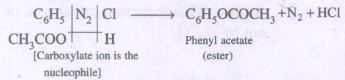
(i) Repl cementby-OH: When the aqueous solution is boiled, phenol is obtained

This is an example of SN1 reaction in which C6H5N2CI initially gives C6H5+ and water is the nudeophile.
(ii) Replacement of RO- (or) RCOO- groups Similarly -N2CI can be replaced acyloxy group by boiling with carboxylic acids.
(iii) Diazonlum coupling reaction: Diazonium salt reacts with aromatic amine and phenols to give azo compounds of the general formula.
Ar - N = N - Ar'
This reaction is known as Coupling reaction since all these compounds are intensely coloured and used as dyes, thousands of azodyes have been synthesised by this procedure.

32.
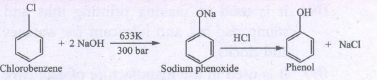
(i) From halo arenes(Dows process):
When Chlorobenzene is hydrolysed with 6-8% NaOH at 300 bar and 633K in a closed vessel, sodium phenoxide is formed which on treatment with dilute HCI gives phenol.
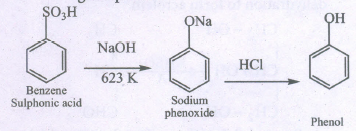
(ii) From benzene sulphonic acid:
Benzene is sulphonated with oleum and the benzene sulphonic acid so formed is heated with molten NaOH at 623K gives sodium phenoxide which on acidification gives phenol.
33.
(a) Alcohols are soluble in water because they form intermolecular hydrogen bonding with water. Lower members are completely miscible with water and the higher members are not. This is because of the increase in size of hydrophobic (water repelling) alkyl group in the alcohol.
(b) Strong basic substances like organo metallic compounds (RMgX-Grignard reagent) are decomposed by alcohol.
R - OH + CH3MgBr ⟶ R - O - Mg - Br + CH4
Hence, alcohols cannot be used as a solvent for Grignard reagent.
34.
E = EO- 2.303 \(\frac { RT }{ 2F } \) log Zn2+
EZn2+/Zn = EZn2+/ Zn- 2.303 \(\frac { RT }{ 2F } \) log [Zn2+]
35.
Henderson equation is an equation which is used to determine the pH of an acid buffer with the help of the dissociation constant Ka of the weak acid and concentration of the acid and the salt used.
\(\boxed { pH={ pK }_{ a }+\log\frac { [salt] }{ [acid] } }\)
For a basic buffer \(pH={ pK }_{ b }+\log\frac { [salt] }{ [base] } \)
36.
\(\underset {Phenol} {\mathrm{C}_{6} \mathrm{H}_{5} \mathrm{OH}}+\mathrm{Zn}(\text { dust }) \rightarrow \underset {benzene(A)} {\mathrm{C}_{6} \mathrm{H}_{6}}+\mathrm{ZnO}\)
37.
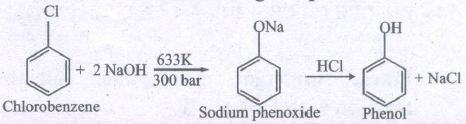
(i) Chloro benzene:
When Chlorobenzene is hydrolysed with 6-8% NaOH at 300 bar and 633K in a closed vessel, sodium phenoxide is formed which on treatment with dilute HCl gives phenol.
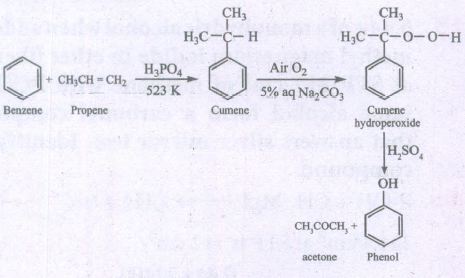
(ii) isopropyl benzene:
A mixture of benzene and propene is heated at 523K in a closed vessel in presence of H3PO4 catalyst gives cumene (isopropylbenzene). On passing air to a mixture of cumene and 5% aqueous sodium carbonate solution, cumene hydro peroxide is formed by oxidation. It is treated with dilute acid to get phenol and acetone. Acetone is also an important byproduct in this reaction.
38.
Yes, we can use nucleophiles such as NH3, CH3O- for the nucleophilic substitution of alcohol.
Example
\(\mathrm{C}_{2} \mathrm{H}_{5} \mathrm{OH}+\mathrm{NH}_{3} \rightarrow \mathrm{C}_{2} \mathrm{H}_{5} \mathrm{NH}_{2}+\mathrm{H}_{2} \mathrm{O} \)
\(\mathrm{C}_{2} \mathrm{H}_{5} \mathrm{OH}+\mathrm{CH}_{2} \mathrm{~N}_{2} \rightarrow \mathrm{C}_{2} \mathrm{H}_{5} \mathrm{OCH}_{3}+\mathrm{N}_{2}\)
39.
Lr Z = 103, is the last element of actinoid series. Its electronic configuration is [Rn]86 5f146d17S2 the possible oxidation state shown by it is +3.
40.
(i) Transition elements have a tendency to form coordination compounds with a species that has an ability to donate an electron pair to form a co-ordinate covalent bond.
(ii) Transition metal ions are small and highly charged and they have vacant low energy orbitals to accept an electron pair donated by other groups. Due to these properties, transition metals form large number of complex.
(iii) Examples: [Fe(CN)6]4-, [Co(NH3)6]3+, etc.
41.
| Properties | Lanthanides | Actinides |
|---|---|---|
| Electronic configuration | [54Xe]4f1-14 5d16s2 | [Rn] 5f0,1-14 6d0,1-27s2 |
| Oxidation state | Common: +3 Uncommon: +2, +4 |
Common: +4 Uncommon: +2, +3, +5, +6 |
| Radii | M3+gradually decrease in size on moving from La to Lu Lanthanide contraction | M3+ and M4+ ions decrease in size on moving from Ac to Lr. Actinide contraction. |
42.
(i) The element of group number 17 and period number 2 is fluorine (A).
(ii) The element of group number 17 and period number 4 is bromine (B).
(iii) (A) and (B) react to give an interhalogen compound (C) bromine pentafluoride
\(\underset { (A) }{ { Br }_{ 3 } } +\underset { (B) }{ { 5F }_{ 2 } } \longrightarrow \underset { (C) }{ { 2BrF }_{ 5 } } \)
(C) undergoes sp3d2 hybridisation and has octahedral structure
| A | F | Fluorine |
| B | Br | Bromine |
| C | BrF5 | Bromine pentafluoride |
43.
Commercial method of preparation
(i) Nitric acid prepared in large scales using Ostwald's process. In this method ammonia from Haber's process is mixed about 10 times, of air.
(ii) This mixture is preheated and passed into the catalyst chamber where they come in contact with platinum gauze.
(iii) The temperature rises to about 1275 K and the metallic gauze brings about the rapid catalytic oxidation of ammonia resulting in the formation of NO, which then oxidised to nitrogen dioxide.
\({ 4NH }_{ 3 }+{ 5O }_{ 2 }\longrightarrow 4NO+6{ H }_{ 2 }O+120KJ\)
\(2NO+{ O }_{ 2 }\longrightarrow { 2NO }_{ 2 }\)
(iv) The nitrogen dioxide produced is passed through a series of adsorption towers. It reacts with water to give nitric acid. Nitric acid formed is bleached by blowing air.
\({ 6NO }_{ 2 }+3{ H }_{ 2 }O\longrightarrow { 4HNO }_{ 3 }+2NO+{ H }_{ 2 }O\)
44.
In Ellingham diagram, the graph of \(CO\rightarrow { CO }_{ 2 }\) conversion remains below \(Fe\rightarrow { Fe }_{ 2 }{ O }_{ 3 }\) upto 1073 K
(for Fe\(\longrightarrow \) FeO). SO, CO (g) act as reducing agent upto this temperature.
\(3{ Fe }_{ 2 }{ O }_{ 3 }+CO\longrightarrow 2{ Fe }_{ 3 }{ O }_{ 4 }\) (i.e. FeO.Fe2O3) + CO2
\({ Fe }_{ 3 }{ O }_{ 4 }+CO\longrightarrow 3Feo+{ CO }_{ 2 }\)
FeO + CO \(\longrightarrow \) Fe + CO2
Also, graph of C\(\longrightarrow \) CO is below the graph of
Fe \(\longrightarrow \)Fe2O3 after 1123 K. So, carbon acts as reducing agent above this temperature.
Fe2O3 + C\(\longrightarrow \) 3 CO + 2 Fe.
45.
(i) The first transition metal Scandium exhibits only +3 oxidation state, but all other transition elements exhibit variable oxidation states by loosing electrons from (n-1)d orbital and ns orbital as the energy difference between them is very small. At the beginning of the series, +3 oxidation state is stable but towards the end +2 oxidation state becomes stable. The first and last elements show less number of oxidation states and the middle elements with more number of oxidation states
(ii) For example, the first element Sc has only one oxidation state +3; the middle element Mn has six different oxidation states from +2 to +7. The last element Cu shows +1 and +2 oxidation states only.
46.
Generally on descending a group the ionisation energy decreases and hence the metallic character increases.
47.
(i) An organic compound (A) with formula C7H6O form bisulphite means it must be benzaldehyde C6H5CHO.
(ii) Benzaldehyde on treatment with KCN form benzoin.
\(\underset { (A) }{ { C }_{ 6 }{ H }_{ 5 }CHO+{ C }_{ 6 }{ H }_{ 5 }CHO } \overset { KCN }{ \longrightarrow } \underset { (B) }{ { C }_{ 6 }{ H }_{ 5 }-\underset { \overset { | }{ HO } }{ CH } -\underset { \overset { || }{ O } }{ C } -{ C }_{ 6 }{ H }_{ 5 } } \)
(iii) Benzaldehyde on treatment with sodium acetate and acetic anhydride form an acid, cinnamic acid it is (C).
\(\underset { (A) }{ { C }_{ 6 }{ H }_{ 5 }CHO } +\left( { CH }_{ 3 }{ CO } \right) O\overset { { CH }_{ 3 }COONa }{ \longrightarrow } \underset { (C) }{ { C }_{ 6 }{ H }_{ 5 }CH } =CH-COOH+CH_{ 3 }COOH\)
| Compound | Compound Name | Formula |
| A | Benzaldehyde | C6HsCHO |
| B | Benzoin | C6H5-CH-OHCO-C6H5 |
| C | Cinnamic acid | C6HsCH=CHCOOH |
48.
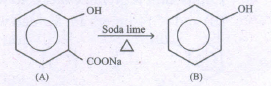
(i) The organic compound (A) which is sodium salt of phenolic acid is sodium salicylate.
(ii) (A) on heating with soda lime gives Compound (B) phenol. Phenol gives violet colouration with neutral perchloride.
(iii) Phenol on treatment with C6H5COCl in the presence of NaOH gives on ester 'C':
C6H5OH + C6H5COCl \(\overset { NaOH }{ \longrightarrow } \underset { (C) }{ { C }_{ 6 }{ H }_{ 5 }OCO{ C }_{ 6 }{ H }_{ 5 }+HCl } \)
| Compound | Compound Name | Formula |
| A | Sodium benzoate' | 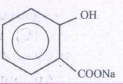 |
| B | Phenol | C6H5OH |
| C | Phenyl benzoate | C6H5OCO C6H5 |
49.
(i) Methyl alcohol and Ethyl alcohol
| S.No | Methyl alcohol | Ethyl alcohol |
| 1. | It does not react with cone. H2SO4 at any temperature. | It reacts with cone. H2SO4 at 410K, to produces diethyl ether and at 440K it produces ethylene products. |
| 2. | It does not react with I2 + NaOH to form iodoform. | It reacts with I2 + NaOH to produce iodoform CHI3. |
(ii) Benzyl alcohol and phenol
| S.No | Benzyl alcohol | Phenol |
| 1. | It does not give violet colour with neutral ferric chloride. |
It gives-violet colour with neutral ferric chloride |
| 2. | It does not decolourise bromin water. | It decolourise bromine water and produce 2,4,6- tribromo phenol. |
(iii) Ethyl alcohol and benzyl alcohol
| S.No | Ethyl alcohol | Benzyl alcohol |
| 1. | It reacts with I2 + NaOH to give iodoform | It does not react with I2 + NaOH |
| 2. | It does not undergo electrophilic substitution | It undergoes electrophilic substitution reactions at ortho and para positions. |
50.
Classification of nitro compounds
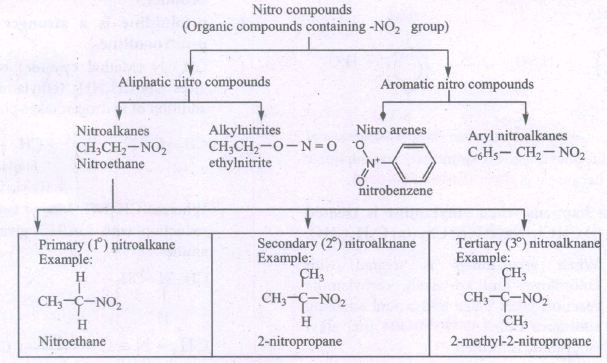
51.
(i) The concentration of hydronium ion in an acidic buffer solution depends on the ratio of the concentration of the weak acid to the concentration of its conjugate base present in the solution i.e.,
\(\left[ { H }_{ 3 }{ O }^{ + } \right] ={ K }_{ a }\frac { [{ acid] }_{ aq } }{ [{ base] }_{ aq } } \)
(ii) The weak acid is dissociated only to a small extent. Moreover, due to common ion effect, the dissociation is further suppressed and hence the equilibrium concentration of the acid is nearly equal to the initial concentration of the unionised acid. Similarly, the concentration of the conjugate base is nearly equal to the initial concentration of the added salt.
\(\left[ { H }_{ 3 }{ O }^{ + } \right] ={ K }_{ a }\frac { [{ acid] } }{ [{ salt] } } \)
(iii) Here [acid] and [salt] represent the initial concentration of the acid and salt, respectively used to prepare the buffer solution
Taking logarithm on both sides of the equation
\(\log\left[ { H }_{ 3 }{ O }^{ + } \right] ={ \log K }_{ a }+\log\frac { [{ acid] } }{ [{ salt] } } \)
reverse the sign on both sides
- \(\log\left[ { H }_{ 3 }{ O }^{ + } \right] ={- \log K }_{ a }-\log\frac { [{ acid] } }{ [{ salt] } } \)
We know that
pH = -log [H3O+] and pKa = -log Ka
\(\Rightarrow pH={ pK }_{ a }-\log\frac { [{ acid] } }{ [{ salt] } } \)
\(\Rightarrow pH={ pK }_{ a }+\log\frac { [{ acid] } }{ [{ salt] } } \)
Similarly for a basic buffer,
pOH = \({ pK }_{ a }+\log\frac { [{ acid] } }{ [{ salt] } } \)
52.
53.
Hoffmann's bromide reaction:
When Amides are treated with bromine in the presence of aqueous or ethanolic solution of KOH, primary amines with one carbon atom less than the parent amides are obtained.
\(\underset { \quad \quad \quad amide\\ R=Alkyl(or)Aryl }{ R-\overset { \underset { || }{ O } }{ C } -{ NH }_{ 2 } } \overset { { Br }_{ 2 }/KOH }{ \longrightarrow } \underset { Primary\quad amine }{ R-{ NH }_{ 2 }+{ K }_{ 2 }{ CO }_{ 3 } } +KBr+{ H }_{ 2 }O\)
(ii) Hoffmann's ammonolysis:
When Alkyl halides (or) benzylhalides are heated with alcoholic ammonia in a sealed tube, mixtures of 1°, 2° and 3° amines and quaternary ammonium salts are obtained.
\( { CH }_{ 3 }-Br\overset { \ddot { N } { H }_{ 3 } }{ \underset { \Delta }{ \longrightarrow } } \underset { { 1 }^{ 0 }-amine }{ { CH }_{ 3 }-\ddot { N } { H }_{ 2 } } \overset { { CH }_{ 3 }-Br }{ \longrightarrow } \underset { { 3 }^{ o }-amine }{ \left( { CH }_{ 3 } \right) _{ 2 }\ddot { N } H } \overset { { CH }_{ 3 }Br }{ \longrightarrow } \underset { 3^{ o }-amine }{ \left( { { CH }_{ 3 } } \right) _{ 3 }\ddot { N } } \overset { CH_{ 3 }Br }{ \longrightarrow } \underset { Quartenary \ ammonium\ bromide }{ \left( { CH }_{ 3 } \right) _{ 4 }\overset { + }{ N } { Br }^{ - } } \)
This is a nucleophilic substitution, the halide ion of alkyl halide is substituted by the -NH2 group. The product primary amine so formed can also has a tendency to act as a nucleophile and hence if excess alkyl halide is taken, further nucleophilic substitution takes place leading to the formation of quarternary ammonium salt. However, if the process is carried out with excess ammonia, primary amine is obtained as the major product. The order of reactivity of alkylhalides with amines
RI > RBr > RCl
(iii) Gabriel phthalimide synthesis:
Gabriel synthesis is used for the preparation of Aliphatic primary amines. Phthalimide on treatment with ethanolic KOH forms potassium salt of phthalimide which on heating with alkyl halide followed by alkaline hydrolysis gives primary amine. Aniline cannot be prepared by this method because the arylhalides do not undergo nucleophilic substitution with the anion formed by phthalimide.
(iv) Schotten - Baumann reaction :
Aniline reacts with benzoylchloride (C6H5COCI) in the presence of NaOH to give N - phenyl benzamide. This reaction is known as Schotten - Baumann reaction. The acylation and benzoylation are nucleophilic substitutions.
\(\underset { Aniline }{ { C }_{ 6 }{ H }_{ 5 }-{ NH }_{ 2 } } +\underset { Benzoyl\quad chloride }{ { C }_{ 6 }{ H }_{ 5 }-\overset { \underset { || }{ O } }{ C } -Cl } \overset { Pyridine }{ \longrightarrow } \underset { N-phenyl\quad benzamide }{ { C }_{ 6 }{ H }_{ 5 }-NH-\overset { \underset { || }{ O } }{ C } -{ C }_{ 6 }{ H }_{ 5 } } +HCl\)
(v) Carbylamine reaction :
Aliphatic (or) aromatic primary amines react with: chloroform and alcoholic KOH to give isocyanides (carbylamines), which has an unpleasant smell. This reaction is known as carbylamines test. This test used to identify the primary amines.
\(\underset { Ethylamine }{ { C }_{ 2 }{ H }_{ 5 }-{ NH }_{ 2 } } +\underset { Chloroform }{ { CHCl }_{ 3 }+3KOH } \longrightarrow \underset { Ethylisocyanide }{ { C }_{ 2 }{ H }_{ 5 }-NC } +3KCl+3{ H }_{ 2 }O\)
(vi) Mustard oil reaction:
(a) When primary amines are treated with carbon disulphide (CS2), N - alkyldithio carbonic acid is formed which on subsequent treatment with HgCI2, gives an alkyl isothiocyanate.
(b) When aniline is treated with carbon disulphide, or heated together, S-diphenylthio urea is formed, which on boiling with strong HCI, phenyl isothiocyanate (phenyl mustard oil), is formed.
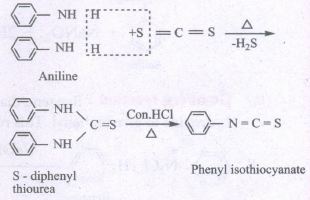
These reactions are known as Hofmann - Mustard oil reaction. This test is used to identify the primary amines.
(vii) Coupling reactions (or) p-hydroxyazobenzene, p-aminoazobenzene, 2-phenyl azo-4-methyl phenol:
Benzene diazonium chloride reacts with electron rich aromatic compounds like phenol, aniline to form brightly coloured azo compounds. Coupling generally occurs at the para position. If para position is occupied then coupling occurs at the ortho position. Coupling tendency is enhanced if an electron donating group is present at the para - position to -N2CI- group. This is an electrophilic substitution.
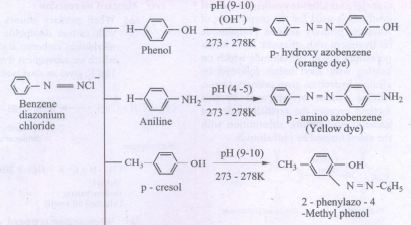
Aryl fluorides and iodides cannot be prepared by direct halogenation and the cyano group cannot be introduced by nucleophilic substitution of chlorine in chlorobenzene. For introducing such a halide group. cyano group -OH, NO2, etc.. benzenediazonium chloride is a very good intermediate Diazo compounds obtained from the coupling reactions of diazonium salts are coloured and are used as dyes.
(viii) Diazotisation :
Aniline reacts with nitrous acid at low temperature (273 - 278 K) to give benzene. Diazonium chloride which is stable for a short time and slowly decomposes even at low temperatures.This reaction is known as diazotization
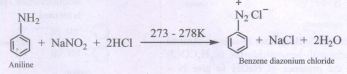
(ix) Gomberg reaction :
Benzene diazonium chloride reacts with benzene in the presence of sodium hydroxide to give biphenyl. This reaction in known as the Gomberg reaction

54.
(i) Ostwald's dilution law relates the dissociation constant of the weak acid (Ka) with its degree of dissociation (α) and the concentration (c).
where \(\alpha=\frac{\text { Number of moles dissociated }}{\text { Total number of moles }}\)
(ii) The dissociation of acetic acid can be represented as
\(\mathrm{CH}_{3} \mathrm{COOH} \rightleftharpoons \mathrm{H}^{+}+\mathrm{CH}_{3} \mathrm{COO}^{-}\)
The dissociation constant of acetic acid is,
\({ K }_{ a }=\frac { \left[ { H }^{ + } \right] \left[ { CH }_{ 3 }COO^{ - } \right] }{ \left[ { CH }_{ 3 }COOH \right] } \) ........(1)
| CH3COOH | H+ | CH3COO- | |
| Initial number of moles | 1 | - | - |
| Degree of dissociation of CH3COOH | α | - | - |
| Number of moles at equilibrium | 1-α | α | α |
| Equilibrium concentration | (1-α)C | αC | αC |
Substituting the equilibrium concentration in equation (1)
\({ K }_{ a }=\cfrac { \left( \alpha C \right) \left( \alpha C \right) }{ \left( 1-\alpha \right) C } \)
\({ K }_{ a }=\cfrac { { \alpha }^{ 2 }C }{ 1-\alpha } \) .......(2)
(iii) We know that weak acid dissociates only to a very small extent compared to one, a is so small and hence in the denominator (1 - α) ⋍1. The above expression (2) now becomes,
ka =a2C \(\Rightarrow { \alpha }^{ 2 }=\cfrac { { k }_{ a } }{ C } \) ; \(\alpha =\sqrt { \cfrac { { K }_{ a } }{ C } } \)
(iv) When dilution increases, the degree of dissociation of weak electrolyte also increases. This is called Ostwald's dilution law
Also \(;\left[\mathrm{H}^{+}\right]=\alpha \mathrm{C}\) and \(\left[\mathrm{H}^{+}\right]=\left(\sqrt{\frac{\mathrm{K}_{\mathrm{a}}}{\mathrm{C}}}\right) \mathrm{C}=\sqrt{\frac{\mathrm{K}_{\mathrm{a}} \mathrm{C}^{2}}{\mathrm{C}}}=\sqrt{\mathrm{K}_{\mathrm{a}} \cdot \mathrm{C}}\)
Similarly for a weak base
\(\begin{aligned} & \mathrm{K}_{\mathrm{b}}=\alpha^2 \mathrm{C} ; \quad \therefore \alpha=\sqrt{\frac{\mathrm{k}_{\mathrm{b}}}{\mathrm{C}}}, \\ \end{aligned}\)
\(\begin{aligned} & {\left[\mathrm{OH}^{-}\right] \alpha \mathrm{C}=\sqrt{\frac{\mathrm{K}_{\mathrm{b}}}{\mathrm{C}}} \times \mathrm{C}=\sqrt{\frac{\mathrm{K}_{\mathrm{b}} \mathrm{C}^2}{\mathrm{C}}}=\sqrt{\mathrm{K}_{\mathrm{b}} \mathrm{C}}} \end{aligned}\)
55.
The heavier transition elements belong to fourth (4d), fifth (Sd) and sixth (6d) transition series. Their properties are expected to be different form the elements belonging to the first (3d) series due to the following reasons.
(i) Atomic radii: Size of the transition elements 94d and Sd series are larger than those of the corresponding elements of the first transition series though those of 4d and Sd series are very close to each other.
(ii) Ionisation enthalpy of Sd series are higher than the corresponding elements of 3d and 4d series.
(iii) Atomisation enthalpy of 4d and Sd series are higher than the corresponding elements of the first series.
(iv) Melting and boiling points of heavier transition elements are greater than those of the first transition series due to stronger intermetallic bonding.
(v) The elements of the first transition series generally form low or high spin complexes, depending upon the higher of ligand field. However, the heavier transition elements form low spin complexes irrespective of the strength of the ligand filed.
56.
57.
(i) The defects in ionic solids is by adding impurity ions.
(ii) If the impurity ions are in different valance state from that of host, vacancies are created in the crystal lattice of the host.
(iii) For example, addition of CdCl2 to silver chloride yields solid solutions where the divalent cation Cd2+ occupies the position of Ag+.
(iv) This will disturb the electrical neutrality of the crystal.
(v) In order to maintain the same, proportional number of Ag+ ions leaves the lattice.
(vi) This produces a cation vacancy in the lattice, such kind of crystal defects are called impurity defects.
58.
The stability of a complex or co-ordination compound refers to the extent up to which it exists in a solution as co-ordination sphere.
(i) Change on the central metal ion: Greater the charge on the central metal ion, greater the stability of complex.
(ii) Nature of the metal ion: Group 3 and 6 and inner transition elements form stable complexes when donor atoms of the ligands are N, O and F. The elements after group 6 of the transition metals form stable complex when the donor atoms of the ligands are the heavier members of N, O and F family.
(iii) Basic nature of the ligands: Greater the basic strength, greater is the stability of the complex.
(iv) Presence of chelate rings: Its presence increases the stability of the complex. it is called chelate effect. It is maximum for the 5 and 6 membered rings.
(v) Effect of multidentate cyclic ligand: If the ligands are IT multidentate and cyclic without any steric effect the stability of the complex get increased.
59.
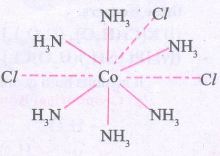
(i) Every metal atom has two types of valencies Primary valency or ionisable valency Secondary valency or non ionisable valency
(ii) The primary valency corresponds to the oxidation state of the metal ion. It is always satisfied by negative ions.
(iii) Secondary valency corresponds to the coordination number of the metal ion or atom. It is satisfied by either negative ions or neutral molecules.
(iv) The molecules or ions that satisfy secondary valencies are called ligands.
(v) The ligands which satisfy secondary valencies must project in definite directions in space. So the secondary valencies are directional in nature whereas the primary valencies are non - directional in nature.
(vi) The ligands have unshared pair of electrons. These unshared pair of electrons are donated to central metal ion or atom in a compound. Such compounds are called coordination compounds.
Werner's representation
Eg: [Co(NH)6]Cl3
Cl: primary valency (dotted lines)
NH3: secondary valency (solid lines).
Defects of Werner's theory
Werner's theory describes the structures of many co-ordination compounds successfully. However, it does not explain the magnetic and spectral properties.
60.
Most of the elements exhibit, two types of valence namely primary valence and secondary valence and each element tend to satisfy both the valences.
The primary valence is referred the oxidation state of the metal atom.
The secondary valence as the coordination number. For example, according to Werner, the primary and secondary valences of cobalt are 3 and 6 respectively.
The primary valence of a metal ions ae always satisfied by negative ions.
For example in the complex CoCI3.6NH3. The primary valence of Co is +3 and is satisfied by 3CI- ions.
The secondary valence is satisfied by negative ions, neutral molecules, positive ions or the combination of these.
For example, in CoCl3.6NH3 complex primary valence of cobalt +3 and it is satisfied by 3 CI-.
The secondary valence of cobalt is 6 and is satisfied by six neutral ammonia molecules. where as in CoCI6.NH3.
Secondary valence of Co = 5{It is satisfied five neutral molecules and a Cl- ion}
According to Werner, there are two spheres of attraction around a metal atom/ion in a complex.
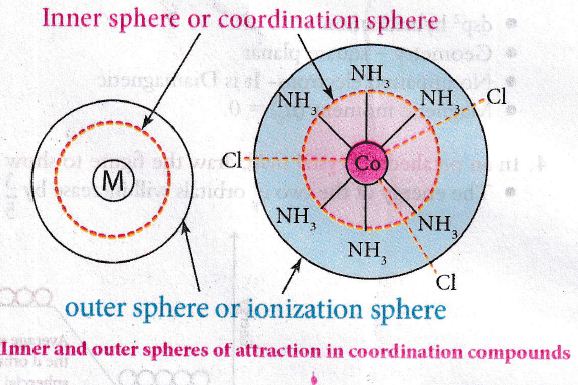
The inner /coordination sphere:
The groups present in this sphere are firmly attached to the metal.
The outer sphere / ionisation sphere:
The groups present in this sphere are loosely bound to the central metal ion and hence can be separated into ions upon dissolving the complex in a suitable solvent.
The primary valencies are non-directional. while the secondary valencies are directional.
The geometry of the complex is determined by the special arrangement of the groups which satisfy the secondary valence.
| Secondary valence | Geometry |
| 4 | Tetrahedral / Square planar |
| 6 | Octahedral |

12th Standard Syllabus & Materials
12th Standard
TN 12th Computer Applications களப்பெயர் முறைமை (DNS) Sample Question Papers Study Material - QB365 Set A
NEW12th Standard
TN 12th Computer Applications வலையமைப்பு எடுத்துக்காட்டுகள் மற்றும் நெறிமுறைகள் Sample Question Papers Study Material - QB365 Set A
NEW12th Standard
TN 12th Computer Applications கணினி வலையமைப்பு ஓர் அறிமுகம் Sample Question Papers Study Material - QB365 Set A
NEW12th Standard
TN 12th Computer Applications PHP-உடன் MySQL-ஐ இணைத்தல் Sample Question Papers Study Material - QB365 Set A



Tamilnadu Stateboard 12th Standard Subjects

Maths
Chemistry

Physics

Biology

Computer Science

Business Maths and Statistics

Economics

Commerce

Accountancy

History

Computer Applications
Biology
Computer Technology
Computer Applications
Computer Science
Business Maths and Statistics
Commerce
Economics
Maths
Chemistry
Physics
Computer Technology
History
Accountancy

Tamil

English

French
Tamilnadu Stateboard Standards
