
 100% FREE ACCESS
12th Standard Syllabus & Materials
12th Standard
TN 12th Computer Applications மின்னணு தரவு பரிமாற்றம் Sample Question Papers Study Material - QB365 Set A
NEW12th Standard
TN 12th Computer Applications மின் - வணிக பாதுகாப்பு அமைப்புகள் Sample Question Papers Study Material - QB365 Set A
NEW12th Standard
TN 12th Computer Applications மின்னணு செலுத்தல் முறைகள் Sample Question Papers Study Material - QB365 Set A
NEW12th Standard
TN 12th Computer Applications மின் - வணிகம் Sample Question Papers Study Material - QB365 Set A
NEW12th Standard
TN 12th Computer Applications திறந்த மூல கருத்துருக்கள் Sample Question Papers Study Material - QB365 Set A
NEW12th Standard
TN 12th Computer Applications வலையமைப்பு வடமிடல் Sample Question Papers Study Material - QB365 Set A

Published on: 27/01/2021
12th Standard Chemistry English Medium Reduced Syllabus Important Questions with Answer key - 2021 Part - 1
Download Tamil Nadu 12th Standard Chemistry question papers, model tests, one-mark questions, important questions, and public exam papers in PDF format. Free study materials and answer keys for TN State Board students.
Questions + Answers key
Take MCQ Chemistry Test
1.
CH3Br \(\overset { KCN }{ \longrightarrow } (A)\overset { { H }_{ 2 }{ O }^{ + } }{ \longrightarrow } (B)\overset { { PCl }_{ 5 } }{ \longrightarrow } \) (C) product (c) is ______.
acetylchloride
chloro acetic acid
\(\alpha\)- chlorocyano ethanoic acid
none of these
2.
| Electrolyte | KCl | KNO3 | HCl | NaOAC | NaCl |
| Λ- (Scm2 mol-1) |
149.9 | 145.0 | 426.2 | 91.0 | 126.5 |
Calculate ΛoHoAC using appropriate molar conductances of the electrolytes listed above at infinite dilution in water at 25oC_______.
517.2
552.7
390.7
217.5
3.
The solubility of BaSO4 in water is 2.42 × 10⁻³gL-1 at 298K. The value of its solubility product(Ksp) will be (Given molar mass of BaSO4 =233g mol-1)
1.08 × 10⁻¹⁴mol2L-2
1.08 × 10⁻¹²mol2L-2
1.08 × 10⁻¹⁰mol2L-2
1.08 × 10⁻⁸mol2L-2
4.
Predict the rate law of the following reaction based on the data given below
2A+B⟶C+3D
| Reaction number | [A] (min) | [B] (min) | Initial rate (M s-1) |
| 1 | 0.1 | 0.1 | x |
| 2 | 0.2 | 0.1 | 2x |
| 3 | 0.1 | 0.2 | 4x |
| 4 | 0.2 | 0.2 | 8x |
rate = k[A]2 [B]
rate = k[A] [B]2
rate = k[A] [B]
rate = k[A]1/2 [B]3/2
5.
Potassium has a bcc structure with nearest neighbor distance 4.52 \(\overset{o}{A}\). Its atomic weight is 39. its density will be_______.
915 kg m-3
2142 kg m-3
452 kg m-3
390 kg m-3
6.
Which one of the following pairs represents linkage isomers?
[Cu(NH3)4][PtCl4] and [Pt(NH3)4][CuCl4]
[Co(NH3)5(NO3)]SO4 and [Co(NH3)5(ONO)]
[Co(NH3)4(NCS)2]Cl and [Co(NH3)4(SCN)2]Cl
both (b) and (c)
7.
Which one of the following is not correct?
La(OH)3 is less basic than Lu(OH)3
In lanthanoid series ionic radius of Ln3+ ions decreases
La is actually an element of transition metal series rather than lanthanide series
Atomic radii of Zr and Hf are same because of lanthanide contract
8.
Which one of the following statements related to lanthanons is incorrect?
Europium shows +2 oxidation state
The basicity decreases as the ionic radius decreases from Pr to Lu.
All the lanthanons are much more reactive than aluminium
Ce4+ solutions are widely used as oxidising agents in volumetric analysis.
9.
10.
Which of the following d block element has half filled penultimate d sub shell as well as half filled valence sub shell?
Cr
Pd
Pt
none of these
11.
The compound that is used in nuclear reactors as protective shields and control rods is _________.
Metal borides
metal oxides
Metal carbonates
metal carbide
12.
In diborane, the number of electrons that accounts for banana bonds is ________.
six
two
four
three
13.
The following set of reactions are used in refining Zirconium
\(Zr \text{(impure)}+2I_{ 2 }\overset { 523k }{ \longrightarrow } ZrI_{ 4 }\)
\({ ZrI }_{ 4 }\overset { 1800K }{ \longrightarrow } Zr \text{(pure)}+{ 2I }_{ 2 }\)This method is known as ______.
Liquation
Van Arkel process
Zone refining
Mond’s process
14.
Which of the following statements, about the advantage of roasting of sulphide ore before reduction is not true?
\(\Delta { G }_{ f }^{ 0 }\) of sulphide is greater than those for CS2 and H2S
\(\Delta { G }_{ r }^{ 0 }\) is negative for roasting of sulphide ore to oxide
Roasting of the sulphide to its oxide is thermodynamically feasible
Carbon and hydrogen are suitable reducing agents for metal sulphides
15.
Elucidate the structure of fructose.
16.
Explain the prepareation of Bakelite and Give its use.
17.
Write a note on drug target interaction.
18.
Write the differences between nitro methane and nitro benzene.
19.
Explain intermediate compound formation theory of catalysis with an example.
20.
Write short notes on the following
i. Hofmann’s bromide reaction
ii. Ammonolysis
iii. Gabriel phthalimide synthesis
iv. Schotten – Baumann reaction
v. Carbylamine reaction
vi. Mustard oil reaction
vii. Coupling reaction
viii. Diazotisation
ix. Gomberg reaction
21.
What are drugs? How are they classified.
22.
Explain the principle of electrolytic refining with an example.
23.
A copper electrode is dipped in 0.1M copper sulphate solution at 25oC. Calculate the electrode potential of copper. [Given: E0Cu2+|Cu = 0.34V].
24.
Why is anode in galvanic cell considered to be negative and cathode positive electrode?
25.
Write the expression for the solubility product of Ca3(PO4)2
26.
Write the properties of interstitial compound.
27.
Give the characteristics of first order reaction.
28.
Predict the product
(i) PCI5+ C2H5OH \(\longrightarrow \)?
(ii) P4+ SO2Cl2 \(\longrightarrow \) ?
(iii) POCl3 + H2O \(\longrightarrow \) ?
(iv) HBr + PH3\(\longrightarrow \) ? :,
(v) PCl3+ H2O\(\longrightarrow \) ?
29.
Discuss the anomalous nature of fluorine.
30.
Name a reaction for the estimation of Ozone.
31.
Find out the oxidation state of carbon in each of the following:
(i) CaC2
(ii) H2CO3
(iii) HCN
(iv) CO
32.
How is boron trifluoride obtained from boron trioxide?
33.
List the applications of gold.
34.
What is meant by aluminothermic process?
35.
Distinguish Roasting and Calcination.
36.
Explain roasting with an example.
37.
Mohr's salt answers the presence of Fe2+, NH4+and SO42- ions, whereas the potassium ferrithiocyanate will not answer Fe3+ and SCN ions give reason.
38.
Benzene diazonium chloride in aqueous solution decomposes according to the equation \({ C }_{ 6 }{ H }_{ 5 }{ N }_{ 2 }Cl\longrightarrow { C }_{ 6 }{ H }_{ 5 }Cl+{ N }_{ 2 }\)Starting with an initial concentration of 10g L-1, the volume of N2 gas obtained at 50 °C at different intervals of time was found to be as under:
| t(min) | 6 | 12 | 18 | 24 | 30 | \(\infty \) |
| Vol of N2 (ml) | 19.3 | 32.6 | 41.3 | 46.5 | 50.4 | 58.3 |
Show that the above reaction follows the first order kinetics. What is the value of the rate constant?
39.
The half life of the homogeneous gaseous reaction SO2Cl2 → SO2 + Cl2 which obeys first order kinetics is 8.0 minutes. How long will it take for the concentration of SO2Cl2 to be reduced to 1% of the initial value?
40.
The rate law for a reaction of A, B and C has been found to be rate = k[A]2[B][L]3/2 How would the rate of reaction change when
(i) Concentration of [L] is quadrupled
(ii) Concentration of both [A] and [B] are doubled
(iii) Concentration of [A] is halved
(iv) Concentration of [A] is reduced to \(\left(\frac{1}{3}\right)\) and concentration of [L] is quadrupled.
41.
Define half life of a reaction. Show that for a first order reaction half life is independent of initial concentration.
42.
If NaCl is doped with 10-2 mol percentage of strontium chloride, what is the concentration of cation vacancy?
43.
Explain briefly seven types of unit cell.
44.
Thermal decomposition of KClO3 in presence of MnO2 proceeds as follows.
Steps in the reaction 2KClO3 → 2KCl + 3O2 can be given as
45.
Explain any one method for coagulation.
46.
There are two isomers with the formula CH3NO2. How will you distinguish between them?
47.
How is propanoic acid is prepared starting from
(a) an alcohol
(b) an alkylhalide
(c) an alkene
48.
Write the expression for the solubility product of Hg2Cl2 .
49.
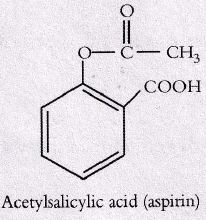
Write the structural formula of aspirin.
50.
Identify the conjugate acid base pair for the following reaction in aqueous solution
i) HS- (aq) + HF \(\rightleftharpoons \) F-(aq) + H2S(aq)
ii) HPO2-4 + SO32- \(\rightleftharpoons \) PO43- + HSO3-
iii) NH4+ + CO32- \(\rightleftharpoons \) NH3 + HCO3-
51.
For a chemical reaction, Variation in the concentration In[A] Vs time in seconds is given as
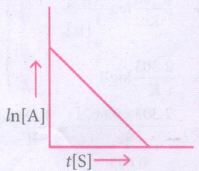
(i) What is the order of the reaction?
(ii) What is the unit of rate constant K?
(iii) Give the relationship between k and \({ t }_{ \frac { 1 }{ 2 } }\)
52.
A compound made up of two atoms X and Y has a face centred cubic arrangement. X is present in the coners and Y at the centre of each face. If one atom is missing from corner. What is the simplest formula of the compound.
53.
Name the building block of zeolites. Why zeolites have high porosity?
54.
Why transition elements form complexes?
55.
Name some depressing agents.
56.
Discuss the use of an acidic flux in metallurgy.
57.
Why first ionization enthalpy of chromium is lower than that of zinc?
58.
Deduce the oxidation number of oxygen in hypofluorous acid – HOF.
59.
Assertion: p – N, N – dimethyl amino benzaldehyde undergoes benzoin condensation
Reason: The aldehydic (-CHO) group is meta directing.
Codes:
A) if both assertion and reason are true and reason is the correct explanation of assertion.
B) if both assertion and reason are true but reason is not the correct explanation of assertion.
C) assertion is true but reason is false
D) both assertion and reason are false
if both assertion and reason are true and reason is the correct explanation of assertion.
if both assertion and reason are true but reason is not the correct explanation of assertion.
assertion is true but reason is false
both assertion and reason are false
1.

2.
(ΛoHoAC) = [(Λo)HCl + Λo)NaOAC ] - (Λo)NaCl
= (426.2 + 91) - (126.5)
= 390.7
3.
BaSO4 ⇌ Ba2+ + SO42-
Ksp = (s) (s)
Ksp = (s)2
= (2.42 × 10⁻³gL-1)2
\(=\frac{2.42 \times 10^{-3} gL^{-1}}{233 \text{ g mol}^{-1}}\)
= (0.01038 x 10⁻³)2
= (1.038 x x 10-5)2
= 1.077 x 10-10
= 1.08 × 10⁻¹⁰mol2L-2
4.
rate1 = k[0.1]n [0.1]m ....(1)
rate2 = k[0.2]n [0.1]m ....(2)
(2) (1)
\(=\frac{2x}{x} = \frac{k[0.2]^n [0.1]^m}{k[0.1]^n [0.1]^m}\)
\(= \frac{2x}{x} = 2^n\)
n = 1
rate3 = k[0.1]n [0.2]m ....(3)
rate4 = k[0.2]n [0.2]m ....(4)
\(=\frac{8x}{2x} = \frac{k[0.2]^n [0.2]^m}{k[0.2]^n [0.1]^m}\)
= 8/2 = 2m
m = 2
rate = k[A] [B]2
5.
\(\rho=\frac{\mathrm{n} \times \mathrm{M}}{\mathrm{a}^{3} \mathrm{~N}_{\mathrm{A}}}\)
For bcc n =2, M = 39 nearest distance 2r = 4.52 A0
\(a =\frac{4r}{\sqrt {3}} = \frac { 2\times 4.52 \times 10^{-10} }{ \sqrt{3}} \)
\(\rho =\frac { {( 5.21\times 10^{-10})^{ 3 }} \times (6.023 \times 10^{-23}) }{ 2 \times 39} \)
ρ = 915 kgm-3
6.
(a) coordination isomers
(b) no isomerism ( different molecular formula)
(c)⬅NCS; ⬅SCN coordinating atom differs : linkage isomers
7.
(a)
La(OH)3 is less basic than Lu(OH)3
8.
As we move from La to Lu, their metallic behaviour because almost similar to that of aluminium.
9.
(b)
10.
Cr ⇒ [Ar]3d54s1
11.
(a)
Metal borides
12.
(c)
four
13.
(b)
Van Arkel process
14.
(d)
Carbon and hydrogen are suitable reducing agents for metal sulphides
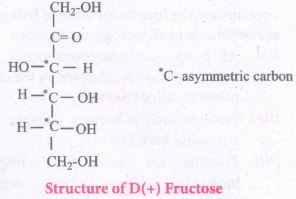
15.
Structure of fructose: Fructose is the sweetest of all known sugars. It is readily soluble in water. Fresh solution of fructose has a specific rotation -1330 which changes to - 920 at equilibrium due to mutarotation. Similar to glucose, the structure of fructose is deduced from the following facts.
(i) Elemental analysis and molecular weight determination of fructose show that it has the molecular formula C6H12O6.
(ii) Fructose on reduction with HI and red phosphorus gives a mixture of n - hexane (major product) and 2 - iodohexane (minor product). This reaction indicates that the six carbon atoms in fructose are in a straight chain.

(ii) Fructose reacts with NH2OH and HCN. It shows the presence of carbonyl groups in the molecule of fructose.
(iv) Fructose reacts with acetic anhydride in the presence of pyridine to form penta acetate. This reaction indicates the presence of five hydroxyl groups in a fructose molecule. ,
(v) Fructose is not oxidized by bromine water. This rules out the possibility of presence of an aldehyde (-CHO) group.
(vi) Partial reduction of fructose with sodium amalgam and water produces mixtures of sorbitol and mannitol which are epimers at second carbon. New asymmetric carbon is formed at C-2. This confirms the presence of keto group.
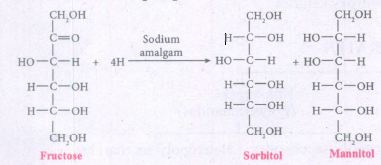
(vii) On oxidation with nitric acid, it gives glycolic acid and tartaric acids which contain smaller number of carbon atoms than in fructose.
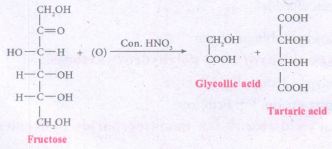
This shows that a keto group is present in C-2. It also shows the presence of 10 alcoholic groups at C- 1 and C- 6
16.
The monomers are phenol and formaldehyde. The polymer is obtained by the condensation polymerization of these monomers in presence of either an acid or a base catalyst.
Phenol reacts with methanal to form ortho or para hydroxyl methylphenols which on further reaction with phenol gives linear polymer called novolac. Novalac on further heating with formaldehyde undergo cross linkages to form Bakelite.
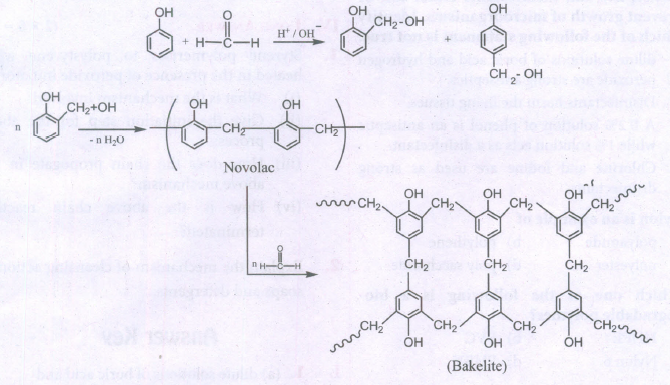
Uses:
Navolac is used in paints. Soft bakelites are used for making glue for binding laminated wooden planks and in varinishes, Hard bakelites are used to prepare combs, pens etc...
17.
(i) The biochemical processes such as metabolism, cell-signaling etc... are essential for the normal functioning of our body.
(ii) These routine processes may be disturbed by any external factors such as microorganism, chemicals etc ..
(iii) Under such conditions medicines restore the normal functioning of the body.
(iv) These drug molecules interact with biomolecules such as proteins, lipids, etc .. that are responsible for different functions of the body.
(v) The drug interacts with these molecules and modify the normal biochemical reactions either by modifying the enzyme activity or by stimulating/suppressing certain receptors.
18.
| S. No. | Nitromethane | Nitrobenzene |
| i. | It is colourless | It is yellow coloured. |
| ii. | It is soluble in water | Insoluble in water. |
| iii. | Has pleasant smell | Has smell of bitter almonds. |
| iv. | Exhibits tautomerism | Doesnot exhibit tautomerism |
| v. | Used as good solvent | Used to prepare explosives Eg. TNT |
| vi. | Undergoes reduction in acidic and neutral medium. | Undergoes reduction in acidic, basic and neutral medium |
19.
The intermediate compound formation theory :
A catalyst acts by providing a new path with low energy of activation. In homogeneous catalysed reactions a catalyst may combine with one or more reactant to form an intermediate which reacts with other reactant or decompose to give products and the catalyst is regenerated.
Consider the reactions :
A+B➝AB; C is the catalyst .............(1)
A + C ➝ AC (intermediate) ..........(2)
AC + B ⟶ AB + C ...............(3)
Example 1:
The mechanism of Fridel crafts reaction is given below
\({ C }_{ 6 }{ H }_{ 6 }+{ { CH }_{ 3 }Cl\overset { anhydrous\\ { AlCl }_{ 3 } }{ \longrightarrow } }{ C }_{ 6 }{ H }_{ 5 }{ CH }_{ 3 }+HCl\)
The action of catalyst is explained as follows
CH3Cl + AlCl3 ⟶ [CH3]+ [AlCl4]-
It is an intermediate.
\({ C }_{ 6 }{ H }_{ 6 }+\left[ { CH }_{ 3 }^{ + } \right] \left[ { AlCl }_{ 4 } \right] ^{ - }\longrightarrow { C }_{ 6 }{ H }_{ 5 }{ CH }_{ 3 }+{ AlCl }_{ 3 }+Hcl\)
Example 2:
\({ { 2KClO }_{ 3 }\overset {\\ { MnO }_{ 3 } }{ \longrightarrow } }{ 2KCl }+{ 3O }_{ 2 }\)
Thermal decomposition of KCIO3 in the presence of MnO2 proceeds as follows. Steps in the reaction
2KCIO3 ⟶ 2KCI + 3O2 Can be given as
2KClO3 + 6MnO2 → 6MnO3 + 2KCl
It is an intermediate
6MnO3 → 6MnO2 + 3O2
Example 3:
Formation of water due to the reaction of H2 and O2 in the presence of Cu can be given as
H2 + 1/2O2 → H2O
2Cu + \(\frac{1}{2}\)O2 → Cu2O
It is an intermediate.
Cu2O + H2 → H2O + 2Cu
Advantages:
This theory describes
(a) The specificity of a catalyst and
(b) The increase in the rate of the reaction with increasc inthe concentration of a catalyst
Limitations:
(a) The intermediate compound theory fails to explain the action of catalytic poison and activators (promoters).
(b) This theory is unable to explain the mechanism of heterogeneous catalysed reactions.
20.
Hoffmann's bromide reaction:
When Amides are treated with bromine in the presence of aqueous or ethanolic solution of KOH, primary amines with one carbon atom less than the parent amides are obtained.
\(\underset { \quad \quad \quad amide\\ R=Alkyl(or)Aryl }{ R-\overset { \underset { || }{ O } }{ C } -{ NH }_{ 2 } } \overset { { Br }_{ 2 }/KOH }{ \longrightarrow } \underset { Primary\quad amine }{ R-{ NH }_{ 2 }+{ K }_{ 2 }{ CO }_{ 3 } } +KBr+{ H }_{ 2 }O\)
(ii) Hoffmann's ammonolysis:
When Alkyl halides (or) benzylhalides are heated with alcoholic ammonia in a sealed tube, mixtures of 1°, 2° and 3° amines and quaternary ammonium salts are obtained.
\( { CH }_{ 3 }-Br\overset { \ddot { N } { H }_{ 3 } }{ \underset { \Delta }{ \longrightarrow } } \underset { { 1 }^{ 0 }-amine }{ { CH }_{ 3 }-\ddot { N } { H }_{ 2 } } \overset { { CH }_{ 3 }-Br }{ \longrightarrow } \underset { { 3 }^{ o }-amine }{ \left( { CH }_{ 3 } \right) _{ 2 }\ddot { N } H } \overset { { CH }_{ 3 }Br }{ \longrightarrow } \underset { 3^{ o }-amine }{ \left( { { CH }_{ 3 } } \right) _{ 3 }\ddot { N } } \overset { CH_{ 3 }Br }{ \longrightarrow } \underset { Quartenary \ ammonium\ bromide }{ \left( { CH }_{ 3 } \right) _{ 4 }\overset { + }{ N } { Br }^{ - } } \)
This is a nucleophilic substitution, the halide ion of alkyl halide is substituted by the -NH2 group. The product primary amine so formed can also has a tendency to act as a nucleophile and hence if excess alkyl halide is taken, further nucleophilic substitution takes place leading to the formation of quarternary ammonium salt. However, if the process is carried out with excess ammonia, primary amine is obtained as the major product. The order of reactivity of alkylhalides with amines
RI > RBr > RCl
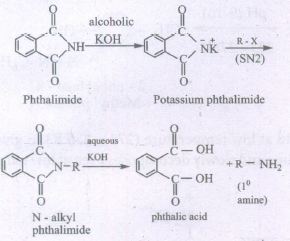
(iii) Gabriel phthalimide synthesis:
Gabriel synthesis is used for the preparation of Aliphatic primary amines. Phthalimide on treatment with ethanolic KOH forms potassium salt of phthalimide which on heating with alkyl halide followed by alkaline hydrolysis gives primary amine. Aniline cannot be prepared by this method because the arylhalides do not undergo nucleophilic substitution with the anion formed by phthalimide.
(iv) Schotten - Baumann reaction :
Aniline reacts with benzoylchloride (C6H5COCI) in the presence of NaOH to give N - phenyl benzamide. This reaction is known as Schotten - Baumann reaction. The acylation and benzoylation are nucleophilic substitutions.
\(\underset { Aniline }{ { C }_{ 6 }{ H }_{ 5 }-{ NH }_{ 2 } } +\underset { Benzoyl\quad chloride }{ { C }_{ 6 }{ H }_{ 5 }-\overset { \underset { || }{ O } }{ C } -Cl } \overset { Pyridine }{ \longrightarrow } \underset { N-phenyl\quad benzamide }{ { C }_{ 6 }{ H }_{ 5 }-NH-\overset { \underset { || }{ O } }{ C } -{ C }_{ 6 }{ H }_{ 5 } } +HCl\)
(v) Carbylamine reaction :
Aliphatic (or) aromatic primary amines react with: chloroform and alcoholic KOH to give isocyanides (carbylamines), which has an unpleasant smell. This reaction is known as carbylamines test. This test used to identify the primary amines.
\(\underset { Ethylamine }{ { C }_{ 2 }{ H }_{ 5 }-{ NH }_{ 2 } } +\underset { Chloroform }{ { CHCl }_{ 3 }+3KOH } \longrightarrow \underset { Ethylisocyanide }{ { C }_{ 2 }{ H }_{ 5 }-NC } +3KCl+3{ H }_{ 2 }O\)
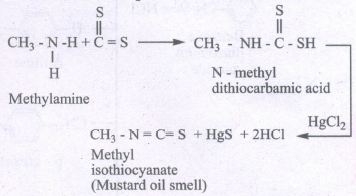
(vi) Mustard oil reaction:
(a) When primary amines are treated with carbon disulphide (CS2), N - alkyldithio carbonic acid is formed which on subsequent treatment with HgCI2, gives an alkyl isothiocyanate.
(b) When aniline is treated with carbon disulphide, or heated together, S-diphenylthio urea is formed, which on boiling with strong HCI, phenyl isothiocyanate (phenyl mustard oil), is formed.
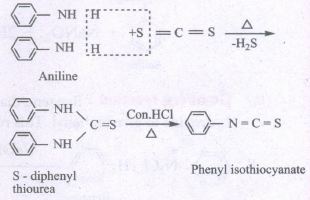
These reactions are known as Hofmann - Mustard oil reaction. This test is used to identify the primary amines.
(vii) Coupling reactions (or) p-hydroxyazobenzene, p-aminoazobenzene, 2-phenyl azo-4-methyl phenol:
Benzene diazonium chloride reacts with electron rich aromatic compounds like phenol, aniline to form brightly coloured azo compounds. Coupling generally occurs at the para position. If para position is occupied then coupling occurs at the ortho position. Coupling tendency is enhanced if an electron donating group is present at the para - position to -N2CI- group. This is an electrophilic substitution.
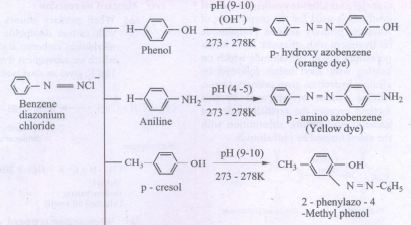
Aryl fluorides and iodides cannot be prepared by direct halogenation and the cyano group cannot be introduced by nucleophilic substitution of chlorine in chlorobenzene. For introducing such a halide group. cyano group -OH, NO2, etc.. benzenediazonium chloride is a very good intermediate Diazo compounds obtained from the coupling reactions of diazonium salts are coloured and are used as dyes.
(viii) Diazotisation :
Aniline reacts with nitrous acid at low temperature (273 - 278 K) to give benzene. Diazonium chloride which is stable for a short time and slowly decomposes even at low temperatures.This reaction is known as diazotization
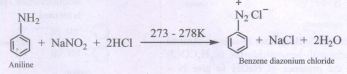
(ix) Gomberg reaction :
Benzene diazonium chloride reacts with benzene in the presence of sodium hydroxide to give biphenyl. This reaction in known as the Gomberg reaction

21.
A drug is a substance that is used to modify or explore physiological systems or pathological states for the benefit of the recipient. It is used for the purpose of diagnosis, prevention, cure/relief of a disease.
a) Classification of drugs:
Drugs are classified based on their properties such as chemical structure, pharmacological effect, target system, site of action etc.
b) Classification based on the chemical structure:
In this classification, drugs with a common chemical skeleton are classified into a single group. For example, ampicillin, amoxicillin, methicillin etc.. all have similar structure and are classified into a single group called penicillin. Similarly, we have other group of drugs such as opiates, steroids, catecholamines etc. Compounds having similar chemical structure are expected to have similar chemical properties. However, their biological actions are not always similar. For example, all drugs belonging to penicillin group have same biological action, while groups such as barbiturates, steroids etc.. have different biological action.
Penicillins
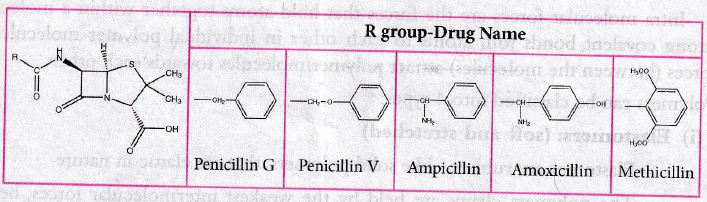
Classification based on Pharmacological effect:
In this classification, the drugs are grouped based on their biological effect that they produce on the recipient. For example, the medicines that have the ability to kill the pathogenic bacteria are grouped as antibiotics. This kind of grouping will provide the full range of drugs that can be used for a particular condition (disease). The physician has to carefully choose a suitable medicine from the available drugs based on the clinical condition of the recipient.
Examples:
Antibiotic drugs: amoxicillin, ampicillin, cefixime, cefpodoxime, erythromycin, tetracycline etc.. Antihypertensive drugs: propranolol, atenolol, metoprolol succinate, amlodipine etc...
Classification based on the target system (drug action):
In this classification, the drugs are grouped based on the biological system/process, that they target in the recipient. This classification is more specific than the pharmacological classification. For example, the antibiotics streptomycin and erythromycin inhibit the protein synthesis (target process) in bacteria and are classified in a same group. However, their mode of action is different. Streptomycin inhibits the initiation of protein synthesis, while erythromycin prevents the incorporation of new amino acids to the protein.
Classification based on the site of action (molecular target):
The drug molecule interacts with biomolecules such as enzymes, receptors etc, which are referred as drug targets. We can classify the drug based on the drug target with which it binds. This classification is highly specific compared to the others. These compounds often have a common mechanism of action, as the target is the same.
22.
1. The crude metal is refined by electrolysis. It is carried out in an electrolytic cell
Anode : Impure metal to be refined with dilute acid.
Cathode : Thin strips of pure metal
Electrolyte : Aqueous solution of the salts of the metal with dilute acid.
2. The metal dissolves from the anode, pass into the solution.
3. At the same amount of metal ions from the solution will be deposited at the cathode.
4. During electrolysis, the less electropositive impurities in the anode, settle down at the bottom and are removed as anode mud.
Example: Electrolytic refining of silver.
Cathode: Pure silver
Anode: lmpure silver rods
Electrolyte: Acidified aqueous solution of silver nitrate
5. When a current is passed through the electrodes the following reactions will take place
(a) Reaction at anode: \({ Ag }_{ (s) }\longrightarrow { Ag }^{ + }_{ (aq) }+{ 1e }^{ - }\)
(b) Reaction at cathode: \({ Ag }^{ + }_{ (aq) }+{ 1e }^{ - }\longrightarrow { Ag }_{ (s) }\)
6. During electrolysis, at anode silver loses electrons and form silver ions and the silver ions migrate towards the cathode and get discharged and deposited on the cathode.
7. Copper, Zinc etc can also be refined by this process.
23.
Given: [Cu2+] = 0.1M; E0Cu2+|Cu = +0.34V
Cell reaction is: \(Cu^{2+}_{(aq)}+2e^{-}\rightarrow Cu_{(s)}\)
\(E_{cell}=E^{0}-\frac{0.0591}{n}\log\frac{[Cu]}{[Cu^{2+}]}\)
\(= 0.34\frac{0.0591}{2}\log\frac{1}{0.1}\)
Ecell = 0.34 - 0.0296 = +0.31V
24.
Anodic oxidation:
The electrode at which the oxidation occurs is called the anode. In Daniel cell, the oxidation take place at zinc electrode, i.e., zinc is oxidised to Zn2+ ions and the electrons. The Zn2+ ions enters the solution and the electrons enter the zinc metal, then flow through the external wire and then enter the copper strip. Electrons are liberated at zinc electrode and hence it is negative (-ve).
\({ Zn }_{ (s) }\longrightarrow { Zn }^{ 2+ }{ _{ (aq) } }+ 2{ e }^{ - } \) (loss of electron-oxidation)
Cathodic reduction:
The electrons flow through the circuit from zinc to copper, where the Cu2+ ions in the solution accept the electrons, get reduced to copper and the same get deposited on the electrode. Here, the electrons are consumed and hence it is positive (+ve).
\({ Cu }^{ 2+ }_{ (aq) }+{ 2e }^{ - }\longrightarrow { Cu }_{ (s) } \)(gain of electron-reduction)
25.
\(\mathrm{Ca}_{3}\left(\mathrm{PO}_{4}\right)_{2} \rightleftharpoons 3 \mathrm{Ca}^{2+}_{(aq)}+2 \mathrm{PO}_{4_{(aq)}}^{3-}\\\)
(s) (3s) (2s)
\(K_{sp}=[Ca^{2+}]^{3}[PO_{4}^{3-}]^{2}\)
\(K_{sp}=(3s)^{3}(2s)^{2}\)
\(K_{sp}=27s^{3}.4s^{2}\)
\(K_{sp}=108s^{5}\)
(or)
\(K_{s p} =m^{m} \cdot n^{n} \cdot(s)^{m+n} \)
\(K_{\text {sp }} =3^{3} \cdot 2^{2} \cdot(s)^{3+2} \)
\(K_{s p} =27 \times 4 \times(s)^{5} \)
\(=108(s)^{5}=108 s^{5}\)
26.
(i) They are hard and show electrical land thermal conductivity.
(ii) They have high melting points higher than those of pure metals.
(iii) Transition metal hydrides are used as powerful reducing agents.
(iv) Metallic carbides are chemically inert
27.
(i) When the concentration of the reactant is increased by 'n' times, the rate of reaction is also increased by n times. That is, if the concentration of the reactant is doubled, the rate is doubled.
(ii) The unit of rate constant of a first order reaction is sec-1 or time-1.
\({ k }_{ 1 }=\frac { rate }{ (a-x) } =\frac { { mol.lit }^{ -1 }{ sec }^{ -1 } }{ { mol.lit }^{ -1 } } \)
(iii) The time required to complete a definite fraction of reaction is independent of the initial concentration, of the reactant if t1/u is the time of one 'u' th fraction of reaction to take place then from equation.
\({ k }_{ 1 }=\frac { 2.303 }{ t } \log { \frac { a }{ a-x } } \)
\(x=\frac { a }{ u } and\quad { t }_{ \frac { 1 }{ u } }=\frac { 2.303 }{ { k }_{ 1 } } \log { \frac { a }{ a-\frac { a }{ u } } } ;\)
\({ t }_{ \frac { 1 }{ u } }=\frac { 2.303 }{ { k }_{ 1 } } \log { \frac { u }{ (u-1) } } \)
since k1 = rate constant, t1/u is independent of initial concentration 'a'.
28.
(i) PCI5+ C2H5OH \(\longrightarrow \) C2H5CI + POCl3 + HCI
(ii) P4+ 10SO2Cl2 \(\longrightarrow \) 4PCI5 + 10SO2
(iii) POCl3 + 3H2O \(\longrightarrow \) H3PO4 + 3HCI
(iv) PH3 + HBr\(\longrightarrow \) PH4Br
(v) PCl3+ 3H2O\(\longrightarrow \) H3PO3 + 3 HCI
29.
(i) Fluorine is the most reactive element among halogens due to minimum value of F- F bond dissociation energy.
(ii) It can form two types of salts with metals NaF and NaHF2
(iii) AgF is soluble in water but other AgX are insoluble.
(iv) HF attacks glass while others do not.
(v) Fluorine, does not form any polyhalides (absence of d - orbitals)
(vi) Fluorine exhibit only negative oxidation state (highly electronegative) while other halogens have both +ve and -ve oxidation state.
30.
O3 oxidises potassium iodide to iodine. This reaction is quantitative and can be used for estimation of ozone
\({ O }_{ 3 }+2KI+{ H }_{ 2 }O\longrightarrow 2KOH+{ O }_{ 2 }+{ I }_{ 2 }\)
31.
(i) CaC2
2 + 2x = 0
2x = -2
x = -1
(ii) H2CO3
2 + x + (-6) = 0
x = +4
(iii) HCN
1 + x + (-3) = 0
x = +3 - 1 = +2
(iv) CO
x + (-2) = 0
x= +2
32.
(i) Boron trifluoride is obtained by the treatment of calcium fluoride with boron trioxide in presence of conc. sulphuric acid.
B2O3 + 3CaF2 + 3H2SO4 \(\overset { \triangle }{ \longrightarrow } \) 2BH3 + 3CaSO4 + 3H2O
(ii) It can also be obtained by treating boron trioxide with carbon and fluorine.
B2O3 + 3C + 3F2 ⟶ 2BF3 + 3CO
(iii) In the laboratory pure BF3 is prepared by the thermal decomposition of benzene diazonium tetrafluoro borate.
PhN2BF4 \(\overset { \triangle }{ \longrightarrow } \) BF3 + PhF + N2
33.
(i) Gold, one of the expensive and precious metals. It is used for coinage, and has been used as standard for monetary systems in some countries.
(ii) It is used extensively in jewellery in its alloy form with copper.
(iii) It is also used in electroplating to cover other metals with a thin layer of gold which are used in watches, artificial limb joints, cheap jewellery, dental fillings and electrical connectors.
(iv) Gold nanoparticles are also used for increasing the efficiency of solar cells and also used an catalysts.
34.
(i) Metallic oxides such as Cr2O3 can be reduced by an aluminothermic process.
(ii) In this process, the metal oxide is mixed with aluminum powder and placed in a fire clay crucible.
(iii)To initiate the reduction process, an ignition mixture (usually magnesium and barium peroxide is used
\({ BaO }_{ 2 }+Mg\longrightarrow Bao+MgO\)
(iv) During the above reaction a large amount of heat is evolved (temperature up to 2400°C, is generated and the reaction enthalpy is: 852 kJ mol-1 which facilitates the reduction of Cr2O3 by aluminium power.
\({ Cr }_{ 2 }{ O }_{ 3 }+2Al\overset { \Delta }{ \longrightarrow } 2Cr+{ Al }_{ 2 }{ O }_{ 3 }\)
35.
| Roasting | Calcination |
|---|---|
| Roasting is a process which ore is heated in the presence of excess of air. | Calcination is a process in which ore is heated in the absence of air. |
| As a result of roasting the sulphide ores are converted into their oxides. | As a result of calcination, the carbonal ore is converted into its oxide. |
| \(2PbS+3O2\overset { \Delta }{ \longrightarrow } PbO+{ 2SO }_{ 2 }\uparrow \) | \(PbCO\overset { \Delta }{ \longrightarrow } PbO+{ CO }_{ 2 }\uparrow \) |
| Roasting removes impurities such as arsenic, sulphur phosphorous by converting them into their volatile oxides \(4As+{ 3O }_{ 2 }\longrightarrow { 2As }_{ 2 }{ O }_{ 3 }\) |
During calcination of hydrated ore, the water of hydration is expelled as vapour. |
36.
(i) Roasting is the method, usually applied for the conversion of sulphide ores into their oxides.
(ii) In this method, the concentrated ore is oxidised by heating it with excess of oxygen in a suitable furnace below the melting point of the metal.
(iii) \(2PbS+{ 3O }_{ 2 }\overset { \Delta }{ \longrightarrow } 2PbO+{ 2SO }_{ 2 }\uparrow \)
\(2ZnS+{ 3O }_{ 2 }\overset { \Delta }{ \longrightarrow } 2ZnO+2{ SO }_{ 2 }\uparrow \)
\(2Cu_{ 2 }S+{ 3O }_{ 2 }\overset { \Delta }{ \longrightarrow } 2Cu_2O + 2SO_2\uparrow \)
(iii) Roasting also removes impurities such as arsenic, sulphur, phosphorous by converting them into their volatile oxides
(v) Ex.\(4As+{ { 3O }_{ 2 } }\longrightarrow { 2As }_{ 2 }{ O }_{ 3 }\uparrow \)
\( \mathrm{S}_{8}+8 \mathrm{O}_{2} \longrightarrow 8 \mathrm{SO}_{2} \uparrow \)
\(\mathrm{P}_{4}+5 \mathrm{O}_{2} \longrightarrow \mathrm{P}_{4} \mathrm{O}_{10} \uparrow\)
37.
If we perform a qualitative analysis to identify the constituent ions present in both the compounds, Mohr's salt answers the presence of Fe2+, NH4+, and SO42- ions, whereas the potassium ferrithiocyanate will not answer Fe3+ and SCN ions. We can infer that the double salts loose their identity and dissociate into their constituent simple ions in solutions, whereas the complex ion in coordination compound, does not loose its identity and never dissociate to give simple ions.
38.
For a first order reaction
\(k=\frac { 2.303 }{ t } \log\frac { \left[ { A }_{ 0 } \right] }{ \left[ A \right] } \)
\(k=\frac { 2.303 }{ t } \log\frac { { V }_{ \infty } }{ { V }_{ \infty }-{ V }_{ 1 } } \)
V∞= 58.3 ml.
| t(min) | Vt | V∞=Vt | \(k=\frac { 2.303 }{ t } \log\frac { { V }_{ \infty } }{ { V }_{ \infty }-{ V }_{ t } } \) |
| 6 | 19.3 | 58.3-19.3=39.0 | \(k=\frac { 2.303 }{ 6 } \log\left( \frac { 58.3 }{ 39 } \right) =0.0670\) min-1 |
| 12 | 32.6 | 58.3-32.6=25.7 | \(k=\frac { 2.303 }{ 12 } \log\left( \frac { 58.3 }{ 25.7 } \right) =0.06838\) min-1 |
| 18 | 41.3 | 58.3-41.3=17.0 | \(k=\frac { 2.303 }{ 18 } \log\left( \frac { 58.3 }{ 17 } \right) =0.06838\) min-1 |
| 24 | 46.5 | 58.3-46.5=11.8 | \(k=\frac { 2.303 }{ 24 } \log\left( \frac { 58.3 }{ 11.8 } \right) =0.0666\) min-1 |
| 30 | 50.4 | 58.3 - 50.4 = 7.9 | \(k=\frac{2.303}{30} \log \left(\frac{58.3}{7.9}\right)=0.067\) min-1 |
| Mean value of k = 0.0674 min-1 |
As the rate constants are constant through out it is a first order reaction.
39.
\(\mathrm{k}=0.693 / \mathrm{t}_{1 / 2}\)
\(\mathrm{k}=\frac{0.693}{8.0}=0.08 \mathrm{~min}^{-1}\)
For the first order reaction:
\(t =\frac{2.303}{k} \log \frac{\left[A_{0}\right]}{[A]} \)
\(t =\frac{2.303}{0.087} \log \left(\frac{100}{1}\right)=26.47 \log 10^{2} \)
\(t =2 \times 26.47 \log 10 \)
\(t =52.94 \mathrm{~min}\)
40.
(i) Reaction Rate = \(k{ \left[ A \right] }^{ 2 }{ \left[ B \right] }{ \left[ L \right] }^{ 3/2 }\) ...(1)
When [L] = [4L]
Rate = \(k{ \left[ A \right] }^{ 2 }{ \left[ B \right] }{ \left[ 4L \right] }^{ 3/2 }\)
The Reaction Rate = \(8(k{ \left[ A \right] }^{ 2 }{ \left[ B \right] }{ \left[ L \right] }^{ 3/2 })\) ...(2)
Comparing (1) and (2) rate is increased by 8 times
(ii) [A] = [2A] and [B] = [2B]
Reaction Rate = \(k{ \left[ 2A \right] }^{ 2 }\left[ 2B \right] { \left[ L \right] }^{ 3/2 }\)
Reaction Rate = \(\\ 8(k{ \left[ A \right] }^{ 2 }{ \left[ B \right] }{ \left[ L \right] }^{ 3/2 })\) ...(3)
Comparing (1) and (3) rate is increased by 8 times
(iii) \(\left[ A \right] =\left[ \frac { A }{ 2 } \right] \)
Reaction Rate = \(k{ \left[ \frac { A }{ 2 } \right] }^{ 2 }{ \left[ B \right] }{ \left[ L \right] }^{ 3/2 }\)
Reaction Rate = \(\frac { 1 }{ 4 } \left( k\left[ { A }^{ 2 } \right] { \left[ B \right] }{ \left[ L \right] }^{ 3/2 } \right) \) ...(4)
Comparing (1) and (4); rate is reduced to (1/4) times.
(iv) \(\left[ A \right] =\left[ \frac { 1 }{ 3 }A \right] and\left[ L \right] =\left[ 4L \right] \)
Rate = \(k{ \left[ \frac { 1 }{ 3 }A \right] }^{ 2 }{ \left[ B \right] }{ \left[ 4L \right] }^{ 3/2 }\)
Rate = \(\left( \frac { 8 }{ 9 } \right) \left( k{ \left[ A \right] }^{ 2 }{ \left[ B \right] }{ \left[ L \right] }^{ 3/2 } \right)\) ...(5)
Comparing (1) and (5); rate is reduced to \(\frac { 8 }{ 9 } \) times.
41.
(i) The half life of a reaction is defined as the time required for the reactant concentration to reach one half its initial value.
\(k=\frac { 2.303 }{ t } log\frac { \left[ { A }_{ 0 } \right] }{ \left[ A \right] } \)
\(at\quad t={ t }_{ \frac { 1 }{ 2 } };\left[ A \right] =\frac { \left[ { A }_{ 0 } \right] }{ 2 } \)
\(k=\frac { 2.303 }{ t_{ 1/2 } } log\frac { \left[ { A }_{ 0 } \right] }{ \frac { \left[ { A }_{ 0 } \right] }{ 2 } } \)
\(k=\frac { 2.303 }{ { t }_{ 1/2 } } log2\)
\(k=\frac { 2.303\times 0.3010 }{ { t }_{ 1/2 } } =\frac { 0.6932 }{ { t }_{ 1/2 } } \)
\({ t }_{ 1/2 }=\frac { 0.6932 }{ k } \)
This equation has no concentration term So, the half life of a first order reaction is independent of initial concentration.
42.
Given: NaCl is doped with 10-2 mole % of SrCl2
(i.e.) 100 moles of NaCl doped with 10-2 moles of SrCl2
\(\therefore \) 1 mole of NaCl is doped with 10-4 moles of SrCl2
1 Sr2+ ion creates 1 cation vacancy
The number of cation vacancies created by 10-4 mole SrCl2 = 10-4 \(\times\) 6.023 \(\times\) 1023
= 6.023 \(\times\) 1019 vacancies
43.
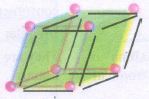
There are seven types of unit cell, Cubic, tetragonal, orthorhombic, hexagonal, monoclinic, triclinic and rhombohedral. They differ in the arrangement of their crystallographic axes and angles.
i) Cubic: a = b = c; α = β = ૪ = 90o.
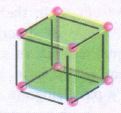
ii) Tetragonal: a = b ≠ c; α = β = ૪ = 90°.
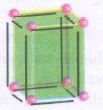
iii) Orthorhombic: a ≠ b ≠ c; α = β = ૪ = 90°.
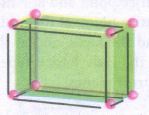
iv) Hexagonal: a = b ≠ c; α = β = 90o, ૪ = 120o.
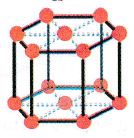
v) Monoclinic: a ≠ b ≠ c; α = ૪ = 90o, β ≠ 90o,
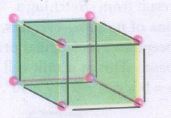
vi) Triclinic: a ≠ b ≠ c; α ≠ β ≠ ૪ ≠ 90o.
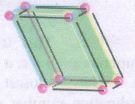
vii) Rhombohedral: a = b = c; α = β = ૪ ≠ 90o.
44.
2KClO3 + 6MnO2 → 6MnO3 + 2KCl
It is an intermediate
6MnO3 → 6MnO2 + 3O2
45.
Addition of electrolytes:
A negative ion causes the precipitation of positively charged sol and vice versa. When the valency of ion is high, the precipitation power is increased.
For example, the precipitation power of some cations and anions varies in the following order
\(\mathrm{Al}^{3+}>\mathrm{Ba}^{2+}>\mathrm{Na}^{+} \text {, Similarly }\left[\mathrm{Fe}\left(\mathrm{CN}_{6}\right)\right]^{3-}>\mathrm{SO}_{4}{ }^{2-}>\mathrm{Cl}^{-}\)
The precipitation power of electrolyte is determined by finding the minimum concentration (millimoles/lit) required to cause precipitation of a sol in 2 hours. This value is called flocculation value. The smaller the flocculation value greater will be precipitation.
46.
a) Primary and secondary nitroalkanes, having α-H, also show an equilibrium mixture of two tautomers namely nitro - and aci - form
.JPG)
b) Difference:
| S.No | Nitro form | Aci - form |
| 1. | Less acidic in nature. | More acidic |
| 2. | Dissolves in NaOH slowly | Dissolves in NaOH instantly |
| 3. | Decolourises FeCl3 solution | With FeCl3 gives reddish brown colour |
| 4. | Electrical conductivity is low | Electrical conductivity is high |
47.
An alcohol:
.JPG)
An alkylhalide:
.JPG)
An alkene:
.JPG)
48.
\(\mathrm{Hg}_{2} \mathrm{Cl}_{2(\mathrm{~s})} \rightleftharpoons \mathrm{Hg}_{2}^{2+} \text { (aq) }+2 \mathrm{Cl^-}_{(\mathrm{aq})}\\ s \quad \quad \quad \quad \quad \quad s \quad \quad \quad \quad \quad 2s\)
\(\mathrm{K}_{\mathrm{sp}} =\left[\mathrm{Hg}_{2}^{2+}\right]{\left[\mathrm{Cl}^{-}\right]^{2}} \)
\(=(\mathrm{s})(2 \mathrm{~s})^{2} \)
\(\mathrm{~K}_{\mathrm{sp}} =4 \mathrm{~s}^{3}\)
49.
Aspirin is o-acetyl salicylic acid
50.
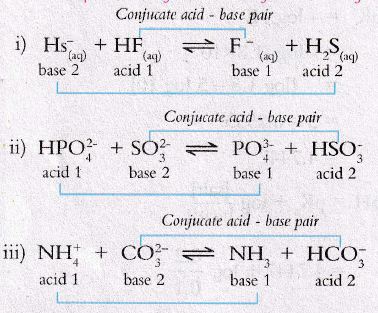
Conjugate Pairs:
\((a) \mathrm{HS}_{\text {(aq) }}^{-} \& \mathrm{H}_{2} \mathrm{~S}_{\text {(aq) }} \) \((b) \mathrm{HF}_{\text {(aq) }} \& \mathrm{~F}_{\text {(aq) }}^{-} \)
\((a) \mathrm{HPO}_{4}^{2-} \& \mathrm{PO}_{4}^{3-} \) \((b) \mathrm{SO}_{3}^{2-} \& \mathrm{HSO}_{3}^{-} \)
\((a) \mathrm{NH}_{4}^{+} \& \mathrm{NH}_{3} \) \((b) \mathrm{CO}_{3}^{2-} \& \mathrm{HCO}_{3}^{-}\)
51.
(i) I Order reaction
(ii) S-1
(iii) \({ t }_{ \frac { 1 }{ 2 } }\) = 0.693/k
52.
No. of atoms of X at the corners = 8 - 1 = 7
(since 1 is missing)
Contribution of X towards unit cell
\(=7\times \frac { 1 }{ 8 } =\frac { 7 }{ 8 } \)
No. of atoms of Y at the face centres = 6
Contribution of Y towards unit cell
= 6 x \(\frac{1}{2}\) = 3
Ratio of X : Y = \(\frac{7}{8}\) : 3 = 7:24
Formula of the compound is X7 Y24.
53.
(i) Zeolites have a three dimensional crystalline structure looks like a honeycomb consisting of a network of interconnected tunnels and cages.
(ii) Water molecules moves freely in and out of these pores hence they are highly porous.
54.
Transition elements have strong tendency to form:
complexes because of two reasons. They are
(i) Small size and high positive charge density.
(ii) Presence of cant (n-1) d orbitals which are of appropriate energy to accept lone pair and unshared pair of electrons from the ligands for bonding with them.
55.
Sodium cyanide and sodium carbonate.
56.
SiO2 is used in the metallurgy of copper to remove FeO as FeSiO3 (slag) (i.e) acidic flux is used to remove basic impurities.
\(FeO+{ SiO }_{ 2 }\longrightarrow { FeSiO }_{ 3 }\)
57.
Chromium (24), the electronic configuration is 3d54s1. It ready to lose its outer most electron (4s1) to get exactly half-filled stable electronic configuration. The electronic configuration of Zinc is 3d104s2.ie., It has completely filled stable configuration. From this configuration, the removal of 1e- from 4s orbital is very difficult & it required more ionisation enthalpy. Due to this reason Zn has higher first Ionisation enthalpy (1.E1) than that of chromium.
58.
Oxidation number of F = -1
Oxidation number of H = +1
Oxidation number of O in HOF =x
(+1) + x + (-1) = 0
x = 0
Oxidation number of O in HOF = 0
59.

B) if both assertion and reason are true but reason is not the correct explanation of assertion.

12th Standard Syllabus & Materials
12th Standard
TN 12th Computer Applications களப்பெயர் முறைமை (DNS) Sample Question Papers Study Material - QB365 Set A
NEW12th Standard
TN 12th Computer Applications வலையமைப்பு எடுத்துக்காட்டுகள் மற்றும் நெறிமுறைகள் Sample Question Papers Study Material - QB365 Set A
NEW12th Standard
TN 12th Computer Applications கணினி வலையமைப்பு ஓர் அறிமுகம் Sample Question Papers Study Material - QB365 Set A
NEW12th Standard
TN 12th Computer Applications PHP-உடன் MySQL-ஐ இணைத்தல் Sample Question Papers Study Material - QB365 Set A



Tamilnadu Stateboard 12th Standard Subjects

Maths
Chemistry

Physics

Biology

Computer Science

Business Maths and Statistics

Economics

Commerce

Accountancy

History

Computer Applications
Biology
Computer Technology
Computer Applications
Computer Science
Business Maths and Statistics
Commerce
Economics
Maths
Chemistry
Physics
Computer Technology
History
Accountancy

Tamil

English

French
Tamilnadu Stateboard Standards
