
 100% FREE ACCESS
12th Standard Syllabus & Materials
12th Standard
TN 12th Computer Applications மின்னணு தரவு பரிமாற்றம் Sample Question Papers Study Material - QB365 Set A
NEW12th Standard
TN 12th Computer Applications மின் - வணிக பாதுகாப்பு அமைப்புகள் Sample Question Papers Study Material - QB365 Set A
NEW12th Standard
TN 12th Computer Applications மின்னணு செலுத்தல் முறைகள் Sample Question Papers Study Material - QB365 Set A
NEW12th Standard
TN 12th Computer Applications மின் - வணிகம் Sample Question Papers Study Material - QB365 Set A
NEW12th Standard
TN 12th Computer Applications திறந்த மூல கருத்துருக்கள் Sample Question Papers Study Material - QB365 Set A
NEW12th Standard
TN 12th Computer Applications வலையமைப்பு வடமிடல் Sample Question Papers Study Material - QB365 Set A

Published on: 27/01/2021
12th Standard Chemistry English Medium Reduced Syllabus Important Questions with Answer key - 2021 Part - 2
Download Tamil Nadu 12th Standard Chemistry question papers, model tests, one-mark questions, important questions, and public exam papers in PDF format. Free study materials and answer keys for TN State Board students.
Questions + Answers key
Take MCQ Chemistry Test
1.
In the reaction sequence, Ethane \(\overset { HOCl }{ \longrightarrow } A\overset { x }{ \longrightarrow } \) ethan -1, 2 - diol. A and X respectively are ________.
Chloroethane and NaOH
ethanol and H2SO4
2 – chloroethan -1-ol and NaHCO3
ethanol and H2O
2.
| Electrolyte | KCl | KNO3 | HCl | NaOAC | NaCl |
| Λ- (Scm2 mol-1) |
149.9 | 145.0 | 426.2 | 91.0 | 126.5 |
Calculate ΛoHoAC using appropriate molar conductances of the electrolytes listed above at infinite dilution in water at 25oC_______.
517.2
552.7
390.7
217.5
3.
Equal volumes of three acid solutions of pH 1,2 and 3 are mixed in a vessel. What will be the H+ ion concentration in the mixture?
3.7 × 10⁻²
10-6
0.111
none of these
4.
\({ Zn }_{ (s) }+2\left[ Au(CN)_{ 2 } \right] ^{ - }_{ (aq) }\longrightarrow \left[ Zn(CN)_{ 4 } \right] ^{ 2- }_{ (aq) }+2A{ { u }_{ (s) } }\) In the above equation the oxidation state of metallic gold is_______
1
0
+2
-2
5.
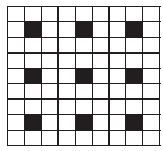
A two dimensional solid pattern formed by two different atoms X and Y is shown below. The black and white squares represent atoms X and Y respectively. The simplest formula for the compound based on the unit cell from the pattern is _______.
XY8
X4Y9
XY2
XY4
6.
If ‘a’ is the length of the side of the cube, the distance between the body centered atom and one corner atom in the cube will be_________.
\(\left( \cfrac { 2 }{ \sqrt { 3 } } \right) a\)
\(\left( \cfrac { 4 }{ \sqrt { 3 } } \right) a\)
\(\left( \cfrac { \sqrt { 3 } }{ 4 } \right) a\)
\(\left( \cfrac { \sqrt { 3 } }{ 2 } \right) a\)
7.
On oxidation with iodine, sulphite ion is transformed to _______.
S4O62-
S2O62-
SO42-
SO32-
8.
Most easily liquefiable gas is _______.
Ar
Ne
He
Kr
9.
The repeating unit in silicone is_______.
SiO2
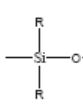
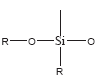
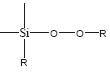
10.
Which of the following metals has the largest abundance in the earth’s crust?
Aluminium
Calcium
Magnesium
Sodium
11.
In the Ellingham diagram, for the formation of carbon monoxide________.
\(\left( \cfrac { \Delta { S }^{ 0 } }{ \Delta T } \right) \) is negative
\(\left( \cfrac { \Delta { G }^{ 0 } }{ \Delta T } \right) \) is positive
\(\left( \cfrac { \Delta { G }^{ 0 } }{ \Delta T } \right) \) is negative
initially \(\left( \cfrac { \Delta T }{ \Delta { G }^{ 0 } } \right) \) is positive, after 700oC,\(\left( \cfrac { \Delta { G }^{ 0 } }{ \Delta T } \right) \) is negative
12.
13.
Electrochemical process is used to extract_______.
Iron
Lead
Sodium
silver
14.
Which one of the following reaction represents calcinations?
\(2Zn+{ O }_{ 2 }\rightarrow 2ZnO\)
\(2ZnS+3O_{ 2 }\rightarrow 2ZnO+2SO_{ 2 }\)
\(MgCO_{ 3 }\rightarrow MgO+CO_{ 2 }\)
Both (a) and (c)
15.
What is 'spirit of nitre'? Give its use.
16.
\({ C }_{ 2 }{ H }_{ 3 }N\xrightarrow [ Ether ]{ LiAl/{ H }_{ 4 } } B\underrightarrow { HN{ O }_{ 2 } } \) Identify A, B and C.
17.
What is glacial acetic acid? How is it obtained.
18.
How is the conversion of acetonitrile to acetic acid effected?
19.
Convert hex-4-ennitrileto hex-4-enal.
20.
How will you distinguish between formaldehyde and acetaldehyde?
21.
How will you distinguish between aniline and ethylamine.
22.
Complete the following:
(i) 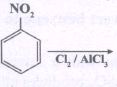
(ii) 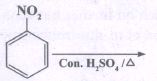
23.
The sucrose that we eat in daily life is converted into glucose and fructose. Name the enzyme which facilitates this chemical reaction.
24.
Name the two constituent of starch.
25.
How are disaccharides classified? Give example.
26.
What is the main function of tRNA?
27.
The two strands in DNA are not identical but are complementary explain.
28.
Define nucleotide.
29.
Arrange the following in the decreasing order of order of acid strength.

30.
What is metamerism? Give the structure and IUPAC name of metamers of 2-methoxy propane
31.
32.
Complete the following reactions.
a. \(B(OH)_3 + NH_3\longrightarrow \)
b. \(Na_{ 2 }B_{ 4 }{ O }_{ 7 }+{ { H }_{ 2 }{ SO }_{ 4 }+{ 5H }_{ 2 }O\longrightarrow }\)
c. \({ B }_{ 2 }{ H }_{ 6 }+2NaOH+2{ H }_{ 2 }O\longrightarrow \)
d. \({ B }_{ 2 }{ H }_{ 6 }+6{ CH }_{ 3 }OH\longrightarrow \)
e. \(4{ BF }_{ 3 }+3{ H }_{ 2 }O\longrightarrow \)
f. \(HCOOH+{ H }_{ 2 }{ SO }_{ 4 }\longrightarrow \)
g. \(2SiCl_{ 4 }+NH\)3
h. SiCl4 + 4C2H5OH \(\rightarrow\)
i. 2\(B+6NaOH\longrightarrow \)
j. \({ H }_{ 2 }{ B }_{ 4 }{ O }_{ 7 }\overset { Red\ hot }{ \rightarrow } \)
33.
Give one example for each of the following
(i) icosogens
(ii) Tetragens
(iii) pnictogens
(iv) chalcogens
34.
Give the basic requirement for vapour phase refining.
35.
Compound A with molecular formula C7H6O reduces Tollen's reagent and also gives Cannizaro reaction. A on oxidation gives the compound B with molecular formula C7H6O2 Calcium salt of B on dry distillation gives the compound C with molecular formula CI3H10O. Find A, B and C. Explain the reaction.
36.
How will acetic anhydride react with the following reagents?
(i) HOH
(ii) C2H5OH
37.
Illustrate the reducing property of acetaldehyde with examples
38.
Give the uses of carbohydrates.
39.
Styrene polymerises to polystyrene when heated in the presence of peroxide initiator.
(i) What is the mechanism involved?
(ii) Give the initiation step for the above process.
(iii) How does the chain propogate in the above mechanism?
(iv) How is the above chain reaction terminated?
40.
Explain Receptor as drug targets.
41.
Account for the following:
(i) Nitroethane is soluble NaOH
(ii) Nitroethane reacts with nitrous acid
(iii) 2-methyl-2-nitro propane has neither of the properties.
42.
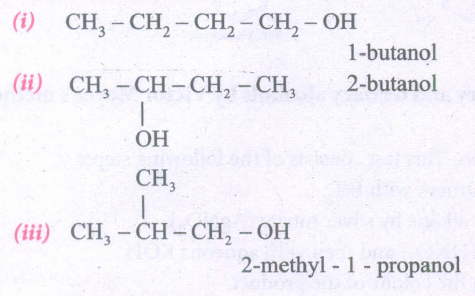
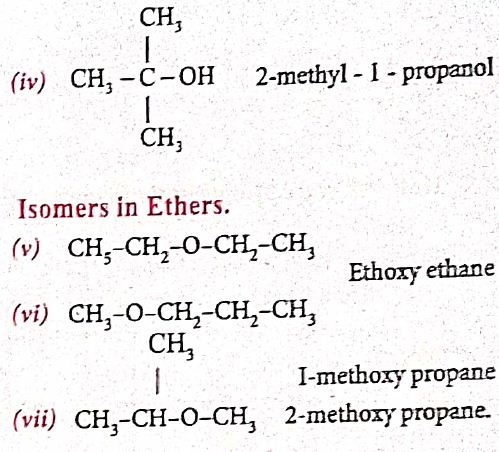
Write all possible isomers with molecular formula C4H10O and name them.
43.
An organic compound A of molecular formula C3H6O on reduction with LiAlH4 gives B. Compound B gives blue colour in Victor Meyer's test and also forms a chloride C with SOCl2. The chloride on treatment with alcoholic KOH gives D. Identify A, B, C and D and explain the reactions.
44.
Write the characteristics of catalysts.
45.
If E1 = 0.5 V corresponds to Cr3++ 3e- ➝ Cr(s) and E2 = 0.41V corresponds to Cr3++ e- ➝ Cr2+ reactions, calculate the emf (E3) of the reaction Cr2++ 2 e- ➝ Cr(s)
46.
Calculate the pH of 0.1 M NH4OH if Kb = 1.75 x 10⁻⁵
47.
Arrange the following
i. In increasing order of solubility in water, C6H5 NH2, (C2H5)2NH, C2H5NH2
ii. In increasing order of basic strength
a) aniline, p- toludine and p – nitroaniline
b) C6H5 NH2, C6H5 NHCH3, C6H5NH2, p-Cl-C6- H4-NH2
iii. In decreasing order of basic strength in gas phase
(C2H5)NH2, (C2H5)NH, (C2H5)5N and NH3
iv. In increasing order of boiling point
C6H5OH, (CH3)2NH, C2H5NH2
v. In decreasing order of the pKb values
C2H5NH2, C6H5NHCH3.(C2H5)2 NH and CH3NH2
vi. Increasing order of basic strength
C2H5NH2,C6H5N(CH3)2, (C2H5)2 NH and CH3NH2
vii. In decreasing order of basic strength

48.
What are drugs? How are they classified.
49.
What are stoichiometric defects in ionic solids? Explain
50.
Give the structure for the following compounds.
(i) pentaamminechlorocobalt (III) ion
(ii) Triamminetrinitrito- k N cobalt (III)
(ill) tetraammineaquabromidooobalt(III)nitrate
(iv) Dichloridobisethane-(1,2-diamine) cobalt (lIl) chloride
(v) Tetraamminecopper (lI) sulphate
51.
Give the difference between double salts and coordination compounds.
52.
How will you prepare propan – 1- amine from
i) butane nitrile
ii) propanamide
ii) 1- nitropropane
53.
Arrange the following solutions in the decreasing order of specific conductance.
i) 0.01M KCl
ii) 0.005M KCl
iii) 0.1M KCl
iv) 0.25M KCl
v) 0.5M KCl
54.
Derive an expression for the hydrolysis constant and degree of hydrolysis of salt of strong acid and weak base.
55.
Calculate the pH of 1.5\(\times\)10-3 M solution of Ba(OH)2
56.
A first order reaction takes 8 hours for 90% completion. Calculate the time required for 80% completion. (log 5 = 0.6989 ; log10 = 1)
57.
Rate constant of a first order reaction is 0.45 sec-1, calculate its half life.
58.
The rate of formation of a dimer in a second order reaction is 7.5 x 10⁻³ mol L-1 s-1 at 0.05 mol L-1 monomer concentration. Calculate the rate constant.
59.
Compare lanthanoids and actinoids.
60.
1.
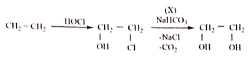
2.
(ΛoHoAC) = [(Λo)HCl + Λo)NaOAC ] - (Λo)NaCl
= (426.2 + 91) - (126.5)
= 390.7
3.
pH = -log10 [H+]
∴ [H+] = 10-pH
Let the volume be x ml.
V1M1 +V2M2 +V3M3 = VM
∴ x ml of 10-1 M+ x ml of 10-2 M + x ml of 10-3 M
= 3 x ml of [H+]
\(∴ [H^+] = \frac{ x[0.1 + 0.01 + 0.001]}{3x}\)
\(= \frac{ [0.1 + 0.01 + 0.001]}{3}\)
\(= \frac{ [0.111]}{3}\)
= 0.037
= 3.7 x 10⁻²
4.
(b)
0
5.
(a)
XY8
6.
If a is the length of the side, then the length of the leading diagonal passing through the body centered atom is \(\sqrt{3a} \)
Required distance = \(\left( \cfrac { \sqrt { 3 } }{ 2 } \right) a\)
7.
(c)
SO42-
8.
(d)
Kr
9.
(b)
10.
(a)
Aluminium
11.
(c)
\(\left( \cfrac { \Delta { G }^{ 0 } }{ \Delta T } \right) \) is negative
12.
(c)
13.
(c)
Sodium
14.
(c)
\(MgCO_{ 3 }\rightarrow MgO+CO_{ 2 }\)
15.
4% solution of ethylnitrite in alcohol is known as sweet spirit of nitre and in used as diuretic.
16.

17.
Pure acetic acid is called glacial acetic acid. Because it forms ice like crystal when cooled. When aqueous acetic acid is cooled at 289.5 K, acetic acid solidifies and forms ice like crystals, where as water remains in liquid state and removed by filtration. This process is repeated to obtain glacial acetic acid.
18.
Acetonitrile (CH3CN) is hydrolysed with aqueous acid or alkali to get acetic acid.
\(\\ \\ \underset { Methylcyanide\\ \quad \quad (or)\\ Acetonitrile }{ { CH }_{ 3 }-C\equiv N+{ H }_{ 2 }O } \longrightarrow \underset { Acetamide }{ { CH }_{ 3 }-\underset { \overset { || }{ O } }{ C } -{ NH }_{ 2 } } \overset { { H }_{ 2 }O }{ \longrightarrow } \underset { Acetic\ acid }{ { CH }_{ 3 }COOH+{ NH }_{ 3 } } \)
19.
Diisobutyl aluminium hydride (DIBAL -H) selectively reduces the alkyl cyanides to form imines which on hydrolysis gives aldehydes.
Example :
\(\underset { hex-4-ennitrile }{ { CH }_{ 3 }-CH=CH-{ CH }_{ 2 }-{ CH }_{ 2 }-CN } \overset { i)AIH\left( t-bu \right) _{ 2 } }{ \underset { ii){ H }_{ 2 }o }{ \longrightarrow } } \underset { hex-4-enal }{ { CH }_{ 3 }-CH=CH-{ CH }_{ 2 }-CHO } \)
20.
| Formaldehyde | acetaldehyde | |
|---|---|---|
| 1. | It does not undergo iodoform reaction with I2+NaOH | It undergo iodoform reaction with I2+NaOH |
| 2. | It undergoes Cannizzaro reaction with alkaline solution. | It undergoes Aldol condensation with alkaline solution. |
21.
| S.No. | Aniline | Ethylamine |
| i. | Reaction with nitrous acid gives diazonium salt | Reaction with nitrous acid gives ethyl acohol. |
| ii. | Treatment with bromine water, decolourisation of bromine takes place with the formation of white precipitate. | It does not form precipitate with bromine water. |
22.
(i) 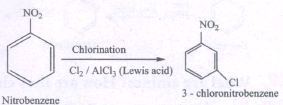
(ii) 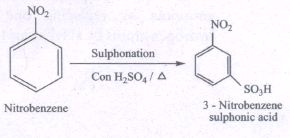
23.
Invertase or sucrose :
\(\underset { Sucrose }{ { C }_{ 12 }{ H }_{ 22 }{ O }_{ 11 } } +{ H }_{ 2 }O\overset { Invertase }{ \underset { orSucrose }{ \longrightarrow } } \underset { Glucose }{ { C }_{ 6 }{ H }_{ 12 }{ O }_{ 6 } } +\underset { Frutose }{ { C }_{ 6 }{ H }_{ 12 }{ O }_{ 6 } } \)
24.
Starch consists of two fraction
(i) amylose and
(ii) amylopectin
25.
(i) Disaccharides linked through C1 of the first to C4 or C6 of the second component are called reducing sugar. Eg: Lactose.
(ii) Disaccharides linked through the glycosidic carbon atoms of each component C1 of glucose to C2 of fructose are nonreducing disaccharides. Eg: Sucrose
26.
The function of tRNA is to carry amino acids to the sites of protein synthesis on ribosomes.
27.
In the helical structure of DNA, the two strands are held together by hydrogen bonds between specific pair of bases. Cytosine forms hydrogen bond with guanine while adenine forms hydrogen bonds with thymine. As a result the two strands are complementary to each other.
28.
Nucleotides are monomers of nucleic acid, They consist of heterocyclic base, pentose sugar and phosphoric acid residue.
29.

30.
Ethers having same molecular formula, but alkyl groups attached to the oxygen atom are different. This phenomenon is known as metamerism.
Metamers of 2- methoxy propane
\(\mathrm{C}_{2} \mathrm{H}_{5}-\mathrm{O}-\mathrm{C}_{2} \mathrm{H}_{5}-\) diethyl ether
\(\mathrm{CH}_{3}-\mathrm{O}-\mathrm{CH}_{2}-\mathrm{CH}_{2}-\mathrm{CH}_{3}\) methyl n-propyl ether
31.
32.
(a) B(OH)3 + NH3\(\overset { \Delta }{ \longrightarrow } \) BN + 3H2O
(Boron nitride)
(b) Na2B4O7 + H2SO4 + 5H2O \(\longrightarrow \) 4H3BO3 + Na2SO4
(Boric acid)
(c) B2H6 + 2NaOH + 2H2O \(\longrightarrow \)2NaBO2 + 6H2
(Sodium metaborate)
(d) B2H6 + 6CH3OH \(\longrightarrow \)2B(OCH3)3 + 6H2O
(Trimethyl borate)
(e) 4BF3 + 3H2O \(\longrightarrow \) H3BO3 + 3H+ + 3[BF4]-
(Boric acid)
(f) HCOOH + H2SO4 \(\longrightarrow \)CO + H2SO4. H2O
(Carbon monoxide)
(g) 2SiCl4 + NH3 \(\overset { 330K }{ \underset { ether }{ \longrightarrow } } \)Cl3Si- NH - SiCl3 + 2HCl
(Chlorosilazane)
(h) SiCl4 + 4C2H5OH\(\longrightarrow \)Si(OC2H5)4 + 4HCI
(Tetraethoxysilane)
(i) 2B + 6NaOH\(\longrightarrow \) 2Na3BO3 + 3H2
(j) H2B4O7 \(\xrightarrow[]{Redhot}\) 2B2O3 + H2O
33.
(i) Icosogens → B, Al, Ga, In, Tl
(ii) Tetragens → C, Si, Ge, Sn, Pb
(iii) Pnictogens → N, P, As, Sb, Bi
(iv) Chalcogens → O, S, Se, Te, Po
34.
In this method, the metal is treated with a suitable reagent which can form a volatile compound with the metal.
Then the volatile compound is decomposed to give the pure metal.
35.
(i) An organic compound (A) is identified as C6H5CHO benzaldehyde. Benzaldehyde reduces Tollen'sreagent and also undergoes.
Cannizaro reaction:
\(\\ \underset { (A) }{ { C }_{ 6 }{ H }_{ 5 }CHO } +{ Ag }_{ 2 }O\longrightarrow 2Ag+{ C }_{ 6 }{ H }_{ 5 }COOH\)
Cannizaro reaction:
\({ C }_{ 6 }{ H }_{ 5 }CHO+{ C }_{ 6 }{ H }_{ 5 }CHO\overset { NaOH }{ \longrightarrow } { C }_{ 6 }{ H }_{ 5 }{ OH }OH+\underset { (B) }{ { C }_{ 6 }{ H }_{ 5 }COOH } \)
(ii) Benzaldehyde on oxidation gives Benzoic acid C6H5COOH and it is (B).
\({ C }_{ 6 }{ H }_{ 5 }CHO\overset { (O) }{ \longrightarrow } \underset { (B) }{ { C }_{ 6 }{ H }_{ 5 }COOH } \)
(iii) Calcium salt of benzoic acid (calcium benzoate) on dry distillation gives benzophenone C6HsCOC6Hs as (C).
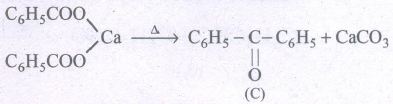
| Compound | Compound Name | Formula |
|---|---|---|
| A | Benzaldehyde | C6H3CHO |
| B | Benzoic acid | C6HsCOOH |
| C | Benzophenone | \(\underset { (C) }{ { C }_{ 6 }{ H }_{ 5 }-\underset { \overset { || }{ O } }{ C } -{ C }_{ 6 }{ H }_{ 5 } } \) |
36.
(i) Hydrolysis: Acid anhydride are slowly hydrolysed, by water to form corresponding carboxylic acids.
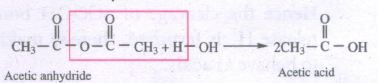
(ii) Reaction with alcohol:
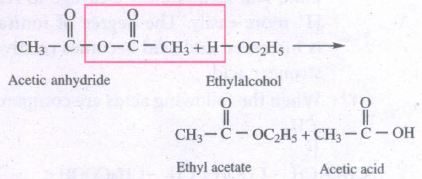
37.
\(\underset { Acetaldehyde }{ { CH }_{ 3 }-\underset { \overset { || }{ O } }{ C } -H+4(H) } \overset { { NH }_{ 2 }{ NH }_{ 2 } }{ \underset { { C }_{ 2 }{ H }_{ 5 }ONa }{ \longrightarrow } } \underset { Ethane }{ { CH }_{ 3 }-{ CH }_{ 3 }+{ H }_{ 2 }O+{ N }_{ 2 } } \)
(i) Clemmensen reduction: Aldehydes and Ketones when heated with zinc amalgam and concentrated hydrochloric acid gives hydrocarbons.
Example:
\(\underset { Acetald4ehyde }{ { CH }_{ 3 }-\underset { \overset { || }{ O } }{ C } -{ H }^{ + }4(H) }
\overset { Zn^{ - }Hg }{ \underset { Conc.HCl }{ \longrightarrow } }
\underset {Ethane}{{ CH }_{ 3 }-{ CH }_{ 3 }\pm { H }_{ 2 }O}\)
\(\underset { Acetone }{ { CH }_{ 3 }-\underset { \overset { || }{ O } }{ C } -{ CH }_{ 3 }+4\left( H \right) } \overset { { Zn }^{ - }Hg }{ \underset { Conc.HCl }{ \longrightarrow } } { CH }_{ 3 }{ CH }_{ 2 }{ CH }_{ 3 }+{ H }_{ 2 }O\)
(ii) Wolff-Kishner Reduction: Aldehydes and Ketones when heated with hydrazine (NH2NH2) and sodium ethoxide, hydrocarbons are formed Hydrazine acts as a reducing agent and sodium ethoxide as a catalyst.
Example :
\(\underset { Acetaldehyde }{ { CH }_{ 3 }-\underset { \overset { || }{ O } }{ C } -H+4(H) } \overset { { NH }_{ 2 }{ NH }_{ 2 } }{ \underset { { C }_{ 2 }{ H }_{ 5 }ONa }{ \longrightarrow } } \underset { Ethane }{ { CH }_{ 3 }-{ CH }_{ 3 }+{ H }_{ 2 }O+{ N }_{ 2 } } \)
\(\underset { Acetone }{ { CH }_{ 3 }-\underset { \overset { || }{ O } }{ C } -{ CH }_{ 3 }+4(H) } \overset { { NH }_{ 2 }{ NH }_{ 2 } }{ \underset { { C }_{ 2 }{ H }_{ 5 }ONa }{ \longrightarrow } } { CH }_{ 3 }{ CH }_{ 2 }{ CH }_{ 3 }+{ H }_{ 2 }O+{ N }_{ 2 }\)
Aldehyde (or) ketones is first converted to its hydrazone which on heating with strong base gives hydrocarbons.
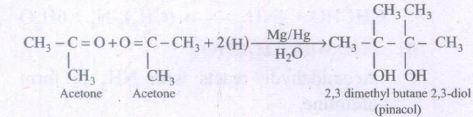
(iii) Reduction to pinacols: Ketones, on reduction with magnesium amalgam and water, are reduced to symmetrical diols known as pinacol.
38.
Importance of carbohydrates:
(i) Carbohydrates, widely distributed in plants and animals, acts mainly as energy sources and structural polymers.
(ii) Carbohydrate is stored in the body as glycogen and in plant as starch.
(iii) Carbohydrates such as cellulose which is the primary components of plant cell wall, is used to make paper, furniture (wood) and cloths (cotton)
(iv) Simple sugar glucose serves as an instant source of energy.
(v) Ribose sugars are one of the components of nucleic acids.
(vi) Modified carbohydrates such as hyaluronate (glycosaminoglycans) act as shock absorber and lubricant.
39.
(i) Free radical polymerisation.
(ii) Styrene polymerises to polystyrene when it is heated to ionic with a peroxide initiator. The mechanism involves the following steps.

(iii) Propagation step
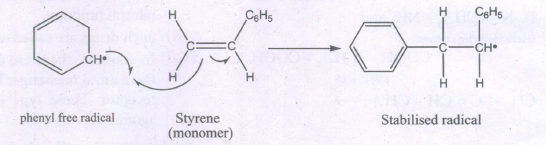
The stabilized radical attacks another monomer molecule to give an elongated radical.

Chain growth will continue with the successive addition of several thousands of monomer units.
(iv) The above chain reaction can be stopped by stopping the supply of monomer or by coupling of two chains or reaction with an impurity such as oxygen.

40.
(i) Many drugs exert their physiological effects by binding to a specific molecule called a receptor whose role is to trigger a response in a cell.
(ii) The chemical messengers, bind to the active site of these receptors. This brings about the transfer of message into the cell.
(iii) The chemical messengers bind to the active site of these receptors.
(iv) This brings about the transfer of message into the cell
(v) These receptors show high selectivity.
(vi) If we want to block a message, a drug that binds to the receptor site should inhibit its natural function.
(vii) Such drugs are called antagonists.
(viii) In contrast, there are drugs which mimic the natural messenger by switching on the receptor. These type of drugs are called agonists.
41.
(i) Nitroethane exhibits tautomerism of nitro form and aci form. Aciform of nitroethane contains (α - Hydrogen) replaceable hydrogen atom. Hence it dissolves in sodium hydroxide solution forming salt like compounds.
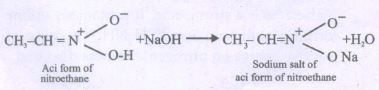
(ii) CH3CH2NO2 has two a-hydrogen and that reacts with HNO2
(iii) 2-methyl - 2 - nitro propane neither soluble in alkali nor reacts with nitrous acid. Because it contains a tertiary nitro group where aciform is not possible and . it does not contain α - H atoms. So it has neither of the properties.
42.
43.
(i) Compound (A) is carbonyl compound, it is acetone
(ii) (A) on reduction with LiAlH4 gives (B) it gives blue colour in Victor Meyer'stest.
\({ CH }_{ 3 }-\underset { \overset { || }{ \underset { (A) }{ O } } }{ C } -{ CH }_{ 3 }\overset { { LiAIH }_{ 4 } }{ \underset { \left[ H \right] }{ \longrightarrow } } { CH }_{ 3 }-{ CH }_{ 3 }-\underset { \overset { | }{ \underset { (B) }{ OH } } }{ CH } -{ CH }_{ 3 }\)
(iii) (B) reacts with SOCl2to give (C).
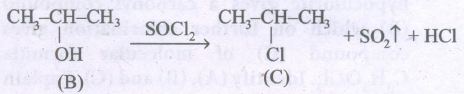
(iv) (C) on treatment with alcoholic KOH, forms (D) by elimination reaction.
\({ CH }_{ 3 }-\underset { \overset { | }{ \underset { (C) }{ Cl } } }{ C } H-{ CH }_{ 3 }\overset { alc.KOH }{ \longrightarrow } \underset { (D) }{ { CH }_{ 3 }CH={ CH }_{ 2 }+HCl } \)
| Compound | Compound Name | Formula |
| A | Acetone | \({ CH }_{ 3 }-\underset { \overset { || }{ O } }{ C } -{ CH }_{ 3 }\) |
| B | Isopropyl alcohol | \({ CH }_{ 3 }-\underset { \overset { | }{ OH } }{ CH } -{ CH }_{ 3 }\) |
| C | Isopropyl chloride | \({ CH }_{ 3 }-\underset { \overset { | }{ Cl } }{ CH } -{ CH }_{ 3 }\) |
| D | Propylene | CH3-CH=CH2 |
44.
(i) For a chemical reaction, catalyst is needed in very small quantity.
(ii) There may be some physical changes, but the catalyst remains unchanged in mass and chemical composition in a chemical reaction.
(iii) A catalyst itself cannot initiate a reaction.
(iv) A solid catalyst will be more effective if it is taken in a finely divided form.
(v) A catalyst are specific in nature.
(vi) In an equilibrium reaction, presence of catalyst reduces the time for attainment of equilibrium and hence it does not affect the position of equilibrium and the value of equilibrium constant.
(vii) A catalyst is highly effective at a particular temperature called as optimum temperature.
(viii) Presence of a catalyst generally does not change the nature of products
45.
Given:
E1 = 0.5 V
Cr3++ 3e- ➝ Cr(s).......(1)
E2 = 0.41 V
Cr3++ e- ➝ Cr2+ .....(2)
The required reaction is,
Cr2++ 2 e- ➝ Cr(s)
Then,
Formula:
\({ E }_{ 3 }=\frac { 3{ E }_{ 1 }+{ E }_{ 2 } }{ 2 } \)
Solution:
= \(\frac { 3(0.5)+(0.41) }{ 2 } =\frac { 1.5+0.41 }{ 2 } \)
= 0.955 V
E3 = 0.955 V
46.
Degree if dissociation \(\alpha =\sqrt { \frac { K_{ a } }{ C } } ,C\alpha =\sqrt { { K }_{ a }.C } \)
∴ \(pOH=\log\frac { 1 }{ \sqrt { { K }_{ b }.C } } =\log\frac { { 10 }^{ 3 } }{ \sqrt { 1.75\times { 10 }^{ -5 }\times .1 } } \)
\(=\log\frac { 1 }{ \sqrt { 1.75\times { 10 }^{ -6 } } } =\log\frac { { 10 }^{ 3 } }{ \sqrt { 1.75 } } \)
\(=3-\frac { 1 }{ 2 } \log1.75\)
\(=3-\frac { 1 }{ 2 } \times 0.2430=2.8785\)
pH = 14 - pOH
∴ pH = 14 - 2.8785 = 11.1215
Alternating,
\(\left[ { H }^{ - } \right] =\sqrt { { K }_{ b }\times C } \)
\(=\sqrt { 1.75\times { 10 }^{ -5 }\times 0.1 } =\sqrt { 1.75\times { { 10 }^{ -6 } } } \)
= 1.322 x 10⁻³
∴ pOH = - log [H+] = - log (1.323 x 10⁻³)
3 - 0.1216 = 2.8784
∴ pH = 14 - pOH = 14 - 2.8784 = 11.1216
47.
i) In increasing order of solubility in water:
\(\mathrm{C}_{6} \mathrm{H}_{5} \mathrm{NH}_{2},\left(\mathrm{C}_{2} \mathrm{H}_{5}\right)_{2} \mathrm{NH}, \mathrm{C}_{2} \mathrm{H}_{5} \mathrm{NH}_{2} \)
\(\mathrm{C}_{2} \mathrm{H}_{5} \mathrm{NH}_{2}>\mathrm{C}_{6} \mathrm{H}_{5} \mathrm{NH}_{2}>\left(\mathrm{C}_{2} \mathrm{H}_{5}\right)_{2} \mathrm{NH}\)
ii) In increasing order of basic strength:
a. Aniline, p - toluidine and p - nitro aniline
p - toluidine > aniline >p - nitro aniline
.JPG)
b. \(\mathrm{C}_{6} \mathrm{H}_{5} \mathrm{NH}_{2}, \mathrm{C}_{6} \mathrm{H}_{5} \mathrm{NHCH}_{3}, \mathrm{p}-\mathrm{Cl}-\mathrm{C}_{6} \mathrm{H}_{4}-\mathrm{NH}_{2} \)
\(\mathrm{C}_{6} \mathrm{H}_{5} \mathrm{NHCH}_{3}>\mathrm{C}_{6} \mathrm{H}_{5} \mathrm{NH}_{2}>\mathrm{p}-\mathrm{Cl}-\mathrm{C}_{6} \mathrm{H}_{4}-\mathrm{NH}_{2}\\ 2^{o} \text { amine } \quad \quad \quad \quad e^{\ominus} \text { with drawing (group) }\)
(iii) In decreasing order of basic strength in gas phase:
\(\mathrm{C}_{2} \mathrm{H}_{5} \mathrm{NH}_{2},\left(\mathrm{C}_{2} \mathrm{H}_{5}\right) \mathrm{NH},\left(\mathrm{C}_{2} \mathrm{H}_{5}\right)_{3} \mathrm{~N} \text { and } \mathrm{NH}_{3} \)
\(\mathrm{NH}_{3}<\mathrm{C}_{2} \mathrm{H}_{5} \mathrm{NH}_{2}<\left(\mathrm{C}_{2} \mathrm{H}_{5}\right)_{2} \mathrm{~N}<\left(\mathrm{C}_{2} \mathrm{H}_{5}\right)_{3} \mathrm{NH}\\ \quad \quad \quad 1^{0} \text { amine } \quad 2^{0} \text { amine } \quad \quad \quad 3^{0} \text { amine }\)
(iv) In increasing order of boiling point:
\(\mathrm{C}_{6} \mathrm{H}_{5} \mathrm{OH},\left(\mathrm{CH}_{3}\right)_{2} \mathrm{NH}, \mathrm{C}_{2} \mathrm{H}_{5} \mathrm{NH}_{2} \)
\(\left(\mathrm{CH}_{3}\right)_{2} \mathrm{NH}>\mathrm{C}_{2} \mathrm{H}_{5} \mathrm{NH}_{2}>\mathrm{C}_{6} \mathrm{H}_{5} \mathrm{OH} \\ 2^{0} \text { amine } \quad \quad1^{0} \text { amine }\)
Generally amines have lower boiling point than alcohol. Due to comparable molecular mass and weaker H-bonds in Amines.
(v) In decreasing order of the pKb values:
\( \mathrm{C}_{2} \mathrm{H}_{5} \mathrm{NH}_{2}, \mathrm{C}_{6} \mathrm{H}_{5} \mathrm{NHCH}_{3},\left(\mathrm{C}_{2} \mathrm{H}_{5}\right)_{2} \mathrm{NH} \text { and } \mathrm{CH}_{3} \mathrm{NH}_{2} \)
\(\left(\mathrm{C}_{2} \mathrm{H}_{5}\right)_{2} \mathrm{NH}<\mathrm{C}_{2} \mathrm{H}_{5} \mathrm{NH}_{2}<\mathrm{CH}_{3} \mathrm{NH}_{2}<\mathrm{C}_{6} \mathrm{H}_{5} \mathrm{NHCH}_{3} \)
\(\quad \quad \quad 2^{0} \text { amine } \quad 1^{0} \text { amine } 1^{0} \text { amine } \quad 2^{0} \text { amine } \)
\(\mathrm{PK}_{b}: \quad 3.00\quad < \quad 3.29 \quad < \quad 3.38 \quad<\quad 9.30\)
pKb ,Due to + 1 effect of C2H5 group. Higher the value of pKb lower is the basicity
(vi) Increasing Order of basic strength:
\(\mathrm{C}_{6} \mathrm{H}_{5} \mathrm{NH}_{2}, \mathrm{C}_{6} \mathrm{H}_{5} \mathrm{~N}\left(\mathrm{CH}_{3}\right)_{2},\left(\mathrm{C}_{2} \mathrm{H}_{5}\right)_{2} \mathrm{NH} \text { and } \mathrm{CH}_{3} \mathrm{NH}_{2} \)
\(\mathrm{C}_{6} \mathrm{H}_{5} \mathrm{NH}_{2}>\mathrm{C}_{6} \mathrm{H}_{5} \mathrm{~N}\left(\mathrm{CH}_{3}\right)_{2}>\mathrm{CH}_{3} \mathrm{NH}_{2}>\left(\mathrm{C}_{2} \mathrm{H}_{5}\right)_{2} \mathrm{NH} \\ \left(\mathrm{pK}_{6}: 9.38 \quad > \quad \quad 8.92 \quad \quad > \quad 3.38 \quad > \quad \quad 3.00\right)\)
Due to + 1 effect of C2H5 group.
In decreasing order of basic strength:
.JPG)
48.
A drug is a substance that is used to modify or explore physiological systems or pathological states for the benefit of the recipient. It is used for the purpose of diagnosis, prevention, cure/relief of a disease.
a) Classification of drugs:
Drugs are classified based on their properties such as chemical structure, pharmacological effect, target system, site of action etc.
b) Classification based on the chemical structure:
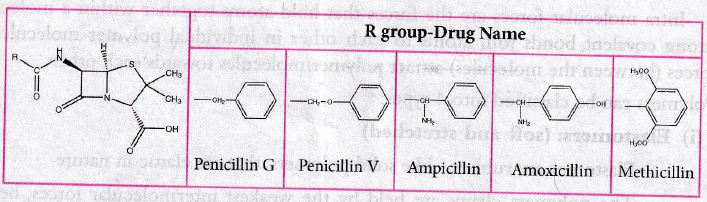
In this classification, drugs with a common chemical skeleton are classified into a single group. For example, ampicillin, amoxicillin, methicillin etc.. all have similar structure and are classified into a single group called penicillin. Similarly, we have other group of drugs such as opiates, steroids, catecholamines etc. Compounds having similar chemical structure are expected to have similar chemical properties. However, their biological actions are not always similar. For example, all drugs belonging to penicillin group have same biological action, while groups such as barbiturates, steroids etc.. have different biological action.
Penicillins
Classification based on Pharmacological effect:
In this classification, the drugs are grouped based on their biological effect that they produce on the recipient. For example, the medicines that have the ability to kill the pathogenic bacteria are grouped as antibiotics. This kind of grouping will provide the full range of drugs that can be used for a particular condition (disease). The physician has to carefully choose a suitable medicine from the available drugs based on the clinical condition of the recipient.
Examples:
Antibiotic drugs: amoxicillin, ampicillin, cefixime, cefpodoxime, erythromycin, tetracycline etc.. Antihypertensive drugs: propranolol, atenolol, metoprolol succinate, amlodipine etc...
Classification based on the target system (drug action):
In this classification, the drugs are grouped based on the biological system/process, that they target in the recipient. This classification is more specific than the pharmacological classification. For example, the antibiotics streptomycin and erythromycin inhibit the protein synthesis (target process) in bacteria and are classified in a same group. However, their mode of action is different. Streptomycin inhibits the initiation of protein synthesis, while erythromycin prevents the incorporation of new amino acids to the protein.
Classification based on the site of action (molecular target):
The drug molecule interacts with biomolecules such as enzymes, receptors etc, which are referred as drug targets. We can classify the drug based on the drug target with which it binds. This classification is highly specific compared to the others. These compounds often have a common mechanism of action, as the target is the same.
49.
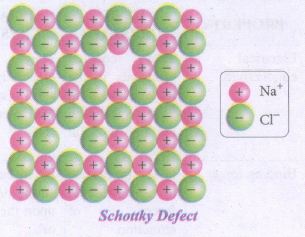
Schottky defect:
(i) Schottky defect arises due to the missing of equal number of cations and anions from the crystal lattice.
(ii) This effect does not change the stoichiometry of the crystal.
(iii) Ionic solids in which the cation and anion are of almost of similar size show schottky defect. Ex: NaCl.
(iv) Presence of large number of schottky defects in a crystal, lowers its density.
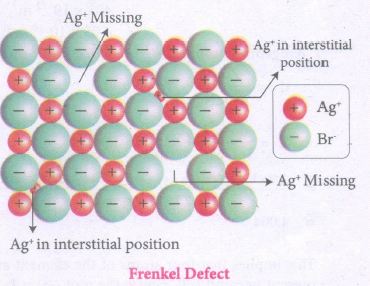
Frenkel defect:
(i) Frenkel defect arises due to the dislocation of ions from its crystal lattice.
(ii) The ion which is missing from the lattice point occupies an interstitial position.
(iii) This defect is shown by ionic solids in which cation and anion differ in size.
(iv) Unlike Schottky defect, this defect does not affect the density of the crystal.
(v) For example AgBr, in this case, small Ag+ ion leaves its normal site and occupies an interstitial position.
50.
(i) [Co(NH3)5 CI]2+
(ii) [CO(NO2)3(NH3)3]
(iii) [Co(NH3)4H2OBr](NO3)2
(iv) [Co(en)2CI2]CI
(v) [Cu(NH3)4]SO4
51.
| S. No | Double salts | Co-ordination compound |
|---|---|---|
| 1. | They usually contain two simple salt in equimolar proportions | The simple salts from which they are formed may or may not be in equimolar proportion. |
| 2. | They exists only in the solid state. In aqueous solution they dissociate completely into ions. | They exist in the solid state as well as in aqueous solution. This is because even in solution, the complex ion does not dissociate into ions. |
| 3. | They are ionic compounds and do not contain any co-ordinate bond. | They may or may not be ion but the complex part always contain coordinate bonds |
| 4. | The properties of the double salts are same as those of its constituent compounds. | The properties of the coordination compounds are different for its constituent bonds. |
| 5. | In a double salt, the metal ion show their normal valency. | In a coordinate compound the metal ion satisfies its two types of valence called primary & secondary valenices. |
| 6. | A double salt loses its identity and dissociates into its constitute simple ions in solution. | The complex ion does not lose its identity and never dissociate to give simple ions. |
| Example: FeSO4 (NH4)2 SO4.6H2O | Example: K4[Fe(CN)6), K3[Fe(SCN)6) |
52.
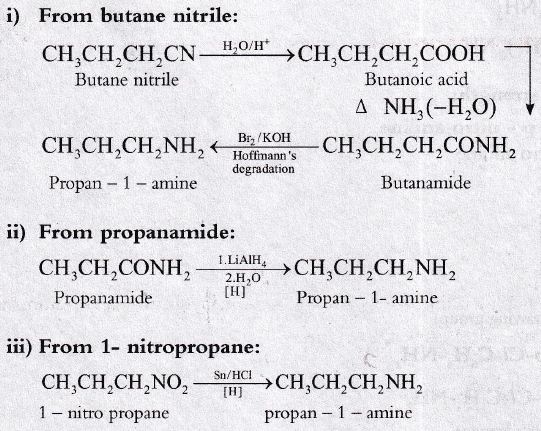 + 2H2O
53.
1. \(\kappa=\mathrm{C}\left(\frac{1}{\mathrm{~A}}\right)\)
2. \(\operatorname{let} \frac{l}{A}=x\)
i) \(0.01 \mathrm{M} \mathrm{KCl}: \kappa=0.01 x=10^{-2} x\)
ii) \(0.005 \mathrm{M} \mathrm{KCl}: \kappa=0.005 x=5 \times 10^{-3} x\)
iii) \(0.1 \mathrm{M} \mathrm{KCl} \quad: \kappa=0.1 x=10^{-1} x\)
iv) \(0.25 \mathrm{M} \mathrm{KCl}: \kappa=0.25 x=2.5 \times 10^{-1} x\)
v) \(0.5 \mathrm{M} \mathrm{KCl}: \mathrm{K}=0.5 x=5 \times 10^{-1} x\)
\(\therefore 5 \times 10^{-1} x>2.5 \times 10^{-1} x>10^{-1} x>10^{-2} x>5 \times 10^{-3} x\)
\((ie) 0.5 \mathrm{M} \mathrm{KCl}>0.25 \mathrm{M} \mathrm{KCl}>0.1 \mathrm{M} \mathrm{KCl}>0.01 \mathrm{M} \mathrm{KCl}>0.005 \mathrm{M} \mathrm{KCl}\)
54.
(i) Let us consider the reactions between a strong acid, HCI, and a weak base, NH4OH, to produce a salt, NH4CI, and water.
HCI(aq) + NH4OH(aq) ⇌ NH4CI(aq) + H2O (I)
NH4CI(aq) ⟶ NH4+ +CI-(aq)
(ii) NH4+ is a strong conjugate acid of the weak base NH4OH and it has a tendency to react with OH- from water to produce unionised NH4OH
NH4+ (aq) + H2O(I) ⇌ NH4OH(aq) + H+(aq)
(iii) There is no such tendency shown by Cl- and therefore [H+] > [OH-]; the solution is acidic and the pH is less than 7.
(iv) The Kh and Kb are related by
\(\mathrm{K}_{\mathrm{h}} \cdot \mathrm{K}_{\mathrm{b}}=\mathrm{K}_{\mathrm{w}}\)
(Or)
\(\mathrm{K}_{\mathrm{h}}=\frac{\mathrm{K}_{\mathrm{w}}}{\mathrm{K}_{\mathrm{b}}}\)
Degree of hydrolysis (h)
\(\underset{(1-h)}{\mathrm{NH}_{4}^{+}(\mathrm{aq})}+\mathrm{H}_{2} \mathrm{O}_{(j)} \rightleftharpoons \underset{h} {\mathrm{NH}_{4} \mathrm{OH}_{(\mathrm{aq})}} +\mathrm{H}^{+} \underset{h}{(\mathrm{aq})}\\ \)
\(\mathrm{K}_{\mathrm{h}} =\frac{\left[\mathrm{NH}_{4} \mathrm{OH}\right]\left[\mathrm{H}^{+}\right]}{\left[\mathrm{NH}_{4}^{+}\right]} \\ \)
\(=\frac{\mathrm{hc} \times \mathrm{h}}{(1-\mathrm{h}) \mathrm{c}} \)
\(K_{h}=\frac{h^{2} c}{(1-h)} \)
\(\text{If } \mathrm{h}<<1 ; \mathrm{K}_{\mathrm{h}} \simeq \mathrm{h}^{2} \mathrm{c} \)
\(h^{2}=\frac{K_{h}}{c}\)
\(h=\sqrt{\frac{K_{h}}{c}} \ (or) \ h=\sqrt{\frac{K_{w}}{K_{b} \cdot C}} \quad\left(\because K_{h}=\frac{K_{w}}{K_{b}}\right)\)
Also; \(\left[\mathrm{H}^{+}\right]=\sqrt{\mathrm{K}_{\mathrm{h}} \cdot \mathrm{C}} \) (or) \(\left[\mathrm{H}^{+}\right]=\sqrt{\frac{\mathrm{K}_{\mathrm{w}} \cdot \mathrm{C}}{\mathrm{K}_{\mathrm{b}}}}\)
pH = -log [H+]
55.
Considering Ba(OH)2 to be a strong base:
\(\text { Normality } =\text { Molarity } \times \text { Acidity } \)
\(=1.5 \times 10^{-3} \times 2\)
\({\left[\mathrm{OH}^{-}\right] } =3 \times 10^{-3} \)
\(\mathrm{pOH} =-\log _{10}[\mathrm{OH}^-] \)
\(=-\log _{10}\left(3 \times 10^{-3}\right) \)
\(=-\left[\log _{10} 3+3 \log 10\right] \)
= 3-log 3
= 3-0.4771
= 2.5229
\(\mathrm{pH} =14-\mathrm{pOH} \)
= 14-2.5229
pH = 11.4771 = 11.48
56.
For a first order reaction
\(\\ \\ k=\frac { 2.303 }{ t } log\left( \frac { [{ A }_{ 0 }] }{ [A] } \right) \\ \) ..(1)
Let[A0] =100M
When
t = t90%; [A] = 10M (given that t90% = 8hours)
t = t80%; [A ] = 20M
\(k=\frac { 2.303 }{ { t }_{ 80\% } } \log\left( \frac { 100 }{ 20 } \right) \)
\({ t }_{ 80\% }=\frac { 2.303 }{ K } \log(5)\) ....(2)
Find the value of k using the given data
\(k=\frac { 2.303 }{ { t }_{ 90\% } } \log\left( \frac { 100 }{ 10 } \right) \)
\(k=\frac { 2.303 }{ 8 } \log10\)
\(k=\frac { 2.303 }{ 8 } ...(3)\)
Substitute the value of k in equation (2)
\({ t }_{ 80\% }\frac { 2.303 }{ 2.303/8hours } \log(5)\)
t80%= 8 hours x 0.6989
t80%= 5.59 hours
57.
Given data: Rate constant of a first order reaction (k) = 0.45 sec-1
Formula: \({ t }_{ \frac { 1 }{ 2 } }=\frac { 0.693 }{ k } \)
Solution: \({ t }_{ \frac { 1 }{ 2 } }=\frac { 0.693 }{ k } =\frac { 0.693 }{ 0.45 } \)
Half-life period = 1.54 sec.
58.
If the monomer is represented by X. Then
\(2 \mathrm{M} \rightarrow(\mathrm{M})_{2}\)
Since the reaction is of second order, the rate of reaction will be given by,
\(\text { Rate }=\mathrm{k}[\mathrm{M}]^{n} \)
\(7.5 \times 10^{-3} \mathrm{~mol} \mathrm{~L}^{-1} \mathrm{~s}^{-1}=\mathrm{k}\left(0.05 \mathrm{~mol} \mathrm{} \mathrm{~L}^{-1}\right)^{2} \)
\(\mathrm{k} =\frac{Rate}{[M]^{n}} \)
\(\mathrm{k} =\frac{7.5 \times 10^{-3}}{(0.05)^{2}} \)
\(=3 \mathrm{~mol}^{-1} \mathrm{~L} \mathrm{~s}^{-1}\)
59.
| S.No | Lanthanoids | Actinoids |
|---|---|---|
| 1. | Differentiating electron enters in 4f orbital | Differentiating electron enters in 5f orbital |
| 2. | Binding energy of 4f orbitals are higher | Binding energy of 5f orbitals are lower |
| 3. | They show less tendency to form complexes | They show greater tendency to form complexes |
| 4. | Most of the lanthanoids are colourless | Most of the actinoids are coloured For Example: U3+ (red) U4+ (green). |
| 5. | They do not form oxo cations | They do form oxo cations such as UO22+, NpO22++ etc. |
| 6. | Besides +3 oxidation states lanthanoids show +2 and +4 oxidation states in few cases | Besides +3 oxidation states actinoids show higher oxidation states such as +4, +5, +6 and +7 |
60.
(a)

12th Standard Syllabus & Materials
12th Standard
TN 12th Computer Applications களப்பெயர் முறைமை (DNS) Sample Question Papers Study Material - QB365 Set A
NEW12th Standard
TN 12th Computer Applications வலையமைப்பு எடுத்துக்காட்டுகள் மற்றும் நெறிமுறைகள் Sample Question Papers Study Material - QB365 Set A
NEW12th Standard
TN 12th Computer Applications கணினி வலையமைப்பு ஓர் அறிமுகம் Sample Question Papers Study Material - QB365 Set A
NEW12th Standard
TN 12th Computer Applications PHP-உடன் MySQL-ஐ இணைத்தல் Sample Question Papers Study Material - QB365 Set A



Tamilnadu Stateboard 12th Standard Subjects

Maths
Chemistry

Physics

Biology

Computer Science

Business Maths and Statistics

Economics

Commerce

Accountancy

History

Computer Applications
Biology
Computer Technology
Computer Applications
Computer Science
Business Maths and Statistics
Commerce
Economics
Maths
Chemistry
Physics
Computer Technology
History
Accountancy

Tamil

English

French
Tamilnadu Stateboard Standards
