
 100% FREE ACCESS
12th Standard Syllabus & Materials
12th Standard
TN 12th Computer Applications மின்னணு தரவு பரிமாற்றம் Sample Question Papers Study Material - QB365 Set A
NEW12th Standard
TN 12th Computer Applications மின் - வணிக பாதுகாப்பு அமைப்புகள் Sample Question Papers Study Material - QB365 Set A
NEW12th Standard
TN 12th Computer Applications மின்னணு செலுத்தல் முறைகள் Sample Question Papers Study Material - QB365 Set A
NEW12th Standard
TN 12th Computer Applications மின் - வணிகம் Sample Question Papers Study Material - QB365 Set A
NEW12th Standard
TN 12th Computer Applications திறந்த மூல கருத்துருக்கள் Sample Question Papers Study Material - QB365 Set A
NEW12th Standard
TN 12th Computer Applications வலையமைப்பு வடமிடல் Sample Question Papers Study Material - QB365 Set A

Published on: 28/01/2021
12th Standard Chemistry English Medium Reduced Syllabus Model Question paper With Answer Key - 2021 Part - 1
Download Tamil Nadu 12th Standard Chemistry question papers, model tests, one-mark questions, important questions, and public exam papers in PDF format. Free study materials and answer keys for TN State Board students.
Questions + Answers key
Take MCQ Chemistry Test
1.
The central dogma of molecular genetics states that the genetic information flows from______.
Amino acids Protein DNA
DNA Carbohydrates Proteins
DNA RNA Proteins
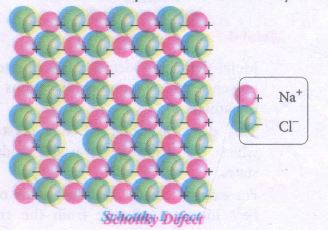
DNA RNA Carbohydrates
2.
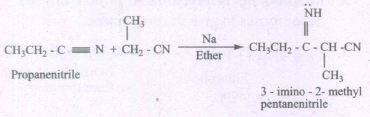
C6H5NO2 \(\overset { Fe/Hel }{ \longrightarrow } A\overset { { NaNO }_{ 2 }/HCl }{ \underset { 273K }{ \longrightarrow } } B\overset { { H }_{ 2 }O }{ \underset { 283 }{ \longrightarrow } } C \) C' is _______.
C6H5 - OH
C6H5 - CH2OH
C6H5 - COH
C6H5NH2
3.
CH3Br \(\overset { KCN }{ \longrightarrow } (A)\overset { { H }_{ 2 }{ O }^{ + } }{ \longrightarrow } (B)\overset { { PCl }_{ 5 } }{ \longrightarrow } \) (C) product (c) is ______.
acetylchloride
chloro acetic acid
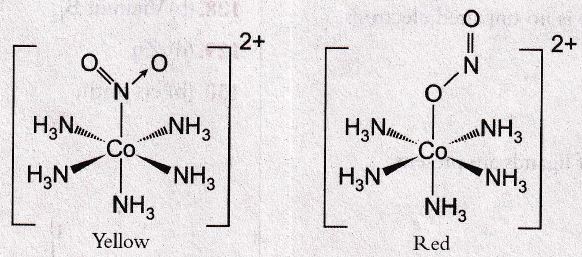
\(\alpha\)- chlorocyano ethanoic acid
none of these
4.
Statement : To stop bleeding from an injury, ferric chloride can be applied. Which comment about the statement is justified?
It is not true, ferric chloride is a poison.
It is true, Fe3+ ions coagulate blood which is a negatively charged sol
It is not true; ferric chloride is ionic and gets into the blood stream.
It is true, coagulation takes place because of formation of negatively charged sol with Cl-.
5.
Among the following cells
I) Leclanche cell
II) Nickel – Cadmium cell
III) Lead storage battery
IV) Mercury cell
Primary cells are ____.
I and IV
I and III
III and IV
II and III
6.
The solubility of BaSO4 in water is 2.42 × 10⁻³gL-1 at 298K. The value of its solubility product(Ksp) will be (Given molar mass of BaSO4 =233g mol-1)
1.08 × 10⁻¹⁴mol2L-2
1.08 × 10⁻¹²mol2L-2
1.08 × 10⁻¹⁰mol2L-2
1.08 × 10⁻⁸mol2L-2
7.
The blistered appearance of Cu obtained from the reverberatory furnace is due to evolution of________.
CO2 gas
SO2 gas
NO2
Due to evaporation of volatile materials
8.
For a first order reaction, the rate constant is 6.909 min-1 the time taken for 75% conversion in minutes is _______.
\(\left( \frac { 3 }{ 2 } \right) { \log 2 }\)
\(\left( \frac { 2 }{ 3 } \right) \log2\)
\(\left( \frac { 3 }{ 2 } \right) \log\left( \frac { 3 }{ 4 } \right) \)
\(\left( \frac { 2 }{ 3 } \right) \log\left( \frac { 4 }{ 3 } \right) \)
9.
The vacant space in bcc lattice unit cell is ________.
48%
23%
32%
26%
10.
A complex in which the oxidation number of the metal is zero is_______.
K4[Fe(CN)6]
[Fe(CN)3(NH3)3]
[Fe(CO)5]
both (b) and (c)
11.
Which of the following d block element has half filled penultimate d sub shell as well as half filled valence sub shell?
Cr
Pd
Pt
none of these
12.
13.
Zinc is obtained from ZnO by________.
Carbon reduction
Reduction using silver
Electrochemical process
Acid leaching
14.
Assertion: Phenol is more acidic than ethanol
Reason: Phenoxide ion is resonance stabilized
Codes:
a) both assertion and reason are true and reason is the correct explanation of assertion.
b) both assertion and reason are true but reason is not the correct explanation of assertion.
c) assertion is true but reason is false
d) both assertion and reason are false.
if both assertion and reason are true and reason is the correct explanation of assertion.
if both assertion and reason are true but reason is not the correct explanation of assertion.
assertion is true but reason is false
both assertion and reason are false.
15.
16.
Explain the IUPAC convention of representing a Galvanic cell.
17.
Calculate i) degree of hydrolysis, ii) the constant hydrolysis and iii) pH of 0.1M CH3COONa solution (pKa for CH3COOH is 4.74).
18.
Write the expression for the solubility product of Ca3(PO4)2
19.
A reaction is second order with respect to a reactant. How is the rate of reaction affected if the concentration of the reactant is
(i) doubled (ii) reduced to half
20.
Complete the following equations.
(i) Cr2O72- + 2OH- ⟶
(ii) MnO4- + 4H+ + 3e- ⟶
21.
Why are solids rigid?
22.
What happens to boranes at high temperatures?
23.
Why europium (II) is more stable than Cerium (II)?
24.
Explain Schottky defect.
25.
How will you convert boric acid to boron nitride?
26.
Write a note on Thrope nitrile condensation
27.
Explain why chloroform is not used as an anaesthetic.
28.
What is Condensation polymerisation?
29.
What are soaps?
30.
What are antipyretic?
31.
Explain the terms.
(i) Antagonists drugs
(ii) Agonist drugs.
32.
Give an example of a macromolecule chosen as drug targets.
33.
The two strands in DNA are not identical but are complementary explain.
34.
List the expected products of hydrolysis of lactose.
35.
What is linkage isomerism? Explain with an example.
36.
KF crystallizes in fcc structure like sodium chloride. Calculate the distance between K+ and F− in KF. (given : density of KF is 248 g cm-3)
37.
CO is a reducing agent. Justify with an example.
38.
Styrene polymerises to polystyrene when heated in the presence of peroxide initiator.
(i) What is the mechanism involved?
(ii) Give the initiation step for the above process.
(iii) How does the chain propogate in the above mechanism?
(iv) How is the above chain reaction terminated?
39.
An organic compound (A) of molecular formula C3H8O gives turbidity within 5-10 min on reaction with anhydrous ZnCI2/HCI.Compound (A) on treatment with sodium hypochlorite gives a carbonyl compound (B) which on further chlorination gives compound (C) of molecular formula C3H3OCl3. Identify (A), (B) and (C). Explain the reactions.
40.
Arrange the following
i. In increasing order of solubility in water, C6H5 NH2, (C2H5)2NH, C2H5NH2
ii. In increasing order of basic strength
a) aniline, p- toludine and p – nitroaniline
b) C6H5 NH2, C6H5 NHCH3, C6H5NH2, p-Cl-C6- H4-NH2
iii. In decreasing order of basic strength in gas phase
(C2H5)NH2, (C2H5)NH, (C2H5)5N and NH3
iv. In increasing order of boiling point
C6H5OH, (CH3)2NH, C2H5NH2
v. In decreasing order of the pKb values
C2H5NH2, C6H5NHCH3.(C2H5)2 NH and CH3NH2
vi. Increasing order of basic strength
C2H5NH2,C6H5N(CH3)2, (C2H5)2 NH and CH3NH2
vii. In decreasing order of basic strength

41.
Distinguish between diamond and graphite.
42.
Predict which of the following will be coloured in aqueous solution Ti2+, V3+, Sc4+, Cu+, Sc3+, Fe3+, Ni2+ and Co3+
43.
Explain AAAA and ABABA and ABCABC type of three dimensional packing with the help of neat diagram.
1.
(c)
DNA RNA Proteins
2.
(a)
C6H5 - OH
3.

4.
(b)
It is true, Fe3+ ions coagulate blood which is a negatively charged sol
5.
(a)
I and IV
6.
BaSO4 ⇌ Ba2+ + SO42-
Ksp = (s) (s)
Ksp = (s)2
= (2.42 × 10⁻³gL-1)2
\(=\frac{2.42 \times 10^{-3} gL^{-1}}{233 \text{ g mol}^{-1}}\)
= (0.01038 x 10⁻³)2
= (1.038 x x 10-5)2
= 1.077 x 10-10
= 1.08 × 10⁻¹⁰mol2L-2
7.
(b)
SO2 gas
8.
\(k=\frac { 2.303 }{ t } \log\frac { \left[ { A }_{ 0 } \right] }{ \left[ A \right] } \)
[A0] = 100: [A] = 25
\(6.909=\frac { 2.303 }{ t } \log\frac { \left[ {100 } \right] }{ \left[ 25\right] } \)
\(t =\frac { 2.303 }{ 6.909 } \log(4)\)
\(t =\frac { 1 }{ 3 } \log(2^2)\)
\(= \left( \frac { 2 }{ 3 } \right) \log2\)
9.
Packing efficiency = 68%
\(\therefore\)empty space percentage = 100 - 68 = 32%
10.
a) Fe2+ b) Fe3+ c) Fe0
11.
Cr ⇒ [Ar]3d54s1
12.
(b)
13.
(a)
Carbon reduction
14.
a) both assertion and reason are true and reason is the correct explanation of assertion.
15.
(d)
16.
The galvanic cell is represented by a cell diagram, for example, Daniel cell is represented as
\({ Zn }_{ (s) }|{ Zn }_{ (aq) }^{ 2+ }||{ Cu }_{ (aq) }^{ 2+ }|{ Cu }_{ (s) }\)
(i) A single vertical bar (|) represents a phase boundary
(ii) The double vertical bar (||) represents the salt bridge.
(iii) The anode half cell is written on the left side of the salt bridge and the cathode half cell on the right side.
(iv) The anode and cathode are written on the extreme left and extreme right, respectively.
(v) The emf of the cell is written on the right side after cell diagram.
17.
(a) CH3COONa is a salt of weak acid
(CH3COOH) and a strong base (NaOH).
Hence, the solutions is alkaline due to hydrolysis.
\(CH_{3}COO^{-}_{(aq)}+H_{2}O_{(aq)}\rightleftharpoons CH_{3}COOH_{(aq)}+OH^{-}_{(aq)}\)
(i)\(h=\sqrt{\frac{K_{w}}{K_{a}\times C}}\)
Given that pKa =4.74
pKa = -log Ka
ie., Ka = antilog of (-pKa)
= antilog of (-4.74)
= antilog of (-5 + 0.26)
= 10-5 \(\times\) 1.8 = 1.8 \(\times\) 10-5
[antilog of 0.26 = 1.82 \( \simeq\) 1.8]
\(\therefore\) h=\(\sqrt{\frac{1\times10^{-14}}{1.8\times10^{-5}\times0.1}}\)
h = 7.5 x 10⁻⁵
(ii) \(K_{h}=\frac{K_{w}}{K_{a}}=\frac{1\times10^{-14}}{1.8\times10^{-5}}\)
\(=5.56\times10^{-10}\)
iii) \(pH=7+\frac{pK_{a}}{2}+\frac{logC}{2}\)
= \(7+\frac{4.74}{2}+\frac{log0.1}{2}\)
= 7 + 2.37 - 0.5
= 8.87
18.
\(\mathrm{Ca}_{3}\left(\mathrm{PO}_{4}\right)_{2} \rightleftharpoons 3 \mathrm{Ca}^{2+}_{(aq)}+2 \mathrm{PO}_{4_{(aq)}}^{3-}\\\)
(s) (3s) (2s)
\(K_{sp}=[Ca^{2+}]^{3}[PO_{4}^{3-}]^{2}\)
\(K_{sp}=(3s)^{3}(2s)^{2}\)
\(K_{sp}=27s^{3}.4s^{2}\)
\(K_{sp}=108s^{5}\)
(or)
\(K_{s p} =m^{m} \cdot n^{n} \cdot(s)^{m+n} \)
\(K_{\text {sp }} =3^{3} \cdot 2^{2} \cdot(s)^{3+2} \)
\(K_{s p} =27 \times 4 \times(s)^{5} \)
\(=108(s)^{5}=108 s^{5}\)
19.
Let the concentration of the reactant be [A] = a
Rate of reaction R = k [A]2
R=ka2
(i) R = k (2a)2
= 4 ka2
= 4R
∴ The rate of the reaction would increase by 4 times.
(ii) If the concentration of the reactant is reduced to half [A] = \(\frac { 1 }{ 2 } \) a than the rate of reaction would be
\(R=k\left( \frac { 1 }{ 2 } a \right) 2\)
\(=\frac { 1 }{ 4 } k{ a }^{ 2 }\)
\(=\frac { 1 }{ 4 } kR\)
∴ The rate of the reaction would reduced by \({ \frac { 1 }{ 4 } }^{ th }\)
20.
(i) Cr2O72- + 2OH- ⟶ 2CrO42- + H2O
(ii) MnO4- + 4H+ + 3e- ⟶ MnO2 + 2H2O
21.
(i) The intermolecular forces of attraction that are present in solids are very strong.
(ii) The constituent particles of solids cannot: move from their positions. They have fixed positions.
(iii) However, they can oscillate about their mean positions.
(iv) This is the reason solids are rigid.
22.
At high temperatures it forms higher boranes liberating hydrogen.
\(5{ B }_{ 2 }{ H }_{ 6 }\overset { 388K }{ \underset { U-tube }{ \longrightarrow } } 2{ B }_{ 5 }{ H }_{ 11 }+4{ H }_{ 2 }\)
\(2{ B }_{ 2 }{ H }_{ 6 }\overset { 198-373K }{ \longrightarrow } { B }_{ 4 }{ H }_{ 10 }+{ H }_{ 2 }\)
\(5{ B }_{ 2 }{ H }_{ 6 }\overset { 373K }{ \underset { sealed\ tube }{ \longrightarrow } } { B }_{ 10 }{ H }_{ 14 }+8{ H }_{ 2 }\)
\(5{ B }_{ 2 }{ H }_{ 6 }\overset { 473-523K }{ \longrightarrow } 2{ B }_{ 5 }{ H }_{ 9 }+6{ H }_{ 2 }\)
\(10{ B }_{ 2 }{ H }_{ 6 }\overset { 523K }{ \longrightarrow } 2{ B }_{ 5 }{ H }_{ 9 }+2{ B }_{ 5 }{ H }_{ 10 }+11{ H }_{ 2 }\)
\({ B }_{ 2 }{ H }_{ 6 }\overset { Red \ hot }{ \longrightarrow } 2B+3{ H }_{ 2 }\).
23.
\(Eu (63)-[\mathrm{Xe}] 4 \mathrm{f}^{7} 5 \mathrm{~d}^{0} 6 \mathrm{~s}^{2}, \mathrm{Eu}^{2+}-[\mathrm{Xe}] 4 \mathrm{f}^{7} \)
\(\mathrm{Ce}(58)-[\mathrm{Xe}] 4 \mathrm{f}^{1} 5 \mathrm{~d}^{1} 6 \mathrm{~s}^{2}, \mathrm{Ce}^{2+}-[\mathrm{Xe}] 4 \mathrm{f}^{1} 5 \mathrm{~d}^{1} \)
Eu2+ has exactly half filled stable electronic configuration. Hence Europium (II) is more stable than Cerium (II).
24.
(i) Schottky defect arises due to the missing of equal number of cations and anions from the crystal lattice. This effect does not change the stoichiometry of the crystal.
(ii) Ionic solids in which the cation and anion are of almost of similar size show schottky defect.
Example: NaCl.
(iii) Presence of large number of schottky defects in a crystal, lowers its density.
(iv) Presence of Schottky defect in the crystal provides a simple way by which atoms or ions can move within the crystal lattice.
25.
Fusion of urea with B(OH)3' in an atmosphere of ammonia at 800 - 1200 K gives boron nitride.
B(OH)3 + NH3 \(\overset { \Delta }{ \longrightarrow } \) BN+ 3H2O
26.
Self condensation of two molecules of alkyl nitrile (containing α-H atom) in the presence of sodium to form iminonitrile.
27.
With oxygen it forms a toxic carbonyl chloride Hence it is not used an an anaesthetic.
28.
Condensation polymers are formed by the reaction between functional groups of an adjacent monomers with the elimination of simple molecules like H2O, NH3 etc....
29.
Chemically soap is the sodium or potassium salt of higher fatty acids. Soaps are made from animal fats or vegetable oils. They contain glyceryl esters of long chain fatty acids:
30.
Drugs that are used to reduce fever are called antipyretic.
Eg: Asprin, paracetamol
31.
(i) Antagonists drugs: The drug that binds to the receptor site and inhibits its natural function are called antagonists.
(ii) Agonist drugs: The drugs which mimic the natural messenger by switching on the receptor are called agonist.
32.
Proteins.
33.
In the helical structure of DNA, the two strands are held together by hydrogen bonds between specific pair of bases. Cytosine forms hydrogen bond with guanine while adenine forms hydrogen bonds with thymine. As a result the two strands are complementary to each other.
34.
Lactose is a dissaccharide so on hydrolysis gives I two monosaccharides.
\(\underset { Lactose }{ { C }_{ 12 }{ H }_{ 22 }{ O }_{ 11 }+{ H }_{ 2 }O } \overset { + }{ \longrightarrow } \underset { D(+)G1ucoseD(+)Galactose }{ { C }_{ 6 }{ { H }_{ 12 }{ O }_{ 6 } }+{ C }_{ 6 }{ H }_{ 12 }{ O }_{ 6 } } \)
35.
(i) This is also called as salt isomerism.
(ii) This type of isomers arises when an ambidentate ligand is bonded to the central metal atom/ion through either of its two different donor atoms. In the below mentioned examples, the nitrite ion is bound to the central metal ion Co3+ through a nitrogen atom in one complex and through oxygen atom in other complex.
\(\left[\mathrm{Co}\left(\mathrm{NH}_{3}\right)_{5}\left(\mathrm{NO}_{2}\right)\right]^{2+}\)
36.
\(\text { Density }(\rho)=\frac{\mathrm{nM}}{\mathrm{a}^{3} \mathrm{~N}_{\mathrm{A}}} \)
\(\mathrm{n}=4, \mathrm{M}=\text { Molar mass of } \mathrm{KF}=58.1 \mathrm{~g} / \mathrm{mol} \)
\(\rho=2.48 \mathrm{~g} \mathrm{~cm}^{-3} \)
\(\mathrm{~N}_{\mathrm{A}}=6.023 \times 10^{23} \)
\(a^{3} =\frac{n M}{\rho N_{A}}=\frac{4 \times 58.1}{2.48 \times 6.023 \times 10^{23}} \)
\(a^{3} =15.55 \times 10^{-23} \)
\(a^{3} =0.1555 \times 10^{-21} \)
\(a =\sqrt[3]{0.1555 \times 10^{-21}} \)
\(a =0.5375 \times 10^{-7} \mathrm{~cm}=5.375 \times 10^{-8} \mathrm{~cm}=537.5 \mathrm{pm} \)
\(d =\frac{a}{\sqrt{2}}(\text { for fcc }) [\therefore r = \frac{a\sqrt{2}}{4}]\)
\(=\frac{537.5}{1.414}=380.13 \mathrm{pm}\)
\(\therefore\) The distance between K+ and F- in KF = 380.13 pm
37.
CO acts as a strong reducing agent.
Example: 3CO + Fe2O3 \(\longrightarrow \) 2Fe + 3CO2
It reduces metallic. oxides into metals.
38.
(i) Free radical polymerisation.
(ii) Styrene polymerises to polystyrene when it is heated to ionic with a peroxide initiator. The mechanism involves the following steps.

(iii) Propagation step
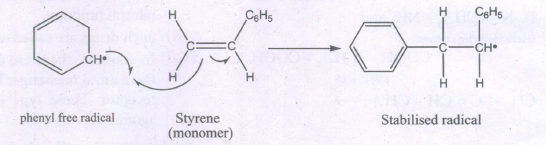
The stabilized radical attacks another monomer molecule to give an elongated radical.

Chain growth will continue with the successive addition of several thousands of monomer units.
(iv) The above chain reaction can be stopped by stopping the supply of monomer or by coupling of two chains or reaction with an impurity such as oxygen.

39.
(i) (A) that gives turbidity within 5-10 min on reaction with anhydrous ZnCl2/HCl means it must be secondary alcohol.
\({ CH }_{ 3 }\underset { \overset { | }{ OH } }{ CH } -{ CH }_{ 3 }\overset { anhydrous\ ZnCl_{ 2 }/HCl }{ \longrightarrow } { CH }_{ 3 }-\underset { \overset { | }{ CH } }{ CH } -{ CH }_{ 3 }\)
(ii) Iso propyl alcohol on treatment with sodium hypochlorite, undergoes oxidation to give acetone compound (B).
\({ CH }_{ 3 }-\underset { \overset { | }{ \underset { (A) }{ OH } } }{ C } H-{ CH }_{ 3 }\overset { (O) }{ \longrightarrow } { CH }_{ 3 }-\underset { \overset { | }{ \underset { (B) }{ O } } }{ C } -{ CH }_{ 3 }\)
| Compound | Compound Name | Formula |
| A | Isopropyl alcohol | \({ CH }_{ 3 }-\underset { \overset { | }{ OH } }{ C } H-{ CH }_{ 3 }\) |
| B | Acetone | \({ CH }_{ 3 }-\underset { \overset { || }{ O } }{ C } -{ CH }_{ 3 }\) |
| C | Trichloro acetone | \({ CCl }_{ 2 }-\underset { \overset { || }{ O } }{ C } -{ CH }_{ 2 }\) |
40.
i) In increasing order of solubility in water:
\(\mathrm{C}_{6} \mathrm{H}_{5} \mathrm{NH}_{2},\left(\mathrm{C}_{2} \mathrm{H}_{5}\right)_{2} \mathrm{NH}, \mathrm{C}_{2} \mathrm{H}_{5} \mathrm{NH}_{2} \)
\(\mathrm{C}_{2} \mathrm{H}_{5} \mathrm{NH}_{2}>\mathrm{C}_{6} \mathrm{H}_{5} \mathrm{NH}_{2}>\left(\mathrm{C}_{2} \mathrm{H}_{5}\right)_{2} \mathrm{NH}\)
ii) In increasing order of basic strength:
a. Aniline, p - toluidine and p - nitro aniline
p - toluidine > aniline >p - nitro aniline
.JPG)
b. \(\mathrm{C}_{6} \mathrm{H}_{5} \mathrm{NH}_{2}, \mathrm{C}_{6} \mathrm{H}_{5} \mathrm{NHCH}_{3}, \mathrm{p}-\mathrm{Cl}-\mathrm{C}_{6} \mathrm{H}_{4}-\mathrm{NH}_{2} \)
\(\mathrm{C}_{6} \mathrm{H}_{5} \mathrm{NHCH}_{3}>\mathrm{C}_{6} \mathrm{H}_{5} \mathrm{NH}_{2}>\mathrm{p}-\mathrm{Cl}-\mathrm{C}_{6} \mathrm{H}_{4}-\mathrm{NH}_{2}\\ 2^{o} \text { amine } \quad \quad \quad \quad e^{\ominus} \text { with drawing (group) }\)
(iii) In decreasing order of basic strength in gas phase:
\(\mathrm{C}_{2} \mathrm{H}_{5} \mathrm{NH}_{2},\left(\mathrm{C}_{2} \mathrm{H}_{5}\right) \mathrm{NH},\left(\mathrm{C}_{2} \mathrm{H}_{5}\right)_{3} \mathrm{~N} \text { and } \mathrm{NH}_{3} \)
\(\mathrm{NH}_{3}<\mathrm{C}_{2} \mathrm{H}_{5} \mathrm{NH}_{2}<\left(\mathrm{C}_{2} \mathrm{H}_{5}\right)_{2} \mathrm{~N}<\left(\mathrm{C}_{2} \mathrm{H}_{5}\right)_{3} \mathrm{NH}\\ \quad \quad \quad 1^{0} \text { amine } \quad 2^{0} \text { amine } \quad \quad \quad 3^{0} \text { amine }\)
(iv) In increasing order of boiling point:
\(\mathrm{C}_{6} \mathrm{H}_{5} \mathrm{OH},\left(\mathrm{CH}_{3}\right)_{2} \mathrm{NH}, \mathrm{C}_{2} \mathrm{H}_{5} \mathrm{NH}_{2} \)
\(\left(\mathrm{CH}_{3}\right)_{2} \mathrm{NH}>\mathrm{C}_{2} \mathrm{H}_{5} \mathrm{NH}_{2}>\mathrm{C}_{6} \mathrm{H}_{5} \mathrm{OH} \\ 2^{0} \text { amine } \quad \quad1^{0} \text { amine }\)
Generally amines have lower boiling point than alcohol. Due to comparable molecular mass and weaker H-bonds in Amines.
(v) In decreasing order of the pKb values:
\( \mathrm{C}_{2} \mathrm{H}_{5} \mathrm{NH}_{2}, \mathrm{C}_{6} \mathrm{H}_{5} \mathrm{NHCH}_{3},\left(\mathrm{C}_{2} \mathrm{H}_{5}\right)_{2} \mathrm{NH} \text { and } \mathrm{CH}_{3} \mathrm{NH}_{2} \)
\(\left(\mathrm{C}_{2} \mathrm{H}_{5}\right)_{2} \mathrm{NH}<\mathrm{C}_{2} \mathrm{H}_{5} \mathrm{NH}_{2}<\mathrm{CH}_{3} \mathrm{NH}_{2}<\mathrm{C}_{6} \mathrm{H}_{5} \mathrm{NHCH}_{3} \)
\(\quad \quad \quad 2^{0} \text { amine } \quad 1^{0} \text { amine } 1^{0} \text { amine } \quad 2^{0} \text { amine } \)
\(\mathrm{PK}_{b}: \quad 3.00\quad < \quad 3.29 \quad < \quad 3.38 \quad<\quad 9.30\)
pKb ,Due to + 1 effect of C2H5 group. Higher the value of pKb lower is the basicity
(vi) Increasing Order of basic strength:
\(\mathrm{C}_{6} \mathrm{H}_{5} \mathrm{NH}_{2}, \mathrm{C}_{6} \mathrm{H}_{5} \mathrm{~N}\left(\mathrm{CH}_{3}\right)_{2},\left(\mathrm{C}_{2} \mathrm{H}_{5}\right)_{2} \mathrm{NH} \text { and } \mathrm{CH}_{3} \mathrm{NH}_{2} \)
\(\mathrm{C}_{6} \mathrm{H}_{5} \mathrm{NH}_{2}>\mathrm{C}_{6} \mathrm{H}_{5} \mathrm{~N}\left(\mathrm{CH}_{3}\right)_{2}>\mathrm{CH}_{3} \mathrm{NH}_{2}>\left(\mathrm{C}_{2} \mathrm{H}_{5}\right)_{2} \mathrm{NH} \\ \left(\mathrm{pK}_{6}: 9.38 \quad > \quad \quad 8.92 \quad \quad > \quad 3.38 \quad > \quad \quad 3.00\right)\)
Due to + 1 effect of C2H5 group.
In decreasing order of basic strength:
.JPG)
41.
| DIAMOND | GRAPHITE |
| C is sp3 hybridised. | C is sp2 hybridised. |
| Three dimensional, tetrahedral structure. | Two dimensional, sheet like structure. |
| Crystalline, transparent with extra brilliance. | Crystalline, opaque and shiny substance. |
| It is hard with high density and high melting point. | It is soft with low density and high melting point. |
| Bad conductor of and electricity. | Good conductor of heat and electricity. |
42.
(i) Only the ions that have unpaired electrons in d- orbital and in which d - d transition is possible will be coloured.
(ii) The ions in which d - orbitals are empty or completely filled will be colourless as no d -d transition is possible in those configurations.
(iii) From the above ions, it can be easily observed that only Sc3+ has an empty d - orbital and Cu+ has completely filled d-orbitals.
(vi) All other ions, except Sc3+ and Cu+, will be coloured in aqueous solution because of d - d transition.
43.
AAAA type of three dimensional packing:
.JPG)
1. This is simple cubic arrangement.
2. Three dimensional packing arrangement can be obtained by repeating the AAAA type two dimensional arrangements in three dimensions.
3. Spheres in one layer sitting directly on the top of in the previous layer so that all layers are identical.
4. All spheres of different layers of crystal are perfectly aligned horizontally and also vertically.
5. In simple cubic packing, each sphere is in contact with 6 neighbouring spheres
6. Four in its own layer, one above and one below and hence the coordination number of the sphere in simple cubic arrangement is 6.
ABABA type of three dimensional packing:
.JPG)
(i) This is body centered cubic arrangement.
(ii) The spheres in the first layer are slightly separated and the second layer is formed by arranging the spheres in the depressions between the spheres in layer A.
(iii) The third layer is a repeat of the first.
(iv) This pattern ABABAB is repeated throughout the crystal.
(v) Each sphere has a coordination number of 8, four neighbors in the layer above and four in the layer below.
ABCABC type of three dimensional packing:
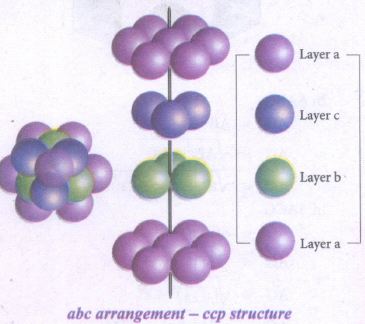
(i) This is face centered cubic arrangement.
(ii) In this arrangement (FCC) second layer spheres are arranged at the dips of first layer. Third layer spheres are arranged in a manner such that it cover the octahedral void.
(iii) Then no longer third layer is similar to first or second layer.
(iv) Third layer gives different arrangement. Fourth layer spheres are similar to first layer.
(v) If the first, second and third layer are represented as A, B, C then this type of packing gives the arrangement of layers as ABCABC.. and the sequence is repeated.

12th Standard Syllabus & Materials
12th Standard
TN 12th Computer Applications களப்பெயர் முறைமை (DNS) Sample Question Papers Study Material - QB365 Set A
NEW12th Standard
TN 12th Computer Applications வலையமைப்பு எடுத்துக்காட்டுகள் மற்றும் நெறிமுறைகள் Sample Question Papers Study Material - QB365 Set A
NEW12th Standard
TN 12th Computer Applications கணினி வலையமைப்பு ஓர் அறிமுகம் Sample Question Papers Study Material - QB365 Set A
NEW12th Standard
TN 12th Computer Applications PHP-உடன் MySQL-ஐ இணைத்தல் Sample Question Papers Study Material - QB365 Set A



Tamilnadu Stateboard 12th Standard Subjects

Maths
Chemistry

Physics

Biology

Computer Science

Business Maths and Statistics

Economics

Commerce

Accountancy

History

Computer Applications
Biology
Computer Technology
Computer Applications
Computer Science
Business Maths and Statistics
Commerce
Economics
Maths
Chemistry
Physics
Computer Technology
History
Accountancy

Tamil

English

French
Tamilnadu Stateboard Standards
