
 100% FREE ACCESS
12th Standard Syllabus & Materials
12th Standard
TN 12th Computer Applications மின்னணு தரவு பரிமாற்றம் Sample Question Papers Study Material - QB365 Set A
NEW12th Standard
TN 12th Computer Applications மின் - வணிக பாதுகாப்பு அமைப்புகள் Sample Question Papers Study Material - QB365 Set A
NEW12th Standard
TN 12th Computer Applications மின்னணு செலுத்தல் முறைகள் Sample Question Papers Study Material - QB365 Set A
NEW12th Standard
TN 12th Computer Applications மின் - வணிகம் Sample Question Papers Study Material - QB365 Set A
NEW12th Standard
TN 12th Computer Applications திறந்த மூல கருத்துருக்கள் Sample Question Papers Study Material - QB365 Set A
NEW12th Standard
TN 12th Computer Applications வலையமைப்பு வடமிடல் Sample Question Papers Study Material - QB365 Set A

Published on: 28/01/2021
12th Standard Chemistry English Medium Reduced Syllabus Model Question paper With Answer Key -2021 Part - 2
Download Tamil Nadu 12th Standard Chemistry question papers, model tests, one-mark questions, important questions, and public exam papers in PDF format. Free study materials and answer keys for TN State Board students.
Questions + Answers key
Take MCQ Chemistry Test
1.
Among the following, the reaction that proceeds through an electrophilic substitution is : _______.
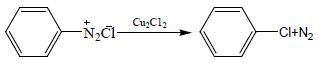
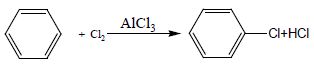
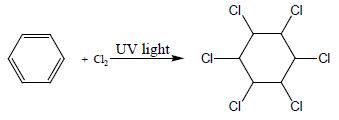
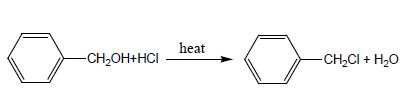
2.
CH3CH2 Br \(\overset { aqNaOH }{ \underset { \Delta }{ \longrightarrow } } A\overset { { KMnO }_{ 4 }{ /H }^{ + } }{ \underset { \Delta }{ \longrightarrow } } B\overset { { NH }_{ 3 } }{ \underset { \Delta }{ \longrightarrow } } C\overset { { Br }_{ 2 }/NaOH }{ \longrightarrow } D\) D' is________.
bromomethane
α - bromo sodium acetate
methanamine
acetamide
3.
Which one of the following reduces tollens reagent
formic acid
acetic acid
benzophenone
none of these
4.
Statement : To stop bleeding from an injury, ferric chloride can be applied. Which comment about the statement is justified?
It is not true, ferric chloride is a poison.
It is true, Fe3+ ions coagulate blood which is a negatively charged sol
It is not true; ferric chloride is ionic and gets into the blood stream.
It is true, coagulation takes place because of formation of negatively charged sol with Cl-.
5.
The correct difference between first and second order reactions is that________.
A first order reaction can be catalysed; a second order reaction cannot be catalysed.
The half life of a first order reaction does not depend on [A0]; the half life of a second order reaction does depend on [A0].
The rate of a first order reaction does not depend on reactant concentrations; the rate of a second order reaction does depend on reactant concentrations.
The rate of a first order reaction does depend on reactant concentrations; the rate of a second order reaction does not depend on reactant concentrations.
6.
If ‘a’ stands for the edge length of the cubic system sc, bcc, and fcc. Then the ratio of radii of spheres in these systems will be respectively ________.
\(\left( \frac { 1 }{ 2 } a;\frac { \sqrt { 3 } }{ 2 } a;\frac { \sqrt { 2 } }{ 2 } a \right) \)
\(\left( \sqrt { 1a } :\sqrt { 3a } :\sqrt { 2a } \right) \)
\(\left( \frac { 1 }{ 2 } a:\frac { \sqrt { 3 } }{ 4 } a:\frac { 1 }{ 2\sqrt { 2 } } a \right) \)
\(\frac { 1 }{ 2 } a:\sqrt { 3 } a:\frac { 1 }{ \sqrt { 2 } } a\)
7.
Choose the correct statement.
Square planar complexes are more stable than octahedral complexes
The spin only magnetic moment of [Cu(Cl)4]2- is BM and it has square planar structure.
Crystal field splitting energy \(\left( { \Delta }_{ 0 } \right) \) [FeF6]4- is higher than the \((\Delta _{ 0 })\) of [Fe(CN)6]4-
crystal field stabilization energy of [V(H2O)6]2+ is higher than the crystal field stabilization of [Ti(H2O)6]2+
8.
As per IUPAC guidelines, the name of the complex [Co(en)2(ONO)Cl]Cl is _______.
chloro bis ethylenediamine nitrocobalt(III) chloride
chloridobis(ethane-1, 2-diamine)nitro K-O Cobaltate(III) chloride
chloridobis(ethane-1, 2-diammine)nitrito K-O Cobalt(II) chloride
chloridobis(ethane-1, 2-diamine)nitrito K-O Cobalt(III) chloride
9.
Which one of the following statements related to lanthanons is incorrect?
Europium shows +2 oxidation state
The basicity decreases as the ionic radius decreases from Pr to Lu.
All the lanthanons are much more reactive than aluminium
Ce4+ solutions are widely used as oxidising agents in volumetric analysis.
10.
The magnetic moment of Mn2+ ion is _______.
5.92BM
2.80BM
8.95BM
3.90BM
11.
The geometry at which carbon atom in diamond are bonded to each other is _______.
Tetrahedral
hexagonal
Octahedral
none of these
12.
Among the following, which is the strongest oxidizing agent?
Cl2
F2
Br2
l2
13.
Which of the following is used for concentrating ore in metallurgy?
Leaching
Roasting
Froth floatation
Both (a) and (c)
14.
The metal oxide which cannot be reduced to metal by carbon is ________.
PbO
Al2O3
ZnO
FeO
15.
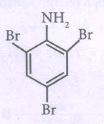
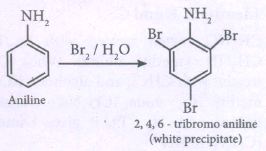
Aniline reacts with bromine water to give a white precipitate.
(i) Give the chemical formula of the white precipitate formed in the above reaction.
(ii) Write the chemical reaction involved
16.
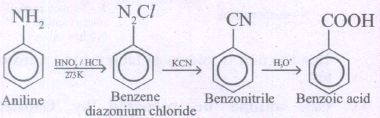
\({ C }_{ 6 }{ H }_{ 5 }{ NH }_{ 2 }\xrightarrow [ 273k,HCl ]{ { HNO }_{ 2 } } A\xrightarrow [ { Cu }_{ 2 }({ CN })_{ 2 } ]{ KCN } B \stackrel { { H }_{ 3 }O }\rightarrow C\)
Identify A, Band C.
17.
Explain the action of morphine as a pain killer.
18.
Name the substance used as an antiseptic as well as disinfectant.
19.
A child is diagnosed with bleeding gums, is likely to have the deficiency of which vitamin?
20.
What are epimers?
21.
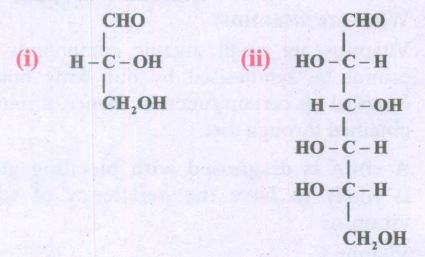
Identify whether the following compounds are D or L isomers.
22.
23.
What is passivation?
24.
What is the action of HCN on
(i) propanone
(ii) 2,4-dichlorobenzaldehyde
iii) ethanal
25.
Write a note on sacrificial protection.
26.
Identify the order for the following reactions
(i) Rusting of Iron
(ii) Radioactive disintegration of 92U238
(iii) 2A+3B⟶ products ;rate = k[A]1/2[B]2
27.
Deduce the oxidation number of oxygen in hypofluorous acid – HOF.
28.
Give one example for each of the following
(i) icosogens
(ii) Tetragens
(iii) pnictogens
(iv) chalcogens
29.
The selection of reducing agent depends on the thermodynamic factor: Explain with an example.
30.
Write a note on
(i) Perkin's reaction, and
(ii) Knoevenagal reaction.
31.
Distinguish between fat soluble and water soluble vitamins.
32.
Derive the relation between EMF and free energy.
33.
Account for the following:
(a) Lower members of alcohols are soluble in water but higher members are not.
(b) Alcohols cannot be used as solvent for Grignard reagent.
34.
Why is AC current used instead of DC in measuring the electrolytic conductance?
35.
Identify A,B and C
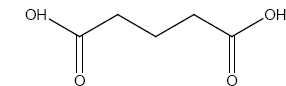 \(\overset{SOCl_2}\longrightarrow A \overset{NH_3}\longrightarrow B\overset{LiAlH_4}\longrightarrow (C)\)
36.
Write the reason for the anomalous behaviour of Nitrogen.
37.
Write the crossed aldol condensation.
38.
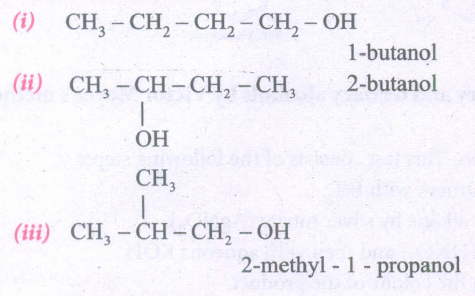
Write all possible isomers with molecular formula C4H10O and name them.
39.
The specific reaction rates of a chemical reaction are 2.45 x 10⁻⁵ sec-1 at 273 K and 16.2 x 10⁻⁴ sec-1 at 303 K. Calculate the activation energy.
40.
Write a short note on the oxidation states of 3d series elements.
41.
List the applications of iron.
42.
The time for half change in a first order decomposition of a substance A is 60 seconds. Calculate the rate constant. How much of A will be left after 180 seconds?
43.
Assertion: Phenol is more reactive than benzene towards electrophilic substitution reaction
Reason: In the case of phenol, the intermediate arenium ion is more stabilized by resonance
Codes:
a) if both assertion and reason are true and reason is the correct explanation of assertion.
b) if both assertion and reason are true but reason is not the correct explanation of assertion.
c) assertion is true but reason is false
d) both assertion and reason are false.
if both assertion and reason are true and reason is the correct explanation of assertion.
if both assertion and reason are true but reason is not the correct explanation of assertion.
assertion is true but reason is false
both assertion and reason are false.
1.
(b)
2.
(c)
methanamine
3.

4.
(b)
It is true, Fe3+ ions coagulate blood which is a negatively charged sol
5.
\({ t }_{ 1/2 }=\frac { 0.6932 }{ k } \)
For a second order reaction
\(\mathrm{t}_{1 / 2}=\frac{2^{\mathrm{n}-1}-1}{(\mathrm{n}-1) \mathrm{k} \cdot\left[\mathrm{A}_{0}\right]^{\mathrm{n}-1}}\)
n = 2
\(\mathrm{t}_{1 / 2}=\frac{2^{\mathrm{2}-1}-1}{(\mathrm{n}-1) \mathrm{k} \cdot\left[\mathrm{A}_{0}\right]^{\mathrm{2}-1}}\)
\(\mathrm{t}_{1 / 2} =\frac{1}{ \mathrm{k}\left[\mathrm{A}_{0}\right]}\)
6.
sc ⇒ 2r = a
⇒ r = a/2
bcc ⇒ 4r = \( \sqrt{3a} \) ⇒ r = \(\frac { \sqrt{3a}} {4}\)
fcc ⇒ 4r ⇒ \( \sqrt{2a} \) ⇒ r = \(\frac { \sqrt{2a}} {4} = \frac { a} {2\sqrt{2a}}\)
\(\left( \frac { a }{ 2 } :\frac { \sqrt { 3 } }{ 4 } a:\frac { a }{ 2\sqrt { 2 } } \right) \)
7.
(d)
crystal field stabilization energy of [V(H2O)6]2+ is higher than the crystal field stabilization of [Ti(H2O)6]2+
8.
(d)
chloridobis(ethane-1, 2-diamine)nitrito K-O Cobalt(III) chloride
9.
As we move from La to Lu, their metallic behaviour because almost similar to that of aluminium.
10.
Mn2+ ⇒ 3d5 contains 5 unpaired electrons
n = 5,
\( \sqrt{n(n+ 2)} \) BM
\(= \sqrt{5(5+ 2)} = \sqrt{35} = 5.92 BM\)
11.
(a)
Tetrahedral
12.
(b)
F2
13.
(d)
Both (a) and (c)
14.
(b)
Al2O3
15.
(i) White precipitate formed is 2,4,6 tribromoaniline.
(ii)
16.
17.
The agonist drug, morphine, is used as a pain killer, binds to the opioid receptors and activates them. This supress the neuro transmitters that causes pain.
18.
Pheneol IS used as an antiseptic as well as a disifectant 0.2% of phenol is an antiseptic whereas 1% solution is a disinfectant.
19.
Vitamin C.
20.
Sugar differing in configuration at an asymmetric centre is known as epimers.
21.
(i) D isomer
(ii) Lisomer
22.
23.
The metal is treated with strong oxidising agents such as concentrated HNO3. As a result, protective oxide layer is formed on the surface of metal
24.
.JPG)
(ii) 2,4-dichlorobenzaldehyde.
.JPG)
(iii) ethanal
.JPG)
25.
Cathodic protection:
In this technique, unlike galvanising the entire surface of the metal to be protected need not be covered with a protecting metal. Instead, metals such as Mg or zinc which is corroded more easily than iron can be used as a sacrificial anode and the iron material acts as a cathode. So iron is protected, but Mg or Zn is corroded. This known as sacrificial protection. (or) Cathodic protection.
26.
(i) First order reaction
(ii) First order reaction
(iii) \(\frac{1}{2}+2=2 \frac{1}{2}\); Pseudo first order reaction
27.
Oxidation number of F = -1
Oxidation number of H = +1
Oxidation number of O in HOF =x
(+1) + x + (-1) = 0
x = 0
Oxidation number of O in HOF = 0
28.
(i) Icosogens → B, Al, Ga, In, Tl
(ii) Tetragens → C, Si, Ge, Sn, Pb
(iii) Pnictogens → N, P, As, Sb, Bi
(iv) Chalcogens → O, S, Se, Te, Po
29.
(i) The extraction of metals from their oxides can be carried out by using different reducing agents.
(ii) Consider the following reaction
\(\frac{2}{\mathrm{y}} \mathrm{M}_{\mathrm{x}} \mathrm{O}_{\mathrm{y}(\mathrm{s})} \rightarrow \frac{2 \mathrm{x}}{\mathrm{y}} \mathrm{M}_{(s)}+\mathrm{O}_{ 2(\mathrm{~g})}\) (1)
(iii) The above reduction may be carried out with carbon. In this case the reducing agent carbon may be oxidized to either CO or CO2
\(\mathrm{C}+\mathrm{O}_{2} \rightarrow \mathrm{CO}_{2(\mathrm{~g})} \) (2)
\(2 \mathrm{C}+\mathrm{O}_{2} \rightarrow 2 \mathrm{CO}_{(\mathrm{g})} \) (3)
(iv) If CO is used as a reducing agent
\(2 \mathrm{CO}+\mathrm{O}_{2} \rightarrow 2 \mathrm{CO}_{2(\mathrm{~g})}\) (4)
(v) A suitable reducing agent is selected based on the thermodynamics considerations.
(vi) We know that for a spontaneous reaction, the change in free energy (\(\triangle\)G) should be negative.
(vii) Therefore, thermodynamically, the reduction of metal oxide with a given reducing agent can occur if the free energy change for the coupled reaction is negative.
(viii) Hence, the reducing agent is selected in such a way that it provides a large negative \(\triangle\)G value for the coupled reaction.
30.
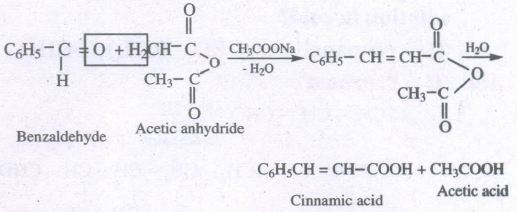
(i) Perkin's Reactions:
When an aromatic aldehyde is heated with an aliphatic acid anhydride in the presence of the sodium salt of the acid corresponding to the anhydride, condensation takes place and an α, β unsaturated acid is obtained
This reaction is known as Perkin's reaction.
(ii) Knoevengal Reaction:
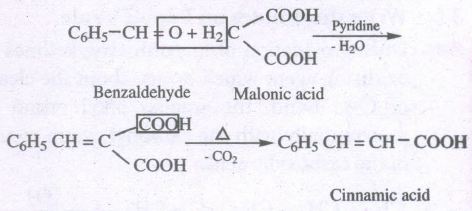
(a) Benzaldehyde condenses with malonic acid in the presence of pyridine forming cinnamic acid
(b) Catalyst - Pyridine
(c) Carbanion formed from malonic acid.
31.
| Fat Soluble Fat Soluble | Water Soluble Vitamins |
|---|---|
| Do not dissolve in water | Readily soluble in water |
| They are stored in fatty tissues and liver | These can't be stored |
| Eg: Vitamin A, D, E and K | Eg: Vitamin Band |
32.
(i) Thermodynamic principles can be employed to derive a relation between electrical energy and the maximum amount of work (Wmax),
(ii) The maximum amount of work obtainable from the cell is the product of charge flowing per mole and maximum potential difference E, through which the charge is transferred.
Wmax = -nFE ..... (1)
where, n = number of moles of electrons transferred
F = Faraday (96495 coulombs)
E = emf of the cell
According to thermodynamics,
Wmax = ΔG ...(2)
From (1) and (2)
ΔG = - nFE
when E is positive, ΔG is positive ΔG will be negative and the cell reaction is spontaneous.
33.
(a) Alcohols are soluble in water because they form intermolecular hydrogen bonding with water. Lower members are completely miscible with water and the higher members are not. This is because of the increase in size of hydrophobic (water repelling) alkyl group in the alcohol.
(b) Strong basic substances like organo metallic compounds (RMgX-Grignard reagent) are decomposed by alcohol.
R - OH + CH3MgBr ⟶ R - O - Mg - Br + CH4
Hence, alcohols cannot be used as a solvent for Grignard reagent.
34.
(a) If we apply DC current through the conductivity cell, it will lead to the electrolysis of the solution taken in the cell.
(b) So, AC current is used for this measurement to prevent electrolysis.
35.

36.
(i) Its small size
(ii) Its high electronegativity
(iii) Its high ionisation energy
(iv) Non-availability of d-orbital in the valence shell.
(v) Rather inert
(vi) High bond energy
37.
Aldol condensation can also takes place between two different aldehydes or ketones or between one aldehyde and one ketone such an aldol condensation is called crossed or mixed aldol condensation. This reaction is not very useful as the product is usually a mixture of all possible condensation products and cannot be separated easily.
\(\underset { formldehyde }{ HCHO } +\underset { acataldehyde }{ { CH }_{ 3 }CHO } \overset { dil.NaOH }{ \longrightarrow } \underset { 3-hydroxy \ propanol }{ HO-{ CH }_{ 2 }-{ CH }_{ 2 }-CHO } \)
\(\underset { formaldehyde }{ { HCHO } } +\underset { acetone }{ { CH }_{ 3 }-\underset { \overset { || }{ O } }{ C } -{ CH }_{ 3 } } \overset { dil.NaOH }{ \longrightarrow } \underset { 4-hydroxy \ butan-2-one }{ HO-{ CH }_{ 2 }-{ CH }_{ 2 }-\underset { \overset { || }{ O } }{ C } -{ CH }_{ 3 } } \)
38.
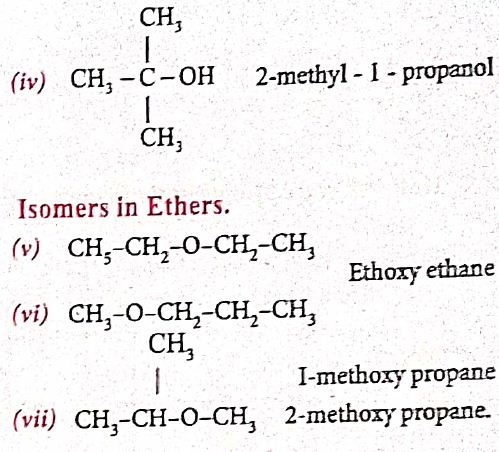
39.
Given data:
k1 = 2.45 x 10⁻⁵ sec-1; T1 = 273 K
k2 = 16.2 x 10⁻⁴ sec-1; T2 = 303 K
R = 8.314 JK-1 mol-1
Formula: \(\log { \frac { { k }_{ 2 } }{ { k }_{ 1 } } } =\frac { { E }_{ a } }{ 2.303R } \left[ \frac { { T }_{ 2 }-{ T }_{ 1 } }{ { T }_{ 1 }{ T }_{ 2 } } \right] \)
Solution:
\(\log { \frac { 16.2\times { 10 }^{ -4 } }{ 2.45\times { 10 }^{ -5 } } } =\frac { { E }_{ a } }{ 2.303\times 8.314 } \left( \frac { 303-273 }{ 273\times 303 } \right) \)
\(1.8203=\frac { { E }_{ a } }{ 2.303\times 8.314 } \times \left[ \frac { 30 }{ 273\times 303 } \right] \)
∴ Ea = 52802.3 x 1.8203
= 96116 J / mol
Ea = 96.116 kJ mol-1.
40.
(i) The first transition metal Scandium exhibits only +3 oxidation state, but all other transition elements exhibit variable oxidation states by loosing electrons from (n-1)d orbital and ns orbital as the energy difference between them is very small.
(ii) At the beginning of the series, +3 oxidation state is stable but towards the end +2 oxidation state becomes stable.
(iii) The number of oxidation states increases with the number of electrons available, and it decreases as the number of paired electrons increases.
(iv) Hence, the first and last elements show less number of oxidation states and the middle elements with more number of oxidation states.
(v) For example, the first element Sc has only one oxidation state +3; the middle element Mn has six different oxidation states from +2 to +7. The last element Cu shows +1 and +2 oxidation states only.
(vi) The relative stability of different oxidation - states of 3d metals is correlated with the extra stability of half filled and fully filled electronic configurations. Example: Mn2+(3d5) is more stable than Mn4+(3d3).
41.
(i) Iron is one of the most useful metals and its alloys are used everywhere including bridges, electricity pylons, bicycle chains, cutting tools and rifle barrels.
(ii) Cast iron is used to make pipes, valves and pumps stoves etc.
(iii) Magnets can be made from iron and its alloys and compounds.
(iv) An important alloy of iron is stainless steel, and it is very resistant to corrosion. It is used in architecture, bearings, cutlery, surgical instruments and jewellery.
(v) Nickel steel is used for making cables, automobiles and aeroplane parts.
(vi) Chrome steels are used for manufacturing cutting tools and crushing machines.
42.
(i) Order of the reaction =1; \(\mathrm{t}_{1 / 2}=60 \mathrm{~s} ; \mathrm{k}=?\)
\(\mathrm{k}=\frac{0.6932}{\mathrm{t}_{\frac{1}{2}}} \)
\(=\frac{0.6932}{60} \)
\(k =1.155 \times 10^{-2} \mathrm{~s}^{-1}\)
(ii) \(\left[\mathrm{A}_{0}\right]=100 \% ; \mathrm{t}=180 \mathrm{~s} ;[\mathrm{A}]=? ; \mathrm{k}=1.155 \times 10^{-2} \mathrm{~s}^{-1}\)
For first order reaction
\(\mathrm{k}=\frac{2.303}{\mathrm{t}} \log \frac{\left[\mathrm{A}_{0}\right]}{[\mathrm{A}]} \)
\(1.155 \times 10^{-2} =\frac{2.303}{180} \log \left(\frac{100}{[A]}\right) \)
\(\frac{0.01155 \times 180}{2.303} =\log \left(\frac{100}{[A]}\right) \)
\(0.9027 =\log 100-\log [\mathrm{A}] \)
\(\log [\mathrm{A}] =\log 100-0.9027 \)
\(\log [A]=2-0.9027 \)
\(\log [A]=1.0972 \)
[A] = antilog of (1.0972)
[A] =12.51 %
43.
a) if both assertion and reason are true and reason is the correct explanation of assertion.

12th Standard Syllabus & Materials
12th Standard
TN 12th Computer Applications களப்பெயர் முறைமை (DNS) Sample Question Papers Study Material - QB365 Set A
NEW12th Standard
TN 12th Computer Applications வலையமைப்பு எடுத்துக்காட்டுகள் மற்றும் நெறிமுறைகள் Sample Question Papers Study Material - QB365 Set A
NEW12th Standard
TN 12th Computer Applications கணினி வலையமைப்பு ஓர் அறிமுகம் Sample Question Papers Study Material - QB365 Set A
NEW12th Standard
TN 12th Computer Applications PHP-உடன் MySQL-ஐ இணைத்தல் Sample Question Papers Study Material - QB365 Set A



Tamilnadu Stateboard 12th Standard Subjects

Maths
Chemistry

Physics

Biology

Computer Science

Business Maths and Statistics

Economics

Commerce

Accountancy

History

Computer Applications
Biology
Computer Technology
Computer Applications
Computer Science
Business Maths and Statistics
Commerce
Economics
Maths
Chemistry
Physics
Computer Technology
History
Accountancy

Tamil

English

French
Tamilnadu Stateboard Standards
