
 100% FREE ACCESS
12th Standard Syllabus & Materials
12th Standard
TN 12th Computer Applications மின்னணு தரவு பரிமாற்றம் Sample Question Papers Study Material - QB365 Set A
NEW12th Standard
TN 12th Computer Applications மின் - வணிக பாதுகாப்பு அமைப்புகள் Sample Question Papers Study Material - QB365 Set A
NEW12th Standard
TN 12th Computer Applications மின்னணு செலுத்தல் முறைகள் Sample Question Papers Study Material - QB365 Set A
NEW12th Standard
TN 12th Computer Applications மின் - வணிகம் Sample Question Papers Study Material - QB365 Set A
NEW12th Standard
TN 12th Computer Applications திறந்த மூல கருத்துருக்கள் Sample Question Papers Study Material - QB365 Set A
NEW12th Standard
TN 12th Computer Applications வலையமைப்பு வடமிடல் Sample Question Papers Study Material - QB365 Set A

Published on: 31/08/2020
12th Standard Chemistry English Medium Sample 2 Mark Book Back Questions (New Syllabus) 2020
Download Tamil Nadu 12th Standard Chemistry question papers, model tests, one-mark questions, important questions, and public exam papers in PDF format. Free study materials and answer keys for TN State Board students.
Questions + Answers key
Take MCQ Chemistry Test
1.
Give the characteristics of image formed by a plane mirror.
2.
Calculate the pH of 0.001M HCl solution
3.
Heat of adsorption is greater for chemisorptions than physisorption. Why?
4.
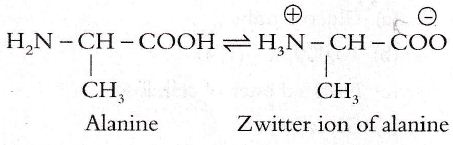
Write the Zwitter ion structure of alanine
5.
The concentration of hydroxide ion in a water sample is found to be 2.5 × 10⁻⁶M. Identify the nature of the solution.
6.
What is the order with respect to each of the reactant and overall order of the following reactions?
a) 5Br-(aq)+BrO3-(aq)+6H+(aq) ➝3Br2(l)+3H2O(l)
The experimental rate law is Rate = k [Br−][BrO3−][H+]2
b) CH3CHO(g)\(\overset { \Delta }{ \longrightarrow } \) CH4(g)+CO(g) the experimental rate law is
Rate =K[CH3CHO]\(\frac{3}{2}\)
7.
Why Gd3+ is colourless?
8.
Give an example of coordination compound used in medicine and two examples of biologically important coordination compounds.
9.
Out of coke and CO, which is better reducing agent for the reduction of ZnO? Why?
10.
Draw the major product formed when 1-ethoxyprop-1-ene is heated with one equivalent of HI.
11.
State Faraday’s Laws of electrolysis
12.
Write a note on synthetic detergents
13.
Derive integrated rate law for a zero order reaction A\(\longrightarrow \) product.
14.
Give the uses of helium.
15.
16.
How will you convert nitrobenzene into
i. 1,3,5 - trinitrobenzene
ii. o and p- nitrophenol
iii. m – nitro aniline
iv. azoxybenzene
v. hydrozobenzene
vi. N – phenylhydroxylamine
vii. aniline
17.
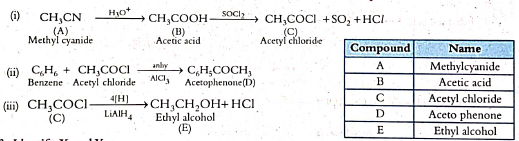
A Compound (A) with molecular formula C2H3N on acid hydrolysis gives (B) which reacts with thionylchloride to give compound(C). Benzene reacts with compound (C) in presence of anhydrous AlCl3 to give compound(D). Compound (D) on reduction with Zn/Hg and Conc.HCl gives (E). Identify (A), (B), (C) (D) and (E). Write the equations.
18.
Differentiate crystalline solids and amorphous solids.
1.
(i) The image formed by a plane mirror is virtual, erect, and laterally inverted.
(ii) The size of the image is equal to the size of the object.
(iii The image distance far behind the mirror is equal to the object distance in front of it.
(iv) If an object is placed between two plane mirrors inclined at an angle e, then the number of images n formed is as,
\(n=\left( \cfrac { 360 }{ \theta } -1 \right) \)
2.
\(\underset{0.001M}{HCl}\overset{H_{2}O}{\rightleftharpoons }\underset{0.001M}{H_{3}O^{+}}+\underset{0.001M}{Cl^{-}}\)
H3O+ from the auto ionisation of H2O (10-7M) is negligible when compared to the H3O+ from 10-3M HCl.
Hence [H3O+] = 0.001 mol dm-3
pH = -log10 [H3O+]
= -log10(0.001)
= -log10(10-3) = 3
3.
In Chemisorptions the molecules are held on the surface by attractive forces by formation of chemical bonds. As strong bond is formed nearly 400 kJ / mol is given out as heat of adsorption chemical bonds are much stronger, whereas the Vander Waal's forces in physisorption is weaker.
4.
5.
1. If \(\left[\mathrm{OH}^{-}\right]>1 \times 10^{-7} \mathrm{M}\), the solution is basic. \(2.5 \times 10^{-6} \mathrm{M}>1 \times 10^{-7} \mathrm{M}\)
2. \(\therefore\) The solution is basic.
6.
a) First order with respect to Br−, first order with respect to BrO3− and second order with respect to H+. Hence the overall order of the reaction is equal to 1 + 1 + 2 = 4
b) Order of the reaction with respect to acetaldehyde is \(\frac{3}{2}\) and overall order is also \(\frac{3}{2}\)
7.
In Gd+3 there are 64 electrons. Hence electronic configuration will be [Xe]4f7 5d1 6s2. Hence no electrons are there in outer d - orbital. Due to this it is colourless.
8.
Medicinal uses
(i) Ca-EDTA chelate, is used in the treatment of lead and radioactive poisoning.
(ii) That is for removing lead and radioactive metal ions from the body.
(iii) Cis-platin is used as an antitumor drug in cancer treatment.
Biological Importance compounds:-
(i) Fe2+ - porphyrin complex: It plays an important role in carrying oxygen from lungs to tissues and tissue carbon dioxide from to lungs.
(ii) Chlorophyll - useful in photosynthesis in plants.
9.
Ellingham diagram for the formation of ZnO and CO2 intersects around 1200 K. Above this temperature ZnO lies above Carbon which indicates Carbon is the better reducing agent CO is more effective reducing agent only below 983 K.
10.

11.
First law:
The mass of the substance (m) liberated at an electrode during electrolysis is directly proportional to the quantity of charge (Q) passed through the cell.
m α Q \(\left[\because \mathrm{I}=\frac{\mathrm{Q}}{\mathrm{t}} \Rightarrow \mathrm{Q}=\mathrm{It}\right]\)
m α It
m = ZIt
Where Z = electro chemical equivalent of the substance
I = current
t = time of passage of current
Second law:
When the same quantity of charge is passed through the solutions of different electrolytes, the amount of substances liberated at the respective electrodes are directly proportional to their electrochemical equivalents.
m α Z
\(\frac{m_{1}}{Z_{1}}=\frac{m_{2}}{Z_{2}}\)
m = mass of the metal deposited
Z = electro chemical equivalent
12.
Detergents:
a) Anionic detergents:
These are sodium salt of sulphonated long chain alcohols (or) hydrocarbons. The anionic part of the molecule is involved in the cleansing action.
Eg: sodium lawryl sulphate, sodium dodecyl benzene sulphonate.
Use: Household work & tooth paste.
b) Cationie detergents:
These are quarternary. ammonium salts of amines with acetates, chlorides (or) bromides as anions.
It is the cationic part of the molecule which is involved in cleansing action.
Eg: n-hexadecyl trimethyl ammonium chloride
c) Non-ionic detergents:
These donot contain any ion. These are esters of high molecular mass alcohols.
Eg: Pentaerythrityl stearate
Use dish washing detergents.
| Detergent Type | Example |
| Anionic detergent | Sodium Lauryl Sulphate (SLS).JPG) |
| Cationic detergent | N - hexadecyltrimethyl ammonium chloride.JPG) N,N,N - trimethylhexadecan - 1 - aminium chloride |
| Non - ionic detergent | Pentaerythrityl stearate.JPG) 3 - hydroxy -2,2 - bis (hydroxymethyl) propyl heptanoate |
13.
A reaction in which the rate is independent of the concentration of the reactant over a wide range of concentration is called a zero order reaction.
Let us consider the following by hypothetical zero order reaction.
A⟶ product
The rate law can be written as,
Rate = k[A]0
\(\frac { -d\left[ A \right] }{ dt } =k(1)\ \ \ \therefore \left( { \left[ A \right] }^{ 0 }=1 \right) \)
\(\Rightarrow -d\left[ A \right] =kdt\)
Integrate the above equation between the limits of [A0] at zero time and [A] at some later time 't',
\(-\int _{ \left[ { A }_{ 0 } \right] }^{ \left[ A \right] }{ d\left[ A \right] } =k\int _{ 0 }^{ t }{ dt } \)
\(-{ \left( \left[ A \right] \right) }_{ \left[ { A }_{ 0 } \right] }^{ \left[ A \right] }=k{ \left( t \right) }_{ 0 }^{ t }\)
[A0] - [A] = kt
\(k=\frac { \left[ { A }_{ 0 } \right] -\left[ A \right] }{ t } \)
Straight line equation y = mx + c
ie., \(\left[ A \right] =-kt+\left[ { A }_{ 0 } \right] \)
⇒ y = c + mx
A plot [A] vs time gives a straight line with a slope of -k and y intercept of [A0]
14.
(i) Helium is used to provide inert atmosphere in electric-arc welding of metals.
(ii) Helium has lowest boiling point hence used in cryogenics.
(iii) It is much less denser than air and hence used for filling air balloons.
15.
16.
Nitrobenzene into 1,3,5 - trinitro benzene
.JPG)
Nitrobenzene 1,3,5 - trinitro benzene
ii. Nitrobenzene into o - and p - nitro phenols
.JPG)
iii. Nitrobenzene into m - nitro aniline
.JPG) + 6NH3 + 2H2O + 3S
+ 6NH3 + 2H2O + 3S
iv. Nitrobenzene into azoxybenzene
.JPG) +3H2O
+3H2O
v. Nitrobenzene into hydrazobenzene
.JPG)
vi. Nitrobenzene into N - phenyl hydrazobenzene
.JPG)
vii. Nitrobenzene into aniline
.JPG)
17.
18.
| S. No | Crystalline Solids | Amorphous Solids |
| 1. | Long range orderly arrangement of constituents. | Short range, random arrangement of constituents. |
| 2. | Definite shape | Irregular shape |
| 3. | Anisotropic in nature | They are "isotropic" like liquids |
| 4. | They are true solids | They are considered as pseudo solids (or) super cooled liquids |
| 5. | Definite Heat of fusion | Heat of fusion is not definite |
| 6. | They have sharp melting points. | Gradually soften over a range of temperature and so can be moulded. |
| 7. | Eg: NaCl, diamond etc. | Eg: Rubber, plastics, glass etc. |

12th Standard Syllabus & Materials
12th Standard
TN 12th Computer Applications களப்பெயர் முறைமை (DNS) Sample Question Papers Study Material - QB365 Set A
NEW12th Standard
TN 12th Computer Applications வலையமைப்பு எடுத்துக்காட்டுகள் மற்றும் நெறிமுறைகள் Sample Question Papers Study Material - QB365 Set A
NEW12th Standard
TN 12th Computer Applications கணினி வலையமைப்பு ஓர் அறிமுகம் Sample Question Papers Study Material - QB365 Set A
NEW12th Standard
TN 12th Computer Applications PHP-உடன் MySQL-ஐ இணைத்தல் Sample Question Papers Study Material - QB365 Set A



Tamilnadu Stateboard 12th Standard Subjects

Maths
Chemistry

Physics

Biology

Computer Science

Business Maths and Statistics

Economics

Commerce

Accountancy

History

Computer Applications
Biology
Computer Technology
Computer Applications
Computer Science
Business Maths and Statistics
Commerce
Economics
Maths
Chemistry
Physics
Computer Technology
History
Accountancy

Tamil

English

French
Tamilnadu Stateboard Standards
