
 100% FREE ACCESS
12th Standard Syllabus & Materials
12th Standard
TN 12th Computer Applications மின்னணு தரவு பரிமாற்றம் Sample Question Papers Study Material - QB365 Set A
NEW12th Standard
TN 12th Computer Applications மின் - வணிக பாதுகாப்பு அமைப்புகள் Sample Question Papers Study Material - QB365 Set A
NEW12th Standard
TN 12th Computer Applications மின்னணு செலுத்தல் முறைகள் Sample Question Papers Study Material - QB365 Set A
NEW12th Standard
TN 12th Computer Applications மின் - வணிகம் Sample Question Papers Study Material - QB365 Set A
NEW12th Standard
TN 12th Computer Applications திறந்த மூல கருத்துருக்கள் Sample Question Papers Study Material - QB365 Set A
NEW12th Standard
TN 12th Computer Applications வலையமைப்பு வடமிடல் Sample Question Papers Study Material - QB365 Set A

Published on: 03/09/2020
12th Standard Chemistry English Medium Sample 3 Mark Book Back Questions (New Syllabus) 2020
Download Tamil Nadu 12th Standard Chemistry question papers, model tests, one-mark questions, important questions, and public exam papers in PDF format. Free study materials and answer keys for TN State Board students.
Questions + Answers key
Take MCQ Chemistry Test
1.
Calculate the pH of 0.1M CH3COOH solution. Dissociation constant of acetic acid is \(1.8\times10^{-5}\).
2.
What happens when a colloidal sol of Fe(OH)3 and As2S3 are mixed?
3.
Which sweetening agent are used to prepare sweets for a diabetic patient?
4.
Write Arrhenius equation and explains the terms involved.
5.
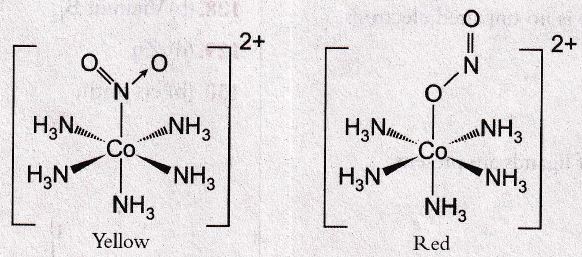
What is linkage isomerism? Explain with an example.
6.
Why ionic crystals are hard and brittle?
7.
Write a short note on hydroboration.
8.
Explain the electrometallurgy of aluminium.
9.
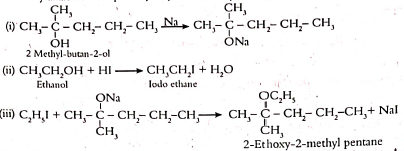
Write the chemical equation for Williamson synthesis of 2-ethoxy – 2- methyl pentane starting from ethanol and 2 – methyl pentan -2-ol.
10.
Identify A,B,and C
CH3- NO2 \(\overset { { L }_{ 1 }{AlH }_{ 4 } }{ \underset { {} }{ \longrightarrow } }\) A \(\overset { { 2CH_3 }{Ch_2Br } }{ \underset { {} }{ \longrightarrow } }\) B \(\overset { {H}_{ 2 }{SO}_{ 4 } }{ \underset { {} }{ \longrightarrow } } \) C
11.
0.1M NaCl solution is placed in two different cells having cell constant 0.5 and 0.25 cm-1 respectively. Which of the two will have greater value of specific conductance.
12.
What are reducing and non – reducing sugars?
13.
The half life of a first order reaction x →products is 6.932 x 10⁴ s at 500K. What percentage of x would be decomposed on heating at 500K for 100 min. (e0.06 = 1.06).
14.
Explain why Cr2+ is strongly reducing while Mn3+ is strongly oxidizing.
15.
Give the uses of sulphuric acid.
16.
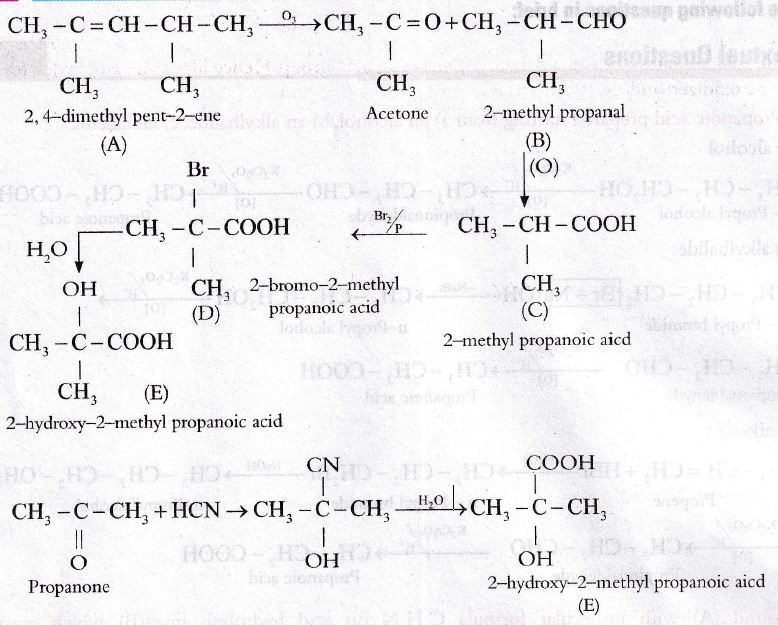
An alkene (A) on ozonolysis gives propanone and aldehyde (B). When (B) is oxidised (C) is obtained. (C) is treated with Br2/P gives (D) which on hydrolysis gives (E). When propanone is treated with HCN followed by hydrolysis gives (E). Identify A, B, C, D and E.
1.
pH=-log[H+]
For weak acids,
\(= \sqrt{k_a \times C}\)
=\(\sqrt{1.8\times10^{-5}\times0.1}\)
=\(1.34 \times10^{-3}\) M
\(pH=-\log(1.34\times10^{-3})\)
= 3-log1.34
= 3-0.1271
= 2.8729 \(\simeq\) 2.87
2.
(i) Neutralisation of chargers of ion will taken place and hence precipitation will take place (ie) Fe3+ and S2- ion changes are neutralized. No new compounds are formed.
(ii) Fe(OH)3 is a positive Sol
(iii) As2S3 is a negative Sol
3.
(i) Sucralose is used as sugar substituent like Sorbitol, Xylitol and Mannitol. All these have sweetness. They are metabolised without the influence of insulin.
(ii) Artificial sweetening agents like Aspartarne, Alitame and Saccharin are also used. These have negligible nutritional value.
Example : Saccharin,Aspartame, Sucralose, Alitame
4.
Arrhenius equation is,
\(k=Ae^\left ({ \frac { -Ea }{ RT } } \right )\)
Here,
A \(\rightarrow\) Frequency factor
Ea \(\rightarrow\) Activation energy of the reaction
R \(\rightarrow\) Gas constant
T \(\rightarrow\) Absolute temperature (in K)
5.
(i) This is also called as salt isomerism.
(ii) This type of isomers arises when an ambidentate ligand is bonded to the central metal atom/ion through either of its two different donor atoms. In the below mentioned examples, the nitrite ion is bound to the central metal ion Co3+ through a nitrogen atom in one complex and through oxygen atom in other complex.
\(\left[\mathrm{Co}\left(\mathrm{NH}_{3}\right)_{5}\left(\mathrm{NO}_{2}\right)\right]^{2+}\)
6.
The structural units of an ionic crystal are cations and anions. They are bound together by strong electrostatic attractive forces. To maximize the attractive force, cations are surrounded by as many anions as possible and vice versa. Hence they are hard and brittle.
7.
Diborane adds on to alkenes and alkynes in ether solvent at room temperature. This reaction is called hydroboration.
\({ B }_{ 2 }{ H }_{ 6 }+6RCH=CHR\longrightarrow 2B(RCH_2-{ CH }R)_{ 3 }B\)
8.
1. This process is called as Hall-Heroult process.
Cathode: In this method, electrolysis is carried out in an iron tank lined with carbon which acts as the cathode.
Anode: The carbon blocks immersed in the electrolyte acts as a anode.
Eletrolyte: A 20% solution of alumina, obtained from the bauxite ore is mixed with molten Cryolite and is taken in the electrolysis chamber.
2. About 10% calcium chloride is also added to the solution.
3. Here Calcium chloride helps to lower the melting point of the mixture.
Temperature: The fused mixture is maintained at a temperature of above 1270 K.
4. The chemical reactions involved in this process as follows
(a) Ionisaiton of alumina: \({ A }l_{ 2 }{ O }_{ 3 }\longrightarrow { 2Al }^{ 3+ }+{ 3O }^{ 2- }\)
(b) Reaction at cathode: \(2{ Al }^{ 3+ }_{(melt)}+{ 6e }^{ - }\longrightarrow { Al }_{ (l) }\)
(c) Reaction at anode: \(6{ O }^{2-}_{(melt)}\longrightarrow { 3O }_{ 2 }+{ 12e }^{ - }\)
5. Since carbon acts as anode the following reaction also takes place
(a) \({ C }_{ (s) }+{ O }^{ 2- }_{(melt)}\longrightarrow CO+{ 2e }^{ - }\)
(b) \({ C }_{ (s) }+{ 2O }^{ 2- }_{(melt)}\longrightarrow { CO }_{ 2 }+{ 4e }^{ - }\)
6. Due to the above two reactions, anodes are slowly consumed during the electrolysis.
7. The pure aluminium is formed at the cathode. The net electrolysis reaction can be written as
\({ 4Al }^{ 3+ }_{(melt)}+{ 6O }^{ 2- }_{(melt)}+{ 3C }_{ (s) }\longrightarrow { 4Al }_{ (l) }+{ 3CO }_{ 2(g) }\)
9.
10.

11.
\(\kappa=\mathrm{C}\left(\frac{l}{\mathrm{~A}}\right)\) (or) k = 1/R.l/A
Where, C - Conductance
\(\frac{l}{A} \Rightarrow\) Cell constant (or)
Sp. Conductance \(\propto\) Cell constant
Sp. Conductance \(\propto\) Concentration
1. Sp. Conductance = concentration x cell constant
i) \(\kappa=0.1 \times 0.5=0.05=5 \times 10^{-2} \mathrm{Scm}^{-1}\)
ii) \(\kappa=0.1 \times 0.25=0.025=2.5 \times 10^{-2} \mathrm{Scm}^{-1}\)
2. So the first case will have greater specific conductance with cell constant 0.05.
12.
i) Reducing sugars:
1. Sugars which reduce Tollen's reagent or Fehling's solution or Benedict's solution are called reducing sugars.
2. These contain either α - hydroxyl ketone or cyclical hemi acetal or hemi ketal or structures in equilibrium with open chain forms having a free- CHO or C=O group.
3. E.g. a) All monosaccharide's like D - glucose, D - fructose (aldoses and ketoses)
b) Sugars like Lactose and maltose except sucrose.
ii) Non - reducing sugars:
1. Sugars which do not reduce either Tollen's reagent, Fehling's solution or Benedict's solution are called non-reducing sugars.
2. They contain a stable acetal or ketal structures which cannot be opened into a free carbonyl group.
E.g. Sucrose, starch, cellulose, glycogen, dextrin etc.
13.
Given t1/2= 0.6392 \(\times\)104 s
To solve: when t = 100 min,
\(\frac { [{ A }_{ 0 }]-[A] }{ [{ A }_{ 0 }] } \times 100=?\)
We know that
For a first order reaction, \({ t }_{ 1/2 }=\frac { 0.6932 }{ k } \)
\(k=\frac { 0.6932 }{ 6.932\times { 10 }^{ 4 } } \)
\(k={ 10 }^{ -5 }{ s }^{ -1 }\)
\(k=\left( \frac { 1 }{ t } \right) In\left( \frac { [{ A }_{ 0 }] }{ [{ A }] } \right) \)
\({ 10 }^{ -5 }{ s }^{ -1 }\times 100\times 60s=In\left( \frac { [{ A }_{ 0 }] }{ [{ A }] } \right) \)
\(0.06-In\ \left( \frac { [{ A }_{ 0 }] }{ [{ A }] } \right) \)
\(\frac { [{ A }_{ 0 }] }{ [{ A }] } ={ e }^{ 0.06 }\) ?(given : e0.06 = 1.06)
\(\frac { [{ A }_{ 0 }] }{ [{ A }] } =1.06\)
\(\therefore \frac { [{ A }_{ 0 }]-[{ A }] }{ [{ A }_{ 0 }] } \times 100\%\)
\(=\left( 1-\frac { [{ A }] }{ [{ A }_{ 0 }] } \right) \times 100\%\)
=\(\left( 1-\frac { 1 }{ 1.06 } \times 100\% \right) \)
= 5.66%
14.
Mn3+ has large and negative standard electrode potential E0 (-1.18 V) than that of Cr2+ which has only -0.91 V. If the standard electrode potential of a metal is large and negative, the metal is a powerful reducing agent because it loses electrons easily. Hence Mn3+ is strongly oxidizing while Cr2+ is strongly reducing.
15.
(i) Sulphuric acid is used in the manufacture of fertilisers, ammonium sulphate and super phosphates and other chemicals such as HCl, HNO3.
(ii) It is used as a drying agent and also used in the preparation of pigments, explosives etc.
16.

12th Standard Syllabus & Materials
12th Standard
TN 12th Computer Applications களப்பெயர் முறைமை (DNS) Sample Question Papers Study Material - QB365 Set A
NEW12th Standard
TN 12th Computer Applications வலையமைப்பு எடுத்துக்காட்டுகள் மற்றும் நெறிமுறைகள் Sample Question Papers Study Material - QB365 Set A
NEW12th Standard
TN 12th Computer Applications கணினி வலையமைப்பு ஓர் அறிமுகம் Sample Question Papers Study Material - QB365 Set A
NEW12th Standard
TN 12th Computer Applications PHP-உடன் MySQL-ஐ இணைத்தல் Sample Question Papers Study Material - QB365 Set A



Tamilnadu Stateboard 12th Standard Subjects

Maths
Chemistry

Physics

Biology

Computer Science

Business Maths and Statistics

Economics

Commerce

Accountancy

History

Computer Applications
Biology
Computer Technology
Computer Applications
Computer Science
Business Maths and Statistics
Commerce
Economics
Maths
Chemistry
Physics
Computer Technology
History
Accountancy

Tamil

English

French
Tamilnadu Stateboard Standards
