
 100% FREE ACCESS
12th Standard Syllabus & Materials
12th Standard
TN 12th Computer Applications மின்னணு தரவு பரிமாற்றம் Sample Question Papers Study Material - QB365 Set A
NEW12th Standard
TN 12th Computer Applications மின் - வணிக பாதுகாப்பு அமைப்புகள் Sample Question Papers Study Material - QB365 Set A
NEW12th Standard
TN 12th Computer Applications மின்னணு செலுத்தல் முறைகள் Sample Question Papers Study Material - QB365 Set A
NEW12th Standard
TN 12th Computer Applications மின் - வணிகம் Sample Question Papers Study Material - QB365 Set A
NEW12th Standard
TN 12th Computer Applications திறந்த மூல கருத்துருக்கள் Sample Question Papers Study Material - QB365 Set A
NEW12th Standard
TN 12th Computer Applications வலையமைப்பு வடமிடல் Sample Question Papers Study Material - QB365 Set A

Published on: 03/09/2020
12th Standard Chemistry English Medium Sample 3 Mark Creative Questions (New Syllabus) 2020
Download Tamil Nadu 12th Standard Chemistry question papers, model tests, one-mark questions, important questions, and public exam papers in PDF format. Free study materials and answer keys for TN State Board students.
Questions + Answers key
Take MCQ Chemistry Test
1.
Write a note on structure of amine.
2.
Write a note on the basicity of amines.
3.
What is Malachite green dye? Explain its preparation?
4.
Explain Stephen's reaction.
5.
6.
Write a short note on Antioxidants.
7.
What are carbohydrates? Give two examples.
8.
Write the product formed when HCN reacts with glucose.
9.
Ethers should not be heated to dryness. Why?
10.
Account for the following:
(i) Phenol has a smaller dipole moment than methanol,
(ii) Phenols do not give protonation reaction readily.
11.
How is coagulation brought about by addition of electrolytes?
12.
Show that SHE can act both as a anode as well as cathode.
13.
Write the reactions taking place in anode and cathode of a mercury button cell. Give the over all redox reaction of the cell with the emf generation
14.
0.1 M solution of two electrolytes P and Q have specific conductance 4 x 10⁻⁴ S cm-1 and 6 x 10⁻⁶ S cm-1 respectively. Which among the following will have greater resistance to the flow of current? Give reason.
15.
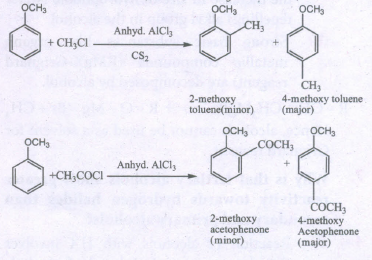
Write a note on Friedel Crafts reaction of anisole.
16.
For an aqueous solution of NH4CI, prove that [H+] = \(\sqrt { { K }_{ n }.C } \)
17.
Which is the last element in the series of the actinoids? Write the electronic configuration of this element comment on the possible oxidation state of this element.
18.
Explain the preparation of potassium permanganate from pyrolusite.
19.
The rate constant for a first order reaction is 60 S-1. How much time will it take to reduce the initial concentration of the reactant to its \({ \frac { 1 }{ 16 } }^{ th }\) value?
20.
The energy of activation for the formation of hydrogen iodide is 150 kJ mol-1 The rate constant of this reaction at 673 K is 2.3 x 10⁻³. Calculate the rate constant at 773 K.
21.
Give reason for the following:
(i) A transition metal exhibits highest oxidation state in oxides and fluorides.
(ii) Cu2+ is unstable in an aqueous solution.
22.
What are the general properties of f-block elements? (Lanthanides and Actinides)
(i) Electronic configuration
(ii) Oxidation state
(iii) Radii of tripositive ions.
23.
Complete the following reactions
(l) Cl2+ H2O\(\longrightarrow \)?
(ii) XeF6 + 2H2O \(\longrightarrow \) ?
(Iii) XeF6 + 2H2O\(\longrightarrow \)?
24.
Explain the structure of ammonia.
25.
Distinguish the following. Crystal lattice and unit cell.
26.
How do the spacings of the three planes (100), (101) and (111) of simple cubic lattice vary?
27.
Silver crystallizes in fcc lattice. If edge length of the cell is 4.07 x 10⁻⁸ em and density is 10.5 g cm-3. Calculate the atomic mass of silver
28.
Give 3 uses of carbon monoxide.
29.
How is boron trifluoride obtained from boron trioxide?
30.
Mention the uses of copper.
31.
Write the molecular composition of the following ores and mentions it metal: magnetite calamine and bauxite.
32.
Explain alkali leaching in the extraction of aluminum.
33.
Name some metal complexes, that are present in our biological system and their role in it.
1.
Structure of amines:
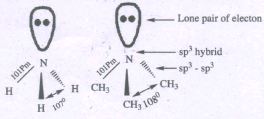
(i) Like, ammonia, nitrogen atom of amines is trivalent and carries a lone pair of electron and sp3 hybridised, out of the four sp3 hybridised orbitals of nitrogen, three sp3 orbitals overlap with orbitals of hydrogen (or) alkyl groups of carbon, the fourth sp3 orbital contains a lone pair of electron.
(ii) Hence, amines possess pyramidal geometry. Due to presence of lone pair of electron C-N-H (or) C-N-C bond angle is less than the normal tetrahedral bond angle 109.5°.
For example, the C-N-C bond angle of trimethylamine is 108° which is lower than tetrahedral angle and higher than the H-N-H bond angle of 107°.
(iii) This increase is due to the repulsion between the bulky methyl groups.
2.
(i) The nitrogen in amines possess an unshared pair of electrons (Lone Pair).
(ii) The lone pair of electrons is available for the formation of a new bond with a proton or lewis acid.
(iii) Thus amines are basic in nature and they react with acids to form salts.
(iv) The greater is the number of electron releasing alkyl. groups, the greater the availability of nitrogen's lone pair and stronger the base.
NH3 < CH3 - NH2 < CH3 - NH - CH3
3.
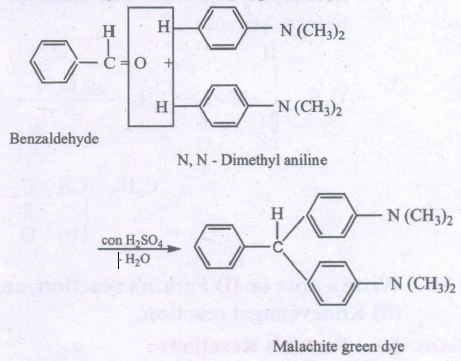
Benzaldehyde condenses with tertiary aromatic amines like N, N - dimethyl aniline in the presence of strong acids to from triphenyl methane dye or malachite green dye.
4.
When alkylcyanides are reduced using SnCl2 HCl, imines are formed, which on hydrolysis gives corresponding aldehyde.
\({ CH }_{ 3 }-C\equiv N\overset { { SnCl }_{ 2 }/HCl }{ \longrightarrow } { CH }_{ 3 }-CH={ NH }\overset { { H }_{ 3 }{ O }^{ + } }{ \longrightarrow } { CH }_{ 3 }-CHO\)
5.
6.
(i) Antioxidants are substances which retard the oxidative deteriorations of food.
(ii) Food containing fats and oils is easily oxidised and turn rancid.
(iii) To prevent the oxidation of the fats and oils, chemical BHT(butylhydroxy toluene), BHA(Butylated hydroxy anisole) are added as food additives.
(iv) They are generally called antioxidants. These materials readily undergo oxidation by reacting with free radicals generated by the oxidation of oils, thereby stop the chain reaction of oxidation of food.
7.
(i) Carbohydrates are polyhydroxy aldehydes or polyhydroxy ketones.
(ii) They are naturally occurring organic substances.
(iii) Carbohydrates are formed in the plants by photosynthesis from water in sunlight.
(iv) They are classified into two types
(a) Sugars Eg: Glucose, Fructose.
(b) Non-sugars Eg: Starch, Cellulose.
8.
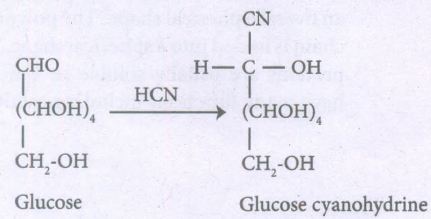
Glucose reacts with HCN to form cyanohydrin.
9.
When ethers are heated to dryness,
(i) They form peroxide by the action of air or oxygen.
(ii) Ether oxygen is capable of forming a co-ordinate covalent bond with electron deficient species.

(ii) These peroxides are unstable and decomposes violently with explosion on heating. Hence, ether should not be heated to dryness.
10.
(i) Phenol are only sparingly soluble in water. Actually they form only negligible hydrogen bonding with water since the size of the phenyl group is large and it almost masks the polar character of -OH group. So, phenol has a smaller dipole moment.
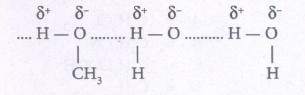
(ii) But methanol is soluble in soluble in water due to the formation of hydrogen bonding with water and it results in higher dipole moment. In henol, there is +ve charge on oxygen, therefore it does not undergo protonation easily.

11.
(i) A negative ion causes the precipitation of positively charged sol and vice versa.
(ii) When the valency of ion is high, the precipitation power is increased. For example, the precipitation power of some cations and anions varies in the following order.
\({ Al }_{ 3 }+>Ba^{ 2+ }+>Na^{ + },Similarly[Fe(CN)_{ 6 }]^{ 3- }>SO_{ 4 }^{ 2- }>{ Cl }^{ - }\)
(iii) The precipitation power of electrolyte is determined by finding the minimum concentration (millimoles/lit) required to cause precipitation of a sol in 2 hours.
(iv) This value is called flocculation value. The smaller the flocculation value greater will be precipitation
12.
(i) When it is placed on the right-hand side of the zinc electrode, the hydrogen electrode reaction is,
2H++ 2e- ➝ H2
The electrons flow to the SHE and it acts as the cathode.
(ii) When the SHE is placed on the left hand side, the electrode reaction is
H2 ➝ 2H++ 2e-
The electrons flow to the copper electrode and the hydrogen electrode acts as the anode.
13.
(i) Oxidation occurs at anode:
.JPG)
(ii) Reduction occurs at cathode:
.JPG)
(iii) Overall reaction:
\({ Zn }_{ (s) }+{ HgO }_{ (s) }\rightarrow { ZnO }_{ (s) }+Hg(l)\)
(iv) Cell emf: about 1.35V.
14.
Specific conductance k = \(C(\frac{l}{a})\)
k = \(\frac{1}{R}(\frac{l}{a})\)
That is k α \(\frac{1}{R}\)
15.
Anisole undergoes Friedel Craft's reaction in presence of anhydrous AlCl3 as a catalyst.
16.
NH4CI is a salt of a strong acid HCI and weak base NH4OH.
\({ HCl }_{ (aq) }+{ NH }_{ 4 }OH_{(aq)}\rightleftharpoons { { NH }_{ 4 }Cl }_{ (aq) }+{ H }_{ 2 }O(I)\)
\({ NH }_{ 4 }^{ + }\) is a strong conjugate acid of the weak base NH4OH and it has a tendency to react with OH- from water to produce unionised NH4OH shown below.
\({ NH }_{ 4 }^{ + }+{ H }_{ 2 }O(1)\rightleftharpoons { NH }_{ 4 }{ { { OH }_{ (aq) }+ }H }_{ (aq) }^{ + }\)
There is no such tendency shown by Cl- and therefore [H+] > [OH-]; the solution is acidic and the pH is less than 7.
As discussed in the salt hydrolysis of strong base and weak acid. In this case also, we can establish a relationship between the Kh and Kb as
Kh·Kb = Kw
Let us calculate the Kh value in terms of degree of hydrolysis (h) and the concentration of salt
Kb = h2C and \([{ H }^{ + }]=\sqrt { { K }_{ h }.C } \)
= \({ [H }^{ + }]=\sqrt { \frac { { K }_{ w } }{ { K }_{ b } } .C } \)
pH = - log [H+]
\(={ \left( \frac { { K }_{ w }.C }{ { K }_{ b } } \right) }^{ \frac { 1 }{ 2 } }\)
= \(-\frac { 1 }{ 2 } \log { K }_{ w }-\frac { 1 }{ 2 } \log C+\frac { 1 }{ 2 } \log{ K }_{ b }\)
\(pH=7-\frac { 1 }{ 2 } p{ K }_{ b }-\frac { 1 }{ 2 } \log C\)
17.
Lr Z = 103, is the last element of actinoid series. Its electronic configuration is [Rn]86 5f146d17S2 the possible oxidation state shown by it is +3.
18.
Potassium permanganate is prepared from pyrolusite (MnO2) ore. The preparation involves the following steps
(i) Conversion of MnO2 to potassium manganate: Powdered ore is fused with KOH in the presence of air or oxidising agents like KNO3 or KCIO3. A green coloured potassium manganate is formed.

(ii) Oxidation of potassium manganate to potassium permanganate: Potassium manganate thus obtained can be oxidised in two ways, either by chemical oxidation or electrolytic oxidation.
19.
It is know that,
\(t=\frac { 2.303 }{ k } \log { \frac { { \left[ R \right] }_{ 0 } }{ \left[ R \right] } } \)
= \(\frac { 2.303 }{ 60{ s }^{ -1 } } \log\frac { 1 }{ \frac { 1 }{ 16 } } \)
= \(\frac { 2.303 }{ 60{ s }^{ -1 } } \log16\)
= 4.6 x 10⁻² s (approximately)
Hence the required time is 4.6 x 10⁻² s
20.
Formula:
\(\log { \frac { { k }_{ 2 } }{ { k }_{ 1 } } } =\frac { { E }_{ a }\left( { T }_{ 2 }-{ T }_{ 1 } \right) }{ 2.303R{ T }_{ 1 }{ T }_{ 2 } } \)
Given:
Energy of activation: E = 150 kJ = 150000 J
Temperatures: T1 = 673 K; T2 = 773 K
Rate constant: k1 = 2.3 x 10⁻³
Gas constant: R = 8.314 J k-1 mol-1
Solution:
\(\log { \frac { { k }_{ 2 } }{ { k }_{ 1 } } } =\frac { { k }_{ 2 } }{ 2.3\times { 10 }^{ -3 } } =\frac { 150000(773-673) }{ 2.303\times 8.314\times 673\times 773 } \)
\(=\frac { 15000000 }{ 2.303\times 8.314\times 673\times 773 } \)
\(\log { \frac { { k }_{ 2 } }{ 2.3\times { 10 }^{ -3 } } } \) = 1.505
\(\frac { { k }_{ 2 } }{ 2.3\times { 10 }^{ -3 } } \) Antilog 1.5905 = 32
∴ k2 = 2.3 x 10-3 x 32 = 7.36 x 10⁻²
k2 = 7.36 x 10⁻²
21.
(i) The highest oxidation state in oxides and fluorides is due to small size and high electro negativity of F and O.
(ii) Many Cu+ compounds are unstable in aqueous solution and undergo disproportionation.
2Cu+ ⟶ Cu2++ Cu
This suggest that in aqueous solution Cu+(aq), converts into Cu2+(aq) which is due to much more negative Δhyd H- of Cu2+(aq) than Cu+, which compensates more for the second ionisation enthalpy of Cu.
22.
| Properties | Lanthanides | Actinides |
|---|---|---|
| Electronic configuration | [54Xe]4f1-14 5d16s2 | [Rn] 5f0,1-14 6d0,1-27s2 |
| Oxidation state | Common: +3 Uncommon: +2, +4 |
Common: +4 Uncommon: +2, +3, +5, +6 |
| Radii | M3+gradually decrease in size on moving from La to Lu Lanthanide contraction | M3+ and M4+ ions decrease in size on moving from Ac to Lr. Actinide contraction. |
23.
(l) Cl2+ H2O\(\longrightarrow \) HCI + HOCI
(ii) XeF6 + 2H2O \(\longrightarrow \) XeO3 + 6HF
(Iii) XeF6 + 2H2O\(\longrightarrow \) XeO2F2+ 4HF
24.
Structure of ammonia
(i) Ammonia molecule is pyramidal in shape N-H bond distance is 1.016Å and H-H bond, distance is 1.645Å with a bond angle 107°.
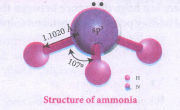
(ii) The structure of ammonia may be regarded as a tetrahedral with one lone pair of electrons in one tetrahedral position hence it has a pyramidal shape.
25.
crystal lattice and unit cell:
| Crystal Lattice | Unit Cell |
| In 3 dimensional space, a regular arrangement and repeating pattern of the constituent particles of a crystal in which each particle is depicted as a point is known as crystal lattice. | The smallest portion of the crystal lattice which, when repeated in different directions generates the entire lattice, is known as unit cell. |
26.
Simple Cubic Lattice
100,101,111
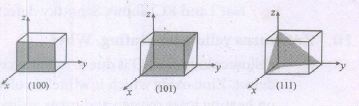
\({ d }_{ hkl }=\frac { a }{ \sqrt { { h }^{ 2 }+{ k }^{ 2 }+{ l }^{ 2 } } } \)
\({ d }_{ 100 }=\frac { 1 }{ \sqrt { { 1 }^{ 2 }+0^{ 2 }+0^{ 2 } } } =1\)
\({ d }_{ 101 }=\frac { 1 }{ \sqrt { { 1 }^{ 2 }+0^{ 2 }+0^{ 2 } } } =\frac { 1 }{ \sqrt { 2 } } \)
\({ d }_{ 111 }=\frac { 1 }{ \sqrt { { 1 }^{ 2 }+1^{ 2 }+1^{ 2 } } } =\frac { 1 }{ \sqrt { 3 } } \)
\(\\ { d }_{ 100 }:{ d }_{ 101 }:{ d }_{ 111 }=1:\frac { 1 }{ \sqrt { 2 } } :\frac { 1 }{ \sqrt { 3 } } (or)\)
=1:0.707:0.577
27.
\(M=\frac { d\times { a }^{ 3 }\times NA }{ g } \)
d = Density of the material
a = Length of the edge of the cell.
NA = Avogadro number
Z = No. of atoms
\(M=\frac { 10.5{ gcm }^{ -3 }{ (4.07\times { 10 }^{ -6 }cm) }^{ 3 }\times \left( 6.023\times { 10 }^{ 23 }{ mol }^{ -1 } \right) }{ 4 } \)
Atomic mass of silver M = 107.08 g mol-1.
28.
(i) Equimolar mixture of hydrogen and carbon monoxide - water gas and the mixture of carbon monoxide and nitrogen - producer gas are important industrial fuels.
(ii) Carbon monoxide is a good reducing agent and can reduce many metal oxides to metals.
(iii) Carbon monoxide is an important ligand and forms carbonyl compound with transition metals.
29.
(i) Boron trifluoride is obtained by the treatment of calcium fluoride with boron trioxide in presence of conc. sulphuric acid.
B2O3 + 3CaF2 + 3H2SO4 \(\overset { \triangle }{ \longrightarrow } \) 2BH3 + 3CaSO4 + 3H2O
(ii) It can also be obtained by treating boron trioxide with carbon and fluorine.
B2O3 + 3C + 3F2 ⟶ 2BF3 + 3CO
(iii) In the laboratory pure BF3 is prepared by the thermal decomposition of benzene diazonium tetrafluoro borate.
PhN2BF4 \(\overset { \triangle }{ \longrightarrow } \) BF3 + PhF + N2
30.
(i) Copper is used for making coins and ornaments along with gold and other metals.
(ii) Copper and its alloys are used for making wires, water pipes and other electrical parts.
31.
| Ore | Molecular composition | Metal |
|---|---|---|
| Magnetite | Fe3O4 | Iron |
| Calamine | ZnCO3 | Zinc |
| Bauxite | Al2O3.nH2O | Aluminium |
32.
(i) In this method, the ore is treated with aqueous alkali to form a soluble complex.
(ii) Bauxite, an important ore of aluminum is heated with a solution of sodium hydroxide or sodium carbonate in the temperature range 470 - 520 K at 35 atm to form soluble sodium meta-aluminate leaving behind the impurities, iron oxide and titanium oxide.
\({ Al }_{ 2 }{ O }_{ 3(s) }+2NaO{ H }_{ (aq) }+3{ H }_{ 2 }{ O }_{ (l) }\longrightarrow 2Na[Al({ OH })_{ 4 }]_{ (aq) }\)
(iii) The hot solution is decanted, cooled, and diluted. This solution is neutralised by passing CO2 gas, to the form hydrated Al2O3 precipitate
\(2Na\left[ Al\left( OH \right) _{ 4 } \right] _{ (aq) }+{ CO }_{ 2(g) }\longrightarrow { Al }_{ 2 }{ { O }_{ 3 }.x{ H }_{ 2 }O_{ (s) }+2NaHCO_{ 3(aq) } }\)
(iii) The precipitate is filtered off and heated around 1670 K to get pure alumina Al2O3
33.
(i) A red blood corpuscle (RBC) is composed of heme group, which is Fe2+- Porphyrin complex. it plays an important role in carrying oxygen from lungs to tissues and carbon dioxide from tissues to lungs.
(ii) Chlorophyll, a green pigment present in green plants and algae, is a coordination complex containing Mg2+ as central metal ion surrounded by a modified Porphyrin ligand called corrin ring. It plays an important role in photosynthesis, by which plants converts CO2 and water into carbohydrates and oxygen.
(iii) Vitamin B12 (cyanocobalamin) is the only vitamin consist of metal ion. it is a coordination complex in which the central, metal ion is Co+ surrounded by Porphyrin like ligand.
(iv) Many enzymes are known to be metal complexes, they regulate biological processes. For example, Carboxypeptidase is a protease enzyme that hydrolytic enzyme important in digestion contains a zinc ion coordinated to the protein.

12th Standard Syllabus & Materials
12th Standard
TN 12th Computer Applications களப்பெயர் முறைமை (DNS) Sample Question Papers Study Material - QB365 Set A
NEW12th Standard
TN 12th Computer Applications வலையமைப்பு எடுத்துக்காட்டுகள் மற்றும் நெறிமுறைகள் Sample Question Papers Study Material - QB365 Set A
NEW12th Standard
TN 12th Computer Applications கணினி வலையமைப்பு ஓர் அறிமுகம் Sample Question Papers Study Material - QB365 Set A
NEW12th Standard
TN 12th Computer Applications PHP-உடன் MySQL-ஐ இணைத்தல் Sample Question Papers Study Material - QB365 Set A



Tamilnadu Stateboard 12th Standard Subjects

Maths
Chemistry

Physics

Biology

Computer Science

Business Maths and Statistics

Economics

Commerce

Accountancy

History

Computer Applications
Biology
Computer Technology
Computer Applications
Computer Science
Business Maths and Statistics
Commerce
Economics
Maths
Chemistry
Physics
Computer Technology
History
Accountancy

Tamil

English

French
Tamilnadu Stateboard Standards
