
 100% FREE ACCESS
12th Standard Syllabus & Materials
12th Standard
TN 12th Computer Applications மின்னணு தரவு பரிமாற்றம் Sample Question Papers Study Material - QB365 Set A
NEW12th Standard
TN 12th Computer Applications மின் - வணிக பாதுகாப்பு அமைப்புகள் Sample Question Papers Study Material - QB365 Set A
NEW12th Standard
TN 12th Computer Applications மின்னணு செலுத்தல் முறைகள் Sample Question Papers Study Material - QB365 Set A
NEW12th Standard
TN 12th Computer Applications மின் - வணிகம் Sample Question Papers Study Material - QB365 Set A
NEW12th Standard
TN 12th Computer Applications திறந்த மூல கருத்துருக்கள் Sample Question Papers Study Material - QB365 Set A
NEW12th Standard
TN 12th Computer Applications வலையமைப்பு வடமிடல் Sample Question Papers Study Material - QB365 Set A

Published on: 03/09/2020
12th Standard Chemistry English Medium Sample 5 Mark Book Back Questions (New Syllabus) 2020
Download Tamil Nadu 12th Standard Chemistry question papers, model tests, one-mark questions, important questions, and public exam papers in PDF format. Free study materials and answer keys for TN State Board students.
Questions + Answers key
Take MCQ Chemistry Test
1.
An organic compound (A) molecular formula CH2O reacts with CH3MgI to give compound (B). Compound (B) liberates Hydrogen with metallic sodium. Compound (B) in the presence of Con. H2SO4 at 410 K on dehydration to give compound (C) molecular formula C4H10O. Identify (A), (B) and (C). Explain the above reactions.
2.
What is the difference between homogenous and hetrogenous catalysis?
3.
Give three uses of emulsions.
4.
Give the limitations of Ellingham diagram.
5.
Identify A aniline + benzaldehyde → A
6.
A zero order reaction is 20% complete in 20 minutes. Calculate the value of the rate constant. In what time will the reaction be 80% complete?
7.
Write the oxidation state, coordination number , nature of ligand, magnetic property and electronic configuration in octahedral crystal field for the complex K4[Mn(CN)6]
8.
Deduce the oxidation number of oxygen in hypofluorous acid – HOF.
9.
An atom crystallizes in fcc crystal lattice and has a density of 10 gcm−3 with unit cell edge length of 100pm. Calculate the number of atoms present in 1 g of crystal.
10.
11.
Complete the following reaction
\({ CH }_{ 3 }-{ CH }_{ 2 }-{ CH }_{ 2 }-\underset { \overset { || }{ O } }{ C } -{ CH }_{ 3 }\overset { HO-{ CH }_{ 2 }-{ CH }_{ 2 }-OH }{ \underset { { dry }{ HCl} }{ \longrightarrow } } ?\)
12.
Calculate i) degree of hydrolysis, ii) the constant hydrolysis and iii) pH of 0.1M CH3COONa solution (pKa for CH3COOH is 4.74).
13.
The same amount of electricity was passed through two separate electrolytic cells containing solutions of nickel nitrate and chromium nitrate respectively. If 2.935 g of Ni was deposited in the first cell. The amount of Cr deposited in the another cell? Give : molar mass of Nickel and chromium are 58.74 and 52gm-1 respectively.
14.
Write a note on electro osmosis.
15.
Write the expression for the solubility product of Ca3(PO4)2
16.
What are anti fertility drugs? Give examples.
17.
18.
Which is stronger reducing agent Cr2+ or Fe2+?
19.
1.
(i) An Organic compound (A) with molecular formula CH2O is formaldehyde (HCHO).
(ii) Formaldehyde reacts with CH3MgI to give compound (B) ethanol.

(iii) Ethanol on dehydration with cone. H2SO4 at 410K gives compound (C)
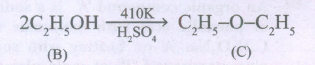
| Compound | Compound Name | Formula |
| A | Formaldehyde | HCHO |
| B | Ethanol | C2H5OH |
| C | Diethyl ether | C2H5-O-C2H5 |
2.
| Homogenous catalysis | Heterogeneous catalysis |
|---|---|
| 1. In a catalysed reaction, the reactants, products and catalyst are present in the same phase. Ex: \( 2\mathrm{SO}_{2(\mathrm{~g})}+\mathrm{O}_{2(\mathrm{~g})}+[\mathrm{NO}]_{(\mathrm{g})} \rightarrow 2 \mathrm{SO}_{3(\mathrm{~g})}+[\mathrm{NO}]_{(\mathrm{g})} \) [NO] - catalyst; gaseous state SO2, O2 & SO3 are gases. |
1. In a catalysed reaction, the catalyst is present in a different phase (ie) it is not present in the same phase as that of the reactants or products. Ex: \(\mathrm{N}_{2(\mathrm{~g})}+3 \mathrm{H}_{2(\mathrm{~g})} \stackrel{\mathrm{Fe}_{(\mathrm{s})}}{\longrightarrow} 2 \mathrm{NH}_{3(\mathrm{~g})}\) Fe - catalyst; solid N2, H2 & NH3 are gases. |
| 2. It is not a contact catalysis. | 2. It is a contact catalysis and the mental catalyst will be in finely divided metal or as gauze. |
| 3. It is explained by intermediate compound formation theory. |
3. It is explained by adsorption theory. |
3.
(i) Emulsions are used in food industries. Food stuff like milk, cream, butter, etc., are emulsions.
(ii) Emulsions are very common in pharmaceutical industries. Many medicines are produced in the form of emulsions. Ex: Milk of magnesia is used for stomach troubles. Many lotions and ointments are emulsions.
(iii) Non ionic emulsions are most popular due to their low toxicity.
(iv) Cationic emulsions have anti microbial properties.
(v) In agriculture industry emulsions are used as delivery vehicles for insecticides, fungicides and pesticides.
(vi) In cosmetics, emulsions are the delivery vehicles for many hair and skin conditioning agents.
(v) The blood, protoplasm in plant and animal cells and fats in intestines are emulsions.
4.
(i) Ellingham diagram is constructed based only on thermodynamic considerations. It gives information about the thermodynamic feasibility of a reaction. It does not tell anything about the rate of the reaction. More over, it does not give any idea about the possibility of other reactions that might be taking place.
(ii) The interpretation of \(\triangle\)G is based on the assumption that the reactants are in equilibrium with the product which is not always true.
5.
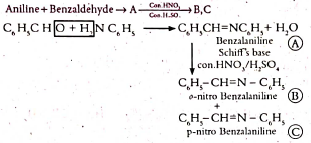
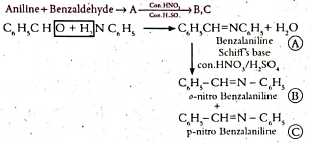

6.
(i) Let A = 100M, [A0] - [A] = 20M,
For the zero order reaction
\(k=\left( \frac { \left[ { A }_{ 0 } \right] -\left[ A \right] }{ t } \right) \)
(i) 20% completion \(k=\left( \frac { 20M }{ 20min } \right) \) = 1 mol L-1 min-1
(ii) 80% completion
\(\mathrm{K}=1 \mathrm{~mol} \mathrm{~L}{ }^{-1} \mathrm{~s}^{-1} ;\left[\mathrm{A}_{0}\right]=100 \mathrm{M} ;\left[\mathrm{A}_{0}\right]-[\mathrm{A}]=80 \mathrm{M} ; \mathrm{t}=?\)
\(\therefore t=\left(\frac{\left[A_{O}\right]-[A]}{K}\right)=\frac{80}{1}=80 \mathrm{mins}\)
7.
(i) Oxidation state of the central metal ion : +2 (i.e) Mn2+
(ii) Co-ordination number : 6
(iii) Nature of ligand: CN- (Negative ligand)
(iv) Magnetic property: Paramagnetic nature
(v) Electronic configuration:
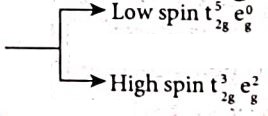
(vi) Oxidation state: +2 (or) Mn2+ of central metal ion
8.
Oxidation number of F = -1
Oxidation number of H = +1
Oxidation number of O in HOF =x
(+1) + x + (-1) = 0
x = 0
Oxidation number of O in HOF = 0
9.
\(\operatorname{Density}(\rho)=\frac{\mathrm{nM}}{\mathrm{a}^{3} \mathrm{~N}_{\mathrm{A}}} \)
\(\rho=10 \mathrm{~g} \mathrm{~cm}^{-3} ; \mathrm{a}=100 \mathrm{pm}=1 \times 10^{-8} \mathrm{~cm} ; \mathrm{N}_{\mathrm{A}}=6.023 \times 10^{23} ; \mathrm{n}=4 ; \mathrm{M}=? \)
\(M=\frac{\rho \mathrm{a}^{3} \mathrm{N_{A}}}{n} \)
\(=\frac{10 \times\left(1 \times 10^{-8}\right)^{3} \times 6.023 \times 10^{23}}{4} \)
\(=\frac{6.023}{4} \)
= 1.505 g /mol
No. of moles \(=\frac{\text { Mass }}{\text { Molar mass }}=\frac{1}{1.505}\)
= 0.664 moles
Hence number of atoms = 0.664 x 6.023 x 1023 = 3.99 x 10²³ atoms
10.
11.

2- Pentanone.
12.
(a) CH3COONa is a salt of weak acid
(CH3COOH) and a strong base (NaOH).
Hence, the solutions is alkaline due to hydrolysis.
\(CH_{3}COO^{-}_{(aq)}+H_{2}O_{(aq)}\rightleftharpoons CH_{3}COOH_{(aq)}+OH^{-}_{(aq)}\)
(i)\(h=\sqrt{\frac{K_{w}}{K_{a}\times C}}\)
Given that pKa =4.74
pKa = -log Ka
ie., Ka = antilog of (-pKa)
= antilog of (-4.74)
= antilog of (-5 + 0.26)
= 10-5 \(\times\) 1.8 = 1.8 \(\times\) 10-5
[antilog of 0.26 = 1.82 \( \simeq\) 1.8]
\(\therefore\) h=\(\sqrt{\frac{1\times10^{-14}}{1.8\times10^{-5}\times0.1}}\)
h = 7.5 x 10⁻⁵
(ii) \(K_{h}=\frac{K_{w}}{K_{a}}=\frac{1\times10^{-14}}{1.8\times10^{-5}}\)
\(=5.56\times10^{-10}\)
iii) \(pH=7+\frac{pK_{a}}{2}+\frac{logC}{2}\)
= \(7+\frac{4.74}{2}+\frac{log0.1}{2}\)
= 7 + 2.37 - 0.5
= 8.87
13.
By Faraday II law of electrolysis:
\(\frac{\mathrm{m}_{\mathrm{Ni}}}{\mathrm{E}_{\mathrm{Ni}}}=\frac{\mathrm{m}_{\mathrm{cr}}}{\mathrm{E}_{\mathrm{cr}}} \)
\(\mathrm{Ni}_{(\mathrm{aq})}^{2+}+2 \mathrm{e}^{-} \rightarrow \mathrm{Ni}_{(\mathrm{s})} \)
\(\mathrm{Cr}_{(\mathrm{aq})}^{3+}+3 \mathrm{e}^{-} \rightarrow \mathrm{Cr}_{(\mathrm{s})}\)
| Ni | Cr |
| \(\mathrm{m}_{\mathrm{Ni}_{\mathrm{i}}} =2.935 \mathrm{~g} \) \(\mathrm{E}_{\mathrm{Ni}} =\frac{58.74}{2} \) \(=29.37 \mathrm{~g} \mathrm{eq}^{-1}\) |
\( \mathrm{m}_{\mathrm{cr}} =x \) \(\mathrm{E}_{\mathrm{cr}} =\frac{52}{3} \) \(=17.33 \mathrm{~g} \mathrm{eq}^{-1}\) |
\( \frac{2.935}{29.37}=\frac{\mathrm{x}}{17.33} \)
\(x =\frac{2.935 \times 17.33}{29.37} \)
=1.732 g
14.
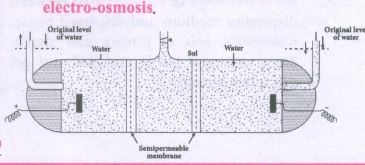
A sol is electrically neutral. Hence the medium carries an equal but opposite charge to that of dispersed particles. When sol particles are prevented from moving, under the influence of electric field the medium moves in a direction opposite to that of the sol particles. This movement of dispersion medium under the influence of electric potential is called electro osmosis.
15.
\(\mathrm{Ca}_{3}\left(\mathrm{PO}_{4}\right)_{2} \rightleftharpoons 3 \mathrm{Ca}^{2+}_{(aq)}+2 \mathrm{PO}_{4_{(aq)}}^{3-}\\\)
(s) (3s) (2s)
\(K_{sp}=[Ca^{2+}]^{3}[PO_{4}^{3-}]^{2}\)
\(K_{sp}=(3s)^{3}(2s)^{2}\)
\(K_{sp}=27s^{3}.4s^{2}\)
\(K_{sp}=108s^{5}\)
(or)
\(K_{s p} =m^{m} \cdot n^{n} \cdot(s)^{m+n} \)
\(K_{\text {sp }} =3^{3} \cdot 2^{2} \cdot(s)^{3+2} \)
\(K_{s p} =27 \times 4 \times(s)^{5} \)
\(=108(s)^{5}=108 s^{5}\)
16.
Anti fertility drugs are synthetic hormones that suppresses ovulation and fertilisation. They are used in birth control pills.
eg: Synthetic Oestrogen : Ethynylestradiol, Menstranol,
Synthetic Progestrone : Norethindrone, Norethynodrel etc.
17.
18.
Cr2+ is stronger reducing agent than Fe2+. The standard electrode potential (E0) of Cr2+ is -0.91 V and that of Fe2+ is only -0.44 V.
If the standard electrode potential of a metal is large and negative is a powerful reducing agent, because it loses electrons easily.
Hence Cr2+ is stronger reducing agent.
19.

12th Standard Syllabus & Materials
12th Standard
TN 12th Computer Applications களப்பெயர் முறைமை (DNS) Sample Question Papers Study Material - QB365 Set A
NEW12th Standard
TN 12th Computer Applications வலையமைப்பு எடுத்துக்காட்டுகள் மற்றும் நெறிமுறைகள் Sample Question Papers Study Material - QB365 Set A
NEW12th Standard
TN 12th Computer Applications கணினி வலையமைப்பு ஓர் அறிமுகம் Sample Question Papers Study Material - QB365 Set A
NEW12th Standard
TN 12th Computer Applications PHP-உடன் MySQL-ஐ இணைத்தல் Sample Question Papers Study Material - QB365 Set A



Tamilnadu Stateboard 12th Standard Subjects

Maths
Chemistry

Physics

Biology

Computer Science

Business Maths and Statistics

Economics

Commerce

Accountancy

History

Computer Applications
Biology
Computer Technology
Computer Applications
Computer Science
Business Maths and Statistics
Commerce
Economics
Maths
Chemistry
Physics
Computer Technology
History
Accountancy

Tamil

English

French
Tamilnadu Stateboard Standards
