
 100% FREE ACCESS
12th Standard Syllabus & Materials
12th Standard
TN 12th Computer Applications மின்னணு தரவு பரிமாற்றம் Sample Question Papers Study Material - QB365 Set A
NEW12th Standard
TN 12th Computer Applications மின் - வணிக பாதுகாப்பு அமைப்புகள் Sample Question Papers Study Material - QB365 Set A
NEW12th Standard
TN 12th Computer Applications மின்னணு செலுத்தல் முறைகள் Sample Question Papers Study Material - QB365 Set A
NEW12th Standard
TN 12th Computer Applications மின் - வணிகம் Sample Question Papers Study Material - QB365 Set A
NEW12th Standard
TN 12th Computer Applications திறந்த மூல கருத்துருக்கள் Sample Question Papers Study Material - QB365 Set A
NEW12th Standard
TN 12th Computer Applications வலையமைப்பு வடமிடல் Sample Question Papers Study Material - QB365 Set A

Published on: 03/09/2020
12th Standard Chemistry English Medium Sample 5 Mark Creative Questions (New Syllabus) 2020
Download Tamil Nadu 12th Standard Chemistry question papers, model tests, one-mark questions, important questions, and public exam papers in PDF format. Free study materials and answer keys for TN State Board students.
Questions + Answers key
Take MCQ Chemistry Test
1.
Compound (A) with molecular formula C2H4O reduces Tollen's reagent. (A) On treatment with HCN gives compound (B). Compound (B) on hydrolysis with an acid gives compound (C) with molecular formula C3H6O3 which is an optically active compound. Compound (A) on reduction with N2H/C2HsONa gives a hydrocarbon (D) of molecular formula C2H6. Identify (A), (B), (C) and (D) and explain the reactions.
2.
An organic compound A (C7H6O) forms a bisulphite. A when treated with alcoholic KCN forms B (C14H12O2) and A on refluxing with sodium acetate and acetic anhydride forms an add C (C9HsO2). Identify A, B and C. Explain the conversion of A to B and C.
3.
Explain the mechanism of Cannizaro reaction.
4.
Elucidate the structure of glucose.
5.
Explain the classification of polymers based on their structure and mode of synthesis.
6.
An organic compound 'A' is a sodium salt of phenolic acid with molecular formula C7H5O3Na. 'A' on heating with soda lime gives compound 'B' of molecular formula C6H6O. 'B' gives violet colour with neutral ferric chloride. 'B' on treatment with C6H5COCI in the presence of NaOH gives an ester 'C'. Identify 'A', 'B' and 'C'. Explain the reactions.
7.
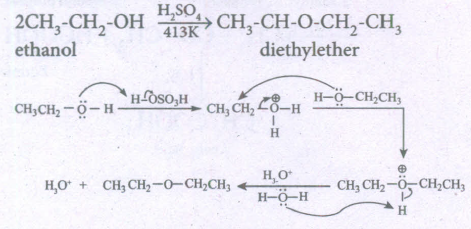
Explain the mechanism involved in the intermolecular dehydration of alcohols to give ethers.
8.
What happens when ethylamine is treated with
(i) CHCl3/NaOH
(ii) CS2
(iii) C6H5CHO.
9.
An organic compound A of molecular f formula C6H6O gives violet colouration with neutral FeCl3. Compound A on treatment with metallic Na gives compound B. Compound B on treatment with CO2 at 400 K under pressure gives C. This product on acidification gives compound D (C7H6O3) which is used in medicine. Identify (A) (B) (C) and D and explain the reactions.
10.
Write the characteristics of catalysts.
11.
How will you calculate solubility product of AgCI which is a sparingly soluble salt?
12.
The emf of the half cell Cu2+(aq)/ Cu(s). containing 0.01 M Cu2+solution is + 0.301V. Calculate the standard emf of the half cell
13.
The electrochemical equivalent of an electrolyte is 2.35 gm amp-1 sec-1. Calculate I the amount of the substance deposited when 5 ampere is passed for 10 sec.
14.
Explain buffer action in an acidic buffer.
15.
A 0.02 M solution of a weak mono basic acid is 5% ionised. Calculate the ionisation constant of the acid.
16.
The ionisation constant of 0.2 M formic acid is 1.8 x 10⁻⁴. Calculate its percentage ionisation.
17.
The half life period of first order reactions is 10 mins. What percentage of the reactant will remain after one hour?
18.
The conversion of molecules x to y follows second order kinetics. Its concentration of x is increased to three times how will it affect the rate of formation of y?
For the reaction x ➝ y as it follows second order kinetics wherefore the rate of formation of y?
19.
Write a short note on the oxidation states of 3d series elements.
20.
An element 'A' occupies group number 15 and period number 3. It reacts with chlorine to give B which further reacts with chlorine to give C at 273K. Both B and C are chlorinating agents for organic compounds. C is a better chlorinating agent because it chlorinates metals also. Breasts with SO3 and reduces it to SO2 B has a pyramidal shape. C has trigonal bipyramidal shape by sp3d hybridisation. Identify the element A and the compounds B and C. Write the reactions.
21.
Explain the oxidising and reducing property of SO2·
22.
Why is dioxygen a gas but sulphur a solid?
23.
How are crystals classified?
24.
A cubic solid is made of two elements P and Q. Atoms of Q are at the corners of the cube and P at the body - centre. What is the formula of the compound? What is the coordination numbers of P and Q?
25.
What are the various methods by which carbon-di-oxide is prepared?
26.
What are the salient feature of crystal field theory?
27.
What are the postulates of valance bond theory? Give its limitations.
1.
(i) Compound (A) with molecular formula C2H4O reduces Tollen'sreagent.
(ii) (A) on treatment with HCN gives compound (B).
\(\underset { (A) }{ { CH }_{ 3 }-CHO } +HCN\longrightarrow { CH }_{ 3 }-\underset { \overset { | }{ OH\\ (B) } }{ CH } -CN\)
(iii) Compound (B) on hydrolysis with an acid gives compound (C) with molecular formula C3H6O3 which is an optically active compound.
\({ CH }_{ 3 }-\underset { \overset { | }{ OH\\ (B) } }{ CH } -CN\overset { { H }^{ + }{ H }_{ 2 }O }{ \underset { \Delta }{ \longrightarrow } } CH_{ 3 }-\underset { \overset { | }{ OH\\ (C) } }{ CH } -COOH\)
(iv) Compound (A) on reduction with N2H/C2H5ONa gives a hydrocarbon (D) of molecular formula C2H6.
\(\underset { (A) }{ { CH }_{ 3 }CHO } \overset { [H] }{ \underset { { N }_{ 2 }{ H }_{ 4 }/{ C }_{ 2 }{ H }_{ 5 }ONa }{ \longrightarrow } } \underset { (D) }{ CH_{ 3 }{ CH }_{ 3 } } \)
| Compound | Compound Name | Formula |
| A | Acetaldehyde | CH3CHO |
| B | Acetaldehyde Cyanohydrin |
\({ CH }_{ 3 }-\underset { \overset { | }{ OH } }{ CH } -CN\) |
| C | Lactic acid | CH3CH OH COOH |
| C | Ethane | CH3-CH3 |
2.
(i) An organic compound (A) with formula C7H6O form bisulphite means it must be benzaldehyde C6H5CHO.
(ii) Benzaldehyde on treatment with KCN form benzoin.
\(\underset { (A) }{ { C }_{ 6 }{ H }_{ 5 }CHO+{ C }_{ 6 }{ H }_{ 5 }CHO } \overset { KCN }{ \longrightarrow } \underset { (B) }{ { C }_{ 6 }{ H }_{ 5 }-\underset { \overset { | }{ HO } }{ CH } -\underset { \overset { || }{ O } }{ C } -{ C }_{ 6 }{ H }_{ 5 } } \)
(iii) Benzaldehyde on treatment with sodium acetate and acetic anhydride form an acid, cinnamic acid it is (C).
\(\underset { (A) }{ { C }_{ 6 }{ H }_{ 5 }CHO } +\left( { CH }_{ 3 }{ CO } \right) O\overset { { CH }_{ 3 }COONa }{ \longrightarrow } \underset { (C) }{ { C }_{ 6 }{ H }_{ 5 }CH } =CH-COOH+CH_{ 3 }COOH\)
| Compound | Compound Name | Formula |
| A | Benzaldehyde | C6HsCHO |
| B | Benzoin | C6H5-CH-OHCO-C6H5 |
| C | Cinnamic acid | C6HsCH=CHCOOH |
3.
Cannizaro reaction involves three steps.
Step 1: Attack of OH- on the carbonyl carbons

Step 2: Hydride ion transfer

Step 3: Acid - base reaction
\({ C }_{ 6 }{ H }_{ 5 }-\overset { \underset { || }{ O } }{ C } -OH+{ C }_{ 6 }{ H }_{ 5 }H_{ 2 }{ O }^{ - }+{ Na }^{ + }\overset { Proton }{ \underset { exchange }{ \longrightarrow } } \underset { Sodium\quad benzoate }{ { C }_{ 6 }{ H }_{ 5 }-\overset { \underset { || }{ O } }{ C } -ONa } +\underset { Benzyl \ alcohol }{ { C }_{ 6 }{ H }_{ 5 }{ CH }_{ 2 }OH } \)
Cannizaro reaction is a characteristic of aldehyde having no a - hydrogen
4.
Structure of glucose: Glucose is an aldohexose. It is optically active with four asymmetric carbons. Its solution is dextrorotatory and hence it is also called as dextrose. The proposed structure of glucose is shown in the figure which was derived based on the following evidences
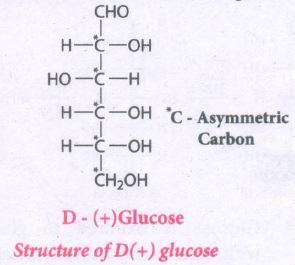
(i) Elemental analysis and molecular weight determination show that the molecular formula of glucose is C6H120 6'
(ii) On reduction with concentrated HI and red phosphorus at 373K, glucose gives a mixture of n hexane and 2, iodohexane indicating that the six carbon atoms are bonded linearly.
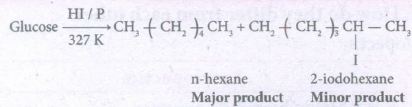
(iii) Glucose reacts with hydroxylamine to form oxime and with HCN to form: cyanohydrin. These reactions indicate the I presence of carbonyl group in glucose
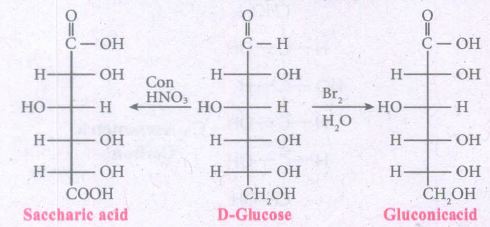
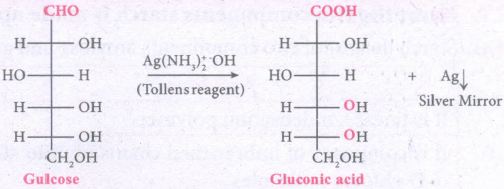
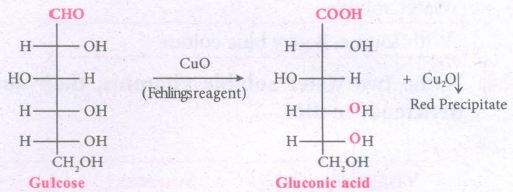
(v) Glucose is oxidised to gluconic acid with ammonical silver nitrate (Tollen's reagent) and alkaline copper sulphate (Fehling's solution). Tollens reagent is I reduced to metallic silver and Fehlings I solution to cuprous oxide which appears as red precipitate. These reactions further: confirm the presence of an aldehyde group
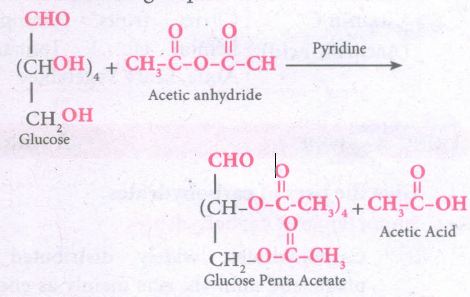
(vi) Glucose forms penta acetate with acetic anhydride suggesting the presence of five alcohol groups.
(vii) Glucoseis a stable compound and does not undergo dehydration easily. It indicates that not more than orie hydroxyl group is bonded to a single carbon atom. Thus the five hydroxyl groups are attached to five different carbon atoms and the sixth carbon is an aldehyde group.
5.
(i) Structure:
(a) Linear polymers (long continuous chain) E.g. HDPE, PVC
(b) Branched polymers (one main chain with small chains as branches) E.g. polypropylene, LDPE.
(c) Cross linked polymers (linking of chain polymers) E.g. bakelite, melamine, formaldehyde
(ii) Mode of synthesis:
(a) Addition polymers. Formed by polymerisation of monomers without the elimination of byproduct. E.g. polyethylene, PVC, teflon.
(b) Condensation Polymer formed by the condensation of two or more monomers with the elimination of simple molecules like H2O, NH3, etc., E.g. Nylon:6-6, polyester.
6.
(i) The organic compound (A) which is sodium salt of phenolic acid is sodium salicylate.
(ii) (A) on heating with soda lime gives Compound (B) phenol. Phenol gives violet colouration with neutral perchloride.
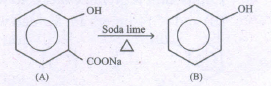
(iii) Phenol on treatment with C6H5COCl in the presence of NaOH gives on ester 'C':
C6H5OH + C6H5COCl \(\overset { NaOH }{ \longrightarrow } \underset { (C) }{ { C }_{ 6 }{ H }_{ 5 }OCO{ C }_{ 6 }{ H }_{ 5 }+HCl } \)
| Compound | Compound Name | Formula |
| A | Sodium benzoate' | 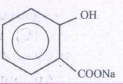 |
| B | Phenol | C6H5OH |
| C | Phenyl benzoate | C6H5OCO C6H5 |
7.
Inter molecular dehydration of alcohol: We have already learnt that when ethanol is treated with con.HSO2 4 at 443K, elimination takes place to form ethene. If the same reaction is carried out at 413K, substitution competes over elimination to form ethers.
8.
(i) When ethylamines is treated with chloroform and an alkali, carbylamine reaction takes place and a foul smelling substance called carbylamlne (or) alkyl isocyanide is formed.
C2H5NH2 + CHCl3 + 3NaOH ➝ \(\underset { Ethyl \ isocyanide }{ { C }_{ 2 }{ H }_{ 5 }NC+3NaCl+3{ H }_{ 2 }O } \)
(ii) When ethylamine is warmed with CS2 and mercuric chloride, alkyl isothiocyanate having a pungent mustard like odour is obtained. This reaction is called mustard oil reaction.
C2H2NH2 + S = C-S \(\underrightarrow { Hg{ Cl }_{ 2 } } \) C2H5 - N = C = S + H2S
(iii) When ethylamine condense with aromatic aldehyde (benzaldehyde) Schiff's base is formed.
C6H5CHO + H2NC2H5 ➝ \(\underset { Schiffi's \ base \ Benzal-ethylamine }{ { C }_{ 6 }{ H }_{ 5 }CH=N{ C }_{ 2 }{ H }_{ 5 }+{ H }_{ 2 }O } \)
9.
(i) Compound A is phenol. (C6H5OH)
Phenols on reaction with metallic Na compound (B) ie., Sodium Phenoxide
\(\underset { (A) }{ { 3C }_{ 6 }{ H }_{ 5 }OH+2Na } \longrightarrow \underset { (B) }{ { 2C }_{ 6 }{ H }_{ 5 }ONa+{ H }_{ 2 } } \)
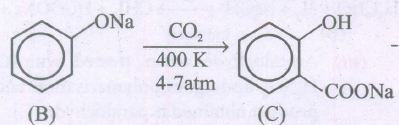
(ii) (B) is heated with CO2 at 400K under pressure, to give (C). This is decomposed by dil.HCl, and (D) is formed
| Compound | Compound Name | Formula |
| A | Phenol | C6H5OH |
| B | Sodium Phenoxide | C6H5ONa |
| C | Sodium Salicylate | 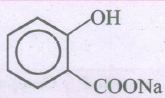 |
| D | Salicylicacid | 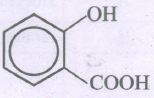 |
10.
(i) For a chemical reaction, catalyst is needed in very small quantity.
(ii) There may be some physical changes, but the catalyst remains unchanged in mass and chemical composition in a chemical reaction.
(iii) A catalyst itself cannot initiate a reaction.
(iv) A solid catalyst will be more effective if it is taken in a finely divided form.
(v) A catalyst are specific in nature.
(vi) In an equilibrium reaction, presence of catalyst reduces the time for attainment of equilibrium and hence it does not affect the position of equilibrium and the value of equilibrium constant.
(vii) A catalyst is highly effective at a particular temperature called as optimum temperature.
(viii) Presence of a catalyst generally does not change the nature of products
11.
Substances like AgCl, PbSO4 etc., are sparingly soluble in water. The solubility product of such substances can be determined using conductivity measurements.
Let us consider AgCl as an example
AgCl(s) ⇌ Ag+ + Cl-
Ksp = [Ag+][Cl-]
Let the concentration of [Ag+] be 'C' mol L-1.
As per the stoichiometry, if [Ag+] = C, then [Cl-] also equal to 'C' mol L-1.
Ksp = C.C
⇒ K =C2
We know that the concentration (in mol dm-3) is related to the molar and sepcific conductance by the following expressions
\({ \Lambda }_{ 0 }=\frac { k\times { 10 }^{ -3 } }{ C(in \ mol \ { L }^{ -1 }) } \)
(or)
\(C=\frac { k\times { 10 }^{ -3 } }{ \Lambda } \)
Substitute the concentration value in the relation Ksp =C2
\({ K }_{ sp }={ \left( \frac { k\times { 10 }^{ -3 } }{ \Lambda } \right) }^{ 2 }\)
12.
Given: E = 0.301 V; [Cu2+] = 0.01M
Formula:
\({ E }_{ { Cu }^{ 2+ }/Cu }^{ o }={ E }_{ { Cu }^{ 2+ }/Cu }^{ }+\frac { 2.303Rt }{ nF } \log\frac { [{ Cu }^{ 2+ }] }{ [Cu] } \)
Solution:
\(=+0.301+\frac { 0.0591 }{ 2 } \log\frac { 0.01 }{ 1 } \)
\({ E }^{ o }=0.301+\frac { 0.059 }{ 2 } \times 2=0.3591V\)
Eo = 0.36 V
13.
Given: Electrochemical
equivalent = Z = 2.35 g amp-1 sec-1
Time = t = 10 sec.
Current strength = 1 = 5 ampere
Formula: m = Zlt
Solution: 2.35 x 10 x 5 = 117.5 gm
The amount of the substance deposited
= 117.5 g
14.
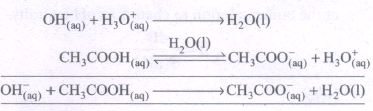
Let us explain the buffer action in a solution containing CH3COOH and CH3COONa.
The dissociation of the buffer components occurs as below.
\( \mathrm{CH}_{3} \mathrm{COOH}_{(\mathrm{sq})} \rightleftharpoons \mathrm{CH}_{3}-\mathrm{COO}_{(\mathrm{aq})}^{-}+\mathrm{H}_{3} \mathrm{O}_{(\mathrm{aq})}^{+} \)
\(\mathrm{CH}_{3} \mathrm{COONa}_{(\mathrm{s})} \stackrel{\mathrm{H}_{2} \mathrm{O}_{(\mathrm{l})}}{\longrightarrow} \mathrm{CH}_{3}-\mathrm{COO}_{(\mathrm{aq})}^{-}+\mathrm{Na}_{(\mathrm{aq})}^{+}\)
If an acid is added to this mixture, it will be consumed by the conjugate baseCH3COO- to form the undissociated weak acid i.e, the increase in the concentration of H+ does not reduce the pH significantly.
\({ { CH }_{ 3 }COO }_{ (aq) }^{ - }+{ H }_{ (aq) }^{ + }\rightarrow { CH }_{ 3 }{ COOH }_{ (aq) }\)
If a base is added, it will be neutralized by H3O+, and the acetic acid is dissociated to maintain the equilibrium. Hence the pH is not significantly altered.
15.
The degree of ionisation and the dissociation constant of the weak acid are related by the equation.
\({ K }_{ a }=\frac { { \alpha }^{ 2 }{ C } }{ 1-\alpha } \cong { \alpha }^{ 2 }C\)
α = 5% (or) 0.05
C = 0.02M
Ka = (0.05)2 x 0.02 = 0.00005
Ka = 5 x 10⁻⁵
16.
Formic acid is a weak acid. Let it be represented as HA.
\(\underset { C(1-\alpha ) }{ HA } \rightleftharpoons \underset { C\alpha }{ { H }^{ + }+ } \underset { C\alpha }{ { A }^{ - } } \)
According to Ostwald's dilution law;
\({ K }_{ a }={ C\alpha }^{ 2 }\)
\(\therefore \alpha =\sqrt { \frac { { K }_{ a } }{ C } } \)
Ka = 1.8 x 10⁻⁴; C = 0.2 M = 2 x 10⁻¹ M
\(\therefore \alpha =\sqrt { \frac { 1.8\times { 10 }^{ -4 } }{ 2\times { 10 }^{ -1 } } } =\sqrt { 9\times { 10 }^{ -4 } } =3\times { 10 }^{ -2 }\)
Percentage of ionisation = 100 α
= 102 x 3 x 10-2 = 3
17.
Given: Half life period (t1/2) = 10 mins
Formula: \(k=\frac { 2.303 }{ t } \log { \frac { a }{ a-x } } \)
Solution:
\(k=\frac { 0.693 }{ { t }_{ \frac { 1 }{ 2 } } } =\frac { 0.693 }{ 10 } \)
= 0.693 min-1 = 6.93 x 10⁻² min-1
Time taken = 1 hour = 60 minutes
a = 100%
x = ?
\(k=\frac { 2.303 }{ t } log\frac { a }{ a-x } \)
\(=\frac { 2.303 }{ 60 } \) [log 100 - log(a - x)]
log 100 - log(a-x) = \(\frac { 6.93\times { 10 }^{ -2 }\times 60 }{ 2.303 } \)
log 100 - log(a-x) = 1.8060
log (a - x) = log 100 - 1.8060
= 2 - 1.8060
log (a - x) = 0.1940
a - x = Antilog of 0.1949
a - x = 1.563%
18.
Rate = k [x]2 = ka2
[x] = a mol-1
If the concentration of x is in cross three time, then
(x) = 3a mol L-1
Rate = R(3a)2 = 9 ka2
Hence, the rate of formation will increase by 9 times.
19.
(i) The first transition metal Scandium exhibits only +3 oxidation state, but all other transition elements exhibit variable oxidation states by loosing electrons from (n-1)d orbital and ns orbital as the energy difference between them is very small.
(ii) At the beginning of the series, +3 oxidation state is stable but towards the end +2 oxidation state becomes stable.
(iii) The number of oxidation states increases with the number of electrons available, and it decreases as the number of paired electrons increases.
(iv) Hence, the first and last elements show less number of oxidation states and the middle elements with more number of oxidation states.
(v) For example, the first element Sc has only one oxidation state +3; the middle element Mn has six different oxidation states from +2 to +7. The last element Cu shows +1 and +2 oxidation states only.
(vi) The relative stability of different oxidation - states of 3d metals is correlated with the extra stability of half filled and fully filled electronic configurations. Example: Mn2+(3d5) is more stable than Mn4+(3d3).
20.
(i) The element which occupies group number 15 and period number 3 is phosphorus. Therefore A is phosphorus. Phosphorus reacts with chlorine to give PCI3There fore compound B is phosphorus trichloride and it has a pyramidal shape.
P4 + 6Cl2 \(\longrightarrow \) 4PCl3
PCl3 further reacts with Cl2 to give PCl5
Therefore, the compound C is phosphorus pentachloride and it has a trigonal bipyramidal shape.
PCI + CI\(\longrightarrow \) PCI
Thus, A= Phosphorus
B = Phosphorus trichloride (PCI3)
C = Phosphorous pentachloride (PCI5)
21.
Oxidising property :
Sulphur dioxide, oxidises hydrogen sulphide to sulphur and magnesium to magnesium oxide.
\({ 2H }_{ 2 }S+{ SO }_{ 2 }\longrightarrow 3S+{ 2H }_{ 2 }O\)
\(2Mg+{ SO }_{ 2 }\longrightarrow 2MgO+S\)
Reducing property :
As it can readily be oxidised, it acts as a reducing agent. It reduces chlorine into hydrochloric acid.
\({ SO }_{ 2 }+2{ H }_{ 2 }O+{ { Cl }_{ 2 }\longrightarrow { H }_{ 2 }{ SO }_{ 4 }+2HCl }\)
It also reduces potassium permanganate and dichromate to Mn2+ and Cr3+ respectively.
\({ 2KMnO }_{ 4 }+5{ SO }_{ 2 }+2{ H }_{ 2 }O\longrightarrow { K }_{ 2 }{ SO }_{ 4 }+{ 2MnSO }_{ 4 }+2{ H }_{ 2 }{ SO }_{ 4 }\)
\({ K }_{ 2 }{ Cr }_{ 2 }{ O }_{ 7 }+{ 3SO }_{ 2 }+{ H }_{ 2 }{ SO }_{ 4 }\longrightarrow { K }_{ 2 }{ SO }_{ 4 }+{ Cr }_{ 2 }\left( SO_{ 4 } \right) _{ 3 }+{ H }_{ 2 }O\)
22.
(i) O2 molecules are held together by weak Vander Waal's force because of small size and high electronegativity of oxygen.
(ii) In contrast, sulphur shows catenation and forms stronger S-S bonds.
(iii) Due to catenation, sulphur forms octa-atomic S8 molecules having eight membered puckered ring structure.
(iv) Because of its bigger size the force of attraction holding S8 molecules are much stronger.
(v) Hence sulphur is a solid at room temperature or in other words, that is why there is a large difference between the boiling point (also melting points) of the two elements.
23.
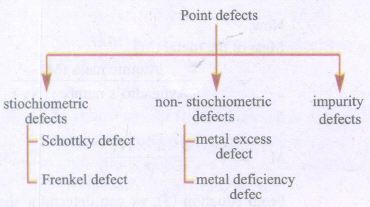
Crystal defects are classified as follows
(i) Point defects
(ii) Line defects
(iii) Interstitial defects
(iv) Volume defects
Point defects are further classified as follows
24.
(i) It is given that the atoms of A are present at the corners of the cube.
(ii) Therefore, number of atoms of Q in one unit cell = 8 x \(\frac{1}{8}\) = 1
(iii) It is also given that the atoms of P are present at the body - centre.
(iv) Therefore, number of atoms of P in one unit cell.
(v) This means that the ratio of the number of P atoms to the number of Q atoms, P: Q = 1:1.
(vi) Hence, the formula of the compound is PQ.
(vii) The coordination number of both P and Q is 8.
25.
(i) Carbon monoxide can be prepared by the reaction of carbon with limited amount of oxygen.
2C + O2 ⟶ 2CO
(ii) (a) On industrial scale carbon monoxide is produced by the reaction of carbon with air.
(b) The carbon monoxide formed will contain nitrogen gas also and the mixture of nitrogen and carbon monoxide is called producer gas.
(c) \(2C+{ O }_{ 2 }/{ N }_{ 2 }(air)\longrightarrow \underset { Producers \ Gas }{ 2CO } +{ N }_{ 2 }\)
(d) The producer gas is then passed through a solution of copper(I) chloride under pressure which results in the formation of CuCI(CO).2H2O.
(e) At reduced pressures this solution releases the pure carbon monoxide.
(iii) Pure carbon monoxide is prepared by warming methanoic acid with concentrated sulphuric acid which acts as a dehydrating agent.
HCOOH + H2SO4 ⟶ CO + H2O + H2SO4
26.
Valance bond theory helps us to visualize the bonding in complexes. However, it has limitations as mentioned above. Hence Crystal Field Theory to explain some of the properties, like colour, magnetic behavior, etc., This theory I was originally used to explain the nature of bonding in ionic crystals. Later on, it is used to explain the properties of transition metals and their complexes. The salient features of this theory are as follows.
(i) Crystal Field Theory (CFT) assumes that the bond between the ligand and the central metal atom is purely ionic. i.e. the bond is formed due to the electrostatic attraction between the electron rich ligand and the electron deficient metal.
(ii) In the coordination compounds, the central metal atom/ion and the ligands are considered as point charges (in case of I charged metal ions or ligands) or electric dipoles (in case of neutral metal atoms or ligands).
(iii) According to crystal field theory, the complex formation is considered as the following series of hypothetical steps.
Step 1: In an isolated gaseous state, all the five d orbitals of the central metal ion are degenerate. Initially, the ligands form a spherical field of negative charge around the metal. In this filed, the energies of all the five d orbitals will increase due to the repulsion between the electrons of the metal and the ligand.
Step 2: The ligands are approaching the metal atom in actual bond directions. To illustrate this let us consider an octahedral field, in which the I central metal ion is located at the origin and the six ligands are coming from the +x, -x, +y, -y, +z and -z directions as shown below.
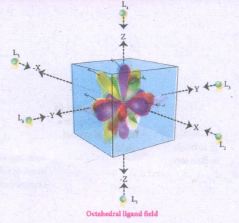
As shown in the figure, the orbitals lying along the axes dx2-y2 and dz2 orbitals will experience strong repulsion and raise in energy to a greater extent than the orbitals with lobes directed between the axes (dxy, dyz, and dzx). Thus the degenerate d orbitals now split into two sets and the process is called crystal field splitting.
Step 3: Up to this point the complex formation would not be favored. However, when the ligands approach further, there will be an attraction between the negatively charged electron and the positively charged metal ion, that results in a net decrease in energy. This decrease in energy is the driving force for the complex formation.
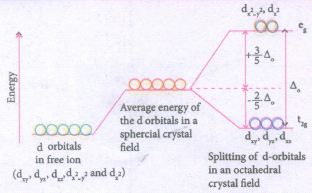
Crystal field splitting in octahedral complexes: During crystal field splitting in octahedral field, in order to maintain the average energy of the orbitals (barycentre) constant, the energy of the orbitals dx2-y2 and d z2 (represented as eg orbitals) will increase by 3/5 \({ \triangle }_{ o }\) while that of the other three orbitals dxy ' dyz and dzx (represented as t2g orbitals) decrease by 2/5 \({ \triangle }_{ o }\) , Here, \({ \triangle }_{ o }\) represents the crystal field splitting energy in the octahedral field.
27.
The postulates of valence bond theory
(i) The central metal atom/ion makes available a number of vacant orbitals equal to its coordination number.
(ii) These vacant orbitals form covalent bonds with the ligand orbitals.
(iii) A covalent bond is formed by the overlap of a vacant metal orbital and filled ligand orbitals. This complete overlap leads to the formation of a metal ligand, σ (sigma) bond.
(iv) A strong covalent bond is formed only when the orbitals overlap to the maximum extent.
(v) This maximum overlapping is possible only when the metal vacant orbitals undergo a process called 'hybridisation'.
(vi) A hybridised orbital has a better directional characteristic than an unhybridized one. The following table gives the coordination number, orbital hybridisation, and geometry of the complexes.
| Coordination number | Types of hybridisation | Geometry |
|---|---|---|
| 2 | sp | linear |
| 4 | sp3 | tetrahedral |
| 4 | dsp3 | square planer |
| 6 | d2sp3 | octahedral |
| 6 | sp3d2 | octahedral |
Magnetic moment
The paramagnetic moment is given by the following spin-only formula.
\({ \mu }_{ s }=\sqrt { n(n+2) } \) BM
BM = Bohr magneton
\({ \mu }_{ s }\) = spin -only magnetic moment
n = number of unpaired electrons.

12th Standard Syllabus & Materials
12th Standard
TN 12th Computer Applications களப்பெயர் முறைமை (DNS) Sample Question Papers Study Material - QB365 Set A
NEW12th Standard
TN 12th Computer Applications வலையமைப்பு எடுத்துக்காட்டுகள் மற்றும் நெறிமுறைகள் Sample Question Papers Study Material - QB365 Set A
NEW12th Standard
TN 12th Computer Applications கணினி வலையமைப்பு ஓர் அறிமுகம் Sample Question Papers Study Material - QB365 Set A
NEW12th Standard
TN 12th Computer Applications PHP-உடன் MySQL-ஐ இணைத்தல் Sample Question Papers Study Material - QB365 Set A



Tamilnadu Stateboard 12th Standard Subjects

Maths
Chemistry

Physics

Biology

Computer Science

Business Maths and Statistics

Economics

Commerce

Accountancy

History

Computer Applications
Biology
Computer Technology
Computer Applications
Computer Science
Business Maths and Statistics
Commerce
Economics
Maths
Chemistry
Physics
Computer Technology
History
Accountancy

Tamil

English

French
Tamilnadu Stateboard Standards
