
 100% FREE ACCESS
12th Standard Syllabus & Materials
12th Standard
TN 12th Computer Applications மின்னணு தரவு பரிமாற்றம் Sample Question Papers Study Material - QB365 Set A
NEW12th Standard
TN 12th Computer Applications மின் - வணிக பாதுகாப்பு அமைப்புகள் Sample Question Papers Study Material - QB365 Set A
NEW12th Standard
TN 12th Computer Applications மின்னணு செலுத்தல் முறைகள் Sample Question Papers Study Material - QB365 Set A
NEW12th Standard
TN 12th Computer Applications மின் - வணிகம் Sample Question Papers Study Material - QB365 Set A
NEW12th Standard
TN 12th Computer Applications திறந்த மூல கருத்துருக்கள் Sample Question Papers Study Material - QB365 Set A
NEW12th Standard
TN 12th Computer Applications வலையமைப்பு வடமிடல் Sample Question Papers Study Material - QB365 Set A

Published on: 02/09/2022
QB365 provides a detailed and simple solution for every Possible Book Back Questions in Class 12 Chemistry Subject - Solid State, English Medium. It will help Students to get more practice questions, Students can Practice these question papers in addition to score best marks.
Download Tamil Nadu 12th Standard Chemistry question papers, model tests, one-mark questions, important questions, and public exam papers in PDF format. Free study materials and answer keys for TN State Board students.
Questions + Answers key
Take MCQ Chemistry Test
1.
An atom crystallizes in fcc crystal lattice and has a density of 10 gcm−3 with unit cell edge length of 100pm. Calculate the number of atoms present in 1 g of crystal.
2.
KF crystallizes in fcc structure like sodium chloride. Calculate the distance between K+ and F− in KF. (given : density of KF is 248 g cm-3)
3.
What is the two dimensional coordination number of a molecule in square close packed layer?
4.
Why ionic crystals are hard and brittle?
5.
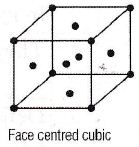
Calculate the number of atoms in a fcc unit cell.
6.
What are point defects?
7.
Classify the following solids
a. P4
b. Brass
c. diamond
d. NaCl
e. Iodine
8.
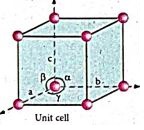
Define unit cell.
1.
\(\operatorname{Density}(\rho)=\frac{\mathrm{nM}}{\mathrm{a}^{3} \mathrm{~N}_{\mathrm{A}}} \)
\(\rho=10 \mathrm{~g} \mathrm{~cm}^{-3} ; \mathrm{a}=100 \mathrm{pm}=1 \times 10^{-8} \mathrm{~cm} ; \mathrm{N}_{\mathrm{A}}=6.023 \times 10^{23} ; \mathrm{n}=4 ; \mathrm{M}=? \)
\(M=\frac{\rho \mathrm{a}^{3} \mathrm{N_{A}}}{n} \)
\(=\frac{10 \times\left(1 \times 10^{-8}\right)^{3} \times 6.023 \times 10^{23}}{4} \)
\(=\frac{6.023}{4} \)
= 1.505 g /mol
No. of moles \(=\frac{\text { Mass }}{\text { Molar mass }}=\frac{1}{1.505}\)
= 0.664 moles
Hence number of atoms = 0.664 x 6.023 x 1023 = 3.99 x 10²³ atoms
2.
\(\text { Density }(\rho)=\frac{\mathrm{nM}}{\mathrm{a}^{3} \mathrm{~N}_{\mathrm{A}}} \)
\(\mathrm{n}=4, \mathrm{M}=\text { Molar mass of } \mathrm{KF}=58.1 \mathrm{~g} / \mathrm{mol} \)
\(\rho=2.48 \mathrm{~g} \mathrm{~cm}^{-3} \)
\(\mathrm{~N}_{\mathrm{A}}=6.023 \times 10^{23} \)
\(a^{3} =\frac{n M}{\rho N_{A}}=\frac{4 \times 58.1}{2.48 \times 6.023 \times 10^{23}} \)
\(a^{3} =15.55 \times 10^{-23} \)
\(a^{3} =0.1555 \times 10^{-21} \)
\(a =\sqrt[3]{0.1555 \times 10^{-21}} \)
\(a =0.5375 \times 10^{-7} \mathrm{~cm}=5.375 \times 10^{-8} \mathrm{~cm}=537.5 \mathrm{pm} \)
\(d =\frac{a}{\sqrt{2}}(\text { for fcc }) [\therefore r = \frac{a\sqrt{2}}{4}]\)
\(=\frac{537.5}{1.414}=380.13 \mathrm{pm}\)
\(\therefore\) The distance between K+ and F- in KF = 380.13 pm
3.
Linear arrangement of spheres in one direction is repeated in two dimension (i.e.) more number of rows can be generated identical to the one dimensional arrangement such that all spheres of different rows align vertically as well as horizontal.
If we denote the first row as A type arrangement, then the above mentioned packing is called AAA type, because all rows are identical as the first one. In this arrangement each sphere is in contact with four of its neighbours.
4.
The structural units of an ionic crystal are cations and anions. They are bound together by strong electrostatic attractive forces. To maximize the attractive force, cations are surrounded by as many anions as possible and vice versa. Hence they are hard and brittle.
5.
Number of atoms in a fcc unit cell = \(\frac{N_{c}}{8}+\frac{N_{f}}{2}=\frac{8}{8}+\frac{6}{2}=1+3=4\)
6.
The imperfection occurs due to missing atoms, displaced atoms or extra atoms, is named as a point defect. Such defects arise due to imperfect packing during the original crystallisation or they may arise from thermal vibrations of atoms at elevated temperatures.
7.
a. P4 - Covalent solid
b. Brass - Metallic solid
c. Diamond - Covalent solid
d. NaCl - Ionic solid
e. Iodine - Covalent solid
8.
(i) A basic repeating structural unit of a crystalline solid is called a unit cell.
(ii) A crystal is consisted of large number of unit cells.

12th Standard Syllabus & Materials
12th Standard
TN 12th Computer Applications களப்பெயர் முறைமை (DNS) Sample Question Papers Study Material - QB365 Set A
NEW12th Standard
TN 12th Computer Applications வலையமைப்பு எடுத்துக்காட்டுகள் மற்றும் நெறிமுறைகள் Sample Question Papers Study Material - QB365 Set A
NEW12th Standard
TN 12th Computer Applications கணினி வலையமைப்பு ஓர் அறிமுகம் Sample Question Papers Study Material - QB365 Set A
NEW12th Standard
TN 12th Computer Applications PHP-உடன் MySQL-ஐ இணைத்தல் Sample Question Papers Study Material - QB365 Set A



Tamilnadu Stateboard 12th Standard Subjects

Maths
Chemistry

Physics

Biology

Computer Science

Business Maths and Statistics

Economics

Commerce

Accountancy

History

Computer Applications
Biology
Computer Technology
Computer Applications
Computer Science
Business Maths and Statistics
Commerce
Economics
Maths
Chemistry
Physics
Computer Technology
History
Accountancy

Tamil

English

French
Tamilnadu Stateboard Standards
