
 100% FREE ACCESS
12th Standard Syllabus & Materials
12th Standard
TN 12th Maths Applications of Matrices and Determinants Sample Question Papers Study Material - QB365 Set A
NEW12th Standard
TN 12th Computer Applications மின்னணு தரவு பரிமாற்றம் Sample Question Papers Study Material - QB365 Set A
NEW12th Standard
TN 12th Computer Applications மின் - வணிக பாதுகாப்பு அமைப்புகள் Sample Question Papers Study Material - QB365 Set A
NEW12th Standard
TN 12th Computer Applications மின்னணு செலுத்தல் முறைகள் Sample Question Papers Study Material - QB365 Set A
NEW12th Standard
TN 12th Computer Applications மின் - வணிகம் Sample Question Papers Study Material - QB365 Set A
NEW12th Standard
TN 12th Computer Applications திறந்த மூல கருத்துருக்கள் Sample Question Papers Study Material - QB365 Set A

Published on: 02/09/2022
QB365 provides a detailed and simple solution for every Possible Creative Questions in Class 12 Chemistry Subject - Solid State, English Medium. It will help Students to get more practice questions, Students can Practice these question papers in addition to score best marks.
Download Tamil Nadu 12th Standard Chemistry question papers, model tests, one-mark questions, important questions, and public exam papers in PDF format. Free study materials and answer keys for TN State Board students.
Questions + Answers key
Take MCQ Chemistry Test
1.
A metallic element exists as a cubic lattice. Each edge of the unit cell is 2.88\(\mathring { A } \). The density of the metal is 7.20 g cm-3. How many unit cells there will be in 100g of the metal?
2.
Diffraction angle 2θ equal to 14.8o for a crystal having interplanar distance in the crystal is 0.400 nm when second order diffraction was observed. Calculate the wavelength of X-ray used.
3.
How do the spacings of the three planes (100), (101) and (111) of simple cubic lattice vary?
4.
(i) What change occurs when AgCl is doped with CdCI2?
(ii) What type of semiconductor is produced when silicon is doped with boron?
5.
ZnO turns yellow on heating. Why?
6.
Examine the given defective crystal:
| X+ | Y- | X+ | Y- | X+ |
| Y- | O | X+ | ||
| X+ | X+ | O | X+ | |
| Y- | X+ | Y- | X+ | Y- |
Answer the following questions
(i) Is the above defect stoichiometric or non-stoichiometric?
(ii) What are such defects called? Give an example of the compound which shows this type of defect.
7.
Inspite of long range order in the arrangement of particles, why are the crystals usually not perfect?
8.
Calculate the number of unit cells in 8.1 g of aluminium, if it crystallises in a face centered cubic structure. (Atomic mass of AI = 27 g mol-1).
9.
What is the formula of a compound in which the element Y forms ccp lattice and atoms of X occupy 2/3rd of tetrahedral voids?
10.
Classify the following solids in different categories based on the nature of intermolecular force operating in them: Potassium sulphate, tin, benzene, urea, ammonia, water, zinc sulphide, graphite, rubidium, argon, silicon carbide.
11.
Why are solids incompressible?
12.
If NaCI is doped with 10-3 mol % of SrCl2 What is the concentration of cation valencies?
13.
Silver crystallizes in fcc lattice. If edge length of the cell is 4.07 x 10⁻⁸ em and density is 10.5 g cm-3. Calculate the atomic mass of silver
14.
Why are solids rigid?
15.
Experiment shows that Nickel oxide has the formula Ni0.96.O1.00. What fraction of Nickel exists as of Ni2+ and Ni3+ ions?
1.
Volume of unit cell = (2.88\(\mathring { A } \))3 = 23.9 x 10⁻²⁴cm3
Volume of 100 g of the metal \(=\frac { m }{ A } =\frac { 100g }{ 7.2{ gcm }^{ -3 } } \) = 13.9 cm3
Number of unit cells in this volume \(=\frac { 13.9{ cm }^{ 3 } }{ 23.9\times { 10 }^{ -24 }{ cm }^{ 3 } } \) = 5.82 x 10²³
2.
Data:
Diffraction angle,
2θ = 14.80 ∴ 8 = 7.4°
Interplanar distance, d = 0.400 nm
Order of reflection, n = 2
Formula:
nλ = 2dsinθ
∴ wavelength,
Solution:
\(\lambda =\frac { 2dsin\theta }{ 2 } \)
= dsinθ
= 0.400 sin 7.4o
= 0.400 x 1.288 nm
= 0.0512 nm
λ = 0.0512 nm
3.
Simple Cubic Lattice
100,101,111
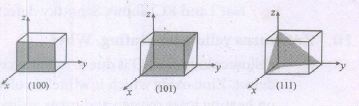
\({ d }_{ hkl }=\frac { a }{ \sqrt { { h }^{ 2 }+{ k }^{ 2 }+{ l }^{ 2 } } } \)
\({ d }_{ 100 }=\frac { 1 }{ \sqrt { { 1 }^{ 2 }+0^{ 2 }+0^{ 2 } } } =1\)
\({ d }_{ 101 }=\frac { 1 }{ \sqrt { { 1 }^{ 2 }+0^{ 2 }+0^{ 2 } } } =\frac { 1 }{ \sqrt { 2 } } \)
\({ d }_{ 111 }=\frac { 1 }{ \sqrt { { 1 }^{ 2 }+1^{ 2 }+1^{ 2 } } } =\frac { 1 }{ \sqrt { 3 } } \)
\(\\ { d }_{ 100 }:{ d }_{ 101 }:{ d }_{ 111 }=1:\frac { 1 }{ \sqrt { 2 } } :\frac { 1 }{ \sqrt { 3 } } (or)\)
=1:0.707:0.577
4.
(i) (a) When AgCl is doped with CdCI2, two Ag+ ions will be replaced by one Cd2+ ion to maintain electrical neutrality.
(b) Thus, a hole is created at the lattice site for every Cd2+ ion introduced. Hence the crystal becomes conductor.
(ii) p-type semiconductor is obtained, when Si is doped with boron.
5.
(i) Yellow colour of ZnO is due to metal excess defect. Zinc oxide which is white in colour on heating loses oxygen and turns yellow.
\(ZnO\overset { Heating }{ \longrightarrow } { Zn }^{ + }+\frac { 1 }{ 2 } { O }_{ 2 }+{ 2e }^{ -1 }\)
(ii) The excess Zn2+ ion thus, formed get trapped into vacant interstitial sites and the electrons in the neighbouring interstitial sites.
6.
(i) The given defect is Stoichiometric since the number of cations and anions are missing from lattice sites unequal.
(ii) The defect is Schottky defect.
These defects are vacancy defects shown by ionic solids in which the anion and cation are nearly of the same size.
Eg: NaCI and KCI shows Schottky defects
7.
i) Crystals have long range repeated pattern of arrangement of constituent particles but in the process of crystallisation.
ii) Some deviations from the ideal arrangement may be introduced because the constituent particles may not get sufficient time to arrange themselves in a perfect order. Therefore, crystals are usually not perfect.
8.
Given:
1 mole of AI = Avogadro's constant = 6.023 x 10²³
Mass of aluminium = 8.1 g
Solution:
1 mole of aluminium (AI) = 27 g
= 6.02 X 10²³ atoms
∴ No. of atoms present in 1g of AI = \(\frac{6.02\times 10^{23}}{27}\)
Face centered cubic unit cell contains 4 atoms.
∴ No. of unit cells \(=\frac { 6.02\times { 10 }^{ 23 } }{ 27\times 4 } \times 8.1=4.52\times { 10 }^{ 22 }\)
9.
Number of tetrahedral voids formed = 2 x No. of atoms of element Y
No. of atoms of element Y in the ccp unit cell = 4
No. of tetrahedral voids by atoms of Y = 2 x 4 = 8
∴ No. of tetrahedral voids occupied by atoms of
X = \(\frac{2}{3}\times 8=\frac{16}{3}\)
Ratio of the no. of atoms of X and Y is = \(\frac{16}{3}:4\)
= 16:12
= 4:3
Hence, formula would be X4Y3.
10.
(i) Covalent Solids: Silicon carbide, graphite.
(ii) Molecular Solids: Urea, benzene, ammonia, water and argon.
(iii) Ionic Solids: Zinc sulphide, potassium sulphate.
(iv) Metallic solids: Rubidium and tin.
11.
(i) Compressibility is the ability of the substance to change its shape by applying external pressure.
(ii) Solids form closed packed structure with negligible intermolecular space and possesses very strong intermolecular forces of attraction.
(iii) Thus, they do not change their shape in the presence of external pressure.
12.
Doping of NaCI with 10-3 mol% SrCl2 means that 100 moles of NaCl are doped with 10-3 mol SrCl2.
∴ 1mole of NaCl is doped with SrCl2
\(=\frac { { 10 }^{ -3 } }{ 100 } \times 6.02\times { 10 }^{ 23 }=6.02\times 10^{ 18 }\)
13.
\(M=\frac { d\times { a }^{ 3 }\times NA }{ g } \)
d = Density of the material
a = Length of the edge of the cell.
NA = Avogadro number
Z = No. of atoms
\(M=\frac { 10.5{ gcm }^{ -3 }{ (4.07\times { 10 }^{ -6 }cm) }^{ 3 }\times \left( 6.023\times { 10 }^{ 23 }{ mol }^{ -1 } \right) }{ 4 } \)
Atomic mass of silver M = 107.08 g mol-1.
14.
(i) The intermolecular forces of attraction that are present in solids are very strong.
(ii) The constituent particles of solids cannot: move from their positions. They have fixed positions.
(iii) However, they can oscillate about their mean positions.
(iv) This is the reason solids are rigid.
15.
Formula is Nio.96 O1.00
So the ration of Ni = O = 96.00
So if there are 100 atom of oxygen, as atoms of Ni
Let the number of atoms of Ni+2 = x
The number of atoms of Ni+2 = 96 - x
Charge on Ni = charge on O
So that oxygen has charge = 2
3 (96 - x) + 2x = 2(100)
288 - 3x + 2x = 200
-x = -88
x = 88
Percentage of Ni + 2 = (atom of Ni+2 / total number of atoms of Ni 100.)
= 100.(94/98) x 100 = 96%
Percentage of Ni+3 = 100 - Ni+2
= 100 - 96 = 4%

12th Standard Syllabus & Materials
12th Standard
TN 12th Computer Applications வலையமைப்பு வடமிடல் Sample Question Papers Study Material - QB365 Set A
NEW12th Standard
TN 12th Computer Applications களப்பெயர் முறைமை (DNS) Sample Question Papers Study Material - QB365 Set A
NEW12th Standard
TN 12th Computer Applications வலையமைப்பு எடுத்துக்காட்டுகள் மற்றும் நெறிமுறைகள் Sample Question Papers Study Material - QB365 Set A
NEW12th Standard
TN 12th Computer Applications கணினி வலையமைப்பு ஓர் அறிமுகம் Sample Question Papers Study Material - QB365 Set A



Tamilnadu Stateboard 12th Standard Subjects

Maths
Chemistry

Physics

Biology

Computer Science

Business Maths and Statistics

Economics

Commerce

Accountancy

History

Computer Applications
Biology
Computer Technology
Computer Applications
Computer Science
Business Maths and Statistics
Commerce
Economics
Maths
Chemistry
Physics
Computer Technology
History
Accountancy

Tamil

English

French
Tamilnadu Stateboard Standards
