
 100% FREE ACCESS
12th Standard Syllabus & Materials
12th Standard
TN 12th Computer Applications மின்னணு தரவு பரிமாற்றம் Sample Question Papers Study Material - QB365 Set A
NEW12th Standard
TN 12th Computer Applications மின் - வணிக பாதுகாப்பு அமைப்புகள் Sample Question Papers Study Material - QB365 Set A
NEW12th Standard
TN 12th Computer Applications மின்னணு செலுத்தல் முறைகள் Sample Question Papers Study Material - QB365 Set A
NEW12th Standard
TN 12th Computer Applications மின் - வணிகம் Sample Question Papers Study Material - QB365 Set A
NEW12th Standard
TN 12th Computer Applications திறந்த மூல கருத்துருக்கள் Sample Question Papers Study Material - QB365 Set A
NEW12th Standard
TN 12th Computer Applications வலையமைப்பு வடமிடல் Sample Question Papers Study Material - QB365 Set A

Published on: 02/09/2022
QB365 provides a detailed and simple solution for every Possible Book Back Questions in Class 12 Chemistry Subject - Solid State, English Medium. It will help Students to get more practice questions, Students can Practice these question papers in addition to score best marks.
Download Tamil Nadu 12th Standard Chemistry question papers, model tests, one-mark questions, important questions, and public exam papers in PDF format. Free study materials and answer keys for TN State Board students.
Questions + Answers key
Take MCQ Chemistry Test
1.
Calculate the percentage efficiency of packing in case of body centered cubic crystal.
2.
Explain AAAA and ABABA and ABCABC type of three dimensional packing with the help of neat diagram.
3.
Write short note on metal excess and metal deficiency defect with an example.
4.
Differentiate crystalline solids and amorphous solids.
1.
In bcc unit cell, ΔABC
AC2 = AB2 + BC2
\(AC=\sqrt { { AB }^{ 2 }+{ BC }^{ 2 } } \)
\(\\ AC=\sqrt { { a }^{ 2 }+{ a }^{ 2 } } =\sqrt { { 2a }^{ 2 } } =\sqrt { 2 } a\)

In ΔACG
AG2 = AC2 + CG2
\(AG=\sqrt { { AC }^{ 2 }+{ CG }^{ 2 } } \)
\(AG=\sqrt { { \left( \sqrt { 2a } \right) }^{ 2 }+{ a }^{ 2 } } \)
\(AG=\sqrt { { 2a }^{ 2 }+{ a }^{ 2 } } =\sqrt { { 3a }^{ 2 } } \)
\(AG=\sqrt { 3a } \)
\(\sqrt { 3 } a=4r\)
\(r=\frac { \sqrt { 3 } }{ 4 } a\)
∴ Volume of the sphere with radius 'r' \(=\frac { 4 }{ 3 } { \pi r }^{ 3 }\)
\(=\frac{4}{3}\pi { \left( \frac { \sqrt { 3 } }{ 4 } a \right) }^{ 3 }\)\(=\frac { \sqrt { 3 } }{ 16 } \pi { a }^{ 3 }\)
Number of spheres belong to a unit cell in BCC arrangement is equal to two and hence the total volume of all spheres.
(i) Packing fraction = \(=\frac{Total \quad volume \quad occupied \quad by \quad spheres \quad in \quad a \quad unit \quad cell}{volume \quad of \quad the \quad unit \quad cell}\times100\)
\(\therefore\)Volume of all spheres \(=2\times \left( \frac { \sqrt { 3 } \pi { a }^{ 3 } }{ 16 } \right) =\frac { \sqrt { 3 } \pi { a }^{ 3 } }{ 8 } \)
Packing fraction \(=\frac { \left( \frac { \sqrt { 3 } \pi { a }^{ 3 } }{ 8 } \right) }{ ({ a }^{ 3 }) } \times 100\)
\(=\frac { \sqrt { 3 } \pi }{ 8 } \times 100\)
\(\\ =\sqrt { 3 } \pi \times 12.5\)
= 1.732 x 3.14 x 12.5
= 68%
2.
AAAA type of three dimensional packing:
.JPG)
1. This is simple cubic arrangement.
2. Three dimensional packing arrangement can be obtained by repeating the AAAA type two dimensional arrangements in three dimensions.
3. Spheres in one layer sitting directly on the top of in the previous layer so that all layers are identical.
4. All spheres of different layers of crystal are perfectly aligned horizontally and also vertically.
5. In simple cubic packing, each sphere is in contact with 6 neighbouring spheres
6. Four in its own layer, one above and one below and hence the coordination number of the sphere in simple cubic arrangement is 6.
ABABA type of three dimensional packing:
.JPG)
(i) This is body centered cubic arrangement.
(ii) The spheres in the first layer are slightly separated and the second layer is formed by arranging the spheres in the depressions between the spheres in layer A.
(iii) The third layer is a repeat of the first.
(iv) This pattern ABABAB is repeated throughout the crystal.
(v) Each sphere has a coordination number of 8, four neighbors in the layer above and four in the layer below.
ABCABC type of three dimensional packing:
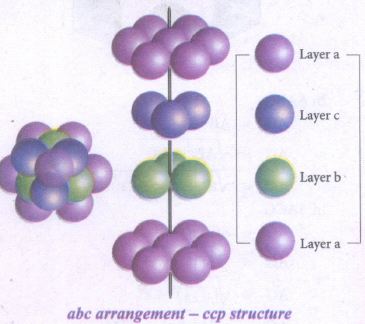
(i) This is face centered cubic arrangement.
(ii) In this arrangement (FCC) second layer spheres are arranged at the dips of first layer. Third layer spheres are arranged in a manner such that it cover the octahedral void.
(iii) Then no longer third layer is similar to first or second layer.
(iv) Third layer gives different arrangement. Fourth layer spheres are similar to first layer.
(v) If the first, second and third layer are represented as A, B, C then this type of packing gives the arrangement of layers as ABCABC.. and the sequence is repeated.
3.
Metal excess defect:
(i) It arises due to the presence of more number of metal ions as compared to anions.
(ii) Examples: NaCl, KCl
(iii) The electrical neutrality of the crystal can be maintained by the presence of anionic vacancies equal to the presence of extra cation.
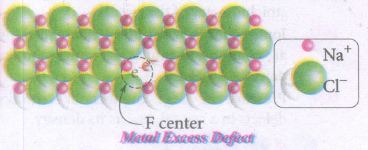
(iii) For example, when NaCI crystals are heated in the presence of sodium vapour, Na+ ions are formed and are deposited on the surface of the crystal.
(iv) Chloride ions (Cl-) diffuse to the surface from the lattice point and combines with Na+ ion.
(v) The electron lost by the sodium vapour diffuse into the vacancy created by the Cl- ions.
(vi) Such anionic vacancies which are occupied by unpaired electrons are called F centers. Hence, the formula of NaCl can be written as Na1+xCl.
Metal deficiency defect:
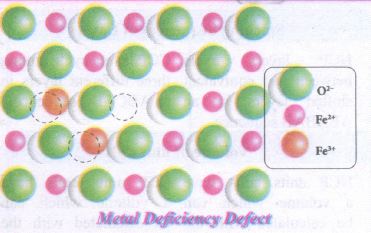
(i) Metal deficiency defect arises due to the presence of less number of cations than the anions. This defect is observed in a crystal in which, the cations have variable oxidation states.
(ii) For example, In FeO crystal, some of the Fe2+ ions are missing from the crystal lattice. To maintain the electrical neutrality, twice the number of other Fe2+ ions in the crystal is oxidized to Fe3+ ions. In such cases, overall number of Fe2+ and Fe3+ ions is less than the O2- ions.
4.
| S. No | Crystalline Solids | Amorphous Solids |
| 1. | Long range orderly arrangement of constituents. | Short range, random arrangement of constituents. |
| 2. | Definite shape | Irregular shape |
| 3. | Anisotropic in nature | They are "isotropic" like liquids |
| 4. | They are true solids | They are considered as pseudo solids (or) super cooled liquids |
| 5. | Definite Heat of fusion | Heat of fusion is not definite |
| 6. | They have sharp melting points. | Gradually soften over a range of temperature and so can be moulded. |
| 7. | Eg: NaCl, diamond etc. | Eg: Rubber, plastics, glass etc. |

12th Standard Syllabus & Materials
12th Standard
TN 12th Computer Applications களப்பெயர் முறைமை (DNS) Sample Question Papers Study Material - QB365 Set A
NEW12th Standard
TN 12th Computer Applications வலையமைப்பு எடுத்துக்காட்டுகள் மற்றும் நெறிமுறைகள் Sample Question Papers Study Material - QB365 Set A
NEW12th Standard
TN 12th Computer Applications கணினி வலையமைப்பு ஓர் அறிமுகம் Sample Question Papers Study Material - QB365 Set A
NEW12th Standard
TN 12th Computer Applications PHP-உடன் MySQL-ஐ இணைத்தல் Sample Question Papers Study Material - QB365 Set A



Tamilnadu Stateboard 12th Standard Subjects

Maths
Chemistry

Physics

Biology

Computer Science

Business Maths and Statistics

Economics

Commerce

Accountancy

History

Computer Applications
Biology
Computer Technology
Computer Applications
Computer Science
Business Maths and Statistics
Commerce
Economics
Maths
Chemistry
Physics
Computer Technology
History
Accountancy

Tamil

English

French
Tamilnadu Stateboard Standards
