
 100% FREE ACCESS
12th Standard Syllabus & Materials
12th Standard
TN 12th Computer Applications மின்னணு தரவு பரிமாற்றம் Sample Question Papers Study Material - QB365 Set A
NEW12th Standard
TN 12th Computer Applications மின் - வணிக பாதுகாப்பு அமைப்புகள் Sample Question Papers Study Material - QB365 Set A
NEW12th Standard
TN 12th Computer Applications மின்னணு செலுத்தல் முறைகள் Sample Question Papers Study Material - QB365 Set A
NEW12th Standard
TN 12th Computer Applications மின் - வணிகம் Sample Question Papers Study Material - QB365 Set A
NEW12th Standard
TN 12th Computer Applications திறந்த மூல கருத்துருக்கள் Sample Question Papers Study Material - QB365 Set A
NEW12th Standard
TN 12th Computer Applications வலையமைப்பு வடமிடல் Sample Question Papers Study Material - QB365 Set A

Published on: 28/01/2021
12th Standard Chemistry English Medium Solid State Reduced Syllabus Important Questions 2021
Download Tamil Nadu 12th Standard Chemistry question papers, model tests, one-mark questions, important questions, and public exam papers in PDF format. Free study materials and answer keys for TN State Board students.
Questions + Answers key
Take MCQ Chemistry Test
1.
What are stoichiometric defects in ionic solids? Explain
2.
How can you determine the atomic mass of an unknown metal if you know its density and the dimension of its unit cell? Explain.
3.
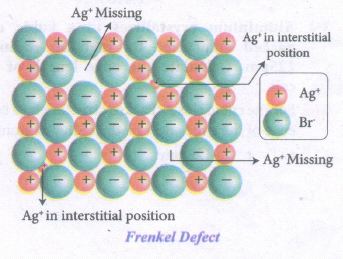
What are the general characteristics of solids?
4.
Ionic solids, which have anionic vacancies due to metal excess defect, develop colour. Explain with the help of a suitable example.
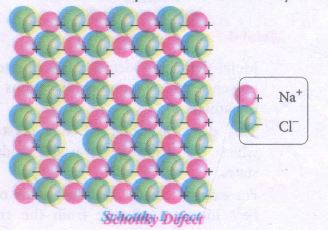
5.
Write short note on metal excess and metal deficiency defect with an example.
6.
Differentiate crystalline solids and amorphous solids.
7.
Frenkel defect is not show by alkali metal halides but silver halides do. Give reason.
8.
Why is FeS not formed in stoichiometric composition?
9.
What is point defect in crystals?
10.
Ionic solids conduct electricity in molten state but not in solid state. Explain.
11.
What type of stoichiometric defect is shown by ZnS.
12.
Classify the following as amorphous or crystalline solids. Polyurethane, Naphthalene, Benzoic acid, Teflon, Potassium nitrate, Cellophane, Polyvinyl chloride, Fiber glass, Copper.
13.
Why do solids have a definite volume?
14.
Atoms X and Y form bcc crystalline structure. Atom X is present at the corners of the cube and Y is at the centre of the cube. What is the formula of the compound?
15.
Why ionic crystals are hard and brittle?
16.
What are point defects?
17.
Classify the following solids
a. P4
b. Brass
c. diamond
d. NaCl
e. Iodine
18.
Write the properties of ionic crystals.
19.
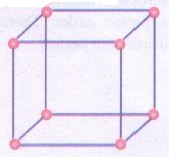
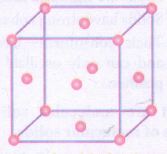
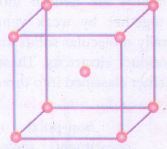
Sketch the
(a) Simple cubic
(b) face-centred cubic and
(c) body centred cubic lattices.
20.
Examine the given defective crystal:
| X+ | Y- | X+ | Y- | X+ |
| Y- | O | X+ | ||
| X+ | X+ | O | X+ | |
| Y- | X+ | Y- | X+ | Y- |
Answer the following questions
(i) Is the above defect stoichiometric or non-stoichiometric?
(ii) What are such defects called? Give an example of the compound which shows this type of defect.
21.
Classify the following solids in different categories based on the nature of intermolecular force operating in them: Potassium sulphate, tin, benzene, urea, ammonia, water, zinc sulphide, graphite, rubidium, argon, silicon carbide.
22.
Why are solids incompressible?
23.
Silver crystallizes in fcc lattice. If edge length of the cell is 4.07 x 10⁻⁸ em and density is 10.5 g cm-3. Calculate the atomic mass of silver
24.
Write a note on Frenkel defect.
25.
If NaCl is doped with 10-2 mol percentage of strontium chloride, what is the concentration of cation vacancy?
26.
Experiment shows that Nickel oxide has the formula Ni0.96.O1.00. What fraction of Nickel exists as of Ni2+ and Ni3+ ions?
27.
Explain Schottky defect.
28.
If electrical conductivity is found to be same in all directions through a solid the substance is ________ solid and the property is called _________.
crystalline, isotropy
amorphous, isotropy
crystalline, anisotropy
amorphous, isotropy
29.
In a solid, the cation is missing from the lattice and is found in an interstitial position. The defect is ________.
Metal excess
p type
Schottky
Frenkel
30.
An example for Frenkel defect is _______.
NaCl
AgBr
CdCl
FeS
31.
The site labelled as 'X' in FCC arrangement is_______.
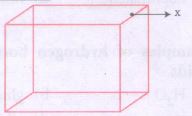
Face with 1/4 contribution
Edge with 1/4 contribution
Corner with 1/4 contribution
Tetrahedral void with 1/8 contribution
32.
Examples of hydrogen bonded molecular solids _______.
H2O
glucose
urea
all the above
33.
Which one of the following statements is wrong about Frenkel defect?
An ion occupies an interstitial position
Anion is much larger in size than the cation
The crystal remains neutral
Non-stoichiometric compound is formed
34.
What is wrong about a.b.c.c. unit cell?
In addition to an atom at the centre of the body of the unit cell, there are 8 atoms at 8 different corners
\(\frac{1}{8}\) atom at a corner of the unit cell
No. of atoms in the unit cells is 2
The no. of atoms in the unit cells is 4
35.
Schottky defects contains _______.
Cation vacancies only
Cation vacancies and interstitial cations
Equal number of cation and anion vacancies
Anion vacancies and interstitial anions
36.
A binary solid A+B has a structure with B- ions constituting the lattice and A+ ions occupying 25% tetrahedral holes. Formula of the solid is _______.
A2B
AB2
AB
AB4
37.
Which of the following is characteristic of ionic solids?
Very low value of electrical conductivity in the molten state
Brittle nature
Very strong forces of attractions
Anisotropic nature
38.
Schottky defect in a crystal is observed when ______.
unequal number of anions and anions are missing from the lattice
Equal number of cations and anions are missing from the lattice
an ion leaves its normal site and occupies an interstitial site
no ion is missing from its lattice
39.
The yellow colour in NaCl crystal is due to ________.
excitation of electrons in F centers
reflection of light from Cl- ion on the surface
refraction of light from Na+ ion
all of the above
40.
The ionic radii of A+ and B− are 0.98 x 10⁻¹⁰ m and 1.81 x 10⁻¹⁰ m. the coordination number of each ion in AB is ________.
8
2
6
4
41.
An ionic compound Ax By crystallizes in fcc type crystal structure with B ions at the centre of each face and A ion occupying corners of the cube the correct formula of Ax, By is ________.
AB
AB3
A3B
A8B6
42.
Assertion: due to Frenkel defect, density of the crystalline solid decreases.
Reason: In Frenkel defect cation and anion leaves the crystal.
Codes:
a) Both assertion and reason are true and reason is the correct explanation of assertion
b) Both assertion and reason are true but reason is not the correct explanation of assertion
c) Assertion is true but reason is false
d) Both assertion and reason are false
Both assertion and reason are true and reason is the correct explanation of assertion
Both assertion and reason are true but reason is not the correct explanation of assertion
Assertion is true but reason is false
Both assertion and reason are false
1.
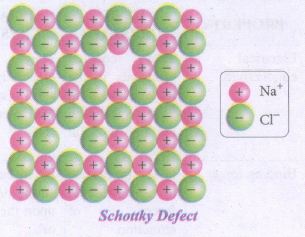
Schottky defect:
(i) Schottky defect arises due to the missing of equal number of cations and anions from the crystal lattice.
(ii) This effect does not change the stoichiometry of the crystal.
(iii) Ionic solids in which the cation and anion are of almost of similar size show schottky defect. Ex: NaCl.
(iv) Presence of large number of schottky defects in a crystal, lowers its density.
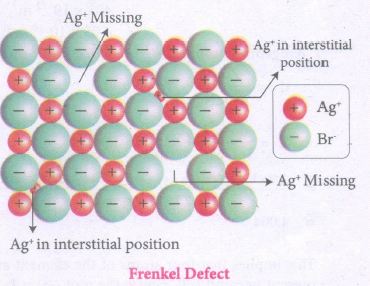
Frenkel defect:
(i) Frenkel defect arises due to the dislocation of ions from its crystal lattice.
(ii) The ion which is missing from the lattice point occupies an interstitial position.
(iii) This defect is shown by ionic solids in which cation and anion differ in size.
(iv) Unlike Schottky defect, this defect does not affect the density of the crystal.
(v) For example AgBr, in this case, small Ag+ ion leaves its normal site and occupies an interstitial position.
2.
(i) By knowing the density of an unknown metal and the dimension of its unit cell, the atomic mass of the metal can be: determined.
(ii) Let 'a' be the edge length of a unit cell of a crystal, 'd' be the density of the metal, 'm' be the atomic mass of the metal and 'z' be the number of atoms in the unit cell.
(iii) Now,
Density of the unit cell
\(=\frac{Mass\ of\ the\ unit\ cell}{Volume\ of\ the\ unit\ cell}\)
\(d=\frac{Z\times m}{a^3}\) ...(1)
[Since, mass of the unit cell = Number of atoms in the unit cell x Atomic mass]
[Volume of the unit cell = (edge length of the cubic unit cell)3]
(iv) From equation (1), We have
\(m=\frac{d\times a^3}{Z}\) ....(2)
(v) Now,
Mass of the metal (M) \(=\frac{Atomic\ mass(M)}{Avogadro's\ number(N_A)}\)
M=\(\frac{d\times a^3 \times N_A}{Z}\)
(vi) From equation (3), we can determine the atomic mass of the unknown metal.
3.
(i) Solids have definite volume and shape
(ii) Solids are rigid and incompressible
(iii) Solids have strong cohesive forces.
(iv) Their constituents have fixed positions and can only oscillate about their mean positions.
4.
(i) The colour develops because of the presence of electrons in the 8 anionic sites.
(ii) These electron absorb energy from the visible region of radiation and get excited.
(iii) For example when crystals of NaCl are heated in an atmosphere of sodium vapours, the sodium atoms get deposited on the surface of the crystal and the deposited Na atoms.
(iv) During this process, the Na atoms on the surface lose electrons to form Na+ ions
(v) These electrons get excited by absorbing energy from the visible light and impart yellow colour to the crystals.
5.
Metal excess defect:
(i) It arises due to the presence of more number of metal ions as compared to anions.
(ii) Examples: NaCl, KCl
(iii) The electrical neutrality of the crystal can be maintained by the presence of anionic vacancies equal to the presence of extra cation.
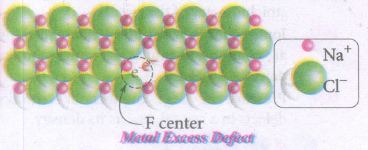
(iii) For example, when NaCI crystals are heated in the presence of sodium vapour, Na+ ions are formed and are deposited on the surface of the crystal.
(iv) Chloride ions (Cl-) diffuse to the surface from the lattice point and combines with Na+ ion.
(v) The electron lost by the sodium vapour diffuse into the vacancy created by the Cl- ions.
(vi) Such anionic vacancies which are occupied by unpaired electrons are called F centers. Hence, the formula of NaCl can be written as Na1+xCl.
Metal deficiency defect:
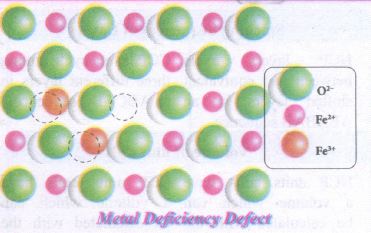
(i) Metal deficiency defect arises due to the presence of less number of cations than the anions. This defect is observed in a crystal in which, the cations have variable oxidation states.
(ii) For example, In FeO crystal, some of the Fe2+ ions are missing from the crystal lattice. To maintain the electrical neutrality, twice the number of other Fe2+ ions in the crystal is oxidized to Fe3+ ions. In such cases, overall number of Fe2+ and Fe3+ ions is less than the O2- ions.
6.
| S. No | Crystalline Solids | Amorphous Solids |
| 1. | Long range orderly arrangement of constituents. | Short range, random arrangement of constituents. |
| 2. | Definite shape | Irregular shape |
| 3. | Anisotropic in nature | They are "isotropic" like liquids |
| 4. | They are true solids | They are considered as pseudo solids (or) super cooled liquids |
| 5. | Definite Heat of fusion | Heat of fusion is not definite |
| 6. | They have sharp melting points. | Gradually soften over a range of temperature and so can be moulded. |
| 7. | Eg: NaCl, diamond etc. | Eg: Rubber, plastics, glass etc. |
7.
Frenkel defect occurs in a Silver halides due to small size of Ag+ ions which occupy interstitial position. Whereas in alkali metal halides, size of the cation and anion are almost similar so alkali metal ions do not fit into the interstitial sites.
8.
In FeS, Fe2+ ions are replaced by Fe3+ ions. To maintain electrical neutrality, 3 Fe2+ ions are replaced by 2Fe3+ ions
9.
The defects which are caused by missing or misplaced atoms or ions in the crystal.
10.
(i) In ionic compounds, electricity is conducted by ions.
(ii) In solid state, ions are held together by A strong electrostatic forces and are not free to move about within the solid.
(iii) Hence, ionic solids do not conduct electricity in solid state
(iv) However, in molten state or in solution form, the ions are free to move and can conduct electricity.
11.
ZnS exhibits Frenkel defect.
12.
| Amorphous Solids | Crystalline solids |
| Polyurethane | Naphthalene |
| Teflon | Benzoic acid |
| Cellophane | Potassium nitrate |
| Polyvinyl chloride | Copper |
| Fiber glass |
13.
(i) The intermolecular forces of attraction that are present in solids are very strong.
(ii) The constituent particles of solids have fixed position.
(iii) Hence, solids have a definite volume.
14.
Number of X type atoms in the unit cell \(=8 \times \frac{1}{8}=1\)
Number of Y type atoms in the unit cell \(=1 \times \frac{1}{1}=1\)
Hence the formula is XY (or) X1Y1
15.
The structural units of an ionic crystal are cations and anions. They are bound together by strong electrostatic attractive forces. To maximize the attractive force, cations are surrounded by as many anions as possible and vice versa. Hence they are hard and brittle.
16.
The imperfection occurs due to missing atoms, displaced atoms or extra atoms, is named as a point defect. Such defects arise due to imperfect packing during the original crystallisation or they may arise from thermal vibrations of atoms at elevated temperatures.
17.
a. P4 - Covalent solid
b. Brass - Metallic solid
c. Diamond - Covalent solid
d. NaCl - Ionic solid
e. Iodine - Covalent solid
18.
In ionic crystals, the units occupying lattice points are positive and negative ions.
The ionic crystals have the following characteristics :
i) The heat of vapourisation is high.
ii) The vapour pressure of ionic crystals at ordinary temperature are very low.
iii) Their melting and boiling points are very high.
iv) They are hard and brittle.
v) They are insulators in the solid state.
vi) Ionic crystals are soluble in water and also in other polar solvents.
vii) Ionic solids are good conductors when dissolved in water.
19.
(a) Simple cubic:
(b) face-centred cubic:
(c) body centred cubic lattices:
20.
(i) The given defect is Stoichiometric since the number of cations and anions are missing from lattice sites unequal.
(ii) The defect is Schottky defect.
These defects are vacancy defects shown by ionic solids in which the anion and cation are nearly of the same size.
Eg: NaCI and KCI shows Schottky defects
21.
(i) Covalent Solids: Silicon carbide, graphite.
(ii) Molecular Solids: Urea, benzene, ammonia, water and argon.
(iii) Ionic Solids: Zinc sulphide, potassium sulphate.
(iv) Metallic solids: Rubidium and tin.
22.
(i) Compressibility is the ability of the substance to change its shape by applying external pressure.
(ii) Solids form closed packed structure with negligible intermolecular space and possesses very strong intermolecular forces of attraction.
(iii) Thus, they do not change their shape in the presence of external pressure.
23.
\(M=\frac { d\times { a }^{ 3 }\times NA }{ g } \)
d = Density of the material
a = Length of the edge of the cell.
NA = Avogadro number
Z = No. of atoms
\(M=\frac { 10.5{ gcm }^{ -3 }{ (4.07\times { 10 }^{ -6 }cm) }^{ 3 }\times \left( 6.023\times { 10 }^{ 23 }{ mol }^{ -1 } \right) }{ 4 } \)
Atomic mass of silver M = 107.08 g mol-1.
24.
(i) Frenkel defect arises due to the dislocation of ions from its crystal lattice.
(ii) The ion which is missing from the lattice point occupies an interstitial position.
(iii) This defect is shown by ionic solids in which cation and anion differ in size.
(iv) Unlike Schottky defect, this defect does not affect the density of the crystal.
For example AgBr, in this case, small Ag+ ion leaves its normal site and occupies an interstitial position.
25.
Given: NaCl is doped with 10-2 mole % of SrCl2
(i.e.) 100 moles of NaCl doped with 10-2 moles of SrCl2
\(\therefore \) 1 mole of NaCl is doped with 10-4 moles of SrCl2
1 Sr2+ ion creates 1 cation vacancy
The number of cation vacancies created by 10-4 mole SrCl2 = 10-4 \(\times\) 6.023 \(\times\) 1023
= 6.023 \(\times\) 1019 vacancies
26.
Formula is Nio.96 O1.00
So the ration of Ni = O = 96.00
So if there are 100 atom of oxygen, as atoms of Ni
Let the number of atoms of Ni+2 = x
The number of atoms of Ni+2 = 96 - x
Charge on Ni = charge on O
So that oxygen has charge = 2
3 (96 - x) + 2x = 2(100)
288 - 3x + 2x = 200
-x = -88
x = 88
Percentage of Ni + 2 = (atom of Ni+2 / total number of atoms of Ni 100.)
= 100.(94/98) x 100 = 96%
Percentage of Ni+3 = 100 - Ni+2
= 100 - 96 = 4%
27.
(i) Schottky defect arises due to the missing of equal number of cations and anions from the crystal lattice. This effect does not change the stoichiometry of the crystal.
(ii) Ionic solids in which the cation and anion are of almost of similar size show schottky defect.
Example: NaCl.
(iii) Presence of large number of schottky defects in a crystal, lowers its density.
(iv) Presence of Schottky defect in the crystal provides a simple way by which atoms or ions can move within the crystal lattice.
28.
(b)
amorphous, isotropy
29.
(d)
Frenkel
30.
(b)
AgBr
31.
(c)
Corner with 1/4 contribution
32.
(d)
all the above
33.
(d)
Non-stoichiometric compound is formed
34.
(d)
The no. of atoms in the unit cells is 4
35.
(c)
Equal number of cation and anion vacancies
36.
(b)
AB2
37.
(c)
Very strong forces of attractions
38.
(b)
Equal number of cations and anions are missing from the lattice
39.
(a)
excitation of electrons in F centers
40.
\(\left( \frac { r_{c^+} }{ r_{A^-} } \right) \) = \(\left( \frac { 0.98 \times 10^{-10 }}{ 1.81 \times 10^{-10} } \right) = 0.54\)
It is in the range of 0.414 to 0.732, hence the coordination number of each ion is 6.
41.
Number of A ions = Nc/8 = 8/8 = 1
Number of B ions = Nf/2 = 6/2 = 3
Simplest formula = AB3
42.
d) Both assertion and reason are false

12th Standard Syllabus & Materials
12th Standard
TN 12th Computer Applications களப்பெயர் முறைமை (DNS) Sample Question Papers Study Material - QB365 Set A
NEW12th Standard
TN 12th Computer Applications வலையமைப்பு எடுத்துக்காட்டுகள் மற்றும் நெறிமுறைகள் Sample Question Papers Study Material - QB365 Set A
NEW12th Standard
TN 12th Computer Applications கணினி வலையமைப்பு ஓர் அறிமுகம் Sample Question Papers Study Material - QB365 Set A
NEW12th Standard
TN 12th Computer Applications PHP-உடன் MySQL-ஐ இணைத்தல் Sample Question Papers Study Material - QB365 Set A



Tamilnadu Stateboard 12th Standard Subjects

Maths
Chemistry

Physics

Biology

Computer Science

Business Maths and Statistics

Economics

Commerce

Accountancy

History

Computer Applications
Biology
Computer Technology
Computer Applications
Computer Science
Business Maths and Statistics
Commerce
Economics
Maths
Chemistry
Physics
Computer Technology
History
Accountancy

Tamil

English

French
Tamilnadu Stateboard Standards
