
 100% FREE ACCESS
12th Standard Syllabus & Materials
12th Standard
TN 12th Computer Applications மின்னணு தரவு பரிமாற்றம் Sample Question Papers Study Material - QB365 Set A
NEW12th Standard
TN 12th Computer Applications மின் - வணிக பாதுகாப்பு அமைப்புகள் Sample Question Papers Study Material - QB365 Set A
NEW12th Standard
TN 12th Computer Applications மின்னணு செலுத்தல் முறைகள் Sample Question Papers Study Material - QB365 Set A
NEW12th Standard
TN 12th Computer Applications மின் - வணிகம் Sample Question Papers Study Material - QB365 Set A
NEW12th Standard
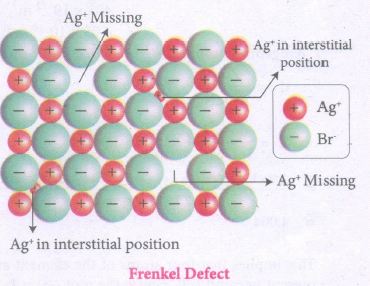
TN 12th Computer Applications திறந்த மூல கருத்துருக்கள் Sample Question Papers Study Material - QB365 Set A
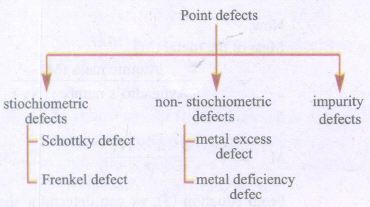
NEW12th Standard
TN 12th Computer Applications வலையமைப்பு வடமிடல் Sample Question Papers Study Material - QB365 Set A

Published on: 28/01/2021
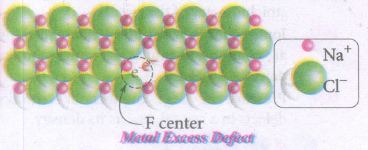
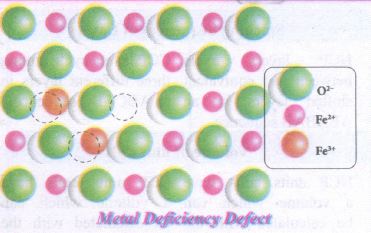
12th Standard Chemistry English Medium Solid State Reduced Syllabus Important Questions With Answer Key 2021
Download Tamil Nadu 12th Standard Chemistry question papers, model tests, one-mark questions, important questions, and public exam papers in PDF format. Free study materials and answer keys for TN State Board students.
Questions + Answers key
Take MCQ Chemistry Test
1.
Diamond and solid rhombic sulphur are covalent solids but the latter has very low melting point than the former. Explain why?
2.
Define void.
3.
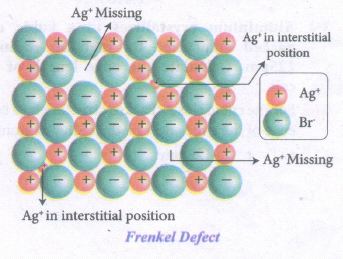
Which point effect in crystal doesn't alter the density of the relevant solid?
4.
Ionic solids conduct electricity in molten state but not in solid state. Explain.
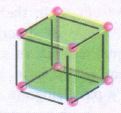
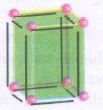
5.
What type of stoichiometric defect is shown by ZnS.
6.
Why do solids have a definite volume?
7.
KF crystallizes in fcc structure like sodium chloride. Calculate the distance between K+ and F− in KF. (given : density of KF is 248 g cm-3)
8.
What is the two dimensional coordination number of a molecule in square close packed layer?
9.
Why ionic crystals are hard and brittle?
10.
Define unit cell.
11.
What are stoichiometric defects in ionic solids? Explain
12.
How are crystals classified?
13.
What are the general characteristics of solids?
14.
Ionic solids, which have anionic vacancies due to metal excess defect, develop colour. Explain with the help of a suitable example.
15.
Write short note on metal excess and metal deficiency defect with an example.
16.
Differentiate crystalline solids and amorphous solids.
17.
State Bragg's law.
18.
Diffraction angle 2θ equal to 14.8o for a crystal having interplanar distance in the crystal is 0.400 nm when second order diffraction was observed. Calculate the wavelength of X-ray used.
19.
How do the spacings of the three planes (100), (101) and (111) of simple cubic lattice vary?
20.
ZnO turns yellow on heating. Why?
21.
Classify the following solids in different categories based on the nature of intermolecular force operating in them: Potassium sulphate, tin, benzene, urea, ammonia, water, zinc sulphide, graphite, rubidium, argon, silicon carbide.
22.
If NaCI is doped with 10-3 mol % of SrCl2 What is the concentration of cation valencies?
23.
Why are solids rigid?
24.
Write a note on Frenkel defect.
25.
An element has bcc structure with a cell edge of 288 pm. The density of the element is 7.2 g cm-3. How many atoms are present in 208 g of the element.
26.
Distinguish between hexagonal close packing and cubic close packing.
27.
Explain briefly seven types of unit cell.
28.
If electrical conductivity is found to be same in all directions through a solid the substance is ________ solid and the property is called _________.
crystalline, isotropy
amorphous, isotropy
crystalline, anisotropy
amorphous, isotropy
29.
An example of covalent crystalline solid is ______.
NaI
AI
Si
Ar
30.
Examples of hydrogen bonded molecular solids _______.
H2O
glucose
urea
all the above
31.
Which among the following is an amorphous solid?
Graphite
SiO2
Sic
Diamond
32.
Which of the following exists as covalent crystals in solid state?
phosphorus
sulphur
chlorine
silicon
33.
Which one of the following statements is wrong about Frenkel defect?
An ion occupies an interstitial position
Anion is much larger in size than the cation
The crystal remains neutral
Non-stoichiometric compound is formed
34.
Pick out the example for covalent and molecular crystal.
Ice, Diamond
Diamond, Ice
NaCl, FeS
FeS, Ice
35.
An element with atomic mass 60 having fee structure has a density of 6.23g/cm3. What is the edge length of unit cell?
200 Pm
300 Pm
400 Pm
500 Pm
36.
The empty space between the shaded balls and hollow balls as shown in the diagram is called, _______.
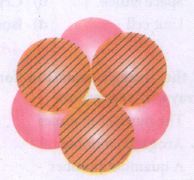
Hexagonal void
Octahedral void
Tetrahedral void
Double triangular void
37.
A binary solid A+B has a structure with B- ions constituting the lattice and A+ ions occupying 25% tetrahedral holes. Formula of the solid is _______.
A2B
AB2
AB
AB4
38.
What is the relation between diamond and graphite?
Polymorphous
Isomer
Isotope
Isomorphous
39.
Which of the following cannot be regarded as molecular solid?
Silicon carbide
AIN
Diamond
All the above
40.
A two dimensional solid pattern formed by two different atoms X and Y is shown below. The black and white squares represent atoms X and Y respectively. The simplest formula for the compound based on the unit cell from the pattern is _______.
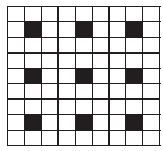
XY8
X4Y9
XY2
XY4
41.
In a solid atom M occupies ccp lattice and \(\left( \frac { 1 }{ 3 } \right) \) of tetrahedral voids are occupied by atom N. Find the formula of solid formed by M and N ________.
MN
M3N
MN3
M3N2
42.
Solid CO2 is an example of ________.
Covalent solid
metallic solid
molecular solid
ionic solid
1.
(I) Diamond has network structure, while sulphur does not.
(II) Due to this, particles of carbon are held at their positions firmly which makes diamond hard, brittle with extremely high melting point.
2.
The empty spaces present between the metal atom or the ions when they are packed within the crystal are called voids.
3.
Frenkel defect
4.
(i) In ionic compounds, electricity is conducted by ions.
(ii) In solid state, ions are held together by A strong electrostatic forces and are not free to move about within the solid.
(iii) Hence, ionic solids do not conduct electricity in solid state
(iv) However, in molten state or in solution form, the ions are free to move and can conduct electricity.
5.
ZnS exhibits Frenkel defect.
6.
(i) The intermolecular forces of attraction that are present in solids are very strong.
(ii) The constituent particles of solids have fixed position.
(iii) Hence, solids have a definite volume.
7.
\(\text { Density }(\rho)=\frac{\mathrm{nM}}{\mathrm{a}^{3} \mathrm{~N}_{\mathrm{A}}} \)
\(\mathrm{n}=4, \mathrm{M}=\text { Molar mass of } \mathrm{KF}=58.1 \mathrm{~g} / \mathrm{mol} \)
\(\rho=2.48 \mathrm{~g} \mathrm{~cm}^{-3} \)
\(\mathrm{~N}_{\mathrm{A}}=6.023 \times 10^{23} \)
\(a^{3} =\frac{n M}{\rho N_{A}}=\frac{4 \times 58.1}{2.48 \times 6.023 \times 10^{23}} \)
\(a^{3} =15.55 \times 10^{-23} \)
\(a^{3} =0.1555 \times 10^{-21} \)
\(a =\sqrt[3]{0.1555 \times 10^{-21}} \)
\(a =0.5375 \times 10^{-7} \mathrm{~cm}=5.375 \times 10^{-8} \mathrm{~cm}=537.5 \mathrm{pm} \)
\(d =\frac{a}{\sqrt{2}}(\text { for fcc }) [\therefore r = \frac{a\sqrt{2}}{4}]\)
\(=\frac{537.5}{1.414}=380.13 \mathrm{pm}\)
\(\therefore\) The distance between K+ and F- in KF = 380.13 pm
8.
Linear arrangement of spheres in one direction is repeated in two dimension (i.e.) more number of rows can be generated identical to the one dimensional arrangement such that all spheres of different rows align vertically as well as horizontal.
If we denote the first row as A type arrangement, then the above mentioned packing is called AAA type, because all rows are identical as the first one. In this arrangement each sphere is in contact with four of its neighbours.
9.
The structural units of an ionic crystal are cations and anions. They are bound together by strong electrostatic attractive forces. To maximize the attractive force, cations are surrounded by as many anions as possible and vice versa. Hence they are hard and brittle.
10.
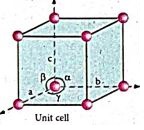
(i) A basic repeating structural unit of a crystalline solid is called a unit cell.
(ii) A crystal is consisted of large number of unit cells.
11.
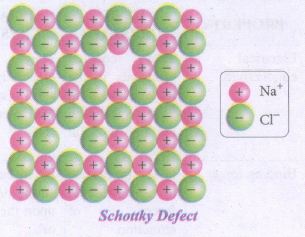
Schottky defect:
(i) Schottky defect arises due to the missing of equal number of cations and anions from the crystal lattice.
(ii) This effect does not change the stoichiometry of the crystal.
(iii) Ionic solids in which the cation and anion are of almost of similar size show schottky defect. Ex: NaCl.
(iv) Presence of large number of schottky defects in a crystal, lowers its density.
Frenkel defect:
(i) Frenkel defect arises due to the dislocation of ions from its crystal lattice.
(ii) The ion which is missing from the lattice point occupies an interstitial position.
(iii) This defect is shown by ionic solids in which cation and anion differ in size.
(iv) Unlike Schottky defect, this defect does not affect the density of the crystal.
(v) For example AgBr, in this case, small Ag+ ion leaves its normal site and occupies an interstitial position.
12.
Crystal defects are classified as follows
(i) Point defects
(ii) Line defects
(iii) Interstitial defects
(iv) Volume defects
Point defects are further classified as follows
13.
(i) Solids have definite volume and shape
(ii) Solids are rigid and incompressible
(iii) Solids have strong cohesive forces.
(iv) Their constituents have fixed positions and can only oscillate about their mean positions.
14.
(i) The colour develops because of the presence of electrons in the 8 anionic sites.
(ii) These electron absorb energy from the visible region of radiation and get excited.
(iii) For example when crystals of NaCl are heated in an atmosphere of sodium vapours, the sodium atoms get deposited on the surface of the crystal and the deposited Na atoms.
(iv) During this process, the Na atoms on the surface lose electrons to form Na+ ions
(v) These electrons get excited by absorbing energy from the visible light and impart yellow colour to the crystals.
15.
Metal excess defect:
(i) It arises due to the presence of more number of metal ions as compared to anions.
(ii) Examples: NaCl, KCl
(iii) The electrical neutrality of the crystal can be maintained by the presence of anionic vacancies equal to the presence of extra cation.
(iii) For example, when NaCI crystals are heated in the presence of sodium vapour, Na+ ions are formed and are deposited on the surface of the crystal.
(iv) Chloride ions (Cl-) diffuse to the surface from the lattice point and combines with Na+ ion.
(v) The electron lost by the sodium vapour diffuse into the vacancy created by the Cl- ions.
(vi) Such anionic vacancies which are occupied by unpaired electrons are called F centers. Hence, the formula of NaCl can be written as Na1+xCl.
Metal deficiency defect:
(i) Metal deficiency defect arises due to the presence of less number of cations than the anions. This defect is observed in a crystal in which, the cations have variable oxidation states.
(ii) For example, In FeO crystal, some of the Fe2+ ions are missing from the crystal lattice. To maintain the electrical neutrality, twice the number of other Fe2+ ions in the crystal is oxidized to Fe3+ ions. In such cases, overall number of Fe2+ and Fe3+ ions is less than the O2- ions.
16.
| S. No | Crystalline Solids | Amorphous Solids |
| 1. | Long range orderly arrangement of constituents. | Short range, random arrangement of constituents. |
| 2. | Definite shape | Irregular shape |
| 3. | Anisotropic in nature | They are "isotropic" like liquids |
| 4. | They are true solids | They are considered as pseudo solids (or) super cooled liquids |
| 5. | Definite Heat of fusion | Heat of fusion is not definite |
| 6. | They have sharp melting points. | Gradually soften over a range of temperature and so can be moulded. |
| 7. | Eg: NaCl, diamond etc. | Eg: Rubber, plastics, glass etc. |
17.
The fundamental equation that gives a simple relation between the wavelength of the X-rays, the interplanar distance in the crystal and the angle of reflection is known as Bragg's equation.
nλ = 2dsinθ
Where n is the order of reflection
λ is the wavelength of X-rays
d is the interplanar distance in the crystal
θ is the angle of reflection
18.
Data:
Diffraction angle,
2θ = 14.80 ∴ 8 = 7.4°
Interplanar distance, d = 0.400 nm
Order of reflection, n = 2
Formula:
nλ = 2dsinθ
∴ wavelength,
Solution:
\(\lambda =\frac { 2dsin\theta }{ 2 } \)
= dsinθ
= 0.400 sin 7.4o
= 0.400 x 1.288 nm
= 0.0512 nm
λ = 0.0512 nm
19.
Simple Cubic Lattice
100,101,111
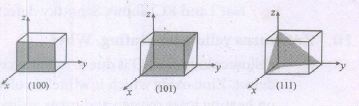
\({ d }_{ hkl }=\frac { a }{ \sqrt { { h }^{ 2 }+{ k }^{ 2 }+{ l }^{ 2 } } } \)
\({ d }_{ 100 }=\frac { 1 }{ \sqrt { { 1 }^{ 2 }+0^{ 2 }+0^{ 2 } } } =1\)
\({ d }_{ 101 }=\frac { 1 }{ \sqrt { { 1 }^{ 2 }+0^{ 2 }+0^{ 2 } } } =\frac { 1 }{ \sqrt { 2 } } \)
\({ d }_{ 111 }=\frac { 1 }{ \sqrt { { 1 }^{ 2 }+1^{ 2 }+1^{ 2 } } } =\frac { 1 }{ \sqrt { 3 } } \)
\(\\ { d }_{ 100 }:{ d }_{ 101 }:{ d }_{ 111 }=1:\frac { 1 }{ \sqrt { 2 } } :\frac { 1 }{ \sqrt { 3 } } (or)\)
=1:0.707:0.577
20.
(i) Yellow colour of ZnO is due to metal excess defect. Zinc oxide which is white in colour on heating loses oxygen and turns yellow.
\(ZnO\overset { Heating }{ \longrightarrow } { Zn }^{ + }+\frac { 1 }{ 2 } { O }_{ 2 }+{ 2e }^{ -1 }\)
(ii) The excess Zn2+ ion thus, formed get trapped into vacant interstitial sites and the electrons in the neighbouring interstitial sites.
21.
(i) Covalent Solids: Silicon carbide, graphite.
(ii) Molecular Solids: Urea, benzene, ammonia, water and argon.
(iii) Ionic Solids: Zinc sulphide, potassium sulphate.
(iv) Metallic solids: Rubidium and tin.
22.
Doping of NaCI with 10-3 mol% SrCl2 means that 100 moles of NaCl are doped with 10-3 mol SrCl2.
∴ 1mole of NaCl is doped with SrCl2
\(=\frac { { 10 }^{ -3 } }{ 100 } \times 6.02\times { 10 }^{ 23 }=6.02\times 10^{ 18 }\)
23.
(i) The intermolecular forces of attraction that are present in solids are very strong.
(ii) The constituent particles of solids cannot: move from their positions. They have fixed positions.
(iii) However, they can oscillate about their mean positions.
(iv) This is the reason solids are rigid.
24.
(i) Frenkel defect arises due to the dislocation of ions from its crystal lattice.
(ii) The ion which is missing from the lattice point occupies an interstitial position.
(iii) This defect is shown by ionic solids in which cation and anion differ in size.
(iv) Unlike Schottky defect, this defect does not affect the density of the crystal.
For example AgBr, in this case, small Ag+ ion leaves its normal site and occupies an interstitial position.
25.
\(\operatorname{Density}(\rho)=\frac{\mathrm{nM}}{\mathrm{a}^{3} \mathrm{~N}_{\mathrm{A}}} \)
\(\mathrm{n}=2, \mathrm{~N}_{\mathrm{A}}=6.023 \times 10^{23} ; \mathrm{a}=288 \mathrm{pm}=2.88 \times 10^{-8} \mathrm{~cm}, \rho=7.2 \mathrm{~g} \mathrm{~cm}^{-3} \)
\(\therefore M=\frac{\rho \times a^{3} \times N_{A}}{n} \)
\(=\frac{7.2 \times\left(2.88 \times 10^{-8}\right)^{3} \times 6.023 \times 10^{23}}{2} \)
\(=517.95 \times 10^{-1} \)
\(=51.795 \mathrm{~g} \mathrm{~mol}^{-1} \)
Number of moles (n) \(=\frac{\text { Mass }}{\text { Molar mass }}=\frac{208}{51.795}\)=4.02 moles
No. of atoms = No. of moles \(\times\) Avogadro number
=n \(\times\) NA
\(=4.01 \times 6.023 \times 10^{23} \)
\(=24.15 \times 10^{23} \text { atoms }\)
26.
| hcp structure | ccp structure | |
| 1. | This is 'aba' pattern of arrangement. | This is 'abc' pattern of arrangement. |
| 2. | The spheres can be arranged so as to fit into the depression in such a way that the third layer is directly over a first layer. | The third layer may be placed over the second layer in such a way that all the spheres of the third layer fit in octahedral voids. |
| 3. | The tetrahedral voids of the second layer are covered by the spheres of the third layer. | This arrangement of the third layer is different from other two layers and the stacking of layers continued. |
| 4. | 6 spheres are present | 4 spheres are present |
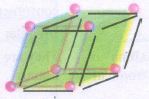
27.
There are seven types of unit cell, Cubic, tetragonal, orthorhombic, hexagonal, monoclinic, triclinic and rhombohedral. They differ in the arrangement of their crystallographic axes and angles.
i) Cubic: a = b = c; α = β = ૪ = 90o.
ii) Tetragonal: a = b ≠ c; α = β = ૪ = 90°.
iii) Orthorhombic: a ≠ b ≠ c; α = β = ૪ = 90°.
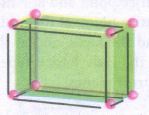
iv) Hexagonal: a = b ≠ c; α = β = 90o, ૪ = 120o.
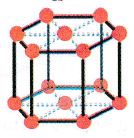
v) Monoclinic: a ≠ b ≠ c; α = ૪ = 90o, β ≠ 90o,
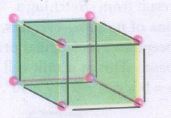
vi) Triclinic: a ≠ b ≠ c; α ≠ β ≠ ૪ ≠ 90o.
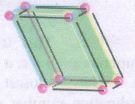
vii) Rhombohedral: a = b = c; α = β = ૪ ≠ 90o.
28.
(b)
amorphous, isotropy
29.
(c)
Si
30.
(d)
all the above
31.
(a)
Graphite
32.
(d)
silicon
33.
(d)
Non-stoichiometric compound is formed
34.
(b)
Diamond, Ice
35.
(c)
400 Pm
36.
(b)
Octahedral void
37.
(b)
AB2
38.
(a)
Polymorphous
39.
(d)
All the above
40.
(a)
XY8
41.
If the total number of M atoms is n, then the number of tetrahedral voids = 2n
Given that \(\left( \frac { 1 }{ 3 } \right) ^{rd}\) of tetrahedral voids are occupied.
i.,e \(\left( \frac { 1 }{ 3 } \right) \times 2n\) are occupied by N atoms
\(\therefore\)M : N = n : \(\left( \frac { 2 }{ 3 } \right) n\)
= 1 : \(\frac { 2 }{ 3 }\)
Hence M3N2 = 3 : 2
42.
Lattice points are occupied by CO2 molecules

12th Standard Syllabus & Materials
12th Standard
TN 12th Computer Applications களப்பெயர் முறைமை (DNS) Sample Question Papers Study Material - QB365 Set A
NEW12th Standard
TN 12th Computer Applications வலையமைப்பு எடுத்துக்காட்டுகள் மற்றும் நெறிமுறைகள் Sample Question Papers Study Material - QB365 Set A
NEW12th Standard
TN 12th Computer Applications கணினி வலையமைப்பு ஓர் அறிமுகம் Sample Question Papers Study Material - QB365 Set A
NEW12th Standard
TN 12th Computer Applications PHP-உடன் MySQL-ஐ இணைத்தல் Sample Question Papers Study Material - QB365 Set A



Tamilnadu Stateboard 12th Standard Subjects

Maths
Chemistry

Physics

Biology

Computer Science

Business Maths and Statistics

Economics

Commerce

Accountancy

History

Computer Applications
Biology
Computer Technology
Computer Applications
Computer Science
Business Maths and Statistics
Commerce
Economics
Maths
Chemistry
Physics
Computer Technology
History
Accountancy

Tamil

English

French
Tamilnadu Stateboard Standards
