
 100% FREE ACCESS
12th Standard Syllabus & Materials
12th Standard
TN 12th Computer Applications மின்னணு தரவு பரிமாற்றம் Sample Question Papers Study Material - QB365 Set A
NEW12th Standard
TN 12th Computer Applications மின் - வணிக பாதுகாப்பு அமைப்புகள் Sample Question Papers Study Material - QB365 Set A
NEW12th Standard
TN 12th Computer Applications மின்னணு செலுத்தல் முறைகள் Sample Question Papers Study Material - QB365 Set A
NEW12th Standard
TN 12th Computer Applications மின் - வணிகம் Sample Question Papers Study Material - QB365 Set A
NEW12th Standard
TN 12th Computer Applications திறந்த மூல கருத்துருக்கள் Sample Question Papers Study Material - QB365 Set A
NEW12th Standard
TN 12th Computer Applications வலையமைப்பு வடமிடல் Sample Question Papers Study Material - QB365 Set A

Published on: 02/09/2022
QB365 provides a detailed and simple solution for every Possible Creative Questions in Class 12 Chemistry Subject - Surface Chemistry, English Medium. It will help Students to get more practice questions, Students can Practice these question papers in addition to score best marks.
Download Tamil Nadu 12th Standard Chemistry question papers, model tests, one-mark questions, important questions, and public exam papers in PDF format. Free study materials and answer keys for TN State Board students.
Questions + Answers key
Take MCQ Chemistry Test
1.
Name various techniques by which a colloid can be deemulsified.
2.
What are the tests used to identify the type of emulsion?
3.
Define Gold number.
4.
How is coagulation brought about by addition of electrolytes?
5.
What are the advantages of Brownian movement?
6.
Write a note on Ultrafilteration?
7.
How are colloidal solution of ink and graphite prepared?
8.
Explain the advantages of using nano catalyst.
9.
Give an example for a reaction catalysed by nano particles
10.
Give three examples of enzyme catalyzed reactions.
11.
What are the important concepts of catalysis that adsorption theory explains?
12.
What are active centres?
13.
Write a note on auto catalysis?
14.
Write a note.
(i) Positive catalyst
(ii) Negative catalyst
15.
Give any three application of adsorption.
1.
Various demulsification techniques are given below:
(i) Distilling of one component.
(ii) Adding an electrolyte to destroy the charge.
(iii) Destroying the emulsifier using chemical methods.
(iv) Using solvent extraction to remove one component.
(v) By freezing one of the components.
(vi) By applying centrifugal force.
(vii) Adding dehydrating agents for water in oil.
(viii) Type.
(viii) Using ultrasonic waves.
(ix) Heating at high pressures.
2.
(i) Dye test:
A small amount of dye soluble in oil is added to the emulsion. The emulsion is shaken well. The aqueous emulsion will not take the colour whereas oily emulsion will take up the colour of the dye.
(ii) Viscosity test:
Viscosity of the emulsion is determined by experiments. Oily emulsions will have higher value than aqueous emulsion.
(iii) Conductivity test:
Conductivity of aqueous emulsions are always higher than oily emulsions.
(iv) Spreading test:
Oily emulsions spread readily than aqueous emulsion when spread on an oily surface.
3.
(i) Gold number' is a measure of protecting power of a colloid.
(ii) Gold number is defined as the number of milligrams of hydrophilic colloid that will just prevent the precipitation of 10ml of gold solon the addition of 1ml of 10% NaCl solution.
(iii) Smaller the gold number greater the protective power.
4.
(i) A negative ion causes the precipitation of positively charged sol and vice versa.
(ii) When the valency of ion is high, the precipitation power is increased. For example, the precipitation power of some cations and anions varies in the following order.
\({ Al }_{ 3 }+>Ba^{ 2+ }+>Na^{ + },Similarly[Fe(CN)_{ 6 }]^{ 3- }>SO_{ 4 }^{ 2- }>{ Cl }^{ - }\)
(iii) The precipitation power of electrolyte is determined by finding the minimum concentration (millimoles/lit) required to cause precipitation of a sol in 2 hours.
(iv) This value is called flocculation value. The smaller the flocculation value greater will be precipitation
5.
Brownian movement enables us,
(i) to calculate Avogadro number.
(ii) to confirm kinetic theory which considers the ceaseless rapid movement of molecules that increases with increase in temperature.
(iii) to understand the stability of colloids: As the particles are in continuous rapid movement they do not come close and hence not get condensed.
(iv) That is Brownian movement does not allow the particles to be acted on by force of gravity.
6.
(i) The pores of ordinary filter papers permit the passage of colloidal solutions.
(ii) In ultra filtrations, the membranes are made by using collodion cellophane or visiking.
(iii) When a colloidal solution is filtered using such a filter, colloidal particles are separated on the filter and the impurities are removed as washings.
(iv) This process is quickened by application of pressure.
(v) The separation of sol particles from electrolyte by filteration through an ultrafilter is called ultrafiltration.
7.
(i) Using a colloid mill, the solid is ground to colloidal dimension.
(ii) The colloid mill consists of two metal plates rotating in opposite direction at very high speed of nearly 7000 revolution I minute.
(iii) The colloidal particles of required colloidal size is obtained by adjusting the distance between two plates.
(iv) By this method, colloidal solutions of ink and graphite are prepared.
8.
(i) Nano materials such a metallic nano particles, metal oxides, etc., are used as catalyst in many chemical transformation. Nanocatalysts carry the advantages of both homogeneous and heterogeneous catalyses.
(ii) Like homogeneous catalysts, the nanocatalysts give 100% selective transformations and excellent yield and show extremely high activity.
(iii) Like the heterogeneous catalysts, nanocatalysts can be recovered and recycled.
9.
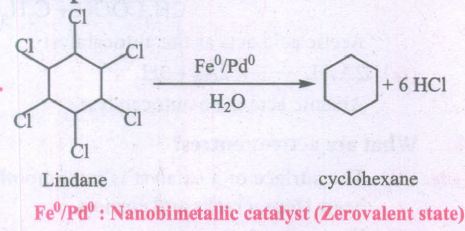
10.
(i) The peptide glycyl L-glutamyl L-lyrosin is hydrolysed by an enzyme called pepsin.
(ii) The enzyme diastase hydrolyses starch into maltose
\(2\left( { C }_{ 6 }{ H }_{ 10 }{ O }_{ 5 } \right) +{ nH }_{ 2 }O\longrightarrow { nC }_{ 12 }{ H }_{ 22 }{ O }_{ 11 }\)
(iii) The yeast contains the enzyme zymase which converts glucose into ethanol.
\({ C }_{ 6 }{ H }_{ 12 }{ O }_{ 6 }\longrightarrow { 2C }_{ 2 }{ H }_{ 5 }OH+{ 2CO }_{ 2 }\)
11.
The adsorption theory explains the following
(i) Increase in the activity of a catalyst by increasing the surface area. Increase in the surface area of metals and metal oxides by reducing the particle size increases the rate of the reaction.
(ii) The action of catalytic poison occurs when the poison blocks the active centres of the catalyst.
(iii) A promoter or activator increases the number of active centres on the surfaces.
12.
(i) The surface of a catalyst is not smooth. It bears steps, cracks ana corners.
(ii) Hence the atoms on such locations of the surface are co-ordinatively unsaturated.
(iii) So, they have much residual force of attraction.
(iv) Such sites are called active centre So, the surface carries high surface free energy.
(v) The presence of such active centres increases the rate of reaction by adsorbing and activating the reactants.
13.
(i) In certain reactions one of the products formed acts as a catalyst to the reaction.
(ii) Initially the rate of reaction will be very slow but with the increase in time the rate of reaction increases.
(iii) Auto catalysis is observed in the following reactions.
\({ CH }_{ 3 }COO{ C }_{ 2 }{ H }_{ 5 }+{ H }_{ 2 }O\longrightarrow CH_{ 3 }COOH+{ C }_{ 2 }{ H }_{ 5 }OH\)
Acetic acid acts as the auto catalyst.
(iv) \(2As{ H }_{ 3 }\longrightarrow 2As+{ 3H }_{ 2 }\)
Arsenic acts as an autocatalyst.
14.
(i) Positive catalyst: A catalyst which enhances the speed of the reactions called positive catalyst and the phenomenon is known as positive catalysis Eg: Decomposition of KClO3 in the presence of manganese dioxide (MnO2).
Eg: Decomposition of KCIO3 in the presence of manganese dioxide (MnO2).
\(2KCl{ O }_{ 3 }\overset { Mn{ O }_{ 2 } }{ \underset { \Delta }{ \longrightarrow } } 2KCl+{ 3O }_{ 2 }\uparrow \)
(ii) Negative catalyst: A catalyst which retard (or) reduce the reaction rate is known as negative catalyst or inhibitors and the phenomenon is known as negative catalysis.
Eg: Decomposition of H2O2 decreases in the presence of glycerine.
\({ 2H }_{ 2 }{ O }_{ 2 }\overset { Glycerine }{ \longrightarrow } { 2H }_{ 2 }O+{ O }_{ 2 }\)
15.
(i) Fuller's earth and silica gel are used for refining process.
(ii) Sugar prepared from molasses is decolourised to remove coloured impurities by adding animal charcoal which acts as decolourising material.
(iii) Catalysis is an important branch of surface chemistry which is based on the phenomenon of adsorption of materials on the catalyst surface.

12th Standard Syllabus & Materials
12th Standard
TN 12th Computer Applications களப்பெயர் முறைமை (DNS) Sample Question Papers Study Material - QB365 Set A
NEW12th Standard
TN 12th Computer Applications வலையமைப்பு எடுத்துக்காட்டுகள் மற்றும் நெறிமுறைகள் Sample Question Papers Study Material - QB365 Set A
NEW12th Standard
TN 12th Computer Applications கணினி வலையமைப்பு ஓர் அறிமுகம் Sample Question Papers Study Material - QB365 Set A
NEW12th Standard
TN 12th Computer Applications PHP-உடன் MySQL-ஐ இணைத்தல் Sample Question Papers Study Material - QB365 Set A



Tamilnadu Stateboard 12th Standard Subjects

Maths
Chemistry

Physics

Biology

Computer Science

Business Maths and Statistics

Economics

Commerce

Accountancy

History

Computer Applications
Biology
Computer Technology
Computer Applications
Computer Science
Business Maths and Statistics
Commerce
Economics
Maths
Chemistry
Physics
Computer Technology
History
Accountancy

Tamil

English

French
Tamilnadu Stateboard Standards
