
 100% FREE ACCESS
12th Standard Syllabus & Materials
12th Standard
TN 12th Computer Applications மின்னணு தரவு பரிமாற்றம் Sample Question Papers Study Material - QB365 Set A
NEW12th Standard
TN 12th Computer Applications மின் - வணிக பாதுகாப்பு அமைப்புகள் Sample Question Papers Study Material - QB365 Set A
NEW12th Standard
TN 12th Computer Applications மின்னணு செலுத்தல் முறைகள் Sample Question Papers Study Material - QB365 Set A
NEW12th Standard
TN 12th Computer Applications மின் - வணிகம் Sample Question Papers Study Material - QB365 Set A
NEW12th Standard
TN 12th Computer Applications திறந்த மூல கருத்துருக்கள் Sample Question Papers Study Material - QB365 Set A
NEW12th Standard
TN 12th Computer Applications வலையமைப்பு வடமிடல் Sample Question Papers Study Material - QB365 Set A

Published on: 29/01/2021
12th Standard Chemistry English Medium Surface Chemistry Reduced Syllabus Important Questions 2021
Download Tamil Nadu 12th Standard Chemistry question papers, model tests, one-mark questions, important questions, and public exam papers in PDF format. Free study materials and answer keys for TN State Board students.
Questions + Answers key
Take MCQ Chemistry Test
1.
Silica gel is utilised for the ________of the number of gases.
adsorption
absorption
desorption
all of these
2.
In auto catalysis _________ acts as catalyst.
reactant
production
both
none
3.
Variation of adsorption at constant pressure is_______.
isobar
isotherm
isochor
isomer
4.
The decomposition of hydrogen peroxide in the presence of colloidal platinum is a/an _______.
positive analysis
negative catalysis
auto-catalysis
induced catalysis
5.
When the operation force between the absorbent and adsorbate is weak Vander waal's force, then it is called _______.
physical adsorption
chemical adsorption
Vander waal's adsorption
both (a) and (c)
6.
In case of physical adsorption, there is desorption when _______.
temperature increases
temperature decreases
pressure increases
concentration increases
7.
Which among the following is not correct with regards to enzyme catalysis?
The rate of enzyme catalysisvaries with pH.
Enzyme catalysisis highly specific in nature
Catalytic activity of enzymes is increased by co-enzymes
Enzymes cannot be inhibited
8.
Which among the following is an example of absorption?
Water on calcium chloride
Water on silica gel
Ammonia gas on charcoal
Hydrogen on finely divided nickel
9.
Adsorption is accompanied by _______.
decrease in free energy
increase in free energy
increase in entropy
both (b) and (c)
10.
Which of the following is true regarding Freundlich adsorption isotherm equation?
Purely empirical
Valid only over a limited pressure range
The value of constants k and n varies with temperature
All the above
11.
According to Freundlich adsorption isotherm,_______.
\(\frac { x }{ m } =kp\)
\(\frac { m }{ x } ={ (kp) }^{ \frac { 1 }{ n } }\)
\(\frac { x }{ m } ={ kp }^{ \frac { 1 }{ n } }\)
\(\\ \\ \frac { x }{ m } =\frac { k }{ { p }^{ \frac { 1 }{ n } } } \)
12.
Which among the following true regarding adsorption?
(i) Adsorption is a spontaneous process
(ii) Adsorption is always accompanied by increase in free energy.
(iii) Adsorption is an endothermic process
(iv) Adsorption can occur in all interfacial surfaces.
only (ii)
(ii) and (iii)
only (i)
(i) and (iv)
13.
Which one of the following is an example for homogeneous catalysis?
manufacture of ammonia by Haber’s process
manufacture of sulphuric acid by contact process
hydrogenation of oil
Hydrolysis of sucrose in presence of all HCl
14.
Which one of the following characteristics are associated with adsorption?
\(\Delta\)G and \(\Delta\)H are negative but \(\Delta\)S is positive
\(\Delta\)G and \(\Delta\)S are negative but \(\Delta\)H is positive
\(\Delta\)G is negative but \(\Delta\)H and \(\Delta\)S are positive
\(\Delta\)G, \(\Delta\)H and \(\Delta\)S all are negative.
15.
For Freundlich isotherm a graph of log \(\frac{x}{m}\) is plotted against log P. The slope of the line and its y – axis intercept respectively corresponds to________.
\(\frac{1}{n}\), K
log\(\frac{1}{n}\), K
\(\frac{1}{n}\), log K
log \(\frac{1}{n}\), log K
16.
Write the optical properties of colloids with diagram.
17.
Name various techniques by which a colloid can be deemulsified.
18.
Explain the advantages of using nano catalyst.
19.
Give three examples of enzyme catalyzed reactions.
20.
Write a note on auto catalysis?
21.
Write a note.
(i) Positive catalyst
(ii) Negative catalyst
22.
Give any three application of adsorption.
23.
Why are lyophillic colloidal sols are more stable than lyophobic colloidal sol.
24.
Write any five applications of colloids in day - to day life.
25.
Write a note on phase transfer catalysis.
26.
Give the special characteristics of enzyme catalysed reactions.
27.
Write a note on Freundlich adsorption isotherm.
28.
Explain the factors affecting adsorption.
29.
Describe adsorption theory of catalysis
30.
What do you mean by activity and selectivity of catalyst?
31.
What are the factors which influence the adsorption of a gas on a solid?
32.
Adsorption of a gas on the surface of solid is generally accompanied by decrease in entropy. Still it is a spontaneous process. Explain.
33.
Write the Freundlich adsorption isotherm?
34.
What are lyophilic colloids? Give examples.
35.
What are the two types of catalysis?
36.
What is the formula for Ziegler - Natta catalyst?
37.
Why are colloids purified?
38.
What are the concepts of catalysis that intermediate compound formation theory throws light on?
39.
40.
Define adsorption isotherm.
41.
What do you mean by positive and negative adsorption?
42.
Why is desorption important for a substance to act as good catalyst?
1.
(a)
adsorption
2.
(b)
production
3.
(a)
isobar
4.
(a)
positive analysis
5.
(d)
both (a) and (c)
6.
(a)
temperature increases
7.
(d)
Enzymes cannot be inhibited
8.
(a)
Water on calcium chloride
9.
(a)
decrease in free energy
10.
(d)
All the above
11.
(c)
\(\frac { x }{ m } ={ kp }^{ \frac { 1 }{ n } }\)
12.
(d)
(i) and (iv)
13.
(d)
Hydrolysis of sucrose in presence of all HCl
14.
Adsorption leads to decrease in randomnes (entropy).i.e, ΔS < 0 for the adsorption to occur, ΔG slhould be -ve. We know that ΔG = ΔH - TΔS if ΔS is -ve, TΔS is +ve.It means that ΔG will become negative only when ΔH is -ve and ΔH > TΔS.
15.
\(\frac{x}{m}\) = K.p1/n
log \((\frac{x}{m})\) = log K + \(\frac{1}{n}\), log p
y = c + mx
m = 1/n and c = log K
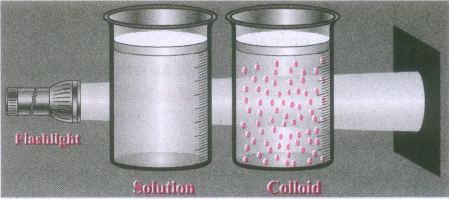
16.
(i) Colloids have optical property. When a homogeneous solution is seen in the direction of light, it appears clear but it appears dark, in a perpendicular direction.
(ii) But when light passes through colloidal solution, it is scattered in all directions.
(iii) This effect was first observed by Faraday, but investigations are made by Tyndall in detail, hence called as Tyndall effect.
17.
Various demulsification techniques are given below:
(i) Distilling of one component.
(ii) Adding an electrolyte to destroy the charge.
(iii) Destroying the emulsifier using chemical methods.
(iv) Using solvent extraction to remove one component.
(v) By freezing one of the components.
(vi) By applying centrifugal force.
(vii) Adding dehydrating agents for water in oil.
(viii) Type.
(viii) Using ultrasonic waves.
(ix) Heating at high pressures.
18.
(i) Nano materials such a metallic nano particles, metal oxides, etc., are used as catalyst in many chemical transformation. Nanocatalysts carry the advantages of both homogeneous and heterogeneous catalyses.
(ii) Like homogeneous catalysts, the nanocatalysts give 100% selective transformations and excellent yield and show extremely high activity.
(iii) Like the heterogeneous catalysts, nanocatalysts can be recovered and recycled.
19.
(i) The peptide glycyl L-glutamyl L-lyrosin is hydrolysed by an enzyme called pepsin.
(ii) The enzyme diastase hydrolyses starch into maltose
\(2\left( { C }_{ 6 }{ H }_{ 10 }{ O }_{ 5 } \right) +{ nH }_{ 2 }O\longrightarrow { nC }_{ 12 }{ H }_{ 22 }{ O }_{ 11 }\)
(iii) The yeast contains the enzyme zymase which converts glucose into ethanol.
\({ C }_{ 6 }{ H }_{ 12 }{ O }_{ 6 }\longrightarrow { 2C }_{ 2 }{ H }_{ 5 }OH+{ 2CO }_{ 2 }\)
20.
(i) In certain reactions one of the products formed acts as a catalyst to the reaction.
(ii) Initially the rate of reaction will be very slow but with the increase in time the rate of reaction increases.
(iii) Auto catalysis is observed in the following reactions.
\({ CH }_{ 3 }COO{ C }_{ 2 }{ H }_{ 5 }+{ H }_{ 2 }O\longrightarrow CH_{ 3 }COOH+{ C }_{ 2 }{ H }_{ 5 }OH\)
Acetic acid acts as the auto catalyst.
(iv) \(2As{ H }_{ 3 }\longrightarrow 2As+{ 3H }_{ 2 }\)
Arsenic acts as an autocatalyst.
21.
(i) Positive catalyst: A catalyst which enhances the speed of the reactions called positive catalyst and the phenomenon is known as positive catalysis Eg: Decomposition of KClO3 in the presence of manganese dioxide (MnO2).
Eg: Decomposition of KCIO3 in the presence of manganese dioxide (MnO2).
\(2KCl{ O }_{ 3 }\overset { Mn{ O }_{ 2 } }{ \underset { \Delta }{ \longrightarrow } } 2KCl+{ 3O }_{ 2 }\uparrow \)
(ii) Negative catalyst: A catalyst which retard (or) reduce the reaction rate is known as negative catalyst or inhibitors and the phenomenon is known as negative catalysis.
Eg: Decomposition of H2O2 decreases in the presence of glycerine.
\({ 2H }_{ 2 }{ O }_{ 2 }\overset { Glycerine }{ \longrightarrow } { 2H }_{ 2 }O+{ O }_{ 2 }\)
22.
(i) Fuller's earth and silica gel are used for refining process.
(ii) Sugar prepared from molasses is decolourised to remove coloured impurities by adding animal charcoal which acts as decolourising material.
(iii) Catalysis is an important branch of surface chemistry which is based on the phenomenon of adsorption of materials on the catalyst surface.
23.
(i) In lyophillic colloids or sols definite attractive force or affinity exists between dispersion medium and dispersed phase. Examples: sols of protein and starch. They are more stable and will not get precipitated easily.
(ii) In a lyophobic colloids, no attractive force exists between the dispersed phase and dispersion medium. They are less stable and precipitated readily, but cannot be produced again by just adding the dispersion medium.
Examples: sols of gold, silver, platinum and copper.
24.
Food:
Food stuffs like milk cream, butter, etc are present in colloidal form.
Medicines:
Antibodies such as penicillin and streptomycin are produced in colloidal form for suitable injections. Colloidal gold and colloidal calcium are used as tonics. Milk of magnesia is used for stomach troubles. Silver sol protected by gelatine known as Argyrol is used as eye lotion.
In Industry:
Colloids find many applications in industries
(i) Water purification:
Purification of drinking water is activated by coagulation of suspended impurities in water using alums containing Al3+.
(ii) In washing:
The cleansing action of soap is due to the formation of emulsion of soap molecules with dirt and grease.
(iii) Tanning of leather:
Skin and hides are protein containing positively charged particles which are coagulated by adding tannin to give hardened leather for further application. Chromium salts are used for the purpose. Chrome tanning can produce soft and polishable leather.
(iv) Rubber industry:
Latex is the emulsion of natural rubber with negative particles. By heating rubber with sulphur, vulcanized rubbers are produced for tyres, tubes, etc.
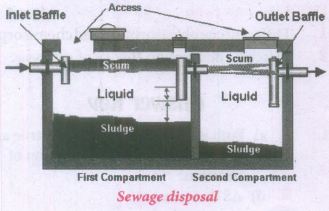
(v) Sewage disposal:
Sewage contains dirt, mud and wastes dispersed in water. The passage of electric current deposits the wastes materials which can be used as a manure.
(vi) Cortrell's precipitator:
Carbon dust in air is solidified by Cottrell's precipitator. In it, a high potential difference of about 50,000V is used. The charge on carbon is neutralized and solidified. Thus the air is free from carbon particles.
(vii) The blue colour of the sky in nature is due to Tyndall effect of air particles.
(viii) Formation of delta:
The electrolyte in sea and river water coagulates the solid particles in river water at their intersection. So, the earth becomes a fertile land.
(ix) Analytical application:
Qualitative and quantitative analysis are based on the various properties of colloids.
25.
(i) Suppose the reactant of a reaction is present in one solvent and the other reactant is present in an another solvent.
(ii) The reaction between them is very slow, if the solvents are immisible.
(iii) As the solvents from separate phases the reactants have to migrate across the boundary to react.
(iv) But migration of reactants across the boundary is not easy. For such situations a third solvent is added which is miscible with both.
(v) So, the phase boundary is eliminated reactants freely mix and react fast.
(vi) But for large scale production of any product, use of a third solvent is not convenient as it may be expensive.
(vii) For such problems phase transfer catalysis provides a simple solution, which avoides the use of solvents.
(viii) It directs the use a phase transfer catalyst (a phase transfer reagent) to facilitate transport of a reactant in one solvent to the other solvent where the second reactant is present.
(ix) As the reactants are now brought together they rapidly react and form the product.
26.
(i) Effective and efficient conversion is the special characteristic of enzyme catalysed reactions. An enzyme may transform a million molecules of reactant in a minute
For Eg: \({ 2H }_{ 2 }{ O }_{ 2 }\longrightarrow { 2H }_{ 2 }O+{ O }_{ 2 }\)
For this reaction, the activation energy is 18k cal/mole without a catalyst With colloidal platinum as a, catalyst the activation energy is 11.7kcal /mole. But with the enzyme catalyst the activation energy of this reaction is less than 2kcal/ mole.
(ii) Enzyme catalysis is highly specific in nature.
(iii) Enzyme catalysed reaction has maximum rate at optimum temperature
(iv) The rate of enzyme catalysed reactions varies with the pH of the system. The rate is maximum at a pH called optimum pH.
(v) Enzymes can be inhibited i.e. poisoned activity of an enzyme is decreased and destroyed by a poison. The physiological action of drugs is related to their inhibiting action.
(vi) Catalytic activity of enzymes is increased by coenzymes or activators.
27.
Freundlich adsorption isotherm:
According to Freundlinch
\(\frac { x }{ m } =kp^{ \frac { 1 }{ n } }\)
where x is the amount of adsorbate or adsorbed on 'm' gm of adsorbent at a pressure of p. K and n are constants Value is always less than unity.
This equation is applicable for adsorption of gases on solid surfaces. The same equation becomes \(\frac { x }{ m } =Kc^{ \frac { 1 }{ n } }\) when used for adsorption in solutions with c as concentration.
These equation quantitively predict the effect of pressure(or concentration) on the adsorption of gases(or adsorbates) at constant temperature.
Taking log on both sides of equation \(\frac { x }{ m } ={ kp }^{ \frac { 1 }{ n } }\)
\(log\frac { x }{ m } =logK+\frac { 1 }{ n } logP\)
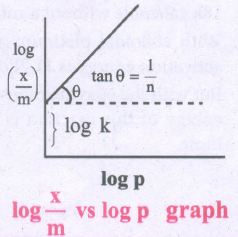
Hence the intercept represents the value of log k and the slope \(\frac { b }{ q } \) gives \(\frac { 1 }{ n } \)
This equation explains the increase of \(\frac { x }{ m } \) with increase in pressure. But experimental values show the deviation at low pressure.
28.
Factors affecting adsorption:
The adsorption is well understood by considering I the various factors affecting it. Qualitatively, the extent of surface adsorption depends on
(i) Nature of adsorbent
(ii) Nature of adsorbate
(iii) Pressure
(iv) Concentration at a given temperature.
(i) The adsorption is a surface phenomenon: it depends on the surface area of adsorbent. i.e., higher the surface area, higher is the amount adsorbed.
(ii) Nature of adsorbate:
The nature of adsorbate can influence the adsorption. Gases like SO2, NH3, HCI and CO2 are easily liquefiable as have greater vander waal's force of attraction. On the other hand, permanent gases like H2, N2 and O2 cannot be liquefied easily. These permanent gases are having low critical temperature and adsorbed slowly, while gases with high critical temperature are adsorbed readily.
(iii) Effect of temperature:
Chemical adsorption is fast with increase pressure, it cannot alter the amount. In Physisorption, when pressure increases the amount of adsorption increases.
(iv) Effect of pressure:
When pressure increases, adsorption becomes steadily increase in case of chemisorption and increases in case of physisorption.
29.
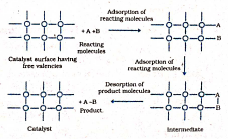
1. Langmuir explained the action of catalyst in heterogeneous catalysed reactions based on adsorption. The reactant molecules are adsorbed on the catalyst surfaces, so this can also be called as contact catalysis.
2. According to this theory, various steps involved in a heterogeneous catalyse reaction are given as follows:
(i) Reactant molecules diffuse from bulk to the catalyst surface.
(ii) The reactant molecules are adsorbed on the surface of the catalyst.
(iii) The adsorbed reactant molecules are activated and form activated complex which is decomposed to form the products.
(iv) The product molecules are desorbed.
(v) The product diffuse away from the surface of the catalyst.
30.
Active centres:
The surface of a catalyst is not smooth. It bears steps, cracks and corners. Hence the atoms on such locations of the surface are co-ordinatively unsaturated. So, they have much residual force of attraction. Such sites are called active centres. So, the surface carries high surface free energy. The presence of such active centres increases the rate of reaction (activity) by adsorbing and activating the reactants.
The adsorption theory explains the following:
(i) Increase in the activity of a catalyst by increasing the surface area. Increase in the surface area of metals and metal oxides by reducing the particle size increases the rate of the reaction.
(ii) The action of catalytic poison occurs when the poison blocks the active centres of the catalyst.
(iii) A promoter or activator increases the number of active centres on the surfaces
Selectivity:
A Catalyst can catalyse a particular type of reaction. Hence they are said to the specific (selectivity) in nature. Enzyme catalysis is highly specific in nature.
\(\mathrm{NH}_{2} \mathrm{CONH}_{2}+\mathrm{H}_{2} \mathrm{O} \stackrel{\text { Unease }}{\longrightarrow} 2 \mathrm{NH}_{3}+\mathrm{CO}_{2}\)
The enzyme urease which catalyses their reaction of Urea does not catalyse the reaction of methyl Urea.
\(\mathrm{NH}_{2} \mathrm{CONH} \mathrm{CH_3}+\mathrm{H}_{2} \mathrm{O} \stackrel{\text { Urease }}{\longrightarrow} \text { No reaction }\)
Intermediate compound formation theory explains the specificity of a catalyst.
31.
Factors affecting adsorption
Qualitatively, the extent of surface adsorption depends on
(i) Nature of adsorbent
(ii) Nature of adsorbate
(iii) Pressure
(iv) Concentration at a given temperature.
1. Surface area of adsorbent:
As the adsorption is a surface phenomenon it depends on the surface area of adsorbent. i.e., higher the surface area, higher is the amount adsorbed.
2. Nature of adsorbate:
The nature of adsorbate can influence the adsorption. Gases like SO2, NH3, HCl and CO2 are easily liquefiable as have greater vander waal's force of attraction. On the other hand, permanent gases like H2, N2 and O2 cannot be liquefied easily. These permanent gases are having low critical temperature and adsorbed slowly, while gases with high critical temperature are adsorbed readily.
3. Effect of temperature:
When temperature is raised chemisorption first increases and then decreases. whereas physisorption decreases with increases in temperature.
4. Effect of Pressure:
Chemical adsorption is fast with increase in pressure, it cannot alter the amount of adsorption. In physisorption, the extend of adsorption increases with increase in pressure.
32.
Adsorption is an exothermic process, i.e.,energy factor favours the process. As ΔG = ΔH - TΔS, in adsorption, though ΔS is -ve but ΔH is also -ve and ΔH > TΔS in magnitude so that ΔG is -ve.
Hence, the process is spontaneous.
33.
According to Freundlinch,
\(\frac { x }{ m } ={ kp }^{ \frac { 1 }{ n } }\)
where x is the amount of adsorbate or adsorbed on 'm' gm of adsorbent at a pressure of p. K and n are constants.
34.
(i) Colloidal solutions in which the dispersed phase has considerable affinity for the dispersion medium are called lyophilic (solvent loving) colloids.
(ii) Gelatin, protein and starch are examples of this type.
35.
The two types of catalysis are
(i) Homogeneous
(ii) Heterogeneous catalysis.
36.
TiCl4 + (C2H5)3AI.
37.
The colloidal solutions due to their different methods of preparation may contain impurities. If they are not removed, they may destablise and precipitate the colloidal solution.
38.
Intermediate compound formation theory:
(i) the specificity of a catalyst and
(ii) the increase in the rate of the reaction with increase in the concentration of a catalyst
39.
40.
A plot between the amount of adsorbate adsorbed and pressure or concentration of adsorbate at constant temperature is called adsorption isotherms.
41.
(i) In adsorption, if the concentration of a substance in the interface is high, then it is called positive adsorption.
(ii) In adsorption, if the concentration of a substance in the interface is less, then it is called negative adsorption.
42.
(a) The product or the unreacted reactant has to be removed from the surface of the catalyst. Desorption helps this.
(b) It makes the catalyst free for the next reaction (ie) adsorption of new reactants.

12th Standard Syllabus & Materials
12th Standard
TN 12th Computer Applications களப்பெயர் முறைமை (DNS) Sample Question Papers Study Material - QB365 Set A
NEW12th Standard
TN 12th Computer Applications வலையமைப்பு எடுத்துக்காட்டுகள் மற்றும் நெறிமுறைகள் Sample Question Papers Study Material - QB365 Set A
NEW12th Standard
TN 12th Computer Applications கணினி வலையமைப்பு ஓர் அறிமுகம் Sample Question Papers Study Material - QB365 Set A
NEW12th Standard
TN 12th Computer Applications PHP-உடன் MySQL-ஐ இணைத்தல் Sample Question Papers Study Material - QB365 Set A



Tamilnadu Stateboard 12th Standard Subjects

Maths
Chemistry

Physics

Biology

Computer Science

Business Maths and Statistics

Economics

Commerce

Accountancy

History

Computer Applications
Biology
Computer Technology
Computer Applications
Computer Science
Business Maths and Statistics
Commerce
Economics
Maths
Chemistry
Physics
Computer Technology
History
Accountancy

Tamil

English

French
Tamilnadu Stateboard Standards
