
 100% FREE ACCESS
12th Standard Syllabus & Materials
12th Standard
TN 12th Maths Applications of Matrices and Determinants Sample Question Papers Study Material - QB365 Set A
NEW12th Standard
TN 12th Computer Applications மின்னணு தரவு பரிமாற்றம் Sample Question Papers Study Material - QB365 Set A
NEW12th Standard
TN 12th Computer Applications மின் - வணிக பாதுகாப்பு அமைப்புகள் Sample Question Papers Study Material - QB365 Set A
NEW12th Standard
TN 12th Computer Applications மின்னணு செலுத்தல் முறைகள் Sample Question Papers Study Material - QB365 Set A
NEW12th Standard
TN 12th Computer Applications மின் - வணிகம் Sample Question Papers Study Material - QB365 Set A
NEW12th Standard
TN 12th Computer Applications திறந்த மூல கருத்துருக்கள் Sample Question Papers Study Material - QB365 Set A

Published on: 29/01/2021
12th Standard Chemistry English Medium Surface Chemistry Reduced Syllabus Important Questions With Answer Key 2021
Download Tamil Nadu 12th Standard Chemistry question papers, model tests, one-mark questions, important questions, and public exam papers in PDF format. Free study materials and answer keys for TN State Board students.
Questions + Answers key
Take MCQ Chemistry Test
1.
Argyrol is_______.
colloidal silver
colloidal antimony
colloidal gold
milk of magnesia
2.
Emulsifying agent is used for________.
precipitation of an emulsion
coagulation of an emulsion
stabilization of an emulsion
none of these
3.
The platinum catalyst used in the oxidation of SO2 by contact process is poisoned by _______.
As2O3
V2O5
Fe2O3
CuCl2
4.
In auto catalysis _________ acts as catalyst.
reactant
production
both
none
5.
When the surface area of the adsorbent increases, adsorption________.
increases
decreases
remains constant
first decreases and then increases
6.
Brownian movement of colloidal particles is a ______ property.
Kinetic
Electrical
Optical
Magnetic
7.
Pick out the dispersion method of preparation of colloids.
oxidation
change of physical state
reduction
peptisation
8.
When the operation force between the absorbent and adsorbate is weak Vander waal's force, then it is called _______.
physical adsorption
chemical adsorption
Vander waal's adsorption
both (a) and (c)
9.
Colloids are purified by _______.
precipitation
coagulation
dialysis
filtration
10.
Which among the following reactions is an example of auto catalysis?
i) CH3COOC2H5+H2O➝ CH3COOH+C2H5OH
ii) 2H2O➝2H2O+O2
iii) 2SO2+O2➝2SO3
iv) 2AsH3➝2As+3H2
only (i)
(i) and (ii)
(i) and (ii)
(i) and (iv)
11.
Pick the odd one out.
dialysis
electro dialysis
electrophoresis
ultrafiltration
12.
Which among the following does not affect adsorption?
surface area of the adsorbent
catalyst
temperature
pressure
13.
On which of the following properties does the coagulating power of an ion depend?
Both magnitude and sign of the charge on the ion.
Size of the ion alone
the magnitude of the charge on the ion alone
the sign of charge on the ion alone.
14.
Match the following
| a | V2O5 | i | High density polyethylene |
| b | Ziegler – Natta | ii | PAN |
| c | Peroxide | iii | NH3 |
| d | Finely divided Fe | iv | H2SO4 |
| A | B | C | D |
| iv | i | ii | iii |
| A | B | C | D |
| i | ii | iv | iii |
| A | B | C | D |
| ii | iii | iv | i |
| A | B | C | D |
| iii | iv | ii | i |
15.
Which one of the following is an example for homogeneous catalysis?
manufacture of ammonia by Haber’s process
manufacture of sulphuric acid by contact process
hydrogenation of oil
Hydrolysis of sucrose in presence of all HCl
16.
Why the sun looks red at the time of setting? Explain on the basis of colloidal properties.
17.
Adsorption of a gas on the surface of solid is generally accompanied by decrease in entropy. Still it is a spontaneous process. Explain.
18.
Which will adsorb more gas, a lump of charcoal or its powder and why?
19.
Explain the kinetic property of colloids.
20.
What are the two types of catalysis?
21.
Write a note on dialysis.
22.
What is ultrasonic dispersion?
23.
24.
Define adsorption isotherm.
25.
What happens when a colloidal sol of Fe(OH)3 and As2S3 are mixed?
26.
Which will be adsorbed more readily on the surface of charcoal and why? NH3 or CO2?
27.
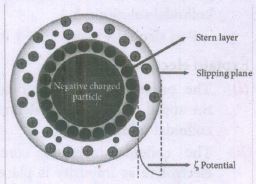
Explain the electrical property of colloids with a neat diagram. (or) Write a note on Helmholta electrical double layer.
28.
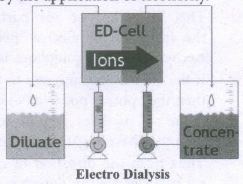
Explain electrodialysis
29.
Write a note on phase transfer catalysis.
30.
Give the special characteristics of enzyme catalysed reactions.
31.
Write a note on Freundlich adsorption isotherm.
32.
Explain the factors affecting adsorption.
33.
Describe adsorption theory of catalysis
34.
What are the factors which influence the adsorption of a gas on a solid?
35.
Explain the meaning of the statement. 'Adsorption is a surface phenomenon'.
36.
For the coagulation of 100 ml of arsenious sulphide sol, 5 ml of 1 M NaCI is required. What is the flocculation value of NaCl?
37.
Write the optical properties of colloids with diagram.
38.
What are the tests used to identify the type of emulsion?
39.
What are the advantages of Brownian movement?
40.
Write a note on Ultrafilteration?
41.
What are the important concepts of catalysis that adsorption theory explains?
42.
Give any three application of adsorption.
1.
(a)
colloidal silver
2.
(c)
stabilization of an emulsion
3.
(a)
As2O3
4.
(b)
production
5.
(a)
increases
6.
(a)
Kinetic
7.
(d)
peptisation
8.
(d)
both (a) and (c)
9.
(c)
dialysis
10.
(d)
(i) and (iv)
11.
(c)
electrophoresis
12.
(b)
catalyst
13.
(a)
Both magnitude and sign of the charge on the ion.
14.
(a)
| A | B | C | D |
| iv | i | ii | iii |
15.
(d)
Hydrolysis of sucrose in presence of all HCl
16.
At the time of setting, the sun is at the horizon The light emitted by the sun has to travel a longer distance through the atmosphere. As a result, blue part of the light is scattered away by the dust particles in the atmosphere. Hence, the red part is visible.
17.
Adsorption is an exothermic process, i.e.,energy factor favours the process. As ΔG = ΔH - TΔS, in adsorption, though ΔS is -ve but ΔH is also -ve and ΔH > TΔS in magnitude so that ΔG is -ve.
Hence, the process is spontaneous.
18.
Powdered charcoal will adsorb more gas because of its larger surface area than a lump of charcoal.
19.
The continuous rapid, zig-zag, chaotic, random I and ceaseless movement executed by a colloidal particle in the dispersion medium is called Brownian movement of colloidal particles.
20.
The two types of catalysis are
(i) Homogeneous
(ii) Heterogeneous catalysis.
21.
(i) In this method, the colloidal solution is taken in a bag made up of semipermeable membrane.
(ii) It is suspended in a trough of flowing water, the electrolytes diffuse out of the membrane and they are carried away by II water.
22.
Sound waves of frequency more than 20kHz (audible limit) could cause transformation of course suspension to colloidal dimensions.
23.
24.
A plot between the amount of adsorbate adsorbed and pressure or concentration of adsorbate at constant temperature is called adsorption isotherms.
25.
(i) Neutralisation of chargers of ion will taken place and hence precipitation will take place (ie) Fe3+ and S2- ion changes are neutralized. No new compounds are formed.
(ii) Fe(OH)3 is a positive Sol
(iii) As2S3 is a negative Sol
26.
The critical temperature of NH3 is 406 K and that of CO2 is 304 K. So, NH3 has higher critical temperature and greater VanderWaal's forces of attraction than CO2. So NH3 will be more adsorbed than CO2.
27.
Helmholtz double layer:
(i) The surface of colloidal particle adsorbs one type of ion due to preferential adsorption.
(ii) This layer attracts the oppositely charged < ions in the medium and hence at the boundary separating the two electrical double layers are setup.
(iii) This is called as Helmholtz electrical double layer.
(iv) As the particies nearby are having similar: charges, they cannot come close and condense.
28.
(i) The presence of electric field increases the speed of removal of electrolytes from colloidal solution.
(ii) The colloidal solution containing an electrolyte as impurity is placed between two dialysing membranes enclosed into two compartments filled with water.
(iii) When current is passed, the impurities pass into water compartment and get removed periodically.
(iv) This process is faster then dialysis, as the rate of diffusion of electrolytes is increased by the application of electricity.
29.
(i) Suppose the reactant of a reaction is present in one solvent and the other reactant is present in an another solvent.
(ii) The reaction between them is very slow, if the solvents are immisible.
(iii) As the solvents from separate phases the reactants have to migrate across the boundary to react.
(iv) But migration of reactants across the boundary is not easy. For such situations a third solvent is added which is miscible with both.
(v) So, the phase boundary is eliminated reactants freely mix and react fast.
(vi) But for large scale production of any product, use of a third solvent is not convenient as it may be expensive.
(vii) For such problems phase transfer catalysis provides a simple solution, which avoides the use of solvents.
(viii) It directs the use a phase transfer catalyst (a phase transfer reagent) to facilitate transport of a reactant in one solvent to the other solvent where the second reactant is present.
(ix) As the reactants are now brought together they rapidly react and form the product.
30.
(i) Effective and efficient conversion is the special characteristic of enzyme catalysed reactions. An enzyme may transform a million molecules of reactant in a minute
For Eg: \({ 2H }_{ 2 }{ O }_{ 2 }\longrightarrow { 2H }_{ 2 }O+{ O }_{ 2 }\)
For this reaction, the activation energy is 18k cal/mole without a catalyst With colloidal platinum as a, catalyst the activation energy is 11.7kcal /mole. But with the enzyme catalyst the activation energy of this reaction is less than 2kcal/ mole.
(ii) Enzyme catalysis is highly specific in nature.
(iii) Enzyme catalysed reaction has maximum rate at optimum temperature
(iv) The rate of enzyme catalysed reactions varies with the pH of the system. The rate is maximum at a pH called optimum pH.
(v) Enzymes can be inhibited i.e. poisoned activity of an enzyme is decreased and destroyed by a poison. The physiological action of drugs is related to their inhibiting action.
(vi) Catalytic activity of enzymes is increased by coenzymes or activators.
31.
Freundlich adsorption isotherm:
According to Freundlinch
\(\frac { x }{ m } =kp^{ \frac { 1 }{ n } }\)
where x is the amount of adsorbate or adsorbed on 'm' gm of adsorbent at a pressure of p. K and n are constants Value is always less than unity.
This equation is applicable for adsorption of gases on solid surfaces. The same equation becomes \(\frac { x }{ m } =Kc^{ \frac { 1 }{ n } }\) when used for adsorption in solutions with c as concentration.
These equation quantitively predict the effect of pressure(or concentration) on the adsorption of gases(or adsorbates) at constant temperature.
Taking log on both sides of equation \(\frac { x }{ m } ={ kp }^{ \frac { 1 }{ n } }\)
\(log\frac { x }{ m } =logK+\frac { 1 }{ n } logP\)
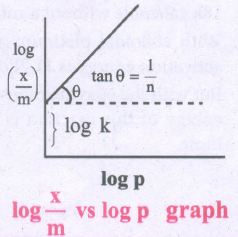
Hence the intercept represents the value of log k and the slope \(\frac { b }{ q } \) gives \(\frac { 1 }{ n } \)
This equation explains the increase of \(\frac { x }{ m } \) with increase in pressure. But experimental values show the deviation at low pressure.
32.
Factors affecting adsorption:
The adsorption is well understood by considering I the various factors affecting it. Qualitatively, the extent of surface adsorption depends on
(i) Nature of adsorbent
(ii) Nature of adsorbate
(iii) Pressure
(iv) Concentration at a given temperature.
(i) The adsorption is a surface phenomenon: it depends on the surface area of adsorbent. i.e., higher the surface area, higher is the amount adsorbed.
(ii) Nature of adsorbate:
The nature of adsorbate can influence the adsorption. Gases like SO2, NH3, HCI and CO2 are easily liquefiable as have greater vander waal's force of attraction. On the other hand, permanent gases like H2, N2 and O2 cannot be liquefied easily. These permanent gases are having low critical temperature and adsorbed slowly, while gases with high critical temperature are adsorbed readily.
(iii) Effect of temperature:
Chemical adsorption is fast with increase pressure, it cannot alter the amount. In Physisorption, when pressure increases the amount of adsorption increases.
(iv) Effect of pressure:
When pressure increases, adsorption becomes steadily increase in case of chemisorption and increases in case of physisorption.
33.
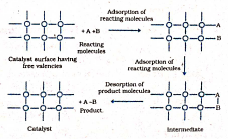
1. Langmuir explained the action of catalyst in heterogeneous catalysed reactions based on adsorption. The reactant molecules are adsorbed on the catalyst surfaces, so this can also be called as contact catalysis.
2. According to this theory, various steps involved in a heterogeneous catalyse reaction are given as follows:
(i) Reactant molecules diffuse from bulk to the catalyst surface.
(ii) The reactant molecules are adsorbed on the surface of the catalyst.
(iii) The adsorbed reactant molecules are activated and form activated complex which is decomposed to form the products.
(iv) The product molecules are desorbed.
(v) The product diffuse away from the surface of the catalyst.
34.
Factors affecting adsorption
Qualitatively, the extent of surface adsorption depends on
(i) Nature of adsorbent
(ii) Nature of adsorbate
(iii) Pressure
(iv) Concentration at a given temperature.
1. Surface area of adsorbent:
As the adsorption is a surface phenomenon it depends on the surface area of adsorbent. i.e., higher the surface area, higher is the amount adsorbed.
2. Nature of adsorbate:
The nature of adsorbate can influence the adsorption. Gases like SO2, NH3, HCl and CO2 are easily liquefiable as have greater vander waal's force of attraction. On the other hand, permanent gases like H2, N2 and O2 cannot be liquefied easily. These permanent gases are having low critical temperature and adsorbed slowly, while gases with high critical temperature are adsorbed readily.
3. Effect of temperature:
When temperature is raised chemisorption first increases and then decreases. whereas physisorption decreases with increases in temperature.
4. Effect of Pressure:
Chemical adsorption is fast with increase in pressure, it cannot alter the amount of adsorption. In physisorption, the extend of adsorption increases with increase in pressure.
35.
When a solid adsorbent is placed in a closed vessel containing some gas or a solution. The molecules of the gas or the solute are adsorbed on the surface so that their concentration or higher on the surface. Hence, it is called a surface phenomenon.
36.
5 ml of 1M NaCI contains NaCI = \(\frac { 1 }{ 1000 } \times \text { 5 moles = 5 millions}\)
Thus, 100 ml of As2S3 sol require NaCI for complete coagulation = 5 millimoles
ஃ l L, i.e., 1000 ml of the sol require NaCI for complete coagulation = 50 millimoles
ஃ By definition, flocculation value of NaCl = 50.
37.
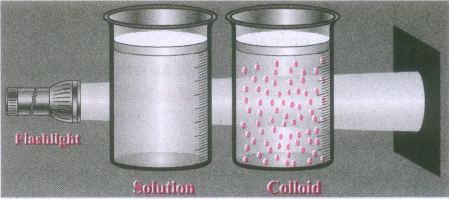
(i) Colloids have optical property. When a homogeneous solution is seen in the direction of light, it appears clear but it appears dark, in a perpendicular direction.
(ii) But when light passes through colloidal solution, it is scattered in all directions.
(iii) This effect was first observed by Faraday, but investigations are made by Tyndall in detail, hence called as Tyndall effect.
38.
(i) Dye test:
A small amount of dye soluble in oil is added to the emulsion. The emulsion is shaken well. The aqueous emulsion will not take the colour whereas oily emulsion will take up the colour of the dye.
(ii) Viscosity test:
Viscosity of the emulsion is determined by experiments. Oily emulsions will have higher value than aqueous emulsion.
(iii) Conductivity test:
Conductivity of aqueous emulsions are always higher than oily emulsions.
(iv) Spreading test:
Oily emulsions spread readily than aqueous emulsion when spread on an oily surface.
39.
Brownian movement enables us,
(i) to calculate Avogadro number.
(ii) to confirm kinetic theory which considers the ceaseless rapid movement of molecules that increases with increase in temperature.
(iii) to understand the stability of colloids: As the particles are in continuous rapid movement they do not come close and hence not get condensed.
(iv) That is Brownian movement does not allow the particles to be acted on by force of gravity.
40.
(i) The pores of ordinary filter papers permit the passage of colloidal solutions.
(ii) In ultra filtrations, the membranes are made by using collodion cellophane or visiking.
(iii) When a colloidal solution is filtered using such a filter, colloidal particles are separated on the filter and the impurities are removed as washings.
(iv) This process is quickened by application of pressure.
(v) The separation of sol particles from electrolyte by filteration through an ultrafilter is called ultrafiltration.
41.
The adsorption theory explains the following
(i) Increase in the activity of a catalyst by increasing the surface area. Increase in the surface area of metals and metal oxides by reducing the particle size increases the rate of the reaction.
(ii) The action of catalytic poison occurs when the poison blocks the active centres of the catalyst.
(iii) A promoter or activator increases the number of active centres on the surfaces.
42.
(i) Fuller's earth and silica gel are used for refining process.
(ii) Sugar prepared from molasses is decolourised to remove coloured impurities by adding animal charcoal which acts as decolourising material.
(iii) Catalysis is an important branch of surface chemistry which is based on the phenomenon of adsorption of materials on the catalyst surface.

12th Standard Syllabus & Materials
12th Standard
TN 12th Computer Applications வலையமைப்பு வடமிடல் Sample Question Papers Study Material - QB365 Set A
NEW12th Standard
TN 12th Computer Applications களப்பெயர் முறைமை (DNS) Sample Question Papers Study Material - QB365 Set A
NEW12th Standard
TN 12th Computer Applications வலையமைப்பு எடுத்துக்காட்டுகள் மற்றும் நெறிமுறைகள் Sample Question Papers Study Material - QB365 Set A
NEW12th Standard
TN 12th Computer Applications கணினி வலையமைப்பு ஓர் அறிமுகம் Sample Question Papers Study Material - QB365 Set A



Tamilnadu Stateboard 12th Standard Subjects

Maths
Chemistry

Physics

Biology

Computer Science

Business Maths and Statistics

Economics

Commerce

Accountancy

History

Computer Applications
Biology
Computer Technology
Computer Applications
Computer Science
Business Maths and Statistics
Commerce
Economics
Maths
Chemistry
Physics
Computer Technology
History
Accountancy

Tamil

English

French
Tamilnadu Stateboard Standards
