
 100% FREE ACCESS
12th Standard Syllabus & Materials
12th Standard
TN 12th Computer Applications மின்னணு தரவு பரிமாற்றம் Sample Question Papers Study Material - QB365 Set A
NEW12th Standard
TN 12th Computer Applications மின் - வணிக பாதுகாப்பு அமைப்புகள் Sample Question Papers Study Material - QB365 Set A
NEW12th Standard
TN 12th Computer Applications மின்னணு செலுத்தல் முறைகள் Sample Question Papers Study Material - QB365 Set A
NEW12th Standard
TN 12th Computer Applications மின் - வணிகம் Sample Question Papers Study Material - QB365 Set A
NEW12th Standard
TN 12th Computer Applications திறந்த மூல கருத்துருக்கள் Sample Question Papers Study Material - QB365 Set A
NEW12th Standard
TN 12th Computer Applications வலையமைப்பு வடமிடல் Sample Question Papers Study Material - QB365 Set A

Published on: 01/09/2022
QB365 provides a detailed and simple solution for every Possible Creative Questions in Class 12 Chemistry Subject - Transition and Inner Transition Elements, English Medium. It will help Students to get more practice questions, Students can Practice these question papers in addition to score best marks.
Download Tamil Nadu 12th Standard Chemistry question papers, model tests, one-mark questions, important questions, and public exam papers in PDF format. Free study materials and answer keys for TN State Board students.
Questions + Answers key
Take MCQ Chemistry Test
1.
Write the properties of interstitial compound.
2.
Complete the following reactions?
i) Cr2 + 2e- ⟶
ii) Mn2+ + 2e- ⟶
iii) Fe2+ + 2e- ⟶
iv) CO2+ + 2e- ⟶
3.
What are redox reactions?
4.
Why are Ni(lI) compounds thermodynamically more stable than Pt(II) compounds?
5.
Give reason for the following:
(i) A transition metal exhibits highest oxidation state in oxides and fluorides.
(ii) Cu2+ is unstable in an aqueous solution.
6.
(i) Name the transition metal
(a) Which is used in the manufacture of sulphuric add.
(b) That is used in Haber's process.
(c) That have light sensitive properties and act as valuable source in photo graphic industry.
(ii) Write the equations which are involved in the oxidation of hydrogen sulphide to sulphur by KMnO4 solution.
7.
Give reason for the following:
(i) Compounds of transition elements are generally coloured,
(ii) MnO is basic while Mn2O7 is acidic.
(iii) Calculate the magnetic moment of a divalent ion in aqueous medium if its atomic number is 26.
8.
Account for the following:
(i) Cobalt (II) is stable in aqueous solution but in the presence of complexing reagents, it is easily oxidised.
(ii) The d1 configuration is very unstable in ions.
9.
Give reasons for the following
(i) Mn3+ is a good oxidising agent.
10.
Explain why oxidation states of transition elements increases first from Sc to Mn and then decrease?
11.
What are the general properties of f-block elements? (Lanthanides and Actinides)
(i) Electronic configuration
(ii) Oxidation state
(iii) Radii of tripositive ions.
12.
Complete the following equations.
(i) Cr2O72- + 2OH- ⟶
(ii) MnO4- + 4H+ + 3e- ⟶
13.
Discuss the general characteristic of the 3d series of the transition elements with special reference to their
(i) Atomic size
(ii) Enthalpies of atomisation
14.
Write chemical equations for the reactions involved in the manufacture of potassium permanganate from pyrolusite ore.
15.
What is meant by lanthanoid contraction?
1.
(i) They are hard and show electrical land thermal conductivity.
(ii) They have high melting points higher than those of pure metals.
(iii) Transition metal hydrides are used as powerful reducing agents.
(iv) Metallic carbides are chemically inert
2.
i) Cr2 + 2e- ⟶ Cr
ii) Mn2+ + 2e- ⟶ Mn
iii) Fe2+ + 2e- ⟶ Fe
iv) CO2+ + 2e- ⟶ Co
3.
(i) Redox reactions involve transfer of electrons from one reactant to another. Such reactions are always coupled, which means that when one substance is oxidised, another must be reduced.
(ii) The substance which is oxidised is a reducing agent and the one which is reduced is an oxidizing agent
4.
(i) The ionisation enthalpy values can be used to predict the thermodynamic stability of their compounds.
(ii) Let us compare the ionisation energy required to form Ni2+and Pt2+ ions.
(iii) For Nickel, IE1 + IE2 = (737 + 1753) 2490 kJmol-1
(iv) For Platinum, IE1 + IE2 = (864 + 1791) = 2655 kJmol-1
(v) Since, the energy required to form Ni2+ is less than that of Pt2+, Ni(II) compounds are thermodynamically more stable than Pt(II) compounds.
5.
(i) The highest oxidation state in oxides and fluorides is due to small size and high electro negativity of F and O.
(ii) Many Cu+ compounds are unstable in aqueous solution and undergo disproportionation.
2Cu+ ⟶ Cu2++ Cu
This suggest that in aqueous solution Cu+(aq), converts into Cu2+(aq) which is due to much more negative Δhyd H- of Cu2+(aq) than Cu+, which compensates more for the second ionisation enthalpy of Cu.
6.
(i) (a) Vanadium
(b) Iron
(c) Silver
(ii) H2S ⟶ 2H++ S2-
[MnO4- + 8H+ + 5e- ⟶ Mn2+ + 4H2O] x 2
[S2- ⟶ S + 2e-] x 5
______________________________________
2MnO4- + 5S2- + 16H+⟶ 2Mn2+ + 5S + 8H2O
_______________________________________
7.
(i) The colour of the transition elements is due to the d-d transition.
(ii) Since the oxidation state and polarising power of Mn in Mn2O7 is higher, it is acidic in nature
(iii) μ = \(\sqrt{n(n+2)}=\sqrt{4(4+2)}\)
= 4.90 BM
8.
(i) Cobalt (III) ion has greater tendency to form complexes than cobalt (II) ion. Therefore, Co (II) ion being stable in aqueous solution, changes to Co (III) ion in the presence of complexing reagents and get oxidised.
(ii) Ions of transition metals with d1 configuration tend to lose one electron to acquire d0 configuration that is quite stable. Therefore, such ions (with d1) undergo either oxidation or disproportionation, hence unstable.
9.
(i) Mn3+/Mn2+ has large positive Eo value. Hence, Mn3+ can be easily reduced to Mn2+ because Mn2+ has half-filled electronic, configuration, so it is stable and Mn3+ is least stable. It is a good oxidising agent.
10.
(i) The use of 3d electron for formation of I bond increases from Sc to Mn, causing the increase in oxidation state upto +7.
(ii) The reason for Mn having highest oxidation state of +7 is due to the presence of 7 unpaired electrons in its atom.
(iii) As the number of unpaired electrons decrease from Fe to Cu. So there is the decrease in oxidation state.
11.
| Properties | Lanthanides | Actinides |
|---|---|---|
| Electronic configuration | [54Xe]4f1-14 5d16s2 | [Rn] 5f0,1-14 6d0,1-27s2 |
| Oxidation state | Common: +3 Uncommon: +2, +4 |
Common: +4 Uncommon: +2, +3, +5, +6 |
| Radii | M3+gradually decrease in size on moving from La to Lu Lanthanide contraction | M3+ and M4+ ions decrease in size on moving from Ac to Lr. Actinide contraction. |
12.
(i) Cr2O72- + 2OH- ⟶ 2CrO42- + H2O
(ii) MnO4- + 4H+ + 3e- ⟶ MnO2 + 2H2O
13.
(i) Atomic size : The atomic size in 3d transition series decrease from Sc to Mn and then Fe, CO, Ni have almost same atomic size while copper has bigger size. It is because number of unpaired electrons in d- orbitals increase in the beginning till Mn. Therefore effective nuclear charge increases hence atomic size decreases then pairing of electrons in d- orbitals takes place, so the atomic size remains the same and finally it increases due to repulsion between paired electrons in d- orbitals which leads to decrease in effective nuclear charge.
(ii) They have high enthalpy of atomisation due to strong metallic bonds and additional covalent bonding due to the presence of unpaired electrons in d- orbitals.
14.
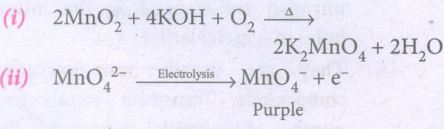
15.
The steady decrease in the atomic/ionic radius from La3+ to Lu3+ is called lanthanoid contraction.

12th Standard Syllabus & Materials
12th Standard
TN 12th Computer Applications களப்பெயர் முறைமை (DNS) Sample Question Papers Study Material - QB365 Set A
NEW12th Standard
TN 12th Computer Applications வலையமைப்பு எடுத்துக்காட்டுகள் மற்றும் நெறிமுறைகள் Sample Question Papers Study Material - QB365 Set A
NEW12th Standard
TN 12th Computer Applications கணினி வலையமைப்பு ஓர் அறிமுகம் Sample Question Papers Study Material - QB365 Set A
NEW12th Standard
TN 12th Computer Applications PHP-உடன் MySQL-ஐ இணைத்தல் Sample Question Papers Study Material - QB365 Set A



Tamilnadu Stateboard 12th Standard Subjects

Maths
Chemistry

Physics

Biology

Computer Science

Business Maths and Statistics

Economics

Commerce

Accountancy

History

Computer Applications
Biology
Computer Technology
Computer Applications
Computer Science
Business Maths and Statistics
Commerce
Economics
Maths
Chemistry
Physics
Computer Technology
History
Accountancy

Tamil

English

French
Tamilnadu Stateboard Standards
