
 100% FREE ACCESS
12th Standard Syllabus & Materials
12th Standard
TN 12th Computer Applications மின்னணு தரவு பரிமாற்றம் Sample Question Papers Study Material - QB365 Set A
NEW12th Standard
TN 12th Computer Applications மின் - வணிக பாதுகாப்பு அமைப்புகள் Sample Question Papers Study Material - QB365 Set A
NEW12th Standard
TN 12th Computer Applications மின்னணு செலுத்தல் முறைகள் Sample Question Papers Study Material - QB365 Set A
NEW12th Standard
TN 12th Computer Applications மின் - வணிகம் Sample Question Papers Study Material - QB365 Set A
NEW12th Standard
TN 12th Computer Applications திறந்த மூல கருத்துருக்கள் Sample Question Papers Study Material - QB365 Set A
NEW12th Standard
TN 12th Computer Applications வலையமைப்பு வடமிடல் Sample Question Papers Study Material - QB365 Set A

Published on: 28/01/2021
12th Standard Chemistry English Medium Transition and inner transition Elements Reduced Syllabus Important Questions 2021
Download Tamil Nadu 12th Standard Chemistry question papers, model tests, one-mark questions, important questions, and public exam papers in PDF format. Free study materials and answer keys for TN State Board students.
Questions + Answers key
Take MCQ Chemistry Test
1.
A mixture of TiCl4 and trialkyl aluminium is _________
hydroformylation of obfine
Zeigler - Natta Catalyst
interstitial compounds
ferromagnetic
2.
Except ________ all element from Rf to Cn, are synthetically prepared and have very low half life periods.
cadmium
actinium
yttrium
cadmium
3.
Which of the following statement is correct for 3d-transition element?
All metals except Zn and Sc form 'MO' Oxide
All metals except Sc forms 'MO' Oxide
All metals except Zn forms 'MO' Oxide
All metals except Mn forms 'MO' Oxide
4.
Which one of the following exhibits highest oxidation state?
Ni
Mn
V
Zr
5.
Hybridisation of chromium ions and dichromate ions is ________.
Sp2
Sp3d
both (a) and (b)
None of these
6.
Which of the following lanthanoid ions is diamagnetic?
Eu2+
Yb2+
Ce2+
Sm2+
7.
Which one of the following statements related to lanthanons is incorrect?
Europium shows +2 oxidation state
The basicity decreases as the ionic radius decreases from Pr to Lu.
All the lanthanons are much more reactive than aluminium
Ce4+ solutions are widely used as oxidising agents in volumetric analysis.
8.
Permanganate ion changes to ________ in acidic medium.
MnO42−
Mn2+
Mn3+
MnO2
9.
Which of the following statements is not true?
on passing H2S, through acidified K2Cr2O7 solution, a milky colour is observed
Na2Cr2O7 is preferred over K2Cr2O7 in volumetric analysis
K2Cr2O7 solution in acidic medium is orange in colour
K2Cr2O7 solution becomes yellow on increasing the PH beyond 7
10.
Which of the following does not give oxygen on heating?
K2Cr2O7
(NH4)2Cr2O7
KClO3
Zn(ClO3)2
11.
The alloy of copper that contain Zinc is________.
Monel metal
Bronze
bell metal
brass
12.
The correct order of increasing oxidizing power in the series _______.
VO2+ < Cr2O72- < MnO4-
Cr2O72- < VO2+ < MnO4-
Cr2O72- < MnO4- < VO2+
MnO4- < Cr2O72- < VO2+
13.
The catalytic behaviour of transition metals and their compounds is ascribed mainly due to _______.
their magnetic behaviour
their unfilled d orbitals
their ability to adopt variable oxidation states
their chemical reactivity
14.
Which of the following d block element has half filled penultimate d sub shell as well as half filled valence sub shell?
Cr
Pd
Pt
none of these
15.
Sc (Z = 21) is a transition element but Zinc (z = 30) is not because _______.
both Sc3+ and Zn2+ ions are colourless and form white compounds
In case of Sc, 3d orbital are partially filled but in Zn these are completely filled
last electron as assumed to be added to 4s level in case of zinc
both Sc and Zn do not exhibit variable oxidation states
16.
Which is the last element in the series of the actinoids? Write the electronic configuration of this element comment on the possible oxidation state of this element.
17.
Why Hcl and HNO3 cannot be used for making the KMnO4 medium acidic?
18.
Explain the oxidising property of KMnO4 in natural medium. Give the equations.
19.
Explain the preparation of potassium permanganate from pyrolusite.
20.
What is chromyl chloride test? Give equations.
21.
Write the properties of interstitial compound.
22.
Complete the following reactions?
i) Cr2 + 2e- ⟶
ii) Mn2+ + 2e- ⟶
iii) Fe2+ + 2e- ⟶
iv) CO2+ + 2e- ⟶
23.
Give reason for the following:
(i) A transition metal exhibits highest oxidation state in oxides and fluorides.
(ii) Cu2+ is unstable in an aqueous solution.
24.
Account for the following:
(i) Cobalt (II) is stable in aqueous solution but in the presence of complexing reagents, it is easily oxidised.
(ii) The d1 configuration is very unstable in ions.
25.
Complete the following equations.
(i) Cr2O72- + 2OH- ⟶
(ii) MnO4- + 4H+ + 3e- ⟶
26.
Which is stronger reducing agent Cr2+ or Fe2+?
27.
Out of Lu(OH)3 and La(OH)3 which is more basic and why?
28.
Justify the position of lanthanoids and actinoids in the periodic table.
29.
What are transition metals? Give four examples.
30.
What are the conditions for alloy formation?
31.
What is an alloy? Give an example.
32.
Arrange the following in increasing order of acidic character?
CrO3, CrO, Cr2O3
33.
Calculate the magnetic moment of Fe3+ ion (Atomic no. of Fe = 26)
34.
Which is the most common oxidation state of lanthanides?
35.
What are coinage metals?
36.
Transition metals show high melting points. Why?
37.
Complete the following.
a. 3MnO42- + 4H+ ⟶?
b. C6H5CH3 \(\overset { acidified }{ \underset { KMnO_{ 4 } }{ \longrightarrow } } \)?
c. MnO4- + Fe2+ ⟶?
d. KMnO4 \(\overset { \triangle }{ \underset { Red\ hot }{ \longrightarrow } } \) ?
e. Cr2O72- + 6I- + 14H+ ⟶?
f. Na2Cr2O7 + 2KCl ⟶?
38.
Why Gd3+ is colourless?
39.
Complete the following reactions
(i) Cr2O72- ⟶
(ii) Cr2O72- + 6I-+ 14H+ ⟶
(iii) Cr2O72-+ 3S2-+ 14H+ ⟶
(iv) Cr2O72- + 3SO2 + 2H+ ⟶
(v) Cr2O72- + 3Sn2+ + 14H+ ⟶
(vi) K2Cr2O7 + 8H2SO4 + 3CH3CH2OH ⟶
(vii) 2MnO4- + 5(COO)2- + 6H+ ⟶
(viii) 2MnO4- + 10I- + 16H+ ⟶
(ix) 2MnO4- + 5S2-+ 16H+ ⟶
(x) 2MnO4- + 5NO2- + 6H+ ⟶
(xi) 2KMnO4 + 3H2SO4 + 5CH3CH2OH ⟶
(xii) 2MnO4- + 5SO32- + 6H+ ⟶
40.
How are materials classified based on their magnetic properties?
41.
Why is there a variation of atomic and ionic size as we move from Sc to Zn?
42.
Justify the following statement.
"Elements of the first transition series possess many properties different from those of heavier transition elements".
1.
(b)
Zeigler - Natta Catalyst
2.
(b)
actinium
3.
(b)
All metals except Sc forms 'MO' Oxide
4.
(b)
Mn
5.
(b)
Sp3d
6.
Yb2+ - 4f14 - no unpaired electrons - diamagnetic
7.
As we move from La to Lu, their metallic behaviour because almost similar to that of aluminium.
8.
MnO-4 + 8H+ + 5e- → Mn2+ + 4H2O
9.
(b)
Na2Cr2O7 is preferred over K2Cr2O7 in volumetric analysis
10.
(b)
(NH4)2Cr2O7
11.
(d)
brass
12.
+5 +6 +7
VO2+ < Cr2O72- < MnO4-
Greater the oxidation state, higher is the oxidising power.
13.
(c)
their ability to adopt variable oxidation states
14.
Cr ⇒ [Ar]3d54s1
15.
(b)
In case of Sc, 3d orbital are partially filled but in Zn these are completely filled
16.
Lr Z = 103, is the last element of actinoid series. Its electronic configuration is [Rn]86 5f146d17S2 the possible oxidation state shown by it is +3.
17.
(i) HCl cannot be used for making the medium acidic since it reacts with KMnO4 as follows.
2MnO4- + 10 Cl- + 16H+ ⟶ 2Mn2+ + 5Cl2+ 8H2O
(ii) HNO3 also cannot be used since it is good oxidising agent and reacts with reducing agents in the reaction.
(iii) However, H2SO4 is found to be most suitable since it does not react with potassium permanganate.
18.
Potassium permanganate is a strong oxidising agent, its oxidising action differs in different reaction medium.
In neutral medium:
In neutral medium, it is reduced to MnO2
MnO4- + 2H2O + 3e- ⟶ MnO2 + 4OH-
(i) It oxidises H2S to sulphur
2MnO4- + 3H2S ⟶ 2MnO2 + 3S + 2OH- + 2H2O
(ii) It oxidises thiosulphate into sulphate
8MnO4- + 3S2O3-2 + H2O ⟶ 6SO4-2 + 8MnO2 + 2OH-
19.
Potassium permanganate is prepared from pyrolusite (MnO2) ore. The preparation involves the following steps
(i) Conversion of MnO2 to potassium manganate: Powdered ore is fused with KOH in the presence of air or oxidising agents like KNO3 or KCIO3. A green coloured potassium manganate is formed.

(ii) Oxidation of potassium manganate to potassium permanganate: Potassium manganate thus obtained can be oxidised in two ways, either by chemical oxidation or electrolytic oxidation.
20.
(i) When potassium dichromate is heated with any chloride salt in the presence of Conc. H2SO4, orange red vapours of chromyl chloride (CrO2CI2) is evolved.
(ii) This reaction is used to confirm the presence of chloride ion in inorganic qualitative analysis
.JPG)
(iii) The chromyl chloride vapours are dissolved in sodium hydroxide solution and then acidified with acetic acid and treated with lead acetate. A yellow precipitate of lead chromate is obtained
.JPG)
21.
(i) They are hard and show electrical land thermal conductivity.
(ii) They have high melting points higher than those of pure metals.
(iii) Transition metal hydrides are used as powerful reducing agents.
(iv) Metallic carbides are chemically inert
22.
i) Cr2 + 2e- ⟶ Cr
ii) Mn2+ + 2e- ⟶ Mn
iii) Fe2+ + 2e- ⟶ Fe
iv) CO2+ + 2e- ⟶ Co
23.
(i) The highest oxidation state in oxides and fluorides is due to small size and high electro negativity of F and O.
(ii) Many Cu+ compounds are unstable in aqueous solution and undergo disproportionation.
2Cu+ ⟶ Cu2++ Cu
This suggest that in aqueous solution Cu+(aq), converts into Cu2+(aq) which is due to much more negative Δhyd H- of Cu2+(aq) than Cu+, which compensates more for the second ionisation enthalpy of Cu.
24.
(i) Cobalt (III) ion has greater tendency to form complexes than cobalt (II) ion. Therefore, Co (II) ion being stable in aqueous solution, changes to Co (III) ion in the presence of complexing reagents and get oxidised.
(ii) Ions of transition metals with d1 configuration tend to lose one electron to acquire d0 configuration that is quite stable. Therefore, such ions (with d1) undergo either oxidation or disproportionation, hence unstable.
25.
(i) Cr2O72- + 2OH- ⟶ 2CrO42- + H2O
(ii) MnO4- + 4H+ + 3e- ⟶ MnO2 + 2H2O
26.
Cr2+ is stronger reducing agent than Fe2+. The standard electrode potential (E0) of Cr2+ is -0.91 V and that of Fe2+ is only -0.44 V.
If the standard electrode potential of a metal is large and negative is a powerful reducing agent, because it loses electrons easily.
Hence Cr2+ is stronger reducing agent.
27.
La(OH)3 is more basic than Lu(OH)3. Due to lanthanide contraction, the size of Ln3+ ions decreases regularly with increase in atomic number. According to Fajan's rule, decrease in size of Ln3+ ions decreases the basic character between Ln3+ and OH- ion in Ln(OH)3. So La(OH)3 is more basic than Lu(OH)3.
28.
(i) The actual position of Lanthanides in the periodic table is at group number 3 and period number 6. However, in the sixth period after lanthanum, the electrons are preferentially filled in inner 4f sub shell and these fourteen elements following lanthanum show similar chemical properties.
(ii) Similarly the fourteen elements following actinium resemble in their physical and chemical properties. Hence they are placed separately bottom of the modern periodic table.
29.
IUPAC defines transition metal as an element whose atom has an incomplete d-sub shell or which can give rise to cations with an incomplete d-sub shell. They occupy the central position of the periodic table, between s and p-block elements.
Examples: Fe, Cu, Ag, Au
30.
(i) According to Hume-Rothery rule to, form a substitute alloy the difference between the atomic radii of solvent and solute is less than 15%.
(ii) Both the solvent and solute must have the same crystal structure and valence and their electro negativity difference must be close to zero.
31.
(i) An alloy is formed by blending a metal with one or more other elements. The elements may be metals or non-metals or both.
(ii) The bulk metal is named as solvent, and the other elements in smaller portions are called solute.
(iii) The alloys so formed are hard and often have high melting points.
(iv) Example: Ferrous alloys, gold - copper alloy, chrome alloys etc.
32.
CrO < Cr2O3 < CrO3
∴ Higher the oxidation state, more will be the acidic character.
33.
Fe3+ has the electronic configuration
[Ar] 4s0 3d5
It is 5 unpaired electron
μ = \(\sqrt{n(n+2)}\)
= \(\sqrt{5(5+2)}\) = \(\sqrt{35}\) = 5.9 BM
34.
+3
35.
Cu, Ag and Au which have been used in making of coins in ancient times are called coinage metals
36.
(i) Transition metals have number of unpaired electron. They are involved in metallic bonding. Hence they show high melting point.
(ii) As we move from left to right along the transition metal series melting point first increases reach a maximum value and then decreases as the d-electrons pair up and become less available for bonding.
37.
a. 3MnO42- + 4H+ ⟶ 2MnO4- + MnO2 + 2H2O
(Manganate ion) (Permanganate ion) Manganese dioxide
b. C6H5CH3 \(\overset { acidified }{ \underset { KMnO_{ 4 } }{ \longrightarrow } } \) C6H5COOH
Toluene Benzoic Acid
c. 2MnO4- + 10Fe2++16H+ \(\underrightarrow { { 8H }^{ + } } \) 2Mn2++ 10Fe3+ + 8H2O
d. 2KMnO4 \(\overset { \triangle }{ \underset { Red\ hot }{ \longrightarrow } } \) K2MnO4 + MnO2 + O2
(Potassium Permanganate) (Potassium Manganate)
e. Cr2O72- + 6I- + 14H+ \(\underrightarrow { { (O) }}\) 2Cr3+ + 3I2 + 7H2O
(Iodide ion) Iodine
f. Na2Cr2O7 + 2KCl ⟶ K2Cr2O7 + 2NaCl
(Sodium dichromate) (Potassium dichromate)
38.
In Gd+3 there are 64 electrons. Hence electronic configuration will be [Xe]4f7 5d1 6s2. Hence no electrons are there in outer d - orbital. Due to this it is colourless.
39.
(i) It oxidises ferrous salts to ferric salts.
Cr2O72- + 6Fe2++ 14H+ ⟶ 2Cr3+ + 6Fe3+ + 7H2O
(ii) It oxidises iodide ions to iodine
Cr2O72- + 6I-+ 14H+ ⟶ 2Cr3+ + 3I2 + 7H2O
(iii) It oxidises sulphide ion to sulphur
Cr2O72- + 3S2-+ 14H+ ⟶ 2Cr3+ + 3S + 7H2O
(iv) It oxidises sulphur dioxide to sulphate ion
Cr2O72- + 3SO2+ 2H+ ⟶ 2Cr3+ + 3SO42- + H2O
(v) It oxidises stannous salts to stannic salt
Cr2O72- + 3Sn2+ + 14H+ ⟶ 2Cr3+ + 3Sn4+ + 7H2O
(vi) It oxidises alcohols to acids
2K2Cr2O7 + 8H2SO4 + 3CH3CH2OH ⟶ 2K2SO4 +2Cr2(SO4)3+ 3CH3COOH + 11H2O
(vii) It oxidises oxalic acid to CO2
2MnO4- + 5(COO)2- + 6H+ ⟶ 2Mn2++ 10CO2 + 8H2O
(viii) It oxidises iodide ions to iodine
2MnO4- + 10I- + 16H+ ⟶ 2Mn2++ 5I2+ 8H2O
(ix) It oxidises sulphide ion to sulphur
2MnO4- + 5S2-+ 16H+ ⟶ 2Mn2++ 5S + 8H2O
(x) It oxidises nitrites to nitrates
2MnO4- + 5NO2- + 6H+ ⟶ 2Mn2++ 5NO3- + 3H2O
(xi) It oxidises alcohols to aldehydes.
2KMnO4 + 3H2SO4 + 5CH3CH2OH ⟶ 2K2SO4 + 2MnSO4 + 5CH3CHO + 8H2O
(xii) It oxidises sulphite to sulphate
2MnO4- + 5SO32- + 6H+ ⟶ 2Mn2+ + 5SO42- + 3H2O
40.
On the basis of magnetic properties, materials can be broadly classified as
(a) paramagnetic materials
(b) diamagnetic materials, besides these there are ferromagnetic and antiferromagnetic materials
(i) Materials with no elementary magnetic dipoles are diamagnetic, in other words a species with all paired electrons exhibits diamagnetism.
(ii) This kind of materials are repelled by the magnetic field because the presence of external magnetic field, a magnetic induction is introduced to the material which generates weak magnetic field that oppose the applied field
(iii) Paramagnetic solids having unpaired electrons possess magnetic dipoles which are isolated from one another.
(iv) In the absence of external magnetic field, the dipoles are arranged at random and hence the solid shows no net magnetism.
(v) But in the presence of magnetic field, the dipoles are aligned parallel to the direction of the applied field and therefore, they are attracted by an external magnetic field.
(vi) Ferromagnetic materials have domain structure and in each domain the magnetic dipoles are arranged.
(vii) But the spin dipoles of the adjacent domains are randomly oriented.
(viii) Some transition elements or ions with unpaired d electrons show ferromagnetism.
41.
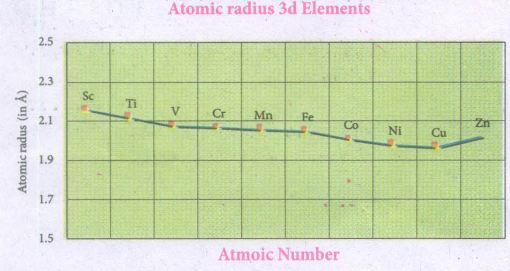
(i) It is generally expected a steady decrease in atomic radius along a period as the nuclear charge increases and the extra electrons are added to the same sub shell.
(ii) But for the 3d transition elements, the expected decrease in atomic radius is observed from Sc to V, thereafter up to Cu the atomic radius nearly remains the same.
(iii) As we move from Sc to Zn in 3d series the extra electrons are added to the 3d orbitals, the added 3d electrons only partially shield the increased nuclear charge and hence the effective nuclear charge increases slightly.
(iv) However, the extra electrons added to the 3d sub shell strongly repel the 4s electrons and these two forces are operated in opposite direction and as they tend to balance each other, it leads to constancy in atomic radii.
(v) At the end of the series, d - orbitals of Zinc contain 10 electrons in which the repulsive interaction between the electrons is more than the effective nuclear charge and hence, the orbitals slightly expand and atomic radius slightly increases.
42.
The heavier transition elements belong to fourth (4d), fifth (Sd) and sixth (6d) transition series. Their properties are expected to be different form the elements belonging to the first (3d) series due to the following reasons.
(i) Atomic radii: Size of the transition elements 94d and Sd series are larger than those of the corresponding elements of the first transition series though those of 4d and Sd series are very close to each other.
(ii) Ionisation enthalpy of Sd series are higher than the corresponding elements of 3d and 4d series.
(iii) Atomisation enthalpy of 4d and Sd series are higher than the corresponding elements of the first series.
(iv) Melting and boiling points of heavier transition elements are greater than those of the first transition series due to stronger intermetallic bonding.
(v) The elements of the first transition series generally form low or high spin complexes, depending upon the higher of ligand field. However, the heavier transition elements form low spin complexes irrespective of the strength of the ligand filed.

12th Standard Syllabus & Materials
12th Standard
TN 12th Computer Applications களப்பெயர் முறைமை (DNS) Sample Question Papers Study Material - QB365 Set A
NEW12th Standard
TN 12th Computer Applications வலையமைப்பு எடுத்துக்காட்டுகள் மற்றும் நெறிமுறைகள் Sample Question Papers Study Material - QB365 Set A
NEW12th Standard
TN 12th Computer Applications கணினி வலையமைப்பு ஓர் அறிமுகம் Sample Question Papers Study Material - QB365 Set A
NEW12th Standard
TN 12th Computer Applications PHP-உடன் MySQL-ஐ இணைத்தல் Sample Question Papers Study Material - QB365 Set A



Tamilnadu Stateboard 12th Standard Subjects

Maths
Chemistry

Physics

Biology

Computer Science

Business Maths and Statistics

Economics

Commerce

Accountancy

History

Computer Applications
Biology
Computer Technology
Computer Applications
Computer Science
Business Maths and Statistics
Commerce
Economics
Maths
Chemistry
Physics
Computer Technology
History
Accountancy

Tamil

English

French
Tamilnadu Stateboard Standards
