
 100% FREE ACCESS
12th Standard Syllabus & Materials
12th Standard
TN 12th Computer Applications மின்னணு தரவு பரிமாற்றம் Sample Question Papers Study Material - QB365 Set A
NEW12th Standard
TN 12th Computer Applications மின் - வணிக பாதுகாப்பு அமைப்புகள் Sample Question Papers Study Material - QB365 Set A
NEW12th Standard
TN 12th Computer Applications மின்னணு செலுத்தல் முறைகள் Sample Question Papers Study Material - QB365 Set A
NEW12th Standard
TN 12th Computer Applications மின் - வணிகம் Sample Question Papers Study Material - QB365 Set A
NEW12th Standard
TN 12th Computer Applications திறந்த மூல கருத்துருக்கள் Sample Question Papers Study Material - QB365 Set A
NEW12th Standard
TN 12th Computer Applications வலையமைப்பு வடமிடல் Sample Question Papers Study Material - QB365 Set A

Published on: 01/08/2019
First Mid Term Model Questions
Download Tamil Nadu 12th Standard Chemistry question papers, model tests, one-mark questions, important questions, and public exam papers in PDF format. Free study materials and answer keys for TN State Board students.
Questions + Answers key
Take MCQ Chemistry Test
1.
The cation leaves its normal position in the crystal and moves to some interstitial position, the defect in the crystal is known as _____.
Schottky defect
F center
Frenkel defect
non-stoichiometric defect
2.
AlF3 is soluble in HF only in the presence of KF. It is due to the formation of _________.
K3[AIF3H3]
K3[AiF6]
AIH3
K[AIF3H]
3.
Considering Ellingham diagram, which of the following metals can be used to reduce alumina?
Fe
Cu
Mg
Zn
4.
Wolframite ore is separated from tinstone by the process of________.
Smelting
Calcination
Roasting
Electromagnetic separation
5.
Bauxite has the composition ______.
Al2O3
Al2O3.nH2O
Fe2O3.2H2O
None of these
6.
Show that in case of first order reaction, the time required for 99.9% completion is nearly ten times the time required for half completion of the reaction.
7.
What are the uses of diborane?
8.
Explain calcination with an example.
9.
10.
Rate of chemical reaction is not uniform throughout. Justify you answer:
11.
Name the various refining process.
12.
Atoms X and Y form bcc crystalline structure. Atom X is present at the corners of the cube and Y is at the centre of the cube. What is the formula of the compound?
13.
Why ionic crystals are hard and brittle?
14.
Give the structure of CO and CO2.
15.
Explain the electrometallurgy of aluminium.
16.
The initial rate of a first order reaction is 5.2 x 10⁻⁶ mol lit-1 S-1 at 298 K. When the initial concentration of reactant is 2.6 x 10⁻³ mol.lit-1, calculate the first order rate constant of the reaction at the same temperature.
17.
What are stoichiometric defects in ionic solids? Explain
18.
What is an elementary reaction? Give the differences between order and molecularity of a reaction.
19.
Pseudo first order reaction
20.
[CO(NH3)4Cl2]SO4
21.
Cyclic silicates
22.
Metal deficiency defect
23.
Sulphide ore
1.
(c)
Frenkel defect
2.
(b)
K3[AiF6]
3.
(c)
Mg
4.
(d)
Electromagnetic separation
5.
(b)
Al2O3.nH2O
6.
Let [A0] = 100;
When t = t99.9%; [A] = (100-99.9) = 0.1
\(k=\frac { 2.303 }{ t } \log\left( \frac { [{ A }_{ 0 }] }{ [A] } \right) \)
\({ t }_{ 99.9\% }=\frac { 2.303 }{ K } \log\left( \frac { 100 }{ 0.1 } \right) \)
\({ t }_{ 99.9\% }=\frac { 2.303 }{ K } \log1000\)
\({ t }_{ 99.9\% }=\frac { 2.303 }{ K } (3)\)
\({ t }_{ 99.9\% }=\frac { 6.909 }{ K } \)
\({ t }_{ 99.9\% }=10\times \frac { 0.69 }{ K } \)
\({ t }_{ 99.9\% }={ 10 } t_{ 1/2 }\)
7.
(i) Diborane is used as a high energy fuel for propellant.
(ii) It is used as a reducing agent in organic chemistry.
(iii) It is used in welding torches.
8.
(i) Calcination is the process in which the concentrated ore is strongly heated in the absence of air.
(ii) During this process, the water of crystallisation present in the hydrated oxide escapes as moisture.
(iii) Any organic matter (if present) also get expelled leaving behind a porous ore.
(iv) This method can also be carried out with 4 limited supply of air.
(v) During calcination of carbonate ore carbon dioxide is expelled.
\(Pb{ CO }_{ 2 }\overset { \Delta }{ \longrightarrow } PbO+{ CO }_{ 2 }\uparrow \)
9.
10.
Rate of a reaction at any time depends on the concentration of the reactants which keeps on decreasing with time.
11.
Distillation, liquation, electrolytic refining, zone refining, vapour phase method, van -Arkel method
12.
Number of X type atoms in the unit cell \(=8 \times \frac{1}{8}=1\)
Number of Y type atoms in the unit cell \(=1 \times \frac{1}{1}=1\)
Hence the formula is XY (or) X1Y1
13.
The structural units of an ionic crystal are cations and anions. They are bound together by strong electrostatic attractive forces. To maximize the attractive force, cations are surrounded by as many anions as possible and vice versa. Hence they are hard and brittle.
14.
| Oxides of Carbon | Structure | Parameters |
| CO |  |
Three electron pairs are shared between carbon and oxygen. The C-O bond distance is 1.128\(\overset{o}{A}\). |
| CO2 |  |
Equal bond distance for the both C-O bonds. Two C-O sigma bond, It has 3c-4e bond. |
15.
1. This process is called as Hall-Heroult process.
Cathode: In this method, electrolysis is carried out in an iron tank lined with carbon which acts as the cathode.
Anode: The carbon blocks immersed in the electrolyte acts as a anode.
Eletrolyte: A 20% solution of alumina, obtained from the bauxite ore is mixed with molten Cryolite and is taken in the electrolysis chamber.
2. About 10% calcium chloride is also added to the solution.
3. Here Calcium chloride helps to lower the melting point of the mixture.
Temperature: The fused mixture is maintained at a temperature of above 1270 K.
4. The chemical reactions involved in this process as follows
(a) Ionisaiton of alumina: \({ A }l_{ 2 }{ O }_{ 3 }\longrightarrow { 2Al }^{ 3+ }+{ 3O }^{ 2- }\)
(b) Reaction at cathode: \(2{ Al }^{ 3+ }_{(melt)}+{ 6e }^{ - }\longrightarrow { Al }_{ (l) }\)
(c) Reaction at anode: \(6{ O }^{2-}_{(melt)}\longrightarrow { 3O }_{ 2 }+{ 12e }^{ - }\)
5. Since carbon acts as anode the following reaction also takes place
(a) \({ C }_{ (s) }+{ O }^{ 2- }_{(melt)}\longrightarrow CO+{ 2e }^{ - }\)
(b) \({ C }_{ (s) }+{ 2O }^{ 2- }_{(melt)}\longrightarrow { CO }_{ 2 }+{ 4e }^{ - }\)
6. Due to the above two reactions, anodes are slowly consumed during the electrolysis.
7. The pure aluminium is formed at the cathode. The net electrolysis reaction can be written as
\({ 4Al }^{ 3+ }_{(melt)}+{ 6O }^{ 2- }_{(melt)}+{ 3C }_{ (s) }\longrightarrow { 4Al }_{ (l) }+{ 3CO }_{ 2(g) }\)
16.
Given data: Rate = 5.2 x 10⁻⁶ mol lit-1 sec-1
Initial concentration [A] = 2.6 x 10⁻³
Formula: Rate = k[A]1
Solution: Rate = 5.2 x 10⁻⁶ mol lit-1 sec-1 = k x 2.6 x 10⁻³ lit-1
= \(\frac { 5.26\times { 10 }^{ -6 }mol{ \ lit }^{ -1 }{ sec }^{ -1 } }{ 2.6\times { 10 }^{ -3 }mol \ { lit }^{ -1 } } \)= 2 x 10⁻³
∴ k = 2 x 10⁻³ s-1
17.
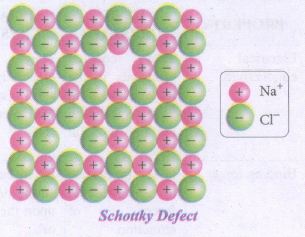
Schottky defect:
(i) Schottky defect arises due to the missing of equal number of cations and anions from the crystal lattice.
(ii) This effect does not change the stoichiometry of the crystal.
(iii) Ionic solids in which the cation and anion are of almost of similar size show schottky defect. Ex: NaCl.
(iv) Presence of large number of schottky defects in a crystal, lowers its density.
Frenkel defect:
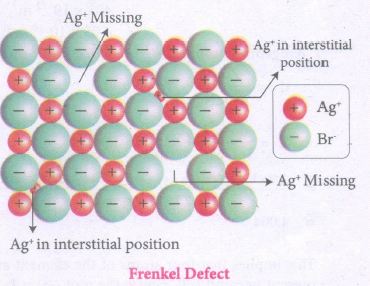
(i) Frenkel defect arises due to the dislocation of ions from its crystal lattice.
(ii) The ion which is missing from the lattice point occupies an interstitial position.
(iii) This defect is shown by ionic solids in which cation and anion differ in size.
(iv) Unlike Schottky defect, this defect does not affect the density of the crystal.
(v) For example AgBr, in this case, small Ag+ ion leaves its normal site and occupies an interstitial position.
18.
(a) Elementary reaction
Each and Every single step in a reaction mechanism is called an elementary reaction.
Rate = k[A] [B]
(b)
| Order of reaction | Molecularity of a reaction |
|---|---|
| Order of reaction is the sum of the powers of concentration terms involved in the experimentally determined rate law. | Molecularity of a reaction is the total number of reactant species that are involved in an elementary step. |
| It can be zero (or) fractional (or) integer | It is always a whole number, cannot be zero or a fractional number. |
| It is assigned for a overall reaction. | It is assigned for each elementary step of the mechanism. |
19.
involves at least two reactants
20.
+4
21.
Ring silicates
22.
FeO
23.
Copper pyrite

12th Standard Syllabus & Materials
12th Standard
TN 12th Computer Applications களப்பெயர் முறைமை (DNS) Sample Question Papers Study Material - QB365 Set A
NEW12th Standard
TN 12th Computer Applications வலையமைப்பு எடுத்துக்காட்டுகள் மற்றும் நெறிமுறைகள் Sample Question Papers Study Material - QB365 Set A
NEW12th Standard
TN 12th Computer Applications கணினி வலையமைப்பு ஓர் அறிமுகம் Sample Question Papers Study Material - QB365 Set A
NEW12th Standard
TN 12th Computer Applications PHP-உடன் MySQL-ஐ இணைத்தல் Sample Question Papers Study Material - QB365 Set A



Tamilnadu Stateboard 12th Standard Subjects

Maths
Chemistry

Physics

Biology

Computer Science

Business Maths and Statistics

Economics

Commerce

Accountancy

History

Computer Applications
Biology
Computer Technology
Computer Applications
Computer Science
Business Maths and Statistics
Commerce
Economics
Maths
Chemistry
Physics
Computer Technology
History
Accountancy

Tamil

English

French
Tamilnadu Stateboard Standards
