
 100% FREE ACCESS
12th Standard Syllabus & Materials
12th Standard
TN 12th Computer Applications மின்னணு தரவு பரிமாற்றம் Sample Question Papers Study Material - QB365 Set A
NEW12th Standard
TN 12th Computer Applications மின் - வணிக பாதுகாப்பு அமைப்புகள் Sample Question Papers Study Material - QB365 Set A
NEW12th Standard
TN 12th Computer Applications மின்னணு செலுத்தல் முறைகள் Sample Question Papers Study Material - QB365 Set A
NEW12th Standard
TN 12th Computer Applications மின் - வணிகம் Sample Question Papers Study Material - QB365 Set A
NEW12th Standard
TN 12th Computer Applications திறந்த மூல கருத்துருக்கள் Sample Question Papers Study Material - QB365 Set A
NEW12th Standard
TN 12th Computer Applications வலையமைப்பு வடமிடல் Sample Question Papers Study Material - QB365 Set A

Published on: 21/02/2020
12th Standard Chemistry Important Question All Chapter I 2020
Download Tamil Nadu 12th Standard Chemistry question papers, model tests, one-mark questions, important questions, and public exam papers in PDF format. Free study materials and answer keys for TN State Board students.
Questions + Answers key
Take MCQ Chemistry Test
1.
Low molar conductivity at high concentration is due to _______.
High attractive force between oppositely charged ions
Viscous drag due to greater solvation
Both High attractive force between oppositely charged ions and Viscous drag due to greater solvation
Neither High attractive force between oppositely charged ions and Viscous drag due to greater solvation
2.
On fusion with KOH benzophenone undergoes __________, and gives potassium benzoate and ________.
disproportionation reaction, toluene
condensation reaction, toluene
disproportionation reaction, benzene
condensation reaction, benzene
3.
Carboxylic acids are synthesised from Grignard reagent by the action of ________.
CO2
H2O
C6H5OH
CH3OH
4.
1 mho is equal to ______.
1 siemen
1 second
1 ohm
none of the above
5.
The equivalent conductivity of CH3COOH at 25°C is 80 ohm-1 cm2 eq-1 and at infinite dilution 400 ohm-1 cm-1 eq-1. The degree of dissociation of CH3COOH is ______.
1
0.2
0.1
0.3
6.
Which of the following compound is optically active?
CH3CH2COOH
HOOC-CH2-COOH
CH3CH(OH)COOH
Cl2CHCOOH
7.
The process of hardening of leather is called _______.
coagulation
tanning
centrifuging
stabilization
8.
Butter and cream are examples of________type of emulsion.
O/O
O/W
W/W
W/O
9.
_______ is a measure of protecting power of a colloid.
Colloid number
Coagulation number
Gold number
Sol number
10.
According to Lowry - Bronsted theory, an acid is a _________.
electron donor
electron acceptor
proton donor
prof on acceptor
11.
The pH of a solution containing 0.1 N NaOH solution is _______.
1
10-1
13
10-13
12.
The ether used in perfumery is ________.
diethyl ether
dimethyl ether
methyl phenyl ether
diphenyl ether
13.
HCl is a strong acid since _______.
It can be easily oxidised
It can be easily ionised
It dissociates completely to give H+ ions in solution
It can be easily oxidised and It can be easily ionised
14.
Ethers are insoluble in water due to the ______.
absence of co-ordinate bond
presence of co-ordinate bond
absence of H - bond
presence of H - bond
15.
The compound that acts as a solvent for Grignard reagent is ______.
Ethyl alcohol
Diethyl ether
Acetone
Benzene
16.
The reagent used to distinguish between acetaldehyde and benzaldehyde is _______.
Tollens reagent
Fehling’s solution
2,4 – dinitrophenyl hydrazine
semicarbazide
17.
Benzoic acid \(\overset { i){ NH }_{ 3 } }{ \underset { ii)\Delta }{ \longrightarrow } } A\overset { NaOBr }{ \longrightarrow } B\overset { NaN{ O }_{ 2 }/HCl }{ \longrightarrow } \) C 'C' is ______.
anilinium chloride
O – nitro aniline
benzene diazonium chloride
m– nitro benzoic acid
18.
Williamson synthesis of preparing dimethyl ether is a / an ______.
SN1 reactions
SN2 reaction
electrophilic addition
electrophilic substitution
19.
20.
Adsorption of a gas on solid metal surface is spontaneous and exothermic, then ______.
ΔH increases
ΔS increases
ΔG increases
ΔS decreases
21.
Which one of the following characteristics are associated with adsorption?
\(\Delta\)G and \(\Delta\)H are negative but \(\Delta\)S is positive
\(\Delta\)G and \(\Delta\)S are negative but \(\Delta\)H is positive
\(\Delta\)G is negative but \(\Delta\)H and \(\Delta\)S are positive
\(\Delta\)G, \(\Delta\)H and \(\Delta\)S all are negative.
22.
In the electrochemical cell: Zn|ZnSO4 (0.01M)|| CuSO4 (1.0M)|Cu, the emf of this Daniel cell is E1. When the concentration of ZnSO4 is changed to 1.0M and that CuSO4 changed to 0.01M, the emf changes to E2. From the above, which one is the relationship between E1 and E2?
E1 < E2
E1 > E2
E2 ≥ E1
E1 = E2
23.
Among the following cells
I) Leclanche cell
II) Nickel – Cadmium cell
III) Lead storage battery
IV) Mercury cell
Primary cells are ____.
I and IV
I and III
III and IV
II and III
24.
The pH of an aqueous solution is Zero. The solution is _______.
slightly acidic
strongly acidic
neutral
basic
25.
Which of these is not likely to act as Lewis base?
BF3
PF3
CO
F–
26.
For a general reaction aA + bB ⟶Products, the rate of the reaction is equal to______.
k[A]p [B]q
k [A] [B]
k
\(\frac { 1 }{ k } \)
27.
The graph between the log K versus \(\frac { 1 }{ T } \) is a straight line. The slope of the line is______.
\(\frac { -2.303R }{ Ea } \)
\(\frac { Ea }{ 2.303R } \)
\(\frac { 2.303R }{ Ea } \)
\(\frac { Ea }{ 2.303R } \)
28.
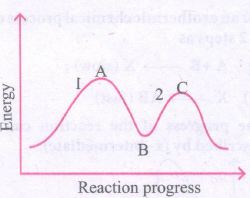
It is a 2 steps reaction, step 1 is slower than step 2
It is a 2 steps reaction, step 2 is slower than step 1.
Single step reaction where B is a activated complex
Single step reaction in which B is a reaction intermediate.
29.
Oxalic acid on heating with cone H2SO4 gives ______.
CO only
CO2 only
CO2 + H2O
CO + CO2 + H2O
30.
Pick the wrong one among the following
F2 - Yellow
Br2 - Red
Cl2 - Colourless
I2- Violet
31.
Catenation property of group 15 elements, follow the order _______.
N < P < As < Sb < Bi
P >> N > As > Sb > Bi
P < N < As < Sb < Bi
N>> P > As > Sb > Bi
32.
The coordination number of ZnS is _______.
3
4
6
8
33.
Which among the following is an amorphous solid?
Graphite
SiO2
Sic
Diamond
34.
Silicones are ______.
ortho silicates
water repellent thermal insulators
both (a) and (b)
None of these
35.
Which of the following features is false regarding the structure of CsCI?
It has bee arrangements
Co-ordination number for each ion is 8
Number of atoms in a unit cell is 4
The radius ratio (r+/r-) is 0.93
36.
Graphite has _______.
2-d sheet structure
Vander waals force between successive layers of carbon sheets
Sp2 hybridised carbon linked with other three carbon atoms in hexagonal planar structure
all the above
37.
Select the incorrect statement regarding B2H6.
It contains B-B ionic bond
Each boron is Sp3 hybridised
It has two types of hydrogen bonds
it is used as a reducing agent
38.
_________ is known as Bayer's reagent.
Hot dilute alkaline KMnO4
Cold dilute alkaline KMnO4
Hot Conc. acidic KMnO4
Cold Conc. acidic KMnO4
39.
Acidified solution of chromic acid on treatment with H2O2 give blue colour which is due to _______.
CrO3 + H2O + O2
H2Cr2O7+ H2O + CO2
Cr2O3 + H2O + O2
CrO5 + H2O
40.
On oxidation with KMnO4 in acidic medium, SO2 is oxidised to _______.
SO2
H2SO4
SO32-
H2S
41.
Froth flotation process is suitable for concentrating ______ores.
oxide
carbonate
sulphide
halide
42.
Concentration of copper glance is done by________.
leaching
magnetic separation
froth flotation
hydraulic washing
43.
Phthalo blue - a bright blue figment is a complex of _______.
Copper (I) ion
Copper (II) ion
Nickel (II) ion
Nickel (IV) ion
44.
______is used as an antitumor drug in cancer treatment.
Ca - EDTA
Cis - platin
Sodium thio sulphate
Nickel chloride
45.
The coordination polyhedron of the complex [Cr(H2O)6]CI3 is________.
square planar
tetrahedral
trigonal
octahedral
46.
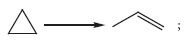 This reaction follows first order kinetics. The rate constant at particular temperature is 2.303 x 10⁻² hour-1. The initial concentration of cyclopropane is 0.25 M. What will be the concentration of cyclopropane after 1806 minutes? (log 2 = 0.3010)
0.125 M
0.215 M
0.25 x 2.303 M
0.05 M
47.
After 2 hours, a radioactive substance becomes \(\left( \frac { 1 }{ 16 } \right) ^{ th }\) of original amount Then the half life (in min) is _______.
60 minutes
120 minutes
30 minutes
15 minutes
48.
The radius of an atom is 300pm, if it crystallizes in a face centered cubic lattice, the length of the edge of the unit cell is ________.
488.5pm
848.5pm
884.5pm
484.5pm
49.
Which one of the following complexes is not expected to exhibit isomerism?
[Ni(NH3)4(H2O)2]2+
[Pt(NH3)2Cl2]
[Co(NH3)5SO4]Cl
[FeCl6]3-
50.
Which type of isomerism is exhibited by [Pt(NH3)2Cl2]?
Coordination isomerism
Linkage isomerism
Optical isomerism
Geometrical isomerism
51.
A white crystalline salt (A) react with dilute HCl to liberate a suffocating gas (B) and also forms a yellow precipitate. The gas (B) turns potassium dichromate acidified with dil H2SO4 to a green coloured solution(C). A, B and C are respectively ________.
Na2SO3, SO2, Cr2(SO4)3
Na2S2O3, SO2, Cr2(SO4)3
Na2S, SO2, Cr2(SO4)3
Na2SO4, SO2, Cr2(SO4)3
52.
Which of the following statements is not true?
on passing H2S, through acidified K2Cr2O7 solution, a milky colour is observed
Na2Cr2O7 is preferred over K2Cr2O7 in volumetric analysis
K2Cr2O7 solution in acidic medium is orange in colour
K2Cr2O7 solution becomes yellow on increasing the PH beyond 7
53.
| Column-I | Column-II | ||
| A | Borazole | 1 | B(OH)3 |
| B | Boric acid | 2 | B3N3H6 |
| C | Quartz | 3 | Na2[B4O5(OH)4]8H2O |
| D | Borax | 4 | SiO2 |
| A | B | C | D |
| 2 | 1 | 4 | 3 |
| A | B | C | D |
| 1 | 2 | 4 | 3 |
| A | B | C | D |
| 1 | 2 | 4 | 3 |
None of these
54.
When copper is heated with conc HNO3 it produces ________.
Cu(NO3)2, NO and NO2
Cu(NO3)2 and N2O
Cu(NO3)2 and NO2
Cu(NO3)2 and NO
55.
The basicity of pyrophosphorous acid ( H4P2O5) is _______.
4
2
3
5
56.
Carbon atoms in fullerene with formula C60 have _______hybridisation.
sp3 hybridised
sp hybridised
sp2 hybridised
partially sp2 and partially sp3 hybridised
57.
Which of the following plot gives Ellingham diagram
\(\Delta S \ \text{Vs} \ T\)
\(\Delta { G }^{ 0 }\ \text{Vs} \ T\)
\(\Delta { G }^{ 0 }\ \text{Vs} \ \frac { 1 }{ T } \)
\(\Delta { G }^{ 0 }\ \text{Vs} \ { T }^{ 2 }\)
58.
The incorrect statement among the following is______.
Nickel is refined by Mond’s process
Titanium is refined by Van Arkel’s process
Zinc blende is concentrated by froth floatation
In the metallurgy of gold, the metal is leached with dilute sodium chloride solution
59.
What happens when soda lime is treated with
(i) CH3COONa
(ii) C6H5COOH?
60.
What is DIBAL -H? What is it used for?
61.
Explain the kinetic property of colloids.
62.
What is Ultrafilteration?
63.
Give the expression that relates molar conductivity and degree of dissociation.
64.
Account for the following : For a strong electrolyte molar conductivity decreases as concentration increases
65.
State Saytzeff's rule.
66.
Name the only primary alcohol which gives positive iodoform test.
67.
Write down the conjugate acid and base of the following
(i) NH3
(ii) HSO-4
68.
When temperature is increased, will ionic product of water increase or decrease? Give reason to justify your answer.
69.
The resistance of a conductivity cell is measured as 190 Ω using 0.1M KCl solution (specific conductance of 0.1M KCl is 1.3 Sm-1). When the same cell is filled with 0.003 M sodium chloride solution, the measured resistance is 6.3KΩ. Both these measurements are made at a particular temperature. Calculate the specific and molar conductance of NaCl solution.
70.
Consider the oxidation of nitric oxide to form NO2
2NO(g) + O2(g) ➝2NO2(g)
(a). Express the rate of the reaction in terms of changes in the concentration of NO,O2 and NO2.
(b). At a particular instant, when [O2] is decreasing at 0.2 mol L−1s−1 at what rate is [NO2] increasing at that instant?
71.
How does the value of rate constant vary with reactant constant.
72.
For a reaction A + B ⟶ C, the rate of the reaction is denoted \(\frac { -dA }{ dt } \) or \(\frac { -dB }{ dt } \) or \(\frac { +dC }{ dt } \). State the significance of plus and minus sign.
73.
Give reason for the following:
F2 is more reactive than CIF3 but CIF3 is more reactive than Cl2
74.
(i) Give correct order of boiling point of hydride of group 17.
(ii) Fluorine exhibits only -1 oxidation state whereas other halogens show +1, +3, +5 and +7 oxidation state also Explain.
75.
In CaF2 crystal, Ca2+ ions are present in arrangement. Calculate the number of F- ions in the unit cell.
76.
Distinguish between : Face - centred and body - centred unit cells.
77.
What is phosgene? How is it prepared?
78.
What are the uses of boron trifluoride?
79.
Comparing La(OH)3 and Lu(OH)3, which is more basic and explain why?
80.
Write ionic equation for the reaction between Cr2O7-2 ions and Fe2+ ions in acidic medium.
81.
What is the role of graphite rods in the electro metallurgy of aluminium?
82.
What are enantiomers?
83.
Name the ore that can be concentrated by magnetic separation method.
84.
Arrange the following complex ions in the increasing order of crystal filed splitting energy (\({ \triangle }_{ 0 }\)) [CrCI6]3-, [Cr(CN)6]3-, [Cr(NH3)6]3+
85.
Explain why compounds of Cu2+ are coloured but those of Zn2+ are colourless.
86.
Calculate the ratio of \(\frac { \left[ { Ag }^{ + } \right] }{ \left[ Ag\left( NH_{ 3 } \right) _{ 2 } \right] ^{ + } } \) in 0.2 M solution of NH3. If the stability constant for the complex \([Ag(NH_{ 3 })_{ 2 }]^{ + }\) is 1.7 x 10⁷
87.
Write the formula for the co-ordination compounds.
88.
How will you prepare chlorine in the laboratory?
89.
Complete the following reactions.
a. \(B(OH)_3 + NH_3\longrightarrow \)
b. \(Na_{ 2 }B_{ 4 }{ O }_{ 7 }+{ { H }_{ 2 }{ SO }_{ 4 }+{ 5H }_{ 2 }O\longrightarrow }\)
c. \({ B }_{ 2 }{ H }_{ 6 }+2NaOH+2{ H }_{ 2 }O\longrightarrow \)
d. \({ B }_{ 2 }{ H }_{ 6 }+6{ CH }_{ 3 }OH\longrightarrow \)
e. \(4{ BF }_{ 3 }+3{ H }_{ 2 }O\longrightarrow \)
f. \(HCOOH+{ H }_{ 2 }{ SO }_{ 4 }\longrightarrow \)
g. \(2SiCl_{ 4 }+NH\)3
h. SiCl4 + 4C2H5OH \(\rightarrow\)
i. 2\(B+6NaOH\longrightarrow \)
j. \({ H }_{ 2 }{ B }_{ 4 }{ O }_{ 7 }\overset { Red\ hot }{ \rightarrow } \)
90.
Give the oxidation state of halogen in the following.
a) OF2
b) O2F2
c) Cl2O3
d) I2O4
91.
What is catenation ? describe briefly the catenation property of carbon.
92.
Give the basic requirement for vapour phase refining.
93.
What are the various steps involved in the extraction of pure metals from their ores?
94.
Organic compound with molecular formula C3H6O has two isomers (A) and (B). (A) on heating with NaOH in I2 forms a yellow precipitate while (B) does not. Identify the isomers A and B and explain the reactions.
95.
When tertiary butyl alcohol and 1-butanol are separately treated with a few drops of KMnO4, in one case only the purple colour disappears and a brown precipitate is formed. Which of the two alcohols gives the above reaction and what is that brown precipitate?
96.
Give three examples of enzyme catalyzed reactions.
97.
Leclanche cell is a non-rechargeable cell. Answer the questions below with respect to Leclanche cell.
(i) Anode
(ii) Cathode
(iii) Electrolyte
(iv) Oxidation half cell reaction
(v) Reduction half cell reaction.
98.
How is glycerol obtained commercially? State its uses.
99.
For an aqueous solution of NH4CI, prove that [H+] = \(\sqrt { { K }_{ n }.C } \)
100.
Why is AC current used instead of DC in measuring the electrolytic conductance?
101.
Describe the electrolysis of molten NaCl using inert electrodes
102.
Calculate the pH of 1.5\(\times\)10-3 M solution of Ba(OH)2
103.
Calculate the pH of 0.04 M HNO3 Solution.
104.
Explain the oxidising property of KMnO4 in natural medium. Give the equations.
105.
Prove that the time required for the completion \({ \frac { 3 }{ 4 } }^{ th }\) of the reaction of a first order is twice the time required for the completion of a half of the reaction.
106.
Out of H2O and H2S which one has higher bond angle and why?
107.
What is the formula of a compound in which the element Y forms ccp lattice and atoms of X occupy 2/3rd of tetrahedral voids?
108.
What are the uses of diborane?
109.
Write the chemical composition of the following alloys and give anyone of its application.
(i) Bronze
(ii) Brass
(iii) Stainless steel
110.
Mohr's salt answers the presence of Fe2+, NH4+and SO42- ions, whereas the potassium ferrithiocyanate will not answer Fe3+ and SCN ions give reason.
111.
Hydrolysis of methyl acetate in aqueous solution has been studied by titrating the liberated acetic acid against sodium hydroxide. The concentration of an ester at different temperatures is given below.
| t(min) | 0 | 20 | 40 | 60 | ∝ |
|---|---|---|---|---|---|
| v (ml) | 20.2 | 25.6 | 29.5 | 32.8 | 50.4 |
Show that the reaction is the first order reactions.
112.
The rate law for a reaction of A, B and C has been found to be rate = k[A]2[B][L]3/2 How would the rate of reaction change when
(i) Concentration of [L] is quadrupled
(ii) Concentration of both [A] and [B] are doubled
(iii) Concentration of [A] is halved
(iv) Concentration of [A] is reduced to \(\left(\frac{1}{3}\right)\) and concentration of [L] is quadrupled.
113.
Compare lanthanoids and actinoids.
114.
What are inner transition elements?
115.
What are interhalogen compounds? Give examples.
116.
117.
An organic compound A (C7H6O) reduces Tollen's reagent. On treating with an alkali compound A forms B and C. B on treating with sodalime forms benzene and C (C7HsO) is an antiseptic. Identify compounds A, B and C. Explain the reactions.
118.
An organic compound A of molecular formula C3H6O on reduction with LiAlH4 gives B. Compound B gives blue colour in Victor Meyer's test and also forms a chloride C with SOCl2. The chloride on treatment with alcoholic KOH gives D. Identify A, B, C and D and explain the reactions.
119.
Give the special characteristics of enzyme catalysed reactions.
120.
The standard reduction potential for the reaction Sn4+ + 2e- ⟶ Sn2+ is + 0.15v. Calcuate the free energy change of the reaction.
121.
If a solution has a pH of 7.41, determine its H+ concentration.
122.
What do you mean by activity and selectivity of catalyst?
123.
Discuss the Lowry – Bronsted concept of acids and bases.
124.
The decomposition of NH3 on platinum surface is zero reaction. What are the rate of production of N2 and H2 it K = 2.5 x 10⁻⁴mol L-1 S-1?
125.
Write a short note on the oxidation states of 3d series elements.
126.
How does sulphuric acid react with metals at various conditions.
127.
What are the general characteristics of solids?
128.
What are the various methods by which carbon-di-oxide is prepared?
129.
Explain refining of titanium by Van-Arkel method.
130.
What are the postulates of valance bond theory? Give its limitations.
131.
Give the difference between double salts and coordination compounds.
132.
Describe briefly allotropism in p- block elements with specific reference to carbon.
133.
Assertion: due to Frenkel defect, density of the crystalline solid decreases.
Reason: In Frenkel defect cation and anion leaves the crystal.
Codes:
a) Both assertion and reason are true and reason is the correct explanation of assertion
b) Both assertion and reason are true but reason is not the correct explanation of assertion
c) Assertion is true but reason is false
d) Both assertion and reason are false
Both assertion and reason are true and reason is the correct explanation of assertion
Both assertion and reason are true but reason is not the correct explanation of assertion
Assertion is true but reason is false
Both assertion and reason are false
1.
(c)
Both High attractive force between oppositely charged ions and Viscous drag due to greater solvation
2.
(c)
disproportionation reaction, benzene
3.
(a)
CO2
4.
(a)
1 siemen
5.
(b)
0.2
6.
(c)
CH3CH(OH)COOH
7.
(b)
tanning
8.
(d)
W/O
9.
(c)
Gold number
10.
(c)
proton donor
11.
(c)
13
12.
(c)
methyl phenyl ether
13.
(c)
It dissociates completely to give H+ ions in solution
14.
(c)
absence of H - bond
15.
(b)
Diethyl ether
16.
(b)
Fehling’s solution
17.

18.
(b)
SN2 reaction
19.
(c)
20.
ΔS is -ve
21.
Adsorption leads to decrease in randomnes (entropy).i.e, ΔS < 0 for the adsorption to occur, ΔG slhould be -ve. We know that ΔG = ΔH - TΔS if ΔS is -ve, TΔS is +ve.It means that ΔG will become negative only when ΔH is -ve and ΔH > TΔS.
22.
Ecell = Eocell - \(\frac{0.0591}{2} \log [\frac{Zn^{2+}}{Cu^{2+}}]\)
El = Eocell - \(\frac{0.0591}{2} \log [\frac{10^{-2}}{1}]\)
El = Eocell + 0.0591 ...(1)
E2 = Eocell - \(\frac{0.0591}{2} \log [\frac{1}{10^{-2}}]\)
E2 = Eocell - 0.0591 ...(2)
E1 > E2
Zn(s)| ⟶ Zn2+(aq) + 2e-
Cu2+(aq) + 2e- ⟶ Cu(s)
Zn(s) + Cu2+(aq) ⟶ Zn2+(aq) + Cu(s)
23.
(a)
I and IV
24.
pH = -log10 [H+]
\(\therefore\) [H+] = 10-pH
100 = 1
[H+] = 1 M
The solution is strongly acidic
25.
BF3 → electron deficient → Lewis acid
PF3 → electron rich → Lewis base
CO → having lone pair of electron → Lewis base
F → unshared pair of electron → Lewis base
26.
(a)
k[A]p [B]q
27.
(b)
\(\frac { Ea }{ 2.303R } \)
28.
(a)
It is a 2 steps reaction, step 1 is slower than step 2
29.
(d)
CO + CO2 + H2O
30.
(c)
Cl2 - Colourless
31.
(b)
P >> N > As > Sb > Bi
32.
(b)
4
33.
(a)
Graphite
34.
(c)
both (a) and (b)
35.
(c)
Number of atoms in a unit cell is 4
36.
(d)
all the above
37.
(a)
It contains B-B ionic bond
38.
(b)
Cold dilute alkaline KMnO4
39.
(d)
CrO5 + H2O
40.
(b)
H2SO4
41.
(c)
sulphide
42.
(c)
froth flotation
43.
(b)
Copper (II) ion
44.
(b)
Cis - platin
45.
(d)
octahedral
46.
\(k=\frac { 2.303 }{ t } log\frac { \left[ { A }_{ 0 } \right] }{ \left[ A \right] } \)
2.303 x 10⁻² hour-1 = \(\frac { 2.303 }{ 1806 min } log\frac { \left[ { 0.25 }_{ } \right] }{ \left[ A \right] } \)
\(=\left(\frac{2.303 \times 10^{-2} hour^{-1 }\times 1806 min}{2.303}\right) = \log \left(\frac{0.25}{A}\right) \)
\(=\left(\frac{ 1806 \times 10 ^{-2}}{60}\right) = \log \left(\frac{0.25}{A}\right) \)
\(= 0.301 = \log \left(\frac{0.25}{A}\right) \)
\(=\log2 = \log \left(\frac{0.25}{A}\right) \)
\(2 = \log \left(\frac{0.25}{A}\right) \)
\([A] = \log \left(\frac{0.25}{2}\right) = 0.125 M\)
47.
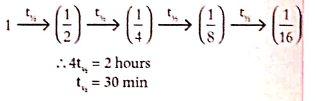
48.
let edge length = a
\(\sqrt{2a} = 4r\)
\(a = \frac{4 \times 300}{\sqrt {2}}\)
a = 600 x 1.414
a = 848.4 pm
49.
Option (a) and (b) -geometrical isomerism is possible
Option (c) - ionization isomerism is possible
Option (d) - no possibility to show either constitutional isomerism or stereo isomerism
50.
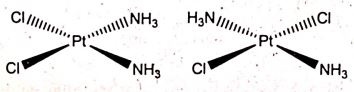
51.
(a)
Na2SO3, SO2, Cr2(SO4)3
52.
(b)
Na2Cr2O7 is preferred over K2Cr2O7 in volumetric analysis
53.
(a)
| A | B | C | D |
| 2 | 1 | 4 | 3 |
54.
(c)
Cu(NO3)2 and NO2
55.
(b)
2
56.
(c)
sp2 hybridised
57.
(b)
\(\Delta { G }^{ 0 }\ \text{Vs} \ T\)
58.
(d)
In the metallurgy of gold, the metal is leached with dilute sodium chloride solution
59.
(i) Decarboxylation: When anhydrous: sodium salt of carboxylic acids are heated with soda lime, carboxyl group is removed with the· formation of hydrocarbon containing one carbon atom less.
\(\underset { Sodium \ acetate }{ { CH }_{ 3 }COONa } \overset { NaOH/CaO }{ \longrightarrow } \underset { Methane }{ { CH }_{ 4 } } +{ Na }_{ 2 }{ CO }_{ 3 }\)
(ii) Heating benzoic acid with soda lime gives benzene.
\({ C }_{ 6 }{ { H }_{ 5 }COOH }\underset { Sodalime }{ \overset { NaOH }{ \underset { CaO\Delta }{ \longrightarrow } } } { C }_{ 6 }{ H }_{ 6 }+{ CO }_{ 2 }\)
60.
DIBAL -H is Diisobutyl aluminium hydride. Its is reducing agent.
61.
The continuous rapid, zig-zag, chaotic, random I and ceaseless movement executed by a colloidal particle in the dispersion medium is called Brownian movement of colloidal particles.
62.
The separation of sol particles from electrolyte by filteration through an ultrafilter is called ultrafiltration.
63.
\(\alpha =\frac { { \Lambda }_{ m } }{ { \Lambda }_{ m }^{ o } } \)
64.
(i) For a strong electrolyte, at high concentration, the number of constituent ions of the electrolyte in a given volume is high and hence the attractive force between the oppositely charged ions is also high.
(ii) Moreover the ions also experience a viscous drag due to greater solvation.
(iii) These factors attribute for the low molar conductivity at high concentration.
65.
During intramolecular dehydration, if there is a possibility to form a carbon-carbon double bond at different locations, the preferred location is the one that gives the more (highly) substituted alkene i.e., the stable alkene.
66.
Ethanol
67.
| (i) | (ii) | |
| Conjugate Acid | \({ NH }_{ 4 }^{ + }\) | \({ H }_{ 2 }{ SO }_{ 4 }\) |
| Conjugate Base | \({ NH }_{ 2 }^{ - }\) | \(^{ }{ SO }_{ 4 }^{ 2- }\) |
68.
With increase in temperature the ionic product of water will increase since the concentration of H3O+ and OH- ions will increase.
69.
Given that
κ = 1.3 Sm-1 (for 0.1M KCl solution)
R = 190 Ω
\(\kappa = \frac{1}{R}(\frac{l}{A})\)
κ . R =\((\frac{l}{A})\) = (1.3 Sm-1) (190Ω)
= 247 m-1
\(\kappa_{(NaCl)} = \frac{1}{R_{(NaCl)}} (\frac{l}{A})\)
\(= \frac{1}{6.3 K\Omega}(247 m^{-1})\) (6.3KΩ = 6.3 x 10³Ω)
= 39.2 x 10⁻³ Sm-1
\(\Lambda_m = \frac{\kappa \times 10^{-3} mol^{-1} m^3}{M}\)
\(=\frac{39.2 \times 10 ^{-3}(Sm^{-1})10^-3 (mol^{-1} m^3)}{0.003}\)
\(\Lambda_m\) = 13.04 \(\times\) 10-3 Sm2 mol-1
70.
a) \(Rate=\frac { -1 }{ 2 } \frac { d[NO] }{ dt } =\frac { -d[{ O }_{ 2 }] }{ dt } =\frac { 1 }{ 2 } \frac { d\left[ { NO }_{ 2 } \right] }{ dt } \)
b) \(\frac { -d\left[ { O }_{ 2 } \right] }{ dt } =\frac { 1 }{ 2 } \frac { d\left[ { NO }_{ 2 } \right] }{ dt } \)
\(\frac { d[{ NO }_{ 2 }] }{ dt } =2 \times\left( \frac { -d\left[ { O }_{ 2 } \right] }{ dt } \right) =2\times 0.2 \ { mol \ L }^{ -1 }{ s }^{ -1 }\)
= 0.4 mol L-1s-1
71.
For nth reaction
\(K\alpha \frac { 1 }{ { C }^{ n-1 } } \)
72.
Minus sign i.e. \(\frac { -dA }{ dt } \) or \(\frac { -dB }{ dt } \) indicates decreases in the concentration of reactants whereas + sign indicates in the concentration of products with time i.e. \(\frac { +dC }{ dt } \)
73.
(i) Fluorine due to its small size high electronegativity and low F-F bond energy is more reactive than CIF3
(ii) While CI-F bond in CIF3 is weaker than CI-CI bond in Cl2 therefore, CIF3 is more reactive than Cl2.
(iii) So these graphite rods are consumed slowly and need to be replaced from time - to - time
74.
(i) HCl < HBr < HI < HF
(ii) Fluorine being the most electronegative element cannot have positive oxidation state. Other halogens have d-orbitals, therefore can expand their octet.
75.
No. of Ca2+ ions per unit cell
= 8 x \(\frac{1}{8}+6\times \frac{1}{2}\)
= 1 + 3 = 4
Hence No. of F- ions per unit cell = 2 x 4 = 8
76.
| Face - centred unit cells | body - centred unit cells |
| In a face - centred unit cell, the constituent particles are present at the corners and one at the centre of each face. | A body - centred unit cell contains particles at the corners and one at the body centre. |
77.
When carbon monoxide is treated with chlorine in presence of light or charcoal, it forms a poisonous gas carbonyl chloride, which is also known as phosgene.
CO + Cl2 ⟶ COCl2
78.
(i) Boron trifluoride is used for preparing HBF4, a catalyst in organic chemistry
(ii) It is also used as a fluorinating reagent.
79.
(i) Due to lanthanide contraction the size of La3+ ions decreases regularly with increase in atomic number.
(ii) According to Fajan's rule decrease in size of Ln3+ ions increase the covalent character and decreases the basic character between Ln3+& OH- ion in Ln(OH)3
(iii) Since the order of size Ln3+ ions are
La3+ > Ce3+ ...> Lu3+
(iv) Hence La(OH)3 is the strongest base while Lu(OH)3 is the weakest base
80.
Cr2O72- + 14H+ + 6Fe2+ ⟶ 2Cr3+ + 6Fe3+ + 7H2O
81.
(i) Graphite rods act a anode during electrolytic reduction of alumina.
(ii) At anode, O2 gas is produced which react with the carbon of anode (rods) to produce CO2 gas.
(iii) So these graphite rods are consumed slowly and need to be replaced from time to time.
82.
The pair of two optically active isomers which are mirror images of each other are called enantiomers.
83.
Magnetite (Fe3O4), haematite (Fe2O3) are the ores which can be separated by the magnetic separation method. In these ores, one component is magnetic in nature.
84.
(i) CFSE is higher when the complex contains strong field ligand as per spectro chemical series.
(ii) Thus, crystal field splitting energy increases in the order
[CrCI6]3- < [Cr(NH3)6]3+ < [Cr(CN)6]3-, Because the order of field strength is Cl- < NH3 < CN-
85.
(i) The compounds of Cu2+ are coloured as it has one free electron its valence shell which absorb I radiation of visible region and get excited to emit its complementary colour.
(ii) Zn has no free electron it has fully filled shells. Due to extra stable orbitals electron can't be excited by radiations of visible light, hence its compounds are colourless.
86.
\({ Ag }^{ + }2N{ H }_{ 3 }\rightleftharpoons { \left[ { Ag\left( { { NH }_{ 3 } } \right) }_{ 2 } \right] }^{ + }\)
\(k=\frac { { \left[ { Ag\left( { { NH }_{ 3 } } \right) }_{ 2 } \right] }^{ + } }{ \left[ { Ag }^{ + } \right] { \left[ { NH }^{ 3+ } \right] }^{ 2 } } \)
\(=\frac { \left[ { Ag }^{ + } \right] }{ { \left[ { Ag\left( { NH }_{ 3 } \right) }_{ 2 } \right] }^{ + } } =\frac { 1 }{ k{ \left( { NH }_{ 3 } \right) }^{ 2 } } \)
\(=\frac { 1 }{ 1.7\times { 10 }^{ 7 }\times { \left( 0.2 \right) }^{ 2 } } =\frac { { 10 }^{ -7 } }{ 1.7\times 4\times { 10 }^{ -2 } } \)
\(=\frac { { 10 }^{ -5 } }{ 6.8 } =1.47\times { 10 }^{ -5 }\)
87.
a) potassiumhexacyanidoferrate(II) - Potassiumhexacyanidoferrate(II) - K4[Fe(CN)6]
b) Pentacarbonyliron(0) - [Fe(CO)5]
c) Pentaamminenitrito −kNcobalt(III)ion - [Co(NH3)5(NO2)]2+
d) Hexaamminecobalt(III) Sulphate - [CO(NH3)6](SO4)3
e) Sodiumtetrafluoridodihydroxidochromate(III) - Na2[CrF4(OH)2]
88.
Chlorine is prepared by the action of conc. sulphuric acid on chlorides in presence of manganese dioxide
4NaCl + MnO2 + 4H2SO4 \(\longrightarrow \)Cl2+ MnCl2 +4NaHSO4 + 2H2O
89.
(a) B(OH)3 + NH3\(\overset { \Delta }{ \longrightarrow } \) BN + 3H2O
(Boron nitride)
(b) Na2B4O7 + H2SO4 + 5H2O \(\longrightarrow \) 4H3BO3 + Na2SO4
(Boric acid)
(c) B2H6 + 2NaOH + 2H2O \(\longrightarrow \)2NaBO2 + 6H2
(Sodium metaborate)
(d) B2H6 + 6CH3OH \(\longrightarrow \)2B(OCH3)3 + 6H2O
(Trimethyl borate)
(e) 4BF3 + 3H2O \(\longrightarrow \) H3BO3 + 3H+ + 3[BF4]-
(Boric acid)
(f) HCOOH + H2SO4 \(\longrightarrow \)CO + H2SO4. H2O
(Carbon monoxide)
(g) 2SiCl4 + NH3 \(\overset { 330K }{ \underset { ether }{ \longrightarrow } } \)Cl3Si- NH - SiCl3 + 2HCl
(Chlorosilazane)
(h) SiCl4 + 4C2H5OH\(\longrightarrow \)Si(OC2H5)4 + 4HCI
(Tetraethoxysilane)
(i) 2B + 6NaOH\(\longrightarrow \) 2Na3BO3 + 3H2
(j) H2B4O7 \(\xrightarrow[]{Redhot}\) 2B2O3 + H2O
90.
(a) OF2
+ 2 + 2(x) = 0
+2 = -2x
2 x = -2 ⇒ x = -1
(b) O2F2
2(+1) + 2x = 0
2x = -2
x = -1
(c) Cl2O3
2(x) + 3(-2) = 0
2x = +6
x = +3
(d) I2O4
2(x) + 4(-2) = 0
2x = +8
x = +4
91.
Catenation is an ability of an element to form chain of atoms.
The conditions for catenation.
(a) The valency of element is greater than or equal to two.
(b) Element should have an ability to bond with itself
(c) The self bond must be as strong as Its bond with other elements
(d) Kinetic inertness of catenated compound towards other molecules.
(e) Carbon possesses all the above properties and forms a wide range of compounds with itself and with other elements such as H, O, N, S and halogens.
92.
In this method, the metal is treated with a suitable reagent which can form a volatile compound with the metal.
Then the volatile compound is decomposed to give the pure metal.
93.
(i) Concentration of the ore
(ii) Extraction of crude metal
(iii) Refining of crude metal
94.
Two possible isomers of C3H6O are
\(\underset { \overset { (A) }{ Acetone } }{ { CH }_{ 3 }CO{ CH }_{ 3 } } \quad \underset { \overset { (B) }{ Propanal } }{ { CH }_{ 3 }{ CH }_{ 2 }CHO } \)
\(\\ \underset { \quad \quad (A)\\ Proponal }{ { CH }_{ 3 }CO{ CH }_{ 3 } } \overset { { I }_{ 2 }/NaOH\Delta }{ \underset { Iodo\ form\ \\ reaction }{ \longrightarrow } } \underset { Sodium\\ acetate }{ { CH }_{ 3 }COONa } +\underset { Iodoform\\ Yellow\ ppt }{ { CHI }_{ 3 } } \)
\(\underset { \quad \quad \quad (B)\\ Propanal }{ { CH }_{ 3 }{ CH }_{ 2 }CHO } \overset { { I }_{ 2 }/NaOH }{ \underset { \Delta }{ \longrightarrow } } No\quad ppt\quad of\quad { CHI }_{ 3 }\)
Acetone answers Iodo form test whereas proponal does not.
95.
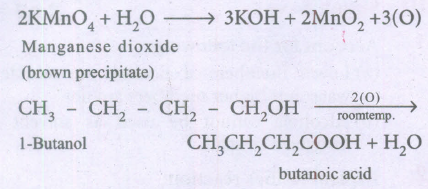
1-Butanol, being primary alcohol gets oxidised by dilute KMnO4. The brown precipitate is due to the formation of manganese dioxide.
96.
(i) The peptide glycyl L-glutamyl L-lyrosin is hydrolysed by an enzyme called pepsin.
(ii) The enzyme diastase hydrolyses starch into maltose
\(2\left( { C }_{ 6 }{ H }_{ 10 }{ O }_{ 5 } \right) +{ nH }_{ 2 }O\longrightarrow { nC }_{ 12 }{ H }_{ 22 }{ O }_{ 11 }\)
(iii) The yeast contains the enzyme zymase which converts glucose into ethanol.
\({ C }_{ 6 }{ H }_{ 12 }{ O }_{ 6 }\longrightarrow { 2C }_{ 2 }{ H }_{ 5 }OH+{ 2CO }_{ 2 }\)
97.
(i) Anode: Zinc container
(ii) Cathode: Graphite rod in contact with MnO2
(iii) Electrolyte: Ammonium chloride and zinc chloride in water
(iv) Oxidation at anode:
\( { Zn }_{ (s) }\rightarrow { Zn }_{ (aq) }^{ 2+ }+2e^{ - }\)
(v) Reduction at cathode:
\({ 2NH }_{ 4(aq) }^{ + }+{ 2e }^{ - }\rightarrow { 2NH }_{ 3(aq) }+{ H }_{ 2(g) }\)
98.
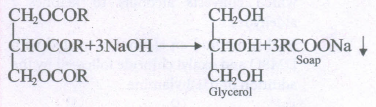
(i) Glycerol is prepared in a large scale by the hydrolysis of oils or fats either by using alkali or by super heated steam.
(ii) During this process, soap is formed along with the byproduct glycerol and this process is called saponification.
Uses of glycerol:
(i) Glycerol is used as a sweetening agent in confectionery and beverages.
(ii) It is used in the manufacture of cosmetics and transparent soaps.
(iii) It is used in making printing inks and stamp pad ink and lubricant for watches and clocks.
(iv) It is used in the manufacture of explosive like dynamite and cordite by mixing it with chaina clay.
99.
NH4CI is a salt of a strong acid HCI and weak base NH4OH.
\({ HCl }_{ (aq) }+{ NH }_{ 4 }OH_{(aq)}\rightleftharpoons { { NH }_{ 4 }Cl }_{ (aq) }+{ H }_{ 2 }O(I)\)
\({ NH }_{ 4 }^{ + }\) is a strong conjugate acid of the weak base NH4OH and it has a tendency to react with OH- from water to produce unionised NH4OH shown below.
\({ NH }_{ 4 }^{ + }+{ H }_{ 2 }O(1)\rightleftharpoons { NH }_{ 4 }{ { { OH }_{ (aq) }+ }H }_{ (aq) }^{ + }\)
There is no such tendency shown by Cl- and therefore [H+] > [OH-]; the solution is acidic and the pH is less than 7.
As discussed in the salt hydrolysis of strong base and weak acid. In this case also, we can establish a relationship between the Kh and Kb as
Kh·Kb = Kw
Let us calculate the Kh value in terms of degree of hydrolysis (h) and the concentration of salt
Kb = h2C and \([{ H }^{ + }]=\sqrt { { K }_{ h }.C } \)
= \({ [H }^{ + }]=\sqrt { \frac { { K }_{ w } }{ { K }_{ b } } .C } \)
pH = - log [H+]
\(={ \left( \frac { { K }_{ w }.C }{ { K }_{ b } } \right) }^{ \frac { 1 }{ 2 } }\)
= \(-\frac { 1 }{ 2 } \log { K }_{ w }-\frac { 1 }{ 2 } \log C+\frac { 1 }{ 2 } \log{ K }_{ b }\)
\(pH=7-\frac { 1 }{ 2 } p{ K }_{ b }-\frac { 1 }{ 2 } \log C\)
100.
(a) If we apply DC current through the conductivity cell, it will lead to the electrolysis of the solution taken in the cell.
(b) So, AC current is used for this measurement to prevent electrolysis.
101.
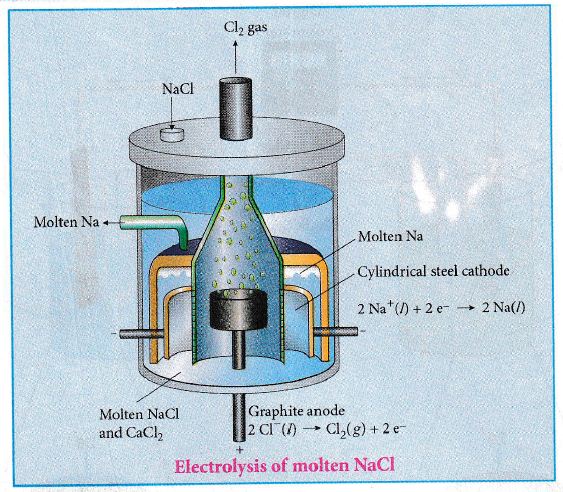
(i) The electrolytic cell consists of two iron electrodes dipped in molten sodium chloride and they are connected to an external DC power supply via a key as shown in the figure. The electrode which is attached to the negative end of the power supply is called the cathode, and the one which attached to the positive end is called the anode. Once the key is closed, the external DC power supply drives the electrons to the cathode and at the same time pull the electrons from the anode.
Cell reactions:
Na+ ions are attracted towards cathode, where they combines with the electrons and reduced to liquid sodium.
Cathode (reduction)
\(N a_{(l)}^{+}+e^{-} \rightarrow N a_{(l)} \quad ; \quad E^{0}=-2.71 V\)
Similarly, Cl- ions are attracted towards anode where they lose their electrons and oxidised to chlorine gas.
Anode (oxidation)
2CI-(l) ⟶ CI2(g) + 2e- E0 = -1.36V
The overall reaction is
2Na+(l) + 2Cl-(l)➝ 2Na(l) + Cl2(g) ; E° = - 4.07V
(ii) The negative E° value shows that the above reaction is a non-spontaneous one.
(iii) Hence, we have to supply a voltage greater than 4.07V to cause the electrolysis of molten NaCI.
(iv) In electrolytic cell, oxidation occurs at the anode and reduction occur at the cathode as in a galvanic cell.
(v) But the sign of the electrodes is the reverse i.e., in the electrolytic cell cathode is -ve and anode is +ve.
102.
Considering Ba(OH)2 to be a strong base:
\(\text { Normality } =\text { Molarity } \times \text { Acidity } \)
\(=1.5 \times 10^{-3} \times 2\)
\({\left[\mathrm{OH}^{-}\right] } =3 \times 10^{-3} \)
\(\mathrm{pOH} =-\log _{10}[\mathrm{OH}^-] \)
\(=-\log _{10}\left(3 \times 10^{-3}\right) \)
\(=-\left[\log _{10} 3+3 \log 10\right] \)
= 3-log 3
= 3-0.4771
= 2.5229
\(\mathrm{pH} =14-\mathrm{pOH} \)
= 14-2.5229
pH = 11.4771 = 11.48
103.
\(\text { Normality }=\text { Molarity } \times \text { Basicity } \)
\(=0.04 \times 1 \)
\({\left[\mathrm{H}_{3} \mathrm{O}\right]^{+}=0.04=4 \times 10^{-2} } \)
\(\mathrm{pH} =-\log _{10}\left[\mathrm{H}_{3} \mathrm{O}^{+}\right] \)
\(=-\log \left[4 \times 10^{-2}\right] \) log10 10 =1
\(=-\left[\log _{10} 4+\log _{10} 10^{-2}\right] \)
\(=-\left[\log _{10} 4-2 \log _{10} 10\right]=2-\log _{10} 4 \)
= 2 - 0.6021
= 1.3979 \(\simeq\) 1.40
104.
Potassium permanganate is a strong oxidising agent, its oxidising action differs in different reaction medium.
In neutral medium:
In neutral medium, it is reduced to MnO2
MnO4- + 2H2O + 3e- ⟶ MnO2 + 4OH-
(i) It oxidises H2S to sulphur
2MnO4- + 3H2S ⟶ 2MnO2 + 3S + 2OH- + 2H2O
(ii) It oxidises thiosulphate into sulphate
8MnO4- + 3S2O3-2 + H2O ⟶ 6SO4-2 + 8MnO2 + 2OH-
105.
\({ t }_{ \frac { 3 }{ 4 } }=\frac { 2.303 }{ K } \log { \frac { { \left[ R \right] }_{ 0 } }{ \frac { 1 }{ 4 } { \left[ R \right] }_{ 6 } } } \)
\({ t }_{ \frac { 3 }{ 4 } }=\frac { 2.303 }{ K } \log 4\)
\(=\frac { 2.303\times 0.6021 }{ K } =\frac { 1.386 }{ K } \)
\(=2\times \frac { 0.693 }{ K } \)
\(=2{ t }_{ \frac { 1 }{ 2 } }\)
106.
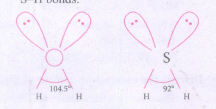
(i) Bond angel of HiX (H-O-H=104.5o) is larger than that of H2S(H-S-H=92o)
(ii) Since oxygen is more electronegative than sulphur, therefore bond pair electrons of O-H bond will be closer to oxygen which will be little away from the sulphur atom.
(iii) As a result bond pair-bond pair repulsions between bond pairs of two O-H bonds would be stronger than in the S-H bonds.
107.
Number of tetrahedral voids formed = 2 x No. of atoms of element Y
No. of atoms of element Y in the ccp unit cell = 4
No. of tetrahedral voids by atoms of Y = 2 x 4 = 8
∴ No. of tetrahedral voids occupied by atoms of
X = \(\frac{2}{3}\times 8=\frac{16}{3}\)
Ratio of the no. of atoms of X and Y is = \(\frac{16}{3}:4\)
= 16:12
= 4:3
Hence, formula would be X4Y3.
108.
(i) Diborane is used as a high energy fuel for propellant.
(ii) It is used as a reducing agent in organic chemistry.
(iii) It is used in welding torches.
109.
| Alloy | Composition | Application |
|---|---|---|
| Bronze | Cu- 80%, Zn-10%, Sn-10% |
Making utensils, statutes, coins, etc. |
| Brass | Cu-60%, Zn-40% |
Making utensils, wires, pairs of machine etc |
| Stainless steel | Fe-73%, Cr-18%, Ni- 8% and CF -1% |
Making utensils, cutlery, cycles, etc. |
110.
If we perform a qualitative analysis to identify the constituent ions present in both the compounds, Mohr's salt answers the presence of Fe2+, NH4+, and SO42- ions, whereas the potassium ferrithiocyanate will not answer Fe3+ and SCN ions. We can infer that the double salts loose their identity and dissociate into their constituent simple ions in solutions, whereas the complex ion in coordination compound, does not loose its identity and never dissociate to give simple ions.
111.
\(k=\frac { 2.303 }{ t } \log\frac { \left( { V }_{ \infty }-{ V }_{ 0 } \right) }{ \left( { V }_{ \infty }-{ V }_{ 0 } \right) } \)
\(k=\frac { 2.303 }{ 20 } \log\frac { 50.4-20.2 }{ 50.4-25.6 } \)
\(=0.1151 \log\frac { 30.2 }{ 24.8 } \)
= 0.1151 log 1.2479
= 0.1151 x 0.0959
= 11.03 x10⁻³ min-1
When t = 40 mts
\(k=\frac { 2.303 }{ 40 } \log\frac { 50.4-20.2 }{ 50.4-25.6 } \)
\(=0.0576\times \log\frac { 30.2 }{ 20.9 } \)
= 9.19 x 10⁻³ min-1
When t = 60 mts
\(k=\frac { 2.303 }{ 60 } \log\frac { 50.4-20.2 }{ 50.4-25.6 } \)
\(=0.03838\times \log\frac { 30.2 }{ 17.6 } \)
= 0.03838 x 0.2343
= 8.99 x 10⁻³ min-1
The constant values of K show that the reaction is of first order.
112.
(i) Reaction Rate = \(k{ \left[ A \right] }^{ 2 }{ \left[ B \right] }{ \left[ L \right] }^{ 3/2 }\) ...(1)
When [L] = [4L]
Rate = \(k{ \left[ A \right] }^{ 2 }{ \left[ B \right] }{ \left[ 4L \right] }^{ 3/2 }\)
The Reaction Rate = \(8(k{ \left[ A \right] }^{ 2 }{ \left[ B \right] }{ \left[ L \right] }^{ 3/2 })\) ...(2)
Comparing (1) and (2) rate is increased by 8 times
(ii) [A] = [2A] and [B] = [2B]
Reaction Rate = \(k{ \left[ 2A \right] }^{ 2 }\left[ 2B \right] { \left[ L \right] }^{ 3/2 }\)
Reaction Rate = \(\\ 8(k{ \left[ A \right] }^{ 2 }{ \left[ B \right] }{ \left[ L \right] }^{ 3/2 })\) ...(3)
Comparing (1) and (3) rate is increased by 8 times
(iii) \(\left[ A \right] =\left[ \frac { A }{ 2 } \right] \)
Reaction Rate = \(k{ \left[ \frac { A }{ 2 } \right] }^{ 2 }{ \left[ B \right] }{ \left[ L \right] }^{ 3/2 }\)
Reaction Rate = \(\frac { 1 }{ 4 } \left( k\left[ { A }^{ 2 } \right] { \left[ B \right] }{ \left[ L \right] }^{ 3/2 } \right) \) ...(4)
Comparing (1) and (4); rate is reduced to (1/4) times.
(iv) \(\left[ A \right] =\left[ \frac { 1 }{ 3 }A \right] and\left[ L \right] =\left[ 4L \right] \)
Rate = \(k{ \left[ \frac { 1 }{ 3 }A \right] }^{ 2 }{ \left[ B \right] }{ \left[ 4L \right] }^{ 3/2 }\)
Rate = \(\left( \frac { 8 }{ 9 } \right) \left( k{ \left[ A \right] }^{ 2 }{ \left[ B \right] }{ \left[ L \right] }^{ 3/2 } \right)\) ...(5)
Comparing (1) and (5); rate is reduced to \(\frac { 8 }{ 9 } \) times.
113.
| S.No | Lanthanoids | Actinoids |
|---|---|---|
| 1. | Differentiating electron enters in 4f orbital | Differentiating electron enters in 5f orbital |
| 2. | Binding energy of 4f orbitals are higher | Binding energy of 5f orbitals are lower |
| 3. | They show less tendency to form complexes | They show greater tendency to form complexes |
| 4. | Most of the lanthanoids are colourless | Most of the actinoids are coloured For Example: U3+ (red) U4+ (green). |
| 5. | They do not form oxo cations | They do form oxo cations such as UO22+, NpO22++ etc. |
| 6. | Besides +3 oxidation states lanthanoids show +2 and +4 oxidation states in few cases | Besides +3 oxidation states actinoids show higher oxidation states such as +4, +5, +6 and +7 |
114.
(i) The elements in which the extra electron enters (n-2) f orbitals are called f-block elements. These elements are called as inner transition elements because they form a transition. Series within the transition elements.
(ii) The f-block elements are also called as rare earth elements. They are divided into lanthanoid series (4f block elements) and actinoid series (5f block elements).
115.
Each halogen combines with other halogens to form a series of compounds are called interhalogen compounds.
Example: AB type: BrF
AB3 type: ICI3
116.
117.
(i) From the molecular formula compound (A) is identified as Benzaldehyde I C6H5CHO and it reduces Tollen's reagent.
\(\underset { Tollen's\ regant\ silver\ mirror }{ { C }_{ 6 }{ H }_{ 5 }CHO+{ Ag }_{ 2 }O\longrightarrow 2Ag+{ C }_{ 6 }{ H }_{ 5 }COOH } \)
(ii) Benzaldehyde on treatment with alkali undergoes Cannizzaro reaction to give benzoic acid (B) and benzyl alcohol (C).
\(\underset { (A) }{ { C }_{ 6 }{ H }_{ 5 }CHO+{ C }_{ 6 }{ H }_{ 5 }CHO } \overset { NaOH }{ \longrightarrow } \underset { (B) }{ { C }_{ 6 }{ H }_{ 5 }COOH } +\underset { (C) }{ { C }_{ 6 }{ H }_{ 5 }{ CH }_{ 2 }OH } \)
(iii) Benzoic acid on treatment with sodalime gives benzene.
\(\underset { (B) }{ { C }_{ 6 }{ H }_{ 5 }COOH } \overset { NaOH }{ \underset { CaO }{ \longrightarrow } } \underset { Benzene }{ { C }_{ 6 }{ H }_{ 5 }+{ CO }_{ 2 } } \)
(iv) Benzyl alcohol acts as an antiseptic.
| Compound | Compound Name | Formula |
| A | Benzaldehyde | C6H5CHO |
| B | Benzoic acid | C6H5COOH |
| C | Benzyl alcohol | C6H5CH2OH |
118.
(i) Compound (A) is carbonyl compound, it is acetone
(ii) (A) on reduction with LiAlH4 gives (B) it gives blue colour in Victor Meyer'stest.
\({ CH }_{ 3 }-\underset { \overset { || }{ \underset { (A) }{ O } } }{ C } -{ CH }_{ 3 }\overset { { LiAIH }_{ 4 } }{ \underset { \left[ H \right] }{ \longrightarrow } } { CH }_{ 3 }-{ CH }_{ 3 }-\underset { \overset { | }{ \underset { (B) }{ OH } } }{ CH } -{ CH }_{ 3 }\)
(iii) (B) reacts with SOCl2to give (C).
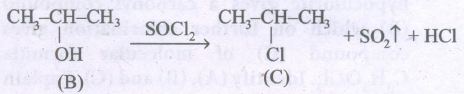
(iv) (C) on treatment with alcoholic KOH, forms (D) by elimination reaction.
\({ CH }_{ 3 }-\underset { \overset { | }{ \underset { (C) }{ Cl } } }{ C } H-{ CH }_{ 3 }\overset { alc.KOH }{ \longrightarrow } \underset { (D) }{ { CH }_{ 3 }CH={ CH }_{ 2 }+HCl } \)
| Compound | Compound Name | Formula |
| A | Acetone | \({ CH }_{ 3 }-\underset { \overset { || }{ O } }{ C } -{ CH }_{ 3 }\) |
| B | Isopropyl alcohol | \({ CH }_{ 3 }-\underset { \overset { | }{ OH } }{ CH } -{ CH }_{ 3 }\) |
| C | Isopropyl chloride | \({ CH }_{ 3 }-\underset { \overset { | }{ Cl } }{ CH } -{ CH }_{ 3 }\) |
| D | Propylene | CH3-CH=CH2 |
119.
(i) Effective and efficient conversion is the special characteristic of enzyme catalysed reactions. An enzyme may transform a million molecules of reactant in a minute
For Eg: \({ 2H }_{ 2 }{ O }_{ 2 }\longrightarrow { 2H }_{ 2 }O+{ O }_{ 2 }\)
For this reaction, the activation energy is 18k cal/mole without a catalyst With colloidal platinum as a, catalyst the activation energy is 11.7kcal /mole. But with the enzyme catalyst the activation energy of this reaction is less than 2kcal/ mole.
(ii) Enzyme catalysis is highly specific in nature.
(iii) Enzyme catalysed reaction has maximum rate at optimum temperature
(iv) The rate of enzyme catalysed reactions varies with the pH of the system. The rate is maximum at a pH called optimum pH.
(v) Enzymes can be inhibited i.e. poisoned activity of an enzyme is decreased and destroyed by a poison. The physiological action of drugs is related to their inhibiting action.
(vi) Catalytic activity of enzymes is increased by coenzymes or activators.
120.
Sn4+ + 2e- ⟶ Sn2+ E0 = 0.15V
Given: n = 2 electrons
F = 96495 coulombs
Formula: ΔG = - nFEO
Solutlon: ∴ ΔG = - 2 x 96495 x 0.15
= 28.948
Free energy = -28.948 kJ.
121.
pH = -log [H+]
∴ [H+] = antilog [-pH]
= antilog [-7.41]
∴ [H+] = 3.9 x 10⁻⁸ M.
122.
Active centres:
The surface of a catalyst is not smooth. It bears steps, cracks and corners. Hence the atoms on such locations of the surface are co-ordinatively unsaturated. So, they have much residual force of attraction. Such sites are called active centres. So, the surface carries high surface free energy. The presence of such active centres increases the rate of reaction (activity) by adsorbing and activating the reactants.
The adsorption theory explains the following:
(i) Increase in the activity of a catalyst by increasing the surface area. Increase in the surface area of metals and metal oxides by reducing the particle size increases the rate of the reaction.
(ii) The action of catalytic poison occurs when the poison blocks the active centres of the catalyst.
(iii) A promoter or activator increases the number of active centres on the surfaces
Selectivity:
A Catalyst can catalyse a particular type of reaction. Hence they are said to the specific (selectivity) in nature. Enzyme catalysis is highly specific in nature.
\(\mathrm{NH}_{2} \mathrm{CONH}_{2}+\mathrm{H}_{2} \mathrm{O} \stackrel{\text { Unease }}{\longrightarrow} 2 \mathrm{NH}_{3}+\mathrm{CO}_{2}\)
The enzyme urease which catalyses their reaction of Urea does not catalyse the reaction of methyl Urea.
\(\mathrm{NH}_{2} \mathrm{CONH} \mathrm{CH_3}+\mathrm{H}_{2} \mathrm{O} \stackrel{\text { Urease }}{\longrightarrow} \text { No reaction }\)
Intermediate compound formation theory explains the specificity of a catalyst.
123.
(i) An acid is defined as a substance that has a tendency to donate a proton to another substance and base is a substance that has a tendency to accept a proton form other substance.
(ii) In other words, an acid is a proton donor and a base is a proton acceptor.
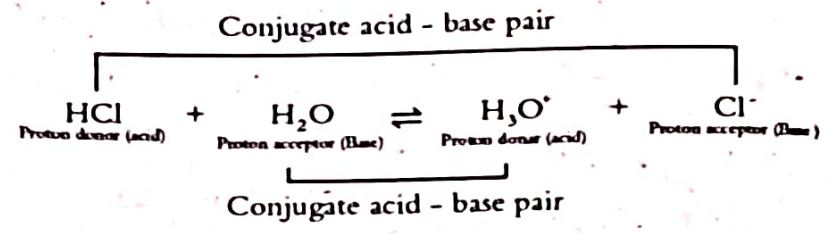
(iii) When hydrogen chloride is dissolved in water, it donates a proton to the later. Thus, HCI behaves as an acid and H2O is base. The proton transfer from the acid to base can be represented as
HCI + H2O ⇌ H3O+ + Cl-
(iv) When ammonia is dissolved in water, it accepts a proton from water. In this case, ammonia (NH3) acts as a base and H2O is acid. The reaction is represented as
H2O + NH3 ⇌ NH4+ + OH-
(v) Let us consider the reverse reaction following equilibrium.
\(\underset { proton\ donar\\ \quad \quad \ (acid) }{ HCl } +\underset { Proton\ acceptor\\ \quad \quad \quad \quad (base) }{ { H }_{ 2 }O } \leftrightharpoons \underset { Proton\ donar\\ \quad \quad \quad \quad \ (acid) }{ { H }_{ 2 }{ O }^{ + } } +\underset { Proton\ acceptor\\ \quad \quad \quad \quad \ (base) }{ { Cl }^{ - } } \)
H3O+ donates a proton to Cl- to form HCI i.e., the products also behave as acid and base.
(vi) In general, Lowry - Bronsted (acid - base) reaction is represented as
Acid1 + Base2 ⇌ Acid2 + Base1
(vii) The species that remains after the donation of a proton is a base (Base1) and is called the conjugate base of the Bronsted acid (Acid1). In other words, chemical species that differ only by a proton are called conjugate acid - base pairs.
124.
The reaction is 2NH3(g) \(\overset { Pt }{ \longrightarrow } \) N2(g) + 3H2(g)
Here k = 2.5 x 10⁻⁴ mol L-1 s-1
The order of the reaction is zero i.e.,
Rate = k[Reactant]o
Rate = 2.5 x 10-4 x 1 = 2.5 x 10⁻⁴ mol L-1 s-1
\(\therefore \frac { d }{ dt } \left[ { H }_{ 2 } \right] =\frac { 1 }{ 3 } \frac { d }{ dt } \left[ { H }_{ 2 } \right] \)
The rate of formation of N2 = 2.5 x 10⁻⁴ mol L-1 s-1
\(\therefore 2.5\times { 10 }^{ -4 }=\frac { 1 }{ 3 } \frac { d }{ dt } \left[ { H }_{ 2 } \right] \)
\(\therefore \frac { d }{ dt } \left[ { H }_{ 2 } \right] \) = 7.5 x 10⁻⁴
Therefore, rate of formation of H2 = 7.5 x 10⁻⁴ mol L-1 s-1
125.
(i) The first transition metal Scandium exhibits only +3 oxidation state, but all other transition elements exhibit variable oxidation states by loosing electrons from (n-1)d orbital and ns orbital as the energy difference between them is very small.
(ii) At the beginning of the series, +3 oxidation state is stable but towards the end +2 oxidation state becomes stable.
(iii) The number of oxidation states increases with the number of electrons available, and it decreases as the number of paired electrons increases.
(iv) Hence, the first and last elements show less number of oxidation states and the middle elements with more number of oxidation states.
(v) For example, the first element Sc has only one oxidation state +3; the middle element Mn has six different oxidation states from +2 to +7. The last element Cu shows +1 and +2 oxidation states only.
(vi) The relative stability of different oxidation - states of 3d metals is correlated with the extra stability of half filled and fully filled electronic configurations. Example: Mn2+(3d5) is more stable than Mn4+(3d3).
126.
Reaction with metals:
(i) Sulphuric acid reacts with metals and gives different product depending on the reactants and reacting condition
(ii) Dilute sulphuric acid reacts with metals like: tin, aluminium, zinc to give corresponding: sulphates.
Zn + H2SO4\(\longrightarrow \) ZnSO4 + H2 \(\uparrow \)
2AI + 3H2SO4 \(\longrightarrow \) Al2(SO4)3+ 3H2 \(\uparrow \)
(iii) Hot concentrated sulphuric acid reacts with copper and lead to give the respective sulphates as shown below
Cu + 2H2SO4 \(\longrightarrow \) CuSO4 + 2H2O + SO2\(\uparrow \)
Pb + 2H2SO4 \(\longrightarrow \) PbSO4 + 2H2O + SO2\(\uparrow \)
(iv) Sulphuric acid doesn't react with noble metals like gold, silver and platinum.
127.
(i) Solids have definite volume and shape
(ii) Solids are rigid and incompressible
(iii) Solids have strong cohesive forces.
(iv) Their constituents have fixed positions and can only oscillate about their mean positions.
128.
(i) Carbon monoxide can be prepared by the reaction of carbon with limited amount of oxygen.
2C + O2 ⟶ 2CO
(ii) (a) On industrial scale carbon monoxide is produced by the reaction of carbon with air.
(b) The carbon monoxide formed will contain nitrogen gas also and the mixture of nitrogen and carbon monoxide is called producer gas.
(c) \(2C+{ O }_{ 2 }/{ N }_{ 2 }(air)\longrightarrow \underset { Producers \ Gas }{ 2CO } +{ N }_{ 2 }\)
(d) The producer gas is then passed through a solution of copper(I) chloride under pressure which results in the formation of CuCI(CO).2H2O.
(e) At reduced pressures this solution releases the pure carbon monoxide.
(iii) Pure carbon monoxide is prepared by warming methanoic acid with concentrated sulphuric acid which acts as a dehydrating agent.
HCOOH + H2SO4 ⟶ CO + H2O + H2SO4
129.
(i) Van-Arkel method is based on the thermal decomposition of metal compounds which lead to the formation of pure metals.
(ii) Titanium and zirconium can be purified, using this method.
(iii) For example, the impure titanium metal is heated in an evacuated vessel with iodine at a temperature of 550 K to form the volatile titanium tetra-iodide(Til4)
(iv) The impurities are left behind, as they do not react with iodine
\({ Ti }_{ (s) }+{ 2I }_{ 2(s) }\longrightarrow { Til }_{ 4 }(vapour)\)
(v) The volatile titanium tetraiodide vapour is passed over a tungsten filament at a temperature around 1800 K.
(vi) The titanium tetraiodide is decomposed and pure titanium is deposited on the filament
(vii) The iodine is reused.
\({ Til }_{ 4 }(vapour)\longrightarrow { { Ti }_{ (s) } }+{ 2I }_{ 2(s) }\)
130.
The postulates of valence bond theory
(i) The central metal atom/ion makes available a number of vacant orbitals equal to its coordination number.
(ii) These vacant orbitals form covalent bonds with the ligand orbitals.
(iii) A covalent bond is formed by the overlap of a vacant metal orbital and filled ligand orbitals. This complete overlap leads to the formation of a metal ligand, σ (sigma) bond.
(iv) A strong covalent bond is formed only when the orbitals overlap to the maximum extent.
(v) This maximum overlapping is possible only when the metal vacant orbitals undergo a process called 'hybridisation'.
(vi) A hybridised orbital has a better directional characteristic than an unhybridized one. The following table gives the coordination number, orbital hybridisation, and geometry of the complexes.
| Coordination number | Types of hybridisation | Geometry |
|---|---|---|
| 2 | sp | linear |
| 4 | sp3 | tetrahedral |
| 4 | dsp3 | square planer |
| 6 | d2sp3 | octahedral |
| 6 | sp3d2 | octahedral |
Magnetic moment
The paramagnetic moment is given by the following spin-only formula.
\({ \mu }_{ s }=\sqrt { n(n+2) } \) BM
BM = Bohr magneton
\({ \mu }_{ s }\) = spin -only magnetic moment
n = number of unpaired electrons.
131.
| S. No | Double salts | Co-ordination compound |
|---|---|---|
| 1. | They usually contain two simple salt in equimolar proportions | The simple salts from which they are formed may or may not be in equimolar proportion. |
| 2. | They exists only in the solid state. In aqueous solution they dissociate completely into ions. | They exist in the solid state as well as in aqueous solution. This is because even in solution, the complex ion does not dissociate into ions. |
| 3. | They are ionic compounds and do not contain any co-ordinate bond. | They may or may not be ion but the complex part always contain coordinate bonds |
| 4. | The properties of the double salts are same as those of its constituent compounds. | The properties of the coordination compounds are different for its constituent bonds. |
| 5. | In a double salt, the metal ion show their normal valency. | In a coordinate compound the metal ion satisfies its two types of valence called primary & secondary valenices. |
| 6. | A double salt loses its identity and dissociates into its constitute simple ions in solution. | The complex ion does not lose its identity and never dissociate to give simple ions. |
| Example: FeSO4 (NH4)2 SO4.6H2O | Example: K4[Fe(CN)6), K3[Fe(SCN)6) |
132.
Allotropism:
1. Some elements exist in more than one crystalline or molecular forms in the same physical state
(a) In Greek "allos" means ⇒ Another
(b) "trope" means ⇒ Change
2. The different forms of an element are called allotropes.
Allotropy of carbon:
Carbon exists as diamond, graphite, fullerenes, carbon nanotubes and graphene.
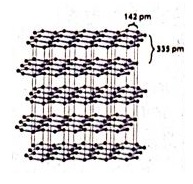
Graphite:
1. Graphite is the most stable allotropic form of carbon at normal temperature and pressure.
2. It is soft and conducts electricity.
3. It is composed of flat two dimensional sheets of carbon atoms.
4. Each sheet is a hexagonal.
5. It is "sp2" hybridised.
6. C-C bond length is 1.41 Å
7. Each C-atom forms three σ bonds with three neighbouring carbon atoms using three of its valence electrons and the fourth electron present in the unhybridised p-orbital form a π-bond.
8. The successive C-sheets are held together by weak Vander Waals forces.
9 The distance successive sheet is 3.40 Å.
10. It is used as a lubricant either on its own or as a graphited oil.
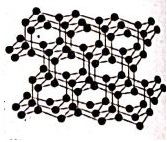
Diamond:
1. It is very hard.
2. It is "sp3" hybridised.
3. C-C bond length is 1.54 Å
4. It is used for sharpening hard tools, cutting glasses, making bores and rock drilling.
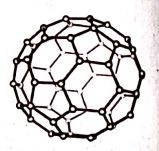
Fullerenes:
1. These allotropes are discrete molecules such as \(C_{32}, C_{50}, C_{60}, C_{70}, C_{76}\) etc.
2. It has cage like structure
3. The C60 molecules have a "soccer" ball like structure and is called buckminster fullerene or buckyballs.
4. It has a fused ring structure consists of 20 six membered rings and 12 five membered ring.
5. Each carbon atom is "sp2" hybridised.
6. It has three σ bonds and a delocalised π bond giving aromatic character to these molecules.
7. The C-C bond distance is 1.44 Å
8. The C=C bond distance is 1.38 Å.
Carbon nanotubes:
1. Carbon nanotubes, another recently discovered allotropes, have graphite like tubes with fullerene ends.
2. Along the axis, these nanotubes are stronger than steel and conduct electricity.
3. These have many applications in nanoscale electronics, catalysis, polymers and medicine.
Graphene:
It has a single planar sheet of "sp2" hybridised carbon atoms that are densely packed in a "honeycomb crystal" lattice.
133.
d) Both assertion and reason are false

12th Standard Syllabus & Materials
12th Standard
TN 12th Computer Applications களப்பெயர் முறைமை (DNS) Sample Question Papers Study Material - QB365 Set A
NEW12th Standard
TN 12th Computer Applications வலையமைப்பு எடுத்துக்காட்டுகள் மற்றும் நெறிமுறைகள் Sample Question Papers Study Material - QB365 Set A
NEW12th Standard
TN 12th Computer Applications கணினி வலையமைப்பு ஓர் அறிமுகம் Sample Question Papers Study Material - QB365 Set A
NEW12th Standard
TN 12th Computer Applications PHP-உடன் MySQL-ஐ இணைத்தல் Sample Question Papers Study Material - QB365 Set A



Tamilnadu Stateboard 12th Standard Subjects

Maths
Chemistry

Physics

Biology

Computer Science

Business Maths and Statistics

Economics

Commerce

Accountancy

History

Computer Applications
Biology
Computer Technology
Computer Applications
Computer Science
Business Maths and Statistics
Commerce
Economics
Maths
Chemistry
Physics
Computer Technology
History
Accountancy

Tamil

English

French
Tamilnadu Stateboard Standards
