
 100% FREE ACCESS
12th Standard Syllabus & Materials
12th Standard
TN 12th Computer Applications மின்னணு தரவு பரிமாற்றம் Sample Question Papers Study Material - QB365 Set A
NEW12th Standard
TN 12th Computer Applications மின் - வணிக பாதுகாப்பு அமைப்புகள் Sample Question Papers Study Material - QB365 Set A
NEW12th Standard
TN 12th Computer Applications மின்னணு செலுத்தல் முறைகள் Sample Question Papers Study Material - QB365 Set A
NEW12th Standard
TN 12th Computer Applications மின் - வணிகம் Sample Question Papers Study Material - QB365 Set A
NEW12th Standard
TN 12th Computer Applications திறந்த மூல கருத்துருக்கள் Sample Question Papers Study Material - QB365 Set A
NEW12th Standard
TN 12th Computer Applications வலையமைப்பு வடமிடல் Sample Question Papers Study Material - QB365 Set A

Published on: 21/02/2020
12th Standard Chemistry Important Question All Chapter II 2020
Download Tamil Nadu 12th Standard Chemistry question papers, model tests, one-mark questions, important questions, and public exam papers in PDF format. Free study materials and answer keys for TN State Board students.
Questions + Answers key
Take MCQ Chemistry Test
1.
The zinc - copper cell has emf of _______.
1V
2.1 V
1.1V
-1.1 V
2.
Benzoic acid, when heated with soda lime gives _________.
C6H5COONa
C6H5COOC6H5
C6H6
C6H5OH
3.
Benzoin is _________.
an ∝ -hydroxy aldehyde
β- hydroxy aldehyde
β-hydroxy ketone
α - hydroxy ketone
4.
The relationship between free energy change and emf of a cell is ______.
∆G = -nFE
∆H = -nF
∆E = -nFG
∆F = -nFG
5.
\(HCHO+{ CH }_{ 3 }-\underset { \overset { || }{ O } }{ C } -{ CH }_{ 3 }\overset { dil }{ \underset { NaOH }{ \longrightarrow } } HO-{ CH }_{ 2 }-{ CH }_{ 2 }-\underset { \overset
{ || }{ \overset { O }{ } } }{ C } -{ CH }_{ 3 }\) is an example of _________ reaction.
4-hydroxy butan-2-one
Claisen Schmidt
Cannizaro
Aldol
Crossed aldol
6.
Kohlrausch's law is applied to calculate ________.
molar conductance at infinite dilution of a weak electrolyte
degree of dissociation of weak electrolyte
solubility of a sparingly soluble salt
all the above
7.
The process of separation of emulsion into two separate layers is called ________.
Emulsification
Deemulsification
Coagulation
Flocculation
8.
Emulsifying agent used for O/W emulsion is: _______.
proteins
heavy metal salts of fatty acids
long chain alcohol
lamp black
9.
According to ________ concept, BF3 acts as a acid.
Bronsted
Arrhenius
Lewis
None of the above
10.
Lower halogenated ethers can be converted into higher ethers by using _______ reagent.
Grignard
Tollen's
Fehling's
none of the above
11.
Which one of the following relationship is correct?
\(pH=\frac { 1 }{ [{ H }^{ + }] } \)
\(pH={ \log }_{ 10 }[{ H }^{ + }]\)
\({ \log }_{ 10 }pH=[{ H }^{ + }]\)
\(pH={ \log }_{ 10 }\frac { 1 }{ [{ H }^{ + }] } \)
12.
The condition for a compound to be precipitated is _______.
Ionic product = solubility product
Ionic product < solubility product
Ionic product > solubility product
Ionic product ≤ solubility product
13.
CH3CH2OH \(\underset { (O) }{ \longrightarrow } \) CH3CHO \(\underset { (O) }{ \longrightarrow } \) CH3COOH To stop the oxidation reaction at the aldehyde stage, ______ is used as an oxidising agent.
KMnO4 | H+
K2Cr2O7 | H+
pyridinium chloro chromate
both (a) and (b)
14.
Which one of the following has the highest boiling point?
CH3CH2CH2CH2CH3
CH3CH2CH2CH2OH
CH3CH2CH2CH3
CH3CH2CH2Cl
15.
The phenomenon of scattering of light by the sol particles is called _______.
tyndall effect
electrophoresis
cataphoresis
dialysis
16.
Which one of the following reaction is an example of disproportionation reaction.
Aldol condensation
cannizaro reaction
Benzoin condensation
none of these
17.
Reaction of acetone with one of the following reagents involves nucleophilic addition followed by elimination of water. The reagent is _______.
Grignard reagent
Sn / HCl
hydrazine in presence of slightly acidic solution
hydrocyanic acid
18.
The reactions
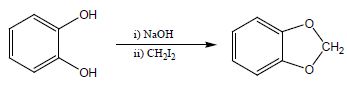 is an example of ______.
Wurtz reaction
cyclic reaction
Williamson reaction
Kolbe reactions
19.
Which one of the is not a surfactant?
CH3 -(CH2)15 -N+ -(CH3)2 CH2Br
CH3 -(CH2)15 -NH2
CH3 -(- CH2- )-16CH2 OSO2- Na+
OHC-(CH2)14 -CH2 -COO- Na+
20.
Fog is colloidal solution of _______.
solid in gas
gas in gas
liquid in gas
gas in liquid
21.
The equivalent conductance of M/36 solution of a weak monobasic acid is 6 mho cm2 equivalent-1 and at infinite dilution is 400 mho cm2 equivalent-1. The dissociation constant of this acid is ______.
1.25 x 10⁻⁶
6.25 x 10⁻⁶
1.25 x 10⁻⁴
6.25 x 10 -5
22.
Which of these is not likely to act as Lewis base?
BF3
PF3
CO
F–
23.
The solubility of BaSO4 in water is 2.42 × 10⁻³gL-1 at 298K. The value of its solubility product(Ksp) will be (Given molar mass of BaSO4 =233g mol-1)
1.08 × 10⁻¹⁴mol2L-2
1.08 × 10⁻¹²mol2L-2
1.08 × 10⁻¹⁰mol2L-2
1.08 × 10⁻⁸mol2L-2
24.
CH3COOCH3 + H2 OH \(\overset { { H }^{ + } }{ \longrightarrow } \) CH3 COOH + CH3 OH is an example of _______ order reaction.
first
zero
third
pseudo
25.
During a chemical reaction, the concentration of reaction _____.
increases
decreases
remains constant
first increases and then decreases
26.
For a reaction, 2A + B ⟶ 3C, The rate of appearance of C at time 't' is 1.2 x 10⁻⁴ mol L-1s-1. Identify the rate of reaction.
4 x 10⁻⁵mol L-1s-1
4.5 x 10⁻¹mol L-1s-1
3.6 x 10⁻⁴ mol L-1s-1
None of these
27.
The incorrect statement among the following is _________.
Reducing character of hydrides of group 15 increases down the group
Basicity of hydrides of group 15 increases down the group
NCl5 does not exist
Phosphorus and arsenic can form P\(\pi \)-d\(\pi \) bond but not nitrogen
28.
Pick the wrong one among the following
F2 - Yellow
Br2 - Red
Cl2 - Colourless
I2- Violet
29.
Which is dibasic?
Orthophosphoric acid
Pyrophosphoric acid
Orthophosphorus acid
Hypophosphorous acid
30.
The force that binds a metal ion to a number of electrons within its sphere of influence is known as_________ bond.
covalent
ionic
metallic
co-ordinate
31.
In an hexagonal crystal _______.
a=b=c,∝ =β=૪=90°
a=b=c,∝ =β=૪≠90°
a=b≠c,∝ =β=૪=90°
a=b≠c,∝ =β=90°૪=120°
32.
Crystalline solids are also called as _______.
supercooled liquids
true solids
pseudo solids
all the above
33.
All elements except carbon have the tendency to show maximum covalency of six ______
due to presence of vacant d-orbitals
due to absence of vacant d-orbitals
due to presence of partially filled d-orbitals
due to presence of completely filled d-orbitals
34.
Chemical formula of phosgene is_______.
COCl2
CaOCl2
CaCO3
COCI
35.
Which one of the following compounds has similar structure to that of graphite?
Boron nitride
Boron Carbide
Aluminium Carbide
Aluminium Oxide
36.
_________ is known as Bayer's reagent.
Hot dilute alkaline KMnO4
Cold dilute alkaline KMnO4
Hot Conc. acidic KMnO4
Cold Conc. acidic KMnO4
37.
Value of magnetic moment of a divalent metal ion is, 5.92 BM. Total number of electron in its atom would be _______.
24
25
26
27
38.
The reaction of aqueous KMnO4 with H2O2 in acidic condition gives_______.
Mn4+ and MnO2
Mn4+ and O2
Mn2+ and O2
Mn2+ and O3
39.
Galena is_______.
PbS
ZnS
Ag2S
FeS2
40.
Steel is an alloy of___________
iron and carbon
iron and calcium
copper and carbon
copper and iron
41.
\({ Zn }_{ (s) }+2\left[ Au(CN)_{ 2 } \right] ^{ - }_{ (aq) }\longrightarrow \left[ Zn(CN)_{ 4 } \right] ^{ 2- }_{ (aq) }+2A{ { u }_{ (s) } }\) In the above equation the oxidation state of metallic gold is_______
1
0
+2
-2
42.
______is used as an antitumor drug in cancer treatment.
Ca - EDTA
Cis - platin
Sodium thio sulphate
Nickel chloride
43.
Consider the following statements and identify the incorrect statement(s).
(i) CN- is a powerful ligand.
(ii) Hemoglobin is a monomer and myoglobin is a tetramer.
(iii) Cis - Pt (NH3)2Cl2 is an anti-tumor drug.
only (i)
only (ii)
only (iii)
both (i) and (iii)
44.
The spin only magnetic moment of [Mnfsr4]2- is 5.9 BM. Geometry of the complex ion is _______.
Tetrahedral
Octahedral
Square planar
Pentagonal pyramidal
45.
In a first order reaction x ⟶ y; if k is the rate constant and the initial concentration of the reactant x is 0.1M, then, the half life is_____.
\(\left( \frac { \log2 }{ k } \right) \)
\(\left( \frac { 0.693 }{ (0.1)k } \right) \)
\(\left( \frac { In2 }{ k } \right) \)
none of these
46.
The addition of a catalyst during a chemical reaction alters which of the following quantities?
Enthalpy
Activation energy
Entropy
Internal energy
47.
48.
Graphite and diamond are ________.
Covalent and molecular crystals
ionic and covalent crystals
both covalent crystals
both molecular crystals
49.
Which one of the following pairs represents linkage isomers?
[Cu(NH3)4][PtCl4] and [Pt(NH3)4][CuCl4]
[Co(NH3)5(NO3)]SO4 and [Co(NH3)5(ONO)]
[Co(NH3)4(NCS)2]Cl and [Co(NH3)4(SCN)2]Cl
both (b) and (c)
50.
A complex has a molecular formula MSO4Cl.6H2O. The aqueous solution of it gives white precipitate with Barium chloride solution and no precipitate is obtained when it is treated with silver nitrate solution. If the secondary valence of the metal is six, which one of the following correctly represents the complex?
[M(H2O)4Cl]SO4.2H2O
[M(H2O)6]SO4
[M(H2O)5Cl]SO4.H2O
[M(H2O)3Cl]SO4.3H2O
51.
When a brown compound of Mn (A) is treated with HCl, it gives a gas (B). The gas (B) taken in excess reacts with NH3 to give an explosive compound (C). The compound A, B and C are ________.
MnO2, Cl2, NCl3
MnO, Cl2, NH4Cl
Mn3O4, Cl2, NCl3
MnO3, Cl2, NCl2
52.
Sc (Z = 21) is a transition element but Zinc (z = 30) is not because _______.
both Sc3+ and Zn2+ ions are colourless and form white compounds
In case of Sc, 3d orbital are partially filled but in Zn these are completely filled
last electron as assumed to be added to 4s level in case of zinc
both Sc and Zn do not exhibit variable oxidation states
53.
The compound that is used in nuclear reactors as protective shields and control rods is _________.
Metal borides
metal oxides
Metal carbonates
metal carbide
54.
The molarity of given orthophosphoric acid solution is 2M. Its normality is _______.
6N
4N
2N
none of these
55.
Which of the following metals has the largest abundance in the earth’s crust?
Aluminium
Calcium
Magnesium
Sodium
56.
Zinc is obtained from ZnO by________.
Carbon reduction
Reduction using silver
Electrochemical process
Acid leaching
57.
Which of the metal is extracted by Hall-Heroult process?
Al
Ni
Cu
Zn
58.
Explain HVZ reaction.
59.
Acetone is soluble in water but benzophenone is not. Give reason.
60.
What are promoters? Give an example.
61.
What is the formula for Ziegler - Natta catalyst?
62.
Explain how iron is protected from corrosion by coating with magnesium.
63.
Name the anode, cathode and electrolyte used in lithium - ion Battery
64.
State Saytzeff's rule.
65.
How will you convert of ethylene glycol to 1,4 - dioxane.
66.
Calculate the ionisation constant for the conjugate base of HF. Ionisation constant of HF at 298 K is 6.8 x 10⁻⁴
67.
Magnesium is not precipitated from a solution of its salt by a mixture of NH4OH and NH4Cl. Explain
68.
Calculate the pH of 0.001M HCl solution
69.
70.
Account for the acidic nature of HClO4 in terms of Bronsted – Lowry theory, identify its conjugate base.
71.
What is hydroformylation of olefins?
72.
(i) Name the element showing maximum number of oxidation states among the first series of transition, metals from Sc (Z= 21) to Zn (Z=30).
(ii) Name the element which shows only +3 oxidation state.
73.
A first order reaction has a specific reaction rate of 10-3 S-1. How much time will it take for 10gm of the reactant to reduce to 2.5 gm?
74.
Why is instantaneous rate preferred over average rate?
75.
Give the reason for bleaching action of Cl2.
76.
How is nitrogen prepared from liquid air?
77.
A compound made up of two atoms X and Y has a face centred cubic arrangement. X is present in the coners and Y at the centre of each face. If one atom is missing from corner. What is the simplest formula of the compound.
78.
Why do solids have a definite volume?
79.
Among group 14 elements, name
(i) the most electro negative element
(ii) the most metallic element
80.
What is tetraethoxy silane? How is it obtained?
81.
What are the different methods of concentration of ores?
82.
Name some reducing agents used to convert Metal oxides to metal
83.
Give the geometry and magnetic character of [NiCI4]2-
84.
Write the IUPAC name of [Cu(NH3)4]SO4
85.
Explain the oxidation states of 4d series elements.
86.
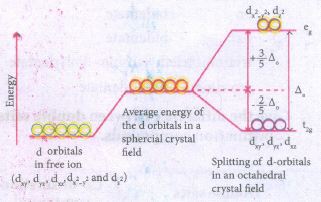
In an octahedral crystal field, draw the figure to show splitting of d orbitals
87.
[CuCl4]2- exists while [Cul4]2- does not exist why?
88.
Write the IUPAC names for the following complexes.
89.
Write a short note on hydroboration.
90.
Give the oxidation state of halogen in the following.
a) OF2
b) O2F2
c) Cl2O3
d) I2O4
91.
Chalcogens belongs to p-block. Give reason.
92.
Give the structure of CO and CO2.
93.
What are the various steps involved in the extraction of pure metals from their ores?
94.
Formaldehyde and benzaldehyde give Cannizaro reaction but acetaldehyde does not - account for this.
95.
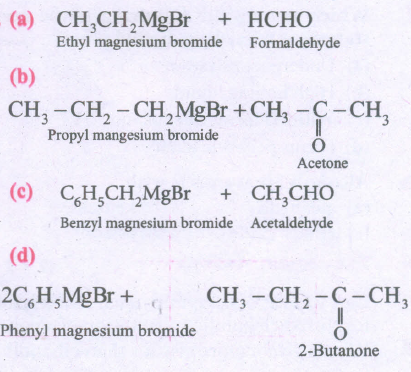
Give the Grignard reagent and carbonyl compound that can be used to prepare.
(a) CH3-CH2-CH2-OH
(b) (CH3)2C(OH)CH2CH2CH3
(c) C6H5CH2CH(OH)CH3
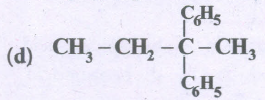
96.
Define adsorption.
97.
What is the oxidation and reduction half cell in a Daniel cell?
98.
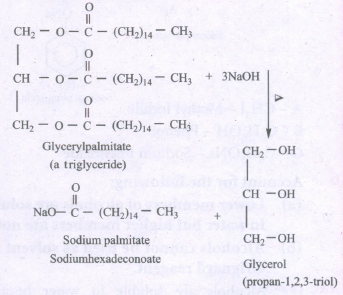
Explain the manufacture of glycerol from triglycerides,
99.
Based on Arrhenius concept, defame acid and bases and give an example for each.
100.
A current of 1.608A is passed through 250 mL of 0.5M solution of copper sulphate for 50 minutes. Calculate the strength of Cu2+ after electrolysis assuming volume to be constant and the current efficiency is 100%.
101.
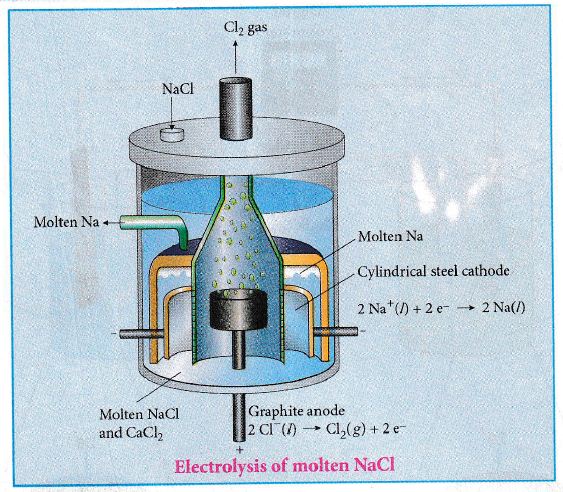
Describe the electrolysis of molten NaCl using inert electrodes
102.
50ml of 0.05M HNO3 is added to 50ml of 0.025M KOH. Calculate the pH of the resultant solution.
103.
The rate constant for a first order reaction is 60 S-1. How much time will it take to reduce the initial concentration of the reactant to its \({ \frac { 1 }{ 16 } }^{ th }\) value?
104.
Give reason for the following:
(i) A transition metal exhibits highest oxidation state in oxides and fluorides.
(ii) Cu2+ is unstable in an aqueous solution.
105.
What is Haber's process?
106.
Inspite of long range order in the arrangement of particles, why are the crystals usually not perfect?
107.
How is aluminum chloride prepared from aluminum?
108.
Write the chemical composition of the following alloys and give anyone of its application.
(i) Bronze
(ii) Brass
(iii) Stainless steel
109.
Draw the structures of geometrical isomers of [Fe(NH3)2 (CN)4]-
110.
Hydrolysis of methyl acetate in aqueous solution has been studied by titrating the liberated acetic acid against sodium hydroxide. The concentration of an ester at different temperatures is given below.
| t(min) | 0 | 20 | 40 | 60 | ∝ |
|---|---|---|---|---|---|
| v (ml) | 20.2 | 25.6 | 29.5 | 32.8 | 50.4 |
Show that the reaction is the first order reactions.
111.
Explain the effect of catalyst on reaction rate with an example.
112.
Explain the rate determining step with an example.
113.
Which is more stable? Fe3+ or Fe2+? Why ?
114.
What are transition metals? Give four examples.
115.
Write the reason for the anomalous behaviour of Nitrogen.
116.
117.
Assertion: Phenol is more reactive than benzene towards electrophilic substitution reaction
Reason: In the case of phenol, the intermediate arenium ion is more stabilized by resonance
Codes:
a) if both assertion and reason are true and reason is the correct explanation of assertion.
b) if both assertion and reason are true but reason is not the correct explanation of assertion.
c) assertion is true but reason is false
d) both assertion and reason are false.
if both assertion and reason are true and reason is the correct explanation of assertion.
if both assertion and reason are true but reason is not the correct explanation of assertion.
assertion is true but reason is false
both assertion and reason are false.
118.
Assertion: pure iron when heated in dry air is converted with a layer of rust.
Reason: Rust has the composition Fe3 O4
Codes:
a) if both assertion and reason are true and reason is the correct explanation of assertion
b) if both assertion and reason are true but reason is not the correct explanation of assertion
c) assertion is true but reason is false
d) both assertion and reason are false
if both assertion and reason are true and reason is the correct explanation of assertion
if both assertion and reason are true but reason is not the correct explanation of assertion
assertion is true but reason is false
both assertion and reason are false
119.
120.
An organic compound (A) with molecular formula C3H6O undergoes iodoform reaction. Two molecules of compound (A) react with dry HCI to give compound (B) (C6H10O). Compound (B) reacts with one more molecule of compound (A) to give compound (C) (C9H14O). Identify (A), (B) and (C). Explain the reactions.
121.
Distinguish between (a) Ethanol and phenol (b) Phenol and acetic acid (c) Phenol and aniline (d) Phenol and anisole.
122.
Explain the factors affecting adsorption.
123.
Specific conductance of 1M KNO3 solution is oberved to be 5.55 x 10⁻³ mho cm2. What is the equivalent conductance of KNO3 when one litre of the solution is used?
124.
A 0.02 M solution of a weak mono basic acid is 5% ionised. Calculate the ionisation constant of the acid.
125.
State Kohlrausch Law. How is it useful to determine the molar conductivity of weak electrolyte at infinite dilution.
126.
Reaction is first order in A and second in B.
(i) Write the different rate equation.
(ii) How is the rate affected on increasing the concentration of B three times?
(iii) How is the rate affected when the concentrations of both A and B are doubled?
127.
Why is there a variation of atomic and ionic size as we move from Sc to Zn?
128.
Explain the bleaching action of Chlorine.
129.
How can you determine the atomic mass of an unknown metal if you know its density and the dimension of its unit cell? Explain.
130.
What are the various methods by which carbon-di-oxide is prepared?
131.
List the applications of iron.
132.
Indicate the types of isomerism exhibited by the following complexes and draw the structures for these isomers.
(i) K[Cr(H2O)2 (C2O4)2]
(ii) [Co(en)3]CI3
(iii) [Co(NH3)5(NO2)](NO3)2
(iv) [Pt (NH3)(H2O)CI2]
1.
(c)
1.1V
2.
(c)
C6H6
3.
(d)
α - hydroxy ketone
4.
(a)
∆G = -nFE
5.
(d)
Crossed aldol
6.
(d)
all the above
7.
(b)
Deemulsification
8.
(a)
proteins
9.
(c)
Lewis
10.
(a)
Grignard
11.
(d)
\(pH={ \log }_{ 10 }\frac { 1 }{ [{ H }^{ + }] } \)
12.
(c)
Ionic product > solubility product
13.
(c)
pyridinium chloro chromate
14.
(b)
CH3CH2CH2CH2OH
15.
(a)
tyndall effect
16.
(b)
cannizaro reaction
17.
(c)
hydrazine in presence of slightly acidic solution
18.
(c)
Williamson reaction
19.
(b)
CH3 -(CH2)15 -NH2
20.
dispersion medium-gas
dispersed phase-liquid
21.
α = Λ/Λo
= 6/400
Ka = α2C
\(= \frac{6}{400} \times \frac{6}{400} \times \frac{1}{36}\)
= 6.25 x 10⁻⁶
22.
BF3 → electron deficient → Lewis acid
PF3 → electron rich → Lewis base
CO → having lone pair of electron → Lewis base
F → unshared pair of electron → Lewis base
23.
BaSO4 ⇌ Ba2+ + SO42-
Ksp = (s) (s)
Ksp = (s)2
= (2.42 × 10⁻³gL-1)2
\(=\frac{2.42 \times 10^{-3} gL^{-1}}{233 \text{ g mol}^{-1}}\)
= (0.01038 x 10⁻³)2
= (1.038 x x 10-5)2
= 1.077 x 10-10
= 1.08 × 10⁻¹⁰mol2L-2
24.
(d)
pseudo
25.
(b)
decreases
26.
(a)
4 x 10⁻⁵mol L-1s-1
27.
(d)
Phosphorus and arsenic can form P\(\pi \)-d\(\pi \) bond but not nitrogen
28.
(c)
Cl2 - Colourless
29.
(c)
Orthophosphorus acid
30.
(c)
metallic
31.
(d)
a=b≠c,∝ =β=90°૪=120°
32.
(b)
true solids
33.
(a)
due to presence of vacant d-orbitals
34.
(a)
COCl2
35.
(a)
Boron nitride
36.
(b)
Cold dilute alkaline KMnO4
37.
(b)
25
38.
(c)
Mn2+ and O2
39.
(a)
PbS
40.
(a)
iron and carbon
41.
(b)
0
42.
(b)
Cis - platin
43.
(b)
only (ii)
44.
(a)
Tetrahedral
45.
\(k=\frac { 1 }{ t } ln \frac { \left[ { A }_{ 0 } \right] }{ \left[ A \right] } \)
[A0] = 0.1: [A] = 0.05
\(k= \left[ \frac { 1 }{ t _{1/2}} \right] ln\left[ \frac { { 0.1 } }{ 0.05 }\right] \)
\(k= \left[ \frac { 1 }{ t _{1/2}} \right] ln (2)\)
t1/2 = In(2)/K
46.
A catalyst provides a new path to the reaction with low activation energy. i.e., it lowers the activation energy.
47.
(c)
48.
(c)
both covalent crystals
49.
(a) coordination isomers
(b) no isomerism ( different molecular formula)
(c)⬅NCS; ⬅SCN coordinating atom differs : linkage isomers
50.
Molecular formula: MSO4Cl.6H2O
Formation of white precipitate with Barium chloride indicates that SO2-4 ions are outside the coordination sphere, and no precipitate with AgNO3 solution indicates that the Cl- ions are inside the coordination sphere. Since the coordination number of M is 6.Cl- and 5 H2O are ligands, remaining 1 H2O molecular and SO2-4 are in the outer coordination sphere.
51.
(a)
MnO2, Cl2, NCl3
52.
(b)
In case of Sc, 3d orbital are partially filled but in Zn these are completely filled
53.
(a)
Metal borides
54.
(a)
6N
55.
(a)
Aluminium
56.
(a)
Carbon reduction
57.
(a)
Al
58.
(i) Carboxylic acids having an a -hydrogen are halogenated at the a -position on treatment with chlorine or bromine in the presence of small amount of red phsosphorus to form a halo carboxylic acids. This reaction is known as Hell - Volhard - Zelinsky reaction (HVZ reaction)
(Ii) The α - Halogenated acids are convenient starting materials for preparing α - substituted acids.
59.
Acetone is soluble in water due to the intermolecular hydrogen bonding between polar carbonyl group and water molecules. In benzophenone, the phenyl groups are bulkier so C = 0 cannot form hydrogen bonds with water due to steric hindrance.
60.
(i) A substance which, though itself not a catalyst, promotes the activity of a catalyst is called a promotor.
(ii) Eg: In the Haber's process for the synthesis of ammonia, traces of molybdenum increase the activity of finely divided iron which acts as acatalyst.
\({ N }_{ 2 }+{ 3H }_{ 2 }\overset { Fe }{ \underset { +mo }{ \leftrightharpoons } } { 2NH }_{ 3 }\)
61.
TiCl4 + (C2H5)3AI.
62.
In this technique, metals such as Mg or zinc which is corroded more easily than iron can be used as a sacrificial anode and the iron material acts as a cathode. So iron is protected, but Mg or Zn is corroded.
63.
(i) Anode: Porous graphite
(ii) Cathode: Transition metal oxide such as CoO2
(iii) Electrolyte: Lithium salt in an organic solvent
64.
During intramolecular dehydration, if there is a possibility to form a carbon-carbon double bond at different locations, the preferred location is the one that gives the more (highly) substituted alkene i.e., the stable alkene.
65.
When ethylene glycol is treated with cone. H2SO4 two molecules of water are removed and the product formed is dioxane.
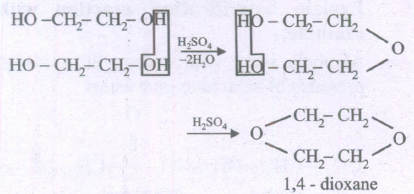
66.
The conjugate base of HF is F-
For F-, \({ K }_{ b }=\frac { { K }_{ w } }{ { K }_{ a } } =\frac { { 10 }^{ -14 } }{ { 6.8\times 10 }^{ -14 } } \)
= 1.47 x 10⁻¹¹.
67.
Magnesium has to precipitate as Mg(OH)2 when treated with NH4OH, but addition of NH4CI will suppress the ionisation of NH4OH due to common ion effect. So ionic product of Mg2+ and OH- ions will be less than the solubility product (Ksp) of Mg(OH)2. Hence will not precipitate.
68.
\(\underset{0.001M}{HCl}\overset{H_{2}O}{\rightleftharpoons }\underset{0.001M}{H_{3}O^{+}}+\underset{0.001M}{Cl^{-}}\)
H3O+ from the auto ionisation of H2O (10-7M) is negligible when compared to the H3O+ from 10-3M HCl.
Hence [H3O+] = 0.001 mol dm-3
pH = -log10 [H3O+]
= -log10(0.001)
= -log10(10-3) = 3
69.
70.
\(\mathrm{HClO}_{4} \rightleftharpoons \mathrm{H}^{+}+\mathrm{ClO}_{4}^{-}\)
Bronsted Acid Proton Conjugate Base
HClO4 can donate a proton. Therefore HClO4 is an acid. Its conjugate base is ClO4-
71.
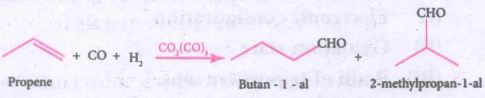
72.
(i) Mn (manganese) shows the maximum number of oxidation state.
(ii) Scandium shows only +3 oxidation state
73.
\({ k }=2.303\log { \frac { \left[ { A }_{ 0 } \right] }{ \left[ A \right] } } \)
\(t=\frac { 2.303 }{ { 10 }^{ -3 } } \log { \frac { 10 }{ 2.5 } } \)
t = 2303 x 0.301 x 2 = 1386 s.
74.
Rate decreases with time as the reaction proceeds and the average rate cannot be used to predict the rate of the reaction at any instant. The rate of the reaction, at a particular instant during the reaction is called the instantaneous rate. So instantaneous rate in prepared over average rate.
75.
(i) Bleaching action of Cl2 is due to its oxidising property.
(ii) In aqueous solution, Cl2 liberates nascent oxygen which brings about the oxidation of coloured substances present in vegetables and organic matter to colourless substances.
\(\mathrm{Cl}_{2}+\mathrm{H}_{2} \mathrm{O} \rightarrow 2 \mathrm{HCl}+\mathrm{[O}]\)
Coloured substance +[O] → colorless substance.
76.
(i) Nitrogen is separated industrially from liquid air by fractional distillation.
(ii) Pure nitrogen gas can be obtained by the thermal decomposition of sodium azide about 575K.
\(2Na{ N }_{ 3 }\longrightarrow 2Na+{ 3N }_{ 2 }\)
77.
No. of atoms of X at the corners = 8 - 1 = 7
(since 1 is missing)
Contribution of X towards unit cell
\(=7\times \frac { 1 }{ 8 } =\frac { 7 }{ 8 } \)
No. of atoms of Y at the face centres = 6
Contribution of Y towards unit cell
= 6 x \(\frac{1}{2}\) = 3
Ratio of X : Y = \(\frac{7}{8}\) : 3 = 7:24
Formula of the compound is X7 Y24.
78.
(i) The intermolecular forces of attraction that are present in solids are very strong.
(ii) The constituent particles of solids have fixed position.
(iii) Hence, solids have a definite volume.
79.
(i) Carbon
(ii) Lead (metallic character increases on going down the group).
80.
Tetraethoxy silane is Si(OC2H5)4·The chloride ion in silicon tetrachloride can be substituted by nucleophile such as OH, OR, etc .. using suitable reagents. For example, it forms silicic esters with alcohols.
\(Si{ Cl }_{ 4 }+{ C }_{ 2 }{ H }_{ 5 }OH\longrightarrow \underset { Tetraethoxy\ silane }{ Si({ OC }_{ 2 }{ H }_{ 5 })_{ 4 } } +4HCl\).
81.
(i) Hydraulic washing or gravity separation
(ii) Froth flotation
(iii) Electromagnetic separation
(iv ) Chemical method.
82.
Metal oxides to metal : Carbon, carbon monoxide, hydrogen, aluminum and metals like sodium.
83.
Tetrahedral, paramagnetic.
84.
Tetraammine copper (II) sulphate.
85.
The oxidation states of 4d metals vary from +3 for Y to +8 for Ru and Os.
The highest oxidation state of 4d elements are found in their compounds with the higher electronegative elements like O, F & Cl.
Example: In RuO4, OsO4 & WCl6
The oxidation state of Ru and Os is +8.
The oxidation state of W is +6.
Generally in going down a group, a stability of higher oxidation state increases while that of lower oxidation state decreases.
4d series (5th period) - Yttrium to Cadmium (10 elements)
| Elements | Oxidation states |
|---|---|
| Y | +3 |
| Zr | +3, +4 |
| Nb | +2, +3, +4, +5 |
| Mo | +2, +3, +4, +5, +6 |
| Tc | +2, +4, +5, +7 |
| Ru | +2, +3, +4, +5, +6, +7 +8 |
| Rh | +2, +3, +4, +6 |
| Pd | +2, +3, +4 |
| Ag | +1, +2, +3 |
| Cd | +2 |
86.
The energy of the two eg orbitals will increase by \(\frac{3}{5} \Delta_{O}\) and that of the three t2g will decrease by (2/5) \(\Delta_{O}\)
87.
In [CuCI4]-2 Cu2+, is reduced to Cu+ by I-. Hence Cupric Iodide in converted to cuprous Iodide so [CuI4]-2 does not exist. In [CuCI4]-2 Cl- cannot effect this change and so exists.
88.
i) Na2[Ni(EDTA)] - Sodium 2, 2', 2",2'" - (ethane-1,2 diyldinitrilo tetraacetatonickelate)(II)
ii) [Ag(CN)2]- - Dicyanido-kC-argentate (I) ion
iii) [CO(en)3]2(SO4)3 - Tris (ethane 1, 2 diamine)cobalt (III) sulphate
iv) [CO(ONO)(NH3)5]2+ - Pentaamminenitrito - KO cobalt (III) ion
v) [Pt(NH3)2Cl(NO2)] - Diammainechloridonitro - kN - platinum (II)
89.
Diborane adds on to alkenes and alkynes in ether solvent at room temperature. This reaction is called hydroboration.
\({ B }_{ 2 }{ H }_{ 6 }+6RCH=CHR\longrightarrow 2B(RCH_2-{ CH }R)_{ 3 }B\)
90.
(a) OF2
+ 2 + 2(x) = 0
+2 = -2x
2 x = -2 ⇒ x = -1
(b) O2F2
2(+1) + 2x = 0
2x = -2
x = -1
(c) Cl2O3
2(x) + 3(-2) = 0
2x = +6
x = +3
(d) I2O4
2(x) + 4(-2) = 0
2x = +8
x = +4
91.
(i) The Chalcogens belong to group (16).
(ii) The group consists of elements: Oxygen, Sulphur, Selenium, Tellurium and Polonium.
(iii) These are ore forming elements as most of the ores are oxides and sulphides.
(iv) Chalcos meaning 'ore formers'.
92.
| Oxides of Carbon | Structure | Parameters |
| CO |  |
Three electron pairs are shared between carbon and oxygen. The C-O bond distance is 1.128\(\overset{o}{A}\). |
| CO2 |  |
Equal bond distance for the both C-O bonds. Two C-O sigma bond, It has 3c-4e bond. |
93.
(i) Concentration of the ore
(ii) Extraction of crude metal
(iii) Refining of crude metal
94.
(i) Cannizzaro reaction is a redox reaction which takes place only in aldehydes which do not have α- hydrogen atom.
(ii) Formaldehyde (HCHO) and benzaldehyde (C6H5CHO) do not have a-hydrogen atom and so they undergo Cannizzaro reaction.
(iii) But acetaldehyde CH3CHO contains 3 α-H atoms and it does not undergo Cannizzaro reaction.
95.
96.
"Adsorption is a phenomenon of concentration of substance on the surface of liquid or solid" (or) "The condition in which concentration of a substance in the interfacial layers between two phases is greater than in the bulk of either phase, then the substance is said to be adsorbed at the interface and the phenomenon is known as adsorption".
97.
Oxidation half cell : A metallic zinc strip that dips into an aqueous solution of zinc sulphate taken in a beaker.
Reduction half cell : A copper strip that dips into an aqueous solution of copper sulphate taken in a beaker.
98.
Glycerol occurs in many natural fats and it is also found in long chain fatty acids in the form of glyceryl esters (Triglycerides). The alkaline hydrolysis of these fats gives glycerol and the reaction is known as saponification.
99.
According to Arrhenius, an acid is a substance that dissociates to give hydrogen ions in water. For example, HCl, H2SO4 etc., are acids. Their dissociation in aqueous solution is expressed as
\({ HCl }_{ (g) }\overset { { H }_{ 2 }O }{ \rightleftharpoons } { H }_{ (aq) }^{ + }+{ Cl }_{ (aq) }^{ - }\)
Similarly a base is a substance that dissociates to give hydroxyl ions in water. For example, substances like NaOH, Ca(OH)2 etc., are bases.
\({ Ca(OH) }_{ 2 }\overset { { H }_{ 2 }O }{ \rightleftharpoons } { Ca }_{ (aq) }^{ 2+ }+{ 2OH^- }_{ (aq) }\)
100.
Given : I = 1.608A;
t = 50 min = 50 \(\times\) 60 = 3000sec ; S = 250 mL;
C = 0.5 M ; \(\eta=100%\)%
i) Q = It (I = Q / t)
= 1.608 x 3000 = 4824 Columb
No. of Faradays of electricity \(=\frac{4824}{96500}=0.04 \mathrm{~F}\)
ii) Electrolysis of CuSO4
\(\mathrm{Cu}_{(\mathrm{aq})}^{2+}+2 \mathrm{e}^{-} \rightarrow \mathrm{Cu}_{(\mathrm{s})}\)
\(\therefore\) 2 F electricity will deposit 1 mole of Cu2+ to Cu
\(\therefore\) 0.05 F electricity will deposit
\(x=\frac{1 \times 0.05}{2}=0.025\) mole
Initial No. of moles of Cu2+ in 250 ml of solution \(=\frac{0.5}{1000} \times 250 \) mole = 0.125 moles
\(\therefore\) No. of moles of Cu2+ after elettrolysis = 0.125 - 0.025 = 0.1 mole
\(\therefore\) concentration of Cu2+
\(=\frac{0.1}{250} \times 1000=0.4 \mathrm{M}\)
101.
(i) The electrolytic cell consists of two iron electrodes dipped in molten sodium chloride and they are connected to an external DC power supply via a key as shown in the figure. The electrode which is attached to the negative end of the power supply is called the cathode, and the one which attached to the positive end is called the anode. Once the key is closed, the external DC power supply drives the electrons to the cathode and at the same time pull the electrons from the anode.
Cell reactions:
Na+ ions are attracted towards cathode, where they combines with the electrons and reduced to liquid sodium.
Cathode (reduction)
\(N a_{(l)}^{+}+e^{-} \rightarrow N a_{(l)} \quad ; \quad E^{0}=-2.71 V\)
Similarly, Cl- ions are attracted towards anode where they lose their electrons and oxidised to chlorine gas.
Anode (oxidation)
2CI-(l) ⟶ CI2(g) + 2e- E0 = -1.36V
The overall reaction is
2Na+(l) + 2Cl-(l)➝ 2Na(l) + Cl2(g) ; E° = - 4.07V
(ii) The negative E° value shows that the above reaction is a non-spontaneous one.
(iii) Hence, we have to supply a voltage greater than 4.07V to cause the electrolysis of molten NaCI.
(iv) In electrolytic cell, oxidation occurs at the anode and reduction occur at the cathode as in a galvanic cell.
(v) But the sign of the electrodes is the reverse i.e., in the electrolytic cell cathode is -ve and anode is +ve.
102.
\(\mathrm{M} =\frac{\mathrm{V}_{1} \mathrm{M}_{1}-\mathrm{V}_{2} \mathrm{M}_{2}}{\mathrm{~V}_{1}+\mathrm{V}_{2}} \)
\(=\frac{(50 \times 0.05)-(50 \times 0.025)}{50+50} \)
\(\text { Molarity }=\frac{\text { Number of millimoles }}{\mathrm{V}_{\mathrm{m} l}}\)
\(=\frac{2.5-1.25}{100}=\frac{1.25}{100}=0.0125 \mathrm{M} \)
\(\mathrm{pH} =-\log _{10}\left[\mathrm{H}^{+}\right] \)
\(=-\log _{10} 0.0125 \)
Normality = Molarity \(\times\) basicity
\(=-\log _{10}\left(1.25 \times 10^{-2}\right) \)
\(=-\left[\log _{10} 1.25-2 \log _{10} 10\right] \)
\(=2-\log _{10} 1.25=2-0.0969 \)
pH = 1.9031
103.
It is know that,
\(t=\frac { 2.303 }{ k } \log { \frac { { \left[ R \right] }_{ 0 } }{ \left[ R \right] } } \)
= \(\frac { 2.303 }{ 60{ s }^{ -1 } } \log\frac { 1 }{ \frac { 1 }{ 16 } } \)
= \(\frac { 2.303 }{ 60{ s }^{ -1 } } \log16\)
= 4.6 x 10⁻² s (approximately)
Hence the required time is 4.6 x 10⁻² s
104.
(i) The highest oxidation state in oxides and fluorides is due to small size and high electro negativity of F and O.
(ii) Many Cu+ compounds are unstable in aqueous solution and undergo disproportionation.
2Cu+ ⟶ Cu2++ Cu
This suggest that in aqueous solution Cu+(aq), converts into Cu2+(aq) which is due to much more negative Δhyd H- of Cu2+(aq) than Cu+, which compensates more for the second ionisation enthalpy of Cu.
105.
Direct reaction of nitrogen with hydrogen gives ammonia. This reaction is favored by high pressures and at optimum temperature in presence of iron catalyst.
\(\cfrac { 1 }{ 2 } { N }_{ 2 }+\cfrac { 3 }{ 2 } { H }_{ 2 }\rightleftharpoons { 2NH }_{ 3 }\)\(\Delta H_f { }_{ }=-46.2KJmol^{ -1 }\)
106.
i) Crystals have long range repeated pattern of arrangement of constituent particles but in the process of crystallisation.
ii) Some deviations from the ideal arrangement may be introduced because the constituent particles may not get sufficient time to arrange themselves in a perfect order. Therefore, crystals are usually not perfect.
107.
(i) When aluminium metal or aluminium hydroxide is treated with hydrochloric acid, aluminium trichloride is formed.
(ii) The reaction mixture is evaporated to obtain hydrated aluminium chloride.
2Al + 6HCl ⟶ 2AICl3 + 3H2
Al(OH)3 + 3HCl ⟶ AlCl3 + 3H2O
108.
| Alloy | Composition | Application |
|---|---|---|
| Bronze | Cu- 80%, Zn-10%, Sn-10% |
Making utensils, statutes, coins, etc. |
| Brass | Cu-60%, Zn-40% |
Making utensils, wires, pairs of machine etc |
| Stainless steel | Fe-73%, Cr-18%, Ni- 8% and CF -1% |
Making utensils, cutlery, cycles, etc. |
109.
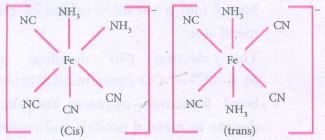
110.
\(k=\frac { 2.303 }{ t } \log\frac { \left( { V }_{ \infty }-{ V }_{ 0 } \right) }{ \left( { V }_{ \infty }-{ V }_{ 0 } \right) } \)
\(k=\frac { 2.303 }{ 20 } \log\frac { 50.4-20.2 }{ 50.4-25.6 } \)
\(=0.1151 \log\frac { 30.2 }{ 24.8 } \)
= 0.1151 log 1.2479
= 0.1151 x 0.0959
= 11.03 x10⁻³ min-1
When t = 40 mts
\(k=\frac { 2.303 }{ 40 } \log\frac { 50.4-20.2 }{ 50.4-25.6 } \)
\(=0.0576\times \log\frac { 30.2 }{ 20.9 } \)
= 9.19 x 10⁻³ min-1
When t = 60 mts
\(k=\frac { 2.303 }{ 60 } \log\frac { 50.4-20.2 }{ 50.4-25.6 } \)
\(=0.03838\times \log\frac { 30.2 }{ 17.6 } \)
= 0.03838 x 0.2343
= 8.99 x 10⁻³ min-1
The constant values of K show that the reaction is of first order.
111.
(i) A catalyst is substance which alters the rate of a reaction without itself undergoing any permanent chemical change. They may participate in the reaction, but again regenerated and the end of the reaction. In the presence of a catalyst, the energy of activation is lowered and hence, greater number of molecules can cross the energy barrier and change over to products, thereby increasing the rate of the reaction.
(ii) The reaction between KMnO4 and H2SO4 and oxalic acid is catalysed by MnSO4 and increases the rate of oxidation of C2O42- by MnO4-.
112.
(i) The step which has the lowest rate value among the other steps of the reaction is called as the rate determining step (or) rate limiting step: (or)
(ii) The overall rate of a reaction is controlled by the slowest step in a reaction called the rate determining step.
Example:
\(2 \mathrm{~A}+\mathrm{B} \rightarrow \mathrm{C}+\mathrm{D}\) going by two steps like,
\( \mathrm{A}+\mathrm{B} \stackrel{\mathrm{k}_{1}}{\longrightarrow} \mathrm{C}+\mathrm{Z}-(1) \text { Step }(\text { slow }) \)
\(Z+A \stackrel{k_{2}}{\longrightarrow} D-(2) \text { Step }(\text { fast }) \)
Over all reaction: \(2 \mathrm{~A}+\mathrm{B} \rightarrow \mathrm{C}+\mathrm{D}\)
Here \(A+B \underset{\text { Slow }}{\stackrel{K_{1}}{\longrightarrow}} C+Z\), step is the rate determining step. For the decomposition of hydrogen peroxide catalysed by I-.
2H2O2(aq)\(\rightarrow\) 2H2O(I) + O2(g)
It is experimentally found that the reaction is first order with respect to both H2,O2, and I-, which indicates that I- is also involved in the reaction. The mechanism involves the following steps.
Step: 1
H2O2(aq)+I-1(aq) \(\rightarrow\) H2O(l)+OI-1(aq)
Step: 2
H2O2(aq)+OI-1(aq)\(\rightarrow\) H2O + I-(aq) + O(g)
Overall reaction is
2H2O2(aq) \(\rightarrow\) 2H2O(l) + O2(g)
These two reactions are elementary reactions. Adding equation (1), and (2) gives the overall reaction. Step 1 is the rate determining step, since it involves both H2,O2 and I-, the overall reaction is bimolecular.
113.
(i) Fe3+ - electronic configuration - [Ar] 3d5
(ii) It has exactly half-filled stable electronic configuration.
(iii) Fe2+ - electronic configuration -[Ar]3d6
(iv) It has only partially filled d-orbitals.
Hence Fe3+ is more stable than Fe2+.
114.
IUPAC defines transition metal as an element whose atom has an incomplete d-sub shell or which can give rise to cations with an incomplete d-sub shell. They occupy the central position of the periodic table, between s and p-block elements.
Examples: Fe, Cu, Ag, Au
115.
(i) Its small size
(ii) Its high electronegativity
(iii) Its high ionisation energy
(iv) Non-availability of d-orbital in the valence shell.
(v) Rather inert
(vi) High bond energy
116.
117.
a) if both assertion and reason are true and reason is the correct explanation of assertion.
118.
d) both assertion and reason are false
119.
(d)
120.
(i) Compound (A) with molecular formula C3H6O that undergoes iodoform reaction is CH3COCH3 (A) (acetone).
(ii) Two molecules of (A) react with dry HCl to give compound (B).

(iii) Compound (B) reacts with (A) to give compound (C).
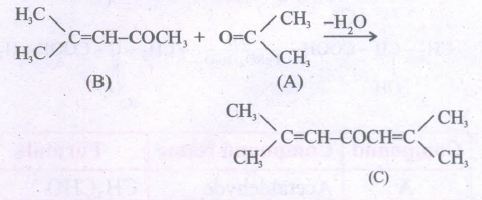
| Compound | Compound Name | Formula |
| A | Acetone | 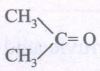 |
| B | Mesityl oxide | 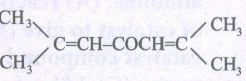 |
| C | Phorone | 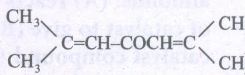 |
121.
| a. | Ethanol | Phenol |
| i. | It does not give violet colour with neutral FeCI3 | It gives violet colour with netural FeCI3 |
| ii. | It does not declourise bromine water (no electroplilic substitution). |
It declourises Br/H2O and the product formed is 2, 4, 6-tribromo (electrtophilic substitution). |
| a. | Phenol | Acetic acid |
| i. | It gives violet colour with neutral FeCI3. | It does not give violet colour with netural FeCI3. |
| ii. | It undergoes electrophilic substitution reaction at ortho & para position. |
It does not undergo electrophilic substitution |
| a. | Phenol | Aniline |
| i. | It does not undergo diazotisation reaction at all temperature |
It undergo diazotisation reaction at 0 C0. |
| ii. | It undergoes condensation polymerisation with HCHO to produce bakelite |
It does not undergo condensation polymerisation reaction with HCHO. |
| a. | Phenol | Anisole |
| i. | It gives violet colour with neutral FeCI3. | It does not give violet colour with neutral FeCI3. |
| ii. | It undergoes coupling reaction with ben- zene diazonium chlo ride to give 'red dye'. |
It does not undergo coupling reaction with benzene diazonium chloride. |
122.
Factors affecting adsorption:
The adsorption is well understood by considering I the various factors affecting it. Qualitatively, the extent of surface adsorption depends on
(i) Nature of adsorbent
(ii) Nature of adsorbate
(iii) Pressure
(iv) Concentration at a given temperature.
(i) The adsorption is a surface phenomenon: it depends on the surface area of adsorbent. i.e., higher the surface area, higher is the amount adsorbed.
(ii) Nature of adsorbate:
The nature of adsorbate can influence the adsorption. Gases like SO2, NH3, HCI and CO2 are easily liquefiable as have greater vander waal's force of attraction. On the other hand, permanent gases like H2, N2 and O2 cannot be liquefied easily. These permanent gases are having low critical temperature and adsorbed slowly, while gases with high critical temperature are adsorbed readily.
(iii) Effect of temperature:
Chemical adsorption is fast with increase pressure, it cannot alter the amount. In Physisorption, when pressure increases the amount of adsorption increases.
(iv) Effect of pressure:
When pressure increases, adsorption becomes steadily increase in case of chemisorption and increases in case of physisorption.
123.
Given:
Specific conductance = K = 5.55 x 10⁻³ mho cm-1
Concentration C = 1M
Volume = 1 litre.
Formula: Equivalent conductance = K x V
= \(\frac { k\times 1000 }{ C } \)
Solution:
\(\frac { { 5.55\times 10 }^{ -3 }\times 1000 }{ 1 } =5.55\times { 10 }^{ -3 }\times { 10 }^{ -3 }\)
124.
The degree of ionisation and the dissociation constant of the weak acid are related by the equation.
\({ K }_{ a }=\frac { { \alpha }^{ 2 }{ C } }{ 1-\alpha } \cong { \alpha }^{ 2 }C\)
α = 5% (or) 0.05
C = 0.02M
Ka = (0.05)2 x 0.02 = 0.00005
Ka = 5 x 10⁻⁵
125.
Kohlraush's law:
(i) At infinite dilution, the limiting molar conductivity of an electrolyte is equal to the sum of the limiting molar conductivities of its constituent ions. i.e., the molar conductivity is due to the independent migration of cations in one direction and anions in the opposite direction.
(ii) For a uni - univalent electrolyte such as NaCl, the Kohlraush's law is expressed as
\(\left(\Lambda_{\mathrm{m}}^{0}\right)_{\mathrm{NaCl}}=\left(\lambda_{\mathrm{m}}^{0}\right)_{\mathrm{Na}^{+}}+\left(\lambda_{\mathrm{m}}^{0}\right)_{\mathrm{Cl}}^{-}\)
(iii) In general, according to Kohlraush's law, the molar conductivity at infinite dilution for a electrolyte represented by the formula Ax By, is given below.
\(\left(\Lambda_{m}^{0}\right)_{A_{x} B_{y}}=x\left(\lambda_{m}^{0}\right)_{A^{y+}}+y\left(\lambda_{m}^{0}\right)_{B^{x-}}\)
b) Calculation of molar conductance at infinite dilution for weak electrolytes experimentally.
(i) However, the same can be calculated using Kohlraush's Law. For example, the molar conductance of CH3COOH, can be calculated using the experimentally determined molar conductivities of strong electrolytes HCl, NaCl and CH3COONa.
\(\Lambda_{\mathrm{CH}_{3} \mathrm{COONa}}^{0}=\lambda_{\mathrm{Na}^{+}}^{0}+\lambda_{\mathrm{CH}_{3} \mathrm{COO}^{-}}^{0} \) ..........(1)
\(\Lambda_{\mathrm{HCl}}^{0}=\lambda_{\mathrm{H}+}^{0}+\lambda_{\mathrm{Cl}^{-}}^{0} \) .........(2)
\(\Lambda_{\mathrm{NaCl}}^{0}=\lambda_{\mathrm{Na}^{+}}^{0}+\lambda_{\mathrm{Cl}^{-}}^{0}\) ...........(3)
(ii) Equation (1) + Equation (2) - Equation (3) gives,
\(\left(\Lambda_{\mathrm{CH}_{3} \mathrm{COONa}}^{0}\right)+\left(\Lambda_{\mathrm{HCl}}^{0}\right)-\left(\Lambda_{\mathrm{NaCl}}^{0}\right)=\lambda_{\mathrm{H}+}^{0}+\lambda_{\mathrm{CH}_{3} \mathrm{COO}-}^{0} \)
\(=\Lambda_{\mathrm{CH}_{2} \mathrm{COOH}}^{0}\)
126.
(i) The differential rate equation will be \(-\frac { d\left[ R \right] }{ dt } \) = k [A] [B]2
(ii) If the concentration of B is increased three times, then
\(-\frac { d\left[ R \right] }{ dt } \) = k [A] [3B]2 = 9.k [A] [B]2
Therefore, the rate of reaction will increase 9 times.
(iii) When the concentration of both A and B are doubled.
\(-\frac { d\left[ R \right] }{ dt } \) = k[A] [B]2
= k [2A] [2B]2
Therefore, the rate of reaction will increase 8 times.
127.
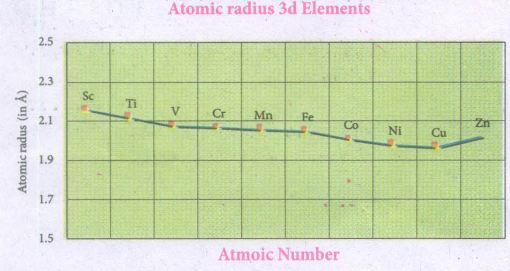
(i) It is generally expected a steady decrease in atomic radius along a period as the nuclear charge increases and the extra electrons are added to the same sub shell.
(ii) But for the 3d transition elements, the expected decrease in atomic radius is observed from Sc to V, thereafter up to Cu the atomic radius nearly remains the same.
(iii) As we move from Sc to Zn in 3d series the extra electrons are added to the 3d orbitals, the added 3d electrons only partially shield the increased nuclear charge and hence the effective nuclear charge increases slightly.
(iv) However, the extra electrons added to the 3d sub shell strongly repel the 4s electrons and these two forces are operated in opposite direction and as they tend to balance each other, it leads to constancy in atomic radii.
(v) At the end of the series, d - orbitals of Zinc contain 10 electrons in which the repulsive interaction between the electrons is more than the effective nuclear charge and hence, the orbitals slightly expand and atomic radius slightly increases.
128.
Oxidising and bleaching action:
Chlorine is a strong oxidising and bleaching agent because of the nascent oxygen.
\({ H }_{ 2 }O+{ Cl }_{ 2 }\longrightarrow Hcl+\underset { Hypo\ chlorous \ acid }{ HOCl } \)
HOCI \(\longrightarrow \) HCI + (0)
Colouring matter + Nascent oxygen - 7 Colourless oxidation product.
The bleaching of chlorine is permanent. It oxidises ferrous salts to ferric, sulphites to sulphates and hydrogen sulphide to sulphur.
2FeCl2 + Cl2 \(\longrightarrow \) 2FeCl3
Cl2 + H2O \(\longrightarrow \)HCI + HOCI
2FeSO4 + H2SO4 + HOCI \(\longrightarrow \)Fe2 (SO4)3 + HCI + H2O
Overall reaction
2FeSO4 + H2SO4 + Cl2 \(\longrightarrow \) Fe2(SO4)3 + 2HCI
Cl2 + H2O \(\longrightarrow \) HCI + HOCI
Na2SO3 + HOCI\(\longrightarrow \) Na2SO4 + HCI
Overall reaction
Na2SO3 + H2O+Cl2 \(\longrightarrow \) Na2SO4 + 2HCI
Cl2 + H2S\(\longrightarrow \)2HCI + S
129.
(i) By knowing the density of an unknown metal and the dimension of its unit cell, the atomic mass of the metal can be: determined.
(ii) Let 'a' be the edge length of a unit cell of a crystal, 'd' be the density of the metal, 'm' be the atomic mass of the metal and 'z' be the number of atoms in the unit cell.
(iii) Now,
Density of the unit cell
\(=\frac{Mass\ of\ the\ unit\ cell}{Volume\ of\ the\ unit\ cell}\)
\(d=\frac{Z\times m}{a^3}\) ...(1)
[Since, mass of the unit cell = Number of atoms in the unit cell x Atomic mass]
[Volume of the unit cell = (edge length of the cubic unit cell)3]
(iv) From equation (1), We have
\(m=\frac{d\times a^3}{Z}\) ....(2)
(v) Now,
Mass of the metal (M) \(=\frac{Atomic\ mass(M)}{Avogadro's\ number(N_A)}\)
M=\(\frac{d\times a^3 \times N_A}{Z}\)
(vi) From equation (3), we can determine the atomic mass of the unknown metal.
130.
(i) Carbon monoxide can be prepared by the reaction of carbon with limited amount of oxygen.
2C + O2 ⟶ 2CO
(ii) (a) On industrial scale carbon monoxide is produced by the reaction of carbon with air.
(b) The carbon monoxide formed will contain nitrogen gas also and the mixture of nitrogen and carbon monoxide is called producer gas.
(c) \(2C+{ O }_{ 2 }/{ N }_{ 2 }(air)\longrightarrow \underset { Producers \ Gas }{ 2CO } +{ N }_{ 2 }\)
(d) The producer gas is then passed through a solution of copper(I) chloride under pressure which results in the formation of CuCI(CO).2H2O.
(e) At reduced pressures this solution releases the pure carbon monoxide.
(iii) Pure carbon monoxide is prepared by warming methanoic acid with concentrated sulphuric acid which acts as a dehydrating agent.
HCOOH + H2SO4 ⟶ CO + H2O + H2SO4
131.
(i) Iron is one of the most useful metals and its alloys are used everywhere including bridges, electricity pylons, bicycle chains, cutting tools and rifle barrels.
(ii) Cast iron is used to make pipes, valves and pumps stoves etc.
(iii) Magnets can be made from iron and its alloys and compounds.
(iv) An important alloy of iron is stainless steel, and it is very resistant to corrosion. It is used in architecture, bearings, cutlery, surgical instruments and jewellery.
(v) Nickel steel is used for making cables, automobiles and aeroplane parts.
(vi) Chrome steels are used for manufacturing cutting tools and crushing machines.
132.
(i) It exhibits both geometrical and optical isomerism
(a) Geometrical isomers:
.JPG)
(b) Optical isomers:
.JPG)
(ii) It shows two optical isomers
.JPG)
(iii) Ionisation isomers
Linkage isomers
[Co(NH3)5(NO2)(NO3)2], [CO(NH3)5 (ONO)](NO3)2
(iv) Geometrical isomers
.JPG)

12th Standard Syllabus & Materials
12th Standard
TN 12th Computer Applications களப்பெயர் முறைமை (DNS) Sample Question Papers Study Material - QB365 Set A
NEW12th Standard
TN 12th Computer Applications வலையமைப்பு எடுத்துக்காட்டுகள் மற்றும் நெறிமுறைகள் Sample Question Papers Study Material - QB365 Set A
NEW12th Standard
TN 12th Computer Applications கணினி வலையமைப்பு ஓர் அறிமுகம் Sample Question Papers Study Material - QB365 Set A
NEW12th Standard
TN 12th Computer Applications PHP-உடன் MySQL-ஐ இணைத்தல் Sample Question Papers Study Material - QB365 Set A



Tamilnadu Stateboard 12th Standard Subjects

Maths
Chemistry

Physics

Biology

Computer Science

Business Maths and Statistics

Economics

Commerce

Accountancy

History

Computer Applications
Biology
Computer Technology
Computer Applications
Computer Science
Business Maths and Statistics
Commerce
Economics
Maths
Chemistry
Physics
Computer Technology
History
Accountancy

Tamil

English

French
Tamilnadu Stateboard Standards
