
 100% FREE ACCESS
12th Standard Syllabus & Materials
12th Standard
TN 12th Computer Applications மின்னணு தரவு பரிமாற்றம் Sample Question Papers Study Material - QB365 Set A
NEW12th Standard
TN 12th Computer Applications மின் - வணிக பாதுகாப்பு அமைப்புகள் Sample Question Papers Study Material - QB365 Set A
NEW12th Standard
TN 12th Computer Applications மின்னணு செலுத்தல் முறைகள் Sample Question Papers Study Material - QB365 Set A
NEW12th Standard
TN 12th Computer Applications மின் - வணிகம் Sample Question Papers Study Material - QB365 Set A
NEW12th Standard
TN 12th Computer Applications திறந்த மூல கருத்துருக்கள் Sample Question Papers Study Material - QB365 Set A
NEW12th Standard
TN 12th Computer Applications வலையமைப்பு வடமிடல் Sample Question Papers Study Material - QB365 Set A

Published on: 21/02/2020
12th Standard Chemistry Important Questions I 2019-2020
Download Tamil Nadu 12th Standard Chemistry question papers, model tests, one-mark questions, important questions, and public exam papers in PDF format. Free study materials and answer keys for TN State Board students.
Questions + Answers key
Take MCQ Chemistry Test
1.
1 F equals to _____.
96500 moles
96500 C
1.6 x 10⁻¹⁹ C
1.6 x 10⁻¹⁹ moles
2.
The feasibility of a redox reaction can be predicted with the help of ______.
Electronegativity
Electrochemical series
Electron affinity
Equivalent conductance
3.
Faraday's laws of electrolysis are related to ______.
atomic number of the cation
atomic number of the anion
equivalent weight of the electrolyte
speed of the cation
4.
Bakelite is a product of reaction between _______.
formaldehyde and NaOH
phenol and methanal
aniline and NaOH
aniline and NaOH
5.
Which of the following does not give iodoform test?
aceto phenone
benzophenone
\({ CH }_{ 3 }-\underset { \overset { | }{ { CH }_{ 3 } } }{ CHOH } \)
\({ CH }_{ 3 }-\underset { \overset { | }{ OH } }{ CH } -{ { CH }_{ 2 }{ CH }_{ 2 }-CH }_{ 3 }\)
6.
Which of the following acids do not exhibit optical isomerism?
lactic acid
tartaric acid
maleic acid
both (a) and (b)
7.
The decomposition of hydrogen peroxide in the presence of colloidal platinum is a/an _______.
positive analysis
negative catalysis
auto-catalysis
induced catalysis
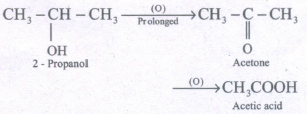
8.
NH4OH is a weak base because _______.
it has low vapour pressure
it is only partially ionised
it is completely ionised
it has low density
9.
pH of buffer depends upon concentration of _______.
acid (H+)
Conjugate base (OH-)
Salt
acid (H+) and Conjugate base (OH-)
10.
The relationship between degree of dissociation of a weak acid and its dissociation constant in a very dilute solution is _______.
Ka = α2C
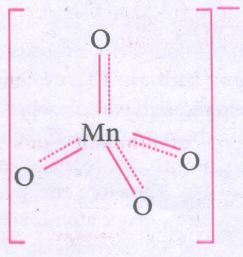
Ka = \(\frac{α^2C}{(1+α)}\)
Ka = \(\frac{α^2}{(1+α)C}\)
Ka = \(\frac{α}{C(1+α)}\)
11.
In swern method of oxidation of alcohols to aldhedye/ ketones _______ is used as an oxidising agent.
dimethyl sulfoxide
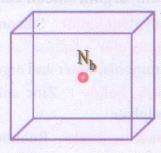
pyridimium chloro chromate
CrO3 in anhydrousmedium
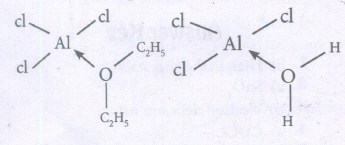
Na2Cr2O7 |H+
12.
The compound that acts as a solvent for Grignard reagent is ______.
Ethyl alcohol
Diethyl ether
Acetone
Benzene
13.
A substance that enhances the catalytic activity of the catalyst is _______.
gel
sol
promoter
poison
14.
Which is optically active?
n-butyl alcohol
isobutyl alcohol
2-butanol
t-butyl alcohol
15.
The phenomenon of Tyndall's effect is not observed in _______.
emulsion
colloidal solution
true solution
none
16.
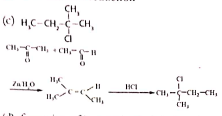
An alkene “A” on reaction with O3 and Zn - H2O gives propanone and ethanol in equimolar ratio. Addition of HCl to alkene “A” gives “B” as the major product. The structure of product “B” is ______.
\(Cl-{ CH }_{ 2 }-CH_{ 2 }-\overset { \overset { CH_{ 3 } }{ | } }{ \underset { \underset { CH_{ 3 } }{ | } }{ CH } } \)
\({ H }_{ 3 }C-{ CH }_{ 2 }-\overset { \overset { CH_{ 2 }Cl }{ | } }{ CH } -{ CH }_{ 3 }\)
\(\\ { H }_{ 3 }C-{ CH }_{ 2 }-\overset { \overset { CH_{ 3 } }{ | } }{ \underset { \underset { CL{ } }{ | } }{ C } } -{ CH }_{ 3 }\)
\({ H }_{ 3 }C-{ CH }-\overset { \overset { CH_{ 3 } }{ | } }{ \underset { \underset { Cl }{ | } }{ C } } \)
17.
Ethanoic acid \(\overset { P/{ Br }_{ 2 } }{ \longrightarrow } \) 2-bromoethanoic acid. This reaction is called _______.
Finkelstein reaction
Haloform reaction
Hell – Volhard – Zelinsky reaction
none of these
18.
Carbolic acid is _____.
Phenol
Picri cacid
benzoic acid
phenylacetic acid
19.
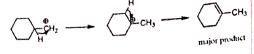
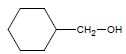 on treatment with Con H2SO4, predominately gives______.
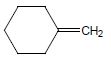
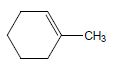
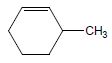
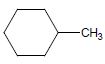
20.
On which of the following properties does the coagulating power of an ion depend?
Both magnitude and sign of the charge on the ion.
Size of the ion alone
the magnitude of the charge on the ion alone
the sign of charge on the ion alone.
21.
Which of the following is incorrect for physisorption?
reversible
increases with increase in temperature
low heat of adsorption
increases with increase in surface area
22.
In H2-O2 fuel cell the reaction occur at cathode is _______.
O2(g) + 2H2O(l) + 4e- ⟶ 4OH− (aq)
H+(aq) + OH− (aq) ⟶ H2O (l)
2H2 (g) + O2 (g) ⟶ 2H2O (g)
H+ + e- ⟶ 1/2 H2
23.
Among the following cells
I) Leclanche cell
II) Nickel – Cadmium cell
III) Lead storage battery
IV) Mercury cell
Primary cells are ____.
I and IV
I and III
III and IV
II and III
24.
Which of the following can act as Lowery – Bronsted acid well as base?
HCl
SO42−
HPO42−
Br-
25.
What is the pH of the resulting solution when equal volumes of 0.1M NaOH and 0.01M HCl are mixed?
2.0
3
7.0
12.65
26.
The oxidation of potassium iodide by potassium persulphate as per the rate law, rate k[K2S2O8] [K1]. The order with respect to potassium iodide is, _______.
two
one
three
four
27.
Compound A reacts by first order kineties. At 25oC, the rate constant of the reaction is 0.60 sec. What is the half life of A?
1.15 sec
0.4158 sec
0.093 sec
1.29 sec
28.
Which of the following statement is not correct?
Molecularity of a reaction cannot be fractional
Molecularity of a reaction cannot be more than three
Molecularity of a reaction can be zero
Molecularity is assigned for each elementary step of mechanism.
29.
Strong reducing behaviour of H3PO2 is due to______.
High oxidation state of phosphorus
High electro gain enthalpy of phosphorus
Presence of two-OH groups and one P-H bond
Presence of one-OH groups and two P-H bonds
30.
Which one of the following orders is not in accordance with the property stated against it?
F2 > CI2 > Br2 > I2: Bond dissociation energy
HI > HBr > HCI > HF: Acidic property in water
F2 > Cl2 > Br2 > l2: Oxidising power
F2 > Cl2 > Br2 > l2: Electronegativity
31.
Allotrope of sulphur which shows paramagnetic behaviour _______.
S8- Rhombic
S8- Monoclinic
S2- In vapour phase
Not possible
32.
A cubic crystal has _______ faces.
2
4
6
8
33.
Iodine crystals are ________.
covalent
ionic
metallic
molecular
34.
Graphite is a good conductor of electricity due to the presence of_______.
Lone pair of electrons
Free valence electrons
Cations
Anions
35.
Borax is _______.
Na2[B4O5(OH)4).8H2O
Na2[B4O5(OH)6).7H2O
Na2[B4O3(OH)8].6H2O
Na2[B4O2(OH)10).5H2O
36.
Boron compounds behave as Lewis acid, because of their _______.
ionisation property
acidic nature
covalent nature
electron deficient nature
37.
Identify the electron - deficient species
(BH3)2
(SiH3)2
PH3
(CH3)2
38.
In black and white photography, the developed film is fixed by washing with ______.
Hypo solution
AgBr solution
Na2S4O6 solution
FeC2O4 solution
39.
On oxidation with KMnO4 in acidic medium, SO2 is oxidised to _______.
SO2
H2SO4
SO32-
H2S
40.
CrO3 is coloured due to_______.
Low L.E
Crystal defects
Charge transfer spectra
Unpaired electrons
41.
In Hall-Heroult process ___________act as an anode.
Carbon blocks
hydrogen
copper rods
Zinc rods
42.
The percentage of carbon in high carbon steel is_________.
0.5 - 1%
0.15 - 1.5%
0.15 - 1.5%
0.15 - 0.3%
43.
Magnesite is_______.
Magnesium oxide
Magnesium carbonate
Magnesium sulphate
Magnesium chloride
44.
[Ni(Co)4] is a________ complex.
anionic
cationic
neutral
ambidentate
45.
Pick out the central metal ion in the complex K3[AI(C2O4)3].
3K+
Al3+
C2O42-
both (a) and (b)
46.
Which is a double salt?
K2SO4AI2(SO4)324H2O
NaCI
K4[Fe(CN)6]
KCl
47.
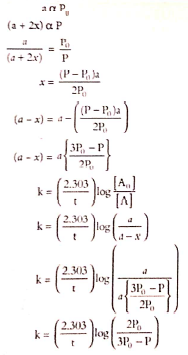
In a homogeneous reaction A⟶B+C+D, the initial pressure was P0 and after time t it was P expression for rate constant in terms of P0, P and t will be _____.
\(k=\left( \frac { 2.303 }{ t } \right) \log\left( \frac { 2{ P }_{ 0 } }{ { 3P }_{ 0 }-P } \right) \)
\(k=\left( \frac { 2.303 }{ t } \right) \log\left( \frac { { 2P }_{ 0 } }{ { P }_{ 0 }-P } \right) \)
\(k=\left( \frac { 2.303 }{ t } \right) \log\left( \frac { 3{ P }_{ 0 }-P }{ 2P_{ 0 } } \right) \)
\(k=\left( \frac { 2.303 }{ t } \right) \log\left( \frac { 2{ P }_{ 0 } }{ { 3P }_{ 0 }-2P } \right) \)
48.
The decomposition of phosphine (PH3) on tungsten at low pressure is a first order reaction. It is because the _____.
rate is proportional to the surface coverage
rate is inversely proportional to the surface coverage
rate is independent of the surface coverage
rate of decomposition is slow
49.
The fraction of total volume occupied by the atoms in a simple cubic is ________.
\(\left( \frac { \pi }{ 4\sqrt { 2 } } \right) \)
\(\left( \frac { \pi }{ 6 } \right) \)
\(\left( \frac { \pi }{ 4 } \right) \)
\(\left( \frac { \pi }{ 3\sqrt { 2 } } \right) \)
50.
The radius of an atom is 300pm, if it crystallizes in a face centered cubic lattice, the length of the edge of the unit cell is ________.
488.5pm
848.5pm
884.5pm
484.5pm
51.
Which kind of isomerism is possible for a complex [Co(NH3)4Br2]CI?
geometrical and ionization
geometrical and optical
optical and ionization
geometrical only
52.
Oxidation state of Iron and the charge on the ligand NO in [Fe(H2O)5NO]SO4 are_______.
+2 and 0 respectively
+3 and 0 respectively
+3 and -1 respectively
+1 and +1 respectively
53.
Which one of the following statements related to lanthanons is incorrect?
Europium shows +2 oxidation state
The basicity decreases as the ionic radius decreases from Pr to Lu.
All the lanthanons are much more reactive than aluminium
Ce4+ solutions are widely used as oxidising agents in volumetric analysis.
54.
Permanganate ion changes to ________ in acidic medium.
MnO42−
Mn2+
Mn3+
MnO2
55.
Thermodynamically the most stable form of carbon is________.
Diamond
graphite
Fullerene
none of these
56.
Duralumin is an alloy of ______.
Cu, Mn
Cu, Al, Mg
Al, Mn
Al, Cu, Mn, Mg
57.
The correct order of the thermal stability of hydrogen halide is_______.
HI > HBr > HCl > HF
HF > HCl > HBr > HI
HCl > HF > HBr > HI
HI > HCl > HF > HBr
58.
In the brown ring test, brown colour of the ring is due to _______.
a mixture of No and NO2
Nitroso ferrous sulphate
Ferrous nitrate
Ferric nitrate
59.
Match items in column - I with the items of column – II and assign the correct code.
| Column-I | Column-II | ||
| A. | Cyanide process | (i) | Ultrapure Ge |
| B | Froth floatation process | (ii) | Dressing of ZnS |
| C | Electrolytic reduction | (iii) | Extraction of Al |
| D | Zone refining | (iv) | Extraction of Au |
| (v) | Purification of Ni | ||
| A | B | C | D |
| (i) | (ii) | (iii) | (iv) |
| A | B | C | D |
| (iii) | (iv) | (v) | (i) |
| A | B | C | D |
| (iv) | (ii) | (iii) | (i) |
| A | B | C | D |
| (ii) | (iii) | (i) | (v) |
60.
Which of the following statements, about the advantage of roasting of sulphide ore before reduction is not true?
\(\Delta { G }_{ f }^{ 0 }\) of sulphide is greater than those for CS2 and H2S
\(\Delta { G }_{ r }^{ 0 }\) is negative for roasting of sulphide ore to oxide
Roasting of the sulphide to its oxide is thermodynamically feasible
Carbon and hydrogen are suitable reducing agents for metal sulphides
61.
Identify (B), (C) and (D)
\({ CH }_{ 3 }-\overset { \underset { || }{ O } }{ C } -{ CH }_{ 3 }-(A)\overset { LIAIH_{ 4 } }{ \longrightarrow } (B)\overset { { SOCl }_{ 2 } }{ \longrightarrow } (C)\overset { alc.KOH }{ \longrightarrow } (D)\)
62.
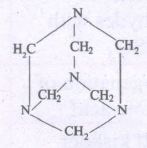
What is urotropine? Give its use.
63.
What is electrophoresis? (or) Write a note on Electrophoresis.
64.
What is a dispersed phase and a dispersion I medium in a colloid?
65.
What is corrosion?
66.
On dilution of 0.1 M of Na2SO4, what will happen to its
(a) Conductance (C)
(b) Conductivity K
(c) Molar conductance \({ \Lambda }_{ m }\)
(d) Equivalent conductance \({ \Lambda }\)
67.
Write the IUPAC names of
(i) CH3OCH2CH2O
(ii) CH3OCH2OCH3 and
(iii) 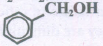
68.
Identify the product A and B.
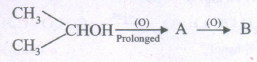
69.
BF3 is termed as an acid though it does not contain H+ ions. Explain.
70.
Write down the conjugate acid and base of the following
(i) NH3
(ii) HSO-4
71.
Calculate the molar conductance of 0.025M aqueous solution of calcium chloride at 25°C. The specific conductance of calcium chloride is 12.04 x 10⁻² Sm-1.
72.
A solution of silver nitrate is electrolysed for 20 minutes with a current of 2 amperes. Calculate the mass of silver deposited at the cathode.
73.
Calculate the pH of 0.001M HCl solution
74.
A lab assistant prepared a solution by adding a calculated quantity of HCl gas 250C to get a solution with [H3O+] = 4\(\times\)10-5M. Is the solution neutral (or) acidic (or) basic.
75.
The rate of the reaction X + 2y→ product is 4 x 10⁻³ mol L-1S-1, if [X] = [Y] = 0.2M and rate constant at 400K is 2 x 10⁻²s-1, What is the overall order of the reaction.
76.
Draw the structure of permanganate ion.
77.
Silver atom has completely filled d-orbitals (4d10) in its ground state. How can you say that it is a transition element?
78.
For a chemical reaction, Variation in the concentration In[A] Vs time in seconds is given as
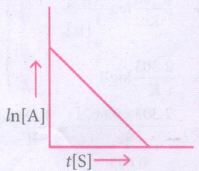
(i) What is the order of the reaction?
(ii) What is the unit of rate constant K?
(iii) Give the relationship between k and \({ t }_{ \frac { 1 }{ 2 } }\)
79.
Rate of chemical reaction is not uniform throughout. Justify you answer:
80.
Elements of group 16 show lower value of first ionization enthalpy compared to group 15, why?
81.
What is the reaction of Phosphorous with alkali?
82.
Write a note on the assignment of atoms per unit cell in body centred cubic lattice or CsCl.
83.
Why do solids have a definite volume?
84.
Which one is more soluble in diethyl ether, anhydrous Alcl3 or hydrated Alcl3? Explain in terms of bonding.
85.
Give the uses of alum.
86.
Define roasting.
87.
The reaction \({ Cr }_{ 2 }{ O }_{ 3 }+2{ Al }_{ (s) }\longrightarrow { Al }_{ 2 }O_{ 3 }+2Cr\) \(\Delta { G }^{ 0 }=-421KJ\) is thermodynamically feasible why does it not take place at room temperature?
88.
What are structural isomers?
89.
Give the geometry and magnetic character of [NiCI4]2-
90.
What are interstitial compounds?
91.
Why Gd3+ is colourless?
92.
Arrange the following in order of increasing molar conductivity
(i) Mg[Cr(NH3)(Cl)5]
(ii) Cr(NH3)5Cl]3[CoF6]2
(iii) [Cr(NH3)3Cl3]
93.
Write the molecular formula and structural formula for the following molecules.
a) Nitric acid
b) Dinitrogen pentoxide
c) phosphoric acid (PTA)
d) phosphine
94.
Write a short note on hydroboration.
95.
What is inert pair effect?
96.
What is catenation ? describe briefly the catenation property of carbon.
97.
Write a short note on anomalous properties of the first element of p-block.
98.
Out of coke and CO, which is better reducing agent for the reduction of ZnO? Why?
99.
100.
An organic compound A (C7H6O) forms a bisulphite. A when treated with alcoholic KCN forms B (C14H12O2) and A on refluxing with sodium acetate and acetic anhydride forms an add C (C9HsO2). Identify A, B and C. Explain the conversion of A to B and C.
101.
Distinguish between (a) Ethanol and phenol (b) Phenol and acetic acid (c) Phenol and aniline (d) Phenol and anisole.
102.
Write a note on Freundlich adsorption isotherm.
103.
Calculate the emf of the cell having the cell reaction 2Ag+ + Zn ⇌ 2Ag + Zn2+ and Eocell = 1.56 V at 25°C when concentration of Zn2+ = 0.1 M and Ag+ = 10 M in the solution.
\([{ E }_{ cell }={ E }_{ cell }^{ o }-\frac { RT }{ nF } In\frac { [{ Zn }^{ 2+ }] }{ [{ Ag] }^{ 2 } } ]\)
104.
Calculate the pH of solution with HO+ concentrations in mol dm-3.
(i) 10-4
(ii) 10-7
(iii) 6.8 x 10⁻³
(iv) 3.2 x 10⁻⁵
(v) 0.035
(vi) 0.25
(vii) 5.4 x 10⁻⁹
(viii) 7.1 x 10⁻⁷
105.
State Kohlrausch Law. How is it useful to determine the molar conductivity of weak electrolyte at infinite dilution.
106.
A first order reaction laws on rate constant 1.15 x 10⁻³ S-1. How long will 5 g of this reactant take to reduce to 3g?
107.
Why is there a variation of atomic and ionic size as we move from Sc to Zn?
108.
An element A occupies group number 15 and period number 3, exhibits allotropy and it is tetra atomic. A reacts with caustic soda to give B which is having rotten fish odour. A reacts with chlorine to give C which has a pungent odour Identify A, B and C. Write the reactions.
109.
Ionic solids, which have anionic vacancies due to metal excess defect, develop colour. Explain with the help of a suitable example.
110.
Distinguish between diamond and graphite.
111.
How can you separate alumina from silica in a bauxite ore.
112.
Give the IUPAC name for the following compounds.
(i) [Ag(NH3)2]CI
(ii) K3[Fe(CN)5NO]
(ill) [Cr(PPh3)(CO)3]
(iv) [Ag(NH3)2]+
(v) [FeF6]4-
113.
Using the Ellingham diagram,
(A) Predict the conditions under which
(i) Aluminium might be expected to reduce magnesia.
(ii) Magnesium could reduce alumina.
(B) it is possible to reduce Fe2O3 by coke at a temperature around 1200K
114.
Explain Stephen's reaction.
115.
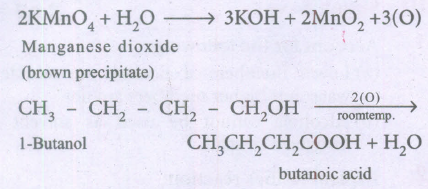
When tertiary butyl alcohol and 1-butanol are separately treated with a few drops of KMnO4, in one case only the purple colour disappears and a brown precipitate is formed. Which of the two alcohols gives the above reaction and what is that brown precipitate?
116.
How do primary, secondary and tertiary alcohols differ in terms of their oxidation?
117.
Give any three application of adsorption.
118.
Explain the process of recharging of lead storage battery.
119.
Based on Arrhenius concept, defame acid and bases and give an example for each.
120.
Why are lyophillic colloidal sols are more stable than lyophobic colloidal sol.
121.
The Ka value for HCN is 10-9. What is the pH of 0.4M HCN solution?
122.
Show that in case of first order reaction, the time required for 99.9% completion is nearly ten times the time required for half completion of the reaction.
123.
The decomposition of NH3 on platinum surface is zero order reaction what are the rates of production of N2 and H2 if k = 2.5 x10⁻⁴ mol + L S-1.
124.
Discuss the general characteristic of the 3d series of the transition elements with special reference to their
(i) Atomic size
(ii) Enthalpies of atomisation
125.
Explain the structure of ammonia.
126.
How do the spacings of the three planes (100), (101) and (111) of simple cubic lattice vary?
127.
How is boron trifluoride obtained from boron trioxide?
128.
Mention the uses of copper.
129.
Explain optical isomerism.
130.
Define half life of a reaction. Show that for a first order reaction half life is independent of initial concentration.
131.
What are inner transition elements?
132.
[Ni(CN)4]2- is diamagnetic, while [NiCl4]2- is paramagnetic, explain using crystal field theory.
133.
Based on VB theory explain why [Cr(NH3)6]3+ is paramagnetic, while [Ni(CN)4]2- is diamagnetic.
134.
Give the uses of helium.
1.
(b)
96500 C
2.
(b)
Electrochemical series
3.
(c)
equivalent weight of the electrolyte
4.
(b)
phenol and methanal
5.
(b)
benzophenone
6.
(c)
maleic acid
7.
(a)
positive analysis
8.
(b)
it is only partially ionised
9.
(d)
acid (H+) and Conjugate base (OH-)
10.
(a)
Ka = α2C
11.
(a)
dimethyl sulfoxide
12.
(b)
Diethyl ether
13.
(c)
promoter
14.
(c)
2-butanol
15.
(c)
true solution
16.
17.
(c)
Hell – Volhard – Zelinsky reaction
18.
(a)
Phenol
19.
According to Saytzeff rule.
20.
(a)
Both magnitude and sign of the charge on the ion.
21.
The incorrect statement is option (n)
Physisorption is an exothermic process. Hence increases in temperature decreases the Physisorption
22.
(a)
O2(g) + 2H2O(l) + 4e- ⟶ 4OH− (aq)
23.
(a)
I and IV
24.
HPO42− can have the ability to accept a proton to form H2PO4-
It can also have the ability to donate a proton to form PO4-3
25.
x ml of 0.1 M NaOH + x mL of 0.01 M HCI
No. of moles of NaOH = 0.1 x X x 10-3
= 0.1 X x 10-3
No. of moles of HCI = 0.01 x X x 10-3
= 0.01 X x 10-3
No. of moles of NaOH after mixing
= 0.1 X x 10-3 - 0.01 X x 10-3
= 0.09 X x 10-3
Concentration of NaOH\(= (\frac{0.09x \times 10^{-3}}{2x \times 10^{-3}}) = 0 .045\)
[OH-] = 0.045
pOH =-log (4.5 x 10⁻²)
= 2 -log 4.5
= 2 - 0.65 = 1.35
pH = 14 - 1.35 = 12.65
26.
(b)
one
27.
(a)
1.15 sec
28.
(c)
Molecularity of a reaction can be zero
29.
(d)
Presence of one-OH groups and two P-H bonds
30.
(a)
F2 > CI2 > Br2 > I2: Bond dissociation energy
31.
(c)
S2- In vapour phase
32.
(c)
6
33.
(d)
molecular
34.
(b)
Free valence electrons
35.
(a)
Na2[B4O5(OH)4).8H2O
36.
(d)
electron deficient nature
37.
(a)
(BH3)2
38.
(a)
Hypo solution
39.
(b)
H2SO4
40.
(c)
Charge transfer spectra
41.
(a)
Carbon blocks
42.
(b)
0.15 - 1.5%
43.
(b)
Magnesium carbonate
44.
(c)
neutral
45.
(b)
Al3+
46.
(a)
K2SO4AI2(SO4)324H2O
47.
| A | ⟶ | B | C | D | |
| Initial rate (M s-1) | a | 0 | 0 | 0 | |
| Reaction number | x | - | - | - | - |
| After time t | (a - x) | x | x | x | |
| Total number of moles | = (a + 2x) |
48.
Given:
At low pressure the reaction follows first order therefore,
Rate α [reactant]1
Rate α (surface area)
At high pressure due to the complete coverage of surface area, the reaction follows zero order.
Rate α [reactant]0
Therefore the rate is independent of surface area.
49.
(b)
\(\left( \frac { \pi }{ 6 } \right) \)
50.
let edge length = a
\(\sqrt{2a} = 4r\)
\(a = \frac{4 \times 300}{\sqrt {2}}\)
a = 600 x 1.414
a = 848.4 pm
51.
For [MA4B2]4+ complexes - geometrical isomerism is possible
{[Co(NH3)4Br2]CI,[Co(NH3)4Br CI]Br} - ionisation isomers
52.
[\( \overset{+}{Fe}\)(H2O)5\( \overset{+}{NO}\)]2+ SO2-4
+1 and +1 respectively
53.
As we move from La to Lu, their metallic behaviour because almost similar to that of aluminium.
54.
MnO-4 + 8H+ + 5e- → Mn2+ + 4H2O
55.
(b)
graphite
56.
(d)
Al, Cu, Mn, Mg
57.
(b)
HF > HCl > HBr > HI
58.
(b)
Nitroso ferrous sulphate
59.
(c)
| A | B | C | D |
| (iv) | (ii) | (iii) | (i) |
60.
(d)
Carbon and hydrogen are suitable reducing agents for metal sulphides
61.
(B) \({ CH }_{ 3 }-\overset { \underset { | }{ OH } }{ CH } -{ CH }_{ 3 }\) Isopropyl alcohol
(C) \(CH_{ 3 }-\overset { \underset { | }{ OH } }{ CH } -{ CH }_{ 3 }\) Isopropyl chloride
(D) CH3 - CH - CH2 Propylene
62.
Hexamethylene tetramine formed by the reaction of formaldehyde and ammonia is called urotropine.
63.
The migration of colloidal particles under the influence of an electric field is termed cataphoresis or electrophoresis.
(i) When electric potential is applied across two platinum electrodes dipped in a hydrophilic sol, the dispersed particles move toward one or other electrode.
(ii) The migration of sol particles under the influence of electric field is called electrophoresis or cataphoresis. If the sol particles migrate to the cathode, then they posses positive (+) charges, and if the sol particles migrate to the anode then they have negative charges(-). Thus from the direction of migration of sol particles we can determine the charge of the sol particles. Hence electrophoresis is used for detection of presence of charges on the sol particles.
64.
In a colloidal, the substance present in larger I amount is called dispersion medium and the substance present in less amount is called dispersed phase.
65.
This redox process which causes the deterioration of metal is called corrosion.
66.
Conductivity, molar conductance and equivalent conductance increases with dilution whereas Conductance (C) decreases.
67.
(i) 2-Methoxy ethanol;
(ii) Dimethoxy methane and
(iii) Phenyl methanol
68.
69.
According to Lewis concept of Acid and bases, any species capable of accepting an electron pair is an acid. BF3 is electron deficient so accepts a pair of electron, Hence termed as acid
70.
| (i) | (ii) | |
| Conjugate Acid | \({ NH }_{ 4 }^{ + }\) | \({ H }_{ 2 }{ SO }_{ 4 }\) |
| Conjugate Base | \({ NH }_{ 2 }^{ - }\) | \(^{ }{ SO }_{ 4 }^{ 2- }\) |
71.
Molar conductance = Λm = \( \frac{k\ (Sm^{-1})\times10^{-3}}{M} mol^{-1}m^{3} \)
\(= \frac{(12.04 \times 10^{-2} Sm^{-1}) \times 10^{-3} (mol^{-1}m^{3})} {0.025}\)
= 481.6 x 10⁻⁵ Sm2mol-1
72.
Electrochemical reaction at cathode is Ag+ + e- → Ag (reduction)
m = ZIT
Z = \(\frac{\text {molar mass of Ag}}{(96500)}\) = \(\frac{108}{1 \times 96500} \)
I = 2A
t = 20 x 60S = 1200 S
It = 2A x 1200S = 2400C
m = \(\frac{108 gmol^{-1}}{96500 C mol^{-1}} \times\) 2400C
m = 2.68g
73.
\(\underset{0.001M}{HCl}\overset{H_{2}O}{\rightleftharpoons }\underset{0.001M}{H_{3}O^{+}}+\underset{0.001M}{Cl^{-}}\)
H3O+ from the auto ionisation of H2O (10-7M) is negligible when compared to the H3O+ from 10-3M HCl.
Hence [H3O+] = 0.001 mol dm-3
pH = -log10 [H3O+]
= -log10(0.001)
= -log10(10-3) = 3
74.
[H3O+] = 4 \(\times\) 10-5M
pH = - log10[H3O+]
pH=-log10[4 \(\times\) 10-5]
pH = -log10[4] - log10[10-5] log10 10 = 1
pH = -log 4 + 5log1010
= 5 - log 4
= 5 - 0.6021
=4.3979
Since pH is less than 7, the solution is acidic.
75.
Rate = K[X]n[y]m
4 x 10⁻³ mol L-1s-1= 2 x 10⁻²s-1(0.2mol L-1)n(0.2mol L-1)m
\(\frac { 4\times { 10 }^{ -3 }mol\quad { L }^{ -1 }{ s }^{ -1 } }{ 2\times { 10 }^{ -2 }{ s }^{ -1 } } =\) (0.2)n+m(mol L-1)n+m
0.2(mol L-1) = (0.2)n+m(mol L-1)n+m
Comparing the powers on both sides
The overall order of the reaction n + m = 1
76.
Permanganate ion has tetrahedral geometry in which the central Mn7+ is Sp3 hybridised.
77.
(i) Silver in its +1 oxidation state, exhibits 4d105s0configuration.
(ii) But in some compounds, it also shows +2 oxidation state, so the configuration becomes 4d95s0
(iii) Here, d-orbital is not completely filled. Therefore silver is a transition element.
78.
(i) I Order reaction
(ii) S-1
(iii) \({ t }_{ \frac { 1 }{ 2 } }\) = 0.693/k
79.
Rate of a reaction at any time depends on the concentration of the reactants which keeps on decreasing with time.
80.
Element of group 15 have stable half-filled p-orbitals hence large amount of energy is required to remove electrons as compared to group 16, which has an incomplete p subshell.
81.
Yellow phosphorus reacts with alkali on boiling in an inert atmosphere liberating phosphine. Phosphorus acts as a reducing agent.
\({ P }_{ 4 }+NaOH+{ H }_{ 2 }O\longrightarrow \underset { Sodiumhypophosphite }{ { 3NaH }_{ 2 }{ PO }_{ 2 } } +\underset { Phosphine }{ { PH }_{ 3 } } \uparrow \)
82.
The total number. of atoms per unit cell in bcc.
\(=\frac { { N }_{ c } }{ 8 } +\frac { { N }_{ b } }{ 1 } =\frac { 8 }{ 8 } +\frac { 1 }{ 1 } =1+1=2\)
Nb = Number of atoms inside the body; Nc is the number of atoms at the comers.
83.
(i) The intermolecular forces of attraction that are present in solids are very strong.
(ii) The constituent particles of solids have fixed position.
(iii) Hence, solids have a definite volume.
84.
(i) Anhydrous AlCl3 is an electro-deficient compound while hydrated AICl3 is not.
(ii) Therefore, anhydrous AICl3 is more soluble in diethyl either because the oxygen atom of ether donates a pair of electrons to the vacant p-orbital on the Al atom in AlCl3 forming a co-ordinate bond.
(iii) In case of hydrated AlCl3, Al is not electron deficient, since, H2O has already donated a pair of e- to it.
85.
(i) It is used for purification of water
(ii) It is also used for water proofing and textiles.
(iii) It is used in dyeing, paper and leather tanning industries.
(iv) It is employed as a styptic agent to arrest bleeding.
86.
In this method, the concentrated ore is oxidised by heating it with excess of oxygen in a suitable furnace below the melting point of the metal.
87.
The change in Gibbs energy is related to the equilibrium constant K as \(\Delta \)G = - RT Ink. A room temperature all reactants and product of the given reaction are in solid state. As a result, equilibrium does not take place at room exist between the reactants and the products. Hence the reaction does not take place at room temperature. Certain amount of activation energy is essential even for reactions which are thermodynamically feasible
88.
The coordination compounds with same formula, but have different connections among their constituent atoms are called structural isomers or constitutional isomers.
89.
Tetrahedral, paramagnetic.
90.
An interstitial compound or alloy is a compound that is formed when small atoms like hydrogen, boron, carbon or nitrogen are trapped in the interstitial holes in a metal lattice. They are usually non-stoichiometric compounds. Transition metals form a number of interstitial compounds such as TiC, ZrH1.92, Mn4N etc.
Properties of interstitial compound
(i) They are hard and show electrical and thermal conductivity.
(ii) They have high melting points higher than those of pure metals.
(iii) Transition metal hydrides are used as powerful reducing agents
(iv) Metallic carbides are chemically inert.
91.
In Gd+3 there are 64 electrons. Hence electronic configuration will be [Xe]4f7 5d1 6s2. Hence no electrons are there in outer d - orbital. Due to this it is colourless.
92.
(i) \(\mathrm{Mg}\left[\mathrm{Cr}\left(\mathrm{NH}_{3}\right) \mathrm{Cl}_{5}\right]^{2-} \rightleftharpoons \mathrm{Mg}^{2+}+\left[\mathrm{Cr}\left(\mathrm{NH}_{3}\right) \mathrm{Cl}_{5}\right]^{2-} (2 ions)\)
(ii) \(\begin{aligned}
{\left[\mathrm{Cr}\left(\mathrm{NH}_3\right)_5 \mathrm{Cl}_3\left[\mathrm{CoF}_6\right]_2 \rightleftharpoons 3\right.} & {\left[\mathrm{Cr}\left(\mathrm{NH}_3\right)_5 \mathrm{Cl}\right]^{2+} } \\
& (5 \text { ions })
\end{aligned}\)\(+2\left[\mathrm{CoF}_6\right]^{3-}\)
(iii) \(\left[\mathrm{Cr}\left(\mathrm{NH}_{3}\right)_{3} \mathrm{Cl}_{3}\right]= \text{ No ions}\)
If no of ions increases, molar conductivity increases molar conductivity of the complex also INCREASES.
\(\therefore\) The order of the given compound is
[Cr(NH3)3Cl3]<Mg[Cr(NH3)3Cl3] < [Cr(NH3)5Cl3] [CoF6]2
(No ion) (2 ions) (5 ions)
93.
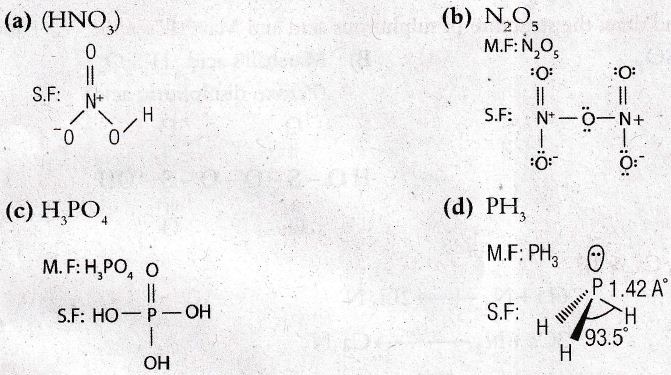
94.
Diborane adds on to alkenes and alkynes in ether solvent at room temperature. This reaction is called hydroboration.
\({ B }_{ 2 }{ H }_{ 6 }+6RCH=CHR\longrightarrow 2B(RCH_2-{ CH }R)_{ 3 }B\)
95.
(i) In heavier post transition metals, the outers electrons (ns) have a tendency to remain inert and show reluctance to take part in the bonding, which is known as inert pair effect.
(ii) This effect is also observed in groups 14, 15 and 16.
96.
Catenation is an ability of an element to form chain of atoms.
The conditions for catenation.
(a) The valency of element is greater than or equal to two.
(b) Element should have an ability to bond with itself
(c) The self bond must be as strong as Its bond with other elements
(d) Kinetic inertness of catenated compound towards other molecules.
(e) Carbon possesses all the above properties and forms a wide range of compounds with itself and with other elements such as H, O, N, S and halogens.
97.
In p-block elements, the first member of each group differs from the other elements of the corresponding group. The following factors are responsible for this anomalous behaviour
(i) Small size of the first member.
(ii) High ionisation enthalpy and high electronegativity.
(iii) Absence of d-orbitals in their valance shell.
98.
Ellingham diagram for the formation of ZnO and CO2 intersects around 1200 K. Above this temperature ZnO lies above Carbon which indicates Carbon is the better reducing agent CO is more effective reducing agent only below 983 K.
99.
100.
(i) An organic compound (A) with formula C7H6O form bisulphite means it must be benzaldehyde C6H5CHO.
(ii) Benzaldehyde on treatment with KCN form benzoin.
\(\underset { (A) }{ { C }_{ 6 }{ H }_{ 5 }CHO+{ C }_{ 6 }{ H }_{ 5 }CHO } \overset { KCN }{ \longrightarrow } \underset { (B) }{ { C }_{ 6 }{ H }_{ 5 }-\underset { \overset { | }{ HO } }{ CH } -\underset { \overset { || }{ O } }{ C } -{ C }_{ 6 }{ H }_{ 5 } } \)
(iii) Benzaldehyde on treatment with sodium acetate and acetic anhydride form an acid, cinnamic acid it is (C).
\(\underset { (A) }{ { C }_{ 6 }{ H }_{ 5 }CHO } +\left( { CH }_{ 3 }{ CO } \right) O\overset { { CH }_{ 3 }COONa }{ \longrightarrow } \underset { (C) }{ { C }_{ 6 }{ H }_{ 5 }CH } =CH-COOH+CH_{ 3 }COOH\)
| Compound | Compound Name | Formula |
| A | Benzaldehyde | C6HsCHO |
| B | Benzoin | C6H5-CH-OHCO-C6H5 |
| C | Cinnamic acid | C6HsCH=CHCOOH |
101.
| a. | Ethanol | Phenol |
| i. | It does not give violet colour with neutral FeCI3 | It gives violet colour with netural FeCI3 |
| ii. | It does not declourise bromine water (no electroplilic substitution). |
It declourises Br/H2O and the product formed is 2, 4, 6-tribromo (electrtophilic substitution). |
| a. | Phenol | Acetic acid |
| i. | It gives violet colour with neutral FeCI3. | It does not give violet colour with netural FeCI3. |
| ii. | It undergoes electrophilic substitution reaction at ortho & para position. |
It does not undergo electrophilic substitution |
| a. | Phenol | Aniline |
| i. | It does not undergo diazotisation reaction at all temperature |
It undergo diazotisation reaction at 0 C0. |
| ii. | It undergoes condensation polymerisation with HCHO to produce bakelite |
It does not undergo condensation polymerisation reaction with HCHO. |
| a. | Phenol | Anisole |
| i. | It gives violet colour with neutral FeCI3. | It does not give violet colour with neutral FeCI3. |
| ii. | It undergoes coupling reaction with ben- zene diazonium chlo ride to give 'red dye'. |
It does not undergo coupling reaction with benzene diazonium chloride. |
102.
Freundlich adsorption isotherm:
According to Freundlinch
\(\frac { x }{ m } =kp^{ \frac { 1 }{ n } }\)
where x is the amount of adsorbate or adsorbed on 'm' gm of adsorbent at a pressure of p. K and n are constants Value is always less than unity.
This equation is applicable for adsorption of gases on solid surfaces. The same equation becomes \(\frac { x }{ m } =Kc^{ \frac { 1 }{ n } }\) when used for adsorption in solutions with c as concentration.
These equation quantitively predict the effect of pressure(or concentration) on the adsorption of gases(or adsorbates) at constant temperature.
Taking log on both sides of equation \(\frac { x }{ m } ={ kp }^{ \frac { 1 }{ n } }\)
\(log\frac { x }{ m } =logK+\frac { 1 }{ n } logP\)
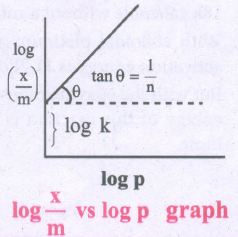
Hence the intercept represents the value of log k and the slope \(\frac { b }{ q } \) gives \(\frac { 1 }{ n } \)
This equation explains the increase of \(\frac { x }{ m } \) with increase in pressure. But experimental values show the deviation at low pressure.
103.
Eocell = 1.56V [Zn2+]
= 0.1 M [Ag+] = 10 M
Formula:
\([{ E }_{ cell }={ E }_{ cell }^{ o }-\frac { RT }{ nF } In\frac { [{ Zn }^{ 2+ }] }{ [{ Ag] }^{ 2 } } ]\)
Solution:
= 1.56 - 0.02955 log 0.001;
= 1.56 - (- 0.08865)
= 1.56 + 0.08865 = 1.6486 V
Ecell = 1.6486 V.
104.
pH = - log [H3O+]
(i) pH - log [104]
pH = log 1 - log 104
pH = - 4
(ii) pH = - log [10-7]
pH = log 1 - log 10-7.
pH = 7
(iii) pH = - log [H3O+]
pH = - log [6.8 x 10⁻³]
pH = log 1 - log 6.8 - log 10-3
= 3 - 0.8325
pH = 2.17 (or) 2.2
(iv) pH = - log [3.2 x 10⁻⁵]
pH = log 1 - log 3.2 - log 10-5
= 5 - 0.5051
pH = 4.49 (or) 4.5
(v) pH = - log [0.035]
pH = log 1 - log 0.035
= 2 - 0.5441
pH = 1.46 (or) 1.5
(vi) pH = - log [0.25]
pH = log 1 - log 0.25
= 1 - 0.3979
pH = 0.602 (or) 0.60
(vii) pH = -log [H3O+]
pH = log 1 - log 5.4 - log 10-9
= 7 - 0.7324
pH = 8.267 (or) 8.3
(viii) pH = - log [7.1 x 10⁻⁷]
pH = log 1 - log 7.1 - log 10-7
= 7 - 0.8513
pH = 6.2.
105.
Kohlraush's law:
(i) At infinite dilution, the limiting molar conductivity of an electrolyte is equal to the sum of the limiting molar conductivities of its constituent ions. i.e., the molar conductivity is due to the independent migration of cations in one direction and anions in the opposite direction.
(ii) For a uni - univalent electrolyte such as NaCl, the Kohlraush's law is expressed as
\(\left(\Lambda_{\mathrm{m}}^{0}\right)_{\mathrm{NaCl}}=\left(\lambda_{\mathrm{m}}^{0}\right)_{\mathrm{Na}^{+}}+\left(\lambda_{\mathrm{m}}^{0}\right)_{\mathrm{Cl}}^{-}\)
(iii) In general, according to Kohlraush's law, the molar conductivity at infinite dilution for a electrolyte represented by the formula Ax By, is given below.
\(\left(\Lambda_{m}^{0}\right)_{A_{x} B_{y}}=x\left(\lambda_{m}^{0}\right)_{A^{y+}}+y\left(\lambda_{m}^{0}\right)_{B^{x-}}\)
b) Calculation of molar conductance at infinite dilution for weak electrolytes experimentally.
(i) However, the same can be calculated using Kohlraush's Law. For example, the molar conductance of CH3COOH, can be calculated using the experimentally determined molar conductivities of strong electrolytes HCl, NaCl and CH3COONa.
\(\Lambda_{\mathrm{CH}_{3} \mathrm{COONa}}^{0}=\lambda_{\mathrm{Na}^{+}}^{0}+\lambda_{\mathrm{CH}_{3} \mathrm{COO}^{-}}^{0} \) ..........(1)
\(\Lambda_{\mathrm{HCl}}^{0}=\lambda_{\mathrm{H}+}^{0}+\lambda_{\mathrm{Cl}^{-}}^{0} \) .........(2)
\(\Lambda_{\mathrm{NaCl}}^{0}=\lambda_{\mathrm{Na}^{+}}^{0}+\lambda_{\mathrm{Cl}^{-}}^{0}\) ...........(3)
(ii) Equation (1) + Equation (2) - Equation (3) gives,
\(\left(\Lambda_{\mathrm{CH}_{3} \mathrm{COONa}}^{0}\right)+\left(\Lambda_{\mathrm{HCl}}^{0}\right)-\left(\Lambda_{\mathrm{NaCl}}^{0}\right)=\lambda_{\mathrm{H}+}^{0}+\lambda_{\mathrm{CH}_{3} \mathrm{COO}-}^{0} \)
\(=\Lambda_{\mathrm{CH}_{2} \mathrm{COOH}}^{0}\)
106.
[R]0 = 5g, [R] = 3g
K = 1.15 x 10⁻³ s-1
As the reaction is of first order
K = \(\frac { 2.303 }{ t } \log { \frac { { \left[ R \right] }_{ 0 } }{ \left[ R \right] } } \)
\(t=\frac { 2.303 }{ 1.15\times { 10 }^{ -3 }{ s }^{ -1 } } \log { \frac { 5g }{ 3g } } \)
= 200 x 103 (log 1.667)s
= 20 x 103 x 0.22 19 s
= 443.8 s
= 444 s (approximately)
107.
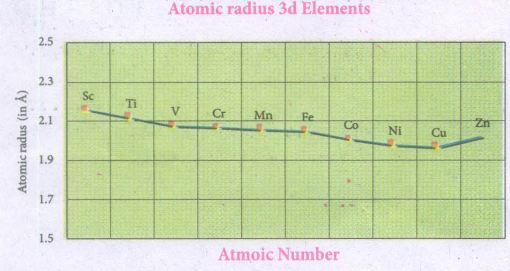
(i) It is generally expected a steady decrease in atomic radius along a period as the nuclear charge increases and the extra electrons are added to the same sub shell.
(ii) But for the 3d transition elements, the expected decrease in atomic radius is observed from Sc to V, thereafter up to Cu the atomic radius nearly remains the same.
(iii) As we move from Sc to Zn in 3d series the extra electrons are added to the 3d orbitals, the added 3d electrons only partially shield the increased nuclear charge and hence the effective nuclear charge increases slightly.
(iv) However, the extra electrons added to the 3d sub shell strongly repel the 4s electrons and these two forces are operated in opposite direction and as they tend to balance each other, it leads to constancy in atomic radii.
(v) At the end of the series, d - orbitals of Zinc contain 10 electrons in which the repulsive interaction between the electrons is more than the effective nuclear charge and hence, the orbitals slightly expand and atomic radius slightly increases.
108.
(i) The element which occupies group number 15 and period number 3 is phosphorus. Hence, A is phosphorus This is further supported by the fact that A exhibits allotropy and A is tetra atomic.
(ii) Phosphorus reacts with caustic soda to form phosphine as below:
4P + 3 NaOH + 3H2O \(\longrightarrow \) PH3 + 3 NaH2PO2
Hence, B is phosphine PH3 which has rotten fish odour.
(iii) Phosphorus reacts with dry chlorine to form phosphorus trichloride which has a pungent odour.
P4 + 6 Cl2\(\longrightarrow \) 4PCl3
Thus, A = Phosphorus
B = Phosphine
C = Phosphorus trichloride
109.
(i) The colour develops because of the presence of electrons in the 8 anionic sites.
(ii) These electron absorb energy from the visible region of radiation and get excited.
(iii) For example when crystals of NaCl are heated in an atmosphere of sodium vapours, the sodium atoms get deposited on the surface of the crystal and the deposited Na atoms.
(iv) During this process, the Na atoms on the surface lose electrons to form Na+ ions
(v) These electrons get excited by absorbing energy from the visible light and impart yellow colour to the crystals.
110.
| DIAMOND | GRAPHITE |
| C is sp3 hybridised. | C is sp2 hybridised. |
| Three dimensional, tetrahedral structure. | Two dimensional, sheet like structure. |
| Crystalline, transparent with extra brilliance. | Crystalline, opaque and shiny substance. |
| It is hard with high density and high melting point. | It is soft with low density and high melting point. |
| Bad conductor of and electricity. | Good conductor of heat and electricity. |
111.
(i) Alumina is separated from silica in a bauxite ore through Baeyer's process, in which bauxite ore is concentrated by the method of leaching or chemical separation.
(ii) Chemical method is employed in case where the ore is to be in a very pure form, e.g., aluminium extraction. Bauxite (Al2O3), an ore of aluminium, contains SiO2 and Fe2O3 as impurities. When bauxite ore is treated with NaOH, the Al2O3 goes into solution as sodium meta aluminate leaving behind the undissolved impurities [Fe2O3, SiO2, Fe(OH)3' etc.], which are then filtered off.
\({ Al }_{ 2 }{ O }_{ 3 }+{ 2NaOH }\longrightarrow \underset { Sod.meta.aliminate\\ (In \ solution \ form) }{ { 2NaAlO }_{ 2 }+{ H }_{ 2 }O } \)
(iii) The filtrate (containing sodium meta aluminate) on dilution, and stirring gives a precipitate of aluminium hydroxide, which is filtered, and ignited to get pure alumina.
\({ NaAlO }_{ 2 }+2{ H }_{ 2 }O\longrightarrow \underset { Ppt }{ { Al(OH) }_{ 3 } } +NaOH\)
\(2Al\left( OH \right) _{ 3 }\overset { \Delta }{ \longrightarrow } \underset { Pure }{ { Al }_{ 2 }{ O }_{ 3 } } +3{ H }_{ 2 }O\)
112.
(i) Diamminesilver(I) chloride
(ii) Potassiumpentacyanidonitrosylferrate(II)
(iii) Ptricarbonyltriphenylphosphanechromium(O)
(iv) diamminesilver(I) ion
(v) Hexafluoridoferrate(II) ion.
113.
a) i) Ellingham diagram for the formation of Al2O3 and MgO intersects around 1500oC. Above this temp Mg lies above the Aluminium line. Hence only above 1500oC Aluminium might be excepted to reduce magnesia.
ii) Ellingham diagram for the formation of MgO lies below the formation of Al2O3. Hence MgO is more stable than Al2O3. Hence Magnesium could reduce Alumina.
1. Below 983K, formation of CO line lies below many of the metal oxide formation in Ellingham diagram, hence CO is more effective reducing agent than Carbon.
2. But above this temperature Carbon lies below other metal oxides.
b) Around 1200K Carbon lies below the formation of Fe2O3. Hence it is possible to reduce Fe2O3 by coke at 1200K.
114.
When alkylcyanides are reduced using SnCl2 HCl, imines are formed, which on hydrolysis gives corresponding aldehyde.
\({ CH }_{ 3 }-C\equiv N\overset { { SnCl }_{ 2 }/HCl }{ \longrightarrow } { CH }_{ 3 }-CH={ NH }\overset { { H }_{ 3 }{ O }^{ + } }{ \longrightarrow } { CH }_{ 3 }-CHO\)
115.
1-Butanol, being primary alcohol gets oxidised by dilute KMnO4. The brown precipitate is due to the formation of manganese dioxide.
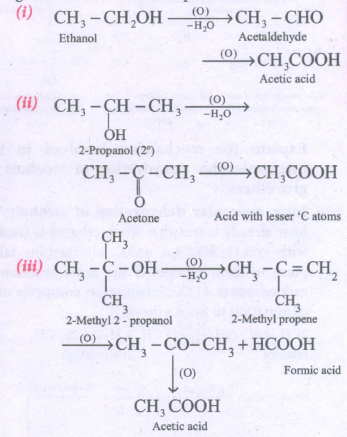
116.
Oxidation of alcohols with acidified K2Cr2O2 gives different oxidation products.
117.
(i) Fuller's earth and silica gel are used for refining process.
(ii) Sugar prepared from molasses is decolourised to remove coloured impurities by adding animal charcoal which acts as decolourising material.
(iii) Catalysis is an important branch of surface chemistry which is based on the phenomenon of adsorption of materials on the catalyst surface.
118.
During recharge process, the role of anode and cathode is reversed and H2SO4 is regenerated.
Oxidation occurs at the cathode ( now act as anode)
\(\stackrel {+2}{{ PbS }O}_{ 4(s) }+2{ H }_{ 2 }O(l)\rightarrow \stackrel{+4}{ Pb }O_{ 2(S) }+{ SO }_{ 4(aq) }^{ 2- }\)
Reduction occurs at the anode (now act as cathode)
\({ PbS }O_{ 4(s) }^{ }+2{ e }^{ - }\rightarrow { Pb }_{ (s) }+{ SO }_{ 4(aq) }^{ 2- }\)
Overall reaction:
\({ 2PbS }O_{ 4(s) }^{ }+2{ H }_{ 2 }O(l)\rightarrow { Pb }_{ (s) }+{ Pb }O_{ 2(S) }+{ 4H }_{ (aq) }^{ + }+{ SO }_{ 4(aq) }^{ 2- }\)
Thus, the overall cell reaction is exactly the reverse of the redox reaction which takes place while discharging
119.
According to Arrhenius, an acid is a substance that dissociates to give hydrogen ions in water. For example, HCl, H2SO4 etc., are acids. Their dissociation in aqueous solution is expressed as
\({ HCl }_{ (g) }\overset { { H }_{ 2 }O }{ \rightleftharpoons } { H }_{ (aq) }^{ + }+{ Cl }_{ (aq) }^{ - }\)
Similarly a base is a substance that dissociates to give hydroxyl ions in water. For example, substances like NaOH, Ca(OH)2 etc., are bases.
\({ Ca(OH) }_{ 2 }\overset { { H }_{ 2 }O }{ \rightleftharpoons } { Ca }_{ (aq) }^{ 2+ }+{ 2OH^- }_{ (aq) }\)
120.
(i) In lyophillic colloids or sols definite attractive force or affinity exists between dispersion medium and dispersed phase. Examples: sols of protein and starch. They are more stable and will not get precipitated easily.
(ii) In a lyophobic colloids, no attractive force exists between the dispersed phase and dispersion medium. They are less stable and precipitated readily, but cannot be produced again by just adding the dispersion medium.
Examples: sols of gold, silver, platinum and copper.
121.
HCN is a weak acid
\({\left[\mathrm{H}^{+}\right] } =\sqrt{\mathrm{K}_{\mathrm{a}} \cdot \mathrm{C}} \)
\(=\sqrt{10^{-9} \times 0.4} \)
\(=\sqrt{4 \times 10^{-10}} \)
\(=2 \times 10^{-5} \)
\(\mathrm{pH} =-\log _{10}\left[\mathrm{H}^{+}\right] \)
\(=-\log _{10}\left(2 \times 10^{-5}\right) \)
\(=-\left[\log _{10} 2-5 \log 10\right] \)
\(=5-\log 2\)
= 5-0.3010 = 4.6990
122.
Let [A0] = 100;
When t = t99.9%; [A] = (100-99.9) = 0.1
\(k=\frac { 2.303 }{ t } \log\left( \frac { [{ A }_{ 0 }] }{ [A] } \right) \)
\({ t }_{ 99.9\% }=\frac { 2.303 }{ K } \log\left( \frac { 100 }{ 0.1 } \right) \)
\({ t }_{ 99.9\% }=\frac { 2.303 }{ K } \log1000\)
\({ t }_{ 99.9\% }=\frac { 2.303 }{ K } (3)\)
\({ t }_{ 99.9\% }=\frac { 6.909 }{ K } \)
\({ t }_{ 99.9\% }=10\times \frac { 0.69 }{ K } \)
\({ t }_{ 99.9\% }={ 10 } t_{ 1/2 }\)
123.
\(2{ NH }_{ { 3 }_{ (g) } }\overset { pt }{ \longrightarrow } { N }_{ { 2 }_{ (g) } }+3{ H }_{ { 2 }_{ (g) } }\)
Rate = \(-\frac { 1 }{ 2 } \frac { d\left[ { NH }_{ 3 } \right] }{ dt } =\frac { d\left[ { N }_{ 2 } \right] }{ dt } =\frac { 1 }{ 3 } \frac { d\left[ { N }_{ 2 } \right] }{ dt } \)
However, it is given that the reaction is of zero order. Therefore
\(-\frac { 1 }{ 2 } \frac { d\left[ { NH }_{ 3 } \right] }{ dt } =\frac { d\left[ { N }_{ 2 } \right] }{ dt } =\frac { 1 }{ 3 } \frac { d\left[ { N }_{ 2 } \right] }{ dt } k\)
= 2.5 x 10⁻⁴ mol L-1 S-1
The rate of production of N2 is
\(\frac { d\left[ { N }_{ 2 } \right] }{ dt } \)= 2.5 x 10⁻⁴ mol L-1 S-1
The rate of production of H2 is
\(\frac { d\left[ { N }_{ 2 } \right] }{ dt } \)= 3 x 2.5 x 10-4 mol L-1 s-1
= 7.5 x 10⁻⁴ mol L-1 s-1.
124.
(i) Atomic size : The atomic size in 3d transition series decrease from Sc to Mn and then Fe, CO, Ni have almost same atomic size while copper has bigger size. It is because number of unpaired electrons in d- orbitals increase in the beginning till Mn. Therefore effective nuclear charge increases hence atomic size decreases then pairing of electrons in d- orbitals takes place, so the atomic size remains the same and finally it increases due to repulsion between paired electrons in d- orbitals which leads to decrease in effective nuclear charge.
(ii) They have high enthalpy of atomisation due to strong metallic bonds and additional covalent bonding due to the presence of unpaired electrons in d- orbitals.
125.
Structure of ammonia
(i) Ammonia molecule is pyramidal in shape N-H bond distance is 1.016Å and H-H bond, distance is 1.645Å with a bond angle 107°.
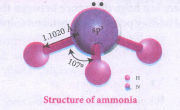
(ii) The structure of ammonia may be regarded as a tetrahedral with one lone pair of electrons in one tetrahedral position hence it has a pyramidal shape.
126.
Simple Cubic Lattice
100,101,111
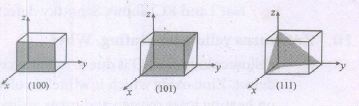
\({ d }_{ hkl }=\frac { a }{ \sqrt { { h }^{ 2 }+{ k }^{ 2 }+{ l }^{ 2 } } } \)
\({ d }_{ 100 }=\frac { 1 }{ \sqrt { { 1 }^{ 2 }+0^{ 2 }+0^{ 2 } } } =1\)
\({ d }_{ 101 }=\frac { 1 }{ \sqrt { { 1 }^{ 2 }+0^{ 2 }+0^{ 2 } } } =\frac { 1 }{ \sqrt { 2 } } \)
\({ d }_{ 111 }=\frac { 1 }{ \sqrt { { 1 }^{ 2 }+1^{ 2 }+1^{ 2 } } } =\frac { 1 }{ \sqrt { 3 } } \)
\(\\ { d }_{ 100 }:{ d }_{ 101 }:{ d }_{ 111 }=1:\frac { 1 }{ \sqrt { 2 } } :\frac { 1 }{ \sqrt { 3 } } (or)\)
=1:0.707:0.577
127.
(i) Boron trifluoride is obtained by the treatment of calcium fluoride with boron trioxide in presence of conc. sulphuric acid.
B2O3 + 3CaF2 + 3H2SO4 \(\overset { \triangle }{ \longrightarrow } \) 2BH3 + 3CaSO4 + 3H2O
(ii) It can also be obtained by treating boron trioxide with carbon and fluorine.
B2O3 + 3C + 3F2 ⟶ 2BF3 + 3CO
(iii) In the laboratory pure BF3 is prepared by the thermal decomposition of benzene diazonium tetrafluoro borate.
PhN2BF4 \(\overset { \triangle }{ \longrightarrow } \) BF3 + PhF + N2
128.
(i) Copper is used for making coins and ornaments along with gold and other metals.
(ii) Copper and its alloys are used for making wires, water pipes and other electrical parts.
129.
(i) Coordination compounds which possess chirality exhibit optical isomerism similar to organic compounds.
(ii) The pair of two optically active isomers which are mirror images of each other are called enantiomers.
(iii) Their solutions rotate the plane of the plane polarised light either clockwise or anticlockwise and the corresponding isomers are called 'd' (dextrorotatory) and 'I'(levorotatory) forms respectively.
(iv) The octahedral complexes of type I [M(xx)3]n±, [M(xx)2AB]n± and [M(xx)2B2]n± exhibit optical isomerism.
(v) Examples:
The optical isomers of [Co(en)3]3+
130.
(i) The half life of a reaction is defined as the time required for the reactant concentration to reach one half its initial value.
\(k=\frac { 2.303 }{ t } log\frac { \left[ { A }_{ 0 } \right] }{ \left[ A \right] } \)
\(at\quad t={ t }_{ \frac { 1 }{ 2 } };\left[ A \right] =\frac { \left[ { A }_{ 0 } \right] }{ 2 } \)
\(k=\frac { 2.303 }{ t_{ 1/2 } } log\frac { \left[ { A }_{ 0 } \right] }{ \frac { \left[ { A }_{ 0 } \right] }{ 2 } } \)
\(k=\frac { 2.303 }{ { t }_{ 1/2 } } log2\)
\(k=\frac { 2.303\times 0.3010 }{ { t }_{ 1/2 } } =\frac { 0.6932 }{ { t }_{ 1/2 } } \)
\({ t }_{ 1/2 }=\frac { 0.6932 }{ k } \)
This equation has no concentration term So, the half life of a first order reaction is independent of initial concentration.
131.
(i) The elements in which the extra electron enters (n-2) f orbitals are called f-block elements. These elements are called as inner transition elements because they form a transition. Series within the transition elements.
(ii) The f-block elements are also called as rare earth elements. They are divided into lanthanoid series (4f block elements) and actinoid series (5f block elements).
132.
1. [Ni(CN)4]2- is a low spin square planar complex as it contains strong field CN- ligand in it.
2. Oxidation state of Ni in complex is +2 Electronic Configuration of Ni2+ is 3d8 4s0
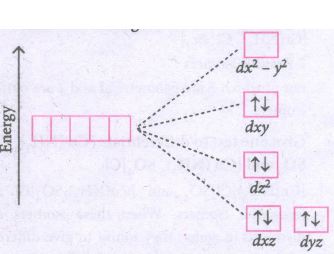
Crystal field splitting in square planar complex.
1. No unpaired electrons, so the complex is diamagnetic.
2. [NiCl4]2- is a high spin tetrahedral complex as it contains weak field Cl- ligand in it.
3. Oxidation state of Ni in complex in +2
4. Electronic Configuration of Ni2+ is 3d8 4s6.
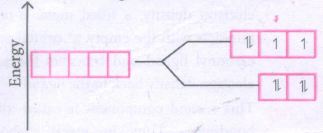
It has two unpaired electrons, so the complex is paramagnetic.
133.
\(\text {(a) }\left[\mathrm{Cr}\left(\mathrm{NH}_{3}\right)_{6}\right]^{3+}:{ }_{24} \mathrm{Cr} \Rightarrow{ }_{18}[\mathrm{Ar}] 4 \mathrm{~s}^{2} 3 \mathrm{~d}^{4} \)
\({ }_{21} \mathrm{Cr}^{3+} \Rightarrow{ }_{18}[\mathrm{Ar}] 3 \mathrm{~d}^{3}\)
.JPG)
(i) d2sp3 hybridisation (octahedral)
(ii) It has three unpaired electrons (n = 3)
(iii) So it is paramagnetic
(iv) Magnetic moment \(\left(\mu_{\mathrm{s}}\right)=\sqrt{\mathrm{n}(\mathrm{n}+2)} \mathrm{BM}\)
\(=\sqrt{3(3+2)}=\sqrt{15}=3.87 \mathrm{BM}\)
\((b) \ \left[\mathrm{Ni}(\mathrm{CN})_{4}\right]^{2-:}{ }_{28} \mathrm{Ni} \Rightarrow[\mathrm{Ar}] 4 \mathrm{~s}^{2} 3 \mathrm{~d}^{8} ;{ }_{26} \mathrm{Ni}^{2+} \Rightarrow{ }_{18}[\mathrm{Ar}] 3 \mathrm{~d}^{8}\)
.JPG)
(i) dsp2 hybridisation
(ii) Geometry - square planar
(iii) No unpaired electrons- It is Diamagnetic
(iv) Magnetic moment (μs) = 0.
134.
(i) Helium is used to provide inert atmosphere in electric-arc welding of metals.
(ii) Helium has lowest boiling point hence used in cryogenics.
(iii) It is much less denser than air and hence used for filling air balloons.

12th Standard Syllabus & Materials
12th Standard
TN 12th Computer Applications களப்பெயர் முறைமை (DNS) Sample Question Papers Study Material - QB365 Set A
NEW12th Standard
TN 12th Computer Applications வலையமைப்பு எடுத்துக்காட்டுகள் மற்றும் நெறிமுறைகள் Sample Question Papers Study Material - QB365 Set A
NEW12th Standard
TN 12th Computer Applications கணினி வலையமைப்பு ஓர் அறிமுகம் Sample Question Papers Study Material - QB365 Set A
NEW12th Standard
TN 12th Computer Applications PHP-உடன் MySQL-ஐ இணைத்தல் Sample Question Papers Study Material - QB365 Set A



Tamilnadu Stateboard 12th Standard Subjects

Maths
Chemistry

Physics

Biology

Computer Science

Business Maths and Statistics

Economics

Commerce

Accountancy

History

Computer Applications
Biology
Computer Technology
Computer Applications
Computer Science
Business Maths and Statistics
Commerce
Economics
Maths
Chemistry
Physics
Computer Technology
History
Accountancy

Tamil

English

French
Tamilnadu Stateboard Standards
