
 100% FREE ACCESS
12th Standard Syllabus & Materials
12th Standard
TN 12th Computer Applications மின்னணு தரவு பரிமாற்றம் Sample Question Papers Study Material - QB365 Set A
NEW12th Standard
TN 12th Computer Applications மின் - வணிக பாதுகாப்பு அமைப்புகள் Sample Question Papers Study Material - QB365 Set A
NEW12th Standard
TN 12th Computer Applications மின்னணு செலுத்தல் முறைகள் Sample Question Papers Study Material - QB365 Set A
NEW12th Standard
TN 12th Computer Applications மின் - வணிகம் Sample Question Papers Study Material - QB365 Set A
NEW12th Standard
TN 12th Computer Applications திறந்த மூல கருத்துருக்கள் Sample Question Papers Study Material - QB365 Set A
NEW12th Standard
TN 12th Computer Applications வலையமைப்பு வடமிடல் Sample Question Papers Study Material - QB365 Set A

Published on: 21/02/2020
12th Standard Chemistry Important Questions II 2019-2020
Download Tamil Nadu 12th Standard Chemistry question papers, model tests, one-mark questions, important questions, and public exam papers in PDF format. Free study materials and answer keys for TN State Board students.
Questions + Answers key
Take MCQ Chemistry Test
1.
SHE is _______.
Standard Helium Electrode
Standard Hydrogen Electrode
Standard Mercury Electrode
none of these
2.
1 F equals to _____.
96500 moles
96500 C
1.6 x 10⁻¹⁹ C
1.6 x 10⁻¹⁹ moles
3.
Ohm's law is mathematically expressed as ______.
I = \(\frac{V}{R}\)
I = \(\frac{R}{V}\)
V = \(\frac{I}{R}\)
R = \(\frac{I}{V}\)
4.
On Kolbe's electrolysis, formic acid gives _______.
H2
methane
ethane
none
5.
From which of the following, tertiary butyl alcohol is obtained by the action of methyl magnesium iodide?
HCHO
CH3CHO
CH3COCH3
CO2
6.
Which of the following acids do not exhibit optical isomerism?
lactic acid
tartaric acid
maleic acid
both (a) and (b)
7.
An example of positively charged colloid is________.
clay
starch
Ag
haemoglobin
8.
A drop of hydrochloric acid is added to pure water, its pH _____.
increases
decreases
increases and then decreases
resist the change in pH and so remains unaltered
9.
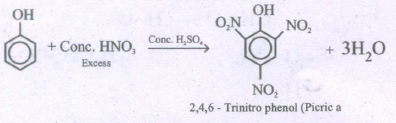
The degree of hydrolysis of 0.1 M solution of ammonium acetate is 8.48 x 10⁻⁵. The dissociation constant of the weak base is _______.
1.39 x 10⁻⁴
1.39 x 10⁻⁵
1.45 x 10⁻¹⁰
1.45 x 10⁻⁹
10.
Henderson equation for a weak acid and its salt is _______.
pH = pKb+ log (Salt) / (Acid)
pH = pKa + log (Salt) / (Acid)
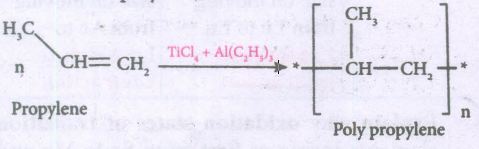
pH = pKa + log (Salt) / (Base)
pH = pKa + log (Acid) / (Salt)
11.
The number of primary alcoholic groups in ethylene glycol is ________.
0
1
2
3
12.
In swern method of oxidation of alcohols to aldhedye/ ketones _______ is used as an oxidising agent.
dimethyl sulfoxide
pyridimium chloro chromate
CrO3 in anhydrousmedium
Na2Cr2O7 |H+
13.
Lucas test is used to distinguish 10, 20 and 30 ______.
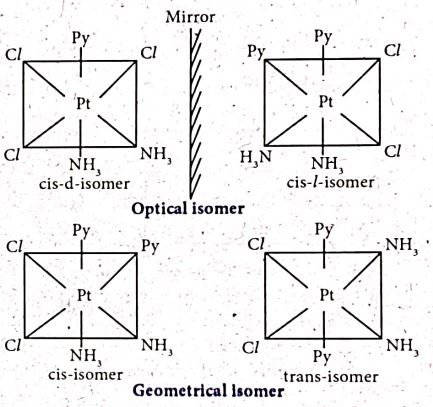
amines
nitro compound
alcohols
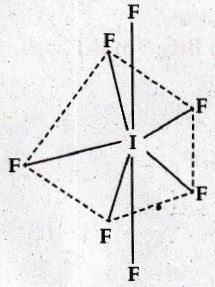
all the above
14.
The multilayer adsorption of gases on solids take place in _______.
physical adsorption
chemisorption
sols
active centres
15.
Which of the following interface cannot be obtained?
solid - solid
solid - liquid
gas - gas
liquid -Iiquid
16.
In which of the following reactions new carbon – carbon bond is not formed?
Aldol condensation
Friedel craft reaction
Kolbe’s reaction
Wolf kishner reduction
17.
Reaction of acetone with one of the following reagents involves nucleophilic addition followed by elimination of water. The reagent is _______.
Grignard reagent
Sn / HCl
hydrazine in presence of slightly acidic solution
hydrocyanic acid
18.
Isoprophylbenzene on air oxidation in the presence of dilute acid gives ______.
C6H5COOH
C6H5COCH3
C6H5COC6H5
C6H5- OH
19.
An alcohol (x) gives blue colour in victormayer’s test and 3.7g of X when treated with metallic sodium liberates 560 mL of hydrogen at 273 K and 1 atm pressure what will be the possible structure of X?
CH3 CH (OH) CH2CH3
CH3 – CH (OH) – CH3
CH3 – C (OH) – (CH3)2
CH3- CH2 –CH (OH) – CH2 – CH3
20.
Match the following
| a | V2O5 | i | High density polyethylene |
| b | Ziegler – Natta | ii | PAN |
| c | Peroxide | iii | NH3 |
| d | Finely divided Fe | iv | H2SO4 |
| A | B | C | D |
| iv | i | ii | iii |
| A | B | C | D |
| i | ii | iv | iii |
| A | B | C | D |
| ii | iii | iv | i |
| A | B | C | D |
| iii | iv | ii | i |
21.
Hair cream is _____.
gel
emulsion
solid sol
sol.
22.
| Electrolyte | KCl | KNO3 | HCl | NaOAC | NaCl |
| Λ- (Scm2 mol-1) |
149.9 | 145.0 | 426.2 | 91.0 | 126.5 |
Calculate ΛoHoAC using appropriate molar conductances of the electrolytes listed above at infinite dilution in water at 25oC_______.
517.2
552.7
390.7
217.5
23.
24.
Equal volumes of three acid solutions of pH 1,2 and 3 are mixed in a vessel. What will be the H+ ion concentration in the mixture?
3.7 × 10⁻²
10-6
0.111
none of these
25.
What is the decreasing order of strength of bases
OH, NH2- H - C ≡ C and CH3 - CH2-
OH->NH2- >H-C≡C >CH3-CH2-
NH2->OH->CH3-CH2- >H-C≡C
CH3-CH2->NH2->H-C≡C->OH-
OH->H-C ≡ C->CH3-CH2- >NH2-
26.
Which of the following statement is not correct?
Molecularity of a reaction cannot be fractional
Molecularity of a reaction cannot be more than three
Molecularity of a reaction can be zero
Molecularity is assigned for each elementary step of mechanism.
27.
A+B \(\longrightarrow \) C; ∆H = 60 kJ mol-1 Eaf = 150 kJ. What is the activation energy of the backward reaction?
210 kJ
105 kJ
90 kJ
145 kJ
28.
2N2O5 ⟶ NO2 + O2, \(\frac { d\left[ { N }_{ 2 }{ O }_{ 5 } \right] }{ dt } \) = k1[N2O5], \(\frac { d\left[ { NO }_{ 2 } \right] }{ dt } \)= k2[N2O5] and \(\frac { d{ O }_{ 2 } }{ dt } \) = k 3[N2O5], the relation between k1, k2 and k3 is _____.
2k1 = 4k2 = k3
k1 = k2 = k3
2k1 = k2 = 4k3
2k1 = k2 = k3
29.
The incorrect statement among the following is _________.
Reducing character of hydrides of group 15 increases down the group
Basicity of hydrides of group 15 increases down the group
NCl5 does not exist
Phosphorus and arsenic can form P\(\pi \)-d\(\pi \) bond but not nitrogen
30.
When Copper is heated with cone HNO3 it produces
Cu (NO3)2 and N2O
Cu (NO3)2 and NO2
Cu (NO3)2 and NO
Cu (NO3)2 NO and N2O
31.
Which of the following halides of group 15 is not hydrolysed?
NF3
PF3
NI3
Both (a) and (b)
32.
Frankel defect is also known as ________.
stoichiometric defect
dislocation defect
both (a) & (b)
non-stoichiometric defect
33.
In the Bragg's equation for diffraction of X-rays, 'n' represents _______.
The number of moles
Avogadro number
A quantum number
Order of reflection
34.
In a face-centered cubic lattice, a unit cell is shared equally by how many unit cells?
8
4
2
6
35.
On moving down the group 13, density ______
decreases
increases
First decreases then increases
remains same
36.
Graphite has _______.
2-d sheet structure
Vander waals force between successive layers of carbon sheets
Sp2 hybridised carbon linked with other three carbon atoms in hexagonal planar structure
all the above
37.
Select the incorrect statement regarding B2H6.
It contains B-B ionic bond
Each boron is Sp3 hybridised
It has two types of hydrogen bonds
it is used as a reducing agent
38.
Equivalent weight of KMnO4 in acidic medium is _______.
3.16
31.6
158
52.67
39.
The correct statement is_______.
Cu2Cl2 and Ag2S are coloured
Upon strong heating paramagnetic gases are evolved by NaNO3 and AgNO3
Green vitriol and blue vitriol are isomorphous
KMnO4 and K2Cr2O7 are coloured due to
40.
What are the species X and Y in the following?

CrO3, CrO42-
CrO3, Cr2O3
CrO4-2, Cr2O72-
H2CrO4, H2Cr2O7
41.
In acid leaching process the insoluble sulphide is converted into soluble sulphate and elemental_______.
carbon
lead
sulphur
zinc
42.
Ignition mixture used in aluminothermic process is ________.
Cr + AI2O3
Mg + BaO2
AI + Cr2O3
Ba + MgO
43.
The process of heating of copper pyrites to remove sulphur is called ________.
froth flotation
roasting
calcination
smelling
44.
The ionisation isomer of [Cr(H2O)4CI(NO2)]Cl is _________.
[Cr(H2O)4Cl2(NO)2]
[Cr(H2O)4Cl2]NO2
[Cr(H2O)4Cl(ONO)]
both (a) and (b)
45.
Which of the following is not true about secondary valency?
It corresponds to the co-ordination number of metal
It is satisfied by negative ions or neutral molecule
They are non directional in nature
both (a) and (b)
46.
[FeF6]4- is paramagnetic because _______.
F- is a weaker ligand
F- is a strong ligand
F- is a flexidentate ligand
F- is a chelating ligand
47.
If the initial concentration of the reactant is doubled, the time for half reaction is also doubled. Then the order of the reaction is______.
Zero
one
Fraction
none
48.
For a first order reaction, the rate constant is 6.909 min-1 the time taken for 75% conversion in minutes is _______.
\(\left( \frac { 3 }{ 2 } \right) { \log 2 }\)
\(\left( \frac { 2 }{ 3 } \right) \log2\)
\(\left( \frac { 3 }{ 2 } \right) \log\left( \frac { 3 }{ 4 } \right) \)
\(\left( \frac { 2 }{ 3 } \right) \log\left( \frac { 4 }{ 3 } \right) \)
49.
50.
Solid CO2 is an example of ________.
Covalent solid
metallic solid
molecular solid
ionic solid
51.
Which one of the following complexes is not expected to exhibit isomerism?
[Ni(NH3)4(H2O)2]2+
[Pt(NH3)2Cl2]
[Co(NH3)5SO4]Cl
[FeCl6]3-
52.
The sum of primary valence and secondary valence of the metal M in the complex [M(en)2(Ox)]Cl is________.
3
6
-3
9
53.
The actinoid elements which show the highest oxidation state of +7 are _______.
Np, Pu, Am
U, Fm, Th
U, Th, Md
Es, No, Lr
54.
Which of the following statements is not true?
on passing H2S, through acidified K2Cr2O7 solution, a milky colour is observed
Na2Cr2O7 is preferred over K2Cr2O7 in volumetric analysis
K2Cr2O7 solution in acidic medium is orange in colour
K2Cr2O7 solution becomes yellow on increasing the PH beyond 7
55.
| Column-I | Column-II | ||
| A | Borazole | 1 | B(OH)3 |
| B | Boric acid | 2 | B3N3H6 |
| C | Quartz | 3 | Na2[B4O5(OH)4]8H2O |
| D | Borax | 4 | SiO2 |
| A | B | C | D |
| 2 | 1 | 4 | 3 |
| A | B | C | D |
| 1 | 2 | 4 | 3 |
| A | B | C | D |
| 1 | 2 | 4 | 3 |
None of these
56.
The correct order of the thermal stability of hydrogen halide is_______.
HI > HBr > HCl > HF
HF > HCl > HBr > HI
HCl > HF > HBr > HI
HI > HCl > HF > HBr
57.
Solid (A) reacts with strong aqueous NaOH liberating a foul smelling gas(B) which spontaneously burn in air giving smoky rings. A and B are respectively_________.
P4(red) & PH3
P4(white) & PH3
S8 & H2S
P4(white) & H2S
58.
In diborane, the number of electrons that accounts for banana bonds is ________.
six
two
four
three
59.
60.
Bauxite has the composition ______.
Al2O3
Al2O3.nH2O
Fe2O3.2H2O
None of these
61.
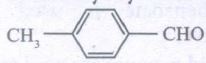
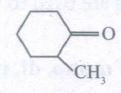
Write the structural formula of
(i) p - methyl benzaldehyde
(ii) 2 - methyl cyclohexanone
62.
Mention the industrial use of formaldehyde.
63.
A solid catalyst is more effective in its finely divided form - Justify.
64.
What are the two types of emulsion?
65.
Give examples of primary cells.
66.
On dilution of 0.1 M of Na2SO4, what will happen to its
(a) Conductance (C)
(b) Conductivity K
(c) Molar conductance \({ \Lambda }_{ m }\)
(d) Equivalent conductance \({ \Lambda }\)
67.
How can isopropyl alcohols be converted to t-butyl alcohol?
68.
Complete the following reaction giving names of products.
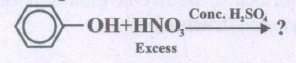
69.
Why is aqueous solution of FeCl3 acidic?
70.
When temperature is increased, will ionic product of water increase or decrease? Give reason to justify your answer.
71.
Calculate the molar conductance of 0.025M aqueous solution of calcium chloride at 25°C. The specific conductance of calcium chloride is 12.04 x 10⁻² Sm-1.
72.
73.
Two metals M1 and M2 have reduction potential values of -xV and +yV respectively. Which will liberate H2 and H2SO4.
74.
A lab assistant prepared a solution by adding a calculated quantity of HCl gas 250C to get a solution with [H3O+] = 4\(\times\)10-5M. Is the solution neutral (or) acidic (or) basic.
75.
Account for the acidic nature of HClO4 in terms of Bronsted – Lowry theory, identify its conjugate base.
76.
The rate of the reaction X + 2y→ product is 4 x 10⁻³ mol L-1S-1, if [X] = [Y] = 0.2M and rate constant at 400K is 2 x 10⁻²s-1, What is the overall order of the reaction.
77.
What is Zeigler - Natta catalyst?
78.
For a chemical reaction, Variation in the concentration In[A] Vs time in seconds is given as
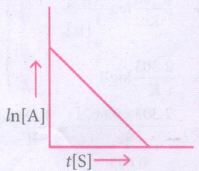
(i) What is the order of the reaction?
(ii) What is the unit of rate constant K?
(iii) Give the relationship between k and \({ t }_{ \frac { 1 }{ 2 } }\)
79.
Why is instantaneous rate preferred over average rate?
80.
A compound forms hexagonal dosed packed structure. What is the total number of voids in 0.5 mol of it? How many of these are tetrahedral voids?
81.
Why hydrides of oxygen is a liquid whereas hydride of sulphur is a gas?
82.
How is ammonia prepared in the lab?
83.
What are primitive unit cells?
84.
Name the two important ores of Boron.
85.
What is tetraethoxy silane? How is it obtained?
86.
Give the general electronic configuration of actinides?
87.
Define metallurgy.
88.
What is Co-ordination sphere?
89.
What is Co-ordination entity?
90.
Write the two similarities between calcination and roasting.
91.
What are interstitial compounds?
92.
Explain why compounds of Cu2+ are coloured but those of Zn2+ are colourless.
93.
Give an example for complex of the type [Ma2b2c2] where a, b, c are monodentate ligands and give the possible isomers.
94.
Give an example of coordination compound used in medicine and two examples of biologically important coordination compounds.
95.
Write the formula for the co-ordination compounds.
96.
What is the hybridisation of iodine in IF7? Give its structure.
97.
Give one example for each of the following
(i) icosogens
(ii) Tetragens
(iii) pnictogens
(iv) chalcogens
98.
Write a short note on anomalous properties of the first element of p-block.
99.
100.
What are the various steps involved in the extraction of pure metals from their ores?
101.
Give two tests for aldehydes.
102.
Explain the mechanism involved in the intermolecular dehydration of alcohols to give ethers.
103.
Write the characteristics of catalysts.
104.
To one molar solution of a trivalent metal salt, electrolysis was carried out and 0.667 M was the concentration remaining after electrolysis. Calculate the quantity of electricity passed.
105.
Derive Henderson - Hasselbalch equation
106.
Why is there a variation of atomic and ionic size as we move from Sc to Zn?
107.
For the reaction 2A + B ⟶ A2B. The rate = k [A] [B]2 with k = 2.0 x 10⁻⁶ mol? L2 S-1. Calculate the initial rate of the reaction, when [A] = 0.1 mol L-1, [B] = 0.2 mol L-1. Calculate the rate of reaction after [A] is reduced to 0.06 mol L-1
108.
Why is dioxygen a gas but sulphur a solid?
109.
What are molecular solids? Explain the types of molecular solids.
110.
What are the various methods by which carbon-di-oxide is prepared?
111.
Write short note on the following:
(i) The process in which no external reducing agent is used.
(ii) The process which is used for highly electro positive metal.
(iii) Write the equation involved in the thermite process.
112.
What are the salient feature of crystal field theory?
113.
Describe briefly allotropism in p- block elements with specific reference to carbon.
114.
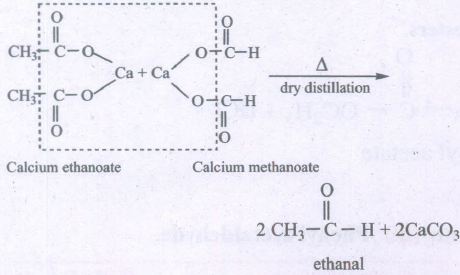
Predict the product when calcium ethanoate and calcium methanoate are dry distilled. Explain the reaction.
115.
Give the IUPAC names of each of the following and classify them as 1°, 2° and 3°
(a) CH3(CH2)3CHOHCH(CH3)2
(b) (CH3)3C-CH2OH
(c) \(({ CH }_{ 3 })_{ 2 }\underset { \overset { | }{ { C }_{ 6 }{ H }_{ 5 } } }{ C } -OH\)
(d) \(BrCH_{ 2 }-\underset { \overset { | }{ OH } }{ { CH }_{ 2 } } -CH-C({ CH }_{ 3 })_{ 3 }\)
(e) CH2=CH-CHOHCH
(f) PhCH2OH
(g) HOCH2CH2CH2CH2C6H5
(h) (C2H5)3COH
116.
Why does physisorption decrease with increase of temperature?
117.
Corrosion of aluminum takes place at a much slower rate than iron. Give reason
118.
Define buffer Index
119.
How is phenol prepared from
i) chloro benzene
ii) isopropyl benzene
120.
State Faraday’s Laws of electrolysis
121.
Derive an expression for the hydrolysis constant and degree of hydrolysis of salt of strong acid and weak base.
122.
Show that in case of first order reaction, the time required for 99.9% completion is nearly ten times the time required for half completion of the reaction.
123.
Explain why oxidation states of transition elements increases first from Sc to Mn and then decrease?
124.
Give the characteristics of first order reaction.
125.
Explain the structure of ammonia.
126.
Classify the following solids in different categories based on the nature of intermolecular force operating in them: Potassium sulphate, tin, benzene, urea, ammonia, water, zinc sulphide, graphite, rubidium, argon, silicon carbide.
127.
Find out the oxidation state of carbon in each of the following:
(i) CaC2
(ii) H2CO3
(iii) HCN
(iv) CO
128.
Explain how the metal oxide is converted into metal using carbon as a reducing agent.
129.
What is stability constant?
130.
The rate law for a reaction of A, B and C has been found to be rate = k[A]2[B][L]3/2 How would the rate of reaction change when
(i) Concentration of [L] is quadrupled
(ii) Concentration of both [A] and [B] are doubled
(iii) Concentration of [A] is halved
(iv) Concentration of [A] is reduced to \(\left(\frac{1}{3}\right)\) and concentration of [L] is quadrupled.
131.
What are inner transition elements?
132.
Write the reason for the anomalous behaviour of Nitrogen.
133.
What are interhalogen compounds? Give examples.
1.
(b)
Standard Hydrogen Electrode
2.
(b)
96500 C
3.
(a)
I = \(\frac{V}{R}\)
4.
(a)
H2
5.
(c)
CH3COCH3
6.
(c)
maleic acid
7.
(d)
haemoglobin
8.
(b)
decreases
9.
(b)
1.39 x 10⁻⁵
10.
(b)
pH = pKa + log (Salt) / (Acid)
11.
(c)
2
12.
(a)
dimethyl sulfoxide
13.
(c)
alcohols
14.
(a)
physical adsorption
15.
(c)
gas - gas
16.
(d)
Wolf kishner reduction
17.
(c)
hydrazine in presence of slightly acidic solution
18.
phenol
19.
CH3 CH (OH) CH2CH3
2R-OH+ 2Na ⟶ 2RONa + H2 ↑
2 moles of alcohol gives 1 mole of H2 which occupies 22.4 L at 273 K and 1 atm number of moles of alcohol
= 2 moles of R -OH/22.4L of H2 x 560 ml
= 0.05 moles
No of moles = mass/molar mass = m/M
= 3.7/0.05 = 74 g mol-1
General formula for (R-OH) Cn H2n + 1OH
n(12) + (2n + 1) (1) + 16 + 1 = 74
14n = 74 - 18
14n = 56
n = 56/14 = 4
The "2" alcohol which contains 4 carbon is CH3 - CH (OH) CH2 - CH3
20.
(a)
| A | B | C | D |
| iv | i | ii | iii |
21.
Emulsion-Dispersed phase
Dispersion meduun -liquid
22.
(ΛoHoAC) = [(Λo)HCl + Λo)NaOAC ] - (Λo)NaCl
= (426.2 + 91) - (126.5)
= 390.7
23.
(c)
24.
pH = -log10 [H+]
∴ [H+] = 10-pH
Let the volume be x ml.
V1M1 +V2M2 +V3M3 = VM
∴ x ml of 10-1 M+ x ml of 10-2 M + x ml of 10-3 M
= 3 x ml of [H+]
\(∴ [H^+] = \frac{ x[0.1 + 0.01 + 0.001]}{3x}\)
\(= \frac{ [0.1 + 0.01 + 0.001]}{3}\)
\(= \frac{ [0.111]}{3}\)
= 0.037
= 3.7 x 10⁻²
25.
(c)
CH3-CH2->NH2->H-C≡C->OH-
26.
(c)
Molecularity of a reaction can be zero
27.
(c)
90 kJ
28.
(c)
2k1 = k2 = 4k3
29.
(d)
Phosphorus and arsenic can form P\(\pi \)-d\(\pi \) bond but not nitrogen
30.
(b)
Cu (NO3)2 and NO2
31.
(d)
Both (a) and (b)
32.
(c)
both (a) & (b)
33.
(d)
Order of reflection
34.
(d)
6
35.
(b)
increases
36.
(d)
all the above
37.
(a)
It contains B-B ionic bond
38.
(b)
31.6
39.
(b)
Upon strong heating paramagnetic gases are evolved by NaNO3 and AgNO3
40.
(a)
CrO3, CrO42-
41.
(c)
sulphur
42.
(b)
Mg + BaO2
43.
(b)
roasting
44.
(b)
[Cr(H2O)4Cl2]NO2
45.
(c)
They are non directional in nature
46.
(a)
F- is a weaker ligand
47.
t1/2 α \(\frac{1}{[A_{0}]^{n-1}}\)...(1)
If [A0 = 2[A0]; then t1/2 = 2t1/2
2t1/2 α \(\frac{1}{[2A_{0}]^{n-1}}\)...(2)
(2)/(1) = \(2= \frac{1}{[2A_{0}]^{n-1}} \times \frac{1}{[A_{0}]^{n-1}}\)
\(2= \frac {[2A_{0}]^{n-1}} {[A_{0}]^{n-1}}\)
\(2= \frac {1} {2}^{n-1}\)
2 = (2-1)n-1
21 = (2-n+1)
n = 0
48.
\(k=\frac { 2.303 }{ t } \log\frac { \left[ { A }_{ 0 } \right] }{ \left[ A \right] } \)
[A0] = 100: [A] = 25
\(6.909=\frac { 2.303 }{ t } \log\frac { \left[ {100 } \right] }{ \left[ 25\right] } \)
\(t =\frac { 2.303 }{ 6.909 } \log(4)\)
\(t =\frac { 1 }{ 3 } \log(2^2)\)
\(= \left( \frac { 2 }{ 3 } \right) \log2\)
49.
(c)
50.
Lattice points are occupied by CO2 molecules
51.
Option (a) and (b) -geometrical isomerism is possible
Option (c) - ionization isomerism is possible
Option (d) - no possibility to show either constitutional isomerism or stereo isomerism
52.
In the complex [M(en)2(Ox)]Cl For the central metal ion M3+
The primary valence is = +3
The secondary valence = 6
sum of primary valence and secondary valence = 3 + 6 = 9
53.
(a)
Np, Pu, Am
54.
(b)
Na2Cr2O7 is preferred over K2Cr2O7 in volumetric analysis
55.
(a)
| A | B | C | D |
| 2 | 1 | 4 | 3 |
56.
(b)
HF > HCl > HBr > HI
57.
(b)
P4(white) & PH3
58.
(c)
four
59.
(c)
60.
(b)
Al2O3.nH2O
61.
(i)
(ii)
62.
It is used in the manufacture of polymeric resin called bakelite, a thermo setting plastic.
63.
Finely divided form of a catalyst has greater surface area when compared to their crystalline form. Greater the surface area, greater the adsorption and higher the catalytical activity.
64.
There are two types of emulsions.
(i) Oil in gwater (O/W)
(ii) Water in oli (W/O)
65.
(i) Leclanche cell
(ii) Mercury button cell
66.
Conductivity, molar conductance and equivalent conductance increases with dilution whereas Conductance (C) decreases.
67.

68.
69.
FeCl3 when dissolved in water gives strong acid HCl and a weak base Fe(OH)3 A strong acid ionises completely so concentration of H+ ion becomes much greater than OH- ion. So, aqueous solution of FeCl3 is acidic.
70.
With increase in temperature the ionic product of water will increase since the concentration of H3O+ and OH- ions will increase.
71.
Molar conductance = Λm = \( \frac{k\ (Sm^{-1})\times10^{-3}}{M} mol^{-1}m^{3} \)
\(= \frac{(12.04 \times 10^{-2} Sm^{-1}) \times 10^{-3} (mol^{-1}m^{3})} {0.025}\)
= 481.6 x 10⁻⁵ Sm2mol-1
72.
73.
Metals having higher oxidation potential will liberate H2 from H2SO4. Hence, the metal M1 having +xV, oxidation potential will liberate H2 from H2SO4.
74.
[H3O+] = 4 \(\times\) 10-5M
pH = - log10[H3O+]
pH=-log10[4 \(\times\) 10-5]
pH = -log10[4] - log10[10-5] log10 10 = 1
pH = -log 4 + 5log1010
= 5 - log 4
= 5 - 0.6021
=4.3979
Since pH is less than 7, the solution is acidic.
75.
\(\mathrm{HClO}_{4} \rightleftharpoons \mathrm{H}^{+}+\mathrm{ClO}_{4}^{-}\)
Bronsted Acid Proton Conjugate Base
HClO4 can donate a proton. Therefore HClO4 is an acid. Its conjugate base is ClO4-
76.
Rate = K[X]n[y]m
4 x 10⁻³ mol L-1s-1= 2 x 10⁻²s-1(0.2mol L-1)n(0.2mol L-1)m
\(\frac { 4\times { 10 }^{ -3 }mol\quad { L }^{ -1 }{ s }^{ -1 } }{ 2\times { 10 }^{ -2 }{ s }^{ -1 } } =\) (0.2)n+m(mol L-1)n+m
0.2(mol L-1) = (0.2)n+m(mol L-1)n+m
Comparing the powers on both sides
The overall order of the reaction n + m = 1
77.
A mixture of TiCl4 and trialkyl aluminium is used for polymerization.
78.
(i) I Order reaction
(ii) S-1
(iii) \({ t }_{ \frac { 1 }{ 2 } }\) = 0.693/k
79.
Rate decreases with time as the reaction proceeds and the average rate cannot be used to predict the rate of the reaction at any instant. The rate of the reaction, at a particular instant during the reaction is called the instantaneous rate. So instantaneous rate in prepared over average rate.
80.
1 Mole of hexagonal packed structure contains 1 mole of octahedral voids and two moles of tetrahedral voids. Therefore, 0.5 moles of hexagonal packed structure contains 0.5 moles of octahedral voids and 1 mole of tetrahedral voids.
No. of tetrahedral voids = 6.022 x 10²³
No. of octahedral voids\(\frac{1}{2}\) x no. of tetrahedral voids
No. of octahedral voids = \(\frac{1}{2}\) x 6.022 x 1023
= 3.011 x 10²³
Total No. of voids = (6.022+3.011) x 1023
= 9.033 x 10²³.
81.
(i) H2O undergoes extensive H-bonding due to high electronegativity of O-atom and hence exist as an associated molecule.
(ii) Therefore H2O is a liquid. On the other hand H2O does not undergo H-bonding and hence exists as a discrete molecules and as a gas.
82.
Ammonia is prepared in the laboratory by heating an ammonium salt with a base.
\({ 2NH }_{ 4 }^{ + }+{ OH }^{ - }\longrightarrow { 2NH }_{ 3 }+{ H }_{ 2 }O\)
\({ 2NH }_{ 4 }Cl+CaO\longrightarrow { CaCl }_{ 2 }+{ 2NH }_{ 3 }+{ H }_{ 2 }O\)
83.
A unit cell that contains only one lattice point is called a primitive unit cell, which is made up from the lattice points at each of the corners.
84.
(i) Borax - Na2[B4O5.(OH)4].8H2O
(ii) Kernite - Na2[B4O5(OH)4]·2H2O
85.
Tetraethoxy silane is Si(OC2H5)4·The chloride ion in silicon tetrachloride can be substituted by nucleophile such as OH, OR, etc .. using suitable reagents. For example, it forms silicic esters with alcohols.
\(Si{ Cl }_{ 4 }+{ C }_{ 2 }{ H }_{ 5 }OH\longrightarrow \underset { Tetraethoxy\ silane }{ Si({ OC }_{ 2 }{ H }_{ 5 })_{ 4 } } +4HCl\).
86.
5f1-14 6d0-1 7s2
87.
Metallurgy is the process of extraction of metal in the purest form from its ores.
88.
(i) The complex ion of the coordination compound containing the central metal atom/ion and the ligands attached to it is collectively called coordination sphere and are usually enclosed in square brackets with the net charge.
(ii) The other ionisable ions, are written outside the bracket are called counter ions. For example, the coordination compound K4[Fe(CN)6] contains the complex ion [Fe(CN)6]4- and is referred as the coordination sphere.
(iii) The other associated ion K+ is called the counter ion.
89.
(i) Coordination entity is an ion or a neutral molecule, composed of a central atom, usually a metal and the array of other atoms or groups of atoms (ligands) that are attached to it. In the formula, the coordination entity is enclosed in square brackets.
(ii) For example, in potassium ferrocyanide, K4[Fe(CN)6], the coordination entity is [Fe(CN)6]4-.
90.
(i) The end product of both the processes is oxide of metal.
(ii) Volatile impurities are removed from the ore and surface area for the further reaction increases.
91.
An interstitial compound or alloy is a compound that is formed when small atoms like hydrogen, boron, carbon or nitrogen are trapped in the interstitial holes in a metal lattice. They are usually non-stoichiometric compounds. Transition metals form a number of interstitial compounds such as TiC, ZrH1.92, Mn4N etc.
Properties of interstitial compound
(i) They are hard and show electrical and thermal conductivity.
(ii) They have high melting points higher than those of pure metals.
(iii) Transition metal hydrides are used as powerful reducing agents
(iv) Metallic carbides are chemically inert.
92.
(i) The compounds of Cu2+ are coloured as it has one free electron its valence shell which absorb I radiation of visible region and get excited to emit its complementary colour.
(ii) Zn has no free electron it has fully filled shells. Due to extra stable orbitals electron can't be excited by radiations of visible light, hence its compounds are colourless.
93.
[Ma2b2C2]\(\pm\)n where a, b, c are monodentate ligands.
[Pt(py2)(NH3)2Cl2]2+. It exhibits both optical and geometrical isomerism. c is isomer exhibit optical isomerism also. While trans isomer exhibits geometrical isomerism only.
94.
Medicinal uses
(i) Ca-EDTA chelate, is used in the treatment of lead and radioactive poisoning.
(ii) That is for removing lead and radioactive metal ions from the body.
(iii) Cis-platin is used as an antitumor drug in cancer treatment.
Biological Importance compounds:-
(i) Fe2+ - porphyrin complex: It plays an important role in carrying oxygen from lungs to tissues and tissue carbon dioxide from to lungs.
(ii) Chlorophyll - useful in photosynthesis in plants.
95.
a) potassiumhexacyanidoferrate(II) - Potassiumhexacyanidoferrate(II) - K4[Fe(CN)6]
b) Pentacarbonyliron(0) - [Fe(CO)5]
c) Pentaamminenitrito −kNcobalt(III)ion - [Co(NH3)5(NO2)]2+
d) Hexaamminecobalt(III) Sulphate - [CO(NH3)6](SO4)3
e) Sodiumtetrafluoridodihydroxidochromate(III) - Na2[CrF4(OH)2]
96.
(i) sp3d3 hybridisation
(ii) Pentagonal bipyramidal structure.
97.
(i) Icosogens → B, Al, Ga, In, Tl
(ii) Tetragens → C, Si, Ge, Sn, Pb
(iii) Pnictogens → N, P, As, Sb, Bi
(iv) Chalcogens → O, S, Se, Te, Po
98.
In p-block elements, the first member of each group differs from the other elements of the corresponding group. The following factors are responsible for this anomalous behaviour
(i) Small size of the first member.
(ii) High ionisation enthalpy and high electronegativity.
(iii) Absence of d-orbitals in their valance shell.
99.
100.
(i) Concentration of the ore
(ii) Extraction of crude metal
(iii) Refining of crude metal
101.
(i) Tollens Reagent Test: Tollens reagent is an ammoniacal silver nitrate solution. When an aldehyde is warmed with Tollens reagent a bright silver mirror is produced due to the formation of silver metal. This reaction is also called silver mirror test for aldehydes.
\({ CH }_{ 3 }CHO+2\left[ Ag\left( { NH }_{ 3 } \right) _{ 2 } \right] ^{ + }+3{ OH }^{ - }\longrightarrow { CH }_{ 3 }CO{ O }^{ - }+\underset { Silver\ mirror }{ 4{ NH }_{ 3 }+2Ag+2{ H }_{ 2 }O } \)
(ii) Fehlings solution Test:
(a) Fehling's solution is prepared by mixing equal volumes of Fehlings solution A containing aqueous copper sulphate and Fehlings solution 'B' containing alkaline solution of sodium potassium tartarate (Rochelle salt).
(b) When aldehyde is warmed with Fehlings solution deep blue colour solution is changed to red precipitate of cuprous oxide.
\(\\ \\ { CH }_{ 3 }CHO+\underset { blue }{ 2{ Cu }^{ 2 } } +5{ OH }^{ - }\longrightarrow { CH }_{ 3 }{ COO }^{ - }+\underset { red }{ { Cu }_{ 2 }O\downarrow } +3{ H }_{ 2 }O\)
(iii) Schiffs' reagent Test: Dilute solution of aldehydes when added to Schiff's reagent (Rosaniline hydrochloride dissolved in water and its red colour decolourised by passing SO2) yields its red colour. This is known as Schiff's test for aldehydes. Ketones do not give this test. Acetone however gives a positive test but slowly.
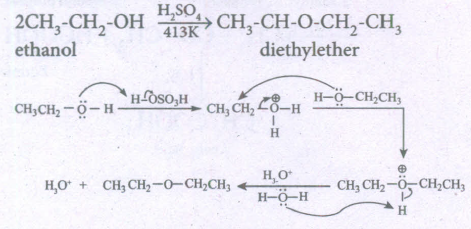
102.
Inter molecular dehydration of alcohol: We have already learnt that when ethanol is treated with con.HSO2 4 at 443K, elimination takes place to form ethene. If the same reaction is carried out at 413K, substitution competes over elimination to form ethers.
103.
(i) For a chemical reaction, catalyst is needed in very small quantity.
(ii) There may be some physical changes, but the catalyst remains unchanged in mass and chemical composition in a chemical reaction.
(iii) A catalyst itself cannot initiate a reaction.
(iv) A solid catalyst will be more effective if it is taken in a finely divided form.
(v) A catalyst are specific in nature.
(vi) In an equilibrium reaction, presence of catalyst reduces the time for attainment of equilibrium and hence it does not affect the position of equilibrium and the value of equilibrium constant.
(vii) A catalyst is highly effective at a particular temperature called as optimum temperature.
(viii) Presence of a catalyst generally does not change the nature of products
104.
Given: Initial concentration of the solution = 1 M
The concentration remaining after electrolysis = 0.667 M
Solution:
∴ The amount deposited = 1 - 0.667 M
= 0.333 M
1F = Faraday = 3 x 0.333 M
= 0.999M
= 1M
∴1 Faraday current is used.
105.
(i) The concentration of hydronium ion in an acidic buffer solution depends on the ratio of the concentration of the weak acid to the concentration of its conjugate base present in the solution i.e.,
\(\left[ { H }_{ 3 }{ O }^{ + } \right] ={ K }_{ a }\frac { [{ acid] }_{ aq } }{ [{ base] }_{ aq } } \)
(ii) The weak acid is dissociated only to a small extent. Moreover, due to common ion effect, the dissociation is further suppressed and hence the equilibrium concentration of the acid is nearly equal to the initial concentration of the unionised acid. Similarly, the concentration of the conjugate base is nearly equal to the initial concentration of the added salt.
\(\left[ { H }_{ 3 }{ O }^{ + } \right] ={ K }_{ a }\frac { [{ acid] } }{ [{ salt] } } \)
(iii) Here [acid] and [salt] represent the initial concentration of the acid and salt, respectively used to prepare the buffer solution
Taking logarithm on both sides of the equation
\(\log\left[ { H }_{ 3 }{ O }^{ + } \right] ={ \log K }_{ a }+\log\frac { [{ acid] } }{ [{ salt] } } \)
reverse the sign on both sides
- \(\log\left[ { H }_{ 3 }{ O }^{ + } \right] ={- \log K }_{ a }-\log\frac { [{ acid] } }{ [{ salt] } } \)
We know that
pH = -log [H3O+] and pKa = -log Ka
\(\Rightarrow pH={ pK }_{ a }-\log\frac { [{ acid] } }{ [{ salt] } } \)
\(\Rightarrow pH={ pK }_{ a }+\log\frac { [{ acid] } }{ [{ salt] } } \)
Similarly for a basic buffer,
pOH = \({ pK }_{ a }+\log\frac { [{ acid] } }{ [{ salt] } } \)
106.
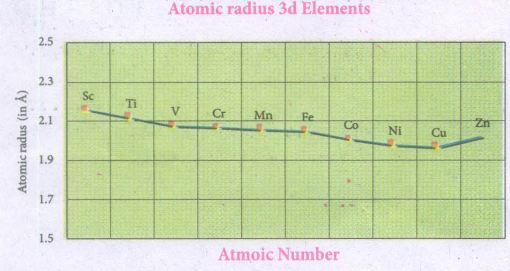
(i) It is generally expected a steady decrease in atomic radius along a period as the nuclear charge increases and the extra electrons are added to the same sub shell.
(ii) But for the 3d transition elements, the expected decrease in atomic radius is observed from Sc to V, thereafter up to Cu the atomic radius nearly remains the same.
(iii) As we move from Sc to Zn in 3d series the extra electrons are added to the 3d orbitals, the added 3d electrons only partially shield the increased nuclear charge and hence the effective nuclear charge increases slightly.
(iv) However, the extra electrons added to the 3d sub shell strongly repel the 4s electrons and these two forces are operated in opposite direction and as they tend to balance each other, it leads to constancy in atomic radii.
(v) At the end of the series, d - orbitals of Zinc contain 10 electrons in which the repulsive interaction between the electrons is more than the effective nuclear charge and hence, the orbitals slightly expand and atomic radius slightly increases.
107.
The initial rate of the reaction is
Rate = k [A] [B] 2
= (2.0 x 10⁻⁶ mol-2 L2 S-1) (0.1 mol L-1)2
= 8.0 x 10⁻⁹ mol-2 L2 s-1
When [A] is reduced from 0.1 mol L-1 to 0.06 mol-1, the concentration of A reacted = (0.1 - 0.06) mol L-1 = 0.04 mol L-1.
∴ The concentration of B reaction
= \(\frac { 1 }{ 2 } \) x 0.04 mol L-1
= 0.02 mol L-1
Then, concentration of B available [B] = (0.2 - 0.02) mol L-1
= 0.18 mol L-1.
After [A] is reduced to 0.06 mol L-1, the rate of the reaction is given by,
Rate = k [A] [B] 2
= (2.0 x 10⁻⁶ mol-2 L2 s-1) (0.06 mol L-1) (0.18 mol L-1)2
= 3.89 mol L-1 s-1.
108.
(i) O2 molecules are held together by weak Vander Waal's force because of small size and high electronegativity of oxygen.
(ii) In contrast, sulphur shows catenation and forms stronger S-S bonds.
(iii) Due to catenation, sulphur forms octa-atomic S8 molecules having eight membered puckered ring structure.
(iv) Because of its bigger size the force of attraction holding S8 molecules are much stronger.
(v) Hence sulphur is a solid at room temperature or in other words, that is why there is a large difference between the boiling point (also melting points) of the two elements.
109.
Molecular solids:
In molecular solids, the constituents are neutral molecules. They are held together by weak Vander Waals forces. Generally molecular solids are soft and they do not conduct electricity. These molecular solids are further classified into three types.
(i) Non-polar molecular solids:
(a) In non-polar molecular solids constituent molecules are held together by weak dispersion forces or London forces.
(b) They have low melting points and are usually in liquids or gaseous state at room temperature.
Ex: Naphthalene, anthracene etc.,
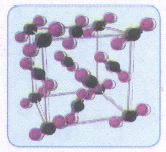
(ii) Polar molecular solids:
(a) The constituents are molecules formed by polar covalent bonds.
(b) They are held together by relatively strong dipole-dipole interactions.
(c) They have higher melting points than the nonpolar molecular solids.
Ex: Solid CO2, solid NH3 etc.
(iii) Hydrogen bonded molecular solids:
(a) The constituents are held together by hydrogen bonds.
(b) They are generally soft solids under room temperature.
(c) Examples: solid ice (H2O), glucose, urea etc.
110.
(i) Carbon monoxide can be prepared by the reaction of carbon with limited amount of oxygen.
2C + O2 ⟶ 2CO
(ii) (a) On industrial scale carbon monoxide is produced by the reaction of carbon with air.
(b) The carbon monoxide formed will contain nitrogen gas also and the mixture of nitrogen and carbon monoxide is called producer gas.
(c) \(2C+{ O }_{ 2 }/{ N }_{ 2 }(air)\longrightarrow \underset { Producers \ Gas }{ 2CO } +{ N }_{ 2 }\)
(d) The producer gas is then passed through a solution of copper(I) chloride under pressure which results in the formation of CuCI(CO).2H2O.
(e) At reduced pressures this solution releases the pure carbon monoxide.
(iii) Pure carbon monoxide is prepared by warming methanoic acid with concentrated sulphuric acid which acts as a dehydrating agent.
HCOOH + H2SO4 ⟶ CO + H2O + H2SO4
111.
(i) The process in which no external reducing. When ore is heated in air, a part of the ore gets oxidised which combines with remaining sulphide to give metal.
Eg: Reduction copper glance (Cu2S)
\({ 2Cu }_{ 2 }S+{ 3O }_{ 2 }\longrightarrow { 2Cu }_{ 2 }O+2{ SO }_{ 2 }\uparrow \)
\({ 2Cu }_{ 2 }O+{ Cu }_{ 2 }S\longrightarrow 6Cu+{ SO }_{ 2 }\uparrow \)
(ii) Electrolytic reduction is used for highly electro positive metals. In this method, fused metal ore is electrolysed and pure metal is deposited at cathode.
Eg: Al is obtained by electrolysis of Al2O3
\({ 2Al }_{ 2 }{ O }_{ 3 }+3C\longrightarrow \underset { Cathode\quad Anode }{ 4Al+{ 3CO }_{ 2 } } \)
(iii) \({ Cr }_{ 2 }{ O }_{ 3 }+2Al\longrightarrow {Al }_{ 2 }{ O }_{ 3 }+2Cr\)
\(3 \mathrm{Mn} _3 O_{4}+8 \mathrm{Al} \longrightarrow 4 \mathrm{Al}_{2} \mathrm{O}_{3}+9 \mathrm{Mn}\)
112.
Valance bond theory helps us to visualize the bonding in complexes. However, it has limitations as mentioned above. Hence Crystal Field Theory to explain some of the properties, like colour, magnetic behavior, etc., This theory I was originally used to explain the nature of bonding in ionic crystals. Later on, it is used to explain the properties of transition metals and their complexes. The salient features of this theory are as follows.
(i) Crystal Field Theory (CFT) assumes that the bond between the ligand and the central metal atom is purely ionic. i.e. the bond is formed due to the electrostatic attraction between the electron rich ligand and the electron deficient metal.
(ii) In the coordination compounds, the central metal atom/ion and the ligands are considered as point charges (in case of I charged metal ions or ligands) or electric dipoles (in case of neutral metal atoms or ligands).
(iii) According to crystal field theory, the complex formation is considered as the following series of hypothetical steps.
Step 1: In an isolated gaseous state, all the five d orbitals of the central metal ion are degenerate. Initially, the ligands form a spherical field of negative charge around the metal. In this filed, the energies of all the five d orbitals will increase due to the repulsion between the electrons of the metal and the ligand.
Step 2: The ligands are approaching the metal atom in actual bond directions. To illustrate this let us consider an octahedral field, in which the I central metal ion is located at the origin and the six ligands are coming from the +x, -x, +y, -y, +z and -z directions as shown below.
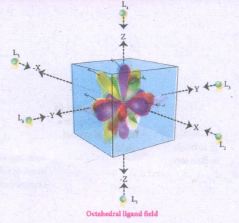
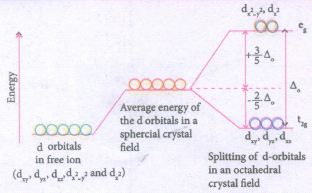
As shown in the figure, the orbitals lying along the axes dx2-y2 and dz2 orbitals will experience strong repulsion and raise in energy to a greater extent than the orbitals with lobes directed between the axes (dxy, dyz, and dzx). Thus the degenerate d orbitals now split into two sets and the process is called crystal field splitting.
Step 3: Up to this point the complex formation would not be favored. However, when the ligands approach further, there will be an attraction between the negatively charged electron and the positively charged metal ion, that results in a net decrease in energy. This decrease in energy is the driving force for the complex formation.
Crystal field splitting in octahedral complexes: During crystal field splitting in octahedral field, in order to maintain the average energy of the orbitals (barycentre) constant, the energy of the orbitals dx2-y2 and d z2 (represented as eg orbitals) will increase by 3/5 \({ \triangle }_{ o }\) while that of the other three orbitals dxy ' dyz and dzx (represented as t2g orbitals) decrease by 2/5 \({ \triangle }_{ o }\) , Here, \({ \triangle }_{ o }\) represents the crystal field splitting energy in the octahedral field.
113.
Allotropism:
1. Some elements exist in more than one crystalline or molecular forms in the same physical state
(a) In Greek "allos" means ⇒ Another
(b) "trope" means ⇒ Change
2. The different forms of an element are called allotropes.
Allotropy of carbon:
Carbon exists as diamond, graphite, fullerenes, carbon nanotubes and graphene.
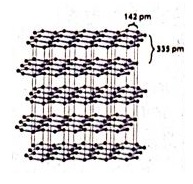
Graphite:
1. Graphite is the most stable allotropic form of carbon at normal temperature and pressure.
2. It is soft and conducts electricity.
3. It is composed of flat two dimensional sheets of carbon atoms.
4. Each sheet is a hexagonal.
5. It is "sp2" hybridised.
6. C-C bond length is 1.41 Å
7. Each C-atom forms three σ bonds with three neighbouring carbon atoms using three of its valence electrons and the fourth electron present in the unhybridised p-orbital form a π-bond.
8. The successive C-sheets are held together by weak Vander Waals forces.
9 The distance successive sheet is 3.40 Å.
10. It is used as a lubricant either on its own or as a graphited oil.
Diamond:
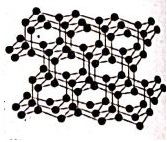
1. It is very hard.
2. It is "sp3" hybridised.
3. C-C bond length is 1.54 Å
4. It is used for sharpening hard tools, cutting glasses, making bores and rock drilling.
Fullerenes:
1. These allotropes are discrete molecules such as \(C_{32}, C_{50}, C_{60}, C_{70}, C_{76}\) etc.
2. It has cage like structure
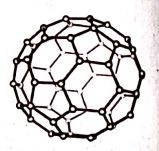
3. The C60 molecules have a "soccer" ball like structure and is called buckminster fullerene or buckyballs.
4. It has a fused ring structure consists of 20 six membered rings and 12 five membered ring.
5. Each carbon atom is "sp2" hybridised.
6. It has three σ bonds and a delocalised π bond giving aromatic character to these molecules.
7. The C-C bond distance is 1.44 Å
8. The C=C bond distance is 1.38 Å.
Carbon nanotubes:
1. Carbon nanotubes, another recently discovered allotropes, have graphite like tubes with fullerene ends.
2. Along the axis, these nanotubes are stronger than steel and conduct electricity.
3. These have many applications in nanoscale electronics, catalysis, polymers and medicine.
Graphene:
It has a single planar sheet of "sp2" hybridised carbon atoms that are densely packed in a "honeycomb crystal" lattice.
114.
The product obtained is ethanol
115.
(a) 2-methyl-heptan-3-ol (2°)
(b) 2,2-dimethyl-propan-1-01-(1°)
(c) 2-phenyl-2-propanol (3°)
(d) 2,2-dimethyl-S-bromo-3-pentanol (2°)
(e) l-Butene-ol (2°)
(f) Phenyl methanol (1°)
(g) 4-phenyl-1-butanol (1°)
(h) 3-ethyl-3-pentanol (3°)
116.
Physisorption is an exothermic process
\(\underset { (Adsorbent) }{ Solid } +\underset { (Adsorbate) }{ Gas } \rightleftharpoons \underset { (Gas\ adsorbed \ on\ solid) }{ Gas/solid } +Heat\)
According to Le chatelier's principle, if we increase the temperature, equilibrium will shift in the backward direction, i.e., gas is released from the surface on which it is adsorbed.
117.
Other metals such as aluminium, copper and silver also undergo corrosion, but at a slower rate than iron. Let us consider the reduction of aluminium,
\({ Al }_{ (s) }\rightarrow { Al }_{ (aq) }^{ 3+ }+{ 3e }^{ - }\)
Al3+, which reacts with oxygen in air to form a protective coating of Al2O3. This coating act as a protective film for the inner surface. So, further corrosion is prevented.
118.
Buffer index β, as a quantitative measure of the buffer capacity. It is defined as the number of gram equivalents of acid or base added to 1litre of the buffer solution to change its pH by unity.
\(\beta =\frac { dB }{ d(pH) } \)
Here,
dB = number of gram equivalents of acid / base added to one litre of buffer solution
d(pH) = The change in the pH after the addition of acid / base.
119.
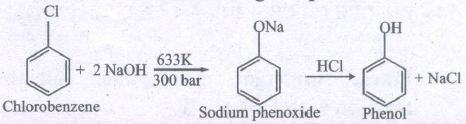
(i) Chloro benzene:
When Chlorobenzene is hydrolysed with 6-8% NaOH at 300 bar and 633K in a closed vessel, sodium phenoxide is formed which on treatment with dilute HCl gives phenol.
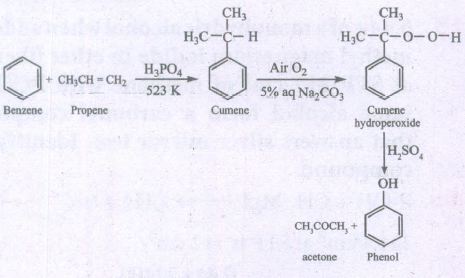
(ii) isopropyl benzene:
A mixture of benzene and propene is heated at 523K in a closed vessel in presence of H3PO4 catalyst gives cumene (isopropylbenzene). On passing air to a mixture of cumene and 5% aqueous sodium carbonate solution, cumene hydro peroxide is formed by oxidation. It is treated with dilute acid to get phenol and acetone. Acetone is also an important byproduct in this reaction.
120.
First law:
The mass of the substance (m) liberated at an electrode during electrolysis is directly proportional to the quantity of charge (Q) passed through the cell.
m α Q \(\left[\because \mathrm{I}=\frac{\mathrm{Q}}{\mathrm{t}} \Rightarrow \mathrm{Q}=\mathrm{It}\right]\)
m α It
m = ZIt
Where Z = electro chemical equivalent of the substance
I = current
t = time of passage of current
Second law:
When the same quantity of charge is passed through the solutions of different electrolytes, the amount of substances liberated at the respective electrodes are directly proportional to their electrochemical equivalents.
m α Z
\(\frac{m_{1}}{Z_{1}}=\frac{m_{2}}{Z_{2}}\)
m = mass of the metal deposited
Z = electro chemical equivalent
121.
(i) Let us consider the reactions between a strong acid, HCI, and a weak base, NH4OH, to produce a salt, NH4CI, and water.
HCI(aq) + NH4OH(aq) ⇌ NH4CI(aq) + H2O (I)
NH4CI(aq) ⟶ NH4+ +CI-(aq)
(ii) NH4+ is a strong conjugate acid of the weak base NH4OH and it has a tendency to react with OH- from water to produce unionised NH4OH
NH4+ (aq) + H2O(I) ⇌ NH4OH(aq) + H+(aq)
(iii) There is no such tendency shown by Cl- and therefore [H+] > [OH-]; the solution is acidic and the pH is less than 7.
(iv) The Kh and Kb are related by
\(\mathrm{K}_{\mathrm{h}} \cdot \mathrm{K}_{\mathrm{b}}=\mathrm{K}_{\mathrm{w}}\)
(Or)
\(\mathrm{K}_{\mathrm{h}}=\frac{\mathrm{K}_{\mathrm{w}}}{\mathrm{K}_{\mathrm{b}}}\)
Degree of hydrolysis (h)
\(\underset{(1-h)}{\mathrm{NH}_{4}^{+}(\mathrm{aq})}+\mathrm{H}_{2} \mathrm{O}_{(j)} \rightleftharpoons \underset{h} {\mathrm{NH}_{4} \mathrm{OH}_{(\mathrm{aq})}} +\mathrm{H}^{+} \underset{h}{(\mathrm{aq})}\\ \)
\(\mathrm{K}_{\mathrm{h}} =\frac{\left[\mathrm{NH}_{4} \mathrm{OH}\right]\left[\mathrm{H}^{+}\right]}{\left[\mathrm{NH}_{4}^{+}\right]} \\ \)
\(=\frac{\mathrm{hc} \times \mathrm{h}}{(1-\mathrm{h}) \mathrm{c}} \)
\(K_{h}=\frac{h^{2} c}{(1-h)} \)
\(\text{If } \mathrm{h}<<1 ; \mathrm{K}_{\mathrm{h}} \simeq \mathrm{h}^{2} \mathrm{c} \)
\(h^{2}=\frac{K_{h}}{c}\)
\(h=\sqrt{\frac{K_{h}}{c}} \ (or) \ h=\sqrt{\frac{K_{w}}{K_{b} \cdot C}} \quad\left(\because K_{h}=\frac{K_{w}}{K_{b}}\right)\)
Also; \(\left[\mathrm{H}^{+}\right]=\sqrt{\mathrm{K}_{\mathrm{h}} \cdot \mathrm{C}} \) (or) \(\left[\mathrm{H}^{+}\right]=\sqrt{\frac{\mathrm{K}_{\mathrm{w}} \cdot \mathrm{C}}{\mathrm{K}_{\mathrm{b}}}}\)
pH = -log [H+]
122.
Let [A0] = 100;
When t = t99.9%; [A] = (100-99.9) = 0.1
\(k=\frac { 2.303 }{ t } \log\left( \frac { [{ A }_{ 0 }] }{ [A] } \right) \)
\({ t }_{ 99.9\% }=\frac { 2.303 }{ K } \log\left( \frac { 100 }{ 0.1 } \right) \)
\({ t }_{ 99.9\% }=\frac { 2.303 }{ K } \log1000\)
\({ t }_{ 99.9\% }=\frac { 2.303 }{ K } (3)\)
\({ t }_{ 99.9\% }=\frac { 6.909 }{ K } \)
\({ t }_{ 99.9\% }=10\times \frac { 0.69 }{ K } \)
\({ t }_{ 99.9\% }={ 10 } t_{ 1/2 }\)
123.
(i) The use of 3d electron for formation of I bond increases from Sc to Mn, causing the increase in oxidation state upto +7.
(ii) The reason for Mn having highest oxidation state of +7 is due to the presence of 7 unpaired electrons in its atom.
(iii) As the number of unpaired electrons decrease from Fe to Cu. So there is the decrease in oxidation state.
124.
(i) When the concentration of the reactant is increased by 'n' times, the rate of reaction is also increased by n times. That is, if the concentration of the reactant is doubled, the rate is doubled.
(ii) The unit of rate constant of a first order reaction is sec-1 or time-1.
\({ k }_{ 1 }=\frac { rate }{ (a-x) } =\frac { { mol.lit }^{ -1 }{ sec }^{ -1 } }{ { mol.lit }^{ -1 } } \)
(iii) The time required to complete a definite fraction of reaction is independent of the initial concentration, of the reactant if t1/u is the time of one 'u' th fraction of reaction to take place then from equation.
\({ k }_{ 1 }=\frac { 2.303 }{ t } \log { \frac { a }{ a-x } } \)
\(x=\frac { a }{ u } and\quad { t }_{ \frac { 1 }{ u } }=\frac { 2.303 }{ { k }_{ 1 } } \log { \frac { a }{ a-\frac { a }{ u } } } ;\)
\({ t }_{ \frac { 1 }{ u } }=\frac { 2.303 }{ { k }_{ 1 } } \log { \frac { u }{ (u-1) } } \)
since k1 = rate constant, t1/u is independent of initial concentration 'a'.
125.
Structure of ammonia
(i) Ammonia molecule is pyramidal in shape N-H bond distance is 1.016Å and H-H bond, distance is 1.645Å with a bond angle 107°.
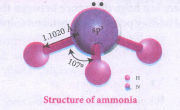
(ii) The structure of ammonia may be regarded as a tetrahedral with one lone pair of electrons in one tetrahedral position hence it has a pyramidal shape.
126.
(i) Covalent Solids: Silicon carbide, graphite.
(ii) Molecular Solids: Urea, benzene, ammonia, water and argon.
(iii) Ionic Solids: Zinc sulphide, potassium sulphate.
(iv) Metallic solids: Rubidium and tin.
127.
(i) CaC2
2 + 2x = 0
2x = -2
x = -1
(ii) H2CO3
2 + x + (-6) = 0
x = +4
(iii) HCN
1 + x + (-3) = 0
x = +3 - 1 = +2
(iv) CO
x + (-2) = 0
x= +2
128.
(i) into metal using carbon as a reducing agent. In this method the oxide ore of the metal is mixed with coal (coke) and heated strongly in a furnace (usually in a blast furnace).
(ii) This process can be applied to the metals which do not form carbides with carbon at the reduction temperature
\({ ZnO }_{ (s) }+{ C }_{ (s) }\longrightarrow { Zn }_{ (s) }+{ { CO }_{ (g) }\uparrow }\)
129.
(i) The stability of a coordination complex is a measure of its resistance to the replacement of one ligand by another.
(ii) The stability of a complex refers to the degree of association between two species involved in an equilibrium.
(iii) Let us consider the following complex formation reaction
Cu2+ +4NH3 ⇌ [Cu(NH3)4]2+
\(\beta =\frac { { \left[ { Cu\left( { NH }_{ 3 } \right) }_{ 4 } \right] }^{ 2+ } }{ \left[ { Cu }^{ 2+ } \right] { { \left[ { NH }_{ 3 } \right] }^{ 4 } } } \)
(iv) So, as the concentration of [Cu (NH3)4]2+ increases the value of stability complexes also increases.
(v) Therefore the greater the value of stability constant greater is the stability of the complex.
130.
(i) Reaction Rate = \(k{ \left[ A \right] }^{ 2 }{ \left[ B \right] }{ \left[ L \right] }^{ 3/2 }\) ...(1)
When [L] = [4L]
Rate = \(k{ \left[ A \right] }^{ 2 }{ \left[ B \right] }{ \left[ 4L \right] }^{ 3/2 }\)
The Reaction Rate = \(8(k{ \left[ A \right] }^{ 2 }{ \left[ B \right] }{ \left[ L \right] }^{ 3/2 })\) ...(2)
Comparing (1) and (2) rate is increased by 8 times
(ii) [A] = [2A] and [B] = [2B]
Reaction Rate = \(k{ \left[ 2A \right] }^{ 2 }\left[ 2B \right] { \left[ L \right] }^{ 3/2 }\)
Reaction Rate = \(\\ 8(k{ \left[ A \right] }^{ 2 }{ \left[ B \right] }{ \left[ L \right] }^{ 3/2 })\) ...(3)
Comparing (1) and (3) rate is increased by 8 times
(iii) \(\left[ A \right] =\left[ \frac { A }{ 2 } \right] \)
Reaction Rate = \(k{ \left[ \frac { A }{ 2 } \right] }^{ 2 }{ \left[ B \right] }{ \left[ L \right] }^{ 3/2 }\)
Reaction Rate = \(\frac { 1 }{ 4 } \left( k\left[ { A }^{ 2 } \right] { \left[ B \right] }{ \left[ L \right] }^{ 3/2 } \right) \) ...(4)
Comparing (1) and (4); rate is reduced to (1/4) times.
(iv) \(\left[ A \right] =\left[ \frac { 1 }{ 3 }A \right] and\left[ L \right] =\left[ 4L \right] \)
Rate = \(k{ \left[ \frac { 1 }{ 3 }A \right] }^{ 2 }{ \left[ B \right] }{ \left[ 4L \right] }^{ 3/2 }\)
Rate = \(\left( \frac { 8 }{ 9 } \right) \left( k{ \left[ A \right] }^{ 2 }{ \left[ B \right] }{ \left[ L \right] }^{ 3/2 } \right)\) ...(5)
Comparing (1) and (5); rate is reduced to \(\frac { 8 }{ 9 } \) times.
131.
(i) The elements in which the extra electron enters (n-2) f orbitals are called f-block elements. These elements are called as inner transition elements because they form a transition. Series within the transition elements.
(ii) The f-block elements are also called as rare earth elements. They are divided into lanthanoid series (4f block elements) and actinoid series (5f block elements).
132.
(i) Its small size
(ii) Its high electronegativity
(iii) Its high ionisation energy
(iv) Non-availability of d-orbital in the valence shell.
(v) Rather inert
(vi) High bond energy
133.
Each halogen combines with other halogens to form a series of compounds are called interhalogen compounds.
Example: AB type: BrF
AB3 type: ICI3

12th Standard Syllabus & Materials
12th Standard
TN 12th Computer Applications களப்பெயர் முறைமை (DNS) Sample Question Papers Study Material - QB365 Set A
NEW12th Standard
TN 12th Computer Applications வலையமைப்பு எடுத்துக்காட்டுகள் மற்றும் நெறிமுறைகள் Sample Question Papers Study Material - QB365 Set A
NEW12th Standard
TN 12th Computer Applications கணினி வலையமைப்பு ஓர் அறிமுகம் Sample Question Papers Study Material - QB365 Set A
NEW12th Standard
TN 12th Computer Applications PHP-உடன் MySQL-ஐ இணைத்தல் Sample Question Papers Study Material - QB365 Set A



Tamilnadu Stateboard 12th Standard Subjects

Maths
Chemistry

Physics

Biology

Computer Science

Business Maths and Statistics

Economics

Commerce

Accountancy

History

Computer Applications
Biology
Computer Technology
Computer Applications
Computer Science
Business Maths and Statistics
Commerce
Economics
Maths
Chemistry
Physics
Computer Technology
History
Accountancy

Tamil

English

French
Tamilnadu Stateboard Standards
