
 100% FREE ACCESS
12th Standard Syllabus & Materials
12th Standard
TN 12th Computer Applications மின்னணு தரவு பரிமாற்றம் Sample Question Papers Study Material - QB365 Set A
NEW12th Standard
TN 12th Computer Applications மின் - வணிக பாதுகாப்பு அமைப்புகள் Sample Question Papers Study Material - QB365 Set A
NEW12th Standard
TN 12th Computer Applications மின்னணு செலுத்தல் முறைகள் Sample Question Papers Study Material - QB365 Set A
NEW12th Standard
TN 12th Computer Applications மின் - வணிகம் Sample Question Papers Study Material - QB365 Set A
NEW12th Standard
TN 12th Computer Applications திறந்த மூல கருத்துருக்கள் Sample Question Papers Study Material - QB365 Set A
NEW12th Standard
TN 12th Computer Applications வலையமைப்பு வடமிடல் Sample Question Papers Study Material - QB365 Set A

Published on: 16/10/2019
Ionic Equilibrium
Download Tamil Nadu 12th Standard Chemistry question papers, model tests, one-mark questions, important questions, and public exam papers in PDF format. Free study materials and answer keys for TN State Board students.
Questions + Answers key
Take MCQ Chemistry Test
1.
Dissociation constant of NH4OH is 1.8 x 10⁻⁵ the hydrolysis constant of NH4Cl would be _______.
1.8 × 10⁻¹⁹
5.55 × 10⁻¹⁰
5.55 × 10⁻⁵
1.80 × 10⁻⁵
2.
The pH of an aqueous solution is Zero. The solution is _______.
slightly acidic
strongly acidic
neutral
basic
3.
The pH of 10-5M KOH solution will be _______.
9
5
19
none of these
4.
What is the pH of the resulting solution when equal volumes of 0.1M NaOH and 0.01M HCl are mixed?
2.0
3
7.0
12.65
5.
Using Gibb’s free energy change, ∆Go=57.34 kJ mol-1, for the reaction, X2Y(s)⇌2X++Y2- (aq), calculate the solubility product of X2Y in water at 300 K_______. (R = 8.3 J K-1Mol-1)
10-10
10-12
10-14
can not be calculated from the given dat
6.
Equal volumes of three acid solutions of pH 1,2 and 3 are mixed in a vessel. What will be the H+ ion concentration in the mixture?
3.7 × 10⁻²
10-6
0.111
none of these
7.
The percentage of pyridine (C5H5N) that forms pyridinium ion (C5H5NH) in a 0.10M aqueous pyridine solution _______.(Kb for C5H5N = 1.7×10⁻⁹) is
0.006%
0.013%
0.77%
1.6%
8.
The aqueous solutions of sodium formate, anilinium chloride and potassium cyanide are respectively _______.
acidic, acidic, basic
basic, acidic, basic
basic, neutral, basic
none of these
9.
Which of these is not likely to act as Lewis base?
BF3
PF3
CO
F–
10.
Which will make basic buffer?
50 mL of 0.1M NaOH+25mL of 0.1M CH3COOH
100 mL of 0.1M CH3COOH+100 mL of 0.1M NH4OH
100 mL of 0.1M HCl+200 mL of 0.1M NH4OH
100 mL of 0.1M HCl+100 mL of 0.1M NaOH
11.
pH of a saturated solution of Ca(OH)2 is 9. The Solubility product (Ksp) of Ca(OH)2 _______.
0.5 × 10⁻¹⁵
0.25 × 10⁻¹⁰
0.125 × 10⁻¹⁵
0.5 × 10⁻¹⁰
12.
Concentration of the Ag+ ions in a saturated solution of Ag2C2O4 is 2.24 ×10⁻⁴mol L-1 solubility product of Ag2C2O4 is_______.
2.42 × 10⁻⁸mol3L-3
2.66 × 10⁻¹²mol3L-3
4.5 × 10⁻¹¹mol3L-3
5.619 × 10⁻¹²mol3L-3
13.
A solution of 0.10M of a weak electrolyte is found to be dissociated to the extent of 1.20% at 25oC. Find the dissociation constant of the acid.
14.
Define pH.
15.
Define ionic product of water. Give its value at room temperature.
16.
17.
The concentration of hydroxide ion in a water sample is found to be 2.5 × 10⁻⁶M. Identify the nature of the solution.
18.
What are Lewis acids and bases? Give two example for each.
19.
Derive an expression for Ostwald’s dilution law.
20.
Discuss the Lowry – Bronsted concept of acids and bases.
21.
What is the pH of an aqueous solution obtained by mixing 6 gram of acetic acid and 8.2 gram of sodium acetate and making the volume equal to 500 ml. (Given: Ka for acetic acid is \(1.8\times10^{-5}\))
22.
A particular saturated solution of silver chromate Ag2CrO4 has \([Ag^{+}]=5\times10^{-5}\) and \([CrO_{4}]^{2-}=4.4\times10^{-4}M\). What is the value of Ksp for Ag2 CrO4?
23.
Solubility product of Ag2CrO4 is \(1\times10^{-12}\). What is the solubility of Ag2CrO4 in 0.01M AgNO3 solution?
24.
Calculate the extent of hydrolysis and the pH of 0.1 M ammonium acetate Given that \(K_{a}=K_{b}=1.8\times10^{-5}\)
1.
\(K_h= { \frac { { K }_{ w } }{ K_b } } = \frac{1 \times 10^{-14}}{1.8 \times 10^{-5}}\)
= 0.55 x 10-9 = 5.5 x 10⁻¹⁰
2.
pH = -log10 [H+]
\(\therefore\) [H+] = 10-pH
100 = 1
[H+] = 1 M
The solution is strongly acidic
3.
KOH → K+ + OH-
10-5M 10-5M 10-5M
[OH-] = 10-5M
pH = 14 - pOH
pH= 14-(-log [OH-])
= 14 + log [OH-]
= 14 + log 10-5
= 14 - 5 = 9
4.
x ml of 0.1 M NaOH + x mL of 0.01 M HCI
No. of moles of NaOH = 0.1 x X x 10-3
= 0.1 X x 10-3
No. of moles of HCI = 0.01 x X x 10-3
= 0.01 X x 10-3
No. of moles of NaOH after mixing
= 0.1 X x 10-3 - 0.01 X x 10-3
= 0.09 X x 10-3
Concentration of NaOH\(= (\frac{0.09x \times 10^{-3}}{2x \times 10^{-3}}) = 0 .045\)
[OH-] = 0.045
pOH =-log (4.5 x 10⁻²)
= 2 -log 4.5
= 2 - 0.65 = 1.35
pH = 14 - 1.35 = 12.65
5.
(a)
10-10
6.
pH = -log10 [H+]
∴ [H+] = 10-pH
Let the volume be x ml.
V1M1 +V2M2 +V3M3 = VM
∴ x ml of 10-1 M+ x ml of 10-2 M + x ml of 10-3 M
= 3 x ml of [H+]
\(∴ [H^+] = \frac{ x[0.1 + 0.01 + 0.001]}{3x}\)
\(= \frac{ [0.1 + 0.01 + 0.001]}{3}\)
\(= \frac{ [0.111]}{3}\)
= 0.037
= 3.7 x 10⁻²
7.
C5H5N + H-OH ⇌ C5H5 +NH + OH-
\(\frac { { \alpha }^{ 2 }{ C } }{ 1-\alpha } =K_b\)
\(\alpha\)2C \(\approx\) Kb
\(\alpha = \sqrt {\frac{K_b} C} = \sqrt {\frac{1.7 \times 10^{-9}} {0.1}}\)
\(= \sqrt{1.7} \times 10^{-4}\)
Percentage of dissociation =\(= \sqrt{1.7} \times 10^{-4}\) x 100
= 1.3 x 10-2 = 0.013%
8.
HCOONa + HOH ⇌ NaOH + H-COOH
strong base weak acid
Basic in nature.
C6H5NH3Cl + HOH ⇌ H3O+ + C6H5 - NH2 + Cl-
acidic
KCN + H - OH ⇌ KOH + HCN
Base strong base weak acid
basic, acidic, basic is correct.
9.
BF3 → electron deficient → Lewis acid
PF3 → electron rich → Lewis base
CO → having lone pair of electron → Lewis base
F → unshared pair of electron → Lewis base
10.
Basic buffer is the solution which has weak base and its salt.
NH4OH + HCI → NH4CI +H2O + NH4OH
200 ml 100 ml salt 100 ml weak base
11.
Ca(OH)2 ⇌ Ca2+ + 2OH-
Given that pH = 9
pOH = 14 - 9 = 5
[pOH = - log10 [OH]]
[OH-] = 10 [pOH]
[OH] = 10-5 M
Ksp = [Ca2+] [OH-]
= 10-5/2 x (10-5)2 = 0.5 x 10⁻¹⁵
12.
\(\mathrm{Ag}_{2} \mathrm{C_2O_4} \rightleftharpoons 2 \mathrm{Ag}_{}^{+}+\mathrm{C_2O}_{4{}}^{2-}\)
\(\left[\mathrm{Ag}^{+}\right]=2 .24 \) ×10-4mol L-1
\(\mathrm{C_2O}_{4{}}^{2-} = \frac {2.24 \times 10 ^{-4}}{2}\) mol L-1
= 1.12 ×10⁻⁴mol L-1
Ksp = [Ag]2 [C2O42-]
= (2.24 ×10⁻⁴mol L-1) (1.12 ×10⁻⁴mol L-1)
= 5.619 × 10⁻¹²mol3L-3
13.
Given that \(\alpha=1.20\)%=\(\frac{1.20}{100}\times1.2\times10^{-2}\)
\(K_{a}=\alpha^{2}c\)
\(=(1.2\times10^{-2})^{2}(0.1)=1.44\times10^{-4}\times10^{-1}\)
=\(1.44\times10^{-5}\)
14.
(i) pH = -log10 [H3O+]
(ii) The pH of a solution is defined as the negative logarithm of base 10 of the molar concentration of the hydronium ions present in the solution.
15.
(i) \(\mathrm{K}_{\mathrm{w}}=\left[\mathrm{H}_{3} \mathrm{O}^{+}\right]\left[\mathrm{OH}^{-}\right]=1 \times 10^{-14}\left(25^{\circ} \mathrm{C}\right)\)
(ii) Ionic product of water is defined as the product of the concentration of hydronium and hydroxide ions of pure water. Its value at 25oC is \(1 \times 10^{-14} \mathrm{~mol}^{2} \mathrm{dm}^{-2}\)
16.
17.
1. If \(\left[\mathrm{OH}^{-}\right]>1 \times 10^{-7} \mathrm{M}\), the solution is basic. \(2.5 \times 10^{-6} \mathrm{M}>1 \times 10^{-7} \mathrm{M}\)
2. \(\therefore\) The solution is basic.
18.
(i) Lewis acid: It is a species that accepts an electron pair. Eg: \(\mathrm{Ag}^{+} ; \mathrm{BF}_{3} ; \mathrm{A} / \mathrm{Cl}_{3}\)
(ii) Lewis base: It is a species that donates an electron pair. Eg: \( \mathrm{Cl}^{-} ; \mathrm{NH}_{3} ; \mathrm{H}_{2} \mathrm{O}\)
19.
(i) Ostwald's dilution law relates the dissociation constant of the weak acid (Ka) with its degree of dissociation (α) and the concentration (c).
where \(\alpha=\frac{\text { Number of moles dissociated }}{\text { Total number of moles }}\)
(ii) The dissociation of acetic acid can be represented as
\(\mathrm{CH}_{3} \mathrm{COOH} \rightleftharpoons \mathrm{H}^{+}+\mathrm{CH}_{3} \mathrm{COO}^{-}\)
The dissociation constant of acetic acid is,
\({ K }_{ a }=\frac { \left[ { H }^{ + } \right] \left[ { CH }_{ 3 }COO^{ - } \right] }{ \left[ { CH }_{ 3 }COOH \right] } \) ........(1)
| CH3COOH | H+ | CH3COO- | |
| Initial number of moles | 1 | - | - |
| Degree of dissociation of CH3COOH | α | - | - |
| Number of moles at equilibrium | 1-α | α | α |
| Equilibrium concentration | (1-α)C | αC | αC |
Substituting the equilibrium concentration in equation (1)
\({ K }_{ a }=\cfrac { \left( \alpha C \right) \left( \alpha C \right) }{ \left( 1-\alpha \right) C } \)
\({ K }_{ a }=\cfrac { { \alpha }^{ 2 }C }{ 1-\alpha } \) .......(2)
(iii) We know that weak acid dissociates only to a very small extent compared to one, a is so small and hence in the denominator (1 - α) ⋍1. The above expression (2) now becomes,
ka =a2C \(\Rightarrow { \alpha }^{ 2 }=\cfrac { { k }_{ a } }{ C } \) ; \(\alpha =\sqrt { \cfrac { { K }_{ a } }{ C } } \)
(iv) When dilution increases, the degree of dissociation of weak electrolyte also increases. This is called Ostwald's dilution law
Also \(;\left[\mathrm{H}^{+}\right]=\alpha \mathrm{C}\) and \(\left[\mathrm{H}^{+}\right]=\left(\sqrt{\frac{\mathrm{K}_{\mathrm{a}}}{\mathrm{C}}}\right) \mathrm{C}=\sqrt{\frac{\mathrm{K}_{\mathrm{a}} \mathrm{C}^{2}}{\mathrm{C}}}=\sqrt{\mathrm{K}_{\mathrm{a}} \cdot \mathrm{C}}\)
Similarly for a weak base
\(\begin{aligned} & \mathrm{K}_{\mathrm{b}}=\alpha^2 \mathrm{C} ; \quad \therefore \alpha=\sqrt{\frac{\mathrm{k}_{\mathrm{b}}}{\mathrm{C}}}, \\ \end{aligned}\)
\(\begin{aligned} & {\left[\mathrm{OH}^{-}\right] \alpha \mathrm{C}=\sqrt{\frac{\mathrm{K}_{\mathrm{b}}}{\mathrm{C}}} \times \mathrm{C}=\sqrt{\frac{\mathrm{K}_{\mathrm{b}} \mathrm{C}^2}{\mathrm{C}}}=\sqrt{\mathrm{K}_{\mathrm{b}} \mathrm{C}}} \end{aligned}\)
20.
(i) An acid is defined as a substance that has a tendency to donate a proton to another substance and base is a substance that has a tendency to accept a proton form other substance.
(ii) In other words, an acid is a proton donor and a base is a proton acceptor.
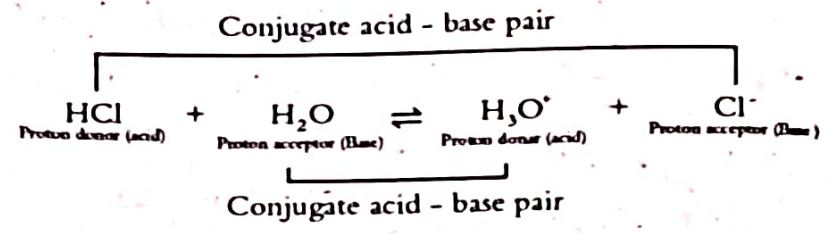
(iii) When hydrogen chloride is dissolved in water, it donates a proton to the later. Thus, HCI behaves as an acid and H2O is base. The proton transfer from the acid to base can be represented as
HCI + H2O ⇌ H3O+ + Cl-
(iv) When ammonia is dissolved in water, it accepts a proton from water. In this case, ammonia (NH3) acts as a base and H2O is acid. The reaction is represented as
H2O + NH3 ⇌ NH4+ + OH-
(v) Let us consider the reverse reaction following equilibrium.
\(\underset { proton\ donar\\ \quad \quad \ (acid) }{ HCl } +\underset { Proton\ acceptor\\ \quad \quad \quad \quad (base) }{ { H }_{ 2 }O } \leftrightharpoons \underset { Proton\ donar\\ \quad \quad \quad \quad \ (acid) }{ { H }_{ 2 }{ O }^{ + } } +\underset { Proton\ acceptor\\ \quad \quad \quad \quad \ (base) }{ { Cl }^{ - } } \)
H3O+ donates a proton to Cl- to form HCI i.e., the products also behave as acid and base.
(vi) In general, Lowry - Bronsted (acid - base) reaction is represented as
Acid1 + Base2 ⇌ Acid2 + Base1
(vii) The species that remains after the donation of a proton is a base (Base1) and is called the conjugate base of the Bronsted acid (Acid1). In other words, chemical species that differ only by a proton are called conjugate acid - base pairs.
21.
According to Henderson – Hasselbalch equation,
\(pH=pK_{a}+\log\frac{[salt]}{[acid]}\)
\(p{K_{a}}=-\log K_{a}=-\log(1.8\times10^{-5})=4.74\)
[Salt]=\(\frac{\text {Number of moles of sodium acetate}}{\text {Volume of the solution (litre)}}\)
Number of moles of sodium acetate =\(\frac{\text {mass of sodium acetate}}{\text {molar mass of sodium acetate}}\)
\(=\frac{8.2}{82}=0.1\)
\(\therefore [Salt]=\frac{0.1\ mole}{1/2 \ Litre}=0.2M\)
\([acid]=\frac{(\frac{mass \ of \ CH_{3}COOH}{molar \ mass \ of \ CH_{3}COOH})}{\text{Volume of solution in litre}}\)
=\(\frac{(\frac{6}{60})}{\frac{1}{2}}\)=0.2 M
\(\therefore pH=4.74+log\frac{(0.2)}{(0.2)}\)
pH = 4.74 + log1
pH = 4.74 + 0 = 4.74
22.
\(Ag_{2}CrO_{4}(s)\rightleftharpoons 2Ag^{+}_{aq}+CrO^{2-}_{4}(aq)\)
\(K_{sp}=[Ag^{+}]^{2}[CrO_{4}^{2-}]\)
\(=(5\times10^{-5})^2(4.4\times10^{-4})\)
=\((1.1\times10^{-12})\)
23.
\(\mathrm{Ag}_{2} \mathrm{CrO}_{4(\mathrm{~s})} \rightleftharpoons 2 \mathrm{Ag}_{(\mathrm{aq})}^{+}+\mathrm{CrO}_{4{(\mathrm{aq})}}^{2-}\\ \quad s \quad \quad \quad \quad \quad 2s \quad \quad \quad \quad s\)
\(\left[\mathrm{Ag}^{+}\right]=2 \mathrm{~s}+0.01 \)
\(\simeq 0.01 \)
\((\because 2 s<<0.01) \)
\(\left[\mathrm{CrO}_{4}^{2-}\right]=\mathrm{S} \)
\(\mathrm{AgNO}_{3(\mathrm{~s})} \rightleftharpoons \mathrm{Ag}_{(\mathrm{aq})}^{+}+\mathrm{NO}_{3_{(\mathrm{aq})}}^{-}\\ 0.01M \quad \quad 0.01M \quad \quad 0.01M \quad\)
\(\mathrm{K}_{\mathrm{sp}}=\left[\mathrm{Ag}^{+}\right]^{2}\left[\mathrm{CrO}_{4}^{2-}\right] \)
\(1 \times 10^{-12}=(0.01)^{2}(\mathrm{~s}) \)
\(\mathrm{S}=\frac{1 \times 10^{-12}}{10^{-4}}=1 \times 10^{-8} \mathrm{M}\)
24.
\(h=\sqrt{K_{h}}=\sqrt{\frac{K_{w}}{K_{a}K_{b}}}=\sqrt{\frac{1\times10^{-14}}{1.8\times10^{-5}\times{1.8\times10^{-5}}}}\)
\(= \frac{1 \times10^{-7}}{1.8\times10^{-5}}\)
=\(0.7453\times10^{-2}\)
\(pH=\frac{1}{2}pK_{w}+\frac{1}{2}pK_{a}-\frac{1}{2}pK_{b}\)
Given that \(K_{a}=K_{b}=1.8\times10^{-5}\)
if Ka = Kb, then, pKa = pKb
\(\therefore pH= \frac{1}{2}pK_{w}=\frac{1}{2}(14)=7\)
pH = 7

12th Standard Syllabus & Materials
12th Standard
TN 12th Computer Applications களப்பெயர் முறைமை (DNS) Sample Question Papers Study Material - QB365 Set A
NEW12th Standard
TN 12th Computer Applications வலையமைப்பு எடுத்துக்காட்டுகள் மற்றும் நெறிமுறைகள் Sample Question Papers Study Material - QB365 Set A
NEW12th Standard
TN 12th Computer Applications கணினி வலையமைப்பு ஓர் அறிமுகம் Sample Question Papers Study Material - QB365 Set A
NEW12th Standard
TN 12th Computer Applications PHP-உடன் MySQL-ஐ இணைத்தல் Sample Question Papers Study Material - QB365 Set A



Tamilnadu Stateboard 12th Standard Subjects

Maths
Chemistry

Physics

Biology

Computer Science

Business Maths and Statistics

Economics

Commerce

Accountancy

History

Computer Applications
Biology
Computer Technology
Computer Applications
Computer Science
Business Maths and Statistics
Commerce
Economics
Maths
Chemistry
Physics
Computer Technology
History
Accountancy

Tamil

English

French
Tamilnadu Stateboard Standards
