
 100% FREE ACCESS
12th Standard Syllabus & Materials
12th Standard
TN 12th Computer Applications மின்னணு தரவு பரிமாற்றம் Sample Question Papers Study Material - QB365 Set A
NEW12th Standard
TN 12th Computer Applications மின் - வணிக பாதுகாப்பு அமைப்புகள் Sample Question Papers Study Material - QB365 Set A
NEW12th Standard
TN 12th Computer Applications மின்னணு செலுத்தல் முறைகள் Sample Question Papers Study Material - QB365 Set A
NEW12th Standard
TN 12th Computer Applications மின் - வணிகம் Sample Question Papers Study Material - QB365 Set A
NEW12th Standard
TN 12th Computer Applications திறந்த மூல கருத்துருக்கள் Sample Question Papers Study Material - QB365 Set A
NEW12th Standard
TN 12th Computer Applications வலையமைப்பு வடமிடல் Sample Question Papers Study Material - QB365 Set A

Published on: 21/02/2020
12th Standard Chemistry Model Question Paper 2020
Download Tamil Nadu 12th Standard Chemistry question papers, model tests, one-mark questions, important questions, and public exam papers in PDF format. Free study materials and answer keys for TN State Board students.
Questions + Answers key
Take MCQ Chemistry Test
1.
In an electrochemical cell, the wrong statement is ______.
electrons move from cathode to anode
anode is negative charged
cathode is positive charged
chemical energy is converted to electrical energy.
2.
What is/are the factor(s) that govern the single electrode potential of a half cell?
concentration of ions in solution
tendency to form ions
temperature
all of these
3.
The important use of Kohlrausch's law is deducing the ______.
λ∞ value of weak electrolyte.
λ∞ value of strong electrolyte.
λ∞ value of weak electrolyte.
λ∞ value of weak electrolyte
4.
Lower members of carboxylic acid family are _______.
waxy solids
pleasant smelling liquids
foul smelling liquids
inert gases
5.
Chloroacetic acid is stronger than acetic acid due to _______.
+ I effect
- I effect
+ M effect
- M effect
6.
When propanoic acid is treated with aqueous sodium-bicarbonate, CO2 is liberated. The "C" of CO comes from _______.
methyl group
carboxylic acid group
methylene group
bicarbonate
7.
Decomposition of hydrogen peroxide is retarded in the presence of________.
alcohol
glycerine
MnO2
Mo
8.
In W/O system, the dispersion medium is_______
water
benzene
alcohol
oil
9.
_______ cannot be prepared by using Grignard reagent.
CH3- OC2H5
CH3-OCH3
C2H5-O-C2H5
CH3-OCH2CH2CH3
10.
CH3-CH2-O-CH2CH3 and \({ CH }_{ 3 }-O-\overset { \underset { | }{ { CH }_{ 3 } } }{ CH } -{ CH }_{ 3 }\) are examples of _______ isomerism.
functional
chain
position
metamerism
11.
NH4OH is a weak base because _______.
it has low vapour pressure
it is only partially ionised
it is completely ionised
it has low density
12.
An example of trihydric alcohol is _________.
trimethyl carbinol
3-hexanol
propane-1,2,3-triol
tert-butylacohol
13.
For two acids A and B, Ka values at 25°C are 2 x 10⁶ and 1.8 x 10⁻⁴ respectively. which among the following is true with respect to the above data _______.
A and B are equally acidic
A is stronger than B
B is stronger than A
Ka value is not a measure of acid strength
14.
Kw represents _______.
ionic product constant of water
Solubility product of water
Equilibrium constant of water
Buffer index
15.
The impurity present in the colloidal particle is _______.
electrolytes
solute
both (a) and (b)
neither (a) or (b)
16.
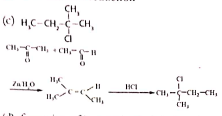
An alkene “A” on reaction with O3 and Zn - H2O gives propanone and ethanol in equimolar ratio. Addition of HCl to alkene “A” gives “B” as the major product. The structure of product “B” is ______.
\(Cl-{ CH }_{ 2 }-CH_{ 2 }-\overset { \overset { CH_{ 3 } }{ | } }{ \underset { \underset { CH_{ 3 } }{ | } }{ CH } } \)
\({ H }_{ 3 }C-{ CH }_{ 2 }-\overset { \overset { CH_{ 2 }Cl }{ | } }{ CH } -{ CH }_{ 3 }\)
\(\\ { H }_{ 3 }C-{ CH }_{ 2 }-\overset { \overset { CH_{ 3 } }{ | } }{ \underset { \underset { CL{ } }{ | } }{ C } } -{ CH }_{ 3 }\)
\({ H }_{ 3 }C-{ CH }-\overset { \overset { CH_{ 3 } }{ | } }{ \underset { \underset { Cl }{ | } }{ C } } \)
17.
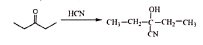
In which case chiral carbon is not generated by reaction with HCN?
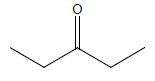
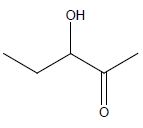
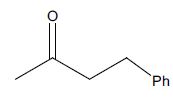
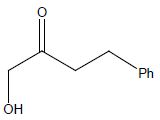
18.
Among the following ethers which one will produce methyl alcohol on treatment with hot HI?
(H3C)3C-O-CH3
(CH3-)2-CH-CH2-O-CH3
CH3-(CH2)3-O-CH3
CH3-CH2-\(\underset { \overset { | }{ { CH }_{ 3 } } }{ CH } \)-O-CH3
19.
 The X is _______.
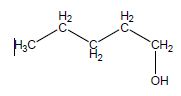
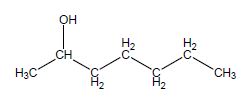
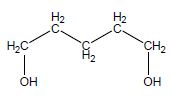
None of these
20.
Adsorption of a gas on solid metal surface is spontaneous and exothermic, then ______.
ΔH increases
ΔS increases
ΔG increases
ΔS decreases
21.
The most effective electrolyte for the coagulation of As2S3Sol is _______.
NaCl
Ba(NO3)2
K3[Fe(CN)6]
Al2(SO4)3
22.
A gas X at 1 atm is bubbled through a solution containing a mixture of 1MY- and 1MZ- at 25oC. If the reduction potential of Z>Y>X, then_____.
Y will oxidize X and not Z
Y will oxidize Z and not X
Y will oxidize both X and Z
Y will reduce both X and Z
23.
In the electrochemical cell: Zn|ZnSO4 (0.01M)|| CuSO4 (1.0M)|Cu, the emf of this Daniel cell is E1. When the concentration of ZnSO4 is changed to 1.0M and that CuSO4 changed to 0.01M, the emf changes to E2. From the above, which one is the relationship between E1 and E2?
E1 < E2
E1 > E2
E2 ≥ E1
E1 = E2
24.
Using Gibb’s free energy change, ∆Go=57.34 kJ mol-1, for the reaction, X2Y(s)⇌2X++Y2- (aq), calculate the solubility product of X2Y in water at 300 K_______. (R = 8.3 J K-1Mol-1)
10-10
10-12
10-14
can not be calculated from the given dat
25.
What is the decreasing order of strength of bases
OH, NH2- H - C ≡ C and CH3 - CH2-
OH->NH2- >H-C≡C >CH3-CH2-
NH2->OH->CH3-CH2- >H-C≡C
CH3-CH2->NH2->H-C≡C->OH-
OH->H-C ≡ C->CH3-CH2- >NH2-
26.
The half-life period of a first order reaction is 69.3 seconds. Its rate constant is ________.
10-2 s-1
10-4 s-1
10 s-1
102 s-1
27.
For the reaction N2(g) + 3H2(g) ⟶ 2NH3(g) the rate of the reaction in terms of ammonia is ______.
\(+\frac { 1 }{ 2 } \frac { -d\left[ { NH }_{ 3 } \right] }{ dt } \)
\(-\frac { 1 }{ 2 } \frac { d\left[ { NH }_{ 3 } \right] }{ dt } \)
\(\frac { -d\left[ { NH }_{ 3 } \right] }{ dt } \)
\(\frac { +d\left[ { NH }_{ 3 } \right] }{ dt } \)
28.
For a reaction: aA ⟶ bB, the rate of reaction is doubled when the concentration of A is increased by four times. The rate of reaction is equal to _____.
k[A]a
\(k{ \left[ A \right] }^{ \frac { 1 }{ 2 } }\)
\(k{ \left[ A \right] }^{ \frac { 1 }{ a } }\)
K[A]
29.
Pick the wrong one among the following
F2 - Yellow
Br2 - Red
Cl2 - Colourless
I2- Violet
30.
The hybridisation and shape of SF6 is respectively?
sp3d2, square planar
sp3d2, octahedral
sp3d see-saw
sp3d, trigonal bipyramidal
31.
Which of the following is correct?
H3PO3 is dibasic and reducing
H3PO3 is dibasic and non-reducing
H3PO4 is tribasic and reducing
H3PO3 is tribasic and non-reducing
32.
Iodine crystals are ________.
covalent
ionic
metallic
molecular
33.
Allotropy is due to ______.
difference in chemical properties
difference in the number of atoms in the molecules
difference in the arrangement of atoms in the molecules in the crystal
None of these
34.
The empty space between the shaded balls and hollow balls as shown in the diagram is called, _______.
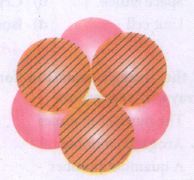
Hexagonal void
Octahedral void
Tetrahedral void
Double triangular void
35.
A solid with formula ABC3 would probably have, _______.
A at body centre, B at face centres and C at corners of the cube
A at corners of cube, B at body centre, C at face centre
A at corners of hexagon, B at centres of the hexagon and C inside the hexagonal unit cell
A at corner, B at face centre, C at body centre
36.
In graphite electrons are _______.
localised on each C-atom
localised on every third C-atom
delocalised within the layer
present in anti-bonding orbital
37.
SiO44- ion has ____ geometry.
Triangular
Tetrahedral
Linear
Pentagonal bipyramidal
38.
FeSO4 on heating gives _______.
SO2 and O2
SO2 and SO3
SO2
SO3
39.
CrO3 is coloured due to_______.
Low L.E
Crystal defects
Charge transfer spectra
Unpaired electrons
40.
Ce (Z=58) and Yb (Z=70) exhibits stable +4 and +2 oxidation states respectively. This is because_______.
Ce4+ and Yb2+acquire f7 configuration
Ce4+ and Yb2+ acquire f0 configuration
Ce4+ and Yb2+acquire f7 and f14 configuration
Ce4+and Yb2+ acquire f0 and f14 configuration
41.
Na[Ag(CN)2] is _________.
Sodium aurocyanide
Sodium meta aluminate
Aluminosilicate
Sodium dicyanoargentate
42.
Zinc is extracted from Zinc blende by________.
Carbon reduction process
Nitrogen reduction process
Oxygen reduction process
All of these
43.
Among the following, one does not belong to calcination, Pick the odd one out.
\({ PBCO }_{ 3 }\overset { \Delta }{ \longrightarrow } PBO+{ CO }_{ 2 }\uparrow \)
\({ CaCo }_{ 3 }\overset { \Delta }{ \longrightarrow } Cao+{ CO }_{ 2 }\uparrow \)
\(PbS{ O }_{ 3 }\overset { \Delta }{ \rightarrow } PbO+{ 2SO }_{ 2 }\uparrow \)
\({ ZnCO }_{ 3 }\overset { \Delta }{ \rightarrow } ZnO+{ CO }_{ 2 }\uparrow \)
44.
Crystal field stabilization energy for high spin d4 octahedral complex is ______.
- 0. 6 \({ \triangle }_{ 0 }\)
- 1. 8 \({ \triangle }_{ 0 }\)
- 1. 6 \({ \triangle }_{ 0 }\)
- 1. 4 \({ \triangle }_{ 0 }\)
45.
Consider the following statements and identify the incorrect statement(s).
(i) CN- is a powerful ligand.
(ii) Hemoglobin is a monomer and myoglobin is a tetramer.
(iii) Cis - Pt (NH3)2Cl2 is an anti-tumor drug.
only (i)
only (ii)
only (iii)
both (i) and (iii)
46.
A metal ion from the first transition series forms an octahedral complex with magnetic moment of 4.9 BM and another octahedral, complex which is diamagnetic. The metal ion is _______.
Fe2+
Co2+
Mn2+
Ni2+
47.
For a reaction Rate = k[acetone]3/2 then unit of rate constant and rate of reaction respectively is _______.
(mol L-1 S-1),(mol1/2 L1/2 S-1)
(mol-1/2 L1/2 s-1),(mol L-1 s-1)
(mol1/2 L1/2 s-1),(mol L-1 s-1)
(mol L s-1),(mol1/2 L1/2 s)
48.
The crystal with a metal deficiency defect is ________.
NaCl
FeO
ZnO
KCl
49.
The cation leaves its normal position in the crystal and moves to some interstitial position, the defect in the crystal is known as _____.
Schottky defect
F center
Frenkel defect
non-stoichiometric defect
50.
For a first order reaction A ⟶ product with initial concentration x mol L-1, has a half life period of 2.5 hours. For the same reaction with initial concentration \(\left( \frac { x }{ 2 } \right) \) mol L-1 the half life is
(2.5 x 2) hours
\(\left( \frac { 2.5 }{ 2 } \right) \) hours
2.5 hours
Without knowing the rate constant, t1/2 cannot be determined from the given data
51.
Which one of the following complexes is not expected to exhibit isomerism?
[Ni(NH3)4(H2O)2]2+
[Pt(NH3)2Cl2]
[Co(NH3)5SO4]Cl
[FeCl6]3-
52.
How many geometrical isomers are possible for [Pt(Py)(NH3)(Br)(Cl)]
3
4
0
15
53.
When a brown compound of Mn (A) is treated with HCl, it gives a gas (B). The gas (B) taken in excess reacts with NH3 to give an explosive compound (C). The compound A, B and C are ________.
MnO2, Cl2, NCl3
MnO, Cl2, NH4Cl
Mn3O4, Cl2, NCl3
MnO3, Cl2, NCl2
54.
Which of the following does not give oxygen on heating?
K2Cr2O7
(NH4)2Cr2O7
KClO3
Zn(ClO3)2
55.
The stability of +1 oxidation state increases in the sequence ________.
Al < Ga < In < Tl
Tl < In < Ga < Al
In < Tl < Ga < Al
Ga< In < Al < Tl
56.
When copper is heated with conc HNO3 it produces ________.
Cu(NO3)2, NO and NO2
Cu(NO3)2 and N2O
Cu(NO3)2 and NO2
Cu(NO3)2 and NO
57.
Solid (A) reacts with strong aqueous NaOH liberating a foul smelling gas(B) which spontaneously burn in air giving smoky rings. A and B are respectively_________.
P4(red) & PH3
P4(white) & PH3
S8 & H2S
P4(white) & H2S
58.
59.
Zinc is obtained from ZnO by________.
Carbon reduction
Reduction using silver
Electrochemical process
Acid leaching
60.
Wolframite ore is separated from tinstone by the process of________.
Smelting
Calcination
Roasting
Electromagnetic separation
61.
Write a note on Claisen Condensation.
62.
Complete the following reaction

63.
What is difference between sol gel and emulsion?
64.
What is Ultrafilteration?
65.
Why is the electrode potential of a single electrode cannot be determined?
66.
On dilution of 0.1 M of Na2SO4, what will happen to its
(a) Conductance (C)
(b) Conductivity K
(c) Molar conductance \({ \Lambda }_{ m }\)
(d) Equivalent conductance \({ \Lambda }\)
67.
Which of the following does not give iodoform reaction?

68.
Identify the product A and B.
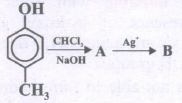
69.
BF3 is termed as an acid though it does not contain H+ ions. Explain.
70.
Give a condition for a compound to be precipitated.
71.
The resistance of a conductivity cell is measured as 190 Ω using 0.1M KCl solution (specific conductance of 0.1M KCl is 1.3 Sm-1). When the same cell is filled with 0.003 M sodium chloride solution, the measured resistance is 6.3KΩ. Both these measurements are made at a particular temperature. Calculate the specific and molar conductance of NaCl solution.
72.
What happens when a colloidal sol of Fe(OH)3 and As2S3 are mixed?
73.
74.
Account for the acidic nature of HClO4 in terms of Bronsted – Lowry theory, identify its conjugate base.
75.
In a reaction, 2A \(\longrightarrow \) products, the concentration of A decreases from 0.5 mol L-1 to 0.4 mol L-1 in 10 minutes. Calculate the rate during this interval?
76.
For a reaction A + B ⟶ C, the rate of the reaction is denoted \(\frac { -dA }{ dt } \) or \(\frac { -dB }{ dt } \) or \(\frac { +dC }{ dt } \). State the significance of plus and minus sign.
77.
Acidic character increases from HF to HI. State whether the above statement is True or false and give reason for your answer.
78.
What is the reaction of Phosphorous with alkali?
79.
What is the total number of atoms per unit cell in a face - centered cubic structure (fcc)?
80.
Why do solids have a definite volume?
81.
Starting from SiCl4, prepare the following in steps not exceeding the number given in parentheses.
(i) Silicon
(ii) Linear silicon containing methyl groups only
(iii) Na2SiO3
82.
What are alums?
83.
Comparing La(OH)3 and Lu(OH)3, which is more basic and explain why?
84.
Which is the most common oxidation state of lanthanides?
85.
What are the different methods of concentration of ores?
86.
Why should we have a ecofriendly metallurgical process?
87.
Write the IUPAC name of [Cu(NH3)4]SO4
88.
Write a neutral molecule in which the central atom is Sp3d2 hybridised.
89.
Why Gd3+ is colourless?
90.
What are actinides? Give three examples.
91.
Calculate the ratio of \(\frac { \left[ { Ag }^{ + } \right] }{ \left[ Ag\left( NH_{ 3 } \right) _{ 2 } \right] ^{ + } } \) in 0.2 M solution of NH3. If the stability constant for the complex \([Ag(NH_{ 3 })_{ 2 }]^{ + }\) is 1.7 x 10⁷
92.
Give the oxidation state of halogen in the following.
a) OF2
b) O2F2
c) Cl2O3
d) I2O4
93.
Write a short note on anomalous properties of the first element of p-block.
94.
What is the role of quick lime in the extraction of Iron from its oxide Fe2O3?
95.
An organic compound (A) of molecular formula C7H6O is not reduced by Fehling's solution but will undergo Cannizzaro reaction. Compound (A) reacts with aniline to give compound (B). Compound (A) also reacts with Cl2 in the presence of catalyst to give compound (C). Identify (A) (B) and (C) and explain the reactions.
96.
Compound (A) with molecular formula C6H6O gives violet colour with neutral FeCI3 (A) reacts with CHCl3 and NaOH gives two isomers (B) and (C) with molecular formula C7H6O2 Compound (A) reacts with ammonia at 473 K in the presence of ZnCl2 gives compound (D) with molecular formula C6H7N. Compound (D) undergoes carbylamine test. Identify (A), (B), (C) and (D) and explain the reactions.
97.
Write a note on phase transfer catalysis.
98.
The equilibrium constant of cell reaction: Ag(s) + Fe3+ ⇌ Fe2+ + Ag+ is 0.335 at 25°C. Calculate the standard emf of the cell AgI Ag+; Fe3+, Fe2+/Pt. Calculate Eo of the half cell Fe3+, Fe2+/Pt is 0.7791 V. Calculate Eo of Fe3+, Fe2+/ Pt half cell.
99.
A 0.02 M solution of a weak mono basic acid is 5% ionised. Calculate the ionisation constant of the acid.
100.
Describe the construction of Daniel cell. Write the cell reaction.
101.
Derive an expression for Ostwald’s dilution law.
102.
The initial rate of a first order reaction is 5.2 x 10⁻⁶ mol lit-1 S-1 at 298 K. When the initial concentration of reactant is 2.6 x 10⁻³ mol.lit-1, calculate the first order rate constant of the reaction at the same temperature.
103.
Why is there a variation of atomic and ionic size as we move from Sc to Zn?
104.
An amorphous solid (A) burns in air to form a gas (B) which turns lime water milky. The gas is also produced as a byproduct during roasting of sulphide ore. This gas decolourises acidified aqueous KMnO4 solution and reduces Fe3+ to Fe2+. Identify the solid 'A' and the gas 'B' and write the reactions involved.
105.
What are the general characteristics of solids?
106.
Distinguish between diamond and graphite.
107.
Write short note on the following:
(i) The process in which no external reducing agent is used.
(ii) The process which is used for highly electro positive metal.
(iii) Write the equation involved in the thermite process.
108.
Give the postulates and limitation of Werner's theory of co-ordination compounds.
109.
Explain briefly the collision theory of bimolecular reactions.
110.
Give the balanced equation for the reaction between chlorine with cold NaOH and hot NaOH.
111.
Describe briefly allotropism in p- block elements with specific reference to carbon.
112.
Explain zone refining process with an example.
113.
What is acidity constant? How is it expressed.
114.
Ethers should not be heated to dryness. Why?
115.
What are the advantages of Brownian movement?
116.
What is the oxidation and reduction half cell in a Daniel cell?
117.
What do you mean by buffer action?
118.
What happens when 1-phenyl ethanol is treated with acidified KMnO4.
119.
Can Fe3+ oxidises Bromide to bromine under standard conditions?
Given: \({ E }_{ { Fe }^{ 3+ }|{ Fe }^{ 2+ } }^{ 0 }=0.771V\); \(\\ { E }^{0}_{ { Br }_{ 2 }|{ Br }^{ - } }=1.09V\).
120.
The energy of activation for the formation of hydrogen iodide is 150 kJ mol-1 The rate constant of this reaction at 673 K is 2.3 x 10⁻³. Calculate the rate constant at 773 K.
121.
Explain why oxidation states of transition elements increases first from Sc to Mn and then decrease?
122.
Explain the reaction of ammonia with chlorine and chlorides at different conditions.
123.
Answer the following:
(I) Name the intermolecular force present in ice.
(II) What type of bond is present in network solid?
124.
Describe the structure of diamond.
125.
Aqueous copper sulphate solution (blue) gives
(i) a green precipitate with aqueous potassium fluoride.
(ii) a bright green solution with aqueous potassium chloride. Explain these experimental results.
126.
Explain the rate determining step with an example.
127.
Define average rate and instantaneous rate.
128.
Explain the variation in E0M3+/M2+ 3d series.
129.
Give one test to differentiate [Co(NH3)5Cl]SO4 and [Co(NH3)5SO4]Cl.
130.
Based on VB theory explain why [Cr(NH3)6]3+ is paramagnetic, while [Ni(CN)4]2- is diamagnetic.
131.
Give the uses of helium.
1.
(a)
electrons move from cathode to anode
2.
(d)
all of these
3.
(a)
λ∞ value of weak electrolyte.
4.
(b)
pleasant smelling liquids
5.
(b)
- I effect
6.
(d)
bicarbonate
7.
(b)
glycerine
8.
(d)
oil
9.
(b)
CH3-OCH3
10.
(d)
metamerism
11.
(b)
it is only partially ionised
12.
(c)
propane-1,2,3-triol
13.
(b)
A is stronger than B
14.
(a)
ionic product constant of water
15.
(a)
electrolytes
16.
17.
18.

19.
Hydroboration - Anti Markownikoff product
CH3 – CH2 –CH2 – CH2 – CH2 – OH
20.
ΔS is -ve
21.
As2S3 is a negatively charged colloid. It will be most effectively coagulated by the cation with greater valency. i.e., Al3+.
22.
Z is tie strongest oxidising agent (High SRP)
X is the strongest reducing agent (Low SRP)
23.
Ecell = Eocell - \(\frac{0.0591}{2} \log [\frac{Zn^{2+}}{Cu^{2+}}]\)
El = Eocell - \(\frac{0.0591}{2} \log [\frac{10^{-2}}{1}]\)
El = Eocell + 0.0591 ...(1)
E2 = Eocell - \(\frac{0.0591}{2} \log [\frac{1}{10^{-2}}]\)
E2 = Eocell - 0.0591 ...(2)
E1 > E2
Zn(s)| ⟶ Zn2+(aq) + 2e-
Cu2+(aq) + 2e- ⟶ Cu(s)
Zn(s) + Cu2+(aq) ⟶ Zn2+(aq) + Cu(s)
24.
(a)
10-10
25.
(c)
CH3-CH2->NH2->H-C≡C->OH-
26.
(a)
10-2 s-1
27.
(a)
\(+\frac { 1 }{ 2 } \frac { -d\left[ { NH }_{ 3 } \right] }{ dt } \)
28.
(b)
\(k{ \left[ A \right] }^{ \frac { 1 }{ 2 } }\)
29.
(c)
Cl2 - Colourless
30.
(b)
sp3d2, octahedral
31.
(a)
H3PO3 is dibasic and reducing
32.
(d)
molecular
33.
(c)
difference in the arrangement of atoms in the molecules in the crystal
34.
(b)
Octahedral void
35.
(b)
A at corners of cube, B at body centre, C at face centre
36.
(c)
delocalised within the layer
37.
(b)
Tetrahedral
38.
(b)
SO2 and SO3
39.
(c)
Charge transfer spectra
40.
(d)
Ce4+and Yb2+ acquire f0 and f14 configuration
41.
(d)
Sodium dicyanoargentate
42.
(a)
Carbon reduction process
43.
(c)
\(PbS{ O }_{ 3 }\overset { \Delta }{ \rightarrow } PbO+{ 2SO }_{ 2 }\uparrow \)
44.
(a)
- 0. 6 \({ \triangle }_{ 0 }\)
45.
(b)
only (ii)
46.
(a)
Fe2+
47.
Rate = k[A]n
Rate = \(\frac{-\mathrm{d}[\mathrm{A}]}{\mathrm{dt}}\)
unit of rate = \(\frac{mol L^{-1}}{s}\)=mol L-1/s-1
unit of rate constant
\(=\frac{ (mol{ L }^{ -1 }{ S }^{ -1 }) }{ ({ mol }{ L }^{ -1 })^n } \)
= mol1-nLn-1s-1
in the case
rate = k [Acetone]3/2
n = 3/2
= mol1-(3/2)L(3/2)-1s-1
(mol-(1/2) L(1/2) s-1).
48.
(b)
FeO
49.
(c)
Frenkel defect
50.
For a first order reaction
t1/2 = \(\frac { 0.693 }{ { k }}\)
t1/2 does not depend on the initial concentration and it remains constant (whatever may be the initial concentration)
t1/2 = 2.5 hrs
51.
Option (a) and (b) -geometrical isomerism is possible
Option (c) - ionization isomerism is possible
Option (d) - no possibility to show either constitutional isomerism or stereo isomerism
52.
Three isomers. If we consider any one of the ligands as reference (say Py), the arrangement of other three ligands (NH3, Br- and Cl-) with respect to (Py) gives three geometrical isomers.
53.
(a)
MnO2, Cl2, NCl3
54.
(b)
(NH4)2Cr2O7
55.
(a)
Al < Ga < In < Tl
56.
(c)
Cu(NO3)2 and NO2
57.
(b)
P4(white) & PH3
58.
(d)
59.
(a)
Carbon reduction
60.
(d)
Electromagnetic separation
61.
Esters containing at least one ∝- hydrogen atom undergo self condensation in the presence of a strong base such as sodium ethoxide to form β-keto ester.
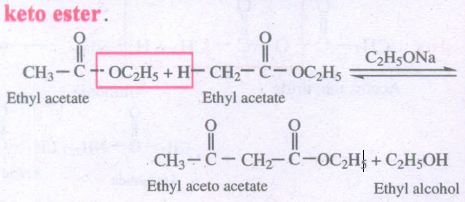
62.
HCHO + CaCO3
63.
| Dispersion medium | Dispersed phase | Name of the colloid |
| Liquid | Liquid | Emulsion |
| Liquid | Solid | Sol |
| Solid | Liquid | Gel |
64.
The separation of sol particles from electrolyte by filteration through an ultrafilter is called ultrafiltration.
65.
Its is because oxidation half reaction and reduction half reaction cannot take place alone. It can be measured only by using a reference electrode.
66.
Conductivity, molar conductance and equivalent conductance increases with dilution whereas Conductance (C) decreases.
67.
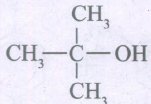 Tertiary butyl alcohol does not give iodoform reaction. All other compounds contains α H atoms and they undergo iodoform reaction.
68.
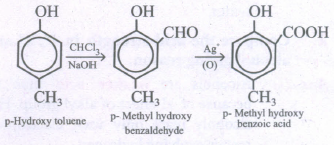
69.
According to Lewis concept of Acid and bases, any species capable of accepting an electron pair is an acid. BF3 is electron deficient so accepts a pair of electron, Hence termed as acid
70.
When the product of molar concentration of the constituent ions i.e., ionic product, exceeds the solubility product then the compound gets precipitated. Ionic product > Ksp, precipitation will occur and the solution is super saturated.
71.
Given that
κ = 1.3 Sm-1 (for 0.1M KCl solution)
R = 190 Ω
\(\kappa = \frac{1}{R}(\frac{l}{A})\)
κ . R =\((\frac{l}{A})\) = (1.3 Sm-1) (190Ω)
= 247 m-1
\(\kappa_{(NaCl)} = \frac{1}{R_{(NaCl)}} (\frac{l}{A})\)
\(= \frac{1}{6.3 K\Omega}(247 m^{-1})\) (6.3KΩ = 6.3 x 10³Ω)
= 39.2 x 10⁻³ Sm-1
\(\Lambda_m = \frac{\kappa \times 10^{-3} mol^{-1} m^3}{M}\)
\(=\frac{39.2 \times 10 ^{-3}(Sm^{-1})10^-3 (mol^{-1} m^3)}{0.003}\)
\(\Lambda_m\) = 13.04 \(\times\) 10-3 Sm2 mol-1
72.
(i) Neutralisation of chargers of ion will taken place and hence precipitation will take place (ie) Fe3+ and S2- ion changes are neutralized. No new compounds are formed.
(ii) Fe(OH)3 is a positive Sol
(iii) As2S3 is a negative Sol
73.
74.
\(\mathrm{HClO}_{4} \rightleftharpoons \mathrm{H}^{+}+\mathrm{ClO}_{4}^{-}\)
Bronsted Acid Proton Conjugate Base
HClO4 can donate a proton. Therefore HClO4 is an acid. Its conjugate base is ClO4-
75.
Average rate = \(-\frac { 1 }{ 2 } \frac { \triangle \left[ A \right] }{ \triangle L } \)
\(=-\frac { 1 }{ 2 } \frac { { \left[ A \right] }_{ 2 }-{ \left[ A \right] }_{ 1 } }{ { t }_{ 2 }-{ t }_{ 1 } } \)
\(=-\frac { 1 }{ 2 } \left( \frac { 0.4-0.5 }{ 10 } \right) \)
\(=-\frac { 1 }{ 2 } \left( \frac { -0.1 }{ 10 } \right) \)
= 0.005 mol L-1 min-1
= 5 x 10⁻³ M min-1
76.
Minus sign i.e. \(\frac { -dA }{ dt } \) or \(\frac { -dB }{ dt } \) indicates decreases in the concentration of reactants whereas + sign indicates in the concentration of products with time i.e. \(\frac { +dC }{ dt } \)
77.
(i) The given statement is true.
(ii) The relative acidic strength of HF, HCI, HBr and HI depends upon their bond dissociation enthalpies.
(iii) Since, the bond dissociation enthalpy of H-X bond from H-F to H-I as the size of atom increases from F to l. Therefore, the acidic strength increases in the opposite order as:
H - F < H - CI < H - Br < H - I
78.
Yellow phosphorus reacts with alkali on boiling in an inert atmosphere liberating phosphine. Phosphorus acts as a reducing agent.
\({ P }_{ 4 }+NaOH+{ H }_{ 2 }O\longrightarrow \underset { Sodiumhypophosphite }{ { 3NaH }_{ 2 }{ PO }_{ 2 } } +\underset { Phosphine }{ { PH }_{ 3 } } \uparrow \)
79.
Total number of atoms per unit cell in a fcc structure = 4 atoms.
80.
(i) The intermolecular forces of attraction that are present in solids are very strong.
(ii) The constituent particles of solids have fixed position.
(iii) Hence, solids have a definite volume.
81.
(i) 3SiCl4 + 4 Al ⟶ 4 AICl3 + 3 Si
(ii) n(CH3)2Si(OH)2
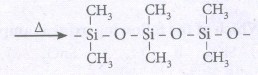
(iii) \(SiC{ l }_{ 4 }+4{ H }_{ 2 }O\longrightarrow \underset { orthosilicic \ acid }{ { H }_{ 4 }Si{ O }_{ 4 } } +4HCl\)
H4SiO4 \(\overset { \triangle }{ \longrightarrow } \) SiO2 + 2H2O
SiO2 + Na2CO3 ⟶ Na2SiO3 + H2O.
82.
The name alum is given to the double salt of potassium aluminium sulphate.
[K2SO4.Al2(SO4)3.24H2O]
83.
(i) Due to lanthanide contraction the size of La3+ ions decreases regularly with increase in atomic number.
(ii) According to Fajan's rule decrease in size of Ln3+ ions increase the covalent character and decreases the basic character between Ln3+& OH- ion in Ln(OH)3
(iii) Since the order of size Ln3+ ions are
La3+ > Ce3+ ...> Lu3+
(iv) Hence La(OH)3 is the strongest base while Lu(OH)3 is the weakest base
84.
+3
85.
(i) Hydraulic washing or gravity separation
(ii) Froth flotation
(iii) Electromagnetic separation
(iv ) Chemical method.
86.
It is essential to design an eco friendly metallurgical process that would minimize waste, maximize energy efficiency. Such advances in metallurgy is vital for the economic and technical progress in the current era.
87.
Tetraammine copper (II) sulphate.
88.
K3[CoF6]
89.
In Gd+3 there are 64 electrons. Hence electronic configuration will be [Xe]4f7 5d1 6s2. Hence no electrons are there in outer d - orbital. Due to this it is colourless.
90.
The fourteen elements following actinoids is from thorium to lawrencium are called actinides.
Examples: Uranium, Thorium, Neptunium
91.
\({ Ag }^{ + }2N{ H }_{ 3 }\rightleftharpoons { \left[ { Ag\left( { { NH }_{ 3 } } \right) }_{ 2 } \right] }^{ + }\)
\(k=\frac { { \left[ { Ag\left( { { NH }_{ 3 } } \right) }_{ 2 } \right] }^{ + } }{ \left[ { Ag }^{ + } \right] { \left[ { NH }^{ 3+ } \right] }^{ 2 } } \)
\(=\frac { \left[ { Ag }^{ + } \right] }{ { \left[ { Ag\left( { NH }_{ 3 } \right) }_{ 2 } \right] }^{ + } } =\frac { 1 }{ k{ \left( { NH }_{ 3 } \right) }^{ 2 } } \)
\(=\frac { 1 }{ 1.7\times { 10 }^{ 7 }\times { \left( 0.2 \right) }^{ 2 } } =\frac { { 10 }^{ -7 } }{ 1.7\times 4\times { 10 }^{ -2 } } \)
\(=\frac { { 10 }^{ -5 } }{ 6.8 } =1.47\times { 10 }^{ -5 }\)
92.
(a) OF2
+ 2 + 2(x) = 0
+2 = -2x
2 x = -2 ⇒ x = -1
(b) O2F2
2(+1) + 2x = 0
2x = -2
x = -1
(c) Cl2O3
2(x) + 3(-2) = 0
2x = +6
x = +3
(d) I2O4
2(x) + 4(-2) = 0
2x = +8
x = +4
93.
In p-block elements, the first member of each group differs from the other elements of the corresponding group. The following factors are responsible for this anomalous behaviour
(i) Small size of the first member.
(ii) High ionisation enthalpy and high electronegativity.
(iii) Absence of d-orbitals in their valance shell.
94.
In this extraction, a basic flux, quick lime (CaO) is used, since the silica gangue present in the ore is acidic in nature. The quick lime combines with it to form calcium silicate (slag).
CaO(s) + Sio2(s) ⟶ CaSio3(s)
Flux Gangue Slag
95.
(i) Compound A is identified as benzaldehyde C6H5CHO from its molecular formula. C6H5CHO undergoes Cannizzaro reaction and it does not reduce Fehling's solution.
\({ C }_{ 6 }{ H }_{ 5 }CHO+{ C }_{ 6 }{ H }_{ 5 }CHO\overset { NaOH }{ \longrightarrow } { C }_{ 6 }{ H }_{ 5 }{ CH }_{ 2 }OH+{ C }_{ 6 }{ H }_{ 5 }COONa\)
(ii) Benzaldehyde reacts with aniline to form Schiff's base C6H5CH = NC6H5 and it is (B)
\({ C }_{ 6 }{ H }_{ 5 }-\overset { \underset { | }{ H } }{ C } =\underset { Aniline }{ O+{ C }_{ 6 }H_{ 5 }{ NH }_{ 2 } } \longrightarrow \underset { Schiff's \ base(B) }{ { C }_{ 6 }{ H }_{ 5 }CH={ NC }_{ 6 }{ H }_{ 5 }+{ H }_{ 2 }O } \)
(iii) Benzaldehyde reacts with chlorine in the presence of catalyst to give m-chlorobenzaldehyde and it is (C).
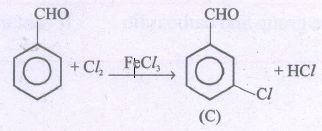
| Compound | Compound Name | Formula |
|---|---|---|
| A | Benzaldehyde | C6H5CHO |
| B | Schiff's base | C6H5CH = NC6H5 |
| C | m-cholorobenzaldehyde |  |
96.
(i) Compound (A) with molecular formula C6H6O gives violet colour with neutral FeCI3.
(ii) (A) reacts with CHCl3 and NaOH gives two isomers (B) and (C) with molecular formula C7H6O2.
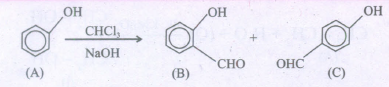
(iii) Compound (A) reacts with ammonia at 473 K in the presence of ZnCl2 gives compound (D) with molecular formula C6H7N.
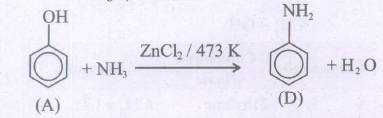
(iv) Compound (D) undergoes carbylamine test.
\(\underset { (D) }{ { C }_{ 6 }{ H }_{ 5 }{ NH }_{ 2 } } +CHCl_{ 3 }+3KOH\overset { \triangle }{ \longrightarrow } { C }_{ 6 }{ H }_{ 5 }NC+3KCl+3{ H }_{ 2 }O\)
| Compound | Compound Name | Formula |
| A | Phenol | C6H5OH |
| B | Orthohydroxy benzaldehyde | 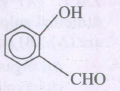 |
| C | Para hydroxy benzaldehyde | 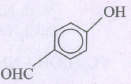 |
| D | Aniline | C6H5NH2 |
97.
(i) Suppose the reactant of a reaction is present in one solvent and the other reactant is present in an another solvent.
(ii) The reaction between them is very slow, if the solvents are immisible.
(iii) As the solvents from separate phases the reactants have to migrate across the boundary to react.
(iv) But migration of reactants across the boundary is not easy. For such situations a third solvent is added which is miscible with both.
(v) So, the phase boundary is eliminated reactants freely mix and react fast.
(vi) But for large scale production of any product, use of a third solvent is not convenient as it may be expensive.
(vii) For such problems phase transfer catalysis provides a simple solution, which avoides the use of solvents.
(viii) It directs the use a phase transfer catalyst (a phase transfer reagent) to facilitate transport of a reactant in one solvent to the other solvent where the second reactant is present.
(ix) As the reactants are now brought together they rapidly react and form the product.
98.
Given: K = 0.335;
Eo = (Ag+, Ag) = 0.7991 V
n = 1, F = 96495 C
Formula:
\({ E }^{ o }=\frac { -2.303RT }{ nF } \log K\)
Solution:
\(=\frac { -0.591 }{ 1 } \log 0.335\)
Standard emf of the cell
= - 0.0280 V
Eocell = EoF - EoL; EoR = ?
∴ EoR = Eocell - EoL
= -0.0280 + 0.7991 = 0.771 V
Eo(Fe3+,Fe2+) = 0.771 V.
99.
The degree of ionisation and the dissociation constant of the weak acid are related by the equation.
\({ K }_{ a }=\frac { { \alpha }^{ 2 }{ C } }{ 1-\alpha } \cong { \alpha }^{ 2 }C\)
α = 5% (or) 0.05
C = 0.02M
Ka = (0.05)2 x 0.02 = 0.00005
Ka = 5 x 10⁻⁵
100.
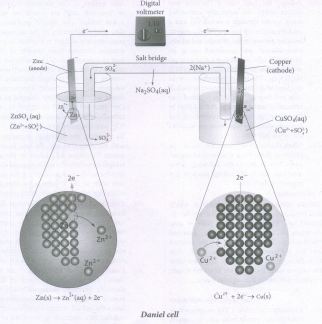
1. Daniel cell is a galvanic cell. This is a voltaic cell also.
(a) The separation of half reaction is the basis for the construction of Daniel cell. It consists of two half cells.
(i) Oxidation half cell: A metallic zinc strip that dips into an aqueous solution of zinc sulphate taken in a beaker, as shown in Figure
(ii) Reduction half cell: A copper strip that dips into an aqueous solution of copper sulphate taken in a beaker, as shown in Figure
(iii) Joining the half cells:
(a) The zinc and copper strips are externally connected using a wire through a switch (k) and a load (example: volt meter). The electrolytic solution present in the cathodic and anodic compartment are connected using an inverted U tube containing a agar-agar gel mixed with an inert electrolyte such as KCI, Na2SO4 etc.,
(b) The ions of inert electrolyte do not react with other ions present in the half I cells and they are not either oxidised (or) reduced at the electrodes. The solution in the salt bridge cannot get poured out, but through which the ions can move into (or) out of the half cells.
(c) When the switch (k) closes the circuit, the electrons flows from zinc strip to copper strip. This is due to the following redox reactions which are taking place at the respective electrodes.
(iv) Anodic oxidation:
(i) zinc strip acts as the anode.
(ii) Here,oxidation occurs.
The electrode at which the oxidation occur is called the anode. In Daniel cell, the oxidation take place at zinc electrode, i.e., zinc is oxidised to Zn2+ ions and the electrons.
The Zn2+ ions enters the solution and the electrons enter the zinc metal, then flow through the external wire and then enter the copper strip.
Electrons are liberated at zinc electrode and hence it is negative (-ve).
\(Zn_{ (s) }\longrightarrow { { Zn }^{ 2+ }_{ (aq) }+{ 2e }^{ - } } \) (loss of electron-oxidation)
(v) Cathodic reduction:
As discussed earlier. the electrons flow through the circuit from zinc to copper, where the Cu2+ ions in the solution accept the electrons, get reduced to copper and the same get deposited on the electrode Here, the electrons are consumed and hence it is positive (+ve).
\({ Cu }_{ (aq) }^{ 2+ }+{ 2e }^{ - }\longrightarrow { { Cu }_{ (s) } } \)(gain of electron - reduction)
b) When a Zinc metal strip is placed in a copper sulphate solution, the blue colour of the solution fades and the copper is deposited on the zinc strip as red - brown crust due to the following spontaneous chemical reaction.
\(\mathrm{Zn}_{(\mathrm{s})}+\mathrm{CuSO}_{4(\mathrm{aq})} \rightarrow \mathrm{ZnSO}_{4(\mathrm{aq})}+\mathrm{Cu}_{(\mathrm{s})}\)
The energy produced in the above reaction is lost to the surroundings as heat.
In the above redox reaction, Zinc is oxidised to Zn2+ ions and the Cu2+ ions are reduced to metallic copper. The half reactions are represented as below.
\(\mathrm{Zn}_{(\mathrm{s})} \rightarrow \mathrm{Zn}^{2+}{ }_{(\mathrm{aq})}+2 \mathrm{e}^{-} \text {(oxidation) } \)
\(\mathrm{Cu}^{2+}{ }_{(\mathrm{aq})}+2 \mathrm{e}^{-} \rightarrow \mathrm{Cu}_{(\mathrm{s})} \text { (reduction) }\)
If we perform the above two half reactions separately in an apparatus as shown in figure, some of the energy produced in the reaction will be converted into electrical energy.
101.
(i) Ostwald's dilution law relates the dissociation constant of the weak acid (Ka) with its degree of dissociation (α) and the concentration (c).
where \(\alpha=\frac{\text { Number of moles dissociated }}{\text { Total number of moles }}\)
(ii) The dissociation of acetic acid can be represented as
\(\mathrm{CH}_{3} \mathrm{COOH} \rightleftharpoons \mathrm{H}^{+}+\mathrm{CH}_{3} \mathrm{COO}^{-}\)
The dissociation constant of acetic acid is,
\({ K }_{ a }=\frac { \left[ { H }^{ + } \right] \left[ { CH }_{ 3 }COO^{ - } \right] }{ \left[ { CH }_{ 3 }COOH \right] } \) ........(1)
| CH3COOH | H+ | CH3COO- | |
| Initial number of moles | 1 | - | - |
| Degree of dissociation of CH3COOH | α | - | - |
| Number of moles at equilibrium | 1-α | α | α |
| Equilibrium concentration | (1-α)C | αC | αC |
Substituting the equilibrium concentration in equation (1)
\({ K }_{ a }=\cfrac { \left( \alpha C \right) \left( \alpha C \right) }{ \left( 1-\alpha \right) C } \)
\({ K }_{ a }=\cfrac { { \alpha }^{ 2 }C }{ 1-\alpha } \) .......(2)
(iii) We know that weak acid dissociates only to a very small extent compared to one, a is so small and hence in the denominator (1 - α) ⋍1. The above expression (2) now becomes,
ka =a2C \(\Rightarrow { \alpha }^{ 2 }=\cfrac { { k }_{ a } }{ C } \) ; \(\alpha =\sqrt { \cfrac { { K }_{ a } }{ C } } \)
(iv) When dilution increases, the degree of dissociation of weak electrolyte also increases. This is called Ostwald's dilution law
Also \(;\left[\mathrm{H}^{+}\right]=\alpha \mathrm{C}\) and \(\left[\mathrm{H}^{+}\right]=\left(\sqrt{\frac{\mathrm{K}_{\mathrm{a}}}{\mathrm{C}}}\right) \mathrm{C}=\sqrt{\frac{\mathrm{K}_{\mathrm{a}} \mathrm{C}^{2}}{\mathrm{C}}}=\sqrt{\mathrm{K}_{\mathrm{a}} \cdot \mathrm{C}}\)
Similarly for a weak base
\(\begin{aligned} & \mathrm{K}_{\mathrm{b}}=\alpha^2 \mathrm{C} ; \quad \therefore \alpha=\sqrt{\frac{\mathrm{k}_{\mathrm{b}}}{\mathrm{C}}}, \\ \end{aligned}\)
\(\begin{aligned} & {\left[\mathrm{OH}^{-}\right] \alpha \mathrm{C}=\sqrt{\frac{\mathrm{K}_{\mathrm{b}}}{\mathrm{C}}} \times \mathrm{C}=\sqrt{\frac{\mathrm{K}_{\mathrm{b}} \mathrm{C}^2}{\mathrm{C}}}=\sqrt{\mathrm{K}_{\mathrm{b}} \mathrm{C}}} \end{aligned}\)
102.
Given data: Rate = 5.2 x 10⁻⁶ mol lit-1 sec-1
Initial concentration [A] = 2.6 x 10⁻³
Formula: Rate = k[A]1
Solution: Rate = 5.2 x 10⁻⁶ mol lit-1 sec-1 = k x 2.6 x 10⁻³ lit-1
= \(\frac { 5.26\times { 10 }^{ -6 }mol{ \ lit }^{ -1 }{ sec }^{ -1 } }{ 2.6\times { 10 }^{ -3 }mol \ { lit }^{ -1 } } \)= 2 x 10⁻³
∴ k = 2 x 10⁻³ s-1
103.
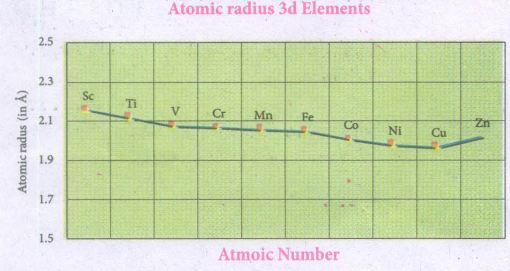
(i) It is generally expected a steady decrease in atomic radius along a period as the nuclear charge increases and the extra electrons are added to the same sub shell.
(ii) But for the 3d transition elements, the expected decrease in atomic radius is observed from Sc to V, thereafter up to Cu the atomic radius nearly remains the same.
(iii) As we move from Sc to Zn in 3d series the extra electrons are added to the 3d orbitals, the added 3d electrons only partially shield the increased nuclear charge and hence the effective nuclear charge increases slightly.
(iv) However, the extra electrons added to the 3d sub shell strongly repel the 4s electrons and these two forces are operated in opposite direction and as they tend to balance each other, it leads to constancy in atomic radii.
(v) At the end of the series, d - orbitals of Zinc contain 10 electrons in which the repulsive interaction between the electrons is more than the effective nuclear charge and hence, the orbitals slightly expand and atomic radius slightly increases.
104.
(I) Since the byproduct of roasting to sulphide ore is SO2 It turns lime water milky.
Therefore, gas 'B' must be SO2
(ii) As the gas 'B' is obtained when amorphous solid 'A' burns in air therefore, amorphous solid 'A' must be sulphur S8
\(\underset { (A) }{ { S }_{ g } } +{ 8O }_{ 2 }\overset { \Delta }{ \longrightarrow } \underset { (B) }{ { 8SO }_{ 2 } } \)
(iii) Gas (B) reduces acidified aqueous KMnO4 solution and reduces Fe3+ to Fe2+ salts as shown below:
\(\underset { (yellow) }{ { 2MnO }_{ 4 } } ^{ - }+\underset { (b) }{ { SO }_{ 2 } } +2{ H }_{ 2 }O\longrightarrow { 2Fe }^{ 2+ }+\underset { (Green) }{ { SO }_{ 4 }^{ 2- } } +{ 4H }^{ + }\)
(iv) Thus, solid 'A' is S8 and gas 'B' is SO2
105.
(i) Solids have definite volume and shape
(ii) Solids are rigid and incompressible
(iii) Solids have strong cohesive forces.
(iv) Their constituents have fixed positions and can only oscillate about their mean positions.
106.
| DIAMOND | GRAPHITE |
| C is sp3 hybridised. | C is sp2 hybridised. |
| Three dimensional, tetrahedral structure. | Two dimensional, sheet like structure. |
| Crystalline, transparent with extra brilliance. | Crystalline, opaque and shiny substance. |
| It is hard with high density and high melting point. | It is soft with low density and high melting point. |
| Bad conductor of and electricity. | Good conductor of heat and electricity. |
107.
(i) The process in which no external reducing. When ore is heated in air, a part of the ore gets oxidised which combines with remaining sulphide to give metal.
Eg: Reduction copper glance (Cu2S)
\({ 2Cu }_{ 2 }S+{ 3O }_{ 2 }\longrightarrow { 2Cu }_{ 2 }O+2{ SO }_{ 2 }\uparrow \)
\({ 2Cu }_{ 2 }O+{ Cu }_{ 2 }S\longrightarrow 6Cu+{ SO }_{ 2 }\uparrow \)
(ii) Electrolytic reduction is used for highly electro positive metals. In this method, fused metal ore is electrolysed and pure metal is deposited at cathode.
Eg: Al is obtained by electrolysis of Al2O3
\({ 2Al }_{ 2 }{ O }_{ 3 }+3C\longrightarrow \underset { Cathode\quad Anode }{ 4Al+{ 3CO }_{ 2 } } \)
(iii) \({ Cr }_{ 2 }{ O }_{ 3 }+2Al\longrightarrow {Al }_{ 2 }{ O }_{ 3 }+2Cr\)
\(3 \mathrm{Mn} _3 O_{4}+8 \mathrm{Al} \longrightarrow 4 \mathrm{Al}_{2} \mathrm{O}_{3}+9 \mathrm{Mn}\)
108.
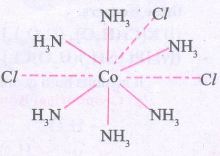
(i) Every metal atom has two types of valencies Primary valency or ionisable valency Secondary valency or non ionisable valency
(ii) The primary valency corresponds to the oxidation state of the metal ion. It is always satisfied by negative ions.
(iii) Secondary valency corresponds to the coordination number of the metal ion or atom. It is satisfied by either negative ions or neutral molecules.
(iv) The molecules or ions that satisfy secondary valencies are called ligands.
(v) The ligands which satisfy secondary valencies must project in definite directions in space. So the secondary valencies are directional in nature whereas the primary valencies are non - directional in nature.
(vi) The ligands have unshared pair of electrons. These unshared pair of electrons are donated to central metal ion or atom in a compound. Such compounds are called coordination compounds.
Werner's representation
Eg: [Co(NH)6]Cl3
Cl: primary valency (dotted lines)
NH3: secondary valency (solid lines).
Defects of Werner's theory
Werner's theory describes the structures of many co-ordination compounds successfully. However, it does not explain the magnetic and spectral properties.
109.
(i) Collision theory is based on the kinetic theory of gases. According to this theory, a chemical reaction occurs as a result of collisions between the reacting molecules.
(ii) Let us understand this theory by considering the following reaction.
A2(g) + B2(g) ⟶ 2AB(g)
(iii) If we consider that, the reaction between A2 and B2 molecules proceeds through collisions between them, then the rate would be proportional to the number of collisions per second.
(iv) Rate ∝ number of molecules colliding per litre per second (collision rate).
(v) The number of collisions is directly proportional to the concentration of both A2 and B2.
Collison rate ∝ [A2][B2]
Collision rate = Z [A2][B2]
(vi) Where, Z is a constant
(vii) A fraction of effective collisions (f) is given by the following expression
\(f={ e }^{ \frac { { -E }_{ a } }{ RT } }\)
(xiv) This fraction of collisions is further reduced due to orientation factor i.e., even if the reactant collides with sufficient energy, they will not react unless the orientation of the reactant molecules is suitable for the formation of the transition state.
(viii) The diagram illustrates the importance of proper alignment of molecules which leads to reaction.
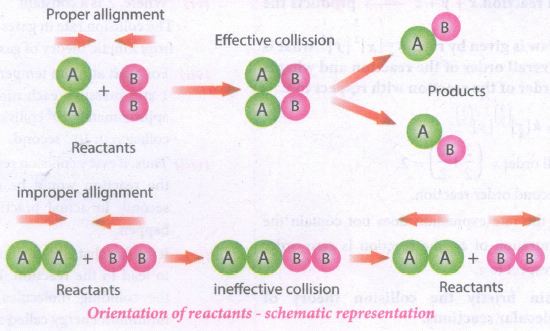
(ix) The fraction of effective collisions (f) having proper orientation is given by the steric factor p.
⇒ Rate = p x f x collision rate
\(\Rightarrow Rate=p\times { e }^{ \frac { -Ea }{ RT } }\times Z\left[ { A }_{ 2 } \right] \left[ { B }_{ 2 } \right] \quad ...(1)\)
As per the rate law,
Rate = \(k=\left[ { A }_{ 2 } \right] \left[ { B }_{ 2 } \right] \quad ...(2)\)
Where k is the rate constant
On comparing equation (1) and (2), the rate constant k is
\(k=pZ{ e }^{ \frac { -Ea }{ RT } }\)
110.
Chlorine reacts with cold dilute alkali to give chloride and hypochlorite, while with hot concentrated alkali chlorides and chlorates are formed.
\(\mathrm{Cl}_{2}+\mathrm{H}_{2} \mathrm{O} \rightarrow \mathrm{HCl}+\underset{\text { Hypochlorous acid }}{\mathrm{HOCl}} \)
\(\mathrm{HCl}+\mathrm{NaOH} \rightarrow \mathrm{NaCl}+\mathrm{H}_{2} \mathrm{O} \)
\(\mathrm{HOCl}+\mathrm{NaOH} \rightarrow \mathrm{NaOCl}+\mathrm{H}_{2} \mathrm{O} \)
(Sodium hypo chlorite)
Overall Reaction
3Cl2 + 6NaOH \(\rightarrow\) NaClO3 + 5NaCl + 3H2O
(Sodium Chlorate)
111.
Allotropism:
1. Some elements exist in more than one crystalline or molecular forms in the same physical state
(a) In Greek "allos" means ⇒ Another
(b) "trope" means ⇒ Change
2. The different forms of an element are called allotropes.
Allotropy of carbon:
Carbon exists as diamond, graphite, fullerenes, carbon nanotubes and graphene.
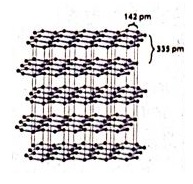
Graphite:
1. Graphite is the most stable allotropic form of carbon at normal temperature and pressure.
2. It is soft and conducts electricity.
3. It is composed of flat two dimensional sheets of carbon atoms.
4. Each sheet is a hexagonal.
5. It is "sp2" hybridised.
6. C-C bond length is 1.41 Å
7. Each C-atom forms three σ bonds with three neighbouring carbon atoms using three of its valence electrons and the fourth electron present in the unhybridised p-orbital form a π-bond.
8. The successive C-sheets are held together by weak Vander Waals forces.
9 The distance successive sheet is 3.40 Å.
10. It is used as a lubricant either on its own or as a graphited oil.
Diamond:
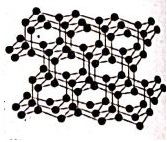
1. It is very hard.
2. It is "sp3" hybridised.
3. C-C bond length is 1.54 Å
4. It is used for sharpening hard tools, cutting glasses, making bores and rock drilling.
Fullerenes:
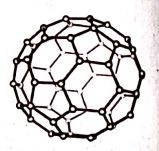
1. These allotropes are discrete molecules such as \(C_{32}, C_{50}, C_{60}, C_{70}, C_{76}\) etc.
2. It has cage like structure
3. The C60 molecules have a "soccer" ball like structure and is called buckminster fullerene or buckyballs.
4. It has a fused ring structure consists of 20 six membered rings and 12 five membered ring.
5. Each carbon atom is "sp2" hybridised.
6. It has three σ bonds and a delocalised π bond giving aromatic character to these molecules.
7. The C-C bond distance is 1.44 Å
8. The C=C bond distance is 1.38 Å.
Carbon nanotubes:
1. Carbon nanotubes, another recently discovered allotropes, have graphite like tubes with fullerene ends.
2. Along the axis, these nanotubes are stronger than steel and conduct electricity.
3. These have many applications in nanoscale electronics, catalysis, polymers and medicine.
Graphene:
It has a single planar sheet of "sp2" hybridised carbon atoms that are densely packed in a "honeycomb crystal" lattice.
112.
Zone refining :
1. Zone refining method is based on the principles of fractional crystallisation.
2. When an impure metal is melted and allowed to solidify, the impurities will prefer to be in the molten region. In this process the impure metal is taken in the form of a rod.
3. One end of the rod is heated using a mobile induction heater which results in melting of the metal on that portion of the rod.
4. When the heater is slowly moved to the other end the pure metal crystallises while the impurities will move on to the adjacent molten zone.
5. As the heater moves further away, the molten zone containing impurities also moves along with it.
6. The process is repeated several times by moving the heater in the same direction again and again to get pure metal.
7. This process is carried out in an inert gas atmosphere to prevent the oxidation of metals.
8. Elements such as germanium (Ge), silicon (Si) and galium (Ga) that are used as semiconductor are refined using this process.
113.
(i) The dissociation constant is generally called acidity constant because it measures the relative strength of an acid. The stronger the acid, the large will be its Ka value.
(ii) The strength of carboxylic acid can be expressed in terms of the dissociation constant(K):
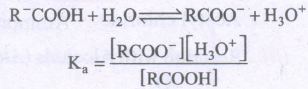
(iii) The dissociation constant of an acid can also be expressed in terms of pKa value
pKa = -log ka,
114.
When ethers are heated to dryness,
(i) They form peroxide by the action of air or oxygen.
(ii) Ether oxygen is capable of forming a co-ordinate covalent bond with electron deficient species.

(ii) These peroxides are unstable and decomposes violently with explosion on heating. Hence, ether should not be heated to dryness.
115.
Brownian movement enables us,
(i) to calculate Avogadro number.
(ii) to confirm kinetic theory which considers the ceaseless rapid movement of molecules that increases with increase in temperature.
(iii) to understand the stability of colloids: As the particles are in continuous rapid movement they do not come close and hence not get condensed.
(iv) That is Brownian movement does not allow the particles to be acted on by force of gravity.
116.
Oxidation half cell : A metallic zinc strip that dips into an aqueous solution of zinc sulphate taken in a beaker.
Reduction half cell : A copper strip that dips into an aqueous solution of copper sulphate taken in a beaker.
117.
(i) To resist changes in its pH on the addition of an acid (or) a base, the buffer solution should contain both acidic as well as basic components so as to neutralize the effect of added acid (or) base and at the same time, these components should not consume each other.
(ii) Let us explain the buffer action in a solution containing CH3COOH and CH3COONa.
(iii) The dissociation of the buffer components occurs as below.
\(\mathrm{CH}_{3} \mathrm{COOH}_{(\mathrm{aq})} \rightleftharpoons \mathrm{CH}_{3}-\mathrm{COO}_{(\mathrm{aq})}^{-}+\mathrm{H}_{3} \mathrm{O}_{(\mathrm{aq})}^{+} \)
\(\mathrm{CH}_{3} \mathrm{COONa}_{(\mathrm{s})} \stackrel{\mathrm{H}_{2} \mathrm{O}_{(\mathrm{l})}}{\longrightarrow} \mathrm{CH}_{3}-\mathrm{COO}_{(\mathrm{aq})}^{-}+\mathrm{Ha}_{(\mathrm{aq})}^{+}\)
118.
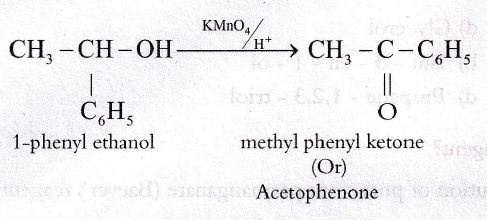
119.
(i) The half cell reactions are :
\(2Br^{-} \rightarrow Br_{2}+2e^{-}\) \(E^{0}_{ox}=-1.09V\) ...(1)
\(2Fe^{3+}+2e^{-}\rightarrow2Fe^{2+}\) \(E_{\mathrm{Fe}^{3+} / \mathrm{Fe}^{2+}}^{0}=+0.771V\) ..(2)
(ii) Adding (1) of (2) :
\(2Fe^{3+}+2Br^{-}\rightarrow 2Fe^{2+}+Br_{2}\) \(E^{0}_{cell}=?\) ...(3)
\(E^{0}_{cell}=E^{0}_{ox}+E_{\mathrm{Fe}^{3+} / \mathrm{Fe}^{2+}}^{0}\)
= (-1.09 + 0.771)V
= -0.319V
(iii) E0cell is – ve; \(\Delta G\) is +ve and the cell reaction is non spontaneous.
(iv) Hence Fe3+ cannot oxidises Br- to Br2.
120.
Formula:
\(\log { \frac { { k }_{ 2 } }{ { k }_{ 1 } } } =\frac { { E }_{ a }\left( { T }_{ 2 }-{ T }_{ 1 } \right) }{ 2.303R{ T }_{ 1 }{ T }_{ 2 } } \)
Given:
Energy of activation: E = 150 kJ = 150000 J
Temperatures: T1 = 673 K; T2 = 773 K
Rate constant: k1 = 2.3 x 10⁻³
Gas constant: R = 8.314 J k-1 mol-1
Solution:
\(\log { \frac { { k }_{ 2 } }{ { k }_{ 1 } } } =\frac { { k }_{ 2 } }{ 2.3\times { 10 }^{ -3 } } =\frac { 150000(773-673) }{ 2.303\times 8.314\times 673\times 773 } \)
\(=\frac { 15000000 }{ 2.303\times 8.314\times 673\times 773 } \)
\(\log { \frac { { k }_{ 2 } }{ 2.3\times { 10 }^{ -3 } } } \) = 1.505
\(\frac { { k }_{ 2 } }{ 2.3\times { 10 }^{ -3 } } \) Antilog 1.5905 = 32
∴ k2 = 2.3 x 10-3 x 32 = 7.36 x 10⁻²
k2 = 7.36 x 10⁻²
121.
(i) The use of 3d electron for formation of I bond increases from Sc to Mn, causing the increase in oxidation state upto +7.
(ii) The reason for Mn having highest oxidation state of +7 is due to the presence of 7 unpaired electrons in its atom.
(iii) As the number of unpaired electrons decrease from Fe to Cu. So there is the decrease in oxidation state.
122.
(i) Ammonia reacts with chlorine and chlorides to give ammonium chloride as a final product.
(ii) The reactions are different under different conditions as given below.
(iii) With excess ammonia
\({ 2NH }_{ 3 }+3{ Cl }_{ 2 }\longrightarrow { N }_{ 2 }+6HCl\)
\(6HCl+6{ NH }_{ 3 }\longrightarrow { 6NH }_{ 4 }Cl\)
(iv) With excess of chlorine ammonia reacts to give nitrogen trichloride, an explosive substance.
\({ 2NH }_{ 3 }+{ 6Cl }_{ 2 }\longrightarrow { 2NCl }_{ 3 }+6HCl\)
\({ 2NH }_{ 3 }(g)+{ HCl }{ (g) }\longrightarrow NH_4Cl(s)\)
123.
(i) H-bonding is the intermolecular force present in ice.
(ii) Covalent bonds are present in network solids.
124.
(i) Diamond is very hard.
(ii) The carbon atoms in diamond are sp3 hybridised and bonded to four neighbouring carbon atoms by a bonds with a C-C bond length of 1.54 Å.
(iii) This results in a tetrahedral arrangement around each carbon atom that extends to the entire lattice.
(iv) Since all four valance electrons of carbon are involved in bonding there is no free electrons for conductivity.
(v) Being the hardest element, it used for sharpening hard tools, cutting glasses, making bores and rock drilling.
125.
Aqueous copper sulphate (blue) is [Cu(H2O)4] SO4.
[Cu(H2O)4]SO4 ⟶ [Cu(H2O)4]2+ + SO42-
[Cu(H2O4)]2+ is a liable complex in which H2O ligand get easily replaced by F- ions of KF and by Cl- ions of KCI.
(i) [Cu(H2O)4]2+(aq) + 4F- ⟶ \(\underset { Green \ ppt }{ { \left[ Cu{ F }_{ 4 } \right] }^{ 2- } } +4{ H }_{ 2 }O\)
(ii) [Cu(H2O)4]2+(aq) +4Cl-(aq) ⟶ \(\underset { Bright \ green\ ppt }{ { \left[ Cu{ F }_{ 4 } \right] }^{ 2- } } +4{ H }_{ 2 }O\)
126.
(i) The step which has the lowest rate value among the other steps of the reaction is called as the rate determining step (or) rate limiting step: (or)
(ii) The overall rate of a reaction is controlled by the slowest step in a reaction called the rate determining step.
Example:
\(2 \mathrm{~A}+\mathrm{B} \rightarrow \mathrm{C}+\mathrm{D}\) going by two steps like,
\( \mathrm{A}+\mathrm{B} \stackrel{\mathrm{k}_{1}}{\longrightarrow} \mathrm{C}+\mathrm{Z}-(1) \text { Step }(\text { slow }) \)
\(Z+A \stackrel{k_{2}}{\longrightarrow} D-(2) \text { Step }(\text { fast }) \)
Over all reaction: \(2 \mathrm{~A}+\mathrm{B} \rightarrow \mathrm{C}+\mathrm{D}\)
Here \(A+B \underset{\text { Slow }}{\stackrel{K_{1}}{\longrightarrow}} C+Z\), step is the rate determining step. For the decomposition of hydrogen peroxide catalysed by I-.
2H2O2(aq)\(\rightarrow\) 2H2O(I) + O2(g)
It is experimentally found that the reaction is first order with respect to both H2,O2, and I-, which indicates that I- is also involved in the reaction. The mechanism involves the following steps.
Step: 1
H2O2(aq)+I-1(aq) \(\rightarrow\) H2O(l)+OI-1(aq)
Step: 2
H2O2(aq)+OI-1(aq)\(\rightarrow\) H2O + I-(aq) + O(g)
Overall reaction is
2H2O2(aq) \(\rightarrow\) 2H2O(l) + O2(g)
These two reactions are elementary reactions. Adding equation (1), and (2) gives the overall reaction. Step 1 is the rate determining step, since it involves both H2,O2 and I-, the overall reaction is bimolecular.
127.
Average rate of reaction:
The average rate is defined as the ratio of change in the final concentration of reactants and the initial concentration of reactants over the entire time period of reaction.
Average rate=\(\frac{-[Final \space concentration \space of \space reactants - Initial \space concentration \space of \space reactants}{(Change \space in \space time)}\)
R \(=\frac{-\left(\left[A_{2}\right]-\left[A_{1}\right]\right)}{\left(t_{2}-t_{1}\right)}=-\left(\frac{\Delta[A]}{\Delta t}\right)\)
[A]1 = Concentration of reactant A1 at time t1
[A]2 = Concentration of reactant A2 at time t2
Instantaneous rate of reaction:
The rate of reaction at any particular instant during the course of reaction is called as instantaneous rate.
Instantaneous rate \(=(\text { Average rate })_{\Delta t \rightarrow 0}\)
Rate of the reaction \(=\left(\frac{-\Delta \mathrm{A}}{\Delta \mathrm{t}}\right)\)
128.
(i) In transition series, as we move down from Ti to Zn, the standard reduction potential E0M2+/M3 value is approaching towards less negative value and copper has a positive reduction potential, i. e. elemental copper is more stable than Cu2+.
(ii) E0M2+/M value for manganese and zinc are more negative than regular trend. It is due to extra stability arises due to the half filled d5 configuration in Mn2+ and completely filled d10 configuration in Zn2+.
(iii) The standard electrode potential for the M3+/M2+ half cell gives the relative stability between M3+ and M2+.
(iv) The high reduction potential of Mn3+/Mn2+ indicates Mn2+ is more stable than Mn3+.
(v) Mn3+ has a 3d4 configuration while that of Mn2+ is 3d5. The extra stability associated with a half filled d sub-shell makes the reduction of Mn3+ very feasible \(\left[\mathrm{E}^{\circ}=+1.51 \mathrm{~V}\right]\).
129.
These two are ionisation isomers. [Co(NH3)5Cl]SO4 gives white precipitate with BaCl2 solution, but not with AgNO3 solution. [Co(NH3)5SO4]Cl gives curdy white precipitate with AgNO3 solution but not with BaCl2 solution.
130.
\(\text {(a) }\left[\mathrm{Cr}\left(\mathrm{NH}_{3}\right)_{6}\right]^{3+}:{ }_{24} \mathrm{Cr} \Rightarrow{ }_{18}[\mathrm{Ar}] 4 \mathrm{~s}^{2} 3 \mathrm{~d}^{4} \)
\({ }_{21} \mathrm{Cr}^{3+} \Rightarrow{ }_{18}[\mathrm{Ar}] 3 \mathrm{~d}^{3}\)
.JPG)
(i) d2sp3 hybridisation (octahedral)
(ii) It has three unpaired electrons (n = 3)
(iii) So it is paramagnetic
(iv) Magnetic moment \(\left(\mu_{\mathrm{s}}\right)=\sqrt{\mathrm{n}(\mathrm{n}+2)} \mathrm{BM}\)
\(=\sqrt{3(3+2)}=\sqrt{15}=3.87 \mathrm{BM}\)
\((b) \ \left[\mathrm{Ni}(\mathrm{CN})_{4}\right]^{2-:}{ }_{28} \mathrm{Ni} \Rightarrow[\mathrm{Ar}] 4 \mathrm{~s}^{2} 3 \mathrm{~d}^{8} ;{ }_{26} \mathrm{Ni}^{2+} \Rightarrow{ }_{18}[\mathrm{Ar}] 3 \mathrm{~d}^{8}\)
.JPG)
(i) dsp2 hybridisation
(ii) Geometry - square planar
(iii) No unpaired electrons- It is Diamagnetic
(iv) Magnetic moment (μs) = 0.
131.
(i) Helium is used to provide inert atmosphere in electric-arc welding of metals.
(ii) Helium has lowest boiling point hence used in cryogenics.
(iii) It is much less denser than air and hence used for filling air balloons.

12th Standard Syllabus & Materials
12th Standard
TN 12th Computer Applications களப்பெயர் முறைமை (DNS) Sample Question Papers Study Material - QB365 Set A
NEW12th Standard
TN 12th Computer Applications வலையமைப்பு எடுத்துக்காட்டுகள் மற்றும் நெறிமுறைகள் Sample Question Papers Study Material - QB365 Set A
NEW12th Standard
TN 12th Computer Applications கணினி வலையமைப்பு ஓர் அறிமுகம் Sample Question Papers Study Material - QB365 Set A
NEW12th Standard
TN 12th Computer Applications PHP-உடன் MySQL-ஐ இணைத்தல் Sample Question Papers Study Material - QB365 Set A



Tamilnadu Stateboard 12th Standard Subjects

Maths
Chemistry

Physics

Biology

Computer Science

Business Maths and Statistics

Economics

Commerce

Accountancy

History

Computer Applications
Biology
Computer Technology
Computer Applications
Computer Science
Business Maths and Statistics
Commerce
Economics
Maths
Chemistry
Physics
Computer Technology
History
Accountancy

Tamil

English

French
Tamilnadu Stateboard Standards
