
 100% FREE ACCESS
12th Standard Syllabus & Materials
12th Standard
TN 12th Computer Applications மின்னணு தரவு பரிமாற்றம் Sample Question Papers Study Material - QB365 Set A
NEW12th Standard
TN 12th Computer Applications மின் - வணிக பாதுகாப்பு அமைப்புகள் Sample Question Papers Study Material - QB365 Set A
NEW12th Standard
TN 12th Computer Applications மின்னணு செலுத்தல் முறைகள் Sample Question Papers Study Material - QB365 Set A
NEW12th Standard
TN 12th Computer Applications மின் - வணிகம் Sample Question Papers Study Material - QB365 Set A
NEW12th Standard
TN 12th Computer Applications திறந்த மூல கருத்துருக்கள் Sample Question Papers Study Material - QB365 Set A
NEW12th Standard
TN 12th Computer Applications வலையமைப்பு வடமிடல் Sample Question Papers Study Material - QB365 Set A

Published on: 20/03/2020
12th Standard Chemistry One Mark important Questions Book back and Creative - 2020
Download Tamil Nadu 12th Standard Chemistry question papers, model tests, one-mark questions, important questions, and public exam papers in PDF format. Free study materials and answer keys for TN State Board students.
Questions + Answers key
Take MCQ Chemistry Test
1.
Sandmeyer's reaction occurs in the presence of _________ and __________
cuprous halide and halo acid
cupric halide and halogen
copper - zinc couple and H2
none of these
2.
A 1% solution of phenol is a _______
antiseptic
disinfectant
antimalarial drug
anthithistamine
3.
The formulation of dettol contains ______________.
chloroxylenol
terpineol
alcohol
all of these
4.
Which of the following cannot be prepared by Sandmeyer's reaction?
Iodobenzene
Fluorobenzene
both Iodobenzene and Fluorobenzene
neither Iodobenzene and Fluorobenzene
5.
On hydrolysis, which one of the following disaccharide will give a ketose and an aldose?
Maltose
Sucrose
Lactose
All the above
6.
Carbohydrates are
polyhydroxy aldehydes
polyhydroxy ketones
polyhydroxy acids
both (a) and (b)
7.
The emf of the unknown half cell is _______.
Emeasured = ER - EL
Emeasured = EL - ER
Emeasured = - nFE
Emeasured = Eo - \(\frac{RT}{F}\) log
8.
Standard electrode potential of Sn4+ / Sn2+ couple is +0.15 V and that of Cr3+ / Cr is 0.85 V. When connected, the cell potential will be ______.
1.10 V
1.00 V
0.70 V
0.30 V
9.
Formic acid contains both __________ and ________ groups.
-CHO and OH
-CHO and X-O
-CHO and COOH
-CHO and -O-
10.
CH3CH2CH2CH2COOH and \({ CH }_{ 3 }-\overset { \underset { | }{ { CH }_{ 3 } } }{ CH } -{ CH }_{ 2 }COOH\) are examples of ________ isomerism.
geometrical
funcational
chain
postional
11.
The platinum catalyst used in the oxidation of SO2 by contact process is poisoned by _______.
As2O3
V2O5
Fe2O3
CuCl2
12.
The common name for 4-hydroxy toluene is ________.
p-cresol
m-cresol
resoricinol
catechol
13.
Degree if dissociation is nearly equal to for _______.
Strong acids and strong bases
Strong acids and weak bases
Weak acids and strong bases
Weak acids and weak bases
14.
Pick out the incorrect statement regarding Lewis acids and bases
A Lewis acid is a electron deficient molecule
Lewis bases is one which donates an electron pair
Lewis base is a cation
Lewis acid is a electron deficient molecule and Lewis base is a cation
15.
Which of the following gives violet colour with neutral ferric chloride solution?
phenol
glycerine
benzyl alcohol
ethanol
16.
The autocatalyst in the oxidation of oxalic acid by acidified KMnO4 is _______.
K2SO4
MnSO4
KMnO4
CO2
17.
Which of the following is a co-polymer?
Orlon
PVC
Teflon
PHBV
18.
Which of the following is an analgesic?
Streptomycin
Chloromycetin
Asprin
Penicillin
19.
Which of the following statement is correct?
Ovalbumin is a simple food reserve in egg-white
Blood proteins thrombin and fibrinogen are involved in blood clotting
Denaturation makes protein more active
Insulin maintains the sugar level of in the human body
20.
The number of sp2 and sp3 hybridised carbon in fructose are respectively ______.
1 and 4
4 and 2
5 and 1
1 and 5
21.
Secondary nitro alkanes react with nitrous acid to form _______.
red solution
blue solution
green solution
yellow solution
22.
Nitrobenzene on reaction with Con HNO3 / H2SO4 at 80-100oC forms which one of the following products?
1,4 – dinitrobenzene
2,4,6 – tirnitrobenzene
1,2 – dinitrobenzene
1,3 – dinitrobenzene
23.
The IUPAC name of 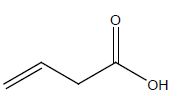
but – 3- enoicacid
but – 1- ene-4-oic acid
but – 2- ene-1-oic acid
but -3-ene-1-oicacid
24.
Predict the product Z in the following series of reactions Ethanoic acid \(\overset { { PCI }_{ 5 } }{ \longrightarrow } X\overset { { C }_{ 6 }{ H }_{ 6 } }{ \underset { Anhydrous \ AlCI }-_{3}{ \longrightarrow } } Y\overset { 1){ CH }_{ 3 }MgBr }{ \underset { II){ H }_{ 3 }{ O }^{ + } }{ \longrightarrow } } Z.\)
(CH3)2 C(OH)C6H5
CH3CH(OH)C6H5
CH3CH(OH)CH2- CH3

25.
The reactions
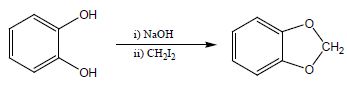 is an example of ______.
Wurtz reaction
cyclic reaction
Williamson reaction
Kolbe reactions
26.
In the reaction Ethanol \(\overset { { PCl }_{ 5 } }{ \longrightarrow } X\overset { alc.KOH }{ \longrightarrow } Y\overset { { H }_{ 2 }{ SO }_{ 4 }/{ H }_{ 2 }O }{ \underset { 298k }{ \longrightarrow } } Z.\) The ‘Z’ is ______.
ethane
ethoxyethane
ethylbisulphite
ethanol
27.
If x is the amount of adsorb ate and m is the amount of adsorbent, which of the following relations is not related to adsorption process?
x/m = f(P) at constant T
x/m = f(T) at constant P
P = f(T) at constant x/m
x/m = PT
28.
Conductivity of a saturated solution of a sparingly soluble salt AB (1:1 electrolyte) at 298K is 1.85 ×10⁻⁵ S m−1. Solubility product of the salt AB at 298K (Λom)AB = 14 ×10−3 S m2 mol−1.
5.7 x 10⁻¹²
1.32 x 10⁻¹²
7.5 x 10⁻¹²
1.74 x 10⁻¹²
29.
The equivalent conductance of M/36 solution of a weak monobasic acid is 6 mho cm2 equivalent-1 and at infinite dilution is 400 mho cm2 equivalent-1. The dissociation constant of this acid is ______.
1.25 x 10⁻⁶
6.25 x 10⁻⁶
1.25 x 10⁻⁴
6.25 x 10 -5
30.
Which of the following relation is correct for degree of hydrolysis of ammonium acetate?
\(h=\sqrt { \frac { { K }_{ h } }{ C } } \)
\(h=\sqrt { \frac { { K }_{ a } }{ K_b } } \)
\(h=\sqrt { \frac { { K }_{ w } }{ { K }_{ a }.{ K }_{ b } } } \)
\(h=\sqrt { \frac { { { K }_{ a }.{ K }_{ b } } }{ { K }_{ w } } } \)
31.
Which will make basic buffer?
50 mL of 0.1M NaOH+25mL of 0.1M CH3COOH
100 mL of 0.1M CH3COOH+100 mL of 0.1M NH4OH
100 mL of 0.1M HCl+200 mL of 0.1M NH4OH
100 mL of 0.1M HCl+100 mL of 0.1M NaOH
32.
CH3COOCH3 + H2O \(\overset { { H }^{ + } }{ \longrightarrow } \) CH3COOH + CH3OH is an example of _______ order reaction.
first
zero
third
pseudo
33.
What would be the rate of disappearance of oxygen, if the rate of formation of nitric oxide (NO) is 3.6 x 10⁻³mol L-1 s-1?
4 x 10⁻³mol L-1s-1
4 x 10⁻³mol-1 L-1s-1
4.5 x 10⁻³mol L-1s-1
4.5 x 10⁻³mol-1 L-1s-1
34.
The high reactivity of fluorine is due to________.
high ionisation energy
low bond dissociation energy
low electron affinity
high electro negativity
35.
Which of the following is correct?
H3PO3 is dibasic and reducing
H3PO3 is dibasic and non-reducing
H3PO4 is tribasic and reducing
H3PO3 is tribasic and non-reducing
36.
Amorphous solids can also be called _______.
pseudo solids
true solids
super cooled liquids
both (a) & (c)
37.
Which of the following is incorrect statement about the Bragg's equation nλ = 2d sin θ?
n, represents order of reflection
λ, represents wave length of uv-rays used
θ, represents angle of incidence
d, represents distance between two parallel planes
38.
The silicates which contain discrete tetrahedral units are _______.
ortho silicates
sheet silicates
pyrosilicates
three dimensional silicates
39.
Group 14 elements have general electronic configuration _______.
ns2
ns2np4
ns2np6
ns2np2
40.
The element corresponding to the electronic configuration [Rn]5f3 6d17s2 is _________
Neptunium
Plutonium
Uranium
Americium
41.
Hybridisation of chromium ions and dichromate ions is ________.
Sp2
Sp3d
both (a) and (b)
None of these
42.
\(HgS_{ (s) }+{ O }_{ 2(g) }\longrightarrow { Hg }_{ (l) }+{ SO }_{ 2 }\uparrow \) The above reaction is an example of _________reduction.
metal
hydrogen
carbon
auto
43.
The process of heating of copper pyrites to remove sulphur is called ________.
froth flotation
roasting
calcination
smelling
44.
Magnu's green salt in________.
[Pt(NH3)4[[PtCl4]
K[PtCl3(C2H4)]
[Ni(CO)4]
[Fe(Co)5]
45.
The oxidation number of nickel in complex ion, [NiCI4]2- is _______.
+1
-1
+2
-2
46.
The correct difference between first and second order reactions is that________.
A first order reaction can be catalysed; a second order reaction cannot be catalysed.
The half life of a first order reaction does not depend on [A0]; the half life of a second order reaction does depend on [A0].
The rate of a first order reaction does not depend on reactant concentrations; the rate of a second order reaction does depend on reactant concentrations.
The rate of a first order reaction does depend on reactant concentrations; the rate of a second order reaction does not depend on reactant concentrations.
47.
In a first order reaction x ⟶ y; if k is the rate constant and the initial concentration of the reactant x is 0.1M, then, the half life is_____.
\(\left( \frac { \log2 }{ k } \right) \)
\(\left( \frac { 0.693 }{ (0.1)k } \right) \)
\(\left( \frac { In2 }{ k } \right) \)
none of these
48.
The number of unit cells in 8 gm of an element X (atomic mass 40) which crystallizes in bcc pattern is (NA is the Avogadro number)________.
6.023 x 10²³
6.023 x 10²²
60.23 x 10²³
\(\left( \frac { 6.023\times { 10 }^{ 23 } }{ 8\times 40 } \right) \)
49.
Formula of tris(ethane-1, 2-diamine)iron(II)phosphate _______.
[Fe(CH3-CH(NH2)2)3](PO4)3
[Fe(H2N-CH2-CH2-NH2)3](PO4)
[Fe(H2N-CH2-CH2-NH2)3](PO4)2
[Fe(H2N-CH2-CH2-NH2)3]3(PO4)2
50.
In which of the following coordination entities the magnitude of Δ0 will be maximum?
[Co(CN)6]3-
[Co(C2O4)3]3-
[Co(H2O)6]3+
[Co(NH3)6]3+
51.
The most common oxidation state of actinoids is _______.
+2
+3
+4
+6
52.
Among the transition metals of 3d series, the one that has highest negative \(\left( \frac { M^{ 2+ } }{ M } \right) \) standard electrode potential is _______.
Ti
Cu
Mn
Zn
53.
Which of these is not a monomer for a high molecular mass silicone polymer?
Me3SiCl
PhSiCl3
MeSiCl3
Me2SiCl2
54.
Among the following, which is the strongest oxidizing agent?
Cl2
F2
Br2
l2
55.
Which is true regarding nitrogen?
least electronegative element
has low ionisation enthalpy than oxygen
d- orbitals available
ability to form pπ-pπ bonds with itself
56.
Which among the following is not a borane?
B2H6
B3H6
B4H10
none of these
57.
In the Ellingham diagram, for the formation of carbon monoxide________.
\(\left( \cfrac { \Delta { S }^{ 0 } }{ \Delta T } \right) \) is negative
\(\left( \cfrac { \Delta { G }^{ 0 } }{ \Delta T } \right) \) is positive
\(\left( \cfrac { \Delta { G }^{ 0 } }{ \Delta T } \right) \) is negative
initially \(\left( \cfrac { \Delta T }{ \Delta { G }^{ 0 } } \right) \) is positive, after 700oC,\(\left( \cfrac { \Delta { G }^{ 0 } }{ \Delta T } \right) \) is negative
58.
Which one of the following is not feasible
Zn(s) + Cu2+(aq) \(\rightarrow\) Cu(s) + Zn2+(aq)
Cu(s)+ Zn2+(aq)\(\rightarrow\) Zn(s) + Cu2+(aq)
Cu(s) + 2Ag+(ag)\(\rightarrow\) 2Ag(s) + Cu2+(aq)
Fe(s) + Cu2+(aq) \(\rightarrow\) Cu(s)+ Fe2+(aq)
59.
Assertion: Coagulation power of Al3+ is more than Na+.
Reason: greater the valency of the flocculating ion added, greater is its power to cause precipitation.
Codes:
a) if both assertion and reason are true and reason is the correct explanation of assertion.
b) if both assertion and reason are true but reason is not the correct explanation of assertion
c) assertion is true but reason is false
d) both assertion and reason are false
if both assertion and reason are true and reason is the correct explanation of assertion.
if both assertion and reason are true but reason is not the correct explanation of assertion
assertion is true but reason is false
both assertion and reason are false
60.
1.
(a)
cuprous halide and halo acid
2.
(b)
disinfectant
3.
(d)
all of these
4.
(c)
both Iodobenzene and Fluorobenzene
5.
(b)
Sucrose
6.
(d)
both (a) and (b)
7.
(a)
Emeasured = ER - EL
8.
(b)
1.00 V
9.
(c)
-CHO and COOH
10.
(c)
chain
11.
(a)
As2O3
12.
(a)
p-cresol
13.
(a)
Strong acids and strong bases
14.
(c)
Lewis base is a cation
15.
(a)
phenol
16.
(b)
MnSO4
17.
(d)
PHBV
18.
(c)
Asprin
19.
(c)
Denaturation makes protein more active
20.
(d)
1 and 5
21.
(b)
blue solution
22.
(d)
1,3 – dinitrobenzene
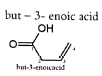
23.
24.

25.
(c)
Williamson reaction
26.

27.
(d)
x/m = PT
28.
For 1:1 electrolyte Ksp = S2
\(=[\frac{ K \times 10^{-3}}{Λ^o}]^2\)
\(=[\frac{1.85 \times 10^{-5} \times 10^{-3}}{14 \times 10^{-3}}]^2\)
= (0.1321 x 10⁻³)2
= 0.01745 x 10¹⁰-10
= 1.74 x 10⁻¹²
29.
α = Λ/Λo
= 6/400
Ka = α2C
\(= \frac{6}{400} \times \frac{6}{400} \times \frac{1}{36}\)
= 6.25 x 10⁻⁶
30.
(c)
\(h=\sqrt { \frac { { K }_{ w } }{ { K }_{ a }.{ K }_{ b } } } \)
31.
Basic buffer is the solution which has weak base and its salt.
NH4OH + HCI → NH4CI +H2O + NH4OH
200 ml 100 ml salt 100 ml weak base
32.
(d)
pseudo
33.
(c)
4.5 x 10⁻³mol L-1s-1
34.
(b)
low bond dissociation energy
35.
(a)
H3PO3 is dibasic and reducing
36.
(d)
both (a) & (c)
37.
(b)
λ, represents wave length of uv-rays used
38.
(b)
sheet silicates
39.
(d)
ns2np2
40.
(c)
Uranium
41.
(b)
Sp3d
42.
(d)
auto
43.
(b)
roasting
44.
(a)
[Pt(NH3)4[[PtCl4]
45.
(c)
+2
46.
\({ t }_{ 1/2 }=\frac { 0.6932 }{ k } \)
For a second order reaction
\(\mathrm{t}_{1 / 2}=\frac{2^{\mathrm{n}-1}-1}{(\mathrm{n}-1) \mathrm{k} \cdot\left[\mathrm{A}_{0}\right]^{\mathrm{n}-1}}\)
n = 2
\(\mathrm{t}_{1 / 2}=\frac{2^{\mathrm{2}-1}-1}{(\mathrm{n}-1) \mathrm{k} \cdot\left[\mathrm{A}_{0}\right]^{\mathrm{2}-1}}\)
\(\mathrm{t}_{1 / 2} =\frac{1}{ \mathrm{k}\left[\mathrm{A}_{0}\right]}\)
47.
\(k=\frac { 1 }{ t } ln \frac { \left[ { A }_{ 0 } \right] }{ \left[ A \right] } \)
[A0] = 0.1: [A] = 0.05
\(k= \left[ \frac { 1 }{ t _{1/2}} \right] ln\left[ \frac { { 0.1 } }{ 0.05 }\right] \)
\(k= \left[ \frac { 1 }{ t _{1/2}} \right] ln (2)\)
t1/2 = In(2)/K
48.
In bcc unit cell,
2 atoms = 1 unit cell
Number of atoms in 8 g of element is, Number of moles = 8g / 40 g mol-1 = 0.2 mol
1 mole contains 6.023 x10²³ atoms
0.2 mole contains 0.2 x 6.023 x 1023 atoms
[1 unit cell / 2 atoms] x 0.2 x 6.023 x 1023
= 6.023 x 10²² unit cells.
49.
[Fe(H2N-CH2-CH2-NH2)3]3(PO4)2
[Fe(en)3]2+(\(PO_{4}^{3-}\))
50.
In all the complexes, the central metal ion is Co3+, among the given ligands CN- is the strongest ligand, which causes large crystal
field splitting i.e maximum Δ0
51.
(b)
+3
52.
(a)
Ti
53.
(a)
Me3SiCl
54.
(b)
F2
55.
(d)
ability to form pπ-pπ bonds with itself
56.
(b)
B3H6
57.
(c)
\(\left( \cfrac { \Delta { G }^{ 0 } }{ \Delta T } \right) \) is negative
58.
(b)
Cu(s)+ Zn2+(aq)\(\rightarrow\) Zn(s) + Cu2+(aq)
59.
a) if both assertion and reason are true and reason is the correct explanation of assertion.
60.
(a)

12th Standard Syllabus & Materials
12th Standard
TN 12th Computer Applications களப்பெயர் முறைமை (DNS) Sample Question Papers Study Material - QB365 Set A
NEW12th Standard
TN 12th Computer Applications வலையமைப்பு எடுத்துக்காட்டுகள் மற்றும் நெறிமுறைகள் Sample Question Papers Study Material - QB365 Set A
NEW12th Standard
TN 12th Computer Applications கணினி வலையமைப்பு ஓர் அறிமுகம் Sample Question Papers Study Material - QB365 Set A
NEW12th Standard
TN 12th Computer Applications PHP-உடன் MySQL-ஐ இணைத்தல் Sample Question Papers Study Material - QB365 Set A



Tamilnadu Stateboard 12th Standard Subjects

Maths
Chemistry

Physics

Biology

Computer Science

Business Maths and Statistics

Economics

Commerce

Accountancy

History

Computer Applications
Biology
Computer Technology
Computer Applications
Computer Science
Business Maths and Statistics
Commerce
Economics
Maths
Chemistry
Physics
Computer Technology
History
Accountancy

Tamil

English

French
Tamilnadu Stateboard Standards
