
 100% FREE ACCESS
12th Standard Syllabus & Materials
12th Standard
TN 12th Computer Applications மின்னணு தரவு பரிமாற்றம் Sample Question Papers Study Material - QB365 Set A
NEW12th Standard
TN 12th Computer Applications மின் - வணிக பாதுகாப்பு அமைப்புகள் Sample Question Papers Study Material - QB365 Set A
NEW12th Standard
TN 12th Computer Applications மின்னணு செலுத்தல் முறைகள் Sample Question Papers Study Material - QB365 Set A
NEW12th Standard
TN 12th Computer Applications மின் - வணிகம் Sample Question Papers Study Material - QB365 Set A
NEW12th Standard
TN 12th Computer Applications திறந்த மூல கருத்துருக்கள் Sample Question Papers Study Material - QB365 Set A
NEW12th Standard
TN 12th Computer Applications வலையமைப்பு வடமிடல் Sample Question Papers Study Material - QB365 Set A

Published on: 21/02/2020
12th Standard Chemistry Public Model Question Paper I 2019 - 2020
Download Tamil Nadu 12th Standard Chemistry question papers, model tests, one-mark questions, important questions, and public exam papers in PDF format. Free study materials and answer keys for TN State Board students.
Questions + Answers key
Take MCQ Chemistry Test
1.
Methylisocyanide on reduction using LiAlH4 gives:
Methyl amine
Ethyl amine
Dimethyl amine
Trimethyl amine
2.
At pH 12, glycine exists as
H3N+ - CH2 - COOH
H2N - CH2 - COO-
H3N+ - CH2- COO-
H2N - CH2 - COOH
3.
The overall reaction that takes place in an electrochemical cell is ______.
oxidation
reduction
decomposition
redox reaction
4.
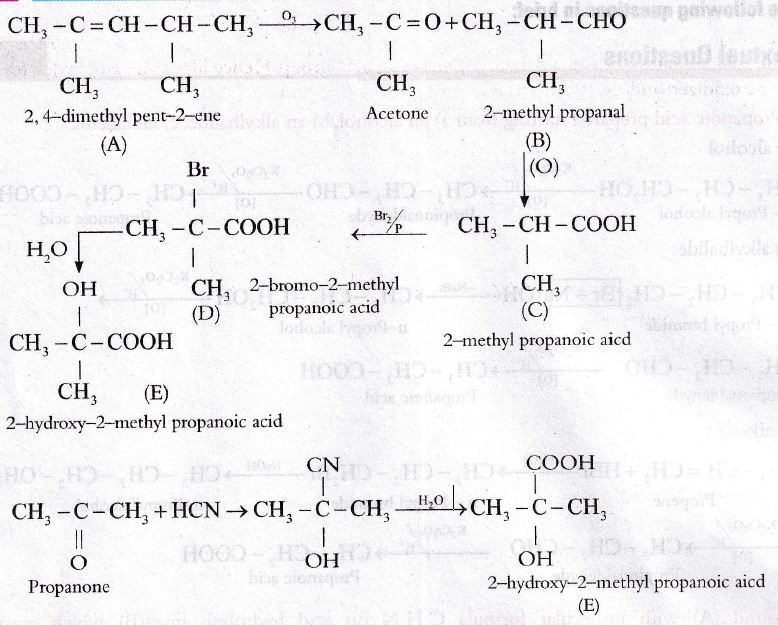
The hydrogen ion concentration of a buffer solution consisting of a weak acid and its salt is given by _______.
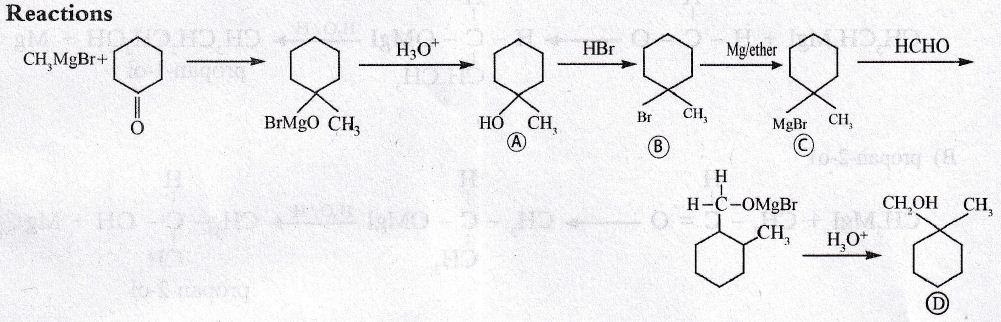
\([{ H }^{ + }]={ K }_{ a }\frac { [Acid] }{ [Salt] } \)
\([{ H }^{ + }]={ K }_{ a }[Salt]\)
\([{ H }^{ + }]={ K }_{ a }[Salt]\)
\([{ H }^{ + }]={ K }_{ a }\frac { [Acid] }{ [Salt] } \)
5.
The IUPAC name for isobutyl alcohol is _______.
2-methyl-l-propanol
2-methyl-l-butanol
2,2-dimethyl-2-propanol
1,1-dimethyl- 2-butanol
6.
Which of the following represents the correct order of acidity in the given compounds
FCH2COOH > CH3COOH > BrCH2COOH > ClCH2COOH
FCH2COOH > ClCH2COOH > BrCH2COOH > CH3COOH
CH3COOH > ClCH2COOH > FCH2COOH > Br-CH2COOH
Cl CH2COOH > CH3COOH > BrCH2COOH > ICH2COOH
7.
Which one of the following is correctly matched?
Emulsion - Smoke
Gel - butter
foam - Mist
whipped cream - sol
8.
Which of these is not likely to act as Lewis base?
BF3
PF3
CO
F–
9.
Pick the wrong one among the following
F2 - Yellow
Br2 - Red
Cl2 - Colourless
I2- Violet
10.
The number of close neighbours in a body centred cubic lattice of identifical spheres is _______.
6
4
12
8
11.
Name the process by which elements such as germanium, silicon and gallium are refined.
Vapour phase method
Electrolytic refining
Zone refining
Van-Arkel method
12.
The half life period of a radioactive element is 140 days. After 560 days, 1 g of element will be reduced to
\(\left( \frac { 1 }{ 2 } \right) g\)
\(\left( \frac { 1 }{ 4 } \right) g\)
\(\left( \frac { 1 }{ 8 } \right) g\)
\(\left( \frac { 1 }{ 16 } \right) g\)
13.
A complex in which the oxidation number of the metal is zero is_______.
K4[Fe(CN)6]
[Fe(CN)3(NH3)3]
[Fe(CO)5]
both (b) and (c)
14.
Which one of the following ions has the same number of unpaired electrons as present in V3+?
Ti3+
Fe3+
Ni2+
Cr3+
15.
An aqueous solution of borax is________.
neutral
acidic
basic
amphoteric
16.
How will convert nitrobenzene to benzoic acid?
17.
Give the structure of melamine formaldehyde resin.
18.
Write a reaction that indicates the presence of an aldehyde group in glucose.
19.
Account for the following:
(i) Phenol has a smaller dipole moment than methanol,
(ii) Phenols do not give protonation reaction readily.
20.
Corrosion of aluminum takes place at a much slower rate than iron. Give reason
21.
Arrange the following in the increasing order of their boiling point and give a reason for your ordering
(i) Butan – 2- ol, Butan -1-ol, 2 –methylpropan -2-ol
(ii) Propan -1-ol, propan -1,2,3-triol, propan -1,3 – diol, propan -2-ol
22.
Complete the following reactions?
i) Cr2 + 2e- ⟶
ii) Mn2+ + 2e- ⟶
iii) Fe2+ + 2e- ⟶
iv) CO2+ + 2e- ⟶
23.
Write the chemical composition of the following alloys and give anyone of its application.
(i) Bronze
(ii) Brass
(iii) Stainless steel
24.
Give any three characteristics of ionic crystals.
25.
26.
Explain the function of a salt bridge in an electrochemical cell.
27.
28.
Write the expression for the solubility product of Hg2Cl2 .
29.
Identify the conjugate acid base pair for the following reaction in aqueous solution
i) HS- (aq) + HF \(\rightleftharpoons \) F-(aq) + H2S(aq)
ii) HPO2-4 + SO32- \(\rightleftharpoons \) PO43- + HSO3-
iii) NH4+ + CO32- \(\rightleftharpoons \) NH3 + HCO3-
30.
Mention the factors that affected the rate of a chemical reaction.
31.
Account for the following:
(i) O-O bond lengths in ozone molecule are identical.
(ii) Most of the reactions in fluorine are exothermic.
32.
What is meant by concentration?
33.
Write the IUPAC name of [Ag(NH3)2]Cl.
34.
A zero order reaction is 20% complete in 20 minutes. Calculate the value of the rate constant. In what time will the reaction be 80% complete?
35.
Write a note on zeolites.
36.
An organic compound (A) of molecular formula C7H8 on oxidation with air and in presence of V2O5 to form (B) of molecular formula C7H6O. (B) on reduction with lithium aluminium hydride to form (C) of molecular formula C7H8O. Identify (A), (B) and (C) and explain the reactions.
37.
Give the special characteristics of enzyme catalysed reactions.
38.
An alkene (A) on ozonolysis gives propanone and aldehyde (B). When (B) is oxidised (C) is obtained. (C) is treated with Br2/P gives (D) which on hydrolysis gives (E). When propanone is treated with HCN followed by hydrolysis gives (E). Identify A, B, C, D and E.
39.

Identify A,B,C,D and write the complete equation
40.
Justify the following statement.
"Elements of the first transition series possess many properties different from those of heavier transition elements".
41.
How is chlorine manufactured by the electrolysis of brine.
42.
How are crystals classified?
43.
What is meant by stability of a co-ordination compound in solution? State the factors which govern stability of complexes.
1.
(c)
Dimethyl amine
2.
(b)
H2N - CH2 - COO-
3.
(d)
redox reaction
4.
(a)
\([{ H }^{ + }]={ K }_{ a }\frac { [Acid] }{ [Salt] } \)
5.
(a)
2-methyl-l-propanol
6.
- I etiect increases the acidity. If electronegativity is high, - I effect is also high.
7.
(b)
Gel - butter
8.
BF3 → electron deficient → Lewis acid
PF3 → electron rich → Lewis base
CO → having lone pair of electron → Lewis base
F → unshared pair of electron → Lewis base
9.
(c)
Cl2 - Colourless
10.
(d)
8
11.
(c)
Zone refining
12.
In 140days ⇒ initial concentration reduced to (1/2) g
In 280 days ⇒ initial concentration reduced to (1/4) g
In 420 days ⇒ initial concentration reduced to (1/8) g
In 560 days ⇒ initial concentration reduced to (1/16) g
13.
a) Fe2+ b) Fe3+ c) Fe0
14.
(c)
Ni2+
15.
(c)
basic
16.
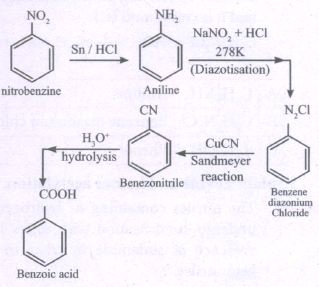
17.
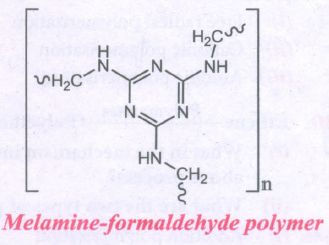
18.
Glucose gets oxidized to gluconic acid with mild oxidizing agents like bromine water suggesting that the carbonyl group is an aldehyde group.
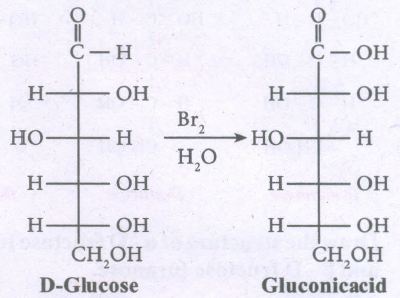
19.
(i) Phenol are only sparingly soluble in water. Actually they form only negligible hydrogen bonding with water since the size of the phenyl group is large and it almost masks the polar character of -OH group. So, phenol has a smaller dipole moment.
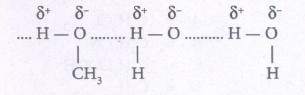
(ii) But methanol is soluble in soluble in water due to the formation of hydrogen bonding with water and it results in higher dipole moment. In henol, there is +ve charge on oxygen, therefore it does not undergo protonation easily.

20.
Other metals such as aluminium, copper and silver also undergo corrosion, but at a slower rate than iron. Let us consider the reduction of aluminium,
\({ Al }_{ (s) }\rightarrow { Al }_{ (aq) }^{ 3+ }+{ 3e }^{ - }\)
Al3+, which reacts with oxygen in air to form a protective coating of Al2O3. This coating act as a protective film for the inner surface. So, further corrosion is prevented.
21.
(i) 2-methyl propan-2-o1 < Butan-2-ol < Butan-1-ol
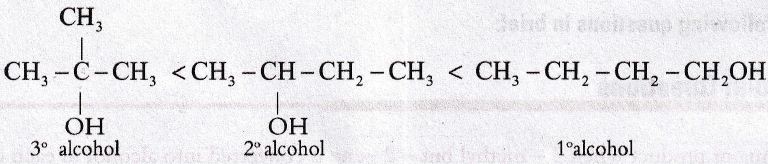
(ii) propan-2-ol < propan-1-ol < propan -1,3- diol < propan-1,2,3-triol
22.
i) Cr2 + 2e- ⟶ Cr
ii) Mn2+ + 2e- ⟶ Mn
iii) Fe2+ + 2e- ⟶ Fe
iv) CO2+ + 2e- ⟶ Co
23.
| Alloy | Composition | Application |
|---|---|---|
| Bronze | Cu- 80%, Zn-10%, Sn-10% |
Making utensils, statutes, coins, etc. |
| Brass | Cu-60%, Zn-40% |
Making utensils, wires, pairs of machine etc |
| Stainless steel | Fe-73%, Cr-18%, Ni- 8% and CF -1% |
Making utensils, cutlery, cycles, etc. |
24.
(i) Ionic solids have high melting points.
(ii) These solids do not conduct electricity, because the ions are fixed in their lattice positions.
(iii) They are hard so strong external force can change the relative positions of ions.
25.
26.
The main functions of the salt bridge are
(i) To complete the electrical circuit by the allowing only ions to flow from one solution to other without mixing the two solutions.
(ii) To maintain electrical neutrality of the solution in the two half cells.
27.
28.
\(\mathrm{Hg}_{2} \mathrm{Cl}_{2(\mathrm{~s})} \rightleftharpoons \mathrm{Hg}_{2}^{2+} \text { (aq) }+2 \mathrm{Cl^-}_{(\mathrm{aq})}\\ s \quad \quad \quad \quad \quad \quad s \quad \quad \quad \quad \quad 2s\)
\(\mathrm{K}_{\mathrm{sp}} =\left[\mathrm{Hg}_{2}^{2+}\right]{\left[\mathrm{Cl}^{-}\right]^{2}} \)
\(=(\mathrm{s})(2 \mathrm{~s})^{2} \)
\(\mathrm{~K}_{\mathrm{sp}} =4 \mathrm{~s}^{3}\)
29.
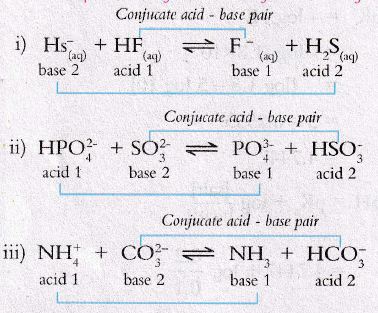
Conjugate Pairs:
\((a) \mathrm{HS}_{\text {(aq) }}^{-} \& \mathrm{H}_{2} \mathrm{~S}_{\text {(aq) }} \) \((b) \mathrm{HF}_{\text {(aq) }} \& \mathrm{~F}_{\text {(aq) }}^{-} \)
\((a) \mathrm{HPO}_{4}^{2-} \& \mathrm{PO}_{4}^{3-} \) \((b) \mathrm{SO}_{3}^{2-} \& \mathrm{HSO}_{3}^{-} \)
\((a) \mathrm{NH}_{4}^{+} \& \mathrm{NH}_{3} \) \((b) \mathrm{CO}_{3}^{2-} \& \mathrm{HCO}_{3}^{-}\)
30.
The rate of a reaction is affected by the following factors.
(i) Nature and state of the reactant
(ii) Concentration of the reactant
(iii) Surface area of the reactant
(iv) Temperature of the reaction
(v) Presence of a catalyst
31.
(i) The two O-O bond lengths are identical due to resonance.
(ii) Due to the strong bond formation with other elements.
32.
The preliminary step in metallurgical process is removal of the impurities. This removal process is known as concentration of ore.
33.
Diammine silver (I) Chloride.
34.
(i) Let A = 100M, [A0] - [A] = 20M,
For the zero order reaction
\(k=\left( \frac { \left[ { A }_{ 0 } \right] -\left[ A \right] }{ t } \right) \)
(i) 20% completion \(k=\left( \frac { 20M }{ 20min } \right) \) = 1 mol L-1 min-1
(ii) 80% completion
\(\mathrm{K}=1 \mathrm{~mol} \mathrm{~L}{ }^{-1} \mathrm{~s}^{-1} ;\left[\mathrm{A}_{0}\right]=100 \mathrm{M} ;\left[\mathrm{A}_{0}\right]-[\mathrm{A}]=80 \mathrm{M} ; \mathrm{t}=?\)
\(\therefore t=\left(\frac{\left[A_{O}\right]-[A]}{K}\right)=\frac{80}{1}=80 \mathrm{mins}\)
35.
(i) Zeolites are three-dimensional crystalline solids containing Al, Si and O in their regular three dimensional framework.
(ii) They are hydrated sodium alumino silicates with general formula Na2O(AI2O3).·x(SiO2)·yH2O
(x = 2 to 10; y = 2 to 6).
(iii) Zeolites have porous structure in which the monovalent sodium ions and water molecules are loosely held.
(iv) The Si and Al atoms are tetrahedrally coordinated with each other through shared oxygen atoms.
(v) Zeolites are similar to clay minerals but they differ in their crystalline structure.
(vi) Zeolites have a three dimensional crystalline structure looks like a honeycomb consisting of a network of interconnected tunnels and cages.
(vii) Water molecules moves freely in and out of these pores but the zeolite framework remains rigid
(viii) Another special aspect of this structure is that the pore/channel sizes are nearly uniform, allowing the crystal to act as a molecular sieve.
36.
(i) (A) on oxidation with air and V2O5 gives (B).
\(\underset{(A)}{{ C }_{ 6 }{ H }_{ 5 }{ CH }_{ 3 }}\overset { \left( O \right) }{ \underset { { V }_{ 2 }{ O }_{ 5 } }{ \longrightarrow } } \underset{(B)}{{ C }_{ 6 }{ H }_{ 5 }CHO}\)
(ii) (B) on reduction with LiAIH4 gives C.
\({ C }_{ 6 }{ H }_{ 5 }CH\overset { \left[ H \right] }{ \underset { LiA/{ H }_{ 4 } }{ \longrightarrow } } \underset{(C)}{{ C }_{ 6 }{ H }_{ 5 }CHO}\)
| Compound | Compound Name | Formula |
| A | Toluene | C6H5CH3 |
| B | Benzaldehyde | C6H5CHO |
| C | Benzylalcohol | C6H5CH2OH |
37.
(i) Effective and efficient conversion is the special characteristic of enzyme catalysed reactions. An enzyme may transform a million molecules of reactant in a minute
For Eg: \({ 2H }_{ 2 }{ O }_{ 2 }\longrightarrow { 2H }_{ 2 }O+{ O }_{ 2 }\)
For this reaction, the activation energy is 18k cal/mole without a catalyst With colloidal platinum as a, catalyst the activation energy is 11.7kcal /mole. But with the enzyme catalyst the activation energy of this reaction is less than 2kcal/ mole.
(ii) Enzyme catalysis is highly specific in nature.
(iii) Enzyme catalysed reaction has maximum rate at optimum temperature
(iv) The rate of enzyme catalysed reactions varies with the pH of the system. The rate is maximum at a pH called optimum pH.
(v) Enzymes can be inhibited i.e. poisoned activity of an enzyme is decreased and destroyed by a poison. The physiological action of drugs is related to their inhibiting action.
(vi) Catalytic activity of enzymes is increased by coenzymes or activators.
38.
39.
40.
The heavier transition elements belong to fourth (4d), fifth (Sd) and sixth (6d) transition series. Their properties are expected to be different form the elements belonging to the first (3d) series due to the following reasons.
(i) Atomic radii: Size of the transition elements 94d and Sd series are larger than those of the corresponding elements of the first transition series though those of 4d and Sd series are very close to each other.
(ii) Ionisation enthalpy of Sd series are higher than the corresponding elements of 3d and 4d series.
(iii) Atomisation enthalpy of 4d and Sd series are higher than the corresponding elements of the first series.
(iv) Melting and boiling points of heavier transition elements are greater than those of the first transition series due to stronger intermetallic bonding.
(v) The elements of the first transition series generally form low or high spin complexes, depending upon the higher of ligand field. However, the heavier transition elements form low spin complexes irrespective of the strength of the ligand filed.
41.
(i) When a solution of brine (NaCl) is electrolysed, Na+ and Cl ions are formed.
(ii) Na+ ion reacts with OH- ions of water and forms sodium hydroxide. Hydrogen and chlorine are liberated as gases.
NaCI \(\longrightarrow \) Na+ + CI-1
H2O \(\longrightarrow \) H+ + OH-
Na+ + OH- \(\longrightarrow \) NaOH
At the cathode,
H+ + e- \(\longrightarrow \) H
H + H\(\longrightarrow \)H2
At the anode,
Cl- \(\longrightarrow \) CI + e-
CI + CI \(\longrightarrow \) Cl2
42.
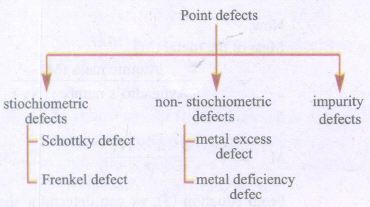
Crystal defects are classified as follows
(i) Point defects
(ii) Line defects
(iii) Interstitial defects
(iv) Volume defects
Point defects are further classified as follows
43.
The stability of a complex or co-ordination compound refers to the extent up to which it exists in a solution as co-ordination sphere.
(i) Change on the central metal ion: Greater the charge on the central metal ion, greater the stability of complex.
(ii) Nature of the metal ion: Group 3 and 6 and inner transition elements form stable complexes when donor atoms of the ligands are N, O and F. The elements after group 6 of the transition metals form stable complex when the donor atoms of the ligands are the heavier members of N, O and F family.
(iii) Basic nature of the ligands: Greater the basic strength, greater is the stability of the complex.
(iv) Presence of chelate rings: Its presence increases the stability of the complex. it is called chelate effect. It is maximum for the 5 and 6 membered rings.
(v) Effect of multidentate cyclic ligand: If the ligands are IT multidentate and cyclic without any steric effect the stability of the complex get increased.

12th Standard Syllabus & Materials
12th Standard
TN 12th Computer Applications களப்பெயர் முறைமை (DNS) Sample Question Papers Study Material - QB365 Set A
NEW12th Standard
TN 12th Computer Applications வலையமைப்பு எடுத்துக்காட்டுகள் மற்றும் நெறிமுறைகள் Sample Question Papers Study Material - QB365 Set A
NEW12th Standard
TN 12th Computer Applications கணினி வலையமைப்பு ஓர் அறிமுகம் Sample Question Papers Study Material - QB365 Set A
NEW12th Standard
TN 12th Computer Applications PHP-உடன் MySQL-ஐ இணைத்தல் Sample Question Papers Study Material - QB365 Set A



Tamilnadu Stateboard 12th Standard Subjects

Maths
Chemistry

Physics

Biology

Computer Science

Business Maths and Statistics

Economics

Commerce

Accountancy

History

Computer Applications
Biology
Computer Technology
Computer Applications
Computer Science
Business Maths and Statistics
Commerce
Economics
Maths
Chemistry
Physics
Computer Technology
History
Accountancy

Tamil

English

French
Tamilnadu Stateboard Standards
