
 100% FREE ACCESS
12th Standard Syllabus & Materials
12th Standard
TN 12th Computer Applications மின்னணு தரவு பரிமாற்றம் Sample Question Papers Study Material - QB365 Set A
NEW12th Standard
TN 12th Computer Applications மின் - வணிக பாதுகாப்பு அமைப்புகள் Sample Question Papers Study Material - QB365 Set A
NEW12th Standard
TN 12th Computer Applications மின்னணு செலுத்தல் முறைகள் Sample Question Papers Study Material - QB365 Set A
NEW12th Standard
TN 12th Computer Applications மின் - வணிகம் Sample Question Papers Study Material - QB365 Set A
NEW12th Standard
TN 12th Computer Applications திறந்த மூல கருத்துருக்கள் Sample Question Papers Study Material - QB365 Set A
NEW12th Standard
TN 12th Computer Applications வலையமைப்பு வடமிடல் Sample Question Papers Study Material - QB365 Set A

Published on: 21/02/2020
12th Standard Chemistry Public Model Question Paper II 2019 - 2020
Download Tamil Nadu 12th Standard Chemistry question papers, model tests, one-mark questions, important questions, and public exam papers in PDF format. Free study materials and answer keys for TN State Board students.
Questions + Answers key
Take MCQ Chemistry Test
1.
Which among the following will from significant amount of meta isomer on nitration?


2.
Sprouting barley is the main source of _____sugar.
glucose
fructose
cellulose
maltose
3.
How will you predict whether a reaction is not feasible?
Eocell = -ve
Eocell = +ve
Eocell = 0
Eocell = -ve and Eocell = 0
4.
When pH of a solution is 2, the hydrogen ion concentration in moles litre-1 is _______.
1 x 10-12
1 x 10⁻²
1 x 10⁻⁷
1 x 10⁻⁴
5.
Addition of water across the double bond of an alkene in presence of sulphuric acid giving alcohol follows ______ rule.
Markownikoff's
anti Markownikoff
Sayt zeff's
Swern
6.
CH3Br \(\overset { KCN }{ \longrightarrow } (A)\overset { { H }_{ 2 }{ O }^{ + } }{ \longrightarrow } (B)\overset { { PCl }_{ 5 } }{ \longrightarrow } \) (C) product (c) is ______.
acetylchloride
chloro acetic acid
\(\alpha\)- chlorocyano ethanoic acid
none of these
7.
Statement : To stop bleeding from an injury, ferric chloride can be applied. Which comment about the statement is justified?
It is not true, ferric chloride is a poison.
It is true, Fe3+ ions coagulate blood which is a negatively charged sol
It is not true; ferric chloride is ionic and gets into the blood stream.
It is true, coagulation takes place because of formation of negatively charged sol with Cl-.
8.
pH of a saturated solution of Ca(OH)2 is 9. The Solubility product (Ksp) of Ca(OH)2 _______.
0.5 × 10⁻¹⁵
0.25 × 10⁻¹⁰
0.125 × 10⁻¹⁵
0.5 × 10⁻¹⁰
9.
Which of the following is correct?
H3PO3 is dibasic and reducing
H3PO3 is dibasic and non-reducing
H3PO4 is tribasic and reducing
H3PO3 is tribasic and non-reducing
10.
The structure of ionic compound depends upon _________ of the ions.
stoichiometry
Size
both (a) and (b)
neither (a) nor (b)
11.
Sulphide ore is converted to oxide form by using the process________.
Calcination
Roasting
Smelting
Leaving
12.
If 75% of a first order reaction was completed in 60 minutes, 50% of the same reaction under the same conditions would be completed in_______.
20 minutes
30 minutes
35 minutes
75 minutes
13.
Oxidation state of Iron and the charge on the ligand NO in [Fe(H2O)5NO]SO4 are_______.
+2 and 0 respectively
+3 and 0 respectively
+3 and -1 respectively
+1 and +1 respectively
14.
Sc (Z = 21) is a transition element but Zinc (z = 30) is not because _______.
both Sc3+ and Zn2+ ions are colourless and form white compounds
In case of Sc, 3d orbital are partially filled but in Zn these are completely filled
last electron as assumed to be added to 4s level in case of zinc
both Sc and Zn do not exhibit variable oxidation states
15.
The geometry at which carbon atom in diamond are bonded to each other is _______.
Tetrahedral
hexagonal
Octahedral
none of these
16.
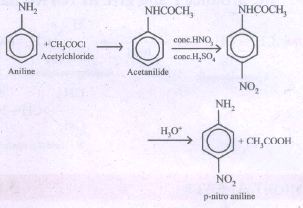
Outline the preparation of (a) para nitroaniline from aniline, (b) tri bromo benzene from tribromo aniline
17.
Write the monomers of the following sugars and explain how they are linked.
(i) Sucrose
(ii) Maltose
(iii) Lactose
18.
How is Nylon - 6,6 prepared? Give it use.
19.
Explain the IUPAC convention of representing a Galvanic cell.
20.
How does glycerol react with KHSO4?
21.
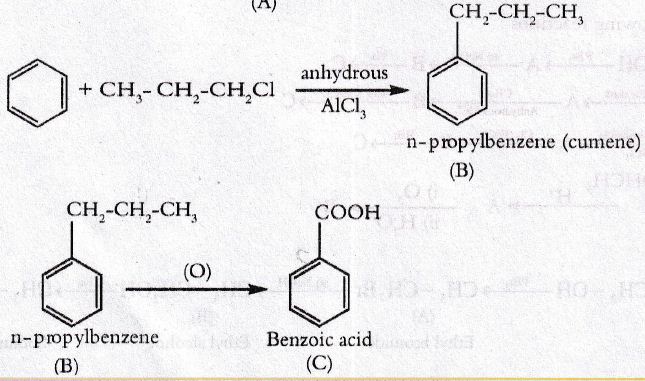
Phenol is distilled with Zn dust followed by friedel – crafts alkylation with prophyl chloride to give a compound B, B on oxidation gives (c) Indentify A,B and C.
22.
Why are lyophillic colloidal sols are more stable than lyophobic colloidal sol.
23.
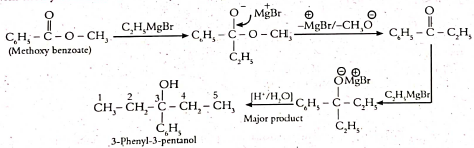
What is the major product obtained when two moles of ethyl magnesium bromide is treated with methyl benzoate followed by acid hydrolysis.
24.
Which is the last element in the series of the actinoids? Write the electronic configuration of this element comment on the possible oxidation state of this element.
25.
What is coupling of reaction? How is it useful in metallurgy?
26.
How do nature of the reactant influence rate of reaction.
27.
Explain briefly seven types of unit cell.
28.
29.
Derive the unit of specific conductance.
30.
Write the expression for the solubility product of Hg2Cl2 .
31.
Identify the conjugate acid base pair for the following reaction in aqueous solution
i) HS- (aq) + HF \(\rightleftharpoons \) F-(aq) + H2S(aq)
ii) HPO2-4 + SO32- \(\rightleftharpoons \) PO43- + HSO3-
iii) NH4+ + CO32- \(\rightleftharpoons \) NH3 + HCO3-
32.
For a chemical reaction, Variation in the concentration In[A] Vs time in seconds is given as
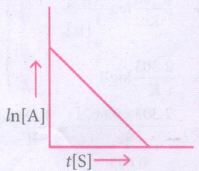
(i) What is the order of the reaction?
(ii) What is the unit of rate constant K?
(iii) Give the relationship between k and \({ t }_{ \frac { 1 }{ 2 } }\)
33.
Although \(\triangle\)H of fluorine is less negative than that of chlorine, but fluorine is a stronger oxidising agent than chlorine, why?
34.
What is hydrate isomerism? Give an example.
35.
Write a note on zeolites.
36.
Compound (A) with Molecular formula C7H6O does not reduce Fehling's solution. Compound (A) reacts with acetone in the presence of NaOH to give a compound (B) which is an α, β-unsaturated compound. Further (A) reacts with dimethyl aniline in the presence of cone, H2SO4 to give compound (C) which is a dye. Identify (A) (B) and (C). Explain the reactions.
37.
Explain the various chemical methods by which colloids can be prepared.
38.
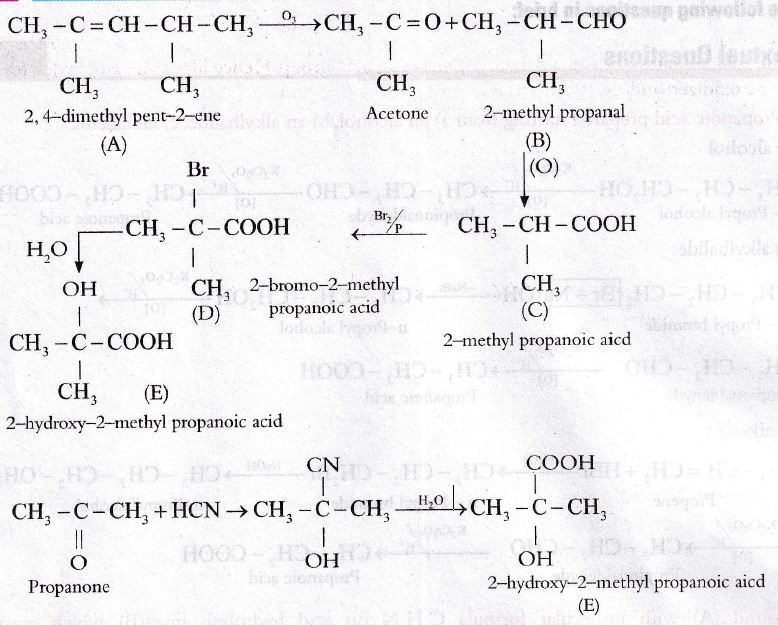
An alkene (A) on ozonolysis gives propanone and aldehyde (B). When (B) is oxidised (C) is obtained. (C) is treated with Br2/P gives (D) which on hydrolysis gives (E). When propanone is treated with HCN followed by hydrolysis gives (E). Identify A, B, C, D and E.
39.
How are materials classified based on their magnetic properties?
40.
Explain the oxidising property of sulphuric acid.
41.
Ionic solids, which have anionic vacancies due to metal excess defect, develop colour. Explain with the help of a suitable example.
42.
For the complex [NiCI4]2- write (i) the IUPAC name (ii) The hybridisation type (iii) The shape of the complex
1.
(b)
2.
(d)
maltose
3.
(a)
Eocell = -ve
4.
(b)
1 x 10⁻²
5.
(a)
Markownikoff's
6.

7.
(b)
It is true, Fe3+ ions coagulate blood which is a negatively charged sol
8.
Ca(OH)2 ⇌ Ca2+ + 2OH-
Given that pH = 9
pOH = 14 - 9 = 5
[pOH = - log10 [OH]]
[OH-] = 10 [pOH]
[OH] = 10-5 M
Ksp = [Ca2+] [OH-]
= 10-5/2 x (10-5)2 = 0.5 x 10⁻¹⁵
9.
(a)
H3PO3 is dibasic and reducing
10.
(c)
both (a) and (b)
11.
(b)
Roasting
12.
t75% = 2t50%
t50% = (t75%/2) = (60/2) = 30 minutes
13.
[\( \overset{+}{Fe}\)(H2O)5\( \overset{+}{NO}\)]2+ SO2-4
+1 and +1 respectively
14.
(b)
In case of Sc, 3d orbital are partially filled but in Zn these are completely filled
15.
(a)
Tetrahedral
16.
(i) p-nitroaniline is prepared from aniline in three stages as follows:
(ii) 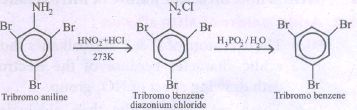
17.
(i) Sucrose: D - glucose and D - fructose linked by α. - 1, 2 glycosidic bond.
(ii) Maltose: Two molecules of α. - D - glucose linked by α. - 1, 4 glycosidic bond.
(iii) Lactose: f3 - D - glucose and f3 - D galactose linked by β - 1, 4 glycosidic bond
18.
Nylon - 6,6 can be prepared by mixing equimolar adipic acid and hexamethylene - diamine to form a nylon salt which on heating eliminate a water molecule to form amide bonds.
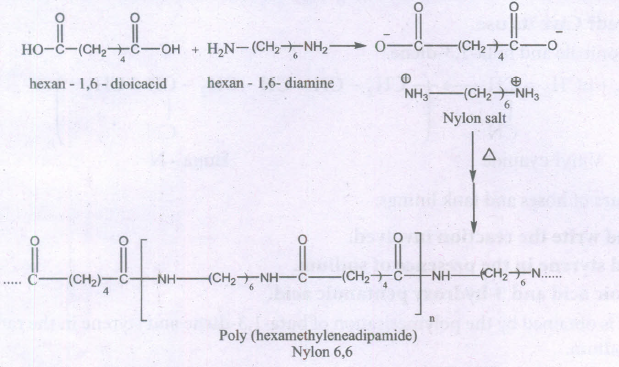
It is used in textiles, manufacture of cards etc ...
19.
The galvanic cell is represented by a cell diagram, for example, Daniel cell is represented as
\({ Zn }_{ (s) }|{ Zn }_{ (aq) }^{ 2+ }||{ Cu }_{ (aq) }^{ 2+ }|{ Cu }_{ (s) }\)
(i) A single vertical bar (|) represents a phase boundary
(ii) The double vertical bar (||) represents the salt bridge.
(iii) The anode half cell is written on the left side of the salt bridge and the cathode half cell on the right side.
(iv) The anode and cathode are written on the extreme left and extreme right, respectively.
(v) The emf of the cell is written on the right side after cell diagram.
20.
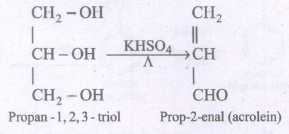
When glycerol is heated with dehydrating agents such as Con H2SO, KHSO4 etc .... , it undergoes dehydration to form acrolein.
21.
\(\underset {Phenol} {\mathrm{C}_{6} \mathrm{H}_{5} \mathrm{OH}}+\mathrm{Zn}(\text { dust }) \rightarrow \underset {benzene(A)} {\mathrm{C}_{6} \mathrm{H}_{6}}+\mathrm{ZnO}\)
22.
(i) In lyophillic colloids or sols definite attractive force or affinity exists between dispersion medium and dispersed phase. Examples: sols of protein and starch. They are more stable and will not get precipitated easily.
(ii) In a lyophobic colloids, no attractive force exists between the dispersed phase and dispersion medium. They are less stable and precipitated readily, but cannot be produced again by just adding the dispersion medium.
Examples: sols of gold, silver, platinum and copper.
23.
24.
Lr Z = 103, is the last element of actinoid series. Its electronic configuration is [Rn]86 5f146d17S2 the possible oxidation state shown by it is +3.
25.
(i) If value of \(\triangle\)G is fur any reaction then to make such reaction spontaneous it is coupled with another reaction of large negative \(\triangle\)G value, so that the sum of two \(\triangle\)G becomes negative. This is known as coupling of reaction.
(ii) In the metallurgy, thermodynamically infeasible reaction is coupled with a reaction which has more negative G, so that net \(\triangle\)G become negative.
26.
(i) The chemical reaction involves breaking of certain existing bonds of the reactant and forming new bonds which lead to the product.
(ii) The net energy involved in this process is dependent on the nature of the reactant and hence the rates are different for different reactants.
Example:
Let us compare the following two reactions that you carried out in volumetric analysis.
1) Redox reaction between ferrous Ammonium Sulphate (FAS) and KMnO4.
2) Redox reaction between oxalic acid and KMnO4.
(i) The oxidation of oxalate ion by KMnO4 is relatively slow compared to the reaction between KMnO4 and Fe2+. In fact heating is required for the reaction between KMnO4 and Oxalate ion and is carried out at around 60oC.
(ii) The physical state of the reactant also plays an important role to influence the rate of reactions.
(iii) Gas phase reactions are faster as compared to the reactions involving solid or liquid reactants.
Ex : Na(s) + I2(vap) [Faster]
Na(s) + I2(s) [Slower]
KI(aq) + Pb(NO3)2(aq) → PbI2 (yellow) [Faster]
KI(s) + Pb(NO3)2(s) → PbI2 (yellow) [Slower]
27.
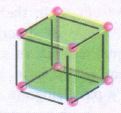
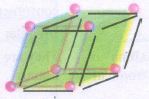
There are seven types of unit cell, Cubic, tetragonal, orthorhombic, hexagonal, monoclinic, triclinic and rhombohedral. They differ in the arrangement of their crystallographic axes and angles.
i) Cubic: a = b = c; α = β = ૪ = 90o.
ii) Tetragonal: a = b ≠ c; α = β = ૪ = 90°.
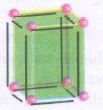
iii) Orthorhombic: a ≠ b ≠ c; α = β = ૪ = 90°.
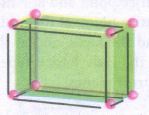
iv) Hexagonal: a = b ≠ c; α = β = 90o, ૪ = 120o.
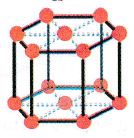
v) Monoclinic: a ≠ b ≠ c; α = ૪ = 90o, β ≠ 90o,
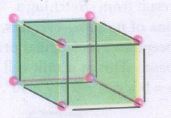
vi) Triclinic: a ≠ b ≠ c; α ≠ β ≠ ૪ ≠ 90o.
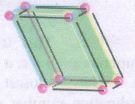
vii) Rhombohedral: a = b = c; α = β = ૪ ≠ 90o.
28.
29.
Unit of x
\(k=\frac { 1 }{ \rho } .\frac { l }{ A } \left( \frac { 1 }{ ohm } .\frac { m }{ { m }^{ 2 } } \right) \)
= ohm-1 m-1 = mho m-1 (or) Sm-1
30.
\(\mathrm{Hg}_{2} \mathrm{Cl}_{2(\mathrm{~s})} \rightleftharpoons \mathrm{Hg}_{2}^{2+} \text { (aq) }+2 \mathrm{Cl^-}_{(\mathrm{aq})}\\ s \quad \quad \quad \quad \quad \quad s \quad \quad \quad \quad \quad 2s\)
\(\mathrm{K}_{\mathrm{sp}} =\left[\mathrm{Hg}_{2}^{2+}\right]{\left[\mathrm{Cl}^{-}\right]^{2}} \)
\(=(\mathrm{s})(2 \mathrm{~s})^{2} \)
\(\mathrm{~K}_{\mathrm{sp}} =4 \mathrm{~s}^{3}\)
31.
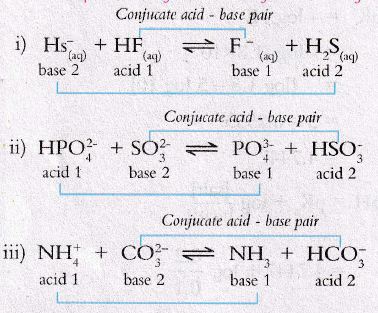
Conjugate Pairs:
\((a) \mathrm{HS}_{\text {(aq) }}^{-} \& \mathrm{H}_{2} \mathrm{~S}_{\text {(aq) }} \) \((b) \mathrm{HF}_{\text {(aq) }} \& \mathrm{~F}_{\text {(aq) }}^{-} \)
\((a) \mathrm{HPO}_{4}^{2-} \& \mathrm{PO}_{4}^{3-} \) \((b) \mathrm{SO}_{3}^{2-} \& \mathrm{HSO}_{3}^{-} \)
\((a) \mathrm{NH}_{4}^{+} \& \mathrm{NH}_{3} \) \((b) \mathrm{CO}_{3}^{2-} \& \mathrm{HCO}_{3}^{-}\)
32.
(i) I Order reaction
(ii) S-1
(iii) \({ t }_{ \frac { 1 }{ 2 } }\) = 0.693/k
33.
This is due to,
(i) Lowbond dissociation enthalpy of F-F-bond
(ii) High hydration enthalpy of F-.
34.
The best known examples of this type of isomerism occur for chromium chloride CrCI3.6H2O which may contain 4, 5, (or) 6 coordinated water molecules.
[Cr(H2O)4CI2]Cl.2H2O -Bright green
Tetraaquadichlorochromium(III)chloride dihydrate
[Cr(H2O)5CI]Cl2.H2O - grey-green
Pentaaquachlorochromium(III) chloride monohydrate
[Cr(H2O)6]CI3 Violet
Hexaaquachromium (III) chloride
35.
(i) Zeolites are three-dimensional crystalline solids containing Al, Si and O in their regular three dimensional framework.
(ii) They are hydrated sodium alumino silicates with general formula Na2O(AI2O3).·x(SiO2)·yH2O
(x = 2 to 10; y = 2 to 6).
(iii) Zeolites have porous structure in which the monovalent sodium ions and water molecules are loosely held.
(iv) The Si and Al atoms are tetrahedrally coordinated with each other through shared oxygen atoms.
(v) Zeolites are similar to clay minerals but they differ in their crystalline structure.
(vi) Zeolites have a three dimensional crystalline structure looks like a honeycomb consisting of a network of interconnected tunnels and cages.
(vii) Water molecules moves freely in and out of these pores but the zeolite framework remains rigid
(viii) Another special aspect of this structure is that the pore/channel sizes are nearly uniform, allowing the crystal to act as a molecular sieve.
36.
(i) Compound (A) does not reduce Fehling's solution, so it is benzaldehyde.
(ii) Benzaldehyde (A) reacts with acetone in the presence of NaOH to give on a, p unsaturated compound (B).
\(\\ \\ \\ \underset { (A) }{ { C }_{ 6 }{ H }_{ 5 }CHO } +{ CH }_{ 3 }-{ COCH }_{ 3 }\overset { NaoH }{ \longrightarrow } \underset { (B) }{ { C }_{ 6 }{ H }_{ 5 } } -\underset { Acetone }{ CH=CH-{ COCH }_{ 3 } } \)
(iii) (A) reacts with dimethyl aniline in the presence of conc. H2SO4 to give compound (C).
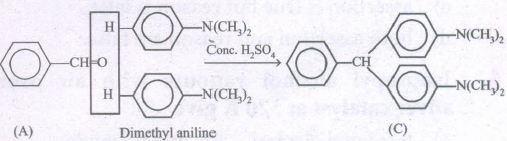
| Compound | Compound Name | Formula |
| A | Benzaldehyde | C6H5CHO |
| B | Benzal acetone | C6H5CH = CH-COCH3 |
| C | Triphenyl methane dye | 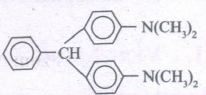 |
37.
Condensation Methods:
Various chemical methods for the formation of colloidal particles.
(i) Oxidation:
Sols of some non-metals are prepared by this method. (a) When hydroiodic acid is treated with iodic acid, 12 sol is obtained.
\({ HIO }_{ 3 }+5HI\longrightarrow { 3H }_{ 2 }O+{ I }_{ 2 }\) (Sol)
(ii) Reduction:
Many organic reagents like phenyl hydrazine, formaldehyde, etc are used for the formation of sols. For example: Gold sol is prepared by reduction of auric chloride using formaldehyde.
\(2{ AuCl }_{ 3 }+3HCHO+{ 3H }_{ 2 }O\longrightarrow 2Au\left( sol \right) +6HCl+3HCOOH\)
(iii) Hydrolysis:
Sols of hydroxides of metals like chromium and aluminium can be produced by this method.
For example,
\({ FeCl }_{ 3 }+3H_{ 2 }O\longrightarrow Fe(OH)_{ 3 }+3HCl\)
(iv) Double decomposition:
For the preparation of water insoluble sols this method can be used. When hydrogen sulphide gas is passed through a solution of arsenic oxide, a yellow coloured arsenic sulphide is obtained as a colloidal solution.
\({ As }_{ 2 }{ O }_{ 3 }+3{ H }_{ 2 }S\longrightarrow { AS }_{ 2 }{ S }_{ 3 }+{ 3H }_{ 2 }O\)
(v) Decomposition:
When few drops of an acid is added to a dilute solution of sodium thio sulphate, the insoluble free sulphur produced by decomposition of sodium thiosulphate accumulates into small, clusters which impart various colours blue, yellow and even red to the system. depending on their growth within the size of colloidal dimensions.
\({ S }_{ 2 }{ O }_{ 3 }^{ 2- }+{ 2H }^{ + }\longrightarrow \underset{sol}S+{ H }_{ 2 }O+{ SO }_{ 2 }\)
By exchange of solvent:
(i) Colloidal solution of few substances like phosphorous or sulphur is obtained by preparing the solutions in alcohol and pouring them into water.
(ii) As they are insoluble in water, they form colloidal solution.
P in alcohol + water ⟶ Psol.
38.
39.
On the basis of magnetic properties, materials can be broadly classified as
(a) paramagnetic materials
(b) diamagnetic materials, besides these there are ferromagnetic and antiferromagnetic materials
(i) Materials with no elementary magnetic dipoles are diamagnetic, in other words a species with all paired electrons exhibits diamagnetism.
(ii) This kind of materials are repelled by the magnetic field because the presence of external magnetic field, a magnetic induction is introduced to the material which generates weak magnetic field that oppose the applied field
(iii) Paramagnetic solids having unpaired electrons possess magnetic dipoles which are isolated from one another.
(iv) In the absence of external magnetic field, the dipoles are arranged at random and hence the solid shows no net magnetism.
(v) But in the presence of magnetic field, the dipoles are aligned parallel to the direction of the applied field and therefore, they are attracted by an external magnetic field.
(vi) Ferromagnetic materials have domain structure and in each domain the magnetic dipoles are arranged.
(vii) But the spin dipoles of the adjacent domains are randomly oriented.
(viii) Some transition elements or ions with unpaired d electrons show ferromagnetism.
40.
Oxidising property of H2SO4:
Sulphuric acid is an oxidising agent as it produces nascent oxygen as shown below.
\({ H }_{ 2 }{ SO }_{ 4 }\longrightarrow { H }_{ 2 }O+\underset { nascentoxygen }{ { SO }_{ 2 } } +\left( O \right) \)
Sulphuric acid oxidises elements such as carbon, sulphur and phosphorus. It also oxides bromide and iodide to bromine and iodine respectively.
C + 2H2SO4 \(\longrightarrow \) 2SO2 + 2H2O + CO2
S + 2H2SO4 \(\longrightarrow \) 3SO2 + 2H2O
P4 + 10H2SO4 \(\longrightarrow \) 4H3PO4 + 10SO2 + 4H2O
H2S + H2SO4 \(\longrightarrow \) SO2 + 2H2O + S
H2SO4 + 2HI \(\longrightarrow \) SO2 + H2O + I2
H2SO4 + 2HBr \(\longrightarrow \) 2SO2 + 2H2O + Br2
41.
(i) The colour develops because of the presence of electrons in the 8 anionic sites.
(ii) These electron absorb energy from the visible region of radiation and get excited.
(iii) For example when crystals of NaCl are heated in an atmosphere of sodium vapours, the sodium atoms get deposited on the surface of the crystal and the deposited Na atoms.
(iv) During this process, the Na atoms on the surface lose electrons to form Na+ ions
(v) These electrons get excited by absorbing energy from the visible light and impart yellow colour to the crystals.
42.
(i) [NiCI4]2-
IUPAC name - Tetrachloridonickelate (II) ion
(ii) Ni2+ = 3d8,4s0
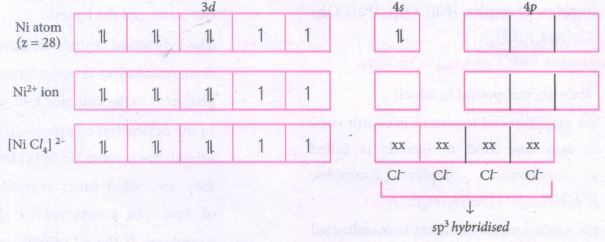
Cl- being a weak field ligand cannot pair up the unpaired electron. So, it is sp3 hybridised, and it has tetrahedral geometry.

12th Standard Syllabus & Materials
12th Standard
TN 12th Computer Applications களப்பெயர் முறைமை (DNS) Sample Question Papers Study Material - QB365 Set A
NEW12th Standard
TN 12th Computer Applications வலையமைப்பு எடுத்துக்காட்டுகள் மற்றும் நெறிமுறைகள் Sample Question Papers Study Material - QB365 Set A
NEW12th Standard
TN 12th Computer Applications கணினி வலையமைப்பு ஓர் அறிமுகம் Sample Question Papers Study Material - QB365 Set A
NEW12th Standard
TN 12th Computer Applications PHP-உடன் MySQL-ஐ இணைத்தல் Sample Question Papers Study Material - QB365 Set A



Tamilnadu Stateboard 12th Standard Subjects

Maths
Chemistry

Physics

Biology

Computer Science

Business Maths and Statistics

Economics

Commerce

Accountancy

History

Computer Applications
Biology
Computer Technology
Computer Applications
Computer Science
Business Maths and Statistics
Commerce
Economics
Maths
Chemistry
Physics
Computer Technology
History
Accountancy

Tamil

English

French
Tamilnadu Stateboard Standards
