
 100% FREE ACCESS
12th Standard Syllabus & Materials
12th Standard
TN 12th Computer Applications மின்னணு தரவு பரிமாற்றம் Sample Question Papers Study Material - QB365 Set A
NEW12th Standard
TN 12th Computer Applications மின் - வணிக பாதுகாப்பு அமைப்புகள் Sample Question Papers Study Material - QB365 Set A
NEW12th Standard
TN 12th Computer Applications மின்னணு செலுத்தல் முறைகள் Sample Question Papers Study Material - QB365 Set A
NEW12th Standard
TN 12th Computer Applications மின் - வணிகம் Sample Question Papers Study Material - QB365 Set A
NEW12th Standard
TN 12th Computer Applications திறந்த மூல கருத்துருக்கள் Sample Question Papers Study Material - QB365 Set A
NEW12th Standard
TN 12th Computer Applications வலையமைப்பு வடமிடல் Sample Question Papers Study Material - QB365 Set A

Published on: 21/02/2020
12th Standard Chemistry Public Model Question Paper II 2020
Download Tamil Nadu 12th Standard Chemistry question papers, model tests, one-mark questions, important questions, and public exam papers in PDF format. Free study materials and answer keys for TN State Board students.
Questions + Answers key
Take MCQ Chemistry Test
1.
The intermediate formed in the nitration of benzene is _________
Arenium ion
Carbanion
Oxonium ion
Nitrite ion
2.
The sugar unit present in nucleic acid is___________
a hexose
tetrose
pentose
glucose
3.
A device in which spontaneous chemical reaction generates electric current ________.
Galvanic cell
Voltaic cell
Daniel cell
All the above
4.
\({ X }_{ m }{ Y }_{ n(s) }\overset { { H }_{ 2 }O }{ \rightleftharpoons } { mX }_{ (aq) }^{ n+ }+{ nY }_{ (aq) }^{ m- }\)
\({ [{ X }^{ n+ }] }^{ m }{ [Y^{ m- }] }^{ n }\)
\({ [X }^{ n+ }][{ Y }^{ m- }]\)
\({ [{ X }^{ n+ }] }^{ m }/{ [Y^{ m- }] }^{ n }\)
\({ [X }^{ n+ }]/[{ Y }^{ m- }]\)
5.
The IUPAC name for isobutyl alcohol is _______.
2-methyl-l-propanol
2-methyl-l-butanol
2,2-dimethyl-2-propanol
1,1-dimethyl- 2-butanol
6.
7.
Which one of the following is an example for homogeneous catalysis?
manufacture of ammonia by Haber’s process
manufacture of sulphuric acid by contact process
hydrogenation of oil
Hydrolysis of sucrose in presence of all HCl
8.
Dissociation constant of NH4OH is 1.8 x 10⁻⁵ the hydrolysis constant of NH4Cl would be _______.
1.8 × 10⁻¹⁹
5.55 × 10⁻¹⁰
5.55 × 10⁻⁵
1.80 × 10⁻⁵
9.
Which among the following ion is not formed?
F3-
C13-
Br3-
I3-
10.
ABAB type of packing is called _________.
hexagonal close packing
cubic close packing
tetragonal close packing
none of the above
11.
Which of the following is incorrect with respect to metallurgy of iron in the blast furnace?
Zone of combustion : \(C+{ O }_{ 2 }\rightarrow { CO }_{ 2 }\)
Zone of heat absorption : \({ CO }_{ 2 }\rightarrow C+{ O }_{ 2 }\)
Zone of slag formation : \(CaO+{ SiO }_{ 2 }\rightarrow CaSiO_{ 3 }\)
Zone of reduction : \({ Fe }_{ 2 }{ O }_{ 3 }3C\rightarrow 3CO+2Fe\)
12.
For a first order reaction A ⟶ B the rate constant is x min−1. If the initial concentration of A is 0.01M, the concentration of A after one hour is given by the expression.
001. e−x
1 x 10⁻²(1-e-60x)
(1 x 10⁻²)e-60x
none of these
13.
The sum of primary valence and secondary valence of the metal M in the complex [M(en)2(Ox)]Cl is________.
3
6
-3
9
14.
Which one of the following statements related to lanthanons is incorrect?
Europium shows +2 oxidation state
The basicity decreases as the ionic radius decreases from Pr to Lu.
All the lanthanons are much more reactive than aluminium
Ce4+ solutions are widely used as oxidising agents in volumetric analysis.
15.
| Column-I | Column-II | ||
| A | Borazole | 1 | B(OH)3 |
| B | Boric acid | 2 | B3N3H6 |
| C | Quartz | 3 | Na2[B4O5(OH)4]8H2O |
| D | Borax | 4 | SiO2 |
| A | B | C | D |
| 2 | 1 | 4 | 3 |
| A | B | C | D |
| 1 | 2 | 4 | 3 |
| A | B | C | D |
| 1 | 2 | 4 | 3 |
None of these
16.
Aniline reacts with Br2/H2O to give a tribromo derivative. How would you convert aniline to get a monobromo derivate?
17.
How is Buna - N prepared? Give its use.
18.
Give example of epimers.
19.
Complete the following equations by writing the missing A, B, C, D etc.,
20.
Give the oxidation and reduction half cell reaction taking place in the Daniel cell.
21.
0.44g of a monohydric alcohol when added to methyl magnesium iodide in ether liberates at STP 112 cm3 of methane with PCC the same alcohol form a carbonyl compound that answers silver mirror test. Identify the compound.
22.
Addition of Alum purifies water. Why?
23.
Can we use nucelophiles such as NH3,CH3O - for the Nucleophilic substitution of alcohols
24.
What are redox reactions?
25.
What are the applications of the Ellingham diagram?
26.
Distinguish between hexagonal close packing and cubic close packing.
27.
A double salt which contains fourth period alkali metal (A) on heating at 500K gives (B). Aqueous solution of (B) gives white precipitate with BaCl2 and gives a red colour compound with alizarin. Identify A and B.
28.
29.
What is standard reduction potential Eo?
30.
What is the action of HCN on
(i) propanone
(ii) 2,4-dichlorobenzaldehyde
iii) ethanal
31.
Ksp of AgCl is \(1.8\times10^{-10}\). Calculate molar solubility in 1 M AgNO3
32.
The concentration of hydroxide ion in a water sample is found to be 2.5 × 10⁻⁶M. Identify the nature of the solution.
33.
Mention the factors that affected the rate of a chemical reaction.
34.
Give reason for the following:
F2 is more reactive than CIF3 but CIF3 is more reactive than Cl2
35.
What are the different methods of concentration of ores?
36.
What are enantiomers?
37.
38.
An aromatic aldehyde (A) of molecular formula C7H6O which has the smell of bitter almonds on treatment with (CH3CO)2O and CH3COONa to give compound (B) which is an aromatic unsaturated add. (A) also reacts with (A) in the presence of ale. KCN to give dimer (C). Identify (A), (B) and (C). Explain the reactions.
39.
Write any five applications of colloids in day - to day life.
40.
Justify the following statement.
"Elements of the first transition series possess many properties different from those of heavier transition elements".
41.
Explain the oxidising and reducing property of SO2·
42.
What are stoichiometric defects in ionic solids? Explain
43.
For the complex [NiCI4]2- write (i) the IUPAC name (ii) The hybridisation type (iii) The shape of the complex
1.
(a)
Arenium ion
2.
(c)
pentose
3.
(d)
All the above
4.
(c)
\({ [{ X }^{ n+ }] }^{ m }/{ [Y^{ m- }] }^{ n }\)
5.
(a)
2-methyl-l-propanol
6.
(d)
7.
(d)
Hydrolysis of sucrose in presence of all HCl
8.
\(K_h= { \frac { { K }_{ w } }{ K_b } } = \frac{1 \times 10^{-14}}{1.8 \times 10^{-5}}\)
= 0.55 x 10-9 = 5.5 x 10⁻¹⁰
9.
(a)
F3-
10.
(a)
hexagonal close packing
11.
(b)
Zone of heat absorption : \({ CO }_{ 2 }\rightarrow C+{ O }_{ 2 }\)
12.
\(k=\frac { 2.303 }{ t } log\frac { \left[ { A }_{ 0 } \right] }{ \left[ A \right] } \)
\(k=\frac { 1 }{ t } ln \frac { \left[ { A }_{ 0 } \right] }{ \left[ A \right] } \)
\(e^{kt}=\frac { \left[ { A }_{ 0 } \right] }{ \left[ A \right] }\)
[A] = [A0] ekt
In this case
k = x min-1 and [A0] = 0.01 M = 1 x 10⁻²M
t = 1 hour = 60 min
[A] = (1 x 10⁻²)e-60x
13.
In the complex [M(en)2(Ox)]Cl For the central metal ion M3+
The primary valence is = +3
The secondary valence = 6
sum of primary valence and secondary valence = 3 + 6 = 9
14.
As we move from La to Lu, their metallic behaviour because almost similar to that of aluminium.
15.
(a)
| A | B | C | D |
| 2 | 1 | 4 | 3 |
16.
To get mono bromo compounds, -NH2 is first acylated to reduce its activity.
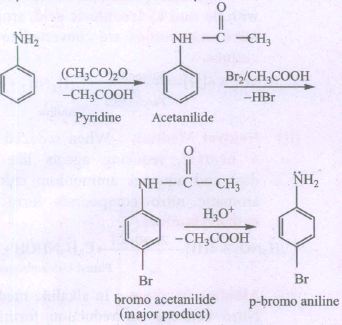
17.
It is a co-polymer of acrylonitrile and buta-1,3-diene.

It is used in the manufacture of hoses and tank linings.
18.
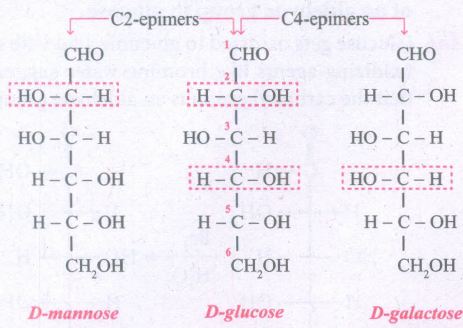
19.
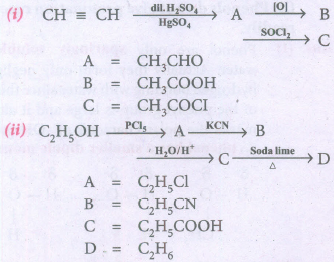
20.
Zinc is oxidised to Zn2+ ions and the Cu2+ ions are reduced to metallic copper. The half reactions are represented as below.
\( { Zn }_{ (s) }\rightarrow { Zn }_{ (aq) }^{ + }+2e^{ - }\) (oxiation)
Loss of election oxidation
\({ Cu }_{ (aq) }^{ 2+ }+{ 2e }^{ - }\rightarrow { Cu }_{ (s) }\) (reduction)
Gain of electron oxidation.
21.
Mass = 0.44 g
No. of moles = Given Volume/Molar Volume = 112/22400
Molar Mass = 0.44/112 x 22400 = 88g
CnH2n+1 + OH = 88
12n+ (1)(2n+1) + 16 +1 = 88
14n + 18 = 88
14n = 88 - 18
n =70/14 = 5

Pentanoicacid
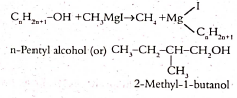
22.
(i) Purification of drinking water is activated by coagulation of suspended impurities in water by using alums containing \(\mathrm{Al}^{3+}\left(\mathrm{K}_{2} \mathrm{SO}_{4} \mathrm{Al}_{2}\left(\mathrm{SO}_{4}\right)_{3} \cdot 24 \mathrm{H}_{2} \mathrm{O}\right)\) Alum has a negative charge and tends to disperse in water very fast.
(ii) The increased size as well as the lack of repelling charges cause the alum particles to settle down at the bottom or rise up and float in water. After the particles are neutralized, they clump together because of the London dispersive force which are part of vander Waal's forces. The weak inter molecular force arising from quantum induced instantaneous polarisation multi poles in molecules causes even non polar particles to attract each other due to the corelated movements of the electrons in interacting molecules. Then they settle down.
23.
Yes, we can use nucleophiles such as NH3, CH3O- for the nucleophilic substitution of alcohol.
Example
\(\mathrm{C}_{2} \mathrm{H}_{5} \mathrm{OH}+\mathrm{NH}_{3} \rightarrow \mathrm{C}_{2} \mathrm{H}_{5} \mathrm{NH}_{2}+\mathrm{H}_{2} \mathrm{O} \)
\(\mathrm{C}_{2} \mathrm{H}_{5} \mathrm{OH}+\mathrm{CH}_{2} \mathrm{~N}_{2} \rightarrow \mathrm{C}_{2} \mathrm{H}_{5} \mathrm{OCH}_{3}+\mathrm{N}_{2}\)
24.
(i) Redox reactions involve transfer of electrons from one reactant to another. Such reactions are always coupled, which means that when one substance is oxidised, another must be reduced.
(ii) The substance which is oxidised is a reducing agent and the one which is reduced is an oxidizing agent
25.
(i) Ellingham diagram helps us to select a suitable reducing agent and appropriate temperature range for reduction.
(ii) From the Ellingham diagram, we can infer the relative stability of different metal oxides at a given temperature.
(iii) Ellingham diagram is used to predict thermodynamic feasibility of reduction of oxides of one metal by another metal.
26.
| hcp structure | ccp structure | |
| 1. | This is 'aba' pattern of arrangement. | This is 'abc' pattern of arrangement. |
| 2. | The spheres can be arranged so as to fit into the depression in such a way that the third layer is directly over a first layer. | The third layer may be placed over the second layer in such a way that all the spheres of the third layer fit in octahedral voids. |
| 3. | The tetrahedral voids of the second layer are covered by the spheres of the third layer. | This arrangement of the third layer is different from other two layers and the stacking of layers continued. |
| 4. | 6 spheres are present | 4 spheres are present |
27.
1. A double salt which contains fourth-period alkali metal (A) is potash alum
K2SO4 Al2(SO4)3 - 24 H₂O
2. On heating potash alum (A) 500 k give anhydrous potash alum (or) burnt alum (B).
\(\mathrm{K}_{2} \mathrm{SO}_{4} \cdot \mathrm{Al}_{2}\left(\mathrm{SO}_{4}\right)_{3} \cdot 24 \mathrm{H}_{2} \mathrm{O} \stackrel{500 \mathrm{~K}}{\longrightarrow} \mathrm{K}_{2} \mathrm{SO}_{4} \cdot \mathrm{Al}_{2}\left(\mathrm{SO}_{4}\right)_{3}+24 \mathrm{H}_{2} \mathrm{O}\)
[Potash alum (A)] [Burnt alum (B)]
3. Aqueous solution of burnt alum, has sulphates ion, potassium ion and aluminium ion. Sulphate ion reacts with BaCl₂ to form a white precipitate of Barium Sulphate
(SO4)2 + BaCl2 → BaSO4 + 2 Cl¯
Aluminium ion reacts with alizarin solution to give a red colour compound.
28.
29.
The standard reduction potential (Eo) is a measure of the oxidising tendency of the species.
30.
.JPG)
(ii) 2,4-dichlorobenzaldehyde.
.JPG)
(iii) ethanal
.JPG)
31.
Ksp = 1.8 \(\times\)10-10, [AgNO3]= 1 M
\(\mathrm{AgCl}_{(\mathrm{s})} \rightleftharpoons \mathrm{Ag}_{(\mathrm{aq})}^{+}+\mathrm{Cl}_{(\mathrm{aq})}^{-} \)
s s
\(\mathrm{AgNO}_{3(\mathrm{aq})} \rightleftharpoons \mathrm{Ag}_{(\text {aq })}^{+}+\mathrm{NO}_{3_{(\text {aq })}}^{-}\\ 1 \mathrm{M} \quad \quad \quad \quad \quad 1 \mathrm{M} \quad \quad 1 \mathrm{M} \)
\(\left[\mathrm{Ag}^{+}\right]=(\mathrm{s}+1) \approx 1 \quad(\therefore \mathrm{s}<<1) \)
\(\left[\mathrm{Cl}^{-}\right]=\mathrm{s} \)
\(\mathrm{K}_{\mathrm{sp}}=\left[\mathrm{Ag}^{+}\right]\left[\mathrm{Cl}^{-}\right] \)
\(1.8 \times 10^{-10}=(1)(s) \)
\(\therefore \mathrm{s}=1.8 \times 10^{-10} \mathrm{M}\)
32.
1. If \(\left[\mathrm{OH}^{-}\right]>1 \times 10^{-7} \mathrm{M}\), the solution is basic. \(2.5 \times 10^{-6} \mathrm{M}>1 \times 10^{-7} \mathrm{M}\)
2. \(\therefore\) The solution is basic.
33.
The rate of a reaction is affected by the following factors.
(i) Nature and state of the reactant
(ii) Concentration of the reactant
(iii) Surface area of the reactant
(iv) Temperature of the reaction
(v) Presence of a catalyst
34.
(i) Fluorine due to its small size high electronegativity and low F-F bond energy is more reactive than CIF3
(ii) While CI-F bond in CIF3 is weaker than CI-CI bond in Cl2 therefore, CIF3 is more reactive than Cl2.
(iii) So these graphite rods are consumed slowly and need to be replaced from time - to - time
35.
(i) Hydraulic washing or gravity separation
(ii) Froth flotation
(iii) Electromagnetic separation
(iv ) Chemical method.
36.
The pair of two optically active isomers which are mirror images of each other are called enantiomers.
37.
38.
(i) An organic compound which has the smell of bitter almonds is benzaldehyde C6H5CHO and it is (A).
(ii) Benzaldehyde reacts with acetic anhydride in the presence of sodium acetate gives Cinnamic acid.
\(\underset { (A) }{ { C }_{ 6 }{ H }_{ 5 }CHO } +\left( { CH }_{ 3 }CO \right) _{ 2 }O\overset { { CH }_{ 3 }COONa }{ \longrightarrow } \underset { (B) }{ { C }_{ 6 }{ H }_{ 5 }CH=CHCOOH } +{ CH }_{ 3 }COOH\)
(iii) Benzaldehyde on treatment with alcoholic KCN gives Benzoin a dimer and it is (C).
| Compound | Compound Name | Formula |
| A | Benzaldehyde | C6H5CHO |
| B | Cinnamic acid | C6H5CH=CHCOOH |
| C | Benzoin | \({ C }_{ 6 }{ H }_{ 5 }\underset { \overset { | }{ OH } }{ CH } -\underset { \overset { || }{ O } }{ C } -{ C }_{ 6 }{ H }_{ 5 }\) |
39.
Food:
Food stuffs like milk cream, butter, etc are present in colloidal form.
Medicines:
Antibodies such as penicillin and streptomycin are produced in colloidal form for suitable injections. Colloidal gold and colloidal calcium are used as tonics. Milk of magnesia is used for stomach troubles. Silver sol protected by gelatine known as Argyrol is used as eye lotion.
In Industry:
Colloids find many applications in industries
(i) Water purification:
Purification of drinking water is activated by coagulation of suspended impurities in water using alums containing Al3+.
(ii) In washing:
The cleansing action of soap is due to the formation of emulsion of soap molecules with dirt and grease.
(iii) Tanning of leather:
Skin and hides are protein containing positively charged particles which are coagulated by adding tannin to give hardened leather for further application. Chromium salts are used for the purpose. Chrome tanning can produce soft and polishable leather.
(iv) Rubber industry:
Latex is the emulsion of natural rubber with negative particles. By heating rubber with sulphur, vulcanized rubbers are produced for tyres, tubes, etc.
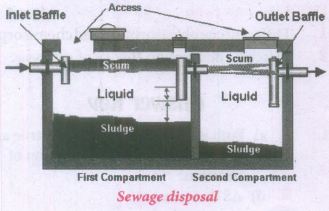
(v) Sewage disposal:
Sewage contains dirt, mud and wastes dispersed in water. The passage of electric current deposits the wastes materials which can be used as a manure.
(vi) Cortrell's precipitator:
Carbon dust in air is solidified by Cottrell's precipitator. In it, a high potential difference of about 50,000V is used. The charge on carbon is neutralized and solidified. Thus the air is free from carbon particles.
(vii) The blue colour of the sky in nature is due to Tyndall effect of air particles.
(viii) Formation of delta:
The electrolyte in sea and river water coagulates the solid particles in river water at their intersection. So, the earth becomes a fertile land.
(ix) Analytical application:
Qualitative and quantitative analysis are based on the various properties of colloids.
40.
The heavier transition elements belong to fourth (4d), fifth (Sd) and sixth (6d) transition series. Their properties are expected to be different form the elements belonging to the first (3d) series due to the following reasons.
(i) Atomic radii: Size of the transition elements 94d and Sd series are larger than those of the corresponding elements of the first transition series though those of 4d and Sd series are very close to each other.
(ii) Ionisation enthalpy of Sd series are higher than the corresponding elements of 3d and 4d series.
(iii) Atomisation enthalpy of 4d and Sd series are higher than the corresponding elements of the first series.
(iv) Melting and boiling points of heavier transition elements are greater than those of the first transition series due to stronger intermetallic bonding.
(v) The elements of the first transition series generally form low or high spin complexes, depending upon the higher of ligand field. However, the heavier transition elements form low spin complexes irrespective of the strength of the ligand filed.
41.
Oxidising property :
Sulphur dioxide, oxidises hydrogen sulphide to sulphur and magnesium to magnesium oxide.
\({ 2H }_{ 2 }S+{ SO }_{ 2 }\longrightarrow 3S+{ 2H }_{ 2 }O\)
\(2Mg+{ SO }_{ 2 }\longrightarrow 2MgO+S\)
Reducing property :
As it can readily be oxidised, it acts as a reducing agent. It reduces chlorine into hydrochloric acid.
\({ SO }_{ 2 }+2{ H }_{ 2 }O+{ { Cl }_{ 2 }\longrightarrow { H }_{ 2 }{ SO }_{ 4 }+2HCl }\)
It also reduces potassium permanganate and dichromate to Mn2+ and Cr3+ respectively.
\({ 2KMnO }_{ 4 }+5{ SO }_{ 2 }+2{ H }_{ 2 }O\longrightarrow { K }_{ 2 }{ SO }_{ 4 }+{ 2MnSO }_{ 4 }+2{ H }_{ 2 }{ SO }_{ 4 }\)
\({ K }_{ 2 }{ Cr }_{ 2 }{ O }_{ 7 }+{ 3SO }_{ 2 }+{ H }_{ 2 }{ SO }_{ 4 }\longrightarrow { K }_{ 2 }{ SO }_{ 4 }+{ Cr }_{ 2 }\left( SO_{ 4 } \right) _{ 3 }+{ H }_{ 2 }O\)
42.
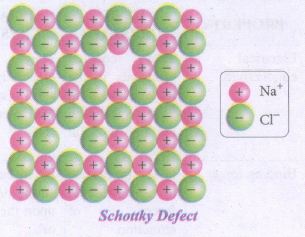
Schottky defect:
(i) Schottky defect arises due to the missing of equal number of cations and anions from the crystal lattice.
(ii) This effect does not change the stoichiometry of the crystal.
(iii) Ionic solids in which the cation and anion are of almost of similar size show schottky defect. Ex: NaCl.
(iv) Presence of large number of schottky defects in a crystal, lowers its density.
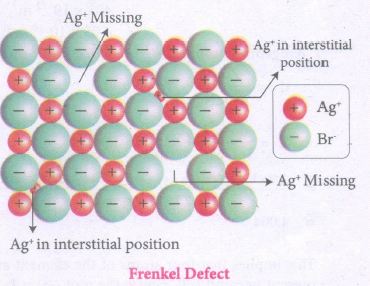
Frenkel defect:
(i) Frenkel defect arises due to the dislocation of ions from its crystal lattice.
(ii) The ion which is missing from the lattice point occupies an interstitial position.
(iii) This defect is shown by ionic solids in which cation and anion differ in size.
(iv) Unlike Schottky defect, this defect does not affect the density of the crystal.
(v) For example AgBr, in this case, small Ag+ ion leaves its normal site and occupies an interstitial position.
43.
(i) [NiCI4]2-
IUPAC name - Tetrachloridonickelate (II) ion
(ii) Ni2+ = 3d8,4s0
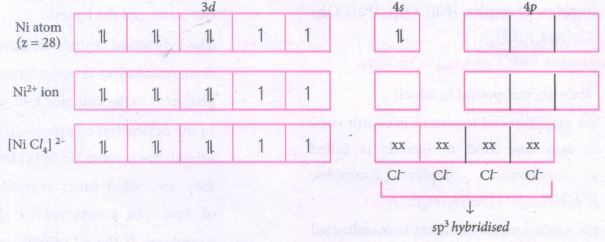
Cl- being a weak field ligand cannot pair up the unpaired electron. So, it is sp3 hybridised, and it has tetrahedral geometry.

12th Standard Syllabus & Materials
12th Standard
TN 12th Computer Applications களப்பெயர் முறைமை (DNS) Sample Question Papers Study Material - QB365 Set A
NEW12th Standard
TN 12th Computer Applications வலையமைப்பு எடுத்துக்காட்டுகள் மற்றும் நெறிமுறைகள் Sample Question Papers Study Material - QB365 Set A
NEW12th Standard
TN 12th Computer Applications கணினி வலையமைப்பு ஓர் அறிமுகம் Sample Question Papers Study Material - QB365 Set A
NEW12th Standard
TN 12th Computer Applications PHP-உடன் MySQL-ஐ இணைத்தல் Sample Question Papers Study Material - QB365 Set A



Tamilnadu Stateboard 12th Standard Subjects

Maths
Chemistry

Physics

Biology

Computer Science

Business Maths and Statistics

Economics

Commerce

Accountancy

History

Computer Applications
Biology
Computer Technology
Computer Applications
Computer Science
Business Maths and Statistics
Commerce
Economics
Maths
Chemistry
Physics
Computer Technology
History
Accountancy

Tamil

English

French
Tamilnadu Stateboard Standards
