
 100% FREE ACCESS
12th Standard Syllabus & Materials
12th Standard
TN 12th Maths Applications of Matrices and Determinants Sample Question Papers Study Material - QB365 Set A
NEW12th Standard
TN 12th Computer Applications மின்னணு தரவு பரிமாற்றம் Sample Question Papers Study Material - QB365 Set A
NEW12th Standard
TN 12th Computer Applications மின் - வணிக பாதுகாப்பு அமைப்புகள் Sample Question Papers Study Material - QB365 Set A
NEW12th Standard
TN 12th Computer Applications மின்னணு செலுத்தல் முறைகள் Sample Question Papers Study Material - QB365 Set A
NEW12th Standard
TN 12th Computer Applications மின் - வணிகம் Sample Question Papers Study Material - QB365 Set A
NEW12th Standard
TN 12th Computer Applications திறந்த மூல கருத்துருக்கள் Sample Question Papers Study Material - QB365 Set A

Published on: 21/02/2020
12th Standard Chemistry Public Model Question Paper III 2019 - 2020
Download Tamil Nadu 12th Standard Chemistry question papers, model tests, one-mark questions, important questions, and public exam papers in PDF format. Free study materials and answer keys for TN State Board students.
Questions + Answers key
Take MCQ Chemistry Test
1.
Nitromethane condenses with acetaldehyde to give
nitro propane
1-nitro-2-propanol
2-nitro-1-propanol
3-nitro propanol
2.
The ultimate product of hydrolysis of starch in the presence of dilute acid is
dextrin
maltose
maltase
glucose
3.
In Daniel cell, the charges developed by Zn/Zn2+ and Cu / Cu2+ are _______.
positive, positive
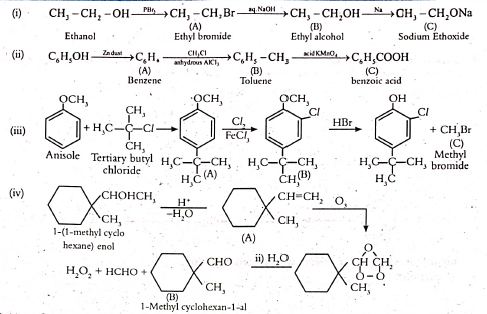
negative, negative
positive, negative
negative, positive
4.
An acid is a substance that dissociates to give hydrogen ions in water.
The above concept of acids was proposed by _______.
Lewis
Arrhenius
Bronsted
Lowry
5.
The functional isomer of n-propanol is _______.
2-propanol
prop-en-ol
ethyl methyl ether
acetaldehyde
6.
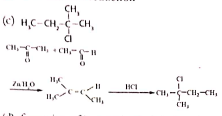
An alkene “A” on reaction with O3 and Zn - H2O gives propanone and ethanol in equimolar ratio. Addition of HCl to alkene “A” gives “B” as the major product. The structure of product “B” is ______.
\(Cl-{ CH }_{ 2 }-CH_{ 2 }-\overset { \overset { CH_{ 3 } }{ | } }{ \underset { \underset { CH_{ 3 } }{ | } }{ CH } } \)
\({ H }_{ 3 }C-{ CH }_{ 2 }-\overset { \overset { CH_{ 2 }Cl }{ | } }{ CH } -{ CH }_{ 3 }\)
\(\\ { H }_{ 3 }C-{ CH }_{ 2 }-\overset { \overset { CH_{ 3 } }{ | } }{ \underset { \underset { CL{ } }{ | } }{ C } } -{ CH }_{ 3 }\)
\({ H }_{ 3 }C-{ CH }-\overset { \overset { CH_{ 3 } }{ | } }{ \underset { \underset { Cl }{ | } }{ C } } \)
7.
The phenomenon observed when a beam of light is passed through a colloidal solution is_______.
Cataphoresis
Electrophoresis
Coagulation
Tyndall effect
8.
Which will make basic buffer?
50 mL of 0.1M NaOH+25mL of 0.1M CH3COOH
100 mL of 0.1M CH3COOH+100 mL of 0.1M NH4OH
100 mL of 0.1M HCl+200 mL of 0.1M NH4OH
100 mL of 0.1M HCl+100 mL of 0.1M NaOH
9.
Repeated use of which one of the following fertilizers would increase the activity of the soil_______.
Ammonium sulphate
Superphosphate of lime
Urea
Potassium nitrate
10.
Which of the following cannot be regarded as molecular solid?
Silicon carbide
AIN
Diamond
All the above
11.
Magnetic separation it is based on the difference in the_________ of the ore and the impurities.
magnetic properties
chemical properties
physical properties
melting point
12.
For a first order reaction A ⟶ B the rate constant is x min−1. If the initial concentration of A is 0.01M, the concentration of A after one hour is given by the expression.
001. e−x
1 x 10⁻²(1-e-60x)
(1 x 10⁻²)e-60x
none of these
13.
Which one of the following complexes is not expected to exhibit isomerism?
[Ni(NH3)4(H2O)2]2+
[Pt(NH3)2Cl2]
[Co(NH3)5SO4]Cl
[FeCl6]3-
14.
The actinoid elements which show the highest oxidation state of +7 are _______.
Np, Pu, Am
U, Fm, Th
U, Th, Md
Es, No, Lr
15.
Which of the following is not sp2 hybridised?
Graphite
graphene
Fullerene
dry ice
16.
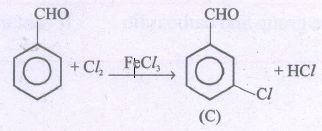
An organic compound (A) of molecular formula C7H6O is not reduced by Fehling's solution but will undergo Cannizzaro reaction. Compound (A) reacts with aniline to give compound (B). Compound (A) also reacts with Cl2 in the presence of catalyst to give compound (C). Identify (A) (B) and (C) and explain the reactions.
17.
Name the method to deduce the charge of the sol particle. Explain it with a neat diagram.
18.
How are materials classified based on their magnetic properties?
19.
Explain the oxidising and reducing property of SO2·
20.
Write note on impurity defect?
21.
Indicate the types of isomerism exhibited by the following complexes and draw the structures for these isomers.
(i) K[Cr(H2O)2 (C2O4)2]
(ii) [Co(en)3]CI3
(iii) [Co(NH3)5(NO2)](NO3)2
(iv) [Pt (NH3)(H2O)CI2]
22.
Describe briefly allotropism in p- block elements with specific reference to carbon.
23.
An Organic compound (A) with molecular formula C6H7N gives (B) with HNO2 / HCI at 273 K. The aqueous solution of (B) on heating gives compound (C) which gives violet colour with netural FeCI3. Identify the compounds (A), (B) and (C) and write the equations.
24.
Write note on oligosaccharides and polysaccharides with examples.
25.
Write a short note on Antioxidants.
26.
Account for the following:
(I) Phenol does not get protonated readily.
(ii) Phenol, benzene diazonium chloride, NaOH solution gives red dye.
27.
State Ohms law.
28.
Predict the major product, when 2-methyl but -2-ene is converted into an alcohol in each of the following methods.
(i) Acid catalysed hydration
(ii) Hydroboration
(iii) Hydroxylation using Baeyer's reagent
29.
Account for the following:
(i) Cobalt (II) is stable in aqueous solution but in the presence of complexing reagents, it is easily oxidised.
(ii) The d1 configuration is very unstable in ions.
30.
What is meant by aluminothermic process?
31.
A hydride of 2nd period alkali metal (A) on reaction with compound of Boron (B) to give a reducing agent (C). Identify A, B and C.
32.
Higher the standard reduction potential lesser is corrosion. Give reason.
33.
A carbonyl compound A having molecular formula C5H10O forms crystalline precipitate with sodium bisulphate and gives positive iodoform test. A does not reduce Fehling solution. Identify A.
34.
Complete the following reactions
i) CH3- CH2 - OH \(\overset { { P}{ Br_3 }{ } }{ \underset { {} }{ \longrightarrow } }\) A \(\overset { { aq.NaOH}{ }{ } }{ \underset { {} }{ \longrightarrow } }\) B \(\overset { { Na}{ } }{ \underset { {} }{ \longrightarrow } }\) C
ii) C6H5- OH \(\overset { { Zn \ dust}{ } }{ \underset { {} }{ \longrightarrow } }\) A \(\overset { { CH_3}{Cl}{ } }{ \underset { {Anhydrs}{AlCl_3} }{ \longrightarrow } }\) B \(\overset { { acid}{K MnO_4}{ } }{ \underset { {} }{ \longrightarrow } }\) C


35.
36.
Write the expression for the solubility product of Hg2Cl2 .
37.
What are Lewis acids and bases? Give two example for each.
38.
Rate of chemical reaction is not uniform throughout. Justify you answer:
39.
How is SO2 an air pollutant?
40.
What are anionic & cationic complex? Give an example.
41.
Why should we have a ecofriendly metallurgical process?
42.
The activation energy of a reaction is 22.5 k Cal mol-1 and the value of rate constant at 40°C is 1.8 x 10⁻⁵s-1. Calculate the frequency factor, A.
43.
What are point defects?
1.
(b)
1-nitro-2-propanol
2.
(d)
glucose
3.
(d)
negative, positive
4.
(b)
Arrhenius
5.
(c)
ethyl methyl ether
6.
7.
Scattering of light
8.
Basic buffer is the solution which has weak base and its salt.
NH4OH + HCI → NH4CI +H2O + NH4OH
200 ml 100 ml salt 100 ml weak base
9.
(a)
Ammonium sulphate
10.
(d)
All the above
11.
(a)
magnetic properties
12.
\(k=\frac { 2.303 }{ t } log\frac { \left[ { A }_{ 0 } \right] }{ \left[ A \right] } \)
\(k=\frac { 1 }{ t } ln \frac { \left[ { A }_{ 0 } \right] }{ \left[ A \right] } \)
\(e^{kt}=\frac { \left[ { A }_{ 0 } \right] }{ \left[ A \right] }\)
[A] = [A0] ekt
In this case
k = x min-1 and [A0] = 0.01 M = 1 x 10⁻²M
t = 1 hour = 60 min
[A] = (1 x 10⁻²)e-60x
13.
Option (a) and (b) -geometrical isomerism is possible
Option (c) - ionization isomerism is possible
Option (d) - no possibility to show either constitutional isomerism or stereo isomerism
14.
(a)
Np, Pu, Am
15.
(d)
dry ice
16.
(i) Compound A is identified as benzaldehyde C6H5CHO from its molecular formula. C6H5CHO undergoes Cannizzaro reaction and it does not reduce Fehling's solution.
\({ C }_{ 6 }{ H }_{ 5 }CHO+{ C }_{ 6 }{ H }_{ 5 }CHO\overset { NaOH }{ \longrightarrow } { C }_{ 6 }{ H }_{ 5 }{ CH }_{ 2 }OH+{ C }_{ 6 }{ H }_{ 5 }COONa\)
(ii) Benzaldehyde reacts with aniline to form Schiff's base C6H5CH = NC6H5 and it is (B)
\({ C }_{ 6 }{ H }_{ 5 }-\overset { \underset { | }{ H } }{ C } =\underset { Aniline }{ O+{ C }_{ 6 }H_{ 5 }{ NH }_{ 2 } } \longrightarrow \underset { Schiff's \ base(B) }{ { C }_{ 6 }{ H }_{ 5 }CH={ NC }_{ 6 }{ H }_{ 5 }+{ H }_{ 2 }O } \)
(iii) Benzaldehyde reacts with chlorine in the presence of catalyst to give m-chlorobenzaldehyde and it is (C).
| Compound | Compound Name | Formula |
|---|---|---|
| A | Benzaldehyde | C6H5CHO |
| B | Schiff's base | C6H5CH = NC6H5 |
| C | m-cholorobenzaldehyde |  |
17.
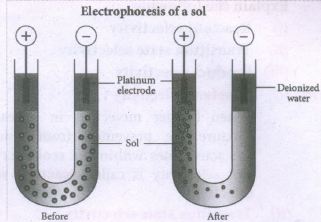
Electrophoresis:
(i) When electric potential is applied across two platinum electrodes dipped in a hydrophilic sol, the dispersed particles move toward one or other electrode.
(ii) This migration of sol particles under the influence of electric field is called electrophoresis or cataphoresis.
(iii) If the sol particles migrate to the cathode, then they posses positive (+) charges, and if the sol particles migrate to the anode then they have negative charges(-).
(iv) Thus from the direction of migration of sol particles we can determine the charge of the sol particles.
(v) Hence electrophoresis is used for detection of presence of charges on the sol particles
18.
On the basis of magnetic properties, materials can be broadly classified as
(a) paramagnetic materials
(b) diamagnetic materials, besides these there are ferromagnetic and antiferromagnetic materials
(i) Materials with no elementary magnetic dipoles are diamagnetic, in other words a species with all paired electrons exhibits diamagnetism.
(ii) This kind of materials are repelled by the magnetic field because the presence of external magnetic field, a magnetic induction is introduced to the material which generates weak magnetic field that oppose the applied field
(iii) Paramagnetic solids having unpaired electrons possess magnetic dipoles which are isolated from one another.
(iv) In the absence of external magnetic field, the dipoles are arranged at random and hence the solid shows no net magnetism.
(v) But in the presence of magnetic field, the dipoles are aligned parallel to the direction of the applied field and therefore, they are attracted by an external magnetic field.
(vi) Ferromagnetic materials have domain structure and in each domain the magnetic dipoles are arranged.
(vii) But the spin dipoles of the adjacent domains are randomly oriented.
(viii) Some transition elements or ions with unpaired d electrons show ferromagnetism.
19.
Oxidising property :
Sulphur dioxide, oxidises hydrogen sulphide to sulphur and magnesium to magnesium oxide.
\({ 2H }_{ 2 }S+{ SO }_{ 2 }\longrightarrow 3S+{ 2H }_{ 2 }O\)
\(2Mg+{ SO }_{ 2 }\longrightarrow 2MgO+S\)
Reducing property :
As it can readily be oxidised, it acts as a reducing agent. It reduces chlorine into hydrochloric acid.
\({ SO }_{ 2 }+2{ H }_{ 2 }O+{ { Cl }_{ 2 }\longrightarrow { H }_{ 2 }{ SO }_{ 4 }+2HCl }\)
It also reduces potassium permanganate and dichromate to Mn2+ and Cr3+ respectively.
\({ 2KMnO }_{ 4 }+5{ SO }_{ 2 }+2{ H }_{ 2 }O\longrightarrow { K }_{ 2 }{ SO }_{ 4 }+{ 2MnSO }_{ 4 }+2{ H }_{ 2 }{ SO }_{ 4 }\)
\({ K }_{ 2 }{ Cr }_{ 2 }{ O }_{ 7 }+{ 3SO }_{ 2 }+{ H }_{ 2 }{ SO }_{ 4 }\longrightarrow { K }_{ 2 }{ SO }_{ 4 }+{ Cr }_{ 2 }\left( SO_{ 4 } \right) _{ 3 }+{ H }_{ 2 }O\)
20.
(i) The defects in ionic solids is by adding impurity ions.
(ii) If the impurity ions are in different valance state from that of host, vacancies are created in the crystal lattice of the host.
(iii) For example, addition of CdCl2 to silver chloride yields solid solutions where the divalent cation Cd2+ occupies the position of Ag+.
(iv) This will disturb the electrical neutrality of the crystal.
(v) In order to maintain the same, proportional number of Ag+ ions leaves the lattice.
(vi) This produces a cation vacancy in the lattice, such kind of crystal defects are called impurity defects.
21.
(i) It exhibits both geometrical and optical isomerism
(a) Geometrical isomers:
.JPG)
(b) Optical isomers:
.JPG)
(ii) It shows two optical isomers
.JPG)
(iii) Ionisation isomers
Linkage isomers
[Co(NH3)5(NO2)(NO3)2], [CO(NH3)5 (ONO)](NO3)2
(iv) Geometrical isomers
.JPG)
22.
Allotropism:
1. Some elements exist in more than one crystalline or molecular forms in the same physical state
(a) In Greek "allos" means ⇒ Another
(b) "trope" means ⇒ Change
2. The different forms of an element are called allotropes.
Allotropy of carbon:
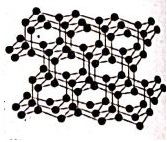
Carbon exists as diamond, graphite, fullerenes, carbon nanotubes and graphene.
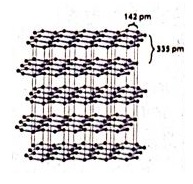
Graphite:
1. Graphite is the most stable allotropic form of carbon at normal temperature and pressure.
2. It is soft and conducts electricity.
3. It is composed of flat two dimensional sheets of carbon atoms.
4. Each sheet is a hexagonal.
5. It is "sp2" hybridised.
6. C-C bond length is 1.41 Å
7. Each C-atom forms three σ bonds with three neighbouring carbon atoms using three of its valence electrons and the fourth electron present in the unhybridised p-orbital form a π-bond.
8. The successive C-sheets are held together by weak Vander Waals forces.
9 The distance successive sheet is 3.40 Å.
10. It is used as a lubricant either on its own or as a graphited oil.
Diamond:
1. It is very hard.
2. It is "sp3" hybridised.
3. C-C bond length is 1.54 Å
4. It is used for sharpening hard tools, cutting glasses, making bores and rock drilling.
Fullerenes:
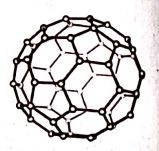
1. These allotropes are discrete molecules such as \(C_{32}, C_{50}, C_{60}, C_{70}, C_{76}\) etc.
2. It has cage like structure
3. The C60 molecules have a "soccer" ball like structure and is called buckminster fullerene or buckyballs.
4. It has a fused ring structure consists of 20 six membered rings and 12 five membered ring.
5. Each carbon atom is "sp2" hybridised.
6. It has three σ bonds and a delocalised π bond giving aromatic character to these molecules.
7. The C-C bond distance is 1.44 Å
8. The C=C bond distance is 1.38 Å.
Carbon nanotubes:
1. Carbon nanotubes, another recently discovered allotropes, have graphite like tubes with fullerene ends.
2. Along the axis, these nanotubes are stronger than steel and conduct electricity.
3. These have many applications in nanoscale electronics, catalysis, polymers and medicine.
Graphene:
It has a single planar sheet of "sp2" hybridised carbon atoms that are densely packed in a "honeycomb crystal" lattice.
23.
(i) An organic compound (A) with molecular formula C6H7N is identified as Aniline C6H5NH2
(ii) Aniline on treatment with HNO2 / HCl at 273 K gives a clear solution of Benzene diazonium chloride C6H5N2CI the compound (B).
\({ C }_{ 6 }{ H }_{ 5 }{ NH }_{ 2 }+{ HNO }_{ 2 }\xrightarrow [ 273K ]{ NCl } \underset { Benzene \ diazonium \ chloride }{ { C }_{ 6 }{ H }_{ 5 }{ N }_{ 2 }Cl } \)
(iii) An aqueous solution of benzene diazonium chloride on heating gives phenol C6H5OH and it is compound (C).
\({ C }_{ 6 }{ H }_{ 5 }{ N }_{ 2 }Cl+{ HOH }\underrightarrow { \triangle } { C }_{ 6 }{ H }_{ 5 }OH-{ N }_{ 2 }+HCl\)
| A | C6H5NH2 | Aniline |
| B | C6H5N2Cl | Benzene diazonium chloride |
| C | C6H5OH | Phenol |
24.
(i) Oligosaccharides are sugars that yield two to ten monosaccharide molecules on hydrolysis. Eg: Sucrose, Raffinose
(ii) Polysaccharides are carbohydrates which involve a large number of monosaccharide units linked to each other by oxide bridges. These linkages are called glycosidic linkages.
Eg: Starch, cellulose and inulin.
25.
(i) Antioxidants are substances which retard the oxidative deteriorations of food.
(ii) Food containing fats and oils is easily oxidised and turn rancid.
(iii) To prevent the oxidation of the fats and oils, chemical BHT(butylhydroxy toluene), BHA(Butylated hydroxy anisole) are added as food additives.
(iv) They are generally called antioxidants. These materials readily undergo oxidation by reacting with free radicals generated by the oxidation of oils, thereby stop the chain reaction of oxidation of food.
26.
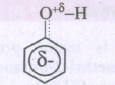
(i) In phenol, there is +ve charge on th oxygen atom, therefore it does not undergo protonation easily.
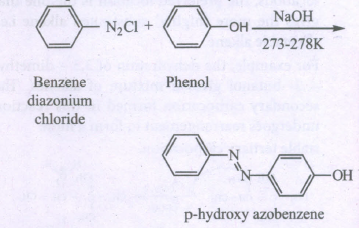
(ii) When phenol, benzene diazonium chloride and NaOH solution are mixed, coupling reaction takes place and the product formed is red dye.
27.
This law can be stated as, "at constant temperature, the strength of the current flowing through a conductor is directly proportional to the potential difference and inversely proportional to the resistance of the conductor".
Thus, I = \(\frac{V}{R}\), V = RI, V = Volts, I = ampere R= ohms.
28.
(i) Acid catalysed hydration
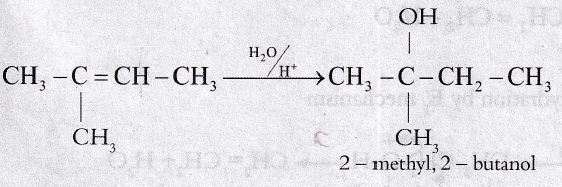
(ii) Hydroboration
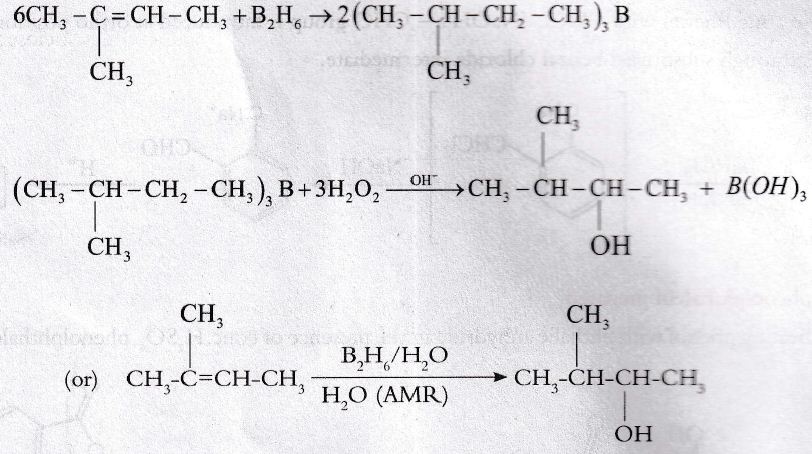
(iii) Hydroxylation using Baeyer's reagent
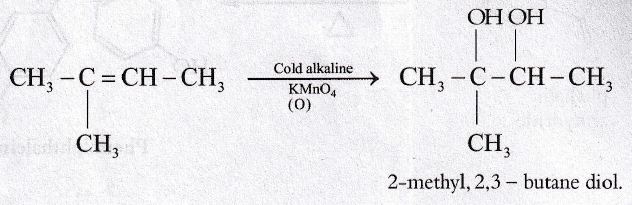
29.
(i) Cobalt (III) ion has greater tendency to form complexes than cobalt (II) ion. Therefore, Co (II) ion being stable in aqueous solution, changes to Co (III) ion in the presence of complexing reagents and get oxidised.
(ii) Ions of transition metals with d1 configuration tend to lose one electron to acquire d0 configuration that is quite stable. Therefore, such ions (with d1) undergo either oxidation or disproportionation, hence unstable.
30.
(i) Metallic oxides such as Cr2O3 can be reduced by an aluminothermic process.
(ii) In this process, the metal oxide is mixed with aluminum powder and placed in a fire clay crucible.
(iii)To initiate the reduction process, an ignition mixture (usually magnesium and barium peroxide is used
\({ BaO }_{ 2 }+Mg\longrightarrow Bao+MgO\)
(iv) During the above reaction a large amount of heat is evolved (temperature up to 2400°C, is generated and the reaction enthalpy is: 852 kJ mol-1 which facilitates the reduction of Cr2O3 by aluminium power.
\({ Cr }_{ 2 }{ O }_{ 3 }+2Al\overset { \Delta }{ \longrightarrow } 2Cr+{ Al }_{ 2 }{ O }_{ 3 }\)
31.
A hydride of 2nd period alkali metal (A) is lithium hydride (LiH).
Lithium hydride (A) reacts with diborane (B) to give lithium borohydride (C) which is acts as a reducing agent.
B2H6 + 2 LiH \(\xrightarrow[]{ether}\) 2 LiBH4
[Diborane (B)] [Lithium hydride (A)] [Lithium borohydride (C)]
Result:
| Compound | Formula | Name |
| A | LiH | Lithium hydride |
| B | B2H6 | Diborane |
| C | LiBH4 | Lithium borohydride |
32.
The greater the Eo value means greater is the tendency shown by the species to accepts I electrons and undergo reduction. So higher the (Eo) values lesser is the tendency to undergo corrosion.
33.
An carbonyl compound having molecular formula C5H10O giving positive iodoform test. It does not reduce Fehling solution.So it is 2- pentanone.
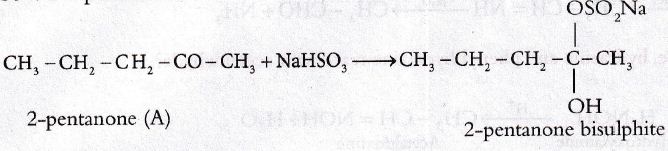
∴ (A) is 2-pentanone.
34.
35.
36.
\(\mathrm{Hg}_{2} \mathrm{Cl}_{2(\mathrm{~s})} \rightleftharpoons \mathrm{Hg}_{2}^{2+} \text { (aq) }+2 \mathrm{Cl^-}_{(\mathrm{aq})}\\ s \quad \quad \quad \quad \quad \quad s \quad \quad \quad \quad \quad 2s\)
\(\mathrm{K}_{\mathrm{sp}} =\left[\mathrm{Hg}_{2}^{2+}\right]{\left[\mathrm{Cl}^{-}\right]^{2}} \)
\(=(\mathrm{s})(2 \mathrm{~s})^{2} \)
\(\mathrm{~K}_{\mathrm{sp}} =4 \mathrm{~s}^{3}\)
37.
(i) Lewis acid: It is a species that accepts an electron pair. Eg: \(\mathrm{Ag}^{+} ; \mathrm{BF}_{3} ; \mathrm{A} / \mathrm{Cl}_{3}\)
(ii) Lewis base: It is a species that donates an electron pair. Eg: \( \mathrm{Cl}^{-} ; \mathrm{NH}_{3} ; \mathrm{H}_{2} \mathrm{O}\)
38.
Rate of a reaction at any time depends on the concentration of the reactants which keeps on decreasing with time.
39.
(i) SO2 present in the atmosphere dissolves in rain water and causes acid rain.
(ii) Acid rain destroys buildings, inhibits plant growth and also causes eye irritation in human.
40.
(i) An anionic complex compound contains a complex anion and simple cation.
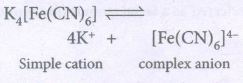
(ii) A cationic complex contains complex cation and simple anion
.JPG)
41.
It is essential to design an eco friendly metallurgical process that would minimize waste, maximize energy efficiency. Such advances in metallurgy is vital for the economic and technical progress in the current era.
42.
\(\mathrm{k}=\mathrm{Ae}^{-\mathrm{E}_{\mathrm{a}} / \mathrm{RT}}\)
\(\log \mathrm{k}=\frac{-\mathrm{E}_{\mathrm{a}}}{2.303 \mathrm{RT}}+\log \mathrm{A} \text { (or) } \log \mathrm{A}=\log \mathrm{k}+\frac{\mathrm{E}_{\mathrm{a}}}{2.303 \mathrm{RT}}\)
\(\mathrm{k}=1.8 \times 10^{-5} \mathrm{~s}^{-1} ;\)
\(\mathrm{Ea}=22.5 \mathrm{k} \mathrm{Cal} \mathrm{mol}^{-1}=22500 \mathrm{Cal} \mathrm{mol}^{-1} \)
\(\log A=\log \left(1.8 \times 10^{-5}\right)+\frac{22500}{2.303 \times 1.987 \times 313} \)
\(=\log 1.8-5 \log {10}+15.71 \)
\(=0.2553-5+15.71 \)
\(\log A=10.9653 \)
\(A=\text { Antilog } 10.9653 \)
\(=9.232 \times 10^{10} \text { collisions } \mathrm{s}^{-1} \text {. }\)
43.
The imperfection occurs due to missing atoms, displaced atoms or extra atoms, is named as a point defect. Such defects arise due to imperfect packing during the original crystallisation or they may arise from thermal vibrations of atoms at elevated temperatures.

12th Standard Syllabus & Materials
12th Standard
TN 12th Computer Applications வலையமைப்பு வடமிடல் Sample Question Papers Study Material - QB365 Set A
NEW12th Standard
TN 12th Computer Applications களப்பெயர் முறைமை (DNS) Sample Question Papers Study Material - QB365 Set A
NEW12th Standard
TN 12th Computer Applications வலையமைப்பு எடுத்துக்காட்டுகள் மற்றும் நெறிமுறைகள் Sample Question Papers Study Material - QB365 Set A
NEW12th Standard
TN 12th Computer Applications கணினி வலையமைப்பு ஓர் அறிமுகம் Sample Question Papers Study Material - QB365 Set A



Tamilnadu Stateboard 12th Standard Subjects

Maths
Chemistry

Physics

Biology

Computer Science

Business Maths and Statistics

Economics

Commerce

Accountancy

History

Computer Applications
Biology
Computer Technology
Computer Applications
Computer Science
Business Maths and Statistics
Commerce
Economics
Maths
Chemistry
Physics
Computer Technology
History
Accountancy

Tamil

English

French
Tamilnadu Stateboard Standards
