
 100% FREE ACCESS
12th Standard Syllabus & Materials
12th Standard
TN 12th Maths Applications of Matrices and Determinants Sample Question Papers Study Material - QB365 Set A
NEW12th Standard
TN 12th Computer Applications மின்னணு தரவு பரிமாற்றம் Sample Question Papers Study Material - QB365 Set A
NEW12th Standard
TN 12th Computer Applications மின் - வணிக பாதுகாப்பு அமைப்புகள் Sample Question Papers Study Material - QB365 Set A
NEW12th Standard
TN 12th Computer Applications மின்னணு செலுத்தல் முறைகள் Sample Question Papers Study Material - QB365 Set A
NEW12th Standard
TN 12th Computer Applications மின் - வணிகம் Sample Question Papers Study Material - QB365 Set A
NEW12th Standard
TN 12th Computer Applications திறந்த மூல கருத்துருக்கள் Sample Question Papers Study Material - QB365 Set A

Published on: 21/02/2020
12th Standard Chemistry Public Model Question Paper III 2020
Download Tamil Nadu 12th Standard Chemistry question papers, model tests, one-mark questions, important questions, and public exam papers in PDF format. Free study materials and answer keys for TN State Board students.
Questions + Answers key
Take MCQ Chemistry Test
1.
Nitro-acinitro tautomerism is exhibited by ____________
nitromethane
nitrobenzene
chloropicrin
o-toluidine
2.
The maximum work that can be derived from a chemical reaction is ______.
Wmax = ΔH
Wmax = ΔG
Wmax = ΔE
Wmax = ΔS
3.
Oxidation of ethylene glycol with HIO4 gives _______.
\(\overset { CHO }{ \underset { { CH }_{ 2 } }{ | } }\)
\(\overset { CH }{ \underset { CHO }{ | } } \)
\(\overset { COOH }{ \underset { COOH }{ | } } \)
HCHO
4.
The conjugate base of NH-2 is _______.
NH-
NH3
NH+3
NH2-
5.
Benzoic acid \(\overset { i){ NH }_{ 3 } }{ \underset { ii)\Delta }{ \longrightarrow } } A\overset { NaOBr }{ \longrightarrow } B\overset { NaN{ O }_{ 2 }/HCl }{ \longrightarrow } \) C 'C' is ______.
anilinium chloride
O – nitro aniline
benzene diazonium chloride
m– nitro benzoic acid
6.
Adsorption of a gas on solid metal surface is spontaneous and exothermic, then ______.
ΔH increases
ΔS increases
ΔG increases
ΔS decreases
7.
Using Gibb’s free energy change, ∆Go=57.34 kJ mol-1, for the reaction, X2Y(s)⇌2X++Y2- (aq), calculate the solubility product of X2Y in water at 300 K_______. (R = 8.3 J K-1Mol-1)
10-10
10-12
10-14
can not be calculated from the given dat
8.
The high reactivity of fluorine is due to________.
high ionisation energy
low bond dissociation energy
low electron affinity
high electro negativity
9.
A regular three dimensional arrangement of identical points in space is called _______.
Unit cell
Space lattice
Primitive
Crystallography
10.
Identify the metal that occurs in free state.
Al
Au
Mg
Ca
11.
For a first order reaction, the rate constant is 6.909 min-1 the time taken for 75% conversion in minutes is _______.
\(\left( \frac { 3 }{ 2 } \right) { \log 2 }\)
\(\left( \frac { 2 }{ 3 } \right) \log2\)
\(\left( \frac { 3 }{ 2 } \right) \log\left( \frac { 3 }{ 4 } \right) \)
\(\left( \frac { 2 }{ 3 } \right) \log\left( \frac { 4 }{ 3 } \right) \)
12.
Which one of the following complexes is not expected to exhibit isomerism?
[Ni(NH3)4(H2O)2]2+
[Pt(NH3)2Cl2]
[Co(NH3)5SO4]Cl
[FeCl6]3-
13.
Permanganate ion changes to ________ in acidic medium.
MnO42−
Mn2+
Mn3+
MnO2
14.
Which of the following statements is not correct?
Beryl is a cyclic silicate
Mg2SiO4 is an orthosilicate
SiO44−is the basic structural unit of silicates
Feldspar is not aluminosilicate
15.
Account for the following : For a strong electrolyte molar conductivity decreases as concentration increases
16.
What happens when a colloidal sol of Fe(OH)3 and As2S3 are mixed?
17.
Account for the acidic nature of HClO4 in terms of Bronsted – Lowry theory, identify its conjugate base.
18.
Mention the factors that affected the rate of a chemical reaction.
19.
Give the reason for bleaching action of Cl2.
20.
What is calcination? Give example.
21.
Give an example for the complexes possessing co-ordination number 8 and 7
22.
What is catenation ? describe briefly the catenation property of carbon.
23.
An organic compound 'A' on reduction gives compound 'B' which on reaction with trichloromethane and caustic potash forms 'C'. Compound 'C' on catalytic reduction given N-methyl benzenamine. Identify A, B and C and write the reactions involved.
24.
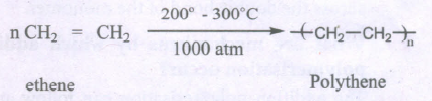
How is Low density polyethene prepared?
25.
Give the sources of vitamin A and E and list the deficiency disease caused by lack of vitamin A and E in diet.
26.
What is salt bridge? How is it represented in a cell diagram?
27.
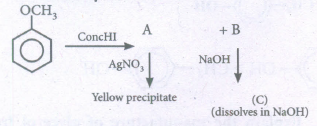
Complete the following sequence of reaction and Identify A, B and C.
28.
How will you convert acetylene into n-butyl alcohol.
29.
Is it possible to oxidise t – butyl alcohol using acidified dichromate to form a carbonyl compound.
30.
Will a precipitate be formed when 0.150 L of 0.1M Pb(NO3)2 and 0.100L of 0.2 M NaCl are mixed? \(K_{sp}\ (PbCl_{2})=1.2\times10^{-5}\).
31.
Complete the following equations.
(i) Cr2O72- + 2OH- ⟶
(ii) MnO4- + 4H+ + 3e- ⟶
32.
Write the complete set of reactions occurring in the zone of reduction in the blast furnace in the metallurgy of iron.
33.
Give any three characteristics of ionic crystals.
34.
A hydride of 2nd period alkali metal (A) on reaction with compound of Boron (B) to give a reducing agent (C). Identify A, B and C.
35.
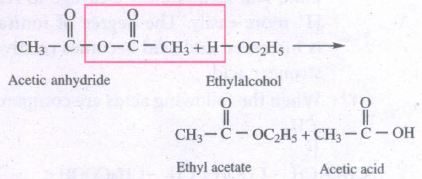
How will acetic anhydride react with the following reagents?
(i) HOH
(ii) C2H5OH
36.
Explain the various chemical methods by which colloids can be prepared.
37.
An alkene (A) on ozonolysis gives propanone and aldehyde (B). When (B) is oxidised (C) is obtained. (C) is treated with Br2/P gives (D) which on hydrolysis gives (E). When propanone is treated with HCN followed by hydrolysis gives (E). Identify A, B, C, D and E.
38.
Write a short note on the oxidation states of 3d series elements.
39.
An element 'A' occupies group number 15 and period number 3. It reacts with chlorine to give B which further reacts with chlorine to give C at 273K. Both B and C are chlorinating agents for organic compounds. C is a better chlorinating agent because it chlorinates metals also. Breasts with SO3 and reduces it to SO2 B has a pyramidal shape. C has trigonal bipyramidal shape by sp3d hybridisation. Identify the element A and the compounds B and C. Write the reactions.
40.
Ionic solids, which have anionic vacancies due to metal excess defect, develop colour. Explain with the help of a suitable example.
41.
What is meant by stability of a co-ordination compound in solution? State the factors which govern stability of complexes.
42.
From the following data, show that the decomposition of hydrogen peroxide is a reaction of the first order:
| t(min) | 0 | 10 | 20 |
| V(ml) | 46.1 | 29.8 | 19.3 |
Where t is the time in minutes and V is the volume of standard KMnO4 solution required for titrating the same volume of the reaction mixture.
1.
(a)
nitromethane
2.
(b)
Wmax = ΔG
3.
(d)
HCHO
4.
(d)
NH2-
5.

6.
ΔS is -ve
7.
(a)
10-10
8.
(b)
low bond dissociation energy
9.
(b)
Space lattice
10.
(b)
Au
11.
\(k=\frac { 2.303 }{ t } \log\frac { \left[ { A }_{ 0 } \right] }{ \left[ A \right] } \)
[A0] = 100: [A] = 25
\(6.909=\frac { 2.303 }{ t } \log\frac { \left[ {100 } \right] }{ \left[ 25\right] } \)
\(t =\frac { 2.303 }{ 6.909 } \log(4)\)
\(t =\frac { 1 }{ 3 } \log(2^2)\)
\(= \left( \frac { 2 }{ 3 } \right) \log2\)
12.
Option (a) and (b) -geometrical isomerism is possible
Option (c) - ionization isomerism is possible
Option (d) - no possibility to show either constitutional isomerism or stereo isomerism
13.
MnO-4 + 8H+ + 5e- → Mn2+ + 4H2O
14.
(d)
Feldspar is not aluminosilicate
15.
(i) For a strong electrolyte, at high concentration, the number of constituent ions of the electrolyte in a given volume is high and hence the attractive force between the oppositely charged ions is also high.
(ii) Moreover the ions also experience a viscous drag due to greater solvation.
(iii) These factors attribute for the low molar conductivity at high concentration.
16.
(i) Neutralisation of chargers of ion will taken place and hence precipitation will take place (ie) Fe3+ and S2- ion changes are neutralized. No new compounds are formed.
(ii) Fe(OH)3 is a positive Sol
(iii) As2S3 is a negative Sol
17.
\(\mathrm{HClO}_{4} \rightleftharpoons \mathrm{H}^{+}+\mathrm{ClO}_{4}^{-}\)
Bronsted Acid Proton Conjugate Base
HClO4 can donate a proton. Therefore HClO4 is an acid. Its conjugate base is ClO4-
18.
The rate of a reaction is affected by the following factors.
(i) Nature and state of the reactant
(ii) Concentration of the reactant
(iii) Surface area of the reactant
(iv) Temperature of the reaction
(v) Presence of a catalyst
19.
(i) Bleaching action of Cl2 is due to its oxidising property.
(ii) In aqueous solution, Cl2 liberates nascent oxygen which brings about the oxidation of coloured substances present in vegetables and organic matter to colourless substances.
\(\mathrm{Cl}_{2}+\mathrm{H}_{2} \mathrm{O} \rightarrow 2 \mathrm{HCl}+\mathrm{[O}]\)
Coloured substance +[O] → colorless substance.
20.
The conversion of ore into metal oxide (oxidation) is called calcination. It is the process in which the ore is subjected to the action of heat at high temperature in the absence of air below its melting point. Example
\({ CaCO }_{ 3 }(limestone)\longrightarrow CaO+{ CO }_{ 2 }\uparrow \)
\({ MgCO }_{ 3 }\left( Magnesite \right) \longrightarrow { MgO }+{ CO }_{ 2 }\uparrow \)
21.
(i) Complex with co-ordination number 8 - Cu2 [ZrF8].
(ii) Complex with co-ordination number 7 - (NH4)3[ZrF7].
22.
Catenation is an ability of an element to form chain of atoms.
The conditions for catenation.
(a) The valency of element is greater than or equal to two.
(b) Element should have an ability to bond with itself
(c) The self bond must be as strong as Its bond with other elements
(d) Kinetic inertness of catenated compound towards other molecules.
(e) Carbon possesses all the above properties and forms a wide range of compounds with itself and with other elements such as H, O, N, S and halogens.
23.
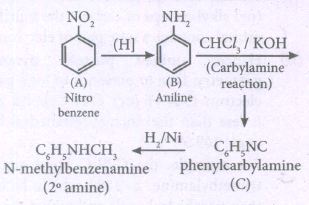
(i) A - C6H5NO2 - Nitro benzene
(ii) B - C6H5NH2 - Aniline
(iii) C - C6H5NC - Phenyl Carbylamine
24.
LDPE is formed by heating ethene at 200° to 300°C under oxygen as a catalyst. The reaction follows free radical mechanism. The peroxides formed from oxygen acts as a free radical initiator.
25.
| Vitamin | Sources | Deficiency Disease |
|---|---|---|
| Vitamin A (Retinol) | Liver oil, Fish, Carrot, Milk spinach and fruits such as Papaya and mango | Night blindness, Xerophthalmia Keratinisation of skin |
| VitaminE (Thiamine) |
Cotton seed oil, Sun flower oil, wheat germ oil, Vegetableoil | muscular dystrophy (muscular weakness) and neurological dysfunction |
26.
(i) In the complete cell diagram, the two half cells are separated by a double vertical line (salt bridge) in between.
(ii) The zinc-copper cell can now be written as
| salt bridge | ||||
| Zn | | Zn2+ | || | Cu2+ | Cu |
| ANODE HALF-CELL CATHODE | HALF-CELL | |||
27.
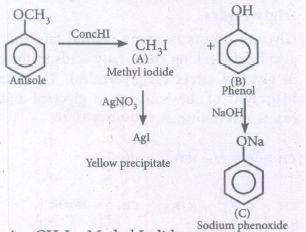
A - CH3I- Methyl Iodide
B - C6H5OH - Phenol
C - C6H5ONa - Sodium Phenoxide
28.
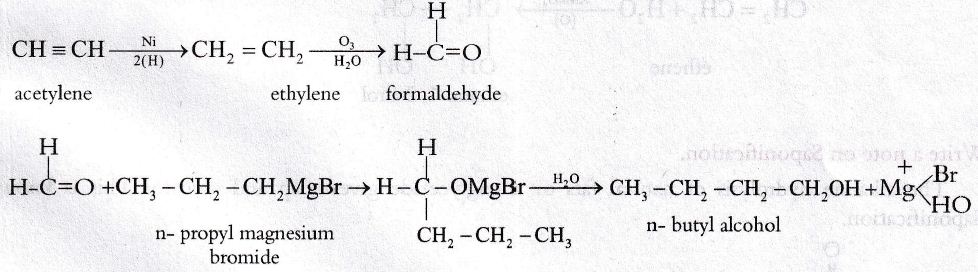
29.
Tertiary alcohols do not undergo oxidation reaction under normal conditions, but at elevated temperature under strong oxidizing, agent cleavage of C-C-bond takes place to give a mixture of carboxylic acid.
30.
When two are more solution are mixed, the resulting concentrations are different from the original.
\(\text { Molarity }=\frac{n}{\mathrm{~V}} \text { (or) } \mathrm{n}=\text { Molarity } \times \mathrm{v} \)
Total Volume of the mixture = 0.15 + 0.1
= 0.25 L
\(\underset{0.1M}{Pb(NO_{3})_{2}}\rightleftharpoons \underset{0.1M}{Pb^{2+}}+2\underset{0.2M}{2NO^{-}_{3}}\)
nPb2+ \(=0.1\times0.15=0.015 \ mol\)
\([Pb^{2+}]_{mix}= \frac{n}{v} = \frac{0.1\times0.15}{0.25}=0.06M\)
\(\underset{0.2M}{NaCl}\rightleftharpoons \underset{0.2M}{Na^{+}}+\underset{0.2M}{Cl^{-}}\)
\(\mathrm{n}_{\mathrm{Cl^-}}=0.2 \times 0.1=0.02 \mathrm{~mol} \)
\(\left[\mathrm{Cl}^{-}\right]_{\text {mix }}=\frac{0.02}{0.25}=0.08 \mathrm{M} \)
\(\therefore Ionic \ Product =\left[\mathrm{Pb}^{2+}\right]\left[\mathrm{Cl}^{-}\right]^{2} \)
\(=0.06 \times(0.08)^{2} \)
\(IP =3.84 \times 10^{-4}\)
\(\therefore 3.84 \times 10^{-4}>1.2 \times 10^{-5}\)
(or) \(\mathrm{IP}>\mathrm{K}_{\mathrm{sp}}\)
\(\therefore\) PbCl2 will be precipitated.
31.
(i) Cr2O72- + 2OH- ⟶ 2CrO42- + H2O
(ii) MnO4- + 4H+ + 3e- ⟶ MnO2 + 2H2O
32.
In Ellingham diagram, the graph of \(CO\rightarrow { CO }_{ 2 }\) conversion remains below \(Fe\rightarrow { Fe }_{ 2 }{ O }_{ 3 }\) upto 1073 K
(for Fe\(\longrightarrow \) FeO). SO, CO (g) act as reducing agent upto this temperature.
\(3{ Fe }_{ 2 }{ O }_{ 3 }+CO\longrightarrow 2{ Fe }_{ 3 }{ O }_{ 4 }\) (i.e. FeO.Fe2O3) + CO2
\({ Fe }_{ 3 }{ O }_{ 4 }+CO\longrightarrow 3Feo+{ CO }_{ 2 }\)
FeO + CO \(\longrightarrow \) Fe + CO2
Also, graph of C\(\longrightarrow \) CO is below the graph of
Fe \(\longrightarrow \)Fe2O3 after 1123 K. So, carbon acts as reducing agent above this temperature.
Fe2O3 + C\(\longrightarrow \) 3 CO + 2 Fe.
33.
(i) Ionic solids have high melting points.
(ii) These solids do not conduct electricity, because the ions are fixed in their lattice positions.
(iii) They are hard so strong external force can change the relative positions of ions.
34.
A hydride of 2nd period alkali metal (A) is lithium hydride (LiH).
Lithium hydride (A) reacts with diborane (B) to give lithium borohydride (C) which is acts as a reducing agent.
B2H6 + 2 LiH \(\xrightarrow[]{ether}\) 2 LiBH4
[Diborane (B)] [Lithium hydride (A)] [Lithium borohydride (C)]
Result:
| Compound | Formula | Name |
| A | LiH | Lithium hydride |
| B | B2H6 | Diborane |
| C | LiBH4 | Lithium borohydride |
35.
(i) Hydrolysis: Acid anhydride are slowly hydrolysed, by water to form corresponding carboxylic acids.
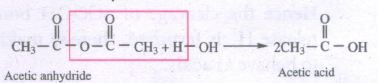
(ii) Reaction with alcohol:
36.
Condensation Methods:
Various chemical methods for the formation of colloidal particles.
(i) Oxidation:
Sols of some non-metals are prepared by this method. (a) When hydroiodic acid is treated with iodic acid, 12 sol is obtained.
\({ HIO }_{ 3 }+5HI\longrightarrow { 3H }_{ 2 }O+{ I }_{ 2 }\) (Sol)
(ii) Reduction:
Many organic reagents like phenyl hydrazine, formaldehyde, etc are used for the formation of sols. For example: Gold sol is prepared by reduction of auric chloride using formaldehyde.
\(2{ AuCl }_{ 3 }+3HCHO+{ 3H }_{ 2 }O\longrightarrow 2Au\left( sol \right) +6HCl+3HCOOH\)
(iii) Hydrolysis:
Sols of hydroxides of metals like chromium and aluminium can be produced by this method.
For example,
\({ FeCl }_{ 3 }+3H_{ 2 }O\longrightarrow Fe(OH)_{ 3 }+3HCl\)
(iv) Double decomposition:
For the preparation of water insoluble sols this method can be used. When hydrogen sulphide gas is passed through a solution of arsenic oxide, a yellow coloured arsenic sulphide is obtained as a colloidal solution.
\({ As }_{ 2 }{ O }_{ 3 }+3{ H }_{ 2 }S\longrightarrow { AS }_{ 2 }{ S }_{ 3 }+{ 3H }_{ 2 }O\)
(v) Decomposition:
When few drops of an acid is added to a dilute solution of sodium thio sulphate, the insoluble free sulphur produced by decomposition of sodium thiosulphate accumulates into small, clusters which impart various colours blue, yellow and even red to the system. depending on their growth within the size of colloidal dimensions.
\({ S }_{ 2 }{ O }_{ 3 }^{ 2- }+{ 2H }^{ + }\longrightarrow \underset{sol}S+{ H }_{ 2 }O+{ SO }_{ 2 }\)
By exchange of solvent:
(i) Colloidal solution of few substances like phosphorous or sulphur is obtained by preparing the solutions in alcohol and pouring them into water.
(ii) As they are insoluble in water, they form colloidal solution.
P in alcohol + water ⟶ Psol.
37.
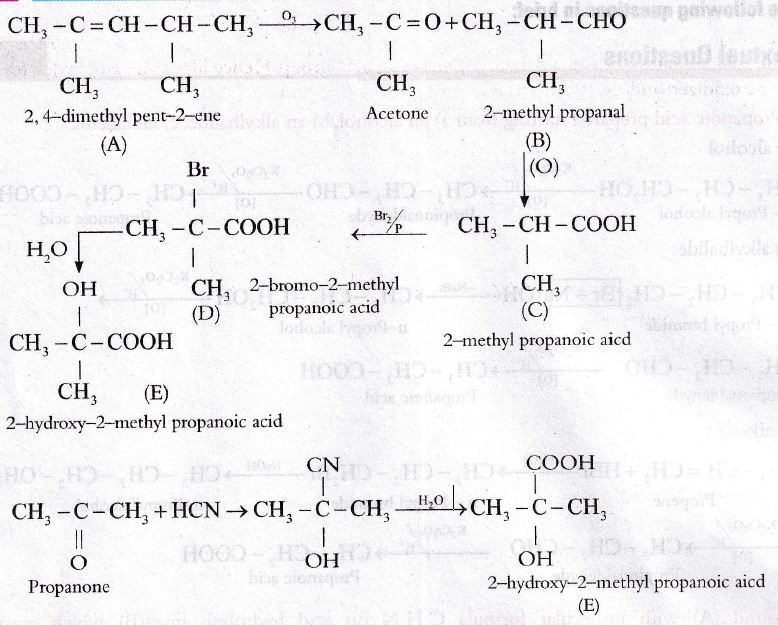
38.
(i) The first transition metal Scandium exhibits only +3 oxidation state, but all other transition elements exhibit variable oxidation states by loosing electrons from (n-1)d orbital and ns orbital as the energy difference between them is very small.
(ii) At the beginning of the series, +3 oxidation state is stable but towards the end +2 oxidation state becomes stable.
(iii) The number of oxidation states increases with the number of electrons available, and it decreases as the number of paired electrons increases.
(iv) Hence, the first and last elements show less number of oxidation states and the middle elements with more number of oxidation states.
(v) For example, the first element Sc has only one oxidation state +3; the middle element Mn has six different oxidation states from +2 to +7. The last element Cu shows +1 and +2 oxidation states only.
(vi) The relative stability of different oxidation - states of 3d metals is correlated with the extra stability of half filled and fully filled electronic configurations. Example: Mn2+(3d5) is more stable than Mn4+(3d3).
39.
(i) The element which occupies group number 15 and period number 3 is phosphorus. Therefore A is phosphorus. Phosphorus reacts with chlorine to give PCI3There fore compound B is phosphorus trichloride and it has a pyramidal shape.
P4 + 6Cl2 \(\longrightarrow \) 4PCl3
PCl3 further reacts with Cl2 to give PCl5
Therefore, the compound C is phosphorus pentachloride and it has a trigonal bipyramidal shape.
PCI + CI\(\longrightarrow \) PCI
Thus, A= Phosphorus
B = Phosphorus trichloride (PCI3)
C = Phosphorous pentachloride (PCI5)
40.
(i) The colour develops because of the presence of electrons in the 8 anionic sites.
(ii) These electron absorb energy from the visible region of radiation and get excited.
(iii) For example when crystals of NaCl are heated in an atmosphere of sodium vapours, the sodium atoms get deposited on the surface of the crystal and the deposited Na atoms.
(iv) During this process, the Na atoms on the surface lose electrons to form Na+ ions
(v) These electrons get excited by absorbing energy from the visible light and impart yellow colour to the crystals.
41.
The stability of a complex or co-ordination compound refers to the extent up to which it exists in a solution as co-ordination sphere.
(i) Change on the central metal ion: Greater the charge on the central metal ion, greater the stability of complex.
(ii) Nature of the metal ion: Group 3 and 6 and inner transition elements form stable complexes when donor atoms of the ligands are N, O and F. The elements after group 6 of the transition metals form stable complex when the donor atoms of the ligands are the heavier members of N, O and F family.
(iii) Basic nature of the ligands: Greater the basic strength, greater is the stability of the complex.
(iv) Presence of chelate rings: Its presence increases the stability of the complex. it is called chelate effect. It is maximum for the 5 and 6 membered rings.
(v) Effect of multidentate cyclic ligand: If the ligands are IT multidentate and cyclic without any steric effect the stability of the complex get increased.
42.
Volume of KMnO4 used is proportional to the amount of H2O2 present. If the reaction is of first order, it must obey the equation.
\(k=\frac { 2.303 }{ t } log\frac { \left[ { A } \right] _{ 0 }}{ \left[ A \right] } \)
(or) \(k=\left( \frac { 2.303 }{ t } \right) log\left( \frac { { V }_{ 0 } }{ { V }_{ 1 } } \right) \)
(i) \( \mathrm{V}_{\mathrm{o}}=46.1 \mathrm{~mL} ; \mathrm{t}=10 \mathrm{mins} ; \mathrm{V}_{\mathrm{t}}=29.8 \mathrm{~mL}\)
\(k =\frac{2.303}{10} \log \left(\frac{46.1}{29.8}\right) \)
\(=0.2303 \log 1.5469 \)
\(=0.2303 \times 0.1894=0.0436 \mathrm{~min}^{-1}\)
\(\mathrm{t}=20 \mathrm{mins} ; \mathrm{V}_{\mathrm{t}}=19.3 ; \mathrm{V}_{\mathrm{o}}=46.1 \mathrm{~mL} \)
\(k =\frac{2.303}{20} \log \left(\frac{46.1}{19.3}\right) \)
\(=0.11515 \times \log 2.388 \)
\(=0.11515 \times 0.3780 \)
\(=0.0435 \mathrm{~min}^{-1}\)
Since the value of k comes out to be almost constant for the reaction, it is of first order. The mean value of k = 0.04355 min-1

12th Standard Syllabus & Materials
12th Standard
TN 12th Computer Applications வலையமைப்பு வடமிடல் Sample Question Papers Study Material - QB365 Set A
NEW12th Standard
TN 12th Computer Applications களப்பெயர் முறைமை (DNS) Sample Question Papers Study Material - QB365 Set A
NEW12th Standard
TN 12th Computer Applications வலையமைப்பு எடுத்துக்காட்டுகள் மற்றும் நெறிமுறைகள் Sample Question Papers Study Material - QB365 Set A
NEW12th Standard
TN 12th Computer Applications கணினி வலையமைப்பு ஓர் அறிமுகம் Sample Question Papers Study Material - QB365 Set A



Tamilnadu Stateboard 12th Standard Subjects

Maths
Chemistry

Physics

Biology

Computer Science

Business Maths and Statistics

Economics

Commerce

Accountancy

History

Computer Applications
Biology
Computer Technology
Computer Applications
Computer Science
Business Maths and Statistics
Commerce
Economics
Maths
Chemistry
Physics
Computer Technology
History
Accountancy

Tamil

English

French
Tamilnadu Stateboard Standards
