
 100% FREE ACCESS
12th Standard Syllabus & Materials
12th Standard
TN 12th Maths Applications of Matrices and Determinants Sample Question Papers Study Material - QB365 Set A
NEW12th Standard
TN 12th Computer Applications மின்னணு தரவு பரிமாற்றம் Sample Question Papers Study Material - QB365 Set A
NEW12th Standard
TN 12th Computer Applications மின் - வணிக பாதுகாப்பு அமைப்புகள் Sample Question Papers Study Material - QB365 Set A
NEW12th Standard
TN 12th Computer Applications மின்னணு செலுத்தல் முறைகள் Sample Question Papers Study Material - QB365 Set A
NEW12th Standard
TN 12th Computer Applications மின் - வணிகம் Sample Question Papers Study Material - QB365 Set A
NEW12th Standard
TN 12th Computer Applications திறந்த மூல கருத்துருக்கள் Sample Question Papers Study Material - QB365 Set A

Published on: 21/02/2020
12th Standard Chemistry Public Model Question Paper IV 2019 - 2020
Download Tamil Nadu 12th Standard Chemistry question papers, model tests, one-mark questions, important questions, and public exam papers in PDF format. Free study materials and answer keys for TN State Board students.
Questions + Answers key
Take MCQ Chemistry Test
1.
Amine that cannot be prepared by Gabriel Phthalimide synthesis is ___________
benzyl amine
methyl amine
ethyl amine
phenyl amine
2.
Insulin is an example of_______hormone.
paracrine
endocrine
autocrine
none of the above
3.
An example of secondary cell is ________.
Daniel cell
galvanic cell
lead acid accumulator
dynam
4.
The test used to distinguish wish 1o, 2o and 3o alcohol is ________.
Lucas test
Victor Meyer's
dehydrogenation
all the above
5.
Degree of dissociation a is _______.
\(\alpha =\frac { { K }_{ a } }{ C } \)
\(\alpha =\frac { { C }^{ 2 } }{ { K }_{ a } } \)
\(\alpha =\sqrt { \frac { { K }_{ a } }{ C } } \)
\(\alpha =\sqrt { \frac { C }{ { K }_{ a } } } \)
6.
Which one of the following reaction is an example of disproportionation reaction.
Aldol condensation
cannizaro reaction
Benzoin condensation
none of these
7.
8.
Conjugate base for Bronsted acids H2O and HF are _______.
OH- and H2FH+, respectively
H3O+ and F-, respectively
OH- and F-, respectively
H3O+ and H2F+, respectively
9.
The ionisation energy of Ga is higher than that of Al because of_________
more effective nuclear charge of Ga
smaller atomic size of Ga
larger size of Ga
both (a) and (b)
10.
If electrical conductivity is found to be same in all directions through a solid the substance is ________ solid and the property is called _________.
crystalline, isotropy
amorphous, isotropy
crystalline, anisotropy
amorphous, isotropy
11.
Which of the following is commonly used to produce foam in froth floatation process?
Pine oil
Cresol
NaCN
Xanthate
12.
What is the activation energy for a reaction if its rate doubles when the temperature is raised from 200K to 400K? (R = 8.314 JK-1 mol-1)
234.65 kJ mol-1
434.65 kJ mol-1
2.305 kJ mol-1
334.65 J mol-1
13.
An excess of silver nitrate is added to 100ml of a 0.01M solution of Pentaaquachlorochromium (III)chloride. The number of moles of AgCl precipitated would be _______.
0.02
0.002
0.01
0.2
14.
Which one of the following is not correct?
La(OH)3 is less basic than Lu(OH)3
In lanthanoid series ionic radius of Ln3+ ions decreases
La is actually an element of transition metal series rather than lanthanide series
Atomic radii of Zr and Hf are same because of lanthanide contract
15.
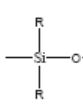
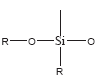
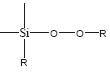
The repeating unit in silicone is_______.
SiO2
16.
Write a note on structure of amine.
17.
Name two water soluble vitamins, their sources, function and diseases caused due to their deficiency in diet.
18.
Give the structure of melamine formaldehyde resin.
19.
Halo alkane are easily prepared from alcohols while alkyl halides cannot be prepared from phenol. Justify.
20.
What is the oxidation and reduction half cell in a Daniel cell?
21.
Calculate i) degree of hydrolysis, ii) the constant hydrolysis and iii) pH of 0.1M CH3COONa solution (pKa for CH3COOH is 4.74).
22.
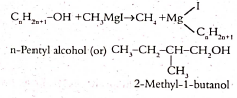
0.44g of a monohydric alcohol when added to methyl magnesium iodide in ether liberates at STP 112 cm3 of methane with PCC the same alcohol form a carbonyl compound that answers silver mirror test. Identify the compound.
23.
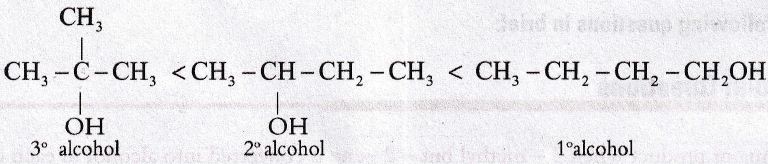
Arrange the following in the increasing order of their boiling point and give a reason for your ordering
(i) Butan – 2- ol, Butan -1-ol, 2 –methylpropan -2-ol
(ii) Propan -1-ol, propan -1,2,3-triol, propan -1,3 – diol, propan -2-ol
24.
Give reason for the following:
(i) A transition metal exhibits highest oxidation state in oxides and fluorides.
(ii) Cu2+ is unstable in an aqueous solution.
25.
List the applications of gold.
26.
A first order reaction is 40% complete in 50 minutes. Calculate the value of the rate constant. In what time will the reaction be 80% complete?
27.
Give any three characteristics of ionic crystals.
28.
How will you convert boric acid to boron nitride?
29.
What is the anode, cathode and electrolyte of a mercury button cell?
30.
How will you convert benzaldehyde into the following compounds?
(i) benzophenone
(ii) benzoic acid
(iii) α-hydroxyphenylaceticacid.
31.
When aqueous ammonia is added to CuSO4 solution, the solution turns deep blue due to the formation of tetra ammine copper (II) complex,\({ [Cu({ H }_{ 2 }O)_4] }_{ (aq) }^{ 2+ }+ 4{ NH }_{ 3 }(aq)\rightleftharpoons { [Cu{ ({ NH }_{ 3 }) }_{ 4 }] }_{ (aq) }^{ 2+ }\) among H2O and NH3 Which is stronger Lewis base.
32.
H2(g) + Cl2(g) \(\overset { hv }{ \longrightarrow } \) 2HCl(g). The reaction proceeds with a uniform rate throughout. What do you conclude?
33.
How would you account for the following? The electron gain enthalpy with negative sign is less for oxygen than that of sulphur.
34.
What are stereoisomers?
35.
Discuss the use of an acidic flux in metallurgy.
36.
An aromatic aldehyde (A) of molecular formula C7H6O which has the smell of bitter almonds on treatment with (CH3CO)2O and CH3COONa to give compound (B) which is an aromatic unsaturated add. (A) also reacts with (A) in the presence of ale. KCN to give dimer (C). Identify (A), (B) and (C). Explain the reactions.
37.
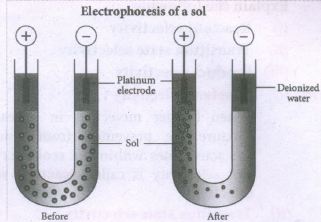
Name the method to deduce the charge of the sol particle. Explain it with a neat diagram.
38.
What are the factors which influence the adsorption of a gas on a solid?
39.
How are materials classified based on their magnetic properties?
40.
Why is dioxygen a gas but sulphur a solid?
41.
How are crystals classified?
42.
Give the IUPAC name for the following compounds.
(i) [Ag(NH3)2]CI
(ii) K3[Fe(CN)5NO]
(ill) [Cr(PPh3)(CO)3]
(iv) [Ag(NH3)2]+
(v) [FeF6]4-
1.
(d)
phenyl amine
2.
(b)
endocrine
3.
(c)
lead acid accumulator
4.
(d)
all the above
5.
(c)
\(\alpha =\sqrt { \frac { { K }_{ a } }{ C } } \)
6.
(b)
cannizaro reaction
7.
(b)
8.
H2O + H2O ⇌ H3O+ + OH-
acid 1 base 1 acid 2 base 2
HF + H2O ⇌ H3O+ + F-
acid 1 base 1 acid 2 base 2
∴ Conjugate bases are OH- and F- respectively.
9.
(d)
both (a) and (b)
10.
(b)
amorphous, isotropy
11.
(a)
Pine oil
12.
T1= 200 K ; k = k1
T2 =400 K ; k1 = k2 = 2k1
log\(\frac {{ k }_{ 2 } }{ { k }_{ 1 } } =\frac { { E }_{ a } }{ 2.303R } \left[ \frac { { T }_{ 2 }-{ T }_{ 1 } }{ { T }_{ 1 }{ T }_{ 2 } } \right] \)
log \( [\frac {{2 k }_{ 1 } }{ { k }_{ 1 } }]\)
\(= \left[ \frac { E_{a} }{ 2.303\times 8.314 JK^{-1} mol^{-1} } \right] \)
\(= \left[ \frac { 400 k - 200K }{200 k \times 400 k } \right] \)
\(E_{a} = \frac{ 0.3010 \times 2.303 \times 8.314 JK^{-1}mol^{-1} \times 200K \times 400 K}{200 K}\)
Ea = 2305 J mol-1
Ea = 2.305 kJ mol-1
13.
The complex is [M(H2O)5Cl]Cl2
1000 ml of 1 M solution of the complex gives 2 moles of Cl- ions 1000 ml of 0.01 M solution of the complex will give
\(\frac{100 ml \times 0.01M \times 2Cl^-}{1000 ml \times 1M}\)
= 0.002 moles of Cl- ions
14.
(a)
La(OH)3 is less basic than Lu(OH)3
15.
(b)
16.
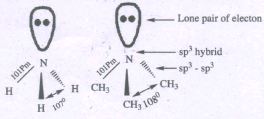
Structure of amines:
(i) Like, ammonia, nitrogen atom of amines is trivalent and carries a lone pair of electron and sp3 hybridised, out of the four sp3 hybridised orbitals of nitrogen, three sp3 orbitals overlap with orbitals of hydrogen (or) alkyl groups of carbon, the fourth sp3 orbital contains a lone pair of electron.
(ii) Hence, amines possess pyramidal geometry. Due to presence of lone pair of electron C-N-H (or) C-N-C bond angle is less than the normal tetrahedral bond angle 109.5°.
For example, the C-N-C bond angle of trimethylamine is 108° which is lower than tetrahedral angle and higher than the H-N-H bond angle of 107°.
(iii) This increase is due to the repulsion between the bulky methyl groups.
17.
| Vitamin | Sources | Functions | Deficiency Disease |
|---|---|---|---|
|
Vitamin B12 |
Egg, Meat, Fish | Co-enzyme in amino acid metabolism, Red blood cells maturation | Pernicious Anaemia |
| Vitamin C (Ascorbic acid) | Citrus fruits (Orange, Lemon etc ... ), Tomato Arnla, Leafy Vegetables | Coenzyme in Antioxidant, building of collagen | Scurvy (bleeding gums) |
18.
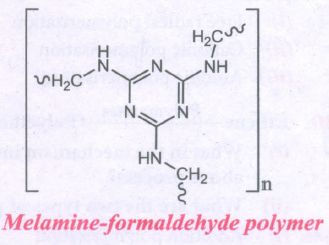
19.
(i) Alcohols are weakly basic in nature so easily in presence of strong acids.
(ii) Due to the presence of +ve charge on the oxygen atom, C-O in protonated alcohols became weak hence easily cleaved by halide ions to form alkyl halides.
(iii) Where as phenols are much weaker bases due to delocalisation of the lone pair of electrons on the oxygen atom due to resonance and so are not easily protonated.
(iv) The C-O bond in phenols has some double bond character; hence not easily cleaved by halide ions to form respective alkyl halides.
20.
Oxidation half cell : A metallic zinc strip that dips into an aqueous solution of zinc sulphate taken in a beaker.
Reduction half cell : A copper strip that dips into an aqueous solution of copper sulphate taken in a beaker.
21.
(a) CH3COONa is a salt of weak acid
(CH3COOH) and a strong base (NaOH).
Hence, the solutions is alkaline due to hydrolysis.
\(CH_{3}COO^{-}_{(aq)}+H_{2}O_{(aq)}\rightleftharpoons CH_{3}COOH_{(aq)}+OH^{-}_{(aq)}\)
(i)\(h=\sqrt{\frac{K_{w}}{K_{a}\times C}}\)
Given that pKa =4.74
pKa = -log Ka
ie., Ka = antilog of (-pKa)
= antilog of (-4.74)
= antilog of (-5 + 0.26)
= 10-5 \(\times\) 1.8 = 1.8 \(\times\) 10-5
[antilog of 0.26 = 1.82 \( \simeq\) 1.8]
\(\therefore\) h=\(\sqrt{\frac{1\times10^{-14}}{1.8\times10^{-5}\times0.1}}\)
h = 7.5 x 10⁻⁵
(ii) \(K_{h}=\frac{K_{w}}{K_{a}}=\frac{1\times10^{-14}}{1.8\times10^{-5}}\)
\(=5.56\times10^{-10}\)
iii) \(pH=7+\frac{pK_{a}}{2}+\frac{logC}{2}\)
= \(7+\frac{4.74}{2}+\frac{log0.1}{2}\)
= 7 + 2.37 - 0.5
= 8.87
22.
Mass = 0.44 g
No. of moles = Given Volume/Molar Volume = 112/22400
Molar Mass = 0.44/112 x 22400 = 88g
CnH2n+1 + OH = 88
12n+ (1)(2n+1) + 16 +1 = 88
14n + 18 = 88
14n = 88 - 18
n =70/14 = 5

Pentanoicacid
23.
(i) 2-methyl propan-2-o1 < Butan-2-ol < Butan-1-ol
(ii) propan-2-ol < propan-1-ol < propan -1,3- diol < propan-1,2,3-triol
24.
(i) The highest oxidation state in oxides and fluorides is due to small size and high electro negativity of F and O.
(ii) Many Cu+ compounds are unstable in aqueous solution and undergo disproportionation.
2Cu+ ⟶ Cu2++ Cu
This suggest that in aqueous solution Cu+(aq), converts into Cu2+(aq) which is due to much more negative Δhyd H- of Cu2+(aq) than Cu+, which compensates more for the second ionisation enthalpy of Cu.
25.
(i) Gold, one of the expensive and precious metals. It is used for coinage, and has been used as standard for monetary systems in some countries.
(ii) It is used extensively in jewellery in its alloy form with copper.
(iii) It is also used in electroplating to cover other metals with a thin layer of gold which are used in watches, artificial limb joints, cheap jewellery, dental fillings and electrical connectors.
(iv) Gold nanoparticles are also used for increasing the efficiency of solar cells and also used an catalysts.
26.
Let \(\left[A_{0}\right]=100 \%\), t = 50 minutes
Then [A]=100 - 40 = 60 %
(1) \(\mathrm{k}=\frac{2.303}{\mathrm{t}} \log \frac{\left[\mathrm{A}_{\mathrm{o}}\right]}{[\mathrm{A}]}\)
\(=\frac{2.303}{50} \log \left(\frac{100}{60}\right) \)
\(=\frac{2.303}{50} \log 1.667 \)
\(=\frac{2.303}{50} \times 0.2219 \)
\(\mathrm{k}=0.010216 \mathrm{~min}^{-1} \)
\(\mathrm{k}=1 \times 10^{-2} \mathrm{~min}^{-1}\)
(2) \( t =\frac{2.303}{0.010216} \log \left(\frac{100}{20}\right) \)
\(t =\frac{2.303}{{0.010216}}\times 0.6990\)
= 225.43 \(\times \) 0.6990
t = 157.58 min.
The time at which the reaction will be 80% complete is 157.58 min.
27.
(i) Ionic solids have high melting points.
(ii) These solids do not conduct electricity, because the ions are fixed in their lattice positions.
(iii) They are hard so strong external force can change the relative positions of ions.
28.
Fusion of urea with B(OH)3' in an atmosphere of ammonia at 800 - 1200 K gives boron nitride.
B(OH)3 + NH3 \(\overset { \Delta }{ \longrightarrow } \) BN+ 3H2O
29.
(i) Anode: Zinc amalgamated with mercury
(ii) Cathode: HgO mixed with graphite
(iii) Electrolyte: Paste of KOH and ZnO
30.
.JPG)
(ii) benzoic acid
.JPG)
(iii) α - hydroxyphenylaceticacid.
.JPG)
31.
(i) According to Lewis theory a species that donates a pair of electron is called Lewis base.
(ii) Nitrogen more in NH3 is less electro negative than oxygen in water. So the non - bonded electron pair on nitrogen is more available for sharing than a non - bonded electron pair on oxygen atom. So NH3 is a stronger lewis base than H2O.
32.
The reaction is a zero order reaction whose rate is independent on the concentration of reactants.
33.
(i) The electron gain enthalpy for oxygen is less negative because of its small size due to which the electron repulsions in the relatively small 2p-subshell are comparatively large.
(ii) Hence the Incoming electrons are not accepted with the same ease as in case of sulphur as it has relatively large size.
34.
(i) The stereoisomers of a coordination compound have the same chemical formula and connectivity between the central metal atom and the ligands.
(ii) But they differ in the spatial arrangement of ligands in three dimensional space. They can be further classified as geometrical isomers and optical isomers.
35.
SiO2 is used in the metallurgy of copper to remove FeO as FeSiO3 (slag) (i.e) acidic flux is used to remove basic impurities.
\(FeO+{ SiO }_{ 2 }\longrightarrow { FeSiO }_{ 3 }\)
36.
(i) An organic compound which has the smell of bitter almonds is benzaldehyde C6H5CHO and it is (A).
(ii) Benzaldehyde reacts with acetic anhydride in the presence of sodium acetate gives Cinnamic acid.
\(\underset { (A) }{ { C }_{ 6 }{ H }_{ 5 }CHO } +\left( { CH }_{ 3 }CO \right) _{ 2 }O\overset { { CH }_{ 3 }COONa }{ \longrightarrow } \underset { (B) }{ { C }_{ 6 }{ H }_{ 5 }CH=CHCOOH } +{ CH }_{ 3 }COOH\)
(iii) Benzaldehyde on treatment with alcoholic KCN gives Benzoin a dimer and it is (C).
| Compound | Compound Name | Formula |
| A | Benzaldehyde | C6H5CHO |
| B | Cinnamic acid | C6H5CH=CHCOOH |
| C | Benzoin | \({ C }_{ 6 }{ H }_{ 5 }\underset { \overset { | }{ OH } }{ CH } -\underset { \overset { || }{ O } }{ C } -{ C }_{ 6 }{ H }_{ 5 }\) |
37.
Electrophoresis:
(i) When electric potential is applied across two platinum electrodes dipped in a hydrophilic sol, the dispersed particles move toward one or other electrode.
(ii) This migration of sol particles under the influence of electric field is called electrophoresis or cataphoresis.
(iii) If the sol particles migrate to the cathode, then they posses positive (+) charges, and if the sol particles migrate to the anode then they have negative charges(-).
(iv) Thus from the direction of migration of sol particles we can determine the charge of the sol particles.
(v) Hence electrophoresis is used for detection of presence of charges on the sol particles
38.
Factors affecting adsorption
Qualitatively, the extent of surface adsorption depends on
(i) Nature of adsorbent
(ii) Nature of adsorbate
(iii) Pressure
(iv) Concentration at a given temperature.
1. Surface area of adsorbent:
As the adsorption is a surface phenomenon it depends on the surface area of adsorbent. i.e., higher the surface area, higher is the amount adsorbed.
2. Nature of adsorbate:
The nature of adsorbate can influence the adsorption. Gases like SO2, NH3, HCl and CO2 are easily liquefiable as have greater vander waal's force of attraction. On the other hand, permanent gases like H2, N2 and O2 cannot be liquefied easily. These permanent gases are having low critical temperature and adsorbed slowly, while gases with high critical temperature are adsorbed readily.
3. Effect of temperature:
When temperature is raised chemisorption first increases and then decreases. whereas physisorption decreases with increases in temperature.
4. Effect of Pressure:
Chemical adsorption is fast with increase in pressure, it cannot alter the amount of adsorption. In physisorption, the extend of adsorption increases with increase in pressure.
39.
On the basis of magnetic properties, materials can be broadly classified as
(a) paramagnetic materials
(b) diamagnetic materials, besides these there are ferromagnetic and antiferromagnetic materials
(i) Materials with no elementary magnetic dipoles are diamagnetic, in other words a species with all paired electrons exhibits diamagnetism.
(ii) This kind of materials are repelled by the magnetic field because the presence of external magnetic field, a magnetic induction is introduced to the material which generates weak magnetic field that oppose the applied field
(iii) Paramagnetic solids having unpaired electrons possess magnetic dipoles which are isolated from one another.
(iv) In the absence of external magnetic field, the dipoles are arranged at random and hence the solid shows no net magnetism.
(v) But in the presence of magnetic field, the dipoles are aligned parallel to the direction of the applied field and therefore, they are attracted by an external magnetic field.
(vi) Ferromagnetic materials have domain structure and in each domain the magnetic dipoles are arranged.
(vii) But the spin dipoles of the adjacent domains are randomly oriented.
(viii) Some transition elements or ions with unpaired d electrons show ferromagnetism.
40.
(i) O2 molecules are held together by weak Vander Waal's force because of small size and high electronegativity of oxygen.
(ii) In contrast, sulphur shows catenation and forms stronger S-S bonds.
(iii) Due to catenation, sulphur forms octa-atomic S8 molecules having eight membered puckered ring structure.
(iv) Because of its bigger size the force of attraction holding S8 molecules are much stronger.
(v) Hence sulphur is a solid at room temperature or in other words, that is why there is a large difference between the boiling point (also melting points) of the two elements.
41.
Crystal defects are classified as follows
(i) Point defects
(ii) Line defects
(iii) Interstitial defects
(iv) Volume defects
Point defects are further classified as follows
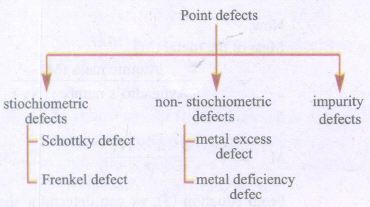
42.
(i) Diamminesilver(I) chloride
(ii) Potassiumpentacyanidonitrosylferrate(II)
(iii) Ptricarbonyltriphenylphosphanechromium(O)
(iv) diamminesilver(I) ion
(v) Hexafluoridoferrate(II) ion.

12th Standard Syllabus & Materials
12th Standard
TN 12th Computer Applications வலையமைப்பு வடமிடல் Sample Question Papers Study Material - QB365 Set A
NEW12th Standard
TN 12th Computer Applications களப்பெயர் முறைமை (DNS) Sample Question Papers Study Material - QB365 Set A
NEW12th Standard
TN 12th Computer Applications வலையமைப்பு எடுத்துக்காட்டுகள் மற்றும் நெறிமுறைகள் Sample Question Papers Study Material - QB365 Set A
NEW12th Standard
TN 12th Computer Applications கணினி வலையமைப்பு ஓர் அறிமுகம் Sample Question Papers Study Material - QB365 Set A



Tamilnadu Stateboard 12th Standard Subjects

Maths
Chemistry

Physics

Biology

Computer Science

Business Maths and Statistics

Economics

Commerce

Accountancy

History

Computer Applications
Biology
Computer Technology
Computer Applications
Computer Science
Business Maths and Statistics
Commerce
Economics
Maths
Chemistry
Physics
Computer Technology
History
Accountancy

Tamil

English

French
Tamilnadu Stateboard Standards
