
 100% FREE ACCESS
12th Standard Syllabus & Materials
12th Standard
TN 12th Computer Applications மின்னணு தரவு பரிமாற்றம் Sample Question Papers Study Material - QB365 Set A
NEW12th Standard
TN 12th Computer Applications மின் - வணிக பாதுகாப்பு அமைப்புகள் Sample Question Papers Study Material - QB365 Set A
NEW12th Standard
TN 12th Computer Applications மின்னணு செலுத்தல் முறைகள் Sample Question Papers Study Material - QB365 Set A
NEW12th Standard
TN 12th Computer Applications மின் - வணிகம் Sample Question Papers Study Material - QB365 Set A
NEW12th Standard
TN 12th Computer Applications திறந்த மூல கருத்துருக்கள் Sample Question Papers Study Material - QB365 Set A
NEW12th Standard
TN 12th Computer Applications வலையமைப்பு வடமிடல் Sample Question Papers Study Material - QB365 Set A

Published on: 21/02/2020
12th Standard Chemistry Public Model Question Paper IV 2020
Download Tamil Nadu 12th Standard Chemistry question papers, model tests, one-mark questions, important questions, and public exam papers in PDF format. Free study materials and answer keys for TN State Board students.
Questions + Answers key
Take MCQ Chemistry Test
1.
Which one of the following is a secondary amine?
aniline
diphenyl amine
see.butylamine
tert.butylamine
2.
Using the data given below find out the strongest reducing agent ______.
\({ E }_{ { Cr }_{ 2 }{ O }_{ 7 }^{ 2- } }^{ o }{ Cr }^{ 3+ }=1.33V{ ,E }_{ { Cl }_{ 2 }{ / }{ Cl }^{ - } }^{ o }=1.36V\)
\({ E }_{ { Mn }O_{ 4 }^{ - } }^{ 0 }/{ Mn }^{ 2+ }=1.51V,{ E }_{ { Cr }^{ 3+ }/Cr }^{ o }=-0.74V\)
Cr
Cr3+
Cl-
Mn2+
3.
The hydrogen ion concentration of a buffer solution consisting of a weak acid and its salt is given by _______.
\([{ H }^{ + }]={ K }_{ a }\frac { [Acid] }{ [Salt] } \)
\([{ H }^{ + }]={ K }_{ a }[Salt]\)
\([{ H }^{ + }]={ K }_{ a }[Salt]\)
\([{ H }^{ + }]={ K }_{ a }\frac { [Acid] }{ [Salt] } \)
4.
Ethers are insoluble in water due to the ______.
absence of co-ordinate bond
presence of co-ordinate bond
absence of H - bond
presence of H - bond
5.
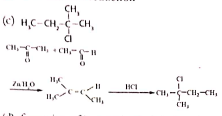
An alkene “A” on reaction with O3 and Zn - H2O gives propanone and ethanol in equimolar ratio. Addition of HCl to alkene “A” gives “B” as the major product. The structure of product “B” is ______.
\(Cl-{ CH }_{ 2 }-CH_{ 2 }-\overset { \overset { CH_{ 3 } }{ | } }{ \underset { \underset { CH_{ 3 } }{ | } }{ CH } } \)
\({ H }_{ 3 }C-{ CH }_{ 2 }-\overset { \overset { CH_{ 2 }Cl }{ | } }{ CH } -{ CH }_{ 3 }\)
\(\\ { H }_{ 3 }C-{ CH }_{ 2 }-\overset { \overset { CH_{ 3 } }{ | } }{ \underset { \underset { CL{ } }{ | } }{ C } } -{ CH }_{ 3 }\)
\({ H }_{ 3 }C-{ CH }-\overset { \overset { CH_{ 3 } }{ | } }{ \underset { \underset { Cl }{ | } }{ C } } \)
6.
The phenomenon observed when a beam of light is passed through a colloidal solution is_______.
Cataphoresis
Electrophoresis
Coagulation
Tyndall effect
7.
Which of the following can act as Lowery – Bronsted acid well as base?
HCl
SO42−
HPO42−
Br-
8.
Repeated use of which one of the following fertilizers would increase the activity of the soil_______.
Ammonium sulphate
Superphosphate of lime
Urea
Potassium nitrate
9.
The number of close neighbours in a body centred cubic lattice of identifical spheres is _______.
6
4
12
8
10.
In acid leaching process the insoluble sulphide is converted into soluble sulphate and elemental_______.
carbon
lead
sulphur
zinc
11.
The half life period of a radioactive element is 140 days. After 560 days, 1 g of element will be reduced to
\(\left( \frac { 1 }{ 2 } \right) g\)
\(\left( \frac { 1 }{ 4 } \right) g\)
\(\left( \frac { 1 }{ 8 } \right) g\)
\(\left( \frac { 1 }{ 16 } \right) g\)
12.
A magnetic moment of 1.73BM will be shown by one among the following.
TiCl4
[CoCl6]4-
[Cu(NH3)4]2+
[Ni(CN)4]2-
13.
The magnetic moment of Mn2+ ion is _______.
5.92BM
2.80BM
8.95BM
3.90BM
14.
Oxidation state of carbon in its hydrides _______.
+4
-4
+3
+2
15.
Write a note on structure of amine.
16.
17.
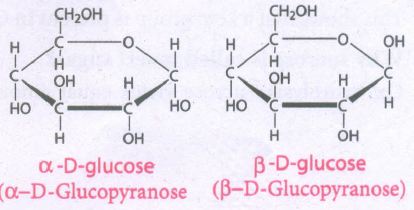
Give the structure of α - D - glucose and β- D - glucose
18.
How to predict the feasibility of a cell reaction?
19.
Account for the following:
(a) Lower members of alcohols are soluble in water but higher members are not.
(b) Alcohols cannot be used as solvent for Grignard reagent.
20.
Suggest a suitable reagent to prepare secondary alcohol with identical group using Grignard reagent.
21.
What is chromyl chloride test? Give equations.
22.
Examine the given defective crystal:
| X+ | Y- | X+ | Y- | X+ |
| Y- | O | X+ | ||
| X+ | X+ | O | X+ | |
| Y- | X+ | Y- | X+ | Y- |
Answer the following questions
(i) Is the above defect stoichiometric or non-stoichiometric?
(ii) What are such defects called? Give an example of the compound which shows this type of defect.
23.
Write the chemical composition of the following alloys and give anyone of its application.
(i) Bronze
(ii) Brass
(iii) Stainless steel
24.
How do nature of the reactant influence rate of reaction.
25.
A hydride of 2nd period alkali metal (A) on reaction with compound of Boron (B) to give a reducing agent (C). Identify A, B and C.
26.
27.
Give the empirical relationship between molar conductance and concentration of the electrolyte.
28.
Complete the following reactions
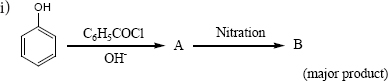
ii) \(C_6H_5-CH_{2}CH(OH)CH(CH_3)_2 \overset{ConH_2SO_4}\longrightarrow\)
29.
Write the expression for the solubility product of Hg2Cl2 .
30.
How will you determine the rate constant for the Decomposition of nitrogen pentoxide in CCl4.
31.
Arrange the following as indicated below:
(i) F2, Cl2, Br2, I2 - increasing bond dissociation enthalpy.
(ii) HF, HCI, HBr, HI - increasing acidic strength.
32.
Give two uses of nitric acid.
33.
Name the various refining process.
34.
Calculate the magnetic moment of [Fe(H2O)6]2+, if atomic number of Fe is 26.
35.
An aromatic aldehyde (A) of molecular formula C7H6O which has the smell of bitter almonds on treatment with (CH3CO)2O and CH3COONa to give compound (B) which is an aromatic unsaturated add. (A) also reacts with (A) in the presence of ale. KCN to give dimer (C). Identify (A), (B) and (C). Explain the reactions.
36.
Write a note on Freundlich adsorption isotherm.
37.
An alkene (A) on ozonolysis gives propanone and aldehyde (B). When (B) is oxidised (C) is obtained. (C) is treated with Br2/P gives (D) which on hydrolysis gives (E). When propanone is treated with HCN followed by hydrolysis gives (E). Identify A, B, C, D and E.
38.
Discuss the Lowry – Bronsted concept of acids and bases.
39.
Write a short note on the oxidation states of 3d series elements.
40.
In a pseudo first order hydrolysis of ester in water, the following results were obtained.
| 1 | 0 | 30 | 60 | 90 |
|---|---|---|---|---|
| [Ester]mol L-1 | 0.55 | 0.31 | 0.17 | 0.085 |
(i) Calculate the average rate of reaction between the time interval 30 to 60 seconds.
(i) Calculate the pseudo first order rate constant for the hydrolysis of ester.
41.
An amorphous solid (A) burns in air to form a gas (B) which turns lime water milky. The gas is also produced as a byproduct during roasting of sulphide ore. This gas decolourises acidified aqueous KMnO4 solution and reduces Fe3+ to Fe2+. Identify the solid 'A' and the gas 'B' and write the reactions involved.
42.
What is meant by stability of a co-ordination compound in solution? State the factors which govern stability of complexes.
1.
(b)
diphenyl amine
2.
(a)
Cr
3.
(a)
\([{ H }^{ + }]={ K }_{ a }\frac { [Acid] }{ [Salt] } \)
4.
(c)
absence of H - bond
5.
6.
Scattering of light
7.
HPO42− can have the ability to accept a proton to form H2PO4-
It can also have the ability to donate a proton to form PO4-3
8.
(a)
Ammonium sulphate
9.
(d)
8
10.
(c)
sulphur
11.
In 140days ⇒ initial concentration reduced to (1/2) g
In 280 days ⇒ initial concentration reduced to (1/4) g
In 420 days ⇒ initial concentration reduced to (1/8) g
In 560 days ⇒ initial concentration reduced to (1/16) g
12.
Ti4+ (d0 ⇒ 0BM)
Co2+ (d7 spain free ⇒ t2g5, e2g; n = 3; μ = 3.9BM)
Cu2+ (d9 Low spain ⇒ t2g6, e3g; n = 1; μ = 1.732BM)
Ni2+ (d8 Low spain ⇒ t2g6, e2g; n = 2; μ = 2.44 BM)
13.
Mn2+ ⇒ 3d5 contains 5 unpaired electrons
n = 5,
\( \sqrt{n(n+ 2)} \) BM
\(= \sqrt{5(5+ 2)} = \sqrt{35} = 5.92 BM\)
14.
(a)
+4
15.
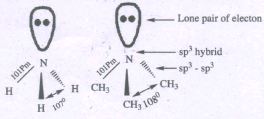
Structure of amines:
(i) Like, ammonia, nitrogen atom of amines is trivalent and carries a lone pair of electron and sp3 hybridised, out of the four sp3 hybridised orbitals of nitrogen, three sp3 orbitals overlap with orbitals of hydrogen (or) alkyl groups of carbon, the fourth sp3 orbital contains a lone pair of electron.
(ii) Hence, amines possess pyramidal geometry. Due to presence of lone pair of electron C-N-H (or) C-N-C bond angle is less than the normal tetrahedral bond angle 109.5°.
For example, the C-N-C bond angle of trimethylamine is 108° which is lower than tetrahedral angle and higher than the H-N-H bond angle of 107°.
(iii) This increase is due to the repulsion between the bulky methyl groups.
16.
17.
18.
The feasibility of a redox reaction can be predicted with the help of the electrochemical series.
(i) The net emf of the cell reaction Ecellcan be calculated from the expression,
Eocell= Eocathode - Eoanode
(ii) In general, if
Eocell = +ve, the reaction is feasible.
Eocell = -ve, the reaction is not feasible.
19.
(a) Alcohols are soluble in water because they form intermolecular hydrogen bonding with water. Lower members are completely miscible with water and the higher members are not. This is because of the increase in size of hydrophobic (water repelling) alkyl group in the alcohol.
(b) Strong basic substances like organo metallic compounds (RMgX-Grignard reagent) are decomposed by alcohol.
R - OH + CH3MgBr ⟶ R - O - Mg - Br + CH4
Hence, alcohols cannot be used as a solvent for Grignard reagent.
20.
Acetaldehyde - CH3-CHO
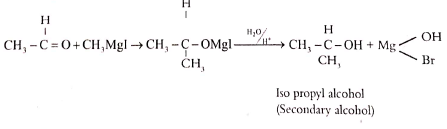
21.
(i) When potassium dichromate is heated with any chloride salt in the presence of Conc. H2SO4, orange red vapours of chromyl chloride (CrO2CI2) is evolved.
(ii) This reaction is used to confirm the presence of chloride ion in inorganic qualitative analysis
.JPG)
(iii) The chromyl chloride vapours are dissolved in sodium hydroxide solution and then acidified with acetic acid and treated with lead acetate. A yellow precipitate of lead chromate is obtained
.JPG)
22.
(i) The given defect is Stoichiometric since the number of cations and anions are missing from lattice sites unequal.
(ii) The defect is Schottky defect.
These defects are vacancy defects shown by ionic solids in which the anion and cation are nearly of the same size.
Eg: NaCI and KCI shows Schottky defects
23.
| Alloy | Composition | Application |
|---|---|---|
| Bronze | Cu- 80%, Zn-10%, Sn-10% |
Making utensils, statutes, coins, etc. |
| Brass | Cu-60%, Zn-40% |
Making utensils, wires, pairs of machine etc |
| Stainless steel | Fe-73%, Cr-18%, Ni- 8% and CF -1% |
Making utensils, cutlery, cycles, etc. |
24.
(i) The chemical reaction involves breaking of certain existing bonds of the reactant and forming new bonds which lead to the product.
(ii) The net energy involved in this process is dependent on the nature of the reactant and hence the rates are different for different reactants.
Example:
Let us compare the following two reactions that you carried out in volumetric analysis.
1) Redox reaction between ferrous Ammonium Sulphate (FAS) and KMnO4.
2) Redox reaction between oxalic acid and KMnO4.
(i) The oxidation of oxalate ion by KMnO4 is relatively slow compared to the reaction between KMnO4 and Fe2+. In fact heating is required for the reaction between KMnO4 and Oxalate ion and is carried out at around 60oC.
(ii) The physical state of the reactant also plays an important role to influence the rate of reactions.
(iii) Gas phase reactions are faster as compared to the reactions involving solid or liquid reactants.
Ex : Na(s) + I2(vap) [Faster]
Na(s) + I2(s) [Slower]
KI(aq) + Pb(NO3)2(aq) → PbI2 (yellow) [Faster]
KI(s) + Pb(NO3)2(s) → PbI2 (yellow) [Slower]
25.
A hydride of 2nd period alkali metal (A) is lithium hydride (LiH).
Lithium hydride (A) reacts with diborane (B) to give lithium borohydride (C) which is acts as a reducing agent.
B2H6 + 2 LiH \(\xrightarrow[]{ether}\) 2 LiBH4
[Diborane (B)] [Lithium hydride (A)] [Lithium borohydride (C)]
Result:
| Compound | Formula | Name |
| A | LiH | Lithium hydride |
| B | B2H6 | Diborane |
| C | LiBH4 | Lithium borohydride |
26.
27.
Kohlrausch deduced the following empirical relationship between the molar conductance (\({ \Lambda }_{ m }\)) and the concentration of the electrolyte (C).
\({ \Lambda }_{ m }={ \Lambda }_{ m }^{ o }-k\sqrt { C } \)
28.
(i) .JPG)
n-Nitro benzoate (Major Product)
(ii) .JPG)
29.
\(\mathrm{Hg}_{2} \mathrm{Cl}_{2(\mathrm{~s})} \rightleftharpoons \mathrm{Hg}_{2}^{2+} \text { (aq) }+2 \mathrm{Cl^-}_{(\mathrm{aq})}\\ s \quad \quad \quad \quad \quad \quad s \quad \quad \quad \quad \quad 2s\)
\(\mathrm{K}_{\mathrm{sp}} =\left[\mathrm{Hg}_{2}^{2+}\right]{\left[\mathrm{Cl}^{-}\right]^{2}} \)
\(=(\mathrm{s})(2 \mathrm{~s})^{2} \)
\(\mathrm{~K}_{\mathrm{sp}} =4 \mathrm{~s}^{3}\)
30.
N2O5 \(\overset { { k }_{ 1 } }{ \longrightarrow } \) 2NO2 + \(\frac { 1 }{ 2 } \) O2
(i) At time t = 0, the volume of oxygen liberated is zero.
(ii) Let V, and V∞ be the measured volumes of oxygen liberated after the reactant has reacted in 't' time and at completion (t = ∞).
(iii) Initial concentration of N2O5 is proportional to total volume of oxygen liberated (i.e.,) (V∞).
(iv) (V∞ - Vt) is proportional to undecomposed. N2O5 at time 't'.
(v) ∴ k1 = \(\frac { 2.303 }{ t } \log { \frac { { V }_{ \infty } }{ \left( { V }_{ \infty }-{ V }_{ t } \right) } } { sec }^{ -1 }\)
31.
(i) l2 < F2 < Br2 < Cl2·
(ii) HF < Hq < HBr < HI.
32.
(i) Nitric acid is used as a oxidising agent and in the preparation of aqua regia.
(ii) Salts of nitric acid are used in photography (AgNO3) and gun powder for fire arms (NaNO3)·
33.
Distillation, liquation, electrolytic refining, zone refining, vapour phase method, van -Arkel method
34.
Magnetic moment (μ) = \(\sqrt { n(n+2) } \) BM
Fe (z = 26) = 1s2 2s2 2p6 3s2 3p6 4s2 3d6
Fe2+ = 1s2 2s2 2p6 3s2 3p6 3d6 4s0

∴μ = \(\sqrt { n(n+2) } \) = \(\sqrt { 4(4+2) } =\sqrt { 24 } \)
= 4. 89 BM
35.
(i) An organic compound which has the smell of bitter almonds is benzaldehyde C6H5CHO and it is (A).
(ii) Benzaldehyde reacts with acetic anhydride in the presence of sodium acetate gives Cinnamic acid.
\(\underset { (A) }{ { C }_{ 6 }{ H }_{ 5 }CHO } +\left( { CH }_{ 3 }CO \right) _{ 2 }O\overset { { CH }_{ 3 }COONa }{ \longrightarrow } \underset { (B) }{ { C }_{ 6 }{ H }_{ 5 }CH=CHCOOH } +{ CH }_{ 3 }COOH\)
(iii) Benzaldehyde on treatment with alcoholic KCN gives Benzoin a dimer and it is (C).
| Compound | Compound Name | Formula |
| A | Benzaldehyde | C6H5CHO |
| B | Cinnamic acid | C6H5CH=CHCOOH |
| C | Benzoin | \({ C }_{ 6 }{ H }_{ 5 }\underset { \overset { | }{ OH } }{ CH } -\underset { \overset { || }{ O } }{ C } -{ C }_{ 6 }{ H }_{ 5 }\) |
36.
Freundlich adsorption isotherm:
According to Freundlinch
\(\frac { x }{ m } =kp^{ \frac { 1 }{ n } }\)
where x is the amount of adsorbate or adsorbed on 'm' gm of adsorbent at a pressure of p. K and n are constants Value is always less than unity.
This equation is applicable for adsorption of gases on solid surfaces. The same equation becomes \(\frac { x }{ m } =Kc^{ \frac { 1 }{ n } }\) when used for adsorption in solutions with c as concentration.
These equation quantitively predict the effect of pressure(or concentration) on the adsorption of gases(or adsorbates) at constant temperature.
Taking log on both sides of equation \(\frac { x }{ m } ={ kp }^{ \frac { 1 }{ n } }\)
\(log\frac { x }{ m } =logK+\frac { 1 }{ n } logP\)
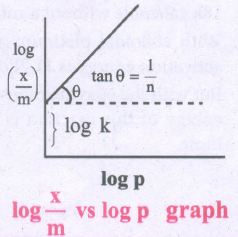
Hence the intercept represents the value of log k and the slope \(\frac { b }{ q } \) gives \(\frac { 1 }{ n } \)
This equation explains the increase of \(\frac { x }{ m } \) with increase in pressure. But experimental values show the deviation at low pressure.
37.
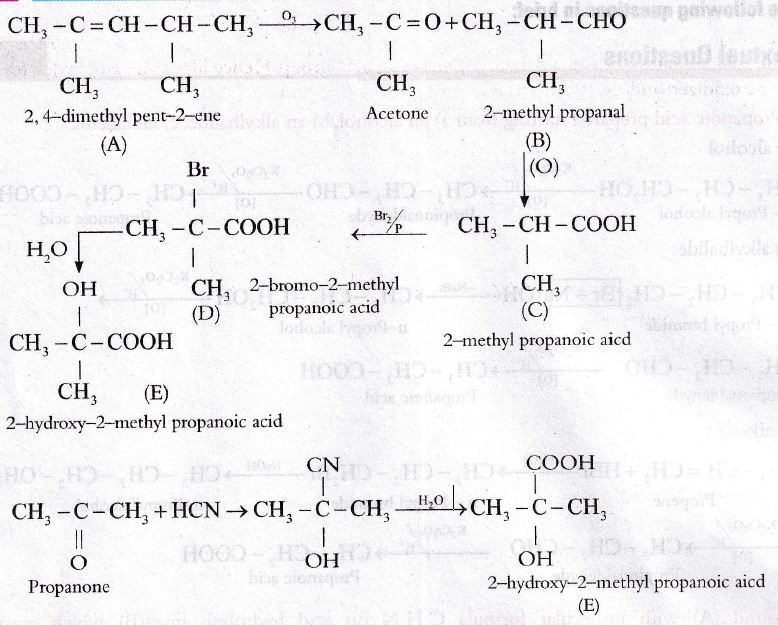
38.
(i) An acid is defined as a substance that has a tendency to donate a proton to another substance and base is a substance that has a tendency to accept a proton form other substance.
(ii) In other words, an acid is a proton donor and a base is a proton acceptor.
(iii) When hydrogen chloride is dissolved in water, it donates a proton to the later. Thus, HCI behaves as an acid and H2O is base. The proton transfer from the acid to base can be represented as
HCI + H2O ⇌ H3O+ + Cl-
(iv) When ammonia is dissolved in water, it accepts a proton from water. In this case, ammonia (NH3) acts as a base and H2O is acid. The reaction is represented as
H2O + NH3 ⇌ NH4+ + OH-
(v) Let us consider the reverse reaction following equilibrium.
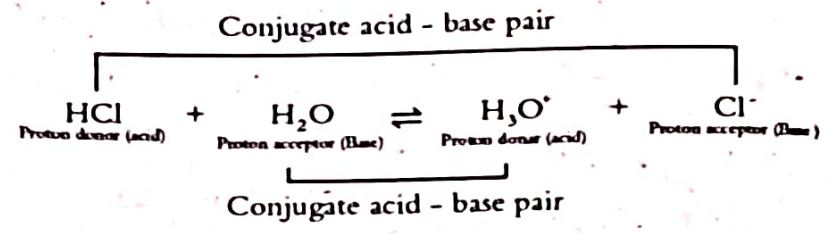
\(\underset { proton\ donar\\ \quad \quad \ (acid) }{ HCl } +\underset { Proton\ acceptor\\ \quad \quad \quad \quad (base) }{ { H }_{ 2 }O } \leftrightharpoons \underset { Proton\ donar\\ \quad \quad \quad \quad \ (acid) }{ { H }_{ 2 }{ O }^{ + } } +\underset { Proton\ acceptor\\ \quad \quad \quad \quad \ (base) }{ { Cl }^{ - } } \)
H3O+ donates a proton to Cl- to form HCI i.e., the products also behave as acid and base.
(vi) In general, Lowry - Bronsted (acid - base) reaction is represented as
Acid1 + Base2 ⇌ Acid2 + Base1
(vii) The species that remains after the donation of a proton is a base (Base1) and is called the conjugate base of the Bronsted acid (Acid1). In other words, chemical species that differ only by a proton are called conjugate acid - base pairs.
39.
(i) The first transition metal Scandium exhibits only +3 oxidation state, but all other transition elements exhibit variable oxidation states by loosing electrons from (n-1)d orbital and ns orbital as the energy difference between them is very small.
(ii) At the beginning of the series, +3 oxidation state is stable but towards the end +2 oxidation state becomes stable.
(iii) The number of oxidation states increases with the number of electrons available, and it decreases as the number of paired electrons increases.
(iv) Hence, the first and last elements show less number of oxidation states and the middle elements with more number of oxidation states.
(v) For example, the first element Sc has only one oxidation state +3; the middle element Mn has six different oxidation states from +2 to +7. The last element Cu shows +1 and +2 oxidation states only.
(vi) The relative stability of different oxidation - states of 3d metals is correlated with the extra stability of half filled and fully filled electronic configurations. Example: Mn2+(3d5) is more stable than Mn4+(3d3).
40.
(i) Average rate of reaction between the time interval, 30 to 60 seconds
\(=\frac { d\left[ Ester \right] }{ dt } \)
\(=\frac { 0.31-0.17 }{ 60-30 } =\frac { 0.14 }{ 30 } \)
= 4.67 x 10⁻³ mol L-1 s-1.
(ii) For a pseudo first order reaction,
\(k=\frac { 2.303 }{ t } \log { \frac { { \left[ R \right] }_{ 0 } }{ \left[ R \right] } } \)
For, t = 303
\({ k }_{ 1 }=\frac { 2.303 }{ t } \log { \frac { 0.55 }{ 0.31 } } \)
For, t = 60 s
\({ k }_{ 2 }=\frac { 2.303 }{ 60 } \log { \frac { 0.55 }{ 0.17 } } \)
For, t = 90 s
\({ k }_{ 3 }=\frac { 2.303 }{ 90 } \log { \frac { 0.55 }{ 0.085 } } \)
= 2.075 x 10⁻² s-1
The average rate constant,
\(k=\frac { { k }_{ 1 }+{ k }_{ 2 }+{ k }_{ 3 } }{ 3 } \)
\(=\frac { \left( 1.911\times { 10 }^{ -2 } \right) +\left( 1.957\times { 10 }^{ -2 } \right) +\left( 2.075\times { 10 }^{ -2 } \right) }{ 3 } \)
= 1.98 x 10⁻² s-1.
41.
(I) Since the byproduct of roasting to sulphide ore is SO2 It turns lime water milky.
Therefore, gas 'B' must be SO2
(ii) As the gas 'B' is obtained when amorphous solid 'A' burns in air therefore, amorphous solid 'A' must be sulphur S8
\(\underset { (A) }{ { S }_{ g } } +{ 8O }_{ 2 }\overset { \Delta }{ \longrightarrow } \underset { (B) }{ { 8SO }_{ 2 } } \)
(iii) Gas (B) reduces acidified aqueous KMnO4 solution and reduces Fe3+ to Fe2+ salts as shown below:
\(\underset { (yellow) }{ { 2MnO }_{ 4 } } ^{ - }+\underset { (b) }{ { SO }_{ 2 } } +2{ H }_{ 2 }O\longrightarrow { 2Fe }^{ 2+ }+\underset { (Green) }{ { SO }_{ 4 }^{ 2- } } +{ 4H }^{ + }\)
(iv) Thus, solid 'A' is S8 and gas 'B' is SO2
42.
The stability of a complex or co-ordination compound refers to the extent up to which it exists in a solution as co-ordination sphere.
(i) Change on the central metal ion: Greater the charge on the central metal ion, greater the stability of complex.
(ii) Nature of the metal ion: Group 3 and 6 and inner transition elements form stable complexes when donor atoms of the ligands are N, O and F. The elements after group 6 of the transition metals form stable complex when the donor atoms of the ligands are the heavier members of N, O and F family.
(iii) Basic nature of the ligands: Greater the basic strength, greater is the stability of the complex.
(iv) Presence of chelate rings: Its presence increases the stability of the complex. it is called chelate effect. It is maximum for the 5 and 6 membered rings.
(v) Effect of multidentate cyclic ligand: If the ligands are IT multidentate and cyclic without any steric effect the stability of the complex get increased.

12th Standard Syllabus & Materials
12th Standard
TN 12th Computer Applications களப்பெயர் முறைமை (DNS) Sample Question Papers Study Material - QB365 Set A
NEW12th Standard
TN 12th Computer Applications வலையமைப்பு எடுத்துக்காட்டுகள் மற்றும் நெறிமுறைகள் Sample Question Papers Study Material - QB365 Set A
NEW12th Standard
TN 12th Computer Applications கணினி வலையமைப்பு ஓர் அறிமுகம் Sample Question Papers Study Material - QB365 Set A
NEW12th Standard
TN 12th Computer Applications PHP-உடன் MySQL-ஐ இணைத்தல் Sample Question Papers Study Material - QB365 Set A



Tamilnadu Stateboard 12th Standard Subjects

Maths
Chemistry

Physics

Biology

Computer Science

Business Maths and Statistics

Economics

Commerce

Accountancy

History

Computer Applications
Biology
Computer Technology
Computer Applications
Computer Science
Business Maths and Statistics
Commerce
Economics
Maths
Chemistry
Physics
Computer Technology
History
Accountancy

Tamil

English

French
Tamilnadu Stateboard Standards
