
 100% FREE ACCESS
12th Standard Syllabus & Materials
12th Standard
TN 12th Maths Applications of Matrices and Determinants Sample Question Papers Study Material - QB365 Set A
NEW12th Standard
TN 12th Computer Applications மின்னணு தரவு பரிமாற்றம் Sample Question Papers Study Material - QB365 Set A
NEW12th Standard
TN 12th Computer Applications மின் - வணிக பாதுகாப்பு அமைப்புகள் Sample Question Papers Study Material - QB365 Set A
NEW12th Standard
TN 12th Computer Applications மின்னணு செலுத்தல் முறைகள் Sample Question Papers Study Material - QB365 Set A
NEW12th Standard
TN 12th Computer Applications மின் - வணிகம் Sample Question Papers Study Material - QB365 Set A
NEW12th Standard
TN 12th Computer Applications திறந்த மூல கருத்துருக்கள் Sample Question Papers Study Material - QB365 Set A

Published on: 01/10/2019
Transition and Inner Transition Elements
Download Tamil Nadu 12th Standard Chemistry question papers, model tests, one-mark questions, important questions, and public exam papers in PDF format. Free study materials and answer keys for TN State Board students.
Questions + Answers key
Take MCQ Chemistry Test
1.
Which of the following is coloured due to charge transfer?
MnO4-
CrO42-
Cu2O
All of these
2.
Identify the paramagnetic species.
Cu+
Cr+
MnO4
Zn2+
3.
Which of the following oxidation states is most common among the lanthanoids?
+4
+2
+5
+3
4.
Which of the following lanthanoid ions is diamagnetic?
Eu2+
Yb2+
Ce2+
Sm2+
5.
The number of moles of acidified KMnO4 required to oxidize 1 mole of ferrous oxalate(FeC2O4) is _______.
5
3
0.6
1.5
6.
MnO4- react with Br- in alkaline PH to give ________.
BrO3- MnO2
Br2, MnO42-
Br2, MnO2
BrO-, MnO42-
7.
Permanganate ion changes to ________ in acidic medium.
MnO42−
Mn2+
Mn3+
MnO2
8.
The alloy of copper that contain Zinc is________.
Monel metal
Bronze
bell metal
brass
9.
The catalytic behaviour of transition metals and their compounds is ascribed mainly due to _______.
their magnetic behaviour
their unfilled d orbitals
their ability to adopt variable oxidation states
their chemical reactivity
10.
Sc (Z = 21) is a transition element but Zinc (z = 30) is not because _______.
both Sc3+ and Zn2+ ions are colourless and form white compounds
In case of Sc, 3d orbital are partially filled but in Zn these are completely filled
last electron as assumed to be added to 4s level in case of zinc
both Sc and Zn do not exhibit variable oxidation states
11.
Write chemical equations for the reactions involved in the manufacture of potassium permanganate from pyrolusite ore.
12.
Which is stronger reducing agent Cr2+ or Fe2+?
13.
Actinoid contraction is greater from element to element than the lanthanoid contraction, why?
14.
Compare lanthanoids and actinoids.
15.
What are inner transition elements?
16.
What are transition metals? Give four examples.
17.
What are coinage metals?
18.
Why first ionization enthalpy of chromium is lower than that of zinc?
19.
Write the electronic configuration of Ce4+ and Co2+.
20.
What are interstitial compounds?
21.
22.
What are actinides? Give three examples.
23.
Titanium
24.
f - block elements
25.
Zr and Hf
26.
Pu-238
27.
CeO2 & ThO2
1.
(d)
All of these
2.
(b)
Cr+
3.
(d)
+3
4.
Yb2+ - 4f14 - no unpaired electrons - diamagnetic
5.
+7 +2+3 2+ 3+ 4+
MnO4- + FeC2O4 ⟶ Mn2+ + Fe3+ + 2CO2
5e- acception 3e- release
5 moles of FeC2O4 \(\equiv\) 3 moles of KMnO4
1 mole of FeC2O4 \(\equiv\) (3/5) moles of KMnO4
1 mole of FeC2O4 \(\equiv\) 0.6 moles of KMnO4
6.
(a)
BrO3- MnO2
7.
MnO-4 + 8H+ + 5e- → Mn2+ + 4H2O
8.
(d)
brass
9.
(c)
their ability to adopt variable oxidation states
10.
(b)
In case of Sc, 3d orbital are partially filled but in Zn these are completely filled
11.
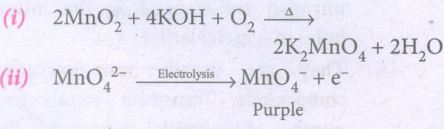
12.
Cr2+ is stronger reducing agent than Fe2+. The standard electrode potential (E0) of Cr2+ is -0.91 V and that of Fe2+ is only -0.44 V.
If the standard electrode potential of a metal is large and negative is a powerful reducing agent, because it loses electrons easily.
Hence Cr2+ is stronger reducing agent.
13.
(i) In the actinoid series, the elements have poor shielding effect when compared with lanthanide series.
(ii) Hence in the actinoid series, when atomic number increases the effective nuclear charge also increases so actinoid contraction is greater from element to element than the lanthanoid contraction.
14.
| S.No | Lanthanoids | Actinoids |
|---|---|---|
| 1. | Differentiating electron enters in 4f orbital | Differentiating electron enters in 5f orbital |
| 2. | Binding energy of 4f orbitals are higher | Binding energy of 5f orbitals are lower |
| 3. | They show less tendency to form complexes | They show greater tendency to form complexes |
| 4. | Most of the lanthanoids are colourless | Most of the actinoids are coloured For Example: U3+ (red) U4+ (green). |
| 5. | They do not form oxo cations | They do form oxo cations such as UO22+, NpO22++ etc. |
| 6. | Besides +3 oxidation states lanthanoids show +2 and +4 oxidation states in few cases | Besides +3 oxidation states actinoids show higher oxidation states such as +4, +5, +6 and +7 |
15.
(i) The elements in which the extra electron enters (n-2) f orbitals are called f-block elements. These elements are called as inner transition elements because they form a transition. Series within the transition elements.
(ii) The f-block elements are also called as rare earth elements. They are divided into lanthanoid series (4f block elements) and actinoid series (5f block elements).
16.
IUPAC defines transition metal as an element whose atom has an incomplete d-sub shell or which can give rise to cations with an incomplete d-sub shell. They occupy the central position of the periodic table, between s and p-block elements.
Examples: Fe, Cu, Ag, Au
17.
Cu, Ag and Au which have been used in making of coins in ancient times are called coinage metals
18.
Chromium (24), the electronic configuration is 3d54s1. It ready to lose its outer most electron (4s1) to get exactly half-filled stable electronic configuration. The electronic configuration of Zinc is 3d104s2.ie., It has completely filled stable configuration. From this configuration, the removal of 1e- from 4s orbital is very difficult & it required more ionisation enthalpy. Due to this reason Zn has higher first Ionisation enthalpy (1.E1) than that of chromium.
19.
Electronic configuration of Ce4+ = [Xe] 4f05d06s0
Electronic configuration of Co2+ = [Ar]3d7
20.
An interstitial compound or alloy is a compound that is formed when small atoms like hydrogen, boron, carbon or nitrogen are trapped in the interstitial holes in a metal lattice. They are usually non-stoichiometric compounds. Transition metals form a number of interstitial compounds such as TiC, ZrH1.92, Mn4N etc.
Properties of interstitial compound
(i) They are hard and show electrical and thermal conductivity.
(ii) They have high melting points higher than those of pure metals.
(iii) Transition metal hydrides are used as powerful reducing agents
(iv) Metallic carbides are chemically inert.
21.

.JPG)
22.
The fourteen elements following actinoids is from thorium to lawrencium are called actinides.
Examples: Uranium, Thorium, Neptunium
23.
Artificial joint
24.
Rare earth elements
25.
Similar size
26.
Long mission space probes
27.
Gas lamp materials

12th Standard Syllabus & Materials
12th Standard
TN 12th Computer Applications வலையமைப்பு வடமிடல் Sample Question Papers Study Material - QB365 Set A
NEW12th Standard
TN 12th Computer Applications களப்பெயர் முறைமை (DNS) Sample Question Papers Study Material - QB365 Set A
NEW12th Standard
TN 12th Computer Applications வலையமைப்பு எடுத்துக்காட்டுகள் மற்றும் நெறிமுறைகள் Sample Question Papers Study Material - QB365 Set A
NEW12th Standard
TN 12th Computer Applications கணினி வலையமைப்பு ஓர் அறிமுகம் Sample Question Papers Study Material - QB365 Set A



Tamilnadu Stateboard 12th Standard Subjects

Maths
Chemistry

Physics

Biology

Computer Science

Business Maths and Statistics

Economics

Commerce

Accountancy

History

Computer Applications
Biology
Computer Technology
Computer Applications
Computer Science
Business Maths and Statistics
Commerce
Economics
Maths
Chemistry
Physics
Computer Technology
History
Accountancy

Tamil

English

French
Tamilnadu Stateboard Standards
