
 100% FREE ACCESS
12th Standard Syllabus & Materials
12th Standard
TN 12th Maths Applications of Matrices and Determinants Sample Question Papers Study Material - QB365 Set A
NEW12th Standard
TN 12th Computer Applications மின்னணு தரவு பரிமாற்றம் Sample Question Papers Study Material - QB365 Set A
NEW12th Standard
TN 12th Computer Applications மின் - வணிக பாதுகாப்பு அமைப்புகள் Sample Question Papers Study Material - QB365 Set A
NEW12th Standard
TN 12th Computer Applications மின்னணு செலுத்தல் முறைகள் Sample Question Papers Study Material - QB365 Set A
NEW12th Standard
TN 12th Computer Applications மின் - வணிகம் Sample Question Papers Study Material - QB365 Set A
NEW12th Standard
TN 12th Computer Applications திறந்த மூல கருத்துருக்கள் Sample Question Papers Study Material - QB365 Set A

Published on: 04/09/2019
Solid State
Download Tamil Nadu 12th Standard Chemistry question papers, model tests, one-mark questions, important questions, and public exam papers in PDF format. Free study materials and answer keys for TN State Board students.
Questions + Answers key
Take MCQ Chemistry Test
1.
Atoms X and Y form bcc crystalline structure. Atom X is present at the corners of the cube and Y is at the centre of the cube. What is the formula of the compound?
2.
Classify the following solids
a. P4
b. Brass
c. diamond
d. NaCl
e. Iodine
3.
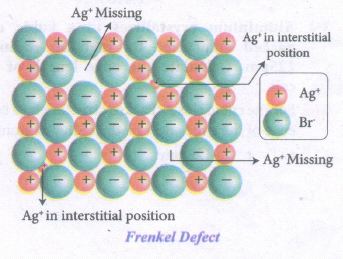
Write a note on Frenkel defect.
4.
Experiment shows that Nickel oxide has the formula Ni0.96.O1.00. What fraction of Nickel exists as of Ni2+ and Ni3+ ions?
5.
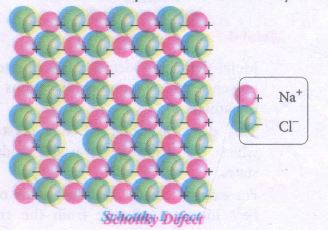
Explain Schottky defect.
6.
7.
Explain briefly seven types of unit cell.
8.
Explain AAAA and ABABA and ABCABC type of three dimensional packing with the help of neat diagram.
9.
A solid compound XY has NaCl structure if the radius of the cation is 100pm, the radius of the anion will be ________.
\(\left( \frac { 100 }{ 0.414 } \right) \)
\(\left( \frac { 0.732 }{ 100 } \right) \)
100 x 0.414
\(\left( \frac { 0.414 }{ 100 } \right) \)
10.
The composition of a sample of wurtzite is Fe0.93 O1.00 what % of Iron present in the form of Fe3+?
16.05%
15.05%
18.05%
17.05%
11.
The number of carbon atoms per unit cell of diamond is _______.
8
6
1
4
12.
13.
Graphite and diamond are ________.
Covalent and molecular crystals
ionic and covalent crystals
both covalent crystals
both molecular crystals
1.
Number of X type atoms in the unit cell \(=8 \times \frac{1}{8}=1\)
Number of Y type atoms in the unit cell \(=1 \times \frac{1}{1}=1\)
Hence the formula is XY (or) X1Y1
2.
a. P4 - Covalent solid
b. Brass - Metallic solid
c. Diamond - Covalent solid
d. NaCl - Ionic solid
e. Iodine - Covalent solid
3.
(i) Frenkel defect arises due to the dislocation of ions from its crystal lattice.
(ii) The ion which is missing from the lattice point occupies an interstitial position.
(iii) This defect is shown by ionic solids in which cation and anion differ in size.
(iv) Unlike Schottky defect, this defect does not affect the density of the crystal.
For example AgBr, in this case, small Ag+ ion leaves its normal site and occupies an interstitial position.
4.
Formula is Nio.96 O1.00
So the ration of Ni = O = 96.00
So if there are 100 atom of oxygen, as atoms of Ni
Let the number of atoms of Ni+2 = x
The number of atoms of Ni+2 = 96 - x
Charge on Ni = charge on O
So that oxygen has charge = 2
3 (96 - x) + 2x = 2(100)
288 - 3x + 2x = 200
-x = -88
x = 88
Percentage of Ni + 2 = (atom of Ni+2 / total number of atoms of Ni 100.)
= 100.(94/98) x 100 = 96%
Percentage of Ni+3 = 100 - Ni+2
= 100 - 96 = 4%
5.
(i) Schottky defect arises due to the missing of equal number of cations and anions from the crystal lattice. This effect does not change the stoichiometry of the crystal.
(ii) Ionic solids in which the cation and anion are of almost of similar size show schottky defect.
Example: NaCl.
(iii) Presence of large number of schottky defects in a crystal, lowers its density.
(iv) Presence of Schottky defect in the crystal provides a simple way by which atoms or ions can move within the crystal lattice.
6.
7.
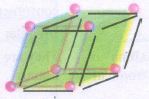
There are seven types of unit cell, Cubic, tetragonal, orthorhombic, hexagonal, monoclinic, triclinic and rhombohedral. They differ in the arrangement of their crystallographic axes and angles.
i) Cubic: a = b = c; α = β = ૪ = 90o.
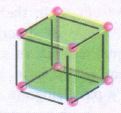
ii) Tetragonal: a = b ≠ c; α = β = ૪ = 90°.
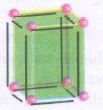
iii) Orthorhombic: a ≠ b ≠ c; α = β = ૪ = 90°.
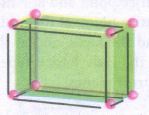
iv) Hexagonal: a = b ≠ c; α = β = 90o, ૪ = 120o.
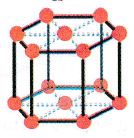
v) Monoclinic: a ≠ b ≠ c; α = ૪ = 90o, β ≠ 90o,
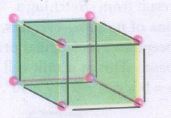
vi) Triclinic: a ≠ b ≠ c; α ≠ β ≠ ૪ ≠ 90o.
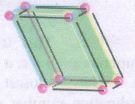
vii) Rhombohedral: a = b = c; α = β = ૪ ≠ 90o.
8.
AAAA type of three dimensional packing:
.JPG)
1. This is simple cubic arrangement.
2. Three dimensional packing arrangement can be obtained by repeating the AAAA type two dimensional arrangements in three dimensions.
3. Spheres in one layer sitting directly on the top of in the previous layer so that all layers are identical.
4. All spheres of different layers of crystal are perfectly aligned horizontally and also vertically.
5. In simple cubic packing, each sphere is in contact with 6 neighbouring spheres
6. Four in its own layer, one above and one below and hence the coordination number of the sphere in simple cubic arrangement is 6.
ABABA type of three dimensional packing:
.JPG)
(i) This is body centered cubic arrangement.
(ii) The spheres in the first layer are slightly separated and the second layer is formed by arranging the spheres in the depressions between the spheres in layer A.
(iii) The third layer is a repeat of the first.
(iv) This pattern ABABAB is repeated throughout the crystal.
(v) Each sphere has a coordination number of 8, four neighbors in the layer above and four in the layer below.
ABCABC type of three dimensional packing:
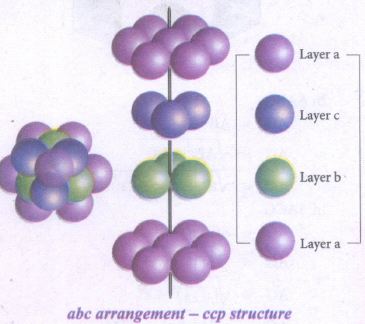
(i) This is face centered cubic arrangement.
(ii) In this arrangement (FCC) second layer spheres are arranged at the dips of first layer. Third layer spheres are arranged in a manner such that it cover the octahedral void.
(iii) Then no longer third layer is similar to first or second layer.
(iv) Third layer gives different arrangement. Fourth layer spheres are similar to first layer.
(v) If the first, second and third layer are represented as A, B, C then this type of packing gives the arrangement of layers as ABCABC.. and the sequence is repeated.
9.
For a fcc structure = rx+ / ry- = 0.414
Given that rx+ = 100 pm
ry = 100pm/0.414
10.
(b)
15.05%
11.
(a)
8
12.
(c)
13.
(c)
both covalent crystals

12th Standard Syllabus & Materials
12th Standard
TN 12th Computer Applications வலையமைப்பு வடமிடல் Sample Question Papers Study Material - QB365 Set A
NEW12th Standard
TN 12th Computer Applications களப்பெயர் முறைமை (DNS) Sample Question Papers Study Material - QB365 Set A
NEW12th Standard
TN 12th Computer Applications வலையமைப்பு எடுத்துக்காட்டுகள் மற்றும் நெறிமுறைகள் Sample Question Papers Study Material - QB365 Set A
NEW12th Standard
TN 12th Computer Applications கணினி வலையமைப்பு ஓர் அறிமுகம் Sample Question Papers Study Material - QB365 Set A



Tamilnadu Stateboard 12th Standard Subjects

Maths
Chemistry

Physics

Biology

Computer Science

Business Maths and Statistics

Economics

Commerce

Accountancy

History

Computer Applications
Biology
Computer Technology
Computer Applications
Computer Science
Business Maths and Statistics
Commerce
Economics
Maths
Chemistry
Physics
Computer Technology
History
Accountancy

Tamil

English

French
Tamilnadu Stateboard Standards
