
 100% FREE ACCESS
12th Standard Syllabus & Materials
12th Standard
TN 12th Computer Applications மின்னணு தரவு பரிமாற்றம் Sample Question Papers Study Material - QB365 Set A
NEW12th Standard
TN 12th Computer Applications மின் - வணிக பாதுகாப்பு அமைப்புகள் Sample Question Papers Study Material - QB365 Set A
NEW12th Standard
TN 12th Computer Applications மின்னணு செலுத்தல் முறைகள் Sample Question Papers Study Material - QB365 Set A
NEW12th Standard
TN 12th Computer Applications மின் - வணிகம் Sample Question Papers Study Material - QB365 Set A
NEW12th Standard
TN 12th Computer Applications திறந்த மூல கருத்துருக்கள் Sample Question Papers Study Material - QB365 Set A
NEW12th Standard
TN 12th Computer Applications வலையமைப்பு வடமிடல் Sample Question Papers Study Material - QB365 Set A

Published on: 26/07/2019
Management By Objectives and Management By Exception
Download Tamil Nadu 12th Standard Commerce question papers, model tests, one-mark questions, important questions, and public exam papers in PDF format. Free study materials and answer keys for TN State Board students.
Questions + Answers key
Take MCQ Commerce Test1.
Objectives are the ________ of Management action.
design
end point
starting points
planning
2.
________ is also known as management by result.
Management by objectives
Management by art
Management by subordinate
Management by planning
3.
___________ can avoid uniformed and impulsive action.
MBO
MBE
KRA
HRM
4.
__________ focuses managerial attention on major problems.
MBA
HRA
MBE
MBO
5.
__________ has both a general business application and a business intelligence application .
MBO
MBE
HRA
MBA
6.
Management by objective (MBO) is also known as
Management by results
Management by goals
Management by planning
Management by evaluation
7.
Target coaching, work planning, mutual goal setting and performance objectives are all terms used to specify concept called
behavioural rating approach
management by objectives
combination method
critical incident method
8.
Second step in process of management by objectives is to
guided setting of objective
Ongoing performance discussion
review job and agreement
develop performance standards
9.
Which is the First step in Process of MBO?
Fixing Key Result Area
Appraisal of Activities
Matching Resources with Activities
Defining Organisational Objectives
10.
__________ System gives full Scope to the Individual Strength and Responsibility.
MBO
MBE
MBM
MBA
11.
How are organisational objectives framed?
12.
What is known as KRA?
13.
Write any two importance of MBE
14.
Mention any two advantages of MBO?
15.
What are the objectives of MBO?
16.
List out any three process of MBO.
17.
What are the Process of MBE?
18.
What are the process involved in MBO?
19.
Write the features of MBO.
20.
Explain the process of MBO. (Any seven)
21.
What are the objectives of MBO?
22.
Discuss the disadvantages of MBE.
23.
What are the major advantages of MBO? (any 5)
1.
(b)
end point
2.
(a)
Management by objectives
3.
(b)
MBE
4.
(c)
MBE
5.
(b)
MBE
6.
(a)
Management by results
7.
(b)
management by objectives
8.
(d)
develop performance standards
9.
(d)
Defining Organisational Objectives
10.
(a)
MBO
11.
Initially, organisational objectives are framed by the top level employees of an organisation. Then it moves downwards
12.
(i) KRA means Key result areas. Key Result area are fixed on the basis of organisational objectives premises.
(ii) Key Result Areas are arranged on a priority basis. KRA indicates the strength of an organisation.
(iii) The examples of KRA are profitability, market standing, innovation etc.
13.
(i) It saves the time of managers because they deal only with exceptional matters. Routine problems are left to subordinates.
(ii) It focuses managerial attention on major problems. As a result, there is better utilisation of managerial talents and energy.
14.
The advantages of MBO are
(i) MBO gives the criteria of performance, It helps to take corrective action
(ii) MBO process helps the managers to understand their role in the total organisation.
15.
The objectives of MBO are ;
(i) to measure and judge performance.
(ii) to relate individual performance to organisational goals
16.
Three process of MB0 are
(i) Defining Organisational Objectives.
(ii) Goals of Each Section.
(iii) Fixing Key Result Areas.
17.
(i) Primarily, it is necessary to set objectives or norms with predictable or estimated results.
(ii) These performances are assessed and get equated to the actual performance. Next, the deviation gets analysed.
(iii) With an insignificant or no deviation; no action is a required and senior managers can concentrate on other matters.
(iv) If actual performances deviates significantly, the issue needs to be passed to the senior managers, as an exception has occurred.
(v) Finally the union is to solve this "exception" immediately.
18.
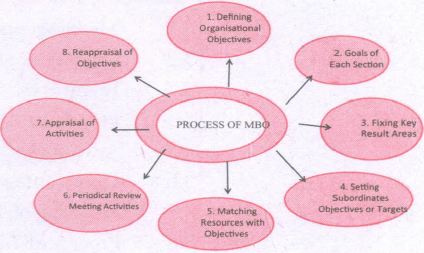
The MBO process is characterised by the balance of objectives of the organisation and individual. The process of MBO is explained below
(i) Defining Organisational Objectives
(ii) Goals of Each Section.
(iii) Fixing Key Result Areas
(iv) Setting subordinate objectives or targets.
(v) Matching resources with objective.
(vi) Periodical review meetings.
(vii) Appraisal of activities.
(viii) Re-appraisal of objectives.
19.
(i) An attempt ismade by the management to integrate the goals of an organisation and individuals. This will lead to effective managerment.
(ii) MBO tries to combine the long run goals of organisation with short run goals.
(iii) Management tries to relate the organisation goals with society goals.
(iv) MBO's emphasis is not only on goals but also on effective performance.
(v) It increases the organisational capability of achieving goals at all levels.
(vi) Aims at replacingthe exercise of authority with consultations.
20.
The process of MBO is explained below:
(i) Defining Organisational Objectives: Initially, organisational objectives are framed by the top level employees of an organisation. The definition of organisational objectives states why the business is started and exists.
(ii) Goals of Each Section : Objectives for each section, department or division are framed on the basis of overall objectives of the organisation. Goals or objectives are expressed in a meaningful manner.
(iii) Fixing Key Result Areas: Key result areas are fixed on the basis of organisational objectives premises. Key Result Areas (KRA) are arranged on a priority basis. KRA indicates the strength of an organisation.
(iv) Setting Subordinate Objectives or Targets : The objectives of each subordinate or individual are fixed. It is preferable to fix the objectives at lower level in quantitative units. There should be a free and frank discussion between the superior and his subordinates.
(v) Matching Resources with Objective : The objectives are framed on the basis of availability of resources. If certain resources (technical personnel or scarce raw material) are not adequately available, the objectives of an organisation are changes accordingly.
(vi) Periodical Review Meetings: The superior and, subordinates should hold meetings periodically in which they discuss the progress in the accomplishment of objectives.
(vii) Appraisal of Activities: At the end of the fixed period for achieving the objectives, there should be a discussion between the superior and subordinates.
21.
Management by objectives is intended primarily
(i) To measure and judge performance
(ii) To relate individual performance to organisational goals.
(ii) To clarify both the job to be done and the expectations of accomplishment.
(iii) To foster the increasing competence and growth of the subordinate.
(v) To serve as a basis for judgements about salary and promotion.
(vi) To stimulate the subordinates motivation
(vii) To serve as a device for organisational control and integration.
22.
(i) The main disadvantage of MBE is, only managers have the power over really important decisions, which can be demotivating for employees at a lower level
(ii) Furthermore, it takes time to pass the issues to managers.
(iii) Managing employees who deviate from the normal procedures.
(iv) Because of compliance failures are considered difficult to manage and typically find themselves with limited job duties and ultimately dismissed / terminated.
23.
The advantages of MBO are explained below:
(i) Managers are involved in objectives setting at various levels of management under MBO and this commitment ensures hard work to achieve them.
(ii) MBO process helps the managers to understand their role in the total organisation.
(iii) Manager recognises the need for planning and appreciates the planning.
(iv) MBO provides a foundation for participative management. Subordinates are also involved in goal setting.
(v) A department does not work at cross purpose with another department.

12th Standard Syllabus & Materials
12th Standard
TN 12th Computer Applications களப்பெயர் முறைமை (DNS) Sample Question Papers Study Material - QB365 Set A
NEW12th Standard
TN 12th Computer Applications வலையமைப்பு எடுத்துக்காட்டுகள் மற்றும் நெறிமுறைகள் Sample Question Papers Study Material - QB365 Set A
NEW12th Standard
TN 12th Computer Applications கணினி வலையமைப்பு ஓர் அறிமுகம் Sample Question Papers Study Material - QB365 Set A
NEW12th Standard
TN 12th Computer Applications PHP-உடன் MySQL-ஐ இணைத்தல் Sample Question Papers Study Material - QB365 Set A



Tamilnadu Stateboard 12th Standard Subjects

Maths

Chemistry

Physics

Biology

Computer Science

Business Maths and Statistics

Economics
Commerce

Accountancy

History

Computer Applications
Biology
Computer Technology
Computer Applications
Computer Science
Business Maths and Statistics
Commerce
Economics
Maths
Chemistry
Physics
Computer Technology
History
Accountancy

Tamil

English

French
Tamilnadu Stateboard Standards

