
 100% FREE ACCESS
12th Standard Syllabus & Materials
12th Standard
TN 12th Maths Applications of Matrices and Determinants Sample Question Papers Study Material - QB365 Set A
NEW12th Standard
TN 12th Computer Applications மின்னணு தரவு பரிமாற்றம் Sample Question Papers Study Material - QB365 Set A
NEW12th Standard
TN 12th Computer Applications மின் - வணிக பாதுகாப்பு அமைப்புகள் Sample Question Papers Study Material - QB365 Set A
NEW12th Standard
TN 12th Computer Applications மின்னணு செலுத்தல் முறைகள் Sample Question Papers Study Material - QB365 Set A
NEW12th Standard
TN 12th Computer Applications மின் - வணிகம் Sample Question Papers Study Material - QB365 Set A
NEW12th Standard
TN 12th Computer Applications திறந்த மூல கருத்துருக்கள் Sample Question Papers Study Material - QB365 Set A

Published on: 31/12/2022
QB365 provides a detailed and simple solution for every Possible Questions in Class 12 Commerce Subject - Important 3 Mark English Medium. It will help Students to get more practice questions, Students can Practice these question papers in addition to score best marks.
Download Tamil Nadu 12th Standard Commerce question papers, model tests, one-mark questions, important questions, and public exam papers in PDF format. Free study materials and answer keys for TN State Board students.
Questions + Answers key
Take MCQ Commerce Test1.
Bring out the Subsidiary Functions of Management.
2.
How the employees are informed about important matters in a company?
3.
Explain Management Vs Administration.
4.
5.
Who is a shadow director?
6.
What do you understand by Issue of Securities at Premium?
7.
Expand the following: i) STEP ii) JAM iii) SEED
8.
Explain about the imitative entrepreneur
9.
Distinguish between entrepreneur and Manager. (any 3)
10.
What are the characteristics of a bill of exchange?
11.
Discuss in detail about existing goods.
12.
Write a short note on New Economic Policy.
13.
What do you know about Technological environment?
14.
Write a note on the Voluntary Consumer Organisation.
15.
What do you understand about "Right to protection of health and safety"?
16.
What is meant by artificial scarcity?
17.
Discuss the objectives E-Marketing. (any 3)
18.
What do you mean by marketing mix? Write any two elements.
19.
Mention any three role of Marketer.
20.
Write short note on trainer and trainee.
21.
What is structured interview?
22.
State the steps in Recruitment process outsourcing.
23.
Define the term Human Resource Management.
24.
Draw the organization structure of SEBI.
25.
Explain Bull and Bear.
26.
Explain the types of Treasury Bills? (any 3)
27.
What are the various kinds of Capital Market? Explain. (any 3)
28.
Give the meaning of Financial Market.
29.
What are the Process of MBE?
30.
Differentiate management from Administration.(any 3)
1.
Innovation, Representation, Decision-making and Communication are the subsidiary functions of management
(i) Innovation: Innovation refers in the preparation of personnel and organisation to face the changes made in the business world.
(ii) Representation: (a) A Manager has to act as representative of a company.
(b) Manager has dealings with customers, suppliers, government officials,banks, financial institutions, trade unions.
(iii) Decision making: (a) Every employee of an organisation has to take a number of decisions every day.
(b) Decision-making helps in the smooth functioning of an organisation.
(iv) Communication: Communication is the transmission of human thoughts, views or opinions,from one person to another person.
2.
Employees are kept informed of all necessary matters by circulars, instructions manuals, newsletters, notice-boards, meeting, participative mechanisms etc., in order to enable the employees to accomplish the organizational goals.
3.
The two terms 'management' and 'administration' are used inter changeably.
(i) While management is more executive in nature. But the concept of administration denotes the art of decision - making.
(ii) Management is all about plans, actions, but the administration is concerned with framing policies and setting objectives.
(iii) The manager looks after the management of the organisation, whereas administration is responsible for the administration of the organisation.
4.
5.
A person who is not the member of Board but has some power to run it can be appointed as the director but according to his/her wish.
6.
When shares are issued at a price above the face or nominal value, they are said to be issued at a premium. For example, a share having the face value of Rs. 10 is issued at Rs.12. Here, Rs.2 is the premium. The amount of share premium has to betransferred to an account called the 'Securities Premium Account! This account is capital in nature and can only be utilized for the purposes specified by the Act.999
(i) To write off preliminary expenses.
(ii) To write off the expenses of issue, or commission paid, or. discount allowed, on issue of shares or debentures of the company.
(iii) To provide for the payment of premium on the redemption of any redeemable preference shares or debentures of the company.
Thus, securities premium is not available for distribution of dividend.
7.
(i) STEP - Support to Training and Employment Programme for Women
(ii) JAM - Jan Dhan - Aadhaar - Mobile
(iii) SEED - Science for Equity Empowerment and Development
8.
Imitative Entrepreneur
(i) Imitative entrepreneur is one who simply imitates existing skill, knowledge or technology already in place in advanced countries.
(ii) A simply re-engineer or redesign the products developed in advanced countries and produce a version suited to their local conditions.
(iii) For example, many electronic products invented in advanced countries are simply re engineered in developing countries.
(iv) Similarly expensive medicines developed in advanced countries are simply reengineered by changing the composition of elements or changing the process of production.
9.
| Basis of Difference | Entrepreneur | Manager |
|---|---|---|
| Motive | The very motive of an entrepreneur is to start a venture by setting of an entity. | The very motive of manager is to render service in an entity setup for execution of venture. |
| Status | Entrepreneur is owner of the entity. | Manager is a salaried employee in the entity set up for carrying on the venture. |
| Risk Bearing | Entrepreneur bears the eventual risk and uncertainty in operating the enterprise | Manager doesn't bear any risk in the venture where the venture is unsuccessful he/ she simply quits the enterprise. |
10.
Characteristics of a bill of exchange
(i) A bill of exchange is a document in writing.
(ii) The document must contain an order to pay.
(iii) The order must be unconditional.
(iv) The instrument must be signed by the person who draws it.
(v) The name of the person on whom the bill is drawn must be specified in the bill itself.
(vi) The amount that isrequired to be paid must also be specified in the bill.
11.
Existing goods are those owned or possessed by the seller at the time of contract of sale. Goods possessed even refer to sale by agents or by pledgers. The existing goods may be either :
(i) Specific Goods : Specific goods denote goods identified and agreed upon at the time of contract of sale.
(ii) Ascertained Goods: The term 'ascertained goods' is also used as similar in meaning to specific goods.
(iii) Unascertained or Generic Goods: These are goods which are not identified and agreed upon at the time of contract of sale.
12.
(i) The base for New Economic Policy in various countries of the world is Dunkel Draft.
(ii) It was allabout the General Agreements on Trade and Tariff.
(iii) Mr. Arthur Dunkel (1932-2005) submitted a 22,000 page document for the World Trade Organisation (WTO) and followed by many Nations to adopt their respective New Economic Policies.
(iv) India is one among such nations to commit itself to the New Economic Policy in 1991.
(v) The new set of economic reforms is commonly known as the LPG or Liberalisation, Privatisation and Globalisation model.
13.
The development in the IT and tele communications has created a global market. Technology is widely used in conducting market research for understanding the special needs of the customer. Data-mining and data analytics are used to know the customer better. Technology is used in managing inventory, storing goods in warehouses, in distributing goods and in receiving payment. This dynamic environnment includes the following;
(i) The level of technology available within the country
(ii) The rate of change in technology
(iii) Technology adopted by competitors
(iv) Technological obsolescence
14.
Voluntary consumer organizations refer to the organization formed voluntarily by the consumers to protect their rights and interests.
Objectives of voluntary organisations :
(i) The Department of Consumer Affairs (DCA) operates the Consumner Welfare Fund (CWF). The primary objective of CWF is to strengthen the Consumer Advocacy Movement in India.
(ii) A wide network of Voluntary Consumer Organisations (VCO) is doing of commendable work to raise awareness amongst consumers.
(iii) To strengthen consumer protection and welfare and to provide counselling, guidance and mediation services.
(iv) Voluntary consumer organisation supported through consumer welfare fund provides grants for diverse projects including comparative testing of products and services and dissemination of the findings.
(v) Steps have been taken to enhance transparency and to digitalise the government's interface with its citizens.
15.
(i) There may be few products that are more likely to cause physical danger to consumers health lives and property. They may contain potentially harmful substances which are dangerous from the consumer welfare point of view.
(ii) The best examples of this kind are food additives, colours, emulsifiers, preservatives. The health hazards which are likely to arise have to be eradicated or reduced altogether.
(iii)In case of food items and drugs both life saving and life sustaining safety is to be guaranteed.One thing that is encouraging to-day is that recent legislations have shifted the responsibility for the production of such unsafe items on to the shoulders of sellers rather than on buyers.
16.
(i) There are certain situations where the shop-keepers put up the board 'No Stock' in front of their shops, even though there is plenty of stock in the store.
(ii) In such situations consumers who are desperate to buy such goods have to pay hefty price to buy those goods and thus earning more profit unconscientiously.
(iii) Even in Cinema houses, board may hang in the main entrance 'House Full' while cinema tickets will be freely available at a higher price in the black market.
17.
The following are the objectives of E-Marketing:
(i) Expansion of market share
(ii) Reduction of distribution and promotional expenses
(iii) Achieving higher brand awareness.
(iv) Strengthening data - base
18.
Marketing mix refers to two things:
(i) A list of important elements or ingredients that make up the marketing programme and
(ii) The list of forces having bearing on marketing operations.
Elements of marketing of mix :
(i) Product : Product is the main element of marketing. Without a product, there can be no marketing.
(ii) Price: Price is the value of a product expressed in monetary terms. It is the amount charged for the product.
19.
(i) Instigator : As an instigator, marketer keenly watches the developments taking place in the market and identifies marketing opportunities emerging in the ever changing market. In such a case, marketer plays an instigator and leads the business towards new directions.
(ii) Innovator : Marketer seeks to distinguish his products/services byadding additional features to the existing product. He also does modifying the price structure, introducing new delivery pattern, creating new business models etc.
(iii) Integrator :Marketer playsa role ofintegrator in the sense that he collects feedback or vital inputs from channel members and consumers and provides products/service solutions to customers/consumers by co-ordinating multiple functions of organisation.
20.
Trainer:
(i) Trainer is a person who teaches skills to employce and prepare them or a job activity.
(ii) The trainer is otherwise called Instructor,Coach, Teacher, Mentor, Counsellor, Guide, Guru, Handler, Tutor and Educator etc.
Trainee :
(i) A person who is learning and practising the skills of particular job is called trainee.
(ii) Trainees should be selected on the basis of self interest and recommendation by the supervisor or by the human resource department itself.
21.
(i) Structured interview method, a series of question to be asked by the interviewer are pre-prepared by the interviewer and only these questions are asked in the interview.
(ii) Ultimately interviewees are ranked on the basis of score earned by the candidate in the interview.
(iii) It is otherwise called as Guided interview and Planned interview.
22.
Recruitment process includes the following steps:
(i) Planning recruitment
(ii) Determining vacancies
(iii) Identifying the sources
(iv) Drafting information for advertisement
(v) Selecting the suitable mode of advertisement
(vi) Facilitating selection process
(vii) Evaluation and control
23.
In the words of E.F.L. Breach, HRM as that part of management process which is primarily concerned with the human constituents of an organisation.
24.
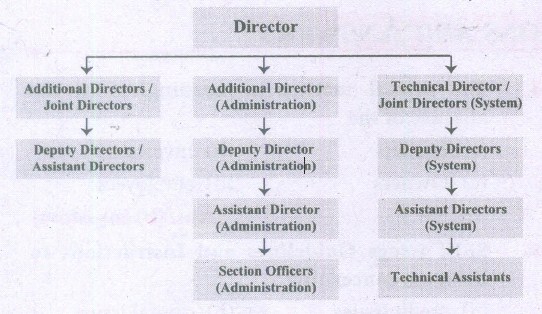
Organization Structure of SEBI
25.
Bull :
(a) A Bull or Tejiwala is an operator who expects a rise in prices of securities in the future.
(b) In anticipation of price rise he makes purchases of shares at present and other securities with the intention to sell at higher prices in future.
(c) He is called bull because just like a bull tends to throw his victim up in the air, the bull stimulates the price to rise. He is an optimistic speculator.
Bear :
(a) A Bear or Mandiwala speculator expects prices to fall in future and sells securities at present with a view to purchase them at lower prices in future.
(b) A bear does not have securities at present but sells them at higher prices in anticipation that he will supply them by purchasing at lower prices in future. A bear is a pessimistic speculator.
26.
Treasury bills are issued to the public and other financial ínstitutíons for rneeting the short-tern financial requirernents of theCentral Governnent. These bills are freely rnarketable and they can be bought and old at any tíme and these bilis are tradable in secondary market as well.
On the basis of periodicity, Treasury bills maybe classified into three. They are:
(a) 91 days Treasury bills
(b) 182 days Treasury bills and
(c) 364 days Treasury bills
(i)Ninety one days Treasury bills are issued at a fixed discount rate of 4 per cent as well as through auctions.
(ii)The RBI holds 91 days and 182 days Treasury bills and they are issued on tap basis throughout the week.
(iii)364 days Treasury Bills do not carry any fixed rate.The discount rate on these bills are quoted in auction by the participants and accepted by the authorities. Such a rate is called cut off rate.
27.
Capital market is divided into two i.e. primary market and secondary market.
(i) Primary Market
(a) Primary Market is a market for new issues or new financial claims. Hence, it is also called New Issue Market.
(b) The primary market deals with those securities which are issued to the public for the first time.
(c) In the primary market, borrowers exchange new financial securities for long term funds.
(d) There are three ways by which a company may raise capital in a primary market.There are:
a) Public Issue
b) Rights Issue
c) Private Placement
(ii) Secondary Market :
(a) Secondary Market may be defined as the market for old securities.
(b) Securities which are previously Issued in the primary market are traded here.
(c) The trading takes place between investors who follow the original issue in the primary market.
28.
A market wherein financial instruments such as financial claims, assets and securities are traded is known as a 'financial market'. In another words, financial markets may be channels through which flow loanable funds directed from a supplier who has an excess of assets toward a demander who experiences a deficit of funds.
29.
(i) Primarily, it is necessary to set objectives or norms with predictable or estimated results.
(ii) These performances are assessed and get equated to the actual performance. Next, the deviation gets analysed.
(iii) With an insignificant or no deviation; no action is a required and senior managers can concentrate on other matters.
(iv) If actual performances deviates significantly, the issue needs to be passed to the senior managers, as an exception has occurred.
(v) Finally the union is to solve this "exception" immediately.
30.
| Basis | Management | Administration | |
|---|---|---|---|
| 1. | Meaning | An organised way of managing people and things of a business is called management | The process of administering an organisation by a group of people is known as administration |
| 2. | Authority | Middle and lower level | Top level |
| 3. | Concerned with | Policy implementation | Policy formulation |
| 4. | Role | Executive | Decisive |
| 5. | Area of operation | It works under administration | It has full control over the activities of the organisation. |

12th Standard Syllabus & Materials
12th Standard
TN 12th Computer Applications வலையமைப்பு வடமிடல் Sample Question Papers Study Material - QB365 Set A
NEW12th Standard
TN 12th Computer Applications களப்பெயர் முறைமை (DNS) Sample Question Papers Study Material - QB365 Set A
NEW12th Standard
TN 12th Computer Applications வலையமைப்பு எடுத்துக்காட்டுகள் மற்றும் நெறிமுறைகள் Sample Question Papers Study Material - QB365 Set A
NEW12th Standard
TN 12th Computer Applications கணினி வலையமைப்பு ஓர் அறிமுகம் Sample Question Papers Study Material - QB365 Set A



Tamilnadu Stateboard 12th Standard Subjects

Maths

Chemistry

Physics

Biology

Computer Science

Business Maths and Statistics

Economics
Commerce

Accountancy

History

Computer Applications
Biology
Computer Technology
Computer Applications
Computer Science
Business Maths and Statistics
Commerce
Economics
Maths
Chemistry
Physics
Computer Technology
History
Accountancy

Tamil

English

French
Tamilnadu Stateboard Standards

