
 100% FREE ACCESS
12th Standard Syllabus & Materials
12th Standard
TN 12th Computer Applications மின்னணு தரவு பரிமாற்றம் Sample Question Papers Study Material - QB365 Set A
NEW12th Standard
TN 12th Computer Applications மின் - வணிக பாதுகாப்பு அமைப்புகள் Sample Question Papers Study Material - QB365 Set A
NEW12th Standard
TN 12th Computer Applications மின்னணு செலுத்தல் முறைகள் Sample Question Papers Study Material - QB365 Set A
NEW12th Standard
TN 12th Computer Applications மின் - வணிகம் Sample Question Papers Study Material - QB365 Set A
NEW12th Standard
TN 12th Computer Applications திறந்த மூல கருத்துருக்கள் Sample Question Papers Study Material - QB365 Set A
NEW12th Standard
TN 12th Computer Applications வலையமைப்பு வடமிடல் Sample Question Papers Study Material - QB365 Set A

Published on: 31/12/2022
QB365 provides a detailed and simple solution for every Possible Questions in Class 12 Commerce Subject - Important 5 Mark English Medium. It will help Students to get more practice questions, Students can Practice these question papers in addition to score best marks.
Download Tamil Nadu 12th Standard Commerce question papers, model tests, one-mark questions, important questions, and public exam papers in PDF format. Free study materials and answer keys for TN State Board students.
Questions + Answers key
Take MCQ Commerce Test1.
What is the Recent trends in Recruitment?
2.
Explain the various functions of management.(Any 5)
3.
Explain different types of open and secret types of voting.
4.
Who are the KMP?
5.
What are the various kinds of Debentures?
6.
7.
Discuss the nature of functional entrepreneurs.
8.
Discuss the challenges faced by Women Entrepreneurs.(any 5)
9.
Discuss in detail the features of a cheque. (any 5)
10.
Distinguish between Conditions and Warranty.
11.
Explain the advantages and disadvantages of liberalisation.(any 5)
12.
Explain the micro environmental factors of business.
13.
Explain the overall performance of the National Commission.
14.
What are the rights of consumers?
15.
What are the objectives of Consumer Protection Act, 1986? (any)
16.
Explain in detail how traditional marketing differ from E-marketing.
17.
Narrate the Elements of Marketing mix.
18.
How the market can be classified on the basis of Economics?
19.
Discuss various types of training. (any 5)
20.
Explain the important methods of interview.(any 5)
21.
Describe the significance of Human Resource Management.(any 5)
22.
What are the functions of SEBI? (any 5)
23.
Distinguish between Stock Exchange and Commodity Exchange.(any 5)
24.
Explain the characteristics of Money Market? (any 5)
25.
Explain the various types of New Financial Institutions.(any 5)
26.
Enumerate the different types of financial markets.
27.
Discuss the disadvantages of MBE.
28.
Explain the primary functions of management OR secondary functions of Management
29.
Discuss the implications of span of management.
30.
1.
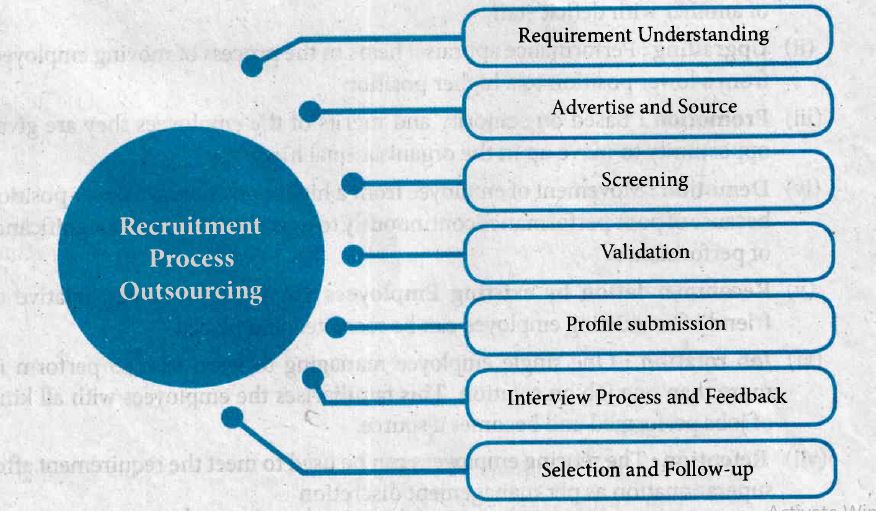
The recent methods of recruiting by organisations include the following methods :
(i) Outsourcing - There are outsourcing firms that help in the process of recruiting through screening of applications and finding the right person for the job for which job they are paid service charges
(ii) Poaching - Organisations instead of training and developing their own employees hire employees of other competitive companies by paying them more both financial and non financial benefits. It is also called raiding.
2.
Functions of management can be classified into two categories.
(i) Main functions
(ii) Subsidiary functions.
A. Main Functions :
(i) Planning :
(a) Planning is the primary function of management.
(b) Planning is a constructive reviewing of future needs so that present actions can be adjusted in view of the established goal.
(c) Eg. Writing a book starts with planning.
(ii) Organising :
(a) Organising is the process of establishing harmonious relationship among the members of an organisation.
(b) Organising function work is assigned to employees who are given authority to carry out the work assigned and made accountable for it.
(iii) Staffing :
(a) Staffing function comprises the activities of selection and placement of competent personnel.
(b) Staffing refers to placement of right persons in the right iobs.
(iv) Directing :
(a) Directing denotes motivating, leading, guiding and communicating with subordinates.
(b) Employees are kept informed of all necessary matters by circulars. instructions manuals, newsletters,
notice-boards, meeting. participative mechanism, etc.
B. Subsidiary functions :
(i) Innovation :
(a) Innovation refers to the preparation of personnel and organisation to face the changes made in the business world.
(b) Innovation includes developing new material, new products, new techniques in production, new package, new design of a product and cost reduction.
(ii) Representation :
(a) A manager has to act as representative of a company.
(b) Manager has dealings with customers, suppliers, government officials, banks, financial institutions, trade unions.,etc
(iii) Decision-making :
(a) Every employee of an organisation has to take a number of decisions every day.
(ii) Decision-making helps in the smooth functioning of an organisation.
(iv) Communication :
(a) Communication is the transmission of human thoughts, views or opinions from one person to another person.
(b) Workers are informed about what should be done, where it is to be done, how it is to be done and when it is to be done.
3.
I. Open Procedure:
This type of voting has no secrey as the all the members assembled can see voting. There are two popular methods of open voting namely voice voting and voting by show of hands.
(a) By Voice : Voice voting is a popular type of voting in which the chairman allows themembers to raise their voice in favour or against an issue 'Yes' for approval and 'No' for rejection. Chairmnan announces the result of voice voting on the basis of strength of words shouted, It is an unscientific method. I cannot be Employed for deciding complex ssue.
(b) By show ot hands: Under this methed, the chairnan, requests the menbers to ratse their hands of those who are in favour of the proposal or Candidate andthen requeststhose are against. llhenthe chairmancounts the number of hands ralsed for 'Yes' and 'No' respectively can announce the result on the basis of hands counted,
II. Secret Procedure:
Secret procedure is adopted to decided certain vital issues. It is a popular voting methodtthat couldnaintain the secrecy of the voter.
(a) By Ballot : Under this system, ballot paper bearingserial number is given to the members to record their opinion by marking with the symbol or Shareholders have to cast their vote ina secret chamber and put the ballot paper into the ballot box. The votes are counted and the results are announced.
(b) Postal Ballot : Big companies or big associations having members scattered all over the country follow this method of voting. The members or voters fill in the ballot papers and return them in sealed covers which are opened when the ballot box is opened for counting the votes.
4.
(i) Key-Managerial Personnel of a Company :
Companies Act, 2013 (Act) has introduced many new concepts and Key Managerial Personnel (KMP) is one of them. KMP covers the traditional roles of managing director and whole time director and.also includes some functional heads like Chief Financial Officer and Chief Executive Officer and Company Secretary
(ii) Key Managerial Personnel : Managerial personnel is contained in section 2(51) of the Companies Act, 2013.This Section states:
(a) The Chief Executive Officer
(b) The Managing Director or the Manager
(c) The Company Secretary
(d) The Whole-time Director
(e) The Chief Financial Officer, and
(f) Such other officer as may be prescribed.
5.
Debenture is a document issued by the company for acknowledging the loan from the public.Debentures are generally classified into different categories on the basis of :
(i) Convertibility ofthe Instrument
(ii) Sccurity of the Instrument
(iii) Redemption ability, and
(iv) Registration of Instrument.
(i) On the basis of convertibility :
(a) Non-convertible debentures : These instruments cannot be converted into equity shares.
(b) Partly convertible debentures : A part of these instruments are converted into equity shares.
(c) Fully convertible debentures : These are fully convertible into equity shares.
(d) Optionally convertibility debentures : The investor can have the option to either convert the debentures at a price decided by the issuer or agreed upon at the time of issue.
(ii) On the basis of security :
(a) Secured debentures : These instruments are secured by a charge on the fixed assets of the issuer company.
(b) Unsecured debentures : These instruments are unsecured against the assets.
(iii) On the basis Redeemability :
(a) Redeemable debentures : It refers to the debentures which will be redeemed in future.
(b) Irredeemable debentures : It is a debenture, in which no specific time is specified by the companies to pay back the money.
(iv) On the basis of Registration, debentures may be classified as:
(a) Registered debentures : These are ssued in the name of a particular person, who registered by the company.
(b) Bearer debentures : These are issued to the bearer and are negotiable. Instruments, and are transterred by mere delivery.
6.
7.
1. Innovating Entrepreneur
(a) Innovative entrepreneur is one who is always focussed on introducing a new-project or introducing something new in the venture already started.
(b) Their innovation may take the form of brand new product, upgraded product, new method of production, reengineering of existing product etc.
2. Imitative Entrepreneur
(a) Imitative entrepreneur is one who simply imitates existing skill, knowledge or technology already in place in advanced countries.
(b) For example many electronic products invented in advanced countries are simply reengineered in developing countries
3. Fabian Entrepreneur
(a) These entrepreneurs are said to be conservatives and sceptical about plasticising any change in their organisation. They are of risk-averse type.
(b) They do not simply change themselves, they change only when they fear than non-adaptability will lead to loss of the enterprise.
4. Drone Entrepreneur
(1) Drone Entrepreneur are those who are totally opposed to changes unfolding in the environment.
(2) Drone never try to adapt themselves with the changes even as a last resort. Example : Global Tooth Power.
8.
Challenges faced by women Entrepreneurs
(i) Problem of Finance:
(1) The access of women to external sources of funds is limited as they do not generally own properties in their own name.
(2) Because of the limited funds, women entrepreneurs are not able to effectively and efficiently run and expand their business.
(ii)Limited Mobility:
(1) Indian women cannot afford toshed their household responsibilities towards their family even after they plunge into the venture started by them.
(2) This restricts the mobility of women entrepreneur significantly.
(iii) ) Lack of Education :
Iliterate and semi-literate women entrepreneurs encounter a lot of challenges in their entrepreneurial journey with respect to maintaining accounts, understanding money matters, day-to-day operations ofthe company,marketing the products, applying technology etc.,
(2) This reduces the efficiency of operating the business successfully.
(iv) Lack of Network Support:
The successful operation of any venture irrespective of the size depends upon the network of support extended by various constituencies like family members, friends, relatives, acquaintances, neighbours, institutions and so on.
(2) But it is reported that women entrepreneursget very limited support in times of crisis from most of these constituencies.
(v)Self Competition:
(1) Women entrepreneurs have to face acute competition for their goods trom organised sector and from their male counter parts.
(2) Since, they are not able to spend liberally due to financial constraints, they are not able to compete effectively and efliciently in the market.
(vi) Lack of Information:
Women entrepreneurs are reported not to be generally aware of subsidies and incentives available for them due to their poor literacy levels or due to their pre-occupation with household responsibilities.
9.
Features of a cheque :
(i) Instrument in writing : A cheque or a bill or a promissory note must be an instrument in writing.Though the law does not prohibit a cheque being written in pencil, bankers never accept it because of risks involved.
(ii) Unconditional order : The instrument must contain an order to pay money.It is not necessary that the word 'order' or its equivalent must be used to make the document a cheque.
(iii) Drawn on a Specified Banker Only: The cheque is always drawn on a specified banker.A cheque vitally differs from a bill in this respect as latter can be drawn on any person including a banker.
(iv) A Certain Sum of Money Only : The order must be for payment of only money. If the banker is asked to deliver securities, the document cannot be called a cheque.Further, the sum ofmoney must be certain.
(v) Payee to be Certain : The cheque must be made payable to a certain person or to the order of a certain person or to the bearer of the instrument.The word, person includes bodies corporate, local authorities, associations, holders of office of an institution etc.
(vi) Signed by the Drawer : The cheque is to be signed by the drawer.Further, it should tally with specimen signature furnished to the bank at the time of opening the account.
10.
| SI.No | Basis of Difference | Conditions | Warranty |
|---|---|---|---|
| 1. | Meaning | It is a stipulation which is essential to the main purpose of the contract of sale. | It is a stipulation which is collateral to the main purpose of contract. |
| 2. | Significance | Condition is so essential to the contract that the breaking of which cancels out the contract. | It is of subsidiary or inferior character. The violation of warranty will not revoke the contract. |
| 3. | Transfer of ownership | Ownership on goods cannot be transferred without fulfilling the conditions. | Ownership on goods can be transferred on the buyer without fulfilling the warranty. |
| 4. | Remedy | In case of breach of contract, the affected party can cancel the contract and claim damages. | In the case of breach of warranty, the affected party cannot cancel the contract but can claim damages only. |
| 5. | Treatment | Breach of condition may be treated as breach of warranty. | Breach of warranty cannot be treated as breach of condition. |
11.
Advantages :
(i) Increase in foreign investment :
If a country liberalises its trade, it will make the country more attractive for inward investment. Inward investment leads to capital inflows but also helps the economy through diffusion of more technology, management techniques and knowledge.
(ii) Increase the foreign exchange reserve :
Relaxation in the regulations covering foreign investment and foreign exchange has paved way for easy access to foreign capital.
(iii) increase in consumption :
Liberalization increases the number of goods available for consumption within a country due to increase in production.
(iv) Control over price :
The removal of tariff barriers can lead to lower prices for Consumers.This would be particularly is benefit for countries who are importers.
Disadvantages :
(i) Increase in unemployment :
Trade liberalisation often leads to a shift in the balance of an economy. Some industries grow, some decline. Therefore, there may often be structural unemployment from certain industries closing.
(ii) Loss to domestic units :
With fewer entry restrictions, it has been possible for many entrants to make inroads into the country which poses a threat and competition to the existing domestic units.
(iii) Increased dependence on foreign nations :
Trade liberalisation means firms will face greater competition from abroad.When competition is not automatically enhanced, it can lead to domination by big institution that has market controlling powers.
(iv) Unbalanced development :
Trade liberalisation may be damaging for developing economies which cannot compete against free trade.
12.
Micro environment rcfers to th0se factors which are in the imncdiate environment of businessaffecting itsperformance. "These includes the following:
(i) Suppliers:In any organisation the suppliers ofraw materials and other inputs play a very vital rolc. Timely procurement of materiáls from suppliers enables continuity in production and reduces the cost ofmaintaining stock/ inventory.
(ii) Customers : The aim of any business is to satisfy the needs of its customers. The customer is the king and the fulcrum around which thebusiness revolves.
(iii) Competitors:All organisationsface competition at all levels such as local, national and global. Itis important for a business to understand its competitors and modify their business strategies in the face of competition.
(iv) Financiers :The financiers of a business which includes the debenture holders and financial institutions play a significant part in the running of a business. Their financial capability, policies strategies, attitude towards risk and ability to give non-financial assistance are all important to a business.
(v)Marketing Channel members:The marketing inter-mediaries serve as a connecting link between the business and its customers. The middlemen like dealers, wholesalers and retailers ensure transfer of product to customers. Insurance firm is another marketing intermediary which provides coverage for risk in business.
(vi) Public: This refers to any group like media group, citizen action group and local public which has an impact on the business. Many companies had to face closure due to actions by local public.
13.
The National Consumer Disputes Redressal Commission (NCDRC), India is a quasi-judicial commission in India which was set up in 1988 under the Consumer Protection Act of 1986. Its head office is in New Delhi. The commission is headed by a serving or retired judge of the Supreme Court of India. The National Consumer Disputes Redressal Commission (NCDRC) is also called as National Commission.
Members
The National Consumer Disputes Redressal Commission has been constituted by a Notification.
(i) The National commission should have five members.
(ii) One should be from judiciary.
(iii) Four other members of ability, knowledge and experience from any other fields.
(iv) It should include a woman.
Jurisdiction
Section 21 of The Consumer Protection Act, 1986 describes, the National Commission shall have jurisdiction
(i) To entertain a complaint valued more than 1 Crore.
(ii) Revised the orders of State Commissions.
(iii) To call for the records and pass appropriate orders from the State Commission and District Forum.
Powers
(i) Adoption of uniform procedure in the hearing of the matters is followed in the National Commission
(ii) Prior service of copies of documents produced by one party to the opposite parties.
(iii) Speedy grant of copies of documents are issued by the National Commission.
(iv) Generally over-seeing the functioning of the State Commissions and the District Forums to ensure that the objects and purposes of the Consumer protection Act are best served, without interfering with their quasi-judicial freedom.
Appellate Forum
(i) Any consumer dispute which is pending before or has been decided by any State Commission where it appears to the National Commission that such State Commission has exercised a jurisdiction not vested in it by law or has failed to exercise a jurisdiction so vested or has acted in the exercise of its jurisdiction illegally or with material irregularity.
(ii) Section 23 of Consumer Protection Act, 1986, provides that any person aggrieved by an order of National Commission may prefer an Appeal against such order to Supreme Court of India within a period of 30 days.
14.
(i) Right to Protection of Health and Right of Safety:
1. There may be few products that are more likely to cause physical danger to consumers health, lives and property.
2. They may contain potentially harmful substances which are dangerous from the consumer welfare point of view
(ii) Right to be Informed:
1. Consumers should be given all the relevant facts about the product so that they can take intelligent decisions on purchasing the product.
2. The package should contain the full details about the name of the product, composition, dosage, date of manufacturing, date of expiry, batch number, warnings, antidose etc.
(iii) Right to choose:
1. Consumer satisfaction is the ultimate aim of modern marketing and is the philosophy of marketing concept.
2. Consumer satisfaction can be increased by giving the consumer the widest choice.
3. The term 'Choice' means offering the widest range of products in quality and brand varieties.
(iv) Right to be heard :
1. Consumers have every right to ventilate and register his or her dissatisfaction.
2. Business enterprises should lend a compassionate ear to complaints or grievances of consumers.
(v) Right to seek Redressal :
1. The complaints and protests are not just to be heard but the aggrieved party is to be granted compensation within a reasonable time period .
2. This will boost consumer confidence and help render justice to buyers.
(vi) Right to consumer education :
1. The consumer has a right to acquire knowledge and stay well-informed all through his life.
2. Many consumer organisations and some enlightened businesses are taking a pro active part in educating consumers in this respect.
(vii) Right to Quality of Life
1. Quality of life refers to the preceived well-being of people, in groups and individually and well-being of the environment in which these people live.
2. Consumerism has been defined as 'an improved quality of life'.
(viii) Right to Consumer Protection
The consumer has a right to be aware of his rights and remedies available to him, redress his grievances through publicity in the mass media.
(ix) Right to Basic Needs
1. Every consumer has a right to get basic necessities of life such as food, clothing and water, and right to pure and healthy environment.
2. Community life should be free from various modes of pollution.
15.
Following are the objectives of consumer protection Act, 1986
(i) Protection of consumers against marketing of goods which are hazardous and dangerous to life and property of consumers.
(ii) Providing correct and complete information about quality, quantity, purity, price and standard of goods purchased by consumers.
(iii) Protecting consumers from unfair trade practices of traders.
(iv) Empowering consumers to seek redressal against exploitation.
(v) Educating the consumer of their rights and duties.
(vi) Ensuring better standard of living for consumers by providing them with quality products at fair price.
16.
| S. No. |
E-Marketing | Traditional Marketing |
|---|---|---|
| 1. | Electronic marketing or E-marketing is the process of marketing of products and services Over internet and tele networks. |
Goods and services are directly purchased and sold in the market is known as traditional marketing. |
| 2 | It is very economical and faster way to promote the products | It is very expensive and takes more time to promote product |
| 3. | It is quite easier for promoting product globally in the short time | It is very expensive and time consuming to promote product/ service under traditional marketing |
| 4. | E-Business enterprises can expand their operation with minimum man power | It needs more man power |
| 5. | In this marketing product can be sold or bought 24 x 7,round the year with minimum manpower | That is not possible in traditional marketing |
17.
They are discussed below :
(i) Product : Product is the main element of marketing. Without a product, there can be no marketing.
(ii) Price : Price is the value of a product expressed in monetary terms. It is the amount charged for the product.
(iii) Place : The third element of product mix, namely place or physical distribution facilitates the movement of products from the place of manufacture to the place of consumption at the right time.
(iv) Promotion : An excellent product with competitive price cannot achieve a desired success and acceptance in market, unless and until its special features and benefits are conveyed effectively to the potential consumers.
18.
On the basis of Economic the market can be classified into (a) Perfect market (b) Imperfect market
(a). Perfect market: A market is said to be a perfect
market, if it satisfies the following conditions:
(i) Large number of buyers and sellers.
(ii) Prices should be uniform throughout the market.
(iii) Buyers and sellers have a perfect knowledge of market.
(iv) Goods can be moved from one place to another without restrictions.
(v) The goods are identical or homogeneous. It should be remembered that such types of markets are rarely found.
(b). Imperfect market: A market is said to be imperfect when:
(i) Products are similar but not identical
(ii) Prices are not uniform
(iii) There is lack of communication
(iv) There are restrictions on the movement of goods.
19.
According to Edwin B. Flippo" Training is the act of increasing the Knowledge and skills of an employee for doing particular jobs".
Methods of training: There are various methods of training are used to train employees. it is vary from one organisation to another. There are two principal methods of employee training. They are:
I. On the job training
On the job training refers to the training which is given to the employee at the work place by his immediate supervisor.
(i) Coaching method
The superior teaches or guides the new employee about the knowledge and skills relevant to a given job.
(ii) Mentoring method
(a) Mentoring is the process of sharing knowledge and experience of an employee.
(b) It is considered as one-to-one interaction, like coaching.
(iii) Job Rotation method
(a) Job rotation is an important method for broadening the knowledge of executives.
(b) The main aim of job rotation is to expose the employee to various inter related jobs.
(iv) Job Instruction Techniques (JIT) method
A trainer supervisory level gives some instructions to an employees to how to perform his job and its purpose.
(v) ApprenticeshipTraining Method
(a) The apprentice or trainee learns the job knowledge and skills from the trainer or superior or senior worker.
(b) The trainee gets the stipend during the training period.
(vi) Committee Assignment
When employees are assigned to committee to address a particular issue, they are able to work closely with other members and committee leader.
(vii) Understudy/Internship Training Method
A superior gives training to a subordinates or understudy like an assistant to a manager or director.
II. Off the Job Training
Off the job training is the training method where in the workers/employees learn the job role away from the actual work floor.
(i) Lecture Method
Under this method trainees are educated about concepts, theories, principles and application of knowledge in any particular area.
(ii) Group Discussion Method
(a) Group of people participate and discuss particular subject or one topic.
(b) In this method participants are divided into various groups. They were provided a particular issue for deliberation.
(iii) Cash Study Method
(a) Trainees are described a situations which stimulate their interest to find solution.
(b) They have to use their theoretical knowledge and practical knowledge to find solution to the problem presented.
(iv) Role Play Method
(a) This method trainees are explained the situation and assigned roles.
(b) They have to act out the roles assigned without any rehearsal.
(v) Seminar/Conference Method
This method enables the trainees to listen to the lectures / talk delivered on specific topics and provides opportunities to participants to interact with speakers.
(vi) Field Trip Method
A field trip or field work or training in the field is a journey undertake by a group employee to a place away from their actual work site.
(vii) Vestibule Training Method
Vestibule training is training of employees in an environment similar to actual work environment artificially created for training purposes.
(viii) E-learning Method
E learning is the use of technological process to access of a traditional classroom or office.
(ix) Demonstration Training Method
Demonstration involves showing by reason or proof explaining or making clear by use of examples or experiments.
(x) Programmed Instruction Method
It is computer based training. It is stored in memory. It gives to participants and effective learning.
20.
(i) Preliminary Interview:
This interview is conducted to know the general suitability ofthe candidates who have applied for the job.
(ii) Structure/Guided/Planned Interview :
Under this method, a series of question to be asked by the interviewer are pre prepared by the interviewer and only these questions are asked in the interview.
(iii) Unstructured Interview : This is quite contrary to structured interview. Ihere is no pre-prepared questions. appreciation test (iv) Attitude test
(iv) In depth Interview : This interview is conducted to test the level of knowledge of the interviewee in a particular field intensively and extensively.
(v)Panel Interview :
Where a group of people interview the candidate, it is called panel interview. All panel members ask different types of questions on general areas of specialisation of the candidate.
21.
(i) To identify manpower needs :
Determination of manpower needs in an organisation is very important as it is a form of investment.The number ofmen required are to be identified accurately to optimise the cost.
(ii) To incorporate change :
Change is constant in any organisation and this change has to be introduced in such a way that the human resource management acts as an agent to make the change effective.
(iii) To ensure the correct requirement of manpower :
At any time the organisation should not suffer from shortage or surplus manpower which is made possible through human resource management.
(iv) To select right man for right job :
Human resource management ensures the right talent available for the right job, so that no employee is either under qualified or over qualified.
(v) To update the skill and knowledge :
Managing human resource plays a significant role in the process ofemployee skill and knowledge enhancement to enable the employees to remain up to date through training and development programmes.
22.
The functions of SEBI are as follows:
(i) Safeguarding the interests of investors by means of adequate education and guidance.
(ii) Regulating and controlling the business on stock markets.
(iii) Conduct inspection and inquiries of stock exchanges, intermediaries and self-regulating organisations and to take appropriate measures wherever required.
(iv) Barring insider trading in securities.
(v) Prohibiting deceptive and unfair methods used by financial intermediaries operating in securities markets.
(vi) SEBI Issues Guidelines and instructions to businesses concerning capital issues.
23.
| S.No. | Feature | Stock Exchange | Commodity Exchange |
| 1. | Meaning | Stock exchange is an organised market for the purchase and sale of industrial and financial security. |
A commodity exchange is an exchange where commodity are traded |
| 2. | Function | Providing easy marketability | Offering hedging or price insurance services and liquidity to securities |
| 3. | Participants | Investors and speculators | Producers, dealers, traders and a body of speculators |
| 4. | Period of dealings |
Cash, ready delivery and dealings for account for a fortnight |
Instant cash dealings and a settlement period of 2 or 3 months for Future Market dealings. |
| 5. | Forward Contract |
Forward dealings are simplified as securities are fully standardized. |
Standards are to be fixed for deliverable grades to facilitate futures contract. |
| 6. | Price Quotation | As regards forward dealings, only one quotation is possible. |
For future dealings, multiple quotations are possible. |
24.
(i) Short-term Funds:
It is a market purely for short-term funds or financial assets called near money.
(ii) Maturity Period:
It deals with financial assets having a maturity period upto one year only.
(iii) Conversion of Cash :
It deals with only those assets which can be converted into cash readily without loss and with minimum transaction cost.
(iv) No Formal Place:
Generally, transactions take place through phone i.e., oral communication.Relevant documents and written communications can be exchanged subsequently.
(v) Sub-markets :
It is not a single homogeneous market. It comprises of several sub-markets each specialising in a particular type of financing.
(vi) Role of Market :
The components of a money market are the Central Banks, Commercial Banks, Non-Banking Financial Companies,Discount Houses and Acceptance House.Commercial banks generally plays a dominant role in this market.
25.
(i) Venture Fund Institutions :
(a) Venture capital financing is a form of equity financing designed especially for funding new and innovative project ideas.
(b) Many specialised financial institutions have promoted their own venture capital funds.
(c) They include Risk Capital Foundation of IFCI, Venture capital of IDBI, SIDBI,TDICI and others.
(ii) Mutual Funds :
(a) Financial institutions that provide facilities for channeling savings of smallinvestors into a venues of productive investments are called "Mutual Funds".
(b) Specialized financial institutions like LIC,UT,etc., beside Commercial banks such as SBI, and Canara Bank are carrying out the business of mutual funds.
(iii) Factoring Institutions :
(a) "Factoring" is an arrangement whereby a financial institution provides financial accommodation on the basis ofassignment/ sale of account receivables.
(b) Some of the factoring institutions operating in India are SBI Factors and Commercial Services Private Limited, a subsidiary of State Bank of India and Canbank Factors Limited, a subsidiary of Canara Bank.
(iv) Over the Counter Exchange of India (0TCEI) :
(a) The OTCEI was set up by a premier financial institution to allow the trading of securities across the electronic counters throughout the country.
(b) It addresses some specific problems of both investors and medium-size companies.
(v) National Stock Exchange of India Limited :
(a) NSEI was established in 1992 to function as a model stock exchange.
(b) The Exchange aims at providing the advantage of nation-wide electronic screen based "scripless" and "loorless" trading system in securities.
26.
Financial markets can be classified in different ways. They are as follows
(i) On the Basis of Type of Financial Claim
(a) Debt Market: Debt market is the financial market for trading in Debt instruments(i.e Government Bonds or Securities, Corporate Debentures or Bonds).
(b) Equity Market: Equity market is the financial market for trading in equity shares of companies
(ii) On the basis of Maturity of Financial Claim
(a) Money Market: Money market is the market for short term financial claim (usually one year or less) E.g. Treasury Bills, Commercial Paper, Certificates of Deposit
(b) Capital Market: Capital market is the market for long term financial claim more than a year Example : Shares and Debentures
(iii) On the Basis of Time of Issue of Financial Claim
(a) Primary Market: Primary market is a term used to include all the institutions that are involved in the sale of securities for the first time by the issuers (Companies).here the money from investors goes directly to the issuers.
(b) Secondary Market: Secondary market is the market for securities that are already issued. Stock Exchange is an important institution in the secondary market.
(iv) On the Basis of Timing of Delivery of Financial Claim
(a) Cash/Spot Market: Cash/Spot market is the market where the delivery of the financial instrument and payment of cash occurs immediately (i.e.) settlement is completed immediately.
(b) Forward or Future Market: Forward or Future market is a market where the delivery of the asset and payment of cash takes place at a pre determined time in future.
(v) On the Basis of the Organisational Structure of the Financial Market
(a) Exchange traded Market: Exchange traded market is a centralized organisation (stock exchange) with standardized procedures.
(b) Over - the- counter Market: Over - the- counter market is a decentralized market (outside the stock exchange) with customized procedures.
27.
(i) The main disadvantage of MBE is, only managers have the power over really important decisions, which can be demotivating for employees at a lower level
(ii) Furthermore, it takes time to pass the issues to managers.
(iii) Managing employees who deviate from the normal procedures.
(iv) Because of compliance failures are considered difficult to manage and typically find themselves with limited job duties and ultimately dismissed / terminated.
28.
Functions of management can be classified into two categories.
A. Main functions; and
B. Subsidiary functions.
A. Main functions:
(i) Planning:
(a) Planning is the primary function of management.
(b) Nothing can be performed without planning.
(c) E.g. Writing a book starts with planning.
(ii) Organising:
(a) Organising is the process of establishing harmonious relationship among the members of an organisation.
(b) Organsing function work is assigned to employees who are given authority to carry out the work assigned and made accountable for it.
(iii) Staffing:
(a) Staffing function comprises the activities of selection and placement of competent personnel.
(b) Staffing refers to placement of right persons in the right jobs.
(iv) Directing:
(a) Directing denotes motivating, leading, guiding and communicating with subordinates.
(b) Employees are kept informed of all necessary matters by circulars, instructions man uals, newsletters, notice-boards, meeting, participative mechanism, etc.
B. Subsidiary functions:
(i) Innovation:
(a) Innovation refers to the preparation of personnel and organisation to face the changes made in the business world.
(b) Innovation includes developing new material, new products, new techniques in production, new package, new design of a product and cost reduction.
(ii) Representation:
(a) A manager has to act as representative of a company.
(b) Manager has dealings with customers, suppliers, government officials, banks, financial institutions, trade unions, etc.
(c) It is the duty of every manager to have good relation with others.
(iii) Decision-making:
(a) Everyemployee of an organisation has to take a number of decisions everyday.
(b) Decision - making helps in the smooth functioning of an organisation.
(iv) Communication:
(a) Communication is the transmission of human thoughts, views or opinions from one person to another person.
(v) Workers are informed about what should be done, where it is to be done, how it is to be done and when it is to be done.
29.
The Span of management refers to the number of subordinates who can be managed efficiently by a superior. Simply,the manager having a group of subordinates who report him directly is called as the span of management. The Span of Management has two implications:
(i) Influences the complexities of the individual manager's job
(ii) Determine the shape or configuration of the Organization
The span of management is related to the horizontal levels of the organization structure. There is a wide and a narrow span of management. With the wider span, there will be less hierarchical levels, and thus, the organizational structure would be flatter. Whereas, with the narrow span, the hierarchical levels increases, hence the organizational structure would be tall.
(iii) Both these organizational structures have their advantages and disadvantages. But however the tall organizational structure imposes more challenges.
(iv) Since the span is narrow, which means less number of subordinates under one superior, requires more managers to be employed in the organization. Thus, it would be very expensive in terms of the salaries to be paid to each senior
(v) With more levels in the hierarchy, the communication suffers drastically. It takes a lot of time to reach the appropriate points, and hence the actions get delayed.
(vi) Lack of coordination and control because the operating staff is far away from the top management.
The major advantage of using this structure is that the cross communication gets facilitated, i.e., operative staff communicating with the top management. Also, the chance of promotion increases with the availability of several job positions
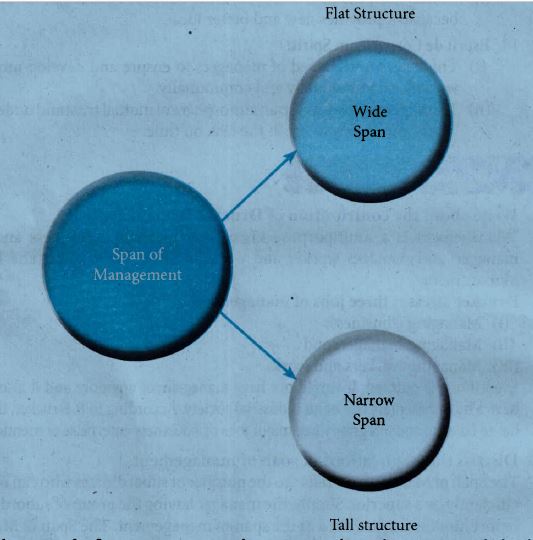
In the case of a flatter organizational structure, where the span is wide leads to a more complex supervisory relationship between the manager and the subordinate. It will be very difficult for a superior to manage a large number of subordinates at a time and also may not listen to all efficiently.
30.

12th Standard Syllabus & Materials
12th Standard
TN 12th Computer Applications களப்பெயர் முறைமை (DNS) Sample Question Papers Study Material - QB365 Set A
NEW12th Standard
TN 12th Computer Applications வலையமைப்பு எடுத்துக்காட்டுகள் மற்றும் நெறிமுறைகள் Sample Question Papers Study Material - QB365 Set A
NEW12th Standard
TN 12th Computer Applications கணினி வலையமைப்பு ஓர் அறிமுகம் Sample Question Papers Study Material - QB365 Set A
NEW12th Standard
TN 12th Computer Applications PHP-உடன் MySQL-ஐ இணைத்தல் Sample Question Papers Study Material - QB365 Set A



Tamilnadu Stateboard 12th Standard Subjects

Maths

Chemistry

Physics

Biology

Computer Science

Business Maths and Statistics

Economics
Commerce

Accountancy

History

Computer Applications
Biology
Computer Technology
Computer Applications
Computer Science
Business Maths and Statistics
Commerce
Economics
Maths
Chemistry
Physics
Computer Technology
History
Accountancy

Tamil

English

French
Tamilnadu Stateboard Standards

