
 100% FREE ACCESS
12th Standard Syllabus & Materials
12th Standard
TN 12th Computer Applications மின்னணு தரவு பரிமாற்றம் Sample Question Papers Study Material - QB365 Set A
NEW12th Standard
TN 12th Computer Applications மின் - வணிக பாதுகாப்பு அமைப்புகள் Sample Question Papers Study Material - QB365 Set A
NEW12th Standard
TN 12th Computer Applications மின்னணு செலுத்தல் முறைகள் Sample Question Papers Study Material - QB365 Set A
NEW12th Standard
TN 12th Computer Applications மின் - வணிகம் Sample Question Papers Study Material - QB365 Set A
NEW12th Standard
TN 12th Computer Applications திறந்த மூல கருத்துருக்கள் Sample Question Papers Study Material - QB365 Set A
NEW12th Standard
TN 12th Computer Applications வலையமைப்பு வடமிடல் Sample Question Papers Study Material - QB365 Set A

Published on: 27/09/2019
Principles of Management
Download Tamil Nadu 12th Standard Commerce question papers, model tests, one-mark questions, important questions, and public exam papers in PDF format. Free study materials and answer keys for TN State Board students.
Questions + Answers key
Take MCQ Commerce Test1.
Principles of management are not
Absolute
Flexible
Behavioural
Universal
2.
Studying the future and arranging the means for dealing with it is part of the process of
Organising
Controlling
Coordinating
Planning
3.
With a wider span, there will be ________ hierarchical levels.
More
Less
Multiple
Additional
4.
Management is what a _________ does?
Manager
Subordinate
Supervisor
Superior
5.
What is unity of command?
6.
What is responsibility?
7.
What do you mean by Span of management?
8.
State the meaning of Authority.
9.
Who is a manager?
10.
What is Management?
11.
What are the principles of Taylor?
12.
Differentiate management from Administration.(any 3)
13.
Define the term management.
14.
Explain the concept of management .(any 5)
15.
Discuss the implications of span of management.
16.
Explain the management process in detail.
17.
Find odd one out
(a) Remuneration
(b) Equity
(c) Team spirit
(d) Administration
18.
(a) Division of work
(b) Unity of command
(c) Taylor
(d) Unity of direction
19.
(a) Separate Discipline
(b) Management Tools
(c) Body of knowledge
(d) Mental Revolution
20.
| System approach | Inputs process |
| Contingency | Business environment |
| Behavioural school | Social resources |
| Functional School | Process of planning |
21.
| Management Tools | Statistics |
| Separate Discipline | Seminars |
| Body of knowledge | Management literature |
| Specialisation | Social institution |
1.
(a)
Absolute
2.
(d)
Planning
3.
(b)
Less
4.
(a)
Manager
5.
(i) This principle states that each subordinate should receive orders and be accountable to one and only one superior.
(ii) If an employee receives orders from more than one superior, it is likely to create confusion and conflict.
(iii) It is the control function which facilitates synchronization of actual performance with pre determined standards.
6.
Responsibility means obligation for performance. It is the amount of work expected from a man by his superior.
7.
(i) The span of management refers to the number of subordinates who can be managed efficiently by a superior.
(ii) Simply, the manager having the group of subordinates who report him directly is called as the span of management.
8.
Authority means the right ofa superior to give the order to his subordinates whereas responsibility means obligation for performance.
9.
(i) Manager is a dynamic and life-giving element in every business.
(ii) Without efficient management it cannot be secure the best allocation and utilisation of human, material and financial resources.
10.
Management is the process of giving direction and controlling the various activities of the people to achieve the objectives of an organisation.
11.
Taylor propounded the principles of scientific management. They are:
(i) Science, Not Rule of Thumb
(ii) Harmony, Not Discord
(iii) Mental Revolution
(iv) Co-operation, Not individualism
(v) Development of each and every person to his or her greatest efficiency and prosperity.
12.
| Basis | Management | Administration | |
|---|---|---|---|
| 1. | Meaning | An organised way of managing people and things of a business is called management | The process of administering an organisation by a group of people is known as administration |
| 2. | Authority | Middle and lower level | Top level |
| 3. | Concerned with | Policy implementation | Policy formulation |
| 4. | Role | Executive | Decisive |
| 5. | Area of operation | It works under administration | It has full control over the activities of the organisation. |
13.
According to Koontz and Weihrich, "Management is the process of designing and maintaining of an environment in which individuals working together in groups efficiently accomplish selected aims.
14.
The management concept can be understood from its profound characteristic features as follows:
1. Body Knowledge:
(i) Management has now developed a specialised body of management theory and philosophy.Management literature is growing in all countries.
2. Management Tools:
Tools of management have been developed such as, accounting, busines law, psychology, statistics, econometrics, data processing, etc.
3. Separate Discipline:
Management studies in many universitis and institutions of higher learning are recognised as a separate discipline.
4. Specialisation:
There is a growing tendency to select and appoint highly qualified, trained and experienced persons to manage the business in each functional area of management.
5. Code of Conduct:
Enlightened businessmen have recognised that business management is a social institution and it has social responsibilities to be fulfilled - towards customers, employees, and the public or community.
15.
The Span of management refers to the number of subordinates who can be managed efficiently by a superior. Simply,the manager having a group of subordinates who report him directly is called as the span of management. The Span of Management has two implications:
(i) Influences the complexities of the individual manager's job
(ii) Determine the shape or configuration of the Organization
The span of management is related to the horizontal levels of the organization structure. There is a wide and a narrow span of management. With the wider span, there will be less hierarchical levels, and thus, the organizational structure would be flatter. Whereas, with the narrow span, the hierarchical levels increases, hence the organizational structure would be tall.
(iii) Both these organizational structures have their advantages and disadvantages. But however the tall organizational structure imposes more challenges.
(iv) Since the span is narrow, which means less number of subordinates under one superior, requires more managers to be employed in the organization. Thus, it would be very expensive in terms of the salaries to be paid to each senior
(v) With more levels in the hierarchy, the communication suffers drastically. It takes a lot of time to reach the appropriate points, and hence the actions get delayed.
(vi) Lack of coordination and control because the operating staff is far away from the top management.
The major advantage of using this structure is that the cross communication gets facilitated, i.e., operative staff communicating with the top management. Also, the chance of promotion increases with the availability of several job positions
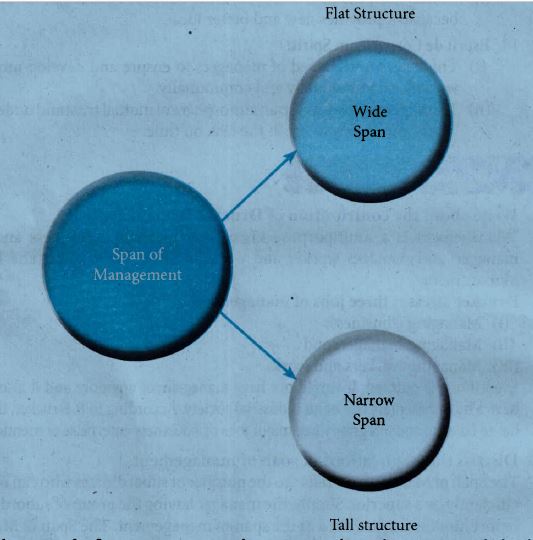
In the case of a flatter organizational structure, where the span is wide leads to a more complex supervisory relationship between the manager and the subordinate. It will be very difficult for a superior to manage a large number of subordinates at a time and also may not listen to all efficiently.
16.
There are five parts of management as a process
1. Management is Co-ordination:
(i) The manager of an enterprise must effectively co-ordinate all activities and resources of the organisation.
(ii) Namely, Men, Machines, Materials and Money the Four M's of Management.
2. Management is a Process :
(i) The manager achieves proper co-ordination of resources by means of the managerial functions.
(ii) Planning, Organising, Staffing, Directing (or leading and motivating) and controlling.
3. Management is a Purposive Process:
(i) It is directed toward the achievement of predetermined goals or objectives.
(ii) Without an objective, we have no destination to reach or a path to follow to arrive at our destination
(ii) Example; A goal, both management and organisation must be purposive or goal-oriented.
4. Management is a Social purpose:
It is the art of getting things done through other people.
5. Management is a Cyclical Process:
It represents planning action-control-re-planning cycle. (i.e.,) an ongoing process to attain the planned goals
17.
(d) Administration
Reason : Administration is concerned with framing policies and setting objectives. Other three are principles of model management.
18.
(c) Taylor
Reason : Scientic management is developed by Taylor. Other three are principles of modern management.
19.
(d) Mental Revolution
Reason : The techniques of mental revolution involves a change in the attitude of workers and management towards each other. Other three are characteristics of management.
20.
Bebavioural school- Social resources
21.
Spedallsation - Sodal institution

12th Standard Syllabus & Materials
12th Standard
TN 12th Computer Applications களப்பெயர் முறைமை (DNS) Sample Question Papers Study Material - QB365 Set A
NEW12th Standard
TN 12th Computer Applications வலையமைப்பு எடுத்துக்காட்டுகள் மற்றும் நெறிமுறைகள் Sample Question Papers Study Material - QB365 Set A
NEW12th Standard
TN 12th Computer Applications கணினி வலையமைப்பு ஓர் அறிமுகம் Sample Question Papers Study Material - QB365 Set A
NEW12th Standard
TN 12th Computer Applications PHP-உடன் MySQL-ஐ இணைத்தல் Sample Question Papers Study Material - QB365 Set A



Tamilnadu Stateboard 12th Standard Subjects

Maths

Chemistry

Physics

Biology

Computer Science

Business Maths and Statistics

Economics
Commerce

Accountancy

History

Computer Applications
Biology
Computer Technology
Computer Applications
Computer Science
Business Maths and Statistics
Commerce
Economics
Maths
Chemistry
Physics
Computer Technology
History
Accountancy

Tamil

English

French
Tamilnadu Stateboard Standards

